Korean J Environ Agric (2013) Online ISSN: 2233-4173 Vol. 32, No. 4, pp. 260-267 http://dx.doi.org/10.5338/KJEA.2013.32.4.260 Print ISSN: 1225-3537
밭토양에서 퇴비시용과 비닐멀칭이 토양탄소 축적에 미치는 영향
강점순,1 서정민,2 신현무,3 조재환,4 홍창오5*
1부산대학교 원예생명과학과, 2부산대학교 바이오환경에너지학과, 3경성대학교 환경공학과,
4부산대학교 농업경제학과, 5부산대학교 생명환경화학과
Effects of Compost Application and Plastic Mulching on Soil Carbon Sequestration in Upland Soil
Jum-Soon Kang,
1Jeong-Min Suh,
2Hyun-Moo Shin,
3Jae-Hwan Cho
4and Chang-Oh Hong
5*(
1Department of Horticultural Bioscience, Pusan National University, Miryang 627-706, South Korea,
2Department of Bio-Environmental Energy, Pusan National University, Miryang 627-706, South Korea,
3Department of Environmental Engineering, Kyungsung University, Busan 608-736,
4Department of Agricultural Economics, Pusan National University, Miryang 627-706, South Korea, South Korea,
5Department of Life Science and Environmental Biochemistry, Pusan National University, Miryang 627-706, South Korea)
Received: 15 September 2013 / Revised: 1 October2013 / Accepted: 26 October 2013
ⓒ 2013 The Korean Society of Environmental Agriculture
This is an Open-Access article distributed under the terms of the Creative Commons Attribution Non-Commercial License (http://creativecommons.org/licenses/by-nc/3.0) which permits unrestricted non-commercial use, distribution, and reproduction in any medium, provided the original work is properly cited.
*교신저자(corresponding Author),
Phone: +82-55-350-5548; Fax: +82-55-350-5549;
E-mail: [email protected]
260
Abstract
BACKGROUND: In most studies, soil carbon sequestration has been evaluated simply with change of soil organic carbon content. So far, information regarding stability of soil organic carbon is limited.
METHODS AND RESULTS: This study was conducted to determine changes in soil organic carbon (SOC) content and stability of carbon in response to compost application rates and plastic mulching treatment during the hot pepper growing season. Under the pot experiment condition, compost was mixed with an arable soil at rates corresponding to 0, 10, 20, and 40 Mg/ha. To determine effects of plastic mulching on soil carbon sequestration, plastic mulching and no mulching treatments were set up in soils amended with the application rate of 20 Mg/ha. The SOC content did not significantly increase with application of compost and
plastic mulching at harvest time. No significant changes in bulk density with compost application and plastic mulching was found. These might result from short duration of experiment. While hot water extractable organic carbon content significantly decreased with compost application and plastic mulching, humic substances increased.
Belowground biomass of hot pepper was biggest at the recommended application rate (20 Mg/ha) of compost.
CONCLUSION: From the above results, continuous applcation of compost at the recommended application rate could improve increase in SOC content and stability of carbon in long term aspect.
Key Words: Compost, Hot pepper, Mulching, Soil carbon sequestration
서 론
산업혁명 이후 화석연료의 사용에 의존하였던 산업구조의
결과 대기의 이산화탄소의 농도는 급격히 증가해 왔으며, 지
금과 같은 속도로 증가할 경우 21세기 안에는 지금의 두 배
Open Access
Research Article
(720 ppm)가 되고, 이에 따라 대기의 평균 온도는 5 ℃ 상 승될 것으로 예측되고 있다(IPCC, 2007).
토양은 대기의 이산화탄소를 제거하는 지구상에서 가장 방 대한 저장고의 역할을 할 수 있다. 토양의 탄소량은 2,500 Gt 으로 대기의 총 탄소량(760 Gt)의 3.3배, 생물체(560 Gt)의 4.5배로, 토양 탄소 저장량을 일부만 증가시켜도 대기 온실가 스 농도 저감효과가 큰 것으로 보고되고 있다(Lal et al., 1997;
Lal, 2000; Schlesinger, 2000). Soil carbon sequestration (토양의 탄소 격리)은 바이오매스가 토양 내에서 부식화되는 과정을 통해 대기 중의 이산화탄소가 토양 유기탄소로 전환되 는 과정으로 일컬어진다(Lal, 2007). 이러한 토양의 탄소격리 능을 향상시키는 전략은 토양 내 탄소의 투입량을 유출량보다 높게 유지하여 탄소의 수지를 높이는 것이다. 토양의 탄소 격 리능을 향상시키기 위해서는 토양유기탄소의 분해, 침식, 용탈 등의 토양으로 부터의 탄소의 유실을 최소화하고 작물의 잔재 를 토양으로 환원시키거나 무경운, 피복작물의 재배, 혹은 유 기물 제재의 투입을 통해 토양의 탄소 투입량을 증가시켜야 한다(Nieder and Benbi, 2008).
현재까지 연구되어진 몇몇 연구결과에 따르면 토양에 유기물 제재를 시용하면 토양의 입단화를 향상시켜 토양유기탄소의 함 량이 증가되어진다고 보고하고 있다(Six et al., 1999; Rasool et al., 2008). 다른 연구결과에 따르면 유기물제재의 시용은 토 양유기탄소의 분해율을 저감시킴에 따라 토양 내 유기탄소의 함 량을 증가시킨다고 보고하고 있다(Mukherjee, 2008). 국내에서 연구되어진 결과에 따르면 40년간 실시되어진 영년동일 처리구 에서 화학비료와 퇴비를 혼용하였을 때 토양유기탄소의 함량이 지속적으로 증가한다고 보고하였다 (Lee et al., 2013).
일부의 연구에서 식물의 잔재를 이용하여 토양을 멀칭 함 으로써 토양 탄소의 격리를 향상시킬 수 있다고 보고했다 (Jastrow, 1996; Six et al., 1999; Dorodnikov et al., 2009).
하지만 비닐멀칭 처리에 따른 토양 유기탄소의 함량 및 탄소 의 안정화에 대한 연구는 부족한 실정이다.
현재까지 국내에서 토양의 탄소격리와 관련하여 수행되어 진 연구는 부족한 실정이며 기존에 연구되어진 연구결과들은 대부분 토양의 유기물 함량 또는 유기탄소 함량을 지표로 삼 아 탄소의 격리능을 정화하게 평가하는데 한계가 있었다. 또 한 국내에서 실시되는 비닐 멀칭법에 따른 토양 탄소의 축적 에 관련된 연구는 극히 드문 실정이다. 따라서 본 연구는 고 추재배시험 동안 축분퇴비의 시용량과 비닐멀칭 유무에 따른 토양 유기탄소의 함량 변화와 토양 탄소의 안정화 정도를 조 사하여 보다 정확하게 탄소의 격리능을 조사하기 위해 실시 되어졌다.
재료 및 방법
공시토양 및 퇴비 특성
본 연구를 수행하기 위해 경남 밀양시 부북면 오례리의 부 산대학교 부속농장(128°72'11"N 35°50'23"E) 내 밭토양을
하는 사질양토(sandy loam)이었다. 시험에 사용된 공시토양 과 축분퇴비의 이화학적 특성은 Table 1에 나타내었다.
Items Soil Compost
pH (1:5 with H2O)
Electrical conductivity (dS/m) Total nitrogen (g/kg)
Organic carbon (g/kg) Humic substances (g/kg) Hot water extractable organic carbon (g/kg)
6.44 1.02 2.5 15.6 2.48 1.39
6.24 4.12 21.5 391 313 19.9 Table 1. Chemical properties of the studied soil and compost
포트시험
밭토양에서 축분퇴비의 시용량과 멀칭조건이 토양유기탄 소의 축적에 미치는 효과를 검정하기 위해 부산대학교 부속 농장 내 밭토양의 표토(0-15 cm)를 채취하여 풍건세토 후 2 mm 체에 통과시켰다. 1/2000a 와그너 포트에 건조된 토양 15 kg을 충진한 후 가비중이 1.25 g/cm
3이 되도록 다지었 다. 퇴비의 시용량에 따른 효과를 검정하기 위해 축분퇴비를 0, 10, 20(추천량), 40 Mg/ha로 처리하였다. 멀칭조건에 따 른 효과를 검정하기 위해 축분퇴비를 추천량인 20 Mg/ha로 처리하고 검은색 비닐로 멀칭한 처리구와 멀칭하지 않은 처 리구를 설정하였다. 모든 처리구에 질소(N 190 kg ha
-1)와 인산(P
2O
5112 kg ha
-1)과 가리(K
2O 149 kg ha
-1)를 동일한 양으로 처리하였다. 고추 모종을 2012년 11월 9일에 심어 2013년 4월 17일에 수확하여 총 150일간 재배하였다. 재배기 간 동안 매주 각 포트에 3.8 L의 물을 나누어 주어 밭토양 조 건을 유지하였다.
이화학적 특성 조사
공시토양의 pH와 전기전도도는 풍건된 시료를 토양/증류 수 비 1:5(w/w)로 하여 유리막대로 잘 저은 후 pH meter 와 EC meter를 이용하여 pH와 EC 값의 변동이 없을 때 값 을 읽었으며, 측정값의 일관성을 유지하기 위하여 동일한 측 정시간을 적용하였다. 총질소 함량은 킬달증류법(Kjeldahl method; Bremner, 1965)으로 측정하였으며 수확 후 토양의 용적밀도는 core법(Blake and Hartge, 1986)으로 실시하였다.
토양유기탄소 함량 및 안정화도 조사
Soil organic carbon (SOC, 토양유기탄소), humic substances (HS, 부식질) 및 hot water extractable organic carbon (HWEOC, 열수 추출 가능한 탄소)에 대한 탄소의 함량은 Aurora1030(O.I. Analytical, USA) TOC 분석기기를 사용하여 분석하였다.
토양유기탄소 함량측정을 위해 토양시료에 5%의 HCl을
TOC 측정컵이 다 젖도록 충분히 채워주고 lab. oven 내에
넣어 시료를 baking 시켜 무기탄소 성분을 제거 후 TOC 분
5분 -2시간 이내를 적용하며 본 실험에서는 100
oC에서 1시 간 동안 baking 하였다.
열수 추출 가능한 탄소는 이동성(labile)이 큰 토양유기탄 소 안정성의 화학적 평가지표로 사용할 수 있으며(Plante et al., 2011), 이를 위해 Sparling 등(1998)이 사용한 추출방법 을 개량하여 사용하였다. 추출을 위하여 풍건된 시료 2 g을 플라스틱 튜브에 넣고 10 mL의 증류수를 가하여 토양/물의 비를 1:5(w/w)로 한 다음 30분간 교반하여 혼합 및 분산이 잘 되도록 하였다. 교반된 튜브는 70
oC의 열수에 남궈 18시 간 동안 추출 반응 시킨 후 손으로 흔들거나 볼텍스 교반기를 사용하여 3초간 토양을 재부유한 후 5C 여과지로 여과하여 TOC를 분석하였다.
부식질은 Janos (2003)이 사용한 방법으로 추출하였다.
먼저 추출효율의 증대를 위하여 0.1 M HCl로 세척을 하여 양이온, 철, 수산화 알루미늄의 제거를 하였다. 세척이 끝난 시료는 질소가스 조건하에서 0.5 M NaOH로 추출하여, 5C 여과지로 분리하고 여액의 탄소 함량을 분석하였다. NaOH 와 같은 강 알칼리 추출용액을 사용한 추출은 토양 및 퇴적물 로부터 부식질을 분리하는데 널리 사용되어 왔다.
침출액 내 탄소의 함량을 측정하기 위해 10% sodiumpersulfate (Na
2S
2O
8)와 5% phosphiric acid(H
3PO
4)를 유기탄소 농도 에 따라 조정하여 가함으로써 시료 내 무기탄소를 제거한 다 음 TOC 분석기로 분석 하였다.
바이오매스 조사
수확 후 고추를 지상부와 지하부로 분리시키고 흐르는 물 에 세척하여 이물질을 제거한 후 드라이 오븐에서 70℃에서 72시간 동안 건조 후 건물중을 측정하였다.
통계분석
통계분석은 SAS 통계프로그램(버전 9.2)을 이용하여 실시 되어졌다(SAS institute, 2006). 처리간의 차이를 비교하기 위하여 조사된 자료는 ANOVA 검증을 통하여 분석되어졌 다. F-test 결과값이 P <0.05의 범위에서 유의한 경우에만 최 소유의차 검정(LSD)을 실시하였다.
결과 및 고찰
퇴비시용 효과
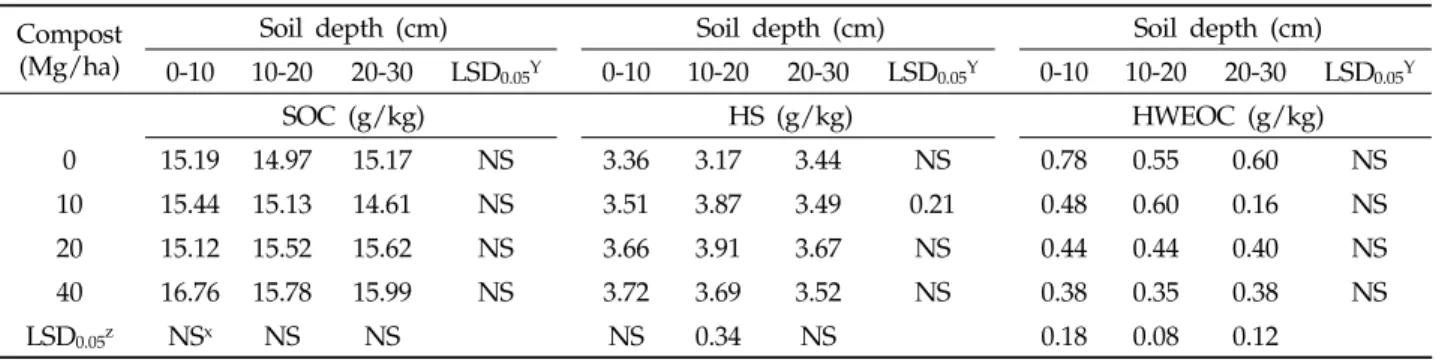
퇴비 시용량의 증가에 따라 토양유기탄소의 함량은 증가 하는 경향을 나타내지 않았으며 통계적으로 유의한 차이는 나타나지 않았다(Table 2). 또한 시험 전 토양과 퇴비시용 후 의 토양 내 유기탄소함량 차이를 조사해본 결과, 퇴비를 40 Mg/ha로 시용하였을 때 무처리구에 비해 유기탄소의 변화 량이 다소 큰 값을 나타내었으나 통계적으로 유의한 차이는 나타내지 않았다(Table 3). 본 연구에서 퇴비의 시용에 따라 토양유기탄소 함량이 유의적으로 증가하지 않은 것은 토양 유기탄소함량 변화의 조사가 단기간에 이루어진 것과 관련이 있는 것으로 판단된다. 많은 연구에서 퇴비의 시용에 따라 토 양의 유기탄소함량이 증가한다고 보고하고 있으나 이러한 연 구들은 대부분이 5년 이상의 장기간의 연구이었다(Six et al., 1999; Mukherjee, 2008; Rasool et al., 2008; Lee et al., 2013). Richter 등(2007)은 토양탄소의 양과 성질은 상당히 늦은 속도로 변화되기 때문에 이러한 변화를 관찰하기 위해 서는 장기간의 연구가 필요하다고 보고하였다.
일부 연구에서는 토양 내 퇴비를 시용하게 되면 미생물의 활성을 개선시켜 토양 내 macroaggregates(대입단)의 형성 을 증가시키게 된다고 보고하고 있다(Jastrow, 1996; Six et al., 1999). Dorodnikov 등(2009)은 토양이 대기 중 탄소를 축적하는 데는 대입단의 형성이 중요하다고 보고하였다. 일반 적으로 대입단(>0.25 mm)은 microaggregates(소입단, <0.25 mm) 보다 훨씬 많은 탄소를 함유하고 있다(Elliott, 1986;
Cambardella and Elliott, 1993a,b; Puget et al., 1995;
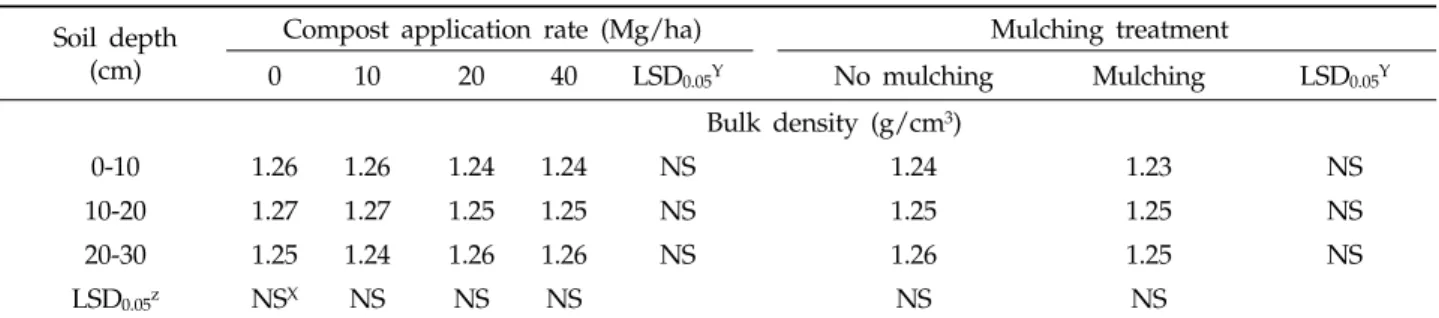
Six et al., 2000). 이러한 대입단의 형성을 위해서는 장기간 의 시간이 요구되어 질것으로 판단된다. 본 연구의 연구기간 인 150일 동안 퇴비의 시용에 의해 토양 내 대입단의 형성이 유의적으로 증가되지 않은 것으로 판단된다. 이러한 판단에 대한 근거는 수확기에 측정되어진 토양의 전용적 밀도를 조 사한 결과에 의해 입증되어 진다. 퇴비의 시용량 증가에 따른 전용적 밀도의 유의한 감소는 발견되지 않았다(Table 4).
Compost (Mg/ha)
Soil depth (cm) Soil depth (cm) Soil depth (cm)
0-10 10-20 20-30 LSD0.05Y 0-10 10-20 20-30 LSD0.05Y 0-10 10-20 20-30 LSD0.05Y
SOC (g/kg) HS (g/kg) HWEOC (g/kg)
0 15.19 14.97 15.17 NS 3.36 3.17 3.44 NS 0.78 0.55 0.60 NS
10 15.44 15.13 14.61 NS 3.51 3.87 3.49 0.21 0.48 0.60 0.16 NS
20 15.12 15.52 15.62 NS 3.66 3.91 3.67 NS 0.44 0.44 0.40 NS
40 16.76 15.78 15.99 NS 3.72 3.69 3.52 NS 0.38 0.35 0.38 NS
LSD0.05z NSx NS NS NS 0.34 NS 0.18 0.08 0.12
z least significant difference (
p<
0.05) among the application rates of compost.Y least significant difference (
p<
0.05) among the soil depths.X not significant at
p<
0.05 level.Table 2. Changes in soil organic carbon (SOC), humic substances (HS), and hot water extractable organic carbon (HWEOC) content in response to compost application rates at harvest time
Compost (Mg/ha)
Soil depth (cm) Soil depth (cm) Soil depth (cm)
0-10 10-20 20-30 LSD0.05Y 0-10 10-20 20-30 LSD0.05Y 0-10 10-20 20-30 LSD0.05Y
∆SOC (g/kg) ∆HS (g/kg) ∆HWEOC (g/kg)
0 -0.43 -0.66 -0.46 NS 0.88 0.68 0.96 NS -0.61 -0.84 -0.79 NS
10 -0.19 -0.49 -1.02 NS 1.03 1.38 1.01 0.21 -0.91 -0.79 -0.93 NS
20 -0.50 -0.11 0.00 NS 1.18 1.42 1.18 NS -0.95 -0.95 -0.98 NS
40 1.14 0.15 0.37 NS 1.24 1.20 1.03 NS -1.00 -1.04 -1.01 NS
LSD0.05z NSx NS NS NS 0.34 NS 0.18 0.08 0.12
z least significant difference (
p<
0.05) among the application rates of compost.Y least significant difference (
p<
0.05) among the soil depths.X not significant at
p<
0.05 level.Table 3. Net changes in soil organic carbon content (∆SOC), humic substances (∆HS), and hot water extractable organic carbon (∆HWEOC) content in response to compost application rates during hot pepper cultivation
Soil depth (cm)
Compost application rate (Mg/ha) Mulching treatment
0 10 20 40 LSD0.05Y No mulching Mulching LSD0.05Y
Bulk density (g/cm3)
0-10 1.26 1.26 1.24 1.24 NS 1.24 1.23 NS
10-20 1.27 1.27 1.25 1.25 NS 1.25 1.25 NS
20-30 1.25 1.24 1.26 1.26 NS 1.26 1.25 NS
LSD0.05z NSX NS NS NS NS NS
z least significant difference (
p<
0.05) among the application rates of compost.Y least significant difference (
p<
0.05) among the soil depths.X not significant at
p<
0.05 level.Table 4. Changes in bulk density of soil in response to application rates of compost and mulching at harvest time
본 연구에서 수확기 토양 내 유기탄소의 함량과 유기탄소 의 함량변화는 토양의 깊이에 따라 유의한 차이가 없는 것으 로 나타났다(Table 2 and 3). Lee 등(2007)은 switchgrass 재배토양에 퇴비를 시용하였을 때 표토(0-5 cm)에서 토양유 기탄소의 함량이 유의적으로 증가하였으나 심토(30-90 cm) 에서는 유의한 변화를 관찰하지 못하였다고 보고하였다. 이 연구는 현장조건에서 실시되어 퇴비를 4년간 지속적으로 표 토에 시용하였을 때 관찰된 결과이었다. 반면에 본 연구는 포 트시험 조건에서 150일간 실시되었으며 퇴비와 토양을 완전 히 혼합한 후 포트에 충진 하였으므로 토양깊이별 유기탄소 의 함량차이는 발견할 수 없었던 것으로 판단된다.
퇴비시용에 따른 토양의 유기탄소함량의 변화와 비슷하게 토양 내 부식질탄소의 함량은 퇴비의 시용에 따라 처리구간 의 통계적으로 유의한차이를 나타내지 않았다. 단지 부식질의 함량은 10-20 cm에서 처리구간 유의한 차이를 나타내었으나 시용량 증가에 따라 부식질의 함량이 일정하게 증가하는 경 향은 나타나지 않았다. 그러나 퇴비를 시용함에 따라 열수추 출 가능한 탄소의 함량은 모든 토양깊이에서 유의하게 감소 하는 결과를 나타내었으며 (Table 2). 퇴비시용 전후의 토양
토양유기탄소의 안정화정도는 탄소가 토양 내에서 쉽게 분해되는가의 정도로 정의될 수 있다. 열수추출 가능한 탄소 의 함량은 미생물에 의해 쉽게 분해가 가능한 토양탄소인 반 면에 부식질은 쉽게 분해되지 않는 토양탄소의 형태로 간주 되고 있다(Spaccini et al., 2000a,b). 음밀히 말하자면 미생 물에 의해 쉽게 분해되지 않는 부식질 탄소의 함량이 증대되 었을 때 토양의 탄소 축적이 증대되었다고 말할 수 있다. 사 실상, 부식질 탄소는 토양 내에서 수백 년간 분해되지 않고 존재한다고 조사되었다(Piccolo et al ., 1999). 토양 내 부식 질은 주로 alkyl기와 같은 지용성의 물질로 구성되어 있다.
이러한 지용성의 물질들은 미생물이 탄소화합물을 분해하는 것을 보호하는 역할을 한다(Piccolo, 1999). 일반적으로 퇴비 는 decomposition(퇴비화과정)을 겪는 동안 미생물에 의해 쉽게 분해 가능한 형태의 탄소는 제거되어 지고 주로 부식질 의 탄소가 존재하게 된다. 본 연구에 사용된 퇴비의 부식질 탄소의 함량과 열수추출 가능한 탄소의 함량은 총 탄소함량 의 각각 80.1%와 5.1%로 이러한 사실을 증명한다(Table 1).
본 연구에서 퇴비의 시용에 따라 토양 내 열수추출 가능한 탄
소의 함량이 감소되는 것은 두 가지의 이유로 판단되어진다.
이러한 퇴비가 토양에 투입되면서 열수추출 가능한 탄소의 함량을 희석시킨 것으로 판단된다(Table 2 and 3).
비닐멀칭처리 효과
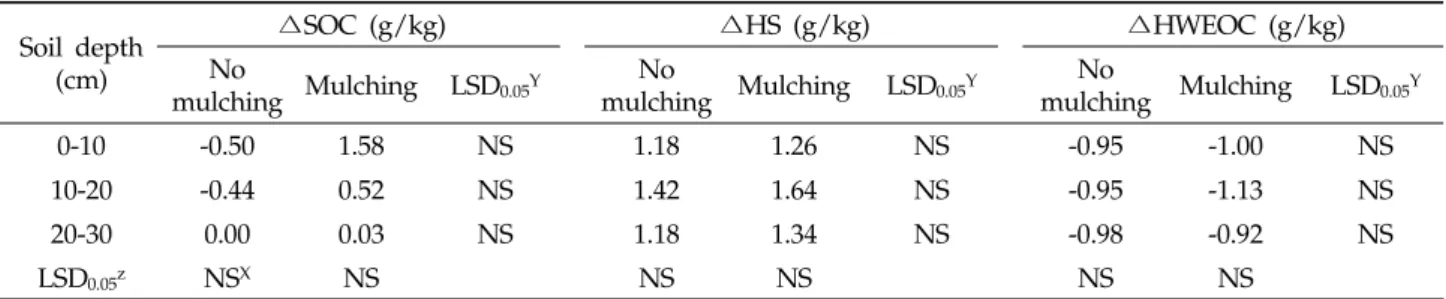
비닐멀칭 처리에 의한 수확기 토양 내 유기탄소의 함량과 비닐멀칭 처리 전후의 유기탄소 함량변화는 다소 증가하는 경향을 나타내었으나 무처리에 비해 통계적으로 유의한 차이 를 나타내지 않았다(Table 5 and 6). 비닐멀칭 처리에 의해 부식질 탄소의 함량은 다소 증가하는 반면 열수추출 가능한 탄소의 함량은 다소 감소하는 경향을 나타내었다. 그러나 두 탄소 형태 모두 무처리에 비해 통계적으로 유의한 차이를 나 타내지 않았다. 이러한 결과는 앞에서 언급한 바와 같이 본 연구의 조사가 단기간에 이루어진 것과 관련이 있는 것으로 판단되어 진다. 현재까지 비닐멀칭 처리에 의한 토양 내 유기 탄소의 격리와 관련된 연구는 거의 보고되어진 것이 없다. 그 러나 일부의 연구에서 식물의 잔재를 이용하여 토양을 멀칭 함으로써 토양 탄소의 격리를 향상시킬 수 있다고 보고했다 (Jastrow, 1996; Six et al., 1999; Dorodnikov et al., 2009). 이들 연구는 대부분 장기간의 연구기간동안 조사되어 진 결과 이었다. 식물의 잔재를 이용한 멀칭법은 토양의 물리 성 및 온도와 수분등을 개선시켜 토양의 미생물 활성을 촉진 시킨다(Gajri et al., 1994; Glab and Kulig, 2008). 결국 토 양의 입단화를 촉진시켜고 토양의 탄소의 함량을 증대시킨다.
본 연구에서 비닐멀칭 처리에 의해 토양 유기탄소의 함량이
다소 증가되어진 것은 토양의 물리성 개선에 의한 것으로 판 단되어 진다. 이것은 비닐멀칭 처리에 의한 토양의 전용적 밀 도 변화에 의해 입증되어진다. 비닐멀칭 처리에 의해 토양의 전용적 밀도는 다소 감소되어 지는 경향을 나타내었다. 그러 나 무처리에 비해 통계적으로 유의한 차이는 없었다(Table 4).
바이오매스 특성
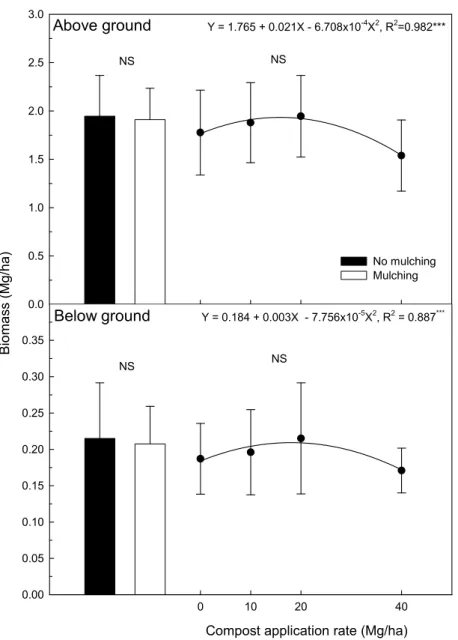
비닐멀칭 처리에 의해 고추의 지상부와 지하부의 바이오 매스는 다소 감소하는 경향을 나타내었으나 무처리에 비해 통계적으로 유의한 차이는 없었다(Fig. 1).
퇴비의 시용량을 증가시킴에 따라 고추의 지상부와 지하 부의 바이오매스가 유의한 증가는 발견되지 않았다(Fig. 1).
작물의 지상부에서 고사된 잎이나 잔재물들은 토양의 유기탄 소로 환원될 수 있는 바이오매스이다. 그러나 지상부 바이오 매스의 대부분은 수확기에 토양으로부터 제거되어 진다. 반면 에 지하부의 바이오매스는 수확 후에도 토양 내에서 남아 토 양 유기탄소의 중요한 공급원이 된다. 지하부의 바이오매스 양은 지상부의 약 1/10에 해당하며 추천량인 20 Mg/ha를 시용하였을 때 지하부의 바이오매스 양은 약 0.2 Mg/ha로 나타났다. 이러한 결과를 미루어 볼 때 장기간 동안 지속적으 로 추천량의 퇴비를 시용한다면 토양 유기탄소의 중요한 공 급원이 되는 지하부의 바이오매스 양을 증대시켜 결론적으로 토양 탄소의 격리능을 향상 시킬 수 있을 것으로 판단된다.
Soil depth (cm)
SOC (g/kg) HS (g/kg) HWEOC (g/kg)
No
mulching Mulching LSD0.05Y No
mulching Mulching LSD0.05Y No
mulching Mulching LSD0.05Y
0-10 15.12 17.21 NS 3.66 3.75 NS 0.44 0.38 NS
10-20 15.19 16.14 NS 3.91 4.12 NS 0.44 0.25 NS
20-30 15.62 15.66 NS 3.67 3.83 NS 0.40 0.46 NS
LSD0.05z NSX NS NS NS NS NS
z least significant difference (
p<
0.05) among the application rates of compost.Y least significant difference (
p<
0.05) among the soil depths.X not significant at
p<
0.05 level.Table 5. Changes of soil organic carbon (SOC), humic substances (HS), and hot water extractable organic carbon (HWEOC) content in response to mulching at harvest time
Soil depth (cm)
∆SOC (g/kg) ∆HS (g/kg) ∆HWEOC (g/kg)
No
mulching Mulching LSD0.05Y No
mulching Mulching LSD0.05Y No
mulching Mulching LSD0.05Y
0-10 -0.50 1.58 NS 1.18 1.26 NS -0.95 -1.00 NS
10-20 -0.44 0.52 NS 1.42 1.64 NS -0.95 -1.13 NS
20-30 0.00 0.03 NS 1.18 1.34 NS -0.98 -0.92 NS
LSD0.05z NSX NS NS NS NS NS
z least significant difference (
p<
0.05) among the application rates of compost.Y least significant difference (
p<
0.05) among the soil depths.X not significant at
p<
0.05 level.Table 6. Net changes in soil organic carbon content (∆SOC), humic substances (∆HS), and hot water extractable organic carbon (∆HWEOC) content in response to mulching during hot pepper cultivation
Above ground
0.0 0.5 1.0 1.5 2.0 2.5 3.0
No mulching Mulching
NS NS
Below ground
Compost application rate (Mg/ha)
0 10 20 40
Biomass (Mg/ha)
0.00 0.05 0.10 0.15 0.20 0.25 0.30 0.35
NS NS
Y = 1.765 + 0.021X - 6.708x10-4X2, R2=0.982***
Y = 0.184 + 0.003X - 7.756x10-5X2, R2 = 0.887***
Fig. 1. Above- and belowground biomass in response to compost application rates and mulching at harvest time.
요 약
본 연구는 고추재배시험 기간 동안 축분퇴비의 시용량과 비닐멀칭 유무에 따른 토양 유기탄소의 함량 변화와 토양 탄 소의 안정화 정도를 조사하기 위해 실시되어졌다. 고추재배 기간 동안 퇴비의 시용과 비닐멀칭 처리에 따라 토양 내 유기 탄소 함량의 유의한 증가는 발견되어지지 않았다. 또한 퇴비 시용과 비닐멀칭 처리에 의한 토양의 물리적 특성 변화는 관 찰되지 않았다. 이러한 결과는 본 연구의 짧은 조사기간과 관 련이 있는 것으로 판단된다. 그러나 퇴비의 시용에 의해 쉽게 분해 가능한 형태인 열수추출 가능한 탄소의 함량은 유의하 게 감소하는 결과를 나타내었다. 추천량인 20 Mg/ha의 퇴
퇴비를 지속적으로 시용한다면 토양 유기탄소의 함량 증대와 안정화 정도를 향상시킬 수 있을 것으로 판단된다.
Acknowledgement
This work was carried out with the support of
“Cooperative Research Program for Agriculture Science
& Technology Development (Project No. PJ009140)”
Rural Development Administration, Republic of Korea.
References