Korean Circulation Journal
Introduction
The primary therapeutic goal in acute decompensated heart fail- ure (ADHF) is symptom relief.
1-3)Most patients admitted to hospital for ADHF are in a volume overloaded state
4)and require fluid re- moval for symptom relief. The standard of care revolves around the use of intravenous loop diuretics, sometimes supported by adjunc-
Print ISSN 1738-5520 • On-line ISSN 1738-5555
A Pilot Study of Target Weight Guided Treatment in Acute Heart Failure Using Ultrafiltration or Usual Care: Effect on Sodium Removal
Eugene S. Chung, MD, Thomas M. O’Brien, MD, Santosh Menon, MD, Cheryl Bartone, BS, Wojciech Mazur, MD, and Dean J. Kereiakes, MD
The Christ Hospital Heart and Vascular Center, Cincinnati, OH, USA
Background and Objectives: In the Ultrafiltration versus Intravenous Diuretics for Patients Hospitalized for Acute Decompensated Heart Failure trial, ultrafiltration (UF) removed volume more effectively than usual care (UC). Hypothetically, UF may be superior to UC due to increased sodium (Na) removal and less neurohormonal activation. We compared UF and UC in a randomized pilot trial of target weight guided therapy for acute decompensated heart failure (ADHF).
Subjects and Methods: Sixteen patients with ADHF were enrolled and target weights established prospectively, prior to randomization to UC or UF. UF patients did not receive diuretics and UC patients were all treated with a continuous furosemide drip. All urine and ultrafil- trate were collected and Na concentrations measured.
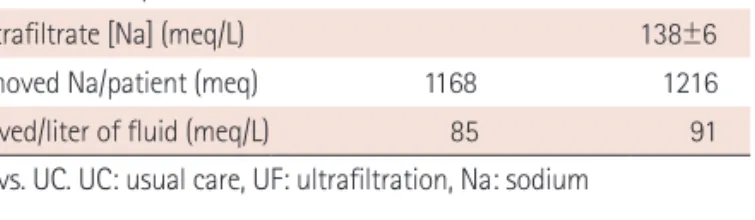
Results: Similar volumes were removed in UC and UF groups (110105 mL and 107415 mL, respectively) and the UF group also produced 45325 mL of urine. Na concentration was 138±6 meq/L in the ultrafiltrate, 85±73 meq/L in the UC group’s urine, and 26±23 meq/L in the UF group’s urine. Given the relevant associated volumes, total meq of the Na removed was similar (1168 in UC vs. 1216 in UF). The UF group produced isotonic ultrafiltrate and a higher volume of dilute urine than anticipated.
Conclusion: In a randomized pilot study of target weight guided therapy with UC or UF for ADHF, there were no differences in total vol- umes or Na removed, and lengths of hospital stays were similar. Isotonic fluid loss by UF was accompanied by the production of very dilute urine. (Korean Circ J 2014;44(3):156-161)
KEY WORDS: Ultrafiltration; Heart failure; Diuretics; Sodium.
Received: January 9, 2014 Revision Received: March 6, 2014 Accepted: March 25, 2014
Correspondence: Eugene S. Chung, MD, The Christ Hospital Heart and Vascular Center, 2123 Auburn Ave, Ste 100, Cincinnati, OH 45219, USA Tel: 1-513-721-9243, Fax: 1-513-721-9249
E-mail: [email protected]
This is an Open Access article distributed under the terms of the Creative Commons Attribution Non-Commercial License (http://creativecommons.
org/licenses/by-nc/3.0) which permits unrestricted non-commercial use, distribution, and reproduction in any medium, provided the original work is properly cited.
tive therapy with vasodilators and inotropic agents.
2)However, in- hospital mortality as well as short-term outcomes remain problem- atic, with 30-day readmission rates of patients that have not im- proved significantly despite increased awareness over 20%.
5)Loop diuretic therapy may have a direct deleterious effect on cardiac func- tion,
6)and the use of higher doses of loop diuretics may be associ- ated with poorer outcomes,
7)although the presence of a causal rela- tionship is unproven. Nonetheless, ample imperatives exist to pro- mpt an evaluation of novel strategies to remove volume in ADHF.
Extracorporeal ultrafiltration (UF) has been explored in the ADHF
population for over two decades.
8)9)With the development of the
Aquadex system (CHF Solutions, Inc., Gambro), UF has become easier
to use, requiring less intense nursing support.
10)The Ultrafiltration
versus Intravenous Diuretics for Patients Hospitalized for Acute De-
compensated Heart Failure (UNLOAD) trial demonstrated that, when
randomized to usual care (UC) or primary therapy with UF, UF re-
moved more volume at 48 hours, although the degree of dyspnea
did not differ.
11)In addition, fewer short-term HF related readmis-
sions were observed in the UF treated group. Subsequently, this therapy has achieved widespread use, and is included in the Ameri- can Heart Association/American College of Cardiology practice guide- lines as a viable therapy in diuretic resistant patients.
12)Other puta- tive benefits of UF include more effective sodium (Na) removal
13)and less neurohormonal stimulation.
14)For these reasons, UF may be a safer and more effective method of removing volume. Howev- er, if similar amounts of volume are removed, it is not known if UF provides more Na removal, shorter lengths of hospital stays, and less renal toxicity. We performed a randomized pilot study to evalu- ate these questions, under the hypothesis that total Na removed by UF is greater than that during UC when matched for volume loss.
Subjects and Methods
Patient selection
The protocol was approved by the Christ Hospital (Cincinnati, Ohio) Institutional Review Board. Patients admitted to the hospital for a primary diagnosis of ADHF were screened for the following inclu- sion criteria: left ventricular ejection fraction less than or equal to 35%, evidence of volume overload (ascites, jugular venous disten- sion or edema), and New York Heart Association 3–4 functional class.
Exclusion criteria included serum creatinine greater than 3.5 mg/
dL, severe lung disease, resynchronization therapy within the past 3 months or planned for the following 3 months, life expectancy of less than 6 months (patients with malignancy were accepted as long as they satisfied this criterion), myocardial infarction within the past 3 months, percutaneous coronary intervention within the past 1 month, coronary artery bypass surgery within the past 3 months, inadequate venous access for UF, and hematocrit ≥45%.
Protocol
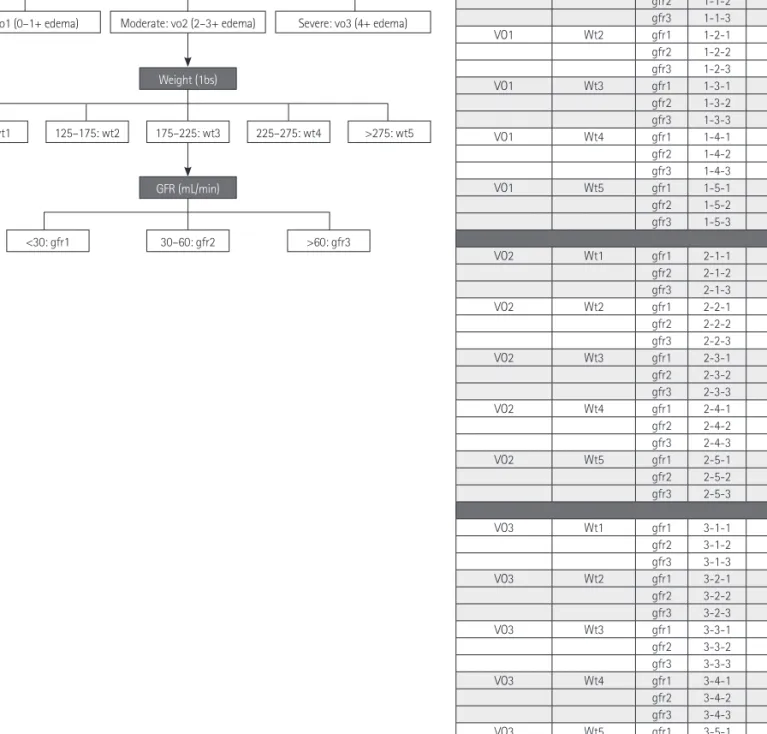
Each patient was evaluated and enrolled within 24 hours of ad- mission. A target weight to be removed was prospectively estab- lished by the heart failure service in attendance (Drs. Chung or Me- non) based on a review of the hospital chart, office chart, and pa- tient/family interviews. If the target weight could not be established satisfactorily, it was determined using an algorithm designed for this study (Fig. 1).
15)After the target weight was determined, the pa- tients were then randomized to either UC or UF. All patients were placed on a 2-gram daily Na restricted diet. Although UC patients could be treated with any form of loop diuretic therapy as well as intravenous vasodilators or inotropes, all were given intravenous furosemide drips. No UF patients received loop diuretics after ran- domization. Patients were treated to target weight unless prevented by a clinical barrier, most typically, a rise in serum creatinine or the treating physician’s judgment that euvolemia had been reached.
After randomization, all urine and ultrafiltrate were collected and volumes recorded. Na concentrations from the first urine and ultra- filtrate samples of each day were measured, representing overnight collection. Weights were recorded each morning, after voiding, using the same scale and wearing similar clothing. Baseline as well as daily electrolytes and renal function were measured and brain natiuretic peptide levels were obtained at baseline and prior to discharge.
Ultrafiltration
Ultrafiltration was performed for each patient using the Aquadex 100 system (CHF Solutions, Inc., Gambro). Seven of the nine patients were treated through a 16-gauge two-chamber mid-line catheter placed by the intravenous team, and two patients required a central line inserted in the internal jugular vein. All UF patients received in- travenous heparin to keep the activated partial thromboplastin time between 80–100 seconds.
Statistics
Discrete data were compared using Fisher’s exact t-test, while continuous variables were compared using the analysis of variance.
Categorical variables were compared using chi-square. Any p<0.05 was considered to be significant. All data were analyzed using the R 2.9.2 statistical package. There was a proportion of patients with missing Na data (21 of 129, 16.3%). These data were replaced with imputed values, defined as the mean of the particular patient’s other Na levels during hospitalization.
Results
A total of sixteen patients were enrolled (8 patients in each arm), with largely similar baseline characteristics, although some vari- ables tended to differ due to the small sample sizes (Table 1). Pro- spectively established, pre-randomization target weights and ac- tual achieved weight loss were as shown in Table 2. Table 3 shows the weight data for individual patients. Overall, the UC group was treated with a mean daily diuretic dose of 212 mg of furosemide per day (continuous intravenous drip) and achieved 80% of the target weight reduction, while the UF group achieved 88% of the target weight loss (p=not significant). In the UC group, 3 of 8 patients lost more weight than the target, and in the UF group, 4 of 8. Random- ization and initiation of study therapies took place within 24 hours of presentation.
The amounts of urine and ultrafiltrate removed are also shown,
and demonstrate similar amounts of total volume removal for both
treatment groups. The mean ultrafiltrate rate was 162 mL/hour in
the UF group. Mean Na concentrations in the urine and ultrafiltrate
are shown in Table 4, and the absolute amounts of Na removed were
calculated by considering the relative volumes. While Na concentra- tions were higher in the ultrafiltrate, the urine Na concentration was very low in UF patients, resulting in similar amounts of total Na re- moved per patient. The amount of Na removed per liter of volume (urine or ultrafiltrate or both), were similar in both groups.
The mean change in creatinine between admission and discharge did not differ between the two groups, although the maximum ob- served change was higher in the UF group. Compared with admis- sion levels, UF patients had a slightly lower creatinine level on dis-
charge, while it was slightly higher at discharge among UC patients.
Four patients in each group developed a transient rise in serum cre- atinine >0.3 mg/dL above the baseline value. Short-term readmis- sions and length of stay did not differ substantially (Table 5).
Discussion
In this pilot study of target weight driven therapy utilizing a pro- spective randomized design, UC with loop diuretic infusion compar-
Volume overload Baseline wt GFR Group Target wt loss
VO1 Wt1 gfr1 1-1-1 0
gfr2 1-1-2 2.5
gfr3 1-1-3 5
VO1 Wt2 gfr1 1-2-1 2.5
gfr2 1-2-2 5
gfr3 1-2-3 7.5
VO1 Wt3 gfr1 1-3-1 2.5
gfr2 1-3-2 7.5
gfr3 1-3-3 10
VO1 Wt4 gfr1 1-4-1 5
gfr2 1-4-2 10
gfr3 1-4-3 15
VO1 Wt5 gfr1 1-5-1 5
gfr2 1-5-2 10
gfr3 1-5-3 20
VO2 Wt1 gfr1 2-1-1 5
gfr2 2-1-2 7.5
gfr3 2-1-3 10
VO2 Wt2 gfr1 2-2-1 7.5
gfr2 2-2-2 10
gfr3 2-2-3 12.5
VO2 Wt3 gfr1 2-3-1 7.5
gfr2 2-3-2 12.5
gfr3 2-3-3 15
VO2 Wt4 gfr1 2-4-1 10
gfr2 2-4-2 15
gfr3 2-4-3 20
VO2 Wt5 gfr1 2-5-1 10
gfr2 2-5-2 20
gfr3 2-5-3 30
VO3 Wt1 gfr1 3-1-1 15
gfr2 3-1-2 17.5
gfr3 3-1-3 20
VO3 Wt2 gfr1 3-2-1 17.5
gfr2 3-2-2 20
gfr3 3-2-3 22.5
VO3 Wt3 gfr1 3-3-1 17.5
gfr2 3-3-2 22.5
gfr3 3-3-3 25
VO3 Wt4 gfr1 3-4-1 20
gfr2 3-4-2 25
gfr3 3-4-3 30
VO3 Wt5 gfr1 3-5-1 20
gfr2 3-5-2 25
gfr3 3-5-3 30
Mild: vo1 (0–1+ edema)
<125: wt1
<30: gfr1
125–175: wt2 175–225: wt3
30–60: gfr2
225–275: wt4 >275: wt5
>60: gfr3 Moderate: vo2 (2–3+ edema) Severe: vo3 (4+ edema) Degree of volume overload (physician judgment)
Weight (1bs)
GFR (mL/min)