ABSTRACT
Poultry red mites (PRMs), Dermanyssus gallinae, are one of the most harmful ectoparasites of laying hens. Because of their public health impact, safe, effective methods to eradicate PRMs are greatly needed. Carbon dioxide (CO
2) was shown to eradicate phytophagous mites;
however, there is no evidence that PRMs can be eradicated by CO
2. Thus, the efficacy of CO
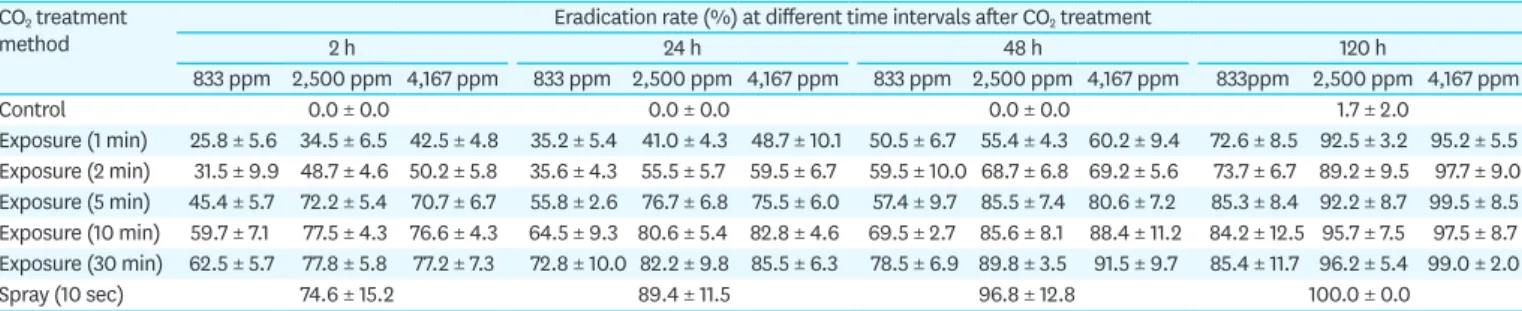
2, applied by direct-spraying and dry ice-generated exposure, for eradicating PRMs was investigated. Both treatments eradicated > 85% of PRMs within 24 h and 100% of PRMs by 120 h of post-treatment. Therefore, these novel approaches may be useful for eradicating PRMs in clinical settings.
Keywords: Acaricides; asphyxiator; carbon dioxide; Dermanyssus gallinae
INTRODUCTION
The poultry red mite (PRM), Dermanyssus gallinae (De Geer, 1778), is an important hematophagous ectoparasite that attacks resting hens, mainly at night, for a blood meal [1]. After feeding, the mites hide in cracks and crevices, where they mate and lay eggs.
PRM infestations have several negative effects on the hens. Because an adult mite ingests approximately 0.2 μL of blood [2]. The PRM infestation and the mortality of hens are strongly related, and it is mentioned in some reports that the mortality rate of hens increases ten- times following severe infestation [3]. In addition to the direct physiological effects, PRMs may also be carriers of several important disease-causing agents, such as Salmonella [4] and the microbial agents that cause spirochetosis [5] and encephalitis.
PRMs are considered to be the most damaging pests in poultry egg production [6-8], and as the number of infections increase, controlling PRMs is becoming very complicated.
A range of acaricides, including organophosphates, carbamate, amidine and pyrethroid- based acaricides, are widely used to control PRMs [6-8]. However, many acaricides are not specifically labeled for use against PRMs [6-8]. Fipronil is an acaricide that is authorized for use in plant protection but is not approved for use as a veterinary medicinal product on food-producing animals [9]; however, in many countries, it is illegally used on laying hens to eradicate red mites [9]. Fipronil-contaminated eggs were detected in Belgium in July
Rapid Communication
Received: Sep 4, 2019 Revised: Feb 28, 2020 Accepted: Mar 2, 2020
*Corresponding author:
Sung-Won Park
Veterinary Drugs & Biologics Division, Animal and Plant Quarantine Agency (APQA), 177 Hyeoksin 8-ro, Gimcheon 39660, Korea.
E-mail: [email protected]
© 2020 The Korean Society of Veterinary Science
This is an Open Access article distributed under the terms of the Creative Commons Attribution Non-Commercial License (https://
creativecommons.org/licenses/by-nc/4.0) which permits unrestricted non-commercial use, distribution, and reproduction in any medium, provided the original work is properly cited.
ORCID iDs JeongWoo Kang
https://orcid.org/0000-0002-2097-6137 Md Akil Hossain
https://orcid.org/0000-0001-7131-4814 Jiyeon Jeong
https://orcid.org/0000-0001-6228-7164 Haechul Park
https://orcid.org/0000-0002-6462-5507 Jin-Hyun Kim
https://orcid.org/0000-0002-5464-0447 Min-Su Kang
https://orcid.org/0000-0002-8983-4129 Yong-Kuk Kwon
https://orcid.org/0000-0003-2435-7330 Yong-Sang Kim
https://orcid.org/0000-0001-9848-7299 Sung-Won Park
https://orcid.org/0000-0002-7251-4313
JeongWoo Kang
1, Md Akil Hossain
1, Jiyeon Jeong
2, Haechul Park
1, Jin-Hyun Kim
2, Min-Su Kang
2, Yong-Kuk Kwon
2, Yong-Sang Kim
1, Sung-Won Park
1,*1
Veterinary Drugs & Biologics Division, Animal and Plant Quarantine Agency (APQA), Gimcheon 39660, Korea
2