Single buccal infiltration of high concentration lignocaine versus articaine in maxillary third molar surgery
Hnin Ei Phyo
1,2, Teeranut Chaiyasamut
1, Sirichai Kiattavorncharoen
1*, Verasak Pairuchvej
1, Bishwa Prakash Bhattarai
3, Natthamet Wongsirichat
1,3*
1Department of Oral and Maxillofacial Surgery, Faculty of Dentistry, Mahidol University, Bangkok, Thailand
2Department of Oral and Maxillofacial Surgery, University of Dental Medicine, Mandalay, Myanmar
3Walailak University International College of Dentistry, Bangkok, Thailand
Background: This research evaluated the numbness produced by lignocaine at an equal or higher concentration than that of 4% articaine through a single point of injection for maxillary third molar surgery. This randomized double-blind study was conducted to compare the anesthetic efficiency of 4% lignocaine with that of 4% articaine in impacted maxillary third molar surgery using a single buccal infiltration alone.
Methods: The study participants were 30 healthy patients requiring the bilateral surgical removal of symmetrically-positioned maxillary third molars. Using a split-mouth design, each patient randomly received buccal infiltration of 1.7 ml of 4% lignocaine and 1.7 ml of 4% articaine during two separate appointments. After 15 minutes of anesthetic injection, surgery was performed by the same surgeon using a consistent technique on both sides. Pinprick test pain scores of the buccal and palatal gingiva of the maxillary third molar after 10 minutes and 15 minutes latencies, pain scores during the surgery, the need for supplemental anesthesia, and patients’ satisfaction with anesthetic efficiency were recorded. Surgery performed without supplemental anesthesia was categorized as successful.
Results: The success rates of 4% lignocaine and 4% articaine (83.34% vs. 86.67%, P = 1.00) were not significantly different. Only 5 cases (4 cases in the articaine group and 1 case in the lignocaine group) reported mild pain and pressure sensation (NRS ≤ 1) on probing at the palatal side after 15 minutes of latency (P = 0.25). The pain scores of maxillary third molar surgery in the two groups were not significantly different (P > 0.05).
Moreover, the statistical analysis confirmed the comparable patient satisfaction of two study groups (P = 0.284).
Conclusion: This study provides evidence that single buccal infiltrations of 4% lignocaine and 4% articaine have comparable anesthetic efficacy and success rates for impacted maxillary third molar surgery. Both 4%
lignocaine and 4% articaine can produce effective palatal anesthesia and pain control using buccal infiltration alone after 15 minutes of latency.
Keywords: Articaine; Buccal administration; Higher Concentration; Lignocaine; Impacted Third Molars; Visual Analog Scale.
This is an Open Access article distributed under the terms of the Creative Commons Attribution Non-Commercial License (http://creativecommons.org/licenses/by-nc/4.0/) which permits unrestricted non-commercial use, distribution, and reproduction in any medium, provided the original work is properly cited.
Received: April 2, 2020•Revised: May 23, 2020•Accepted: July 15, 2020 Corresponding Author:*Sirichai Kiattavornchareon1 & Natthamet Wongsirichat2,
1Department of Oral and Maxillofacial Surgery, Faculty of Dentistry, Mahidol University, 6 Yothi Street, Rachathewee District, Bangkok, 10400, Thailand. E-mail:
2Walailak University International College of Dentistry 979/42-46 Phahonyothin Road 19th floor SM Tower Phaya Thai District Bangkok 10400, Thailand. E-mail:
[email protected], [email protected] Copyrightⓒ 2020 Journal of Dental Anesthesia and Pain Medicine
INTRODUCTION
Local anesthesia and its techniques are integral to the
management of painful dental procedures [1,2]. Most impacted maxillary third molars (IMTMs) are surgically removed under local anesthesia [3]. The conventional injection techniques for local anesthetics (LAs) for
maxillary third molar surgery are buccal and palatal infiltrations adjacent to the tooth to be extracted to block the posterior superior alveolar and greater palatine nerves [4]. Palatal injections are the most painful injections in the oral cavity, which is a reason for the avoidance of dental treatment [5,6]. However, a painful palatal injection can be avoided by leveraging the palatal diffusion of the LA after solitary buccal infiltration (BI) [3,7].
In recent years, many clinical studies have compared the palatal diffusion efficiencies of 4% articaine BI and 2% lignocaine BI for maxillary teeth extractions.
Kandasamy et al. [8] compared the palatal bony diffusion of a single BI of 1.7 ml of 4% articaine with that of 1.7 ml of 2% lignocaine for maxillary teeth extractions and remarked that the 2% lignocaine group required more supplemental palatal injections than the 4% articaine group. Similarly, Sharma et al. [9] found that the pain scores on probing the palatal mucosa after BI of 1.8 ml of 2% lignocaine were statistically higher than those of 4% articaine during the extraction of maxillary posterior teeth. In a meta-analysis by Brandt et al. [10], the infiltration of 4% articaine was 3.81 times more effective than that of 2% lignocaine.
These studies, however, did not consider the concen- tration difference of 4% articaine and 2% lignocaine. The efficiency of 2% lignocaine was compared to that of 4%
articaine using equal volumes rather than equal doses of the anesthetics. The high concentration (4%) of the LA may have been the reason for adequate palatal diffusion anesthesia. However, no published clinical trials have compared BI anesthesia of 4% lignocaine with that of 4% articaine during IMTM surgery. The authors hypothesized that there would be no differences between the anesthetic efficacies and the success rates of solitary BIs of 4% lignocaine and 4% articaine. This study aimed to compare the anesthetic efficiency of a higher concentration (4%) of lignocaine to that of 4% articaine during the surgical removal of IMTMs using a single BI alone.
METHODS
1. Clinical trial design
This study was designed as a split-mouth randomized double-blind clinical trial. For the sample size calculation, the confidence level of the test was targeted at 0.05 and the two-sided z test (z (1 – α/2) = 1.96) was used [11].
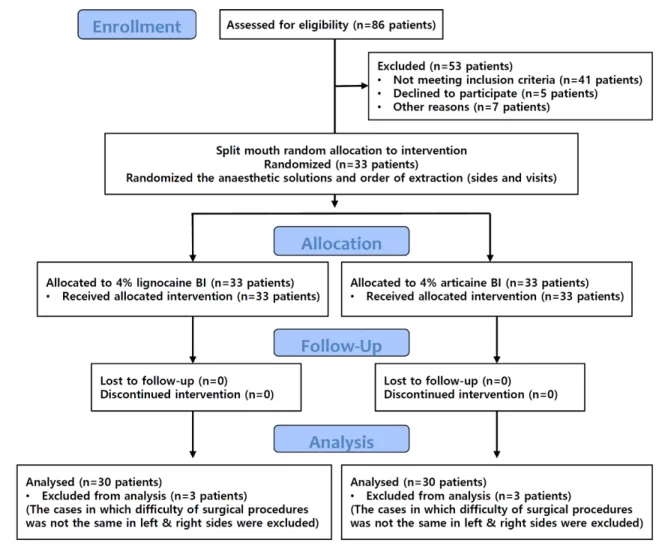
The sample size of 25 patients would have an absolute precision of 0.2 for detecting a difference between the study group (4% lignocaine) of 85% assuming a prevalence of 86% in the control group (4% articaine), according to a study by Majid and Ahmad [6]. Although the required sample size for a 95% confidence interval was 25 patients, a total of 30 patients were enrolled to account for possible dropouts. Fig. 1 illustrates the flow diagram of the study design. The study was performed over eight months, and it was approved by the institutional ethics committee.
2. Eligibility criteria
Panoramic radiographs of patients aged between 18 and 45 years were assessed. Thirty male and female patients with bilateral symmetrical IMTMs that were removable under local anesthesia were recruited at the our department. All patients were healthy, as determined by medical history and oral questioning. The exclusion criteria were any reported allergy to the LAs, any systemic diseases contraindicating the surgical removal of an impacted molar, pregnant and lactating women, acute infection around the IMTM, and current use of analgesics. Cases with incomparable surgical difficulties of the left and right sides were also excluded from the study to standardize the surgical procedure. Written informed consent was obtained from all the participants.
Each patient underwent two surgical interventions for IMTMs with 2-week washouts.
3. Randomization and blinding
At each appointment, 1.7 ml of 4% lignocaine with epinephrine 1:100,000 or 4% articaine with epinephrine
Fig. 1. CONSORT flow diagram of the study design.
1:100,000 was randomly assigned using a randomization table. For the 4% lignocaine group, 4% lignocaine with epinephrine 1:100,000 was immediately prepared before the surgery. Subsequently, 0.02 ml of epinephrine 1:1,000 was drawn with a micropipette and put it into a 2-ml ampule of a 4% lignocaine plane (Jayson Pharmaceuticals Ltd; Dhaka, Bangladesh) to obtain a solution with 1:100,000 epinephrine. Only 1.7 ml of lignocaine solution was drawn from the ampule by using a 3cc disposable syringe and used for the single buccal injection. For the 4% articaine group, 1.7 ml of 4% articaine with 1:100,000 epinephrine (3MTM ESPETM UbistesinTM Forte) was drawn from a dental cartridge using a 3cc disposable syringe. The anesthetic preparation was performed by the first researcher. The patient and the second researcher (the surgeon) were blinded to the solution that was injected.
4. IMTM surgery
Before the surgery, the Visual Analogue Scale (VAS) and the Numerical Rating Scale (NRS) [12] were explained to each patient to enable them to describe the extent of pain more accurately. The VAS is a 100 mm horizontal line with the left end representing no pain and the right end representing the worst pain. The patients were asked to indicate a point along the line that represented the level of their pain. The NRS consists of 0 to 10 points, where 0 represents no pain and 10, the worst possible pain. Patients were instructed to choose a number that related to their pain intensity. The pinprick test (a sharp dental probe was applied to the mucosa and moved in a prickly manner and pain score was noted) [13] and intra-operative pain scores were recorded with
NRS, and immediate post-operative pain was recorded by using VAS. The satisfaction of patients with anesthetic efficiency during IMTM surgery was recorded using the Verbal Rating Scale (VRS) with three categories: “less pain than expected,” “as expected,” and “more than expected.”
At each appointment, the pre-operative assessments (blood pressure, heart rate, and pinprick tests on gingiva at buccal and palatal sides of the IMTM region) were recorded as baseline measures before the anesthetic injection. The allocated LA was injected into the buccal vestibule of the IMTM at a rate of 1.7 ml per 60 seconds using a 27-gauge needle attached to a 3cc disposable syringe. The pinprick test of the buccal and palatal gingiva of the IMTM region was carried out after 10-minute and 15-minute latencies after the LA injection, and the pain responses were recorded.
Fifteen minutes after the LA injection, the surgical procedure was performed by the second researcher. The design of the buccal mucoperiosteal flap (envelope or triangular) and the need for bone removal were decided depending on the depth and angulation of impaction. The IMTM was removed and the flap was repositioned with no. 3/0 vicrylⓇ interrupted sutures. If the patient complained of an unacceptable level of pain or discomfort during surgery, the level of pain was recorded, and additional LA was administered at the palatal or buccal site as necessary.
Surgeries performed without supplemental anesthesia were categorized as successful. After a washout of two weeks, surgical removal of the contralateral IMTM was performed by the same surgeon using a consistent technique on both sides.
5. Study outcomes
The primary outcome of this study was the success rate of 4% lignocaine BI and 4% articaine BI anesthesia in IMTM surgery. The secondary outcome variables that could interpret the primary outcome were pinprick test pain score, anesthetic injection pain, intra-operative pain scores at every step of the surgical procedure, immediate
post-operative pain, need for additional anesthesia, the total volume of LA used and patients’ satisfaction with the anesthetic. Thus, these outcome variables were measured and compared in this study.
6. Statistical analysis
SPSS statistical software version 18 was used to perform the tests of significance. The paired t-test and Wilcoxon’s signed-rank test were used to compare the mean differences between the two treatments in the same patient. McNemar’s test was performed to compare the frequency variables of the treatment groups. The level of significance was set at P < 0.05.
RESULTS
In this study, a total of 30 patients, comprising 6 males (20%) and 24 females (80%) aged between 18 to 36 years (mean age = 21.47 ± 3.82 years), were included. All patients were healthy (ASA class I) with a mean body mass index of 24.41 ± 3.16. Table 1 presents the classification (depth and angulation) of impactions [14]
and surgical techniques. The majority of the cases were class B and C with vertical angulation (46.66% and 28/60 cases, respectively), which were extracted using one of the three surgical techniques depending on the difficulty of the procedure. A triangular mucoperiosteal flap with bone removal was required in 33.33% (20/60) of the cases.
The difference between the injection discomfort of the 4% articaine (mean NRS 1.43 ± 0.5) and the 4%
lignocaine (mean NRS 1.33 ± 0.48) groups was not statistically significant (P = 0.581). According to the pinprick test results, 30% (9/30) of cases in the 4%
articaine group and 26.6% (8/30) of cases in the 4%
lignocaine group still had mild pain (maximum NRS 2) on probing at the palatal side after 10 minutes post-injection (P = 0.721). Only 5 cases (4 cases in the articaine group and 1 case in the lignocaine group) reported mild pain and pressure sensation (NRS ≤ 1) on
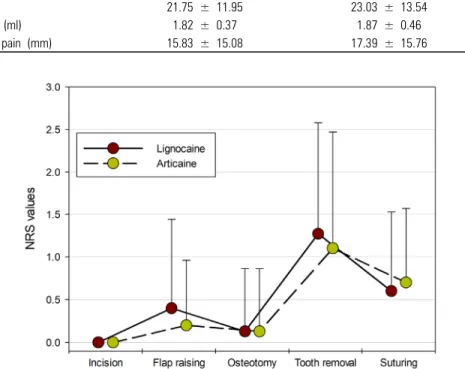
Fig. 2. Intra-operative Numerical Rating Scale (NRS) values at different surgical steps (mean and standard deviation). P-values of each step between two durgs were 1.000, 0.405, 1.000, 0.393, and 0.467.
Table 2. Comparison of the duration of surgery, the total volume of local anesthetic used, and immediate post-operative pain VAS in the two study groups
Variables 4% Articaine
Mean (SD) 4% Lignocaine
Mean (SD) P-value
Duration of surgery (min) 21.75 ± 11.95 23.03 ± 13.54 0.302
Total volume of LA used (ml) 1.82 ± 0.37 1.87 ± 0.46 0.581
Immediate post-operative pain (mm) 15.83 ± 15.08 17.39 ± 15.76 0.483
Table 1. Classification of impacted maxillary third molars of 30 patients and surgical techniques Difficulty and surgical technique
Depth and angulation Position B,
Vertical n (%)
Position C, Vertical
n (%)
Position C, Distoangular
n (%)
Position C, Mesioangular
n (%)
Total n (%)
Easy (Envelope flap, no bone removal) 10 (33.33%) 0 0 0 10 (33.33%)
Moderate (Envelope flap, bone removal) 3 (10%) 7 (23.33%) 0 0 10 (33.33%)
Difficult (Triangular flap, bone removal) 1 (3.33%) 7 (23.33%) 1 (3.33%) 1 (3.33%) 10 (33.33%)
probing at the palatal side after a 15-minute latency (P
= 0.25).
A general linear model was used to evaluate the NRS scores of the intra-operative pain intensities during the various surgical steps (Fig. 2). The intra-operative pain scores of the flap raising and tooth removal steps were higher in the 4% lignocaine group than in the 4% articaine group, but the differences were not significant (P > 0.05).
The total volume of anesthetics used and the duration of surgical procedures in the groups (Table 2) were not significantly different. The mean postoperative pain VAS was higher in the 4% lignocaine group (17.39 ± 15.76
mm) than in the 4% articaine group (15.83 ± 15.1 mm), but the difference was not significant (P = 0.483).
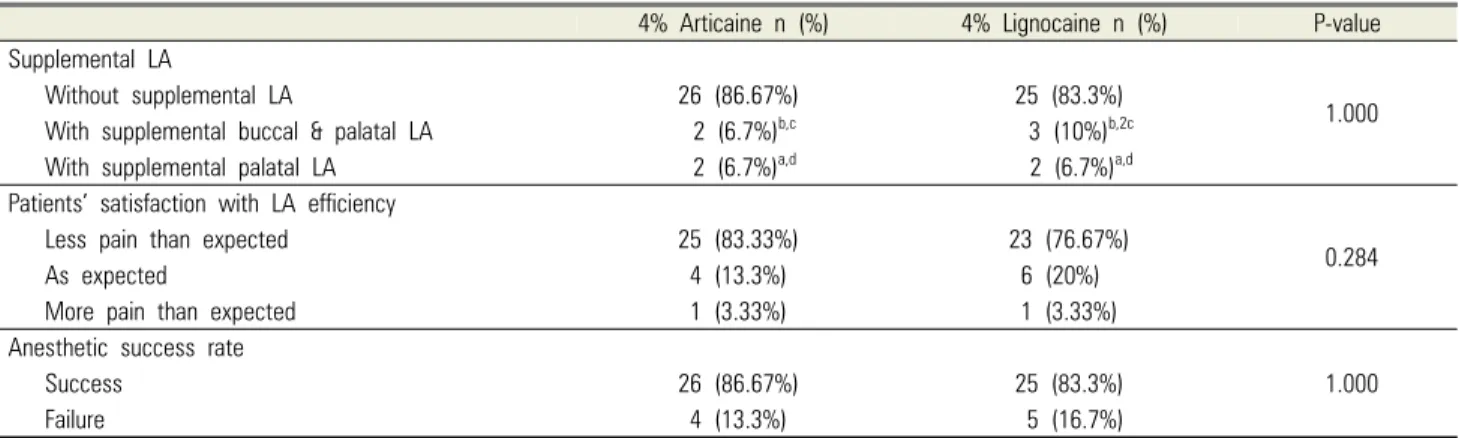
Table 3 summarizes the need for supplemental LA during different steps of the surgical procedure, the patients’ satisfaction with the anesthetic efficiencies and the success rates. Four cases (13.3%) in the articaine group and 5 (16.7%) in the lignocaine group required additional LA. Supplemental buccal and palatal anesthesia were required in 5 cases (2 cases in the articaine group and 3 cases in the lignocaine group) due to the difficulty and the longer duration of the surgical procedure. Regarding patients’ satisfaction with the
Table 3. The efficiencies of the single buccal infiltrations in the two groups and patients’ satisfaction
4% Articaine n (%) 4% Lignocaine n (%) P-value
Supplemental LA
1.000
Without supplemental LA 26 (86.67%) 25 (83.3%)
With supplemental buccal & palatal LA 2 (6.7%)b,c 3 (10%)b,2c
With supplemental palatal LA 2 (6.7%)a,d 2 (6.7%)a,d
Patients’ satisfaction with LA efficiency
0.284
Less pain than expected 25 (83.33%) 23 (76.67%)
As expected 4 (13.3%) 6 (20%)
More pain than expected 1 (3.33%) 1 (3.33%)
Anesthetic success rate
1.000
Success 26 (86.67%) 25 (83.3%)
Failure 4 (13.3%) 5 (16.7%)
LA, local anesthetic.
Supplemental LA duringa flap raising;b bone removal;c elevation;d suturing.
anesthetic agents, most of the patients (83.33% in the articaine group and 76.67% in the lignocaine group) indicated that the surgical pain as “less than expected”.
Only 1 patient (3.33%) from each group indicated that the pain was “more than expected”. Patient satisfaction in the two groups did not differ significantly (P = 0.284).
The success rates of the 4% articaine and 4% lignocaine groups were 86.7% and 83.3%, respectively, with no significant difference (P = 1.00).
DISCUSSION
This double-blinded, randomized, split-mouth study compared the anesthetic efficiencies of 4% lignocaine and 4% articaine during IMTM surgery using 1.7 ml of single BI. The results of this study showed that single buccal injections of 4% lignocaine and 4% articaine had comparable anesthetic efficacies and success rates for IMTM surgery.
The main outcomes of this study were pain experienced and additional anesthesia during the procedure. Many factors impact pain perception. In the current study, the split-mouth design, with each participant acting as their control, minimized the effect of confounding factors that were capable of influencing pain perception, such as age, gender, the difficulty of surgery, anxiety, and the inter- pretation of a painful stimulus [15,16]. Randomization
and double-blinding of the treatment allocation also eliminated the potential interpersonal bias that could have affected the outcomes.
Anesthetic injection pain may be influenced by the site of the injection, the use of topical anesthesia, injection rate, injection volume, and the type of solution used due to its acidic pH [4]. In this study, injection pain was mild in both groups. Fan et al. [17] and Kumaresan et al. [18]
indicated that routine palatal injection yielded signifi- cantly more discomfort than BI. The mean injection pain of BI alone was 0.91 (NRS), which falls in the mild pain category [18]. This was consistent with the values found in our study.
Several studies have reported that patients who receive 4% articaine single BI experience less pain than those who receive 2% lignocaine [8-10]. In the current study, the pain ratings of the two groups were not significantly different. In both groups, pain intensity was maximum during the tooth removal step; the need for supplemental anesthesia was also high during that step. This may be due to the pressure sensation rather than pain, as some patients were not capable of distinguishing pressure sensation from pain. A few patients complained of pain during suturing especially when the needle perforated the palatal interdental papilla between the first and second molars; however, they rated it as mild, and only 2 cases (1 case in each group) requested additional palatal anesthesia. This may be attributed to the distance between
the interdental papilla and the buccal injection site. In previous studies, the extraction pain of maxillary posterior teeth (on 100 mm VAS) after BI ranged from 14 to 38 for 1.7 ml of 4% articaine [17,19,20] and 5.3 to 22 for 2 ml to 3.6 ml of 2% lignocaine [3,6,21]. In this study, the mean VAS scores were 15 mm and 17 mm for 4% articaine and 4% lignocaine, respectively, which were comparable to those reported previously.
In all previous studies, the higher success of articaine BI alone in permanent maxillary tooth removal was based on the theory of better lipid solubility and excellent bone penetrating efficacy than other local anesthetics because of the presence of a thiophene ring [8,22,23]. However, in the current study, 4% lignocaine BI was as effective as 4% articaine BI, with comparable palatal diffusion efficacy and pain control, although the success rate of 4% lignocaine (83.3%) was lower than that of 4%
articaine (86.7%) (P = 1.00). This may be explained by the following mechanisms. Firstly, it may be related to the use of the same concentration (4%) of the LAs.
Lima-Junior et al. [7] stated that 98% of IMTM removals were successful using 1.8 ml of 4% articaine (1:100,000 epinephrine) BI alone. Badcock et al. [3] reported that 86.3% of maxillary third molars could be extracted only with 2.2 ml of 2% lignocaine BI. However, Kandasamy et al. [8] found that all maxillary teeth extractions required supplemental palatal injection with 1.7 ml of 2%
lignocaine BI. The results of these previous studies point out that the concentration and amount of LA influence the palatal diffusion efficacy of the maxillary BI technique. In 2017, Majid and Ahmed [6] stated that the same success rates (85.7%) were achieved when 3.6 ml of 2% lignocaine BI was compared to 1.8 ml of 4%
articaine BI in maxillary molar extraction; the percentage and amount infiltrated were adjusted to deliver an equal dose of local anesthesia. The results of our study support Majid’s findings. Approximately 83% to 86% of IMTM removals may be successfully performed only with 1.7 ml single BI of either 4% lignocaine or 4% articaine after a 15-minute latency.
Secondly, the success of BI alone during IMTM
surgery may be related to the porous thin cortical plates overlying the maxillary tuberosity. The cortical bone thickness and bone density affect the efficacy of infiltration anesthesia [24]. However, age and gender also contribute to variations in bone composition. In this study, the mean age of patients was 21 years, with a range of 18 to 36 years. The study population (80%) was dominated by females. Thus, this study has some limitations. The results of the study need to be cautiously interpreted for the male population and adults older than 36 years. A larger study population, especially more males, is recommended for further studies to make the results more generalizable.
Thirdly, a latency period is thought to influence the palatal diffusion and the efficiency of a single BI of any local anesthetic. In the study by Batained et al. [20], 95.7% of patients rated sharp pain in the palatal gingiva on probing 5 minutes after articaine BI. Majid and Ahmed [6] also found that pain elicited by the pinprick test of the palatal gingiva 8 minutes after injection with articaine or lignocaine was more than “mild”, and high pinprick test scores were noted in all failure cases. Hence, pinprick test results of the present study confirmed that a 15-minute latency was necessary for both groups to achieve an acceptable anesthetic diffusion through the palatal side. This finding is also in agreement with that of Lima-Junior et al. [7], which stated that the latency period influenced the tissue diffusion and efficiency of LA.
Finally, the success rate of BI alone during IMTM surgery is related to the type of impaction and the difficulty of the surgical procedure. In this study, 55%
of anesthetic failure cases were in the surgically difficult category (1 case of class C, vertical; 2 cases of class C, mesioangular; 2 cases of class C, distoangular); 1.7 ml of 4% lignocaine or 4% articaine BI was not enough to get effective anesthesia in these difficult and long surgical procedures, and supplemental buccal and palatal anesthesia were required during the osteotomy and tooth removal steps. However, our results showed that most of the class B and class C vertical categories of IMTM
surgeries were successful using 1.7 ml of 4% lignocaine or 4% articaine single BI alone.
Both lignocaine and articaine are amide LAs. Although, articaine is assumed to be a safe LA, there are few contraindications for its use in clinical practice. Articaine has been classified as a pregnancy category C drug by the FDA, and it should be administered only if the benefits outweigh the risks to the patients. Lignocaine is a category B drug, and it is considered to have almost no negative effects on the mother and fetus [25]. The FDA category of articaine for nursing infants is ‘S?’
(safety unknown); lignocaine is the only ‘S’ (safe for nursing infant) LA [4]. Moreover, patients who were allergic to articaine were able to tolerate lignocaine as shown by case reports. The structural differences between articaine (a thiophene ring) and lignocaine reasonably explain the apparent lack of cross-reactivity [26,27].
Articaine should be avoided in patients with congenital methemoglobinemia [28], and 4% lignocaine may be a suitable alternative to 4% articaine in special patient populations with an anesthetic efficacy that is comparable to that of 4% articaine.
Based on the findings of the present study, it can be concluded that 4% lignocaine and 4% articaine can provide effective palatal anesthesia, and IMTM surgery can be performed using a single BI technique after a 15-minute latency. Using a BI of a high concentration of an LA, the painful palatal injection can be avoided.
Furthermore, this technique can be utilized in certain patients who have limited mouth opening, where the palatal injection is difficult.
AUTHOR ORCIDs
Hnin Ei Phyo: https://orcid.org/0000-0003-0925-9468 Teeranut Chaiyasamut: https://orcid.org/0000-0003-0487-5333 Sirichai Kiattavorncharoen: https://orcid.org/0000-0001-6766-9188 Verasak Pairuchvej: https://orcid.org/0000-0002-9566-2407 Bishwa Prakash Bhattarai: https://orcid.org/0000-0003-3359-9032 Natthamet Wongsirichat: https://orcid.org/0000-0003-3005-2680
AUTHOR CONTRIBUTIONS
Hnin Ei Phyo: Writing – original draft
Teeranut Chaiyasamut: Conceptualization, Visualization Sirichai Kiattavornchareon: Conceptualization
Verasak Pairuchvej: Conceptualization, Project administration, Supervision, Visualization
Bishwa Prakash Bhattarai: Conceptualization, Validation, Visualization, Writing – original draft, Writing – review & editing Natthamet Wongsirichat: Conceptualization
ACKNOWLEDGEMENTS: The authors would like to thank the staff, colleagues, dental assistants, and co-workers in the Department of Oral and Maxillofacial Surgery, Faculty of Dentistry, Mahidol University. The authors also thank the IDCMR association. This research was financially supported by a research grant from the IDCMR. Finally, the authors would like to thank Christian Estacio for editing and revising the language of this manuscript.
DECLARATION OF PATIENT CONSENT: The authors certify that they have obtained all appropriate forms of patient consent. The patients have given their consent for their images and other clinical information to be reported in the journal. The patients understand that their names and initials will not be published, and due efforts will be made to conceal their identity, but anonymity cannot be guaranteed.
FUNDING AND SPONSORSHIP: This research received funding from the IDCMR association. This research was financially supported by a research grant from the IDCMR.
CONFLICTS OF INTEREST: The authors have declared a conflict of interest.
ETHICS APPROVAL FOR CLINICAL STUDY: This study was approved by the Faculty of dentistry/Faculty of Pharmacy, Mahidol University, Institutional Review Board (MU-DT/PY-IRB) with study approval number, COA.No.MU-DT/PY-IRB 2019/010.1103.
CLINICAL TRIAL REGISTRATION: There is no requirement for this in our faculty because clinical research is controlled by the Ethical Committee of Research in
Human Beings of the Dentistry and Pharmacy Mahidol University Institutional Review Board.
REFERENCES
1. Malamed SF, Gagnon S, Leblanc D. Articaine hydro- chloride: a study of the safety of a new amide local anesthetic. J Am Dent Assoc 2001; 132: 177-85.
2. Kolli NK, Nirmala SV, Nuvvula S. The effectiveness of articaine and lidocaine single buccal infiltration versus conventional buccal and palatal injection using lidocaine during primary maxillary molar extraction: A randomized control trial. Anesth Essays Res 2017; 11: 160-4.
3. Badcock ME, Gordon I, McCullough MJ. A blinded randomized controlled trial comparing lignocaine and placebo administration to the palate for removal of maxillary third molars. Int J Oral Maxillofac Surg 2007;
36: 1177-82.
4. Malamed SF. Handbook of Local Anesthetisia. 6th ed.
St. Louis, Missouri, Mosby. 2013, pp 58-221.
5. Gordon D, Heimberg RG, Tellez M, Ismail AI. A critical review of approaches to the treatment of dental anxiety in adults. J Anxiety Disord 2013; 27: 365-78.
6. Majid WO, Ahmed AM. The anesthetic efficacy of articaine and lidocaine in equivalent doses as buccal and non-palatal Infiltration for maxillary molar extraction: a randomized, double-blinded, placebo-controlled clinical trial. J Oral Maxillofac Surg 2018; 76: 737-43.
7. Lima-Ju´nior JL, Dias-Ribeiro E, de Arau´jo TN, Ferreira-Rocha J, Honfi-Ju´nior ES, Sarmento CF, et al.
Evaluation of the buccal vestibule–palatal diffusion of 4%
articaine hydrochloride in impacted maxillary third molar extractions. Med Oral Patol Oral Cir Bucal 2009; 14:
E129-32.
8. Kandasamy S, Elangovanb R, Johnb RR, Kumar CN.
Removal of maxillary teeth with buccal 4% articaine without using palatal anesthesia: a comparative double blind study. J Oral Maxillofac Surg Med Pathol 2015; 27:
154-8.
9. Sharma K, Sharma A, Aseri M, Batta A, Singh V, Pilania
D. Maxillary posterior teeth removal without palatal injection–truth or myth: a dilemma for oral surgeons. J Clin Diagn Res 2014; 8: ZC01-4.
10. Brandt RG, Anderson PF, McDonald NJ, Sohn W, Peters MC. The pulpal anesthetic efficacy of articaine versus lidocaine in dentistry: a meta-analysis. J Am Dent Assoc 2011; 142: 493-504.
11. Lwanga SK, Lemeshow S. Sample Size Determination in Health studies: a practical manual. 1st ed. Geneva, World Health Organization. 1991, pp 33-5.
12. Sirintawat N, Sawang K, Chaiyasamut T, Wongsirichat N.
Pain measurement in oral and maxillofacial surgery. J Dent Anesth Pain Med 2017; 17: 253-63.
13. Curatolo M, Petersen-Felix S, Arendt-Nielsen L. Sensory assessment of regional analgesia in humans: a review of methods and applications. Anesthesiology 2000; 93: 1517- 30.
14. Lim AAT, Wong CW, Allen JC Jr. Maxillary third molar:
patterns of impaction and their relation to oroantral perforation. J Oral Maxillofac Surg 2012; 70: 1035-9.
15. Pozos-Guillén A, Chavarría-Bolaños D, Garrocho-Rangel A. Split-mouth design in Paediatric Dentistry clinical trials.
Eur J Paediatr Dent 2017; 18: 61-5.
16. Pandis N, Walsh T, Polychronopoulou A, Katsaros C, Eliades T. Split-mouth designs in orthodontics: an overview with applications to orthodontic clinical trials.
Eur J Orthod 2013; 35: 783-9.
17. Fan S, Chen WL, Yang ZH, Haung ZQ. Comparison of the efficiencies of permanent maxillary tooth removal performed with single buccal infiltration versus routine buccal and palatal injection. Oral Surg Oral Med Oral Pathol Oral Radiol Endod 2009; 107: 359-63.
18. Kumaresan R, Srinivasan B, Pendayala S. Comparison of the effectiveness of lidocaine in permanent maxillary teeth removal performed with single buccal infiltration versus routine buccal and palatal injection. J Maxillofac Oral Surg 2015; 14: 252-7.
19. Luqman U, Majeed Janjua OS, Ashfaq M, Irfan H, Mushtaq S, Bilal A. Comparison of articaine and lignocaine for uncomplicated maxillary exodontia. J Coll Physicians Surg Pak 2015; 25: 181-4.
20. Bataineh AB, Al-Sabri GA. Extraction of maxillary teeth using articaine without a palatal injection: a comparison between the anterior and posterior regions of the maxilla.
J Oral Maxillofac Surg 2017; 75: 87-91.
21. Yadav S, Verma A, Sachdeva A. Buccal injection of 2%
lidocaine with epinephrine for the removal of maxillary third molars. Anesth Prog 2013; 60: 95-8.
22. Uckan S, Dayangac E, Araz K. Is permanent maxillary tooth removal without palatal injection possible?. Oral Surg Oral Med Oral Pathol Oral Radiol Endod 2006; 102: 733-5.
23. Darawade DA, Kumar S, Budhiraja S, Mittal M, Mehta TN. A clinical study of efficacy of 4% articaine hydro- chloride versus 2% lignocaine hydrochloride in dentistry.
J Int Oral Health 2014; 6: 81-3.
24. Ogaw S, Watanabe M, Kawaai H, Tada H, Yamazaki S.
Lidocaine concentration in mandibular bone after
subperiosteal infiltration anesthesia decreases with elevation of periosteal flap and irrigation with saline.
Anesth Prog 2014; 61: 53-62.
25. Lee JM, Shin TJ. Use of local anesthetics for dental treatment during pregnancy; safety for parturient. J Dent Anesth Pain Med 2017; 17: 81-90.
26. El-Qutob D, Morales C, Pela´ ez A. Allergic reaction caused by articaine. Allergol et Immunopathol 2005; 33: 115-6.
27. Fuzier R, Lapeyre-Mestre M, Mertes PM, Nicolas JF, Benoit Y, Didier A, et al. Immediate- and delayed-type allergic reactions to amide local anesthetics: clinical features and skin testing. Pharmacoepidemiol Drug Saf 2009; 187:
595-601.
28. Haas DA. An update on local anesthetics in dentistry. J Can Dent Assoc 2002; 68: 546-51.