Short Communication: Bioactive Materials
Antioxidant Activity Analysis of Useful Compounds from
Artemisiae Annuae Herba Using On-line Screening HPLC-ABTS + Assay
Kwang Jin Lee · Jin Yeul Ma*
On-line Screening HPLC-ABTS + assay 를 이용한 청호로부터 유용성분 의 항산화 활성 분석
이광진 · 마진열*
Received: 17 March 2014 / Accepted: 13 May 2014 / Published Online: 31 December 2014
© The Korean Society for Applied Biological Chemistry 2014
Abstract The Antioxidant activity screening identification of five kind compounds in Artemisiae annuae herba with the on-line screening high performance liquid chromatography (HPLC) ABTS
+assay. The various experimental variables such as the extraction time (h) and extraction solvent composition (%) of dipping method were investigated efficiently extraction at the room temperature 25
oC. The results, the highest yield of total extract amount (0.458 g, 15.250%) was obtained by dipping method with 100% water and extraction time to 3 h. And the on- line screening HPLC-ABTS
+assay method was rapid and efficient to search for bioactivity from natural products.
Keywords analysis · annuae herba · artemisiae · identification · on-line screening high performance liquid chromatography
청호(Artemisiae Annuae Herba 이하 AAH)는 널리 한국, 일본, 중국 등에 널리 분포되어 있으며 향이 강하고 독특하며 대부분
약재로 사용되고 있다(Kim, 등 2003). 국화과의 식물로서 일명 황화호(黃花蒿)의 전초를 말하며 1년생 또는 2년생 초본으로 높 이는 30−150 cm, 줄기는 원통형이며 어릴적에는 청록색이다 (Kim, 등 1999). 청호의 성분으로는 abrotamine, vitamin A, β- bourbonene, caryophyllene, α-pinene, β-pinene, 1,8-cineole, α-thujone 등이 함유되어있다(Kim, 등 1994). 약리작용으로서는 해열, 이담, 구충 및 피부진균, 황달, 악창, 탈모의 치료 등에 쓰 여지고 있다(Kim, 등 1999; 2002). 본 연구는 상용공정의 기초 데이터를 제시하기 위한 방법으로 청호의 추출액 포함된 chlorogenic acid, caffeic acid, queretin, aremisinin, vitexin의 성분을(Jung 등, 2011), On-line screening high performance liquid chromatography (HPLC)-ABTS+ assay을 이용하여 항산화 활성 을 온라인스크리닝 하였고, 각 추출물의 추출 효율을 확인 하 였다(Lee 등, 2009).
시료 및 용매. 본 연구에 사용된 청호(Artemisiae Annuae Herba) 시료는 영천 현대약업사(한국)에서 구매하여 한국한의학 연구원 한의신약개발그룹에서 엄선된 시료를 사용하였다. 표준 시료인 chlorogenic acid, caffeic acid, queretin, aremisinin은 Sigma-Aldrich (USA)에서 vitexin은 Fluka (USA)에서 구입하였 다. 시료의 균일성을 위하여 수분조절 용기(desiccator)에 보관 하여 사용하였고 모든 시료들은 주입하기 전에 막 여과지(PVDF 0.2µm, Waters Co., USA)를 이용하여 여과를 하였다. 용매는 HPLC급(99.9%)으로 메탄올, 아세토나이트릴은 J.T. Baker Inc (USA)과 TFA은 Sigma-Aldrich용액을 사용하였으며 그리고 물 은 초순수 제조장치 Waters (Milipore, USA)를 이용하여 제조 한 3차 증류수를 0.2 µm mbrane filter (Advantec, Japan)로 여 과 처리하여 사용하였다.
Radical scavenging 항산화 활성 분석을 위하여 ABTS+ 시험 법을 사용했으며 사용된 시약은 2,2'-azino-bis(3-ethylbenzothiazoline- 6-sulfonic acid (ABTS+, C18H24N6S4)와 potassium persulfate를 K. J. Lee · J. Y. Ma
Korean Institute of Oriental Medicine (KIOM), KM-Based Herbal Drug Development Group, 1672 Yuseongdae-ro, Yuseong-gu, Daejeon 305-811, Republic of Korea
*Corresponding author (J. Y. Ma: [email protected])
This is an Open Access article distributed under the terms of the Creative Commons Attribution Non-Commercial License (http://creativecommons.
org/licenses/by-nc/3.0/) which permits unrestricted non-commercial use, distribution, and reproduction in any medium, provided the original work is properly cited.
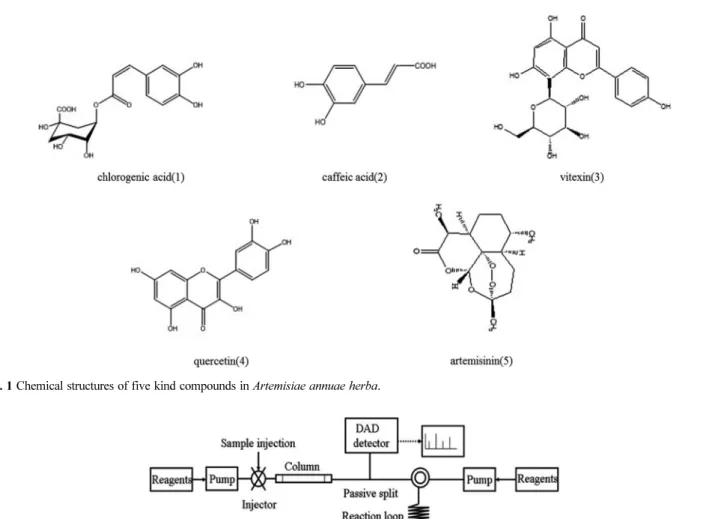
사용하여 완전히 녹인 후, ABTS+시약과 충분히 교반 후 차광 시켰다. 제조된 용액은 1 L 갈색병에 넣고 하루 정도 라디칼의 안정성을 위해 어두운 곳에서 보관한 뒤 사용하였다(Lee 등, 2012). 표준시료는 2 mg을 고순도 메탄올 10 mL를 취하여 200 ppm의 표준원액을 제조하였다. Fig 1에서는 각각의 표준시료 구조식을 나타내었다.
추출 및 전처리(I). 일정한 상온(25oC)에서 수행 하였으며 건조 분쇄된 시료는 푸두믹스(220 W, 1.3 A person Hannil Mixer FM)에서 2 min 동안 분쇄 후 입자를 채 거름(30 µm)으로 분별 하여 시료로 사용하였다. 이후, 청호 건조분말로부터 추출 효율 을 확인하기 위하여 추출시간 변화는 시료 1 g을, 다양한 용매 조성변화는 시료 3 g을, 각각 적용하였다. 각 시료는 200 mL 비 이커에 추출용매 50% 수용성 메탄올, 100% 메탄올, 100% 물 을 각각 100 mL를 첨가하여 침적방법(dipping)을 적용하여 추 출시간 1−6 h동안 2회 반복 실험을 시행하여 물질의 변화를 확 인하였다. 추출물에는 많은 양의 불순물들이 포함되어 있기 때 문에 용매추출 후 여지필터(pore size: 5 µm)에서 감압 여과하 여 시료 잔유물과 분리시켰고 이후 감압 농축 후 동결건조 (refrigerated vapor trap)를 하여 전체 추출 수율 계산과 시험용 액으로 사용 하였다.
추출 및 전처리(II). 청호 건조시료 50 g을 샘플의 10배 부피로 물에 1 h 동안 침적한 다음 3 h 동안 100oC에서 열탕 추출 (Gyeongseo, Cosmos-660, Korea) 하였다. 추출된 추출물은 standard testing sieve (150µm, Rs-tech, Germany)로 여과 후 동결 건조 하였다. 제조된 시료는 4oC에 냉장 보관하여 실험에 사용하였다. 이후 소량의 시료를 0.2 µm PVDF Membrane filter로 여과하여 on-line screening HPLC-ABTS+ assay 분석에 사용하였다.
On-line system 기기. on-line HPLC시스템으로는 Dionex Co.
(USA)의 3000 pump와 injector는 10 µL sample loop (Dionex Co, ID ×0.18 L ×550 mm Viper 550 mm, USA)가 연결되었고, 데이터 처리는 Dionex Co.의 PC에 설치된 Chromeleon data acquisition system (Dionex version 7)과 HPLC-DAD를 사용 하여 분석을 하였다. Fig 2에서는 on-line screening HPLC- ABTS+ assay 시스템을 나타내었다. 분석에 사용된 컬럼은(RS- Tech 4.6×250 mm, 5µm, C18, Korea)와 유속은 1.0 mL/min, 주입부피는 10 µL, 컬럼오븐 온도 40oC로 고정하였다. UV 검 출기(DAD; diode array detector)의 파장범위를 200−450 nm로 적용하여 210, 254, 280, 320 nm로 검출하였고, 항산화 활성은 (MWD; multiple wavelength detector)의 734 nm로 나타내었다.
Fig. 1 Chemical structures of five kind compounds in Artemisiae annuae herba.
Fig. 2 Schematic of on-line screening HPLC-ABTS+ assay system.
이동상은 이성분계 A: H2O/TFA (99.9/0.1 v/v%), B: Acetonitrile (100 v/v%)을 사용하여 (A:B 90-30:10-70 v/v%)으로 60 min 동안 일정용매조성법으로 실험하였다. 본 연구는 청호의 지표성 분인 chlorogenic acid, caffeic acid, vitexin, queretin, aremisinin
를 선정하였고 추출 거동을 확인하기 위하여 침적추출(dipping) 을 적용한 추출용매 50% 수용성 메탄올, 100% 메탄올, 100%
물의 조건을 설정하였다. 이것의 각 추출물에서 얻은 지표성분 (표준물질; 순도: 98%>)과 추출물의 빠른 항산화 활성이 확인 되었고 각 추출물의 함량과 수율을 분석하여 기능성소재로 사 용이 가능한 기초 자료를 제시하였다. Fig. 3에서는 청호 시료 1 g에서 최적의 추출조건을 확립하기 위하여 침적방법(dipping) 을 적용한 상온(25oC)에서 추출용매 100% 물, 추출시간 1−6 h 동안 수행하였다. 이때 수분(10.3%)이 함유되었다. 이 결과 최 적의 추출 시간은 3 h으로 선정하였고 4 h 이후부터는 완만한 추출 거동 및 미미한 수율(%) 변화를 보였다. 일반적으로 천연 물 및 한약재에서의 추출은 물질이 가지고 있는 조직적 특성 및 성상에 따라 재배 특성에 따라 추출 시스템에 따라 추출 효 율의 차이가 클 것으로 보인다(Hazra, 등 2004). Table 1에서는 청호 시료 3 g에서 추출용매 선정에 따른 추출 효율을 확인하 였다. 용매조성 변화에 따라 추출수율(yield)의 변화는 50% 수 용성 메탄올 추출물에서 14.883%, 100% 메탄올 추출물에서 7.430%, 100% 물 추출물에서 15.250%의 추출 거동을 확인 할 수 있었다(선행 실험 Fig. 3). 또한 추출물 함량은 50% 수용성 Fig. 3 Total extraction amount with various extraction time (extraction
solvent: 100% water, room temperature: 25oC, extraction method:
dipping, loading amount: 1 g).
Table 1 Extraction amount and yield in Artemisiae annuae herba with extraction time (3 h) and dipping method (25)
No Extraction solvent (%) Total extract amount (g) Dry sample weight (g) Yield (%)
1 50% MeOH (1) 0.459
3 14.883
2 50% MeOH (2) 0.434
3 100% MeOH (1) 0.227
3 7.430
4 100% MeOH (2) 0.219
5 100% Water (1) 0.460
3 15.250
6 100% Water (2) 0.455
Table 2 Antioxidant activity identification of each extract and standard sample in Artemisiae annuae herba No Dissolve solvent (%) Standard compounds name tR
(min)
Positive peak area (mAU)
Negative peak area (mAU)
UV (nm)
1 50%
MeOH
chlorogenic acid 9.670 71.818 23.769 320
quercetin - - - 254
caffeic acid 11.837 28.126 13.550 320
artemisinin - - - 254
vitexin 15.153 5.305 - 210
2 100% MeOH
chlorogenic acid 9.677 23.927 9.581 320
quercetin - - - 254
caffeic acid 11.813 24.530 11.827 320
artemisinin - - - 254
vitexin 15.017 9.931 - 210
3 100% Water
chlorogenic acid 9.670 115.736 32.780 320
quercetin - - - 254
caffeic acid 11.853 29.708 12.911 320
artemisinin - - - 254
vitexin 15.170 5.507 - 210
4 100% MeOH
(standard compounds)
chlorogenic acid 9.757 56.705 25.070 320
quercetin 24.757 122.167 77.333 254
caffeic acid 11.760 172.290 65.355 320
artemisinin 44.463 1.437 - 254
vitexin 15.180 120.676 - 210
N.D. (-): not detected, chlorogenic acid (1), caffeic acid (2), vitexin (3), quercetin (4), aremisinin (5).
메탄올 추출물에서 0.459−0.434 g과 평균 0.4465 g, 100% 메탄 올 추출물에서 0.227−0.210 g과 평균 0.218 g, 100% 물 추출물 에서 0.460−0.455 g과 평균 0.4575 g을 얻을 수 있었다. 따라서 100% 물 추출물의 추출효율이 가장 좋왔고 100% 메탄올 추출 물의 추출효율이 가장 낮았다. Table 2에서는 5가지 지표성분에 대하여 각각 200 ppm으로 제조한 뒤 빠른 항산화 활성 능력을 on-line screening HPLC-ABTS+ assay 시스템으로 살펴보았다.
이 결과 chlorogenic acid, queretin, caffeic acid에서 항산화 활성을 확인하였고 aremisinin, vitexin에서는 항산화 활성을 확 인하지 못했다. 이때 queretin (Negative peak area (mAU) 77.333) > caffeic acid (Negative peak area (mAU) 65.355) >
chlorogenic acid (Negative peak area (mAU) 25.070) 순으로 활성도가 높았다. 또한 추출 시료의 양이 증가된 50 g을 100%
물 추출(수율: 8.34%)에서 확보된 시료를 50 mg/mL로 제조하 여 분석하였다. 결과적으로 각 지표성분의 항산화 활성은 50%
수용성 메탄올에서는 chlorogenic acid (1, Negative peak area (mAU) 23.769) > caffeic acid (2, Negative peak area (mAU) 13.550)의 활성을 보였고, 100% 메탄올에서는 caffeic acid (2, Negative peak area (mAU) 11.827) > chlorogenic acid (1,
Negative peak area (mAU) 9.581)의 활성을 보였으며, 100%
물에서는 chlorogenic acid (1, Negative peak area (mAU) 32.780) > caffeic acid (2, Negative peak area (mAU) 12.911) 의 활성을 나타내었다. 하지만, vitexin은 소량 함유 되었을 것 으로 사료되며 매우 미미한 활성을 예측 할 수 있었다(본 연구 에서는 제시 하지 않았다). 또한 queretin과 aremisinin은 청호 추출물에서 확인 할 수 없었다. 특히 artemisinin은 UV를 흡수 하는 chromophore가 없어서 254 및 320 nm 파장에서 검출 하 기가 힘들다. 이때 물질 사이의 각 체류시간(tR)은 chlorogenic acid 9.757 min, caffeic acid 11.760 min, vitexin 15.180 min, queretin 24.757 min, aremisinin 44.463 min이였다. 이 결과를 기초로 하여 항산화 활성 screening 시스템을 이용한 동시분석 과 항산화 활성 확인이 탁월한 on-line screening HPLC-ABTS+ assay를 적용한 크로마토그램 결과를 Fig. 4에서 보여주고 있다.
특히 선행연구(Lee 등, 2012)를 기초로 한 빠른 항산화 활성 능 력을 screening 할 수 있었다. 따라서 추출 효율 및 항산화 활 성은 추출 방법에 따라 다양한 각도에서 확인되어 빛, 열에 불 안정 성분을 얻기 위한 안정한 추출 방법을 찾아야 할 것이다 (Lee, 등 2008; Inoue, 등 2011; Song, 등, 2013). 또한 활성산 소(free radical oxygen radical)에 기인하여 추출 과정 중 유용 성분이 소멸되거나 유용성분의 함유되는 정도는 매우 큰 차이 가 있을 것으로 사료된다(Ridder, 등 2008). 이 결과 산업적 경 제성을 고려한 고효율 고비용의 추출조건이 제조공정 특성에 맞 게 제시 되어야 할 것이며 나아가 기초 데이터의 사용은 공학 적 기반을 기초로 한 수학적 모델링을 통해 산업적 적용을 예 측해야 될 것으로 사료된다. 뿐만 아니라 전 처리한 추출액에 포함된 청호로부터 on-line screening HPLC-ABTS+ assay를 이 용한 항산화 활성을 빠르게 screening하여 탐색하고 최적의 추 출조건을 실험적으로 모색 할 수 있었다.
초 록
On-line screening high performance liquid chromatography (HPLC)- ABTS+ assay를 이용한 청호로부터 chlorogenic acid, caffeic acid, vitexin, queretin, aremisinin의 항산화 활성을 온라인스크 리닝 하였다. 이때 침적방법을 적용한 추출시간과 추출용매 조 성으로부터 추출효율을 확인하였다. 이 결과 100% 물 추출물 에서 수율이 가장 좋왔고 chloroenic acid의 항산화 활성이 가 장 높았다. 또한 on-line screening HPLC-ABTS+ assay 분석은 천연물에서 항산화 활성을 신속하게 탐색하는데 효율적이다.
Keywords 분석·온라인스크리닝 HPLC·청호·추출 감사의 글 본 연구는 한국한의학연구원 연구지원(K14050)에 의하여 수행 되었으며 이에 감사 드립니다.
References
Hazra B, Sarma MD, and Sanyal U (2004) Separation methods of quinonoid constituents of plants used in Oriental traditional medicines. J of Chroma B 812, 259–75.
Inoue K, Kitade M, Hino T, and Oka H (2011) Screening assay of angiotensin-converting enzyme inhibitory activity from complex natural colourants and foods using high-throughput LC-MS/MS. F Chemistry 126, 1909–15.
Fig. 4 Analysis of five kind compound in Artemisiae annuae herba using on-line screening HPLC-ABTS+ assay(chlorogenic acid (1), caffeic acid (2), vitexin (3), quercetin (4), aremisinin (5), injection volume: 10µL, positive UV wavelength: 320 nm, negative wavelength: 734 nm, mobile phase A: 0.1% TFA in water 90-30%, B: acetonitrile 10-70%, run time 60 min, positive-flow rate: 1 mL/min, negative-flow rate: 0.5 mL/min).
Jung HA, Nurul Islam MD, Kwon YS, Jin SE, Son YK, Park JJ et al. (2011) Extraction and identification of three major aldose reductase inhibitors from Artemisia montana. F and Chemical Toxi 49, 376–84.
Kim KS, Lee SH, Lee YS, Jung SH, Park YM, Shin KH et al. (2003) Anti- oxidant activities of the extracts from the herbs of Artemisia apiacea. J of Ethnoph 85, 69–72.
Kim KS, Lee SH, Shin JS, Shim SH, and Kim BK (2002) Arteminin, a new coumarin from Artemisia apiacea. Fitoterapia 73, 266–8.
Kim KS, Shim SH, Jang JM, Cheong JH, and Kim BK (1999) A Study on Hair-growth Activity of Artemisia apiacea Hance. Yakhak Hoeji 43, 798–01.
Kim OC and Jang HJ (1994) Volatile components of Artemisia apiacea Herba. Agr Chemistry and Biot 37, 37–42.
Lee KJ and Um BH (2008) Extraction of Useful component from Natural
plants using Ultrasound system. Korean J Biotechnol Bioeng 23, 101–8.
Lee KJ, Liang C, Yang HJ, and Ma JY (2012) Rapid Identification of Homoorientin from Phyllostachys bambusoides Leaves by HPLC On- line ABTS+ Screening Method. Yakhak Hoeji 56, 217–21.
Lee KJ, Shin YK, and Kim YS (2009) Enhanced effect extraction of Antioxidant substance Homoorientin from Pseudosasa japonica and Phyllostachys bambusoides leaves using Ultrasonic wave system.
Korean J Biotechnol Bioeng 24, 189–94.
Ridder SD, Kooy FVD, and Verpoorte R (2008) Artemisia annua as a self- reliant treatment for malaria in developing countries- Review. J of Ethnopharmacology 120, 302–14.
Song XY, Li YD, Shi YP, Ling J, and Chen J (2013) Quality control of traditional Chinese medicines: a review. Chinese J of Nat Medi 11, 596–
607.