Vol. 18, No. 1 pp. 256-261, 2017
Temperature and length of cold storage affect the Quality Maintenance of fresh kiwifruit
(Actinidia chinensis Planch)
Yong-Joon Yang
1*, Byung-Seon Lim
21Department of Plant and Food Science, Sangmyung University
2Postharvest Research division, National Institute of Horticultural & Herbal Science, RDA
저온저장 온도 및 저장기간이 키위 “골드”의 품질 유지에 미치는 효과
양용준1*, 임병선2
1상명대학교 식물식품공학과
2농촌진흥청 국립원예특작과학원 저장유통과
Abstract The effects of temperature and length of cold storage on the quality maintenance of fresh "Gold" kiwifruit were investigated. Physio-chemical properties were analyzed in kiwifruit held at 2°C and 6°C temperatures compared to fruit at room temperature (20~28°C) during 8 weeks of storage. Low temperatures (2°C and 6°C) significantly delayed softening and soluble solids content (SSC) accumulation compared to higher temperature (20~28°C).
Physico-chemical properties of fruits, including weight losses, firmness, SSC, titratable acidity (TA), SSC/TA ratio, and flesh color properties were monitored during storage. Fast firmness loss was detected in fruit stored at higher temperatures compared to low temperature (2°C). Similar results were observed for acidity according to storage temperature and length of cold storage, whereas SSC increased to the limited values (%Brix) during storage. The soluble solids content (SSC) increased markedly during the first 60 days of storage and remained almost constant thereafter for all treatments. SSC accumulation rates decreased from 5 weeks after storage probably due to differences between initial and ripe kiwifruits, and SSC decreased with each passing week due to natural starch conversion over time. The SSC/acid ratio increased from 18 to 27 until 5 weeks after storage and then slowly declined in all kiwifruit stored at different low temperatures. Sensory evaluation results showed no differences in kiwifruit flesh color stored at two storage temperatures of 2°C and 6°C.
요 약 본 연구는 키위 과일의 수출 시 최적 수송온도를 구명하기 위하여 같은 수송조건을 설정한 시물레이션실험을 수행하 였다. 수송온도로 2oC와 6oC 조건을 설정하고 이와 비교한 실험군으로 변온조건으로 상온(20~28°C)을 두어 과실의 여러 물리화학적 변화를 조사하였다. 과실의 경도는 2°C에서 가장 높게 유지되었고 이와 유기산 함량의 유지에서도 같은 결과였 다. 가용성 당함량은 저온 저장 5주까지 완만히 증가하다가 그 이후 감소하기 시작하였는데 저온 처리간 차이는 크지 않았 다. 이에 비하여 상온에서의 가용성 당함량은 저장 3주후에 과실이 부패하여 측정이 불가능하였다. 키위 과실의 당산비는 저온저장 5주 까지 18에서 27까지 크게 증가하여 과실의 품질이 크게 향상되다가 그 이후 감소하기 시작하였다. 이 결과로 키위는 전형적인 수확 후 호흡급등형 과실의 패턴을 보였고 저온처리 간에는 차이가 크지 않았다. 관능검사를 통하여 저장 중인 키위 과육의 색을 조사한 결과, 저온처리(2°C와 6°C)에서 차이가 크지 않았다.
Keywords : kiwifruit, Physicochemical properties, quality, storage, export, transport temperature
This study was carried out with the support of “Cooperative Research Program for Agricultural Science & Technology Development (Project No. PJ011699)”, RDA Republic of Korea
*Corresponding Author : Yong-Joon Yang(Sangmyung University) Tel: +82-10-4756-5290 email: [email protected]
Received November 7, 2016 Accepted January 6, 2017
Revised (1st November 30, 2016, 2nd December 15, 2016, 3rd December 29, 2016) Published January 31, 2017
1. Introduction
Kiwifruit are climacteric fruit which can be successfully stored at 0oC for 4 to 6 months but soften markedly when exposed to even minute (i.e. 0.01 µl L−1) concentrations of ethylene[1]. Kiwifruit handlers and researchers have focused on ways of maintaining firmness during storage primarily through rigorous low temperature(0oC) management, ethylene exclusion and use of controlled atmospheres[2].
The right moment for harvesting kiwis can best be determined by measuring refraction because this corresponds to ripeness and eating quality (in contrast to colour and firmness). In New Zealand, they apply a minimum refraction level of 6.2%; fruits below this level are not good for storing and are less tasty when ripe. A higher level of 7-9% is advised if long-term storage is to take place.
The relative importance of each quality component depends upon the commodity and its intended use (e.g., fresh or processed) and varies among producers, handlers, and consumers. To producers a given commodity must have high yield and good appearance, must be easy to harvest, and must withstand long-distance shipping to markets[3].
Most consumers prefer to purchase kiwifruit that are near ripe ("ready to eat"). To ensure good tasting,
"ready to eat" fruit, kiwifruit should be ripened at any step during postharvest handling before consumer consumption. This is essential for early season, freshly harvested kiwifruit.
Water loss(shriveling) had been identified as the most significant cause of commercial loss in kiwi fruit[4]. By 3~4 percent water loss, fruit may appear shriveled symptoms mainly in stem end of fruit.
Kiwifruit firmness is defined as the force necessary to break the flesh tissues and it is related to different ripening stages.
Crisosto et al. found that a combination of initial SSC content at harvest and flesh firmness seemed to be a maturity index for kiwifruit[5]. According to them, flesh firmness is the parameter of greater concern in
kiwifruit storage and marketing, because flesh softening is associated with senescence and fruit injuries. Although firmness does not apply as an index of harvest time, it is considered as an excellent criterion for assessing the optimum time to interrupt the conservation of the fruit.
Extremely sensitive to ethylene and susceptible to decay-causing pathogens, kiwi fruit are at risk for quality degradation from the moment they are harvested and become even more prone to post-harvest decay as they ripen and soften. Controlled atmosphere (CA) technologies prevent mold growth, and fungicidal treatments can limit market opportunities[6].
The optimum storage conditions for kiwis depend on the variety, harvesting moment, region, location of orchard and cultivation conditions. Moreover, postharvest life and quality of kiwifruit can also be extended by some other techniques in combination with cool storage. During cold storage and ripening, kiwifruit undergo biochemical changes including conversion of starch to sugar, changes in cell wall constituents and production of characteristic volatiles which lead to the taste, texture and aroma desired by consumers[7]. The rate of kiwifruit softening is affected by time, temperature, exogenous ethylene levels and maturity of the fruit[8,9].
The aims of this study was to determine the effect of storage temperature and length on the quality maintenance of fresh “Gold” kiwifruit (Actinidia chinensis Planch)
2. Materials and Methods
Kiwifruit “Zespri” Gold were purchased at the maturity stage(SSC=14%) from a local market in Cheonan/Korea. Medium sized (between 90 and 130 g) golden kiwifruit without visible defects or decay were used for all experiments. Fruits were subsequently transferred to laboratory and sorted based on size and the absence of physical injuries or infections.
Fruits were randomly divided into several groups,
each group containing 120 fruits in three replicates.
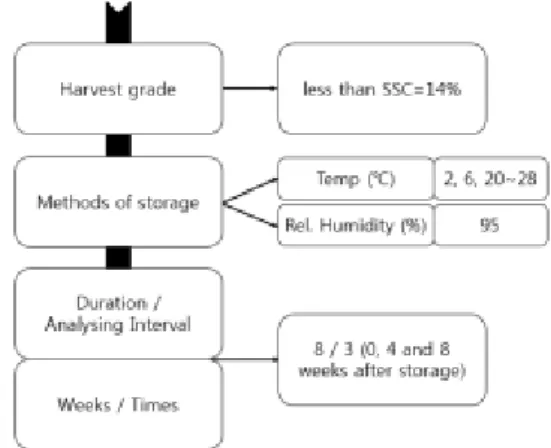
Fruits were then stored at 2oC (Low temperature, LT), 6oC (Low temperature, LT), and 20~28oC (Room temperature, RT). The relative humidity was modified at the range of 95%±2 for two months. After 1 and 2 months storage, 15 fruits per treatment were taken from cool storage for fruit quality assessment(Fig 1).
Fig. 1. Experiment methods for extending freshness of fresh kiwis
Kiwifruit firmness was determined by measuring compression using a hand-held Effegi penetrometer with a 7.9 mm probe after removal of skin to a vertical depth of 1 mm on two sides of the fruit. The firmness considered as an average peak force of 10 fruits and expressed as kg/7.9 mm2. Moreover, 10 fruits per replicate were weighed at the beginning of storage and throughout storage period to calculate weigh loss percentage.
Titratable acidity was determined using 5 ml of fruit puree from five fruits mixed with 25 ml of distilled water, with two drops of phenolphthalein (1%) as indicator, titrated with 0.1 N NaOH to an endpoint pink (pH 8.2). The results were expressed as percent anhydrous citric acid since it is the dominant acid in kiwifruit.
Total soluble solids(SSC)(% Brix) were measured by a digital refractometer, model R1-Atago, Japan, in juice from the equatorial zone of the fruit.
The ANOVA of mixed design using SPSS(Version
18.0) for Windows(SPSS Inc.) was performed to investigate the effect of storage temperatures and duration on fresh weight, firmness, SSC, acidity and SSC/acidity ratio in “Gold” kiwifruit. All treatments including RT were analysed until 2~3 weeks of storage and both treatments LT(2℃) and (6℃) until 8 weeks.
3. Result and Discussion
Kiwifruit is a climacteric fruit with a long post-harvest life in cool storage. Moreover, postharvest life and quality of kiwifruit can also be extended by some other techniques in combination with cool storage. Most consumers prefer to purchase kiwifruit that are near ripe ("ready to at"). To ensure good tasting, "ready to eat" fruit, kiwifruit should be ripened at any step during postharvest handling before consumer consumption[10]. The loss of weight in fresh fruit is mainly due to the loss of water caused by transpiration, respiration and Vapour pressure difference(VPD) between fresh produce and surrounding air. Kiwifruit “Gold” stored at two different temperatures prevented weight loss in comparison with control(Fig.
2). The ANOVA of mixed design showed the statistically difference among storage temperatures and duration on fresh weight. The most loss of fresh weight was found in RT treatment during storage of 3 weeks while two treatments of LT showed no difference during
Fig. 2. Fresh weight loss(%) of freshly-harvested “Gold”
kiwifruit stored at different temperarures.
RT-Room temperature, LT-Low temperature.
The Vertical bars represent standard error
storage until 8 weeks in “Gold” kiwifruit. Water loss(shriveling) had been identified as the most significant cause of commercial loss in kiwifruit[11].
Softening increased generally as storage temperature and time increased. Flesh firmness is the best indicator of kiwifruit ripening and predictor of shelf life.
Maintaining of firmness after harvest is the most important factor that determines storage-life and final kiwifruit quality. Fast firmness loss was found in the kiwifruit stored at higher temperatures compared to the low temperature(2oC)(Fig 3). The storage temperatures and duration affected the most loss of fruit firmness in RT until 3 weeks of storage as the results of the ANOVA. The firmness was a little decreased also in LT treatments however LT(2℃) maintained the firmness statistically longer than LT(6℃) in “Gold”
kiwifruit. After 60 days in storage, kiwifruit had lost about 70% of their initial firmness during cold storage.
A combination of initial SSC content at harvest and flesh firmness seemed to be a maturity index for kiwifruit[12]. According to many reports, flesh firmness is the parameter of greater concern in kiwifruit storage and marketing, because flesh softening is associated with senescence due to respiration.
Fig. 3. Flesh firmness of freshly-harvested “Gold”
kiwifruit stored at different temperarures.
RT-Room temperature, LT-Low temperature.
The vertical bars represent standard error
Total soluble solids content of fruits during storage is considered an index of fruit ripening and an increase in SSC(%) corresponds to a conversion of starch to soluble sugars[13]. The SSC accumulation rates decreased over time probably because the differences
between initial and ripe SSC decreased with each passing week due to natural starch conversion over time (Fig. 4). Kiwifruit softened and accumulated SSC much faster when ripened at 20~28 than at 2 and 6oC.
The most loss of SSC was found in RT treatment until 3 weeks storage and the SSC content accumulated until 5 weeks storage and thereafter sharply decreased. The SSC content of “Gold” kiwifruit was higher statistically in a LT(6℃) compared to other treatments. This had the greatest impact on fruit softening and SSC accumulation compared to either precooling or treatment temperatures.
Fig. 4. SSC(%) of freshly-harvested “Gold” kiwifruit stored at different temperarures. RT-Room temperature, LT-Low temperature. The vertical bars represent standard error
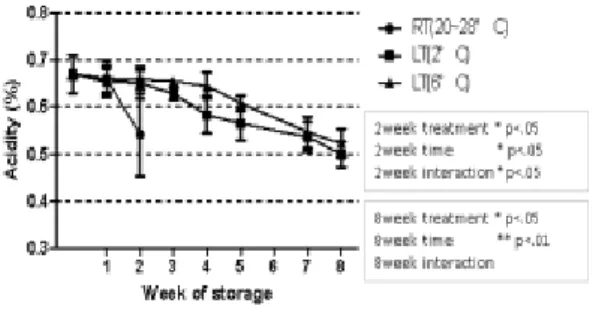
As with the rate of softening, the rate of SSC accumulation was greatest in the low temperature(6oC) while fruit stored in room temperature became decayed after 2 weeks. Similar results(Fig. 5) showed in acidity in according to the storage temperature and length of cold storage while SSC were increased to the limited values(oBrix) during storage. The acid concentrations remained constant in two LT treatments until 4 weeks of storage in “Gold” kiwifruit and thereafter slowly declined due to ripening while RT treated fruit showed a rapid decrease of acids directly after storage to the 2 weeks. Similar results have also been reported by Fattahi(2010) on salicylic acid dipping kiwifruits. The acidity content was higher statistically in a LT(6℃) compared to the LT(2℃) in “Gold” kiwifruit.
Fig. 5. Acidity(%) of freshly-harvested “Gold” kiwifruit stored at different temperarures. RT-Room temperature, LT-Low temperature. The vertical bars represent standard error
The SSC/Acid ratio have been increased from 18 to 27 until 5 weeks after storage and then slowly declined in all kiwifruit stored in different low temperatures(Fig.
6). However the ANOVA of mixed design showed no statistically difference of SSC/Acid ratio among storage temperatures and duration during 8 weeks storage of
“Gold” kiwifruit.
As shown in Fig. 6, the rapid deterioration were found in kiwifruit stored at 20~28oC for less than 1 month. Overall appearance of kiwi fruit fresh of kiwifruit stored at two low temperatures(2oC and 6oC) were better maintained when which compared to the higher temperature (20~28oC). Flesh color is used as the index of maturity for kiwi, apricot, peach and persimmon fruit.
Fig. 6. The rate of freshly-harvested “Gold” kiwifruit stored at different temperarures. RT-Room temperature, LT-Low temperature. The vertical bars represent standard error
In general, kiwifruit should always be kept at low temperatures below 7.5oC and enclosed with storage
liners, except if they are going to be consumed within 3 days[14].
Fig. 7. Overall appearance of kiwi fruit fresh of “Gold”
kiwifruit stored at different temperarures (Upper:20~28oC, Middle:2oC, Lower:6oC)
Fruit visual quality has been correlated with various physical attributes like fruit skin color, flesh color, firmness, fruit shape and size(Fig 7). Most studies on changes in green color due to time and temperature treatments only mention a decrease of green color[15].
Maintaining the natural color in processed and stored fruits has been a major challenge to enhance fruits quality. The best kiwi flesh color was observed in 2oC after 2 months storage[16]. The results showed that best of the sea transport and storage temperature was the low temperature(2oC) for kiwifruit, but there should be considered the temperature difference between the sea transport container and outside air for preventing condensing after the door. The temperature setting during treatment and shipment should be adjusted according to the anticipated consumption schedule.
References
[1] F. G. Mitchell. Postharvest physiology and technology of kiwifruit. Acta Hortic, vol. 282, pp. 291-307, 1990.
DOI: https://doi.org/10.17660/ActaHortic.1990.282.37 [2] J. Fattahi. Postharvest Quality of Kiwifruit affected by
Pre-storage application of Salicylic acid. South west J Hortic Biol Environ South Western Journal of Horticulture, Biology and Environment, pp. 2067-2068.
2010.
[3] M. A. Ritenour, C. H. Crisosto, D. T. Cheng, J. P.
Zoffoli. Temperature, length of cold storage and maturity
influence the ripening rate of ethylene- preconditioned kiwifruit. Postharvest Biol. Technol. vol. 15, pp.
107-115, 1999.
DOI: https://doi.org/10.1016/S0925-5214(98)00074-X [4] M. E. Saltveit. Effect of ethylene on quality of fresh
fruits and vegetables. Postharvest Biology and Technology, vol. 15, pp. 279-292, 1999.
DOI: https://doi.org/10.1016/S0925-5214(98)00091-X [5] G. U. Crisosto, G. F. Mitchell, M. L, Arpaia, G. Mayer.
The effect of growing location and harvest maturity on the storage performance and quality of ``Hayward'' kiwifruit. J. Amer. Soc. Hort. Sci, vol. 109, no. 4, pp.
584-587, 1984.
[6] P. Latocha, T. Krupa, P. Jankowski, J. Radzanowska.
Changes in postharvest physicochemical and sensory characteristics of hardy kiwifruit after cold storage under normal versus controlled atmosphere. Postharvest Biology and Technology, vol. 88, pp. 21-33, 2014.
DOI: https://doi.org/10.1016/j.postharvbio.2013.09.005 [7] J. P. Zoffoli. Temperature, length of cold storage and
maturity influence the ripening rate of ethylene- preconditioned kiwifruit. Postharvest Biology and Technology vol. 15, pp. 107-115, 1999.
DOI: https://doi.org/10.1016/S0925-5214(98)00074-X [8] Y. S. Park, M. H. Im, J. H. Choi, S. H. Yim, H.
Leontowicz, M. Leontowicz, M. Suhaj, S. Gorinstein.
The effects of ethylene treatment on the bioactivity of conventional and organic growing ‘Hayward’ kiwi fruit.Scientia Horticulturae, vol. 164, pp. 589-595, 2013.
DOI: https://doi.org/10.1016/j.scienta.2013.10.016 [9] Y. S. Park, K. S. Ham, Y. K. Park, H. Leontowicz, M.
Leontowicz, J. Namiesnik, E. Katrich, S. Gorinstein. The effects of treatment on quality parameters of smoothie-type ‘Hayward’ kiwi fruit beverages. Food Control, vol. 70, pp. 221-228, 2016.
DOI: https://doi.org/10.1016/j.foodcont.2016.05.046 [10] A. A. Kader. Fruit maturity, ripening, and quality
relationships. Acta Hort. 485. ISHS. pp. 203-208, 1999.
[11] J. M. Harvey, C. Harris, M. Msarousky. Transit temperatures and quality maintenance in export shipments of kiwifruit. International Journal of Refrigeration. vol. 6, no. 4, pp. 219-224, 1983.
DOI: https://doi.org/10.1016/0140-7007(83)90078-6 [12] J. M. Harvey, C. M. Harris. In-storage softening of kiwi
fruit: effects of delayed cooling. International Journal of Refrigeration. vol. 9, no. 6, pp. 352-356, 1986.
DOI: https://doi.org/10.1016/0140-7007(86)90007-1 [13] E. A. MacRae, N. Lallu, A. N. Searle, J. Bowen.
Changes in the softening and composition of kiwifruit (Actinidia deliciosa) affected by maturity at harvest and postharvest treatments. J. Sci. Food Agric. vol. 49, pp.
413-430, 1989.
DOI: https://doi.org/10.1002/jsfa.2740490404
[14] A. Y. Lee. Postharvest Characteristics of Golden Kiwifruit and Storability as influenced by pre- and postharvest treatments. Master of Agricultural Science Thesis. Chungnam National University. 2015.
[15] S. Kim, S. H. Han, J. Kim, H. J. Lee, J. G. Lee, E. J.
Lee. Inhibition of hardy kiwifruit ripening by 1-methylcyclopropene during cold storage abd anticancer
properties of the fruit extract. Food Chemistry. vol. 190, pp. 150-157, 2016.
DOI: https://doi.org/10.1016/j.foodchem.2015.05.085 [16] B. S. Lim, J. S. Lee, S. Y. In, H. J. Park, Y. J. Yang.
Effects of Ethylene Treatment on Postharvest Quality of Kiwi fruit. J. Agr. Sci. Chungbuk. Nat’l Univ. vol. 31, no. 2 pp. 114-118, 2015.
Yong-Joon Yang [Regular member]
•Mar. 1988 ~ current : Department of Plant and Food Science, Sangmyung University
<Research Interests>
freshness, postharvest, controlled atmosphere storage
Byeong-Seon Im [Regular member]
•Jan. 1992 ~ current : Postharvest Research division, National Institute of Horticultural & Herbal Science, RDA, Korea
<Research Interests>
ethylene, postharvest, precooling