c Korean Medical Association
This is an Open Access article distributed under the terms of the Creative Commons Attribution Non-Commercial License (http://creativecommons.
의약분업 정책지지도와 지역주의
신 의 철1·이 창 우2*·김 진 경3·김 광 점4 | 1가톨릭대학교 의과대학 예방의학교실, 2보험연구원, 3건양대학교 병원관리학과,
4가톨릭대학교 의료경영대학원
Patient satisfaction versus political support: Korea’s drug-dispensing law revisited
Euichul Shin, MD1·Changwoo Lee, PhD2*·Jinkyung Kim, PhD3·Kwang Jum Kim, PhD4
1Department of Preventive Medicine, The Catholic University of Korea College of Medicine, 2Korea Insurance Research Institute, Seoul,
3Department of Hospital Management, Konyang University, Daejeon, 4Graduate School of Healthcare and Policy, The Catholic University of Korea, Seoul, Korea
*Corresponding author: Changwoo Lee, E-mail:[email protected] Received May 4, 2012·Accepted May 19, 2012
I
n 2000, Korea enacted a controversial law prohibiting doctors from dispensing drugs. Doctors have opposed this law, and in theory, the law inconveniences patients. We assessed the relation- ship between patients’ satisfaction with drug dispensation and their overall support for the law by using a logit model to determine the effects of the law on patients and which patients are likely to support the law. We employed random digit dialing and obtained a sample of 540 adults who had used drugs since the law was enacted. We collected the data through phone interviews. The results indicate that the respondents were generally dissatisfied with the law regardless of socio- demographic or regional characteristics. However, with other factors controlled for, those respon- dents from the same region as the ruling political party were significantly more likely to support the law. This implies that regional politics influenced the policymaking process through which the law was crafted and enacted.Keywords: Health policy; Regionalism; Drug dispensation
Introduction
I
n 2000, Korea enacted a law prohibiting doctors from dispensing drugs mainly to prevent the misuse or overuse of drugs, control drug expenditures through appropriate drug use, and improve the quality of health- care services. Before the law, doctors prescribed and dis- pensed drugs through their clinics, and pharmacists could give prescriptions for minor conditions such as colds andmigraines. Pharmacists could dispense dugs without a prescription, including powerful drugs such as antibiotics and steroids. Under the law, only doctors are allowed to prescribe drugs, and prescription drugs are dispensed only through pharmacies. Patients’ complaints about increased medical care costs (i.e., paying for both pres- criptions and drugs) and the inconvenience of visiting both clinics and pharmacies have focused the public’s attention on the effectiveness of the law. Despite the
justifiable objectives of the law, there has been strong opposition from various interest groups, particularly from doctors. Doctors went on strike for months, and many healthcare researchers have questioned the law’s inten- tions [1,2]. These interest groups have paid close atten- tion to various issues surrounding the law, such as increa- ses in healthcare expenditures and patients’ inconveni- ence. They have argued that the law allows large phar- maceutical firms to enter the market, which has tradition- ally favored small pharmacies [3].
Some political scientists have insisted that the Korean government enacted the law to obtain additional sup- port from the public, infringing on vested rights of doc- tors, who have been recognized as a politically power- ful group. They have argued that the law was enacted based on political considerations, not on healthcare implications, although the law has serious healthcare implications. Hwang [4] raised the question of why the law received support from the Dae Jung Kim administ- ration, although it failed to secure sufficient support from previous administrations, and focused on the role of the government and the president in the policymaking pro- cess, whereas most studies have focused on the role of civic groups such as non-governmental organizations [5-11]. This argument provides a new perspective on healthcare policymaking by suggesting that healthcare policies can be implemented by governments driven by political interests, not by professional decisions.
This study addresses three important policy questions from the patients’ perspective: whether patients (con- sumers) are satisfied with the law, whether they support the law, and whether their political alignment influences their satisfaction with and support for the law. For this, the study considers Korea’s regional characteristics to evaluate the effects of political alignment on the policy decision because presidential candidates from specific
regions have historically been elected as presidents. In addition, the study assesses patients’ rational decision on the law by considering their satisfaction with the use of healthcare services.
1. Political background
Korea’s political parties or factions can be geogra- phically divided into Gyeongsang (hereafter “the south- eastern region”), Jeolla (hereafter “the southwestern region”), and others. Today’s political differences stem mainly from the regional background of political parties back in the 1970s. However, these regional differences have a long history, reflecting Korea’s 5,000-year history.
For instance, there were two countries -“Baekje” in the southwestern region and “Silla” in the southeastern region -in ancient times, and a long-standing feud bet- ween them continued until they were united to become
“Unified Silla.” The political party based in the south- eastern region maintained its power by achieving the unification, whereas the southwestern region became politically alienated because it was used as a place of exile. This propensity continues to this day. From 1962 (the start of the industrialization era), three presidents from the southeastern region were consecutively elec- ted, and they intensified the regional divide by priori- tizing certain regions and implementing policies that benefited residents in the southeastern region [12,13].
This continued until the election of president Dae Jung Kim, who was supported mainly by the southwestern region. This reflects Koreans’ tendency to choose presi- dential candidates based on their regional identity, not on their long-term political views [14].
Although the Dae Jung Kim administration assumed office with 95% of the votes from the southwestern region in the 1997 presidential election, its political base was weak in other regions[15]. In that election, 40.3% of
the voters chose Kim, but his opponent received a simi- lar number of votes (38.7%), indicating weak political support for the Kim administration (Table 1). For this reason, the administration pushed various policies in conjunction with progressive civic groups. This was mainly to curb the establishment through participatory democracy, inducing the public and laborers to become more involved in the decision-making process [17]. The drug-dispensing law and the unification of national health insurance were part of Kim’s electoral platform and became the main policies to be implemented.
The drug-dispensing law was a key policy enabled by support from progressive civic groups, which made efforts to fortify their organizational competency and increase their political leverage by participating in the policymaking process [8-11,18]. In other words, the government, the ruling party, and civic groups were united in favor of the law, whereas healthcare profes- sionals, particularly doctors, were against of it. Progre- ssive civic groups supported the law to expand their political power, and doctors opposed it, claiming that it would worsen patients’ access to medicine [9-11]. How- ever, the government pushed ahead, despite three strikes in June 2000, which involved more than 70% of all hospitals and clinics.
The law provoked intense conflicts between the two stakeholders and has been constantly criticized as a failure since its implementation. A policy assessment
executed by a National Assembly member a year after the enactment of the law suggested that the misuse and overuse of drugs actually increased under the law [19]. In addition, a public survey showed that most Koreans complained about the inconvenience of the law [20,21].
In 2010, a decade since the enactment of the law, scho- lars, National Assembly members, and even the govern- ment called for a reevaluation of the law. Recently, it has been contended that the separation of prescription and dispensation should be terminated because the law has failed to achieve its original goals [22].
Some, particularly doctors, have believed that the law was enacted mainly for pursuing political interests, not for improving the healthcare system. Therefore, this study examines the effects of political interests on the policymaking process for the law by using survey data on drug use and political preferences after the law was enacted.
Data and Descriptive Statistics
By using random digit dialing, we obtained a random sample of 540 Korean adults (age>19) who used health- care services and prescription drugs after the enactment of the law and interviewed them by telephone in March 2002 to obtain data.
The data focused on the respondents’ selection and use of healthcare services (including prescription drugs), their level of satisfaction with healthcare services and drug dispensation under the law, and their willingness to support the drug dispensing law. We evaluated the res- pondents’ satisfaction with the law by using a five-point Likert-type scale ranging from “very dissatisfied” (1) to
“very satisfied” (5). We determined their support for the law by asking whether they supported it. In addition, we obtained data on their sociodemographic charac- Table 1. Votes for presidential candidate Dae Jung Kim by region
% National capital region (Seoul)
Southeastern region Southwestern region Western region Eastern region
42.0 13.5 94.5 44.0 23.7 From Dong-A Daily. Votes for presidential candidates. 1997 Dec 20 [16].
teristics, including their age, gender, education level, occupation, monthly income, and place of residence.
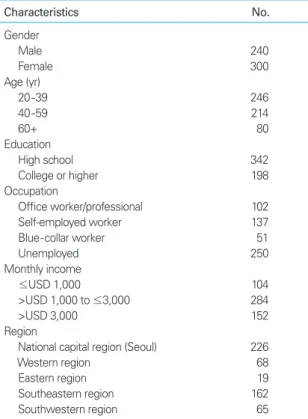
Table 2 shows the characteristics of the respondents.
Among the 540 respondents, 44% were male; 46% were between the ages of 20 and 39; 53% had a monthly income between USD 1,000 and USD 3,000; and 42%
and 30% lived in Seoul and the southeastern region, respectively. Their characteristics generally reflect those of the general population in terms of their age, gender, and place of residence.
Methods
We analyzed the relationship between the respon- dents’ support for/satisfaction with the law and their sociodemographic characteristics by using the χ2
statistic. To examine the causal relationship between their political alignment and support for the law, we employed a logit model by controlling for their socio- demographic characteristics and satisfaction with the law. We used the place of residence as a proxy for poli- tical supports to capture the effects of the respondents’
political alignment on their support for the law.
We used a bivariate probit model to check the ro- bustness of the results. Even if patients’ satisfaction with and support for a healthcare law may be correlated, it is often difficult to find theoretical or empirical evidence of the causal relationship between these two variables.
In this regard, the bivariate probit model has several useful features, including the consideration of the corre- lation between patients’ satisfaction with and support for the law through a regression. In this study, we con-
sidered the following bivariate probit model:
where y1* denotes a latent variable for the patient’s support for the law and is coded as 1 if the patient sup- ports the law and 0 otherwise; y2* is a latent variable for the patient’s satisfaction with the law and is coded as 1 if the patient is satisfied with the law and 0 otherwise; the error terms in the two equations are assumed to be corre- lated; and ρ represents the correlation between the pa- tient’s support for and satisfaction with the law.
Results
1. Respondents’ satisfaction with the law
Table 3 shows the descriptive statistics for the res- Table 2. Characteristics of respondents (n=540)
Characteristics No.
Gender Male Female Age (yr) 20-39 40-59 60+
Education High school College or higher Occupation
Office worker/professional Self-employed worker Blue-collar worker Unemployed Monthly income ≤USD 1,000 >USD 1,000 to ≤3,000 >USD 3,000 Region
National capital region (Seoul) Western region
Eastern region Southeastern region Southwestern region
240 300 246 214 80 342 198 102 137 51 250 104 284 152 226 68 19 162 65
y1* = χ'1β1+ ε1,y1= 1 if y1* > 0 and 0 otherwise, y2* = χ'2β2+ ε2,y2= 1 if y2* > 0 and 0 otherwise, E[ε1|χ1,χ2]= Var[ε2|χ1,χ2] = 0,
Var[ε1|χ1,χ2]= Var[ε2|χ1,χ2] = 1, Cov[ε1,ε2|χ1,χ2]= ρ,
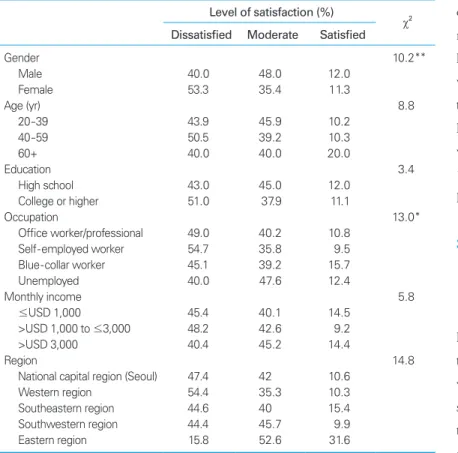
pondents’ satisfaction with the law. Approximately half (248, 46%) were not satisfied with the law. Their satis- faction was significantly related to their gender and oc- cupation but not to their education level, monthly in- come, and place of residence.
2. Respondents’ support for the law
Table 4 shows the descriptive statistics for the respon- dents’ support for the law. Slightly less than half (227, 42.1%) did not support the law. There were significant relationships between their support for the law and all their sociodemographic characteristics except for gender.
As in the case of their satisfaction with the law, those between the ages of 40 and 59 were less likely to sup-
port the law. College graduates and office workers/professionals were more likely to support the law than high school graduates and blue-collar workers, respectively. Those from the southwestern region were most likely to support the law, and those with a monthly income less than USD 1,000 were more likely to support the law than those making more.
3. Effects of respondents’ political alignment on their support for the law
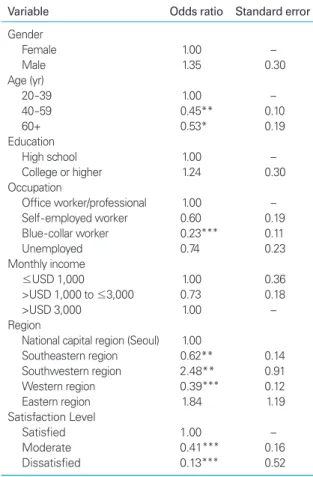
Table 5 shows the results of the logit regression, which indicate that the respondents who were satisfied with the law were more likely to support it. In addition, those over the age of 40 were more likely to support the law. Blue-collar workers were less likely to support the law than office workers/professionals (odds ratio [OR]=0.23).
In addition, those respondents living in Seoul (the nation- al capital), the eastern region, and the southwestern region were much more likely to support the law than those living in the southeastern region (OR=1.55, 3.04, and 3.99, respectively). In particular, the coefficient of region was much higher for the southwestern region than for other regions.
4. Robustness
Table 6 shows the results for the bivariate probit model (with the correlation between the respondents’
support for and satisfaction with the law controlled for). These results verify that the respondents’ place of Table 3. Descriptive statistics for respondents’ satisfaction (n=540)
Level of satisfaction (%)
χ2 Dissatisfied Moderate Satisfied Gender
Male Female Age (yr) 20-39 40-59 60+
Education High school College or higher Occupation
Office worker/professional Self-employed worker Blue-collar worker Unemployed Monthly income ≤USD 1,000 >USD 1,000 to ≤3,000 >USD 3,000 Region
National capital region (Seoul) Western region
Southeastern region Southwestern region Eastern region
40.0 53.3 43.9 50.5 40.0 43.0 51.0 49.0 54.7 45.1 40.0 45.4 48.2 40.4 47.4 54.4 44.6 44.4 15.8
48.0 35.4 45.9 39.2 40.0 45.0 37.9 40.2 35.8 39.2 47.6 40.1 42.6 45.2 42 35.3 40 45.7 52.6
12.0 11.3 10.2 10.3 20.0 12.0 11.1 10.8 9.5 15.7 12.4 14.5 9.2 14.4 10.6 10.3 15.4 9.9 31.6
10.2✽✽
8.8
3.4
13.0✽
5.8
14.8
✽P<0.05,✽✽P<0.01.
residence had a significant effect on their support for the law but not on their satisfaction with it. Those from the southwestern region were significantly more likely to support the law than those from Seoul, but this was not the case for their satisfaction with the law. Those from the southeastern region were less likely to support the law, but their place of residence had no effect on their satisfaction with the law.
Discussion
The study employs cross-sectional data obtained
through telephone interviews to investigate how pa- tients’ political alignment influences their satisfaction with and support for the law in the context of the poli- cymaking process. The study uses a logit model and a bivariate probit model to capture the effects of patients’
political alignment on their satisfaction with and sup- port for the law. To the authors’ knowledge, no study has provided an empirical analysis of the effects of regional characteristics on healthcare policymaking. In this regard, this study contributes to the literature by being the first to provide such an analysis, revealing new insights into the relationship between political alignment and healthcare policymaking in Korea.
Table 4. Descriptive statistics for respondents’ support for the law (n=540)
Support for the law (%)
χ2 support Support Not
Gender Male Female Age (yr) 20-39 40-59 60+
Education High school College or higher Occupation
Office worker/professional Self-employed worker Blue-collar worker Unemployed Monthly income ≤USD 1,000 >USD 1,000 to ≤3,000 >USD 3,000 Region
National capital region (Seoul) Western region
Southeastern region Southwestern region Eastern region
43.5 40.9 30.2 53.9 46.8 47.2 33.3 27.4 47.1 66.7 40.3 31.6 46.1 46.6 36.3 63.2 23.1 51.2 21.1
56.5 59.1 69.8 46.1 53.2 52.8 66.7 72.6 52.9 33.3 59.7 68.4 53.9 53.4 63.7 36.8 76.9 48.8 78.9
0.4
27.3✽✽✽
9.9✽✽✽
23.3✽✽✽
9.6✽✽
34.2✽✽✽
✽✽P<0.05, ✽✽✽P<0.01.
Table 5. Logit result for respondents’ support for the law
Variable Odds ratio Standard error
Gender Female Male Age (yr) 20-39 40-59 60+
Education High school College or higher Occupation
Office worker/professional Self-employed worker Blue-collar worker Unemployed Monthly income ≤USD 1,000 >USD 1,000 to ≤3,000 >USD 3,000 Region
National capital region (Seoul) Southeastern region Southwestern region Western region Eastern region Satisfaction Level Satisfied Moderate Dissatisfied
1.00 1.35 1.00 0.45**
0.53*
1.00 1.24 1.00 0.60 0.23✽✽✽
0.74 1.00 0.73 1.00 1.00 0.62**
2.48**
0.39✽✽✽
1.84 1.00 0.41✽✽✽
0.13✽✽✽
– 0.30
– 0.10 0.19 – 0.30
– 0.19 0.11 0.23 0.36 0.18 –
0.14 0.91 0.12 1.19 – 0.16 0.52
✽P<0.1, ✽✽P<0.05, ✽✽✽P<0.01.
In order to capture the effect of the political align- ment on the law, we used the place of residence as a proxy for the respondents’ political propensity because presidential candidates from specific regions have been elected with unquestioning support of the people from the same area historically. For example, Dae Jung Kim, who implemented the law, won the presidency with approximately 95% of the votes from the southwestern region but only about 14% from the southeastern region.
This implies that the Kim administration was establi- shed through strong regional support. In other words, if the variable for the region is regarded as a proxy for
political alignment, then our results implies that the respondents’ politi- cal alignment had considerable infl- uence on their support for the law.
In short, our results suggest that the respondents’ political alignment was a significant determinant of their support for the law but not of their satisfaction with it.
Conclusion
The results provide empirical evi- dence that regional characteristics have considerable influence on poli- tical support and the policymaking process. The level of satisfaction with the law was low across the country.
The respondents from the south- western region, the political base of the ruling party when the law was enacted, were most likely to support the law, whereas those from the southeastern region were less likely to support it than those from other regions. That is, the respondents’ place of residence was not significantly related to their satisfaction with the law, but it was to their support for the law, particularly for those respon- dents from the same region as the ruling party.
These results suggest that patients’ political preferen- ces are much more likely than their need for conveni- ence to influence the policymaking process and that political power may induce undesirable outcomes for healthcare policies. This indicates an urgent need for a systematic reform that can prevent a repeat of such trial-and-error policymaking in the design and imple- Table 6. Results for the bivariate probit model for respondents’ support for the law and satis-
faction
Support for the law
Coefficient SE Satisfaction SE Gender
Female Male Age (yr) 20-39 40-59 60+
Education High school College or higher Occupation
Office worker/professional Self-employed worker Blue-collar worker Unemployed Monthly income ≤USD 1,000 >USD 1,000 to ≤3,000 >USD 3,000 Region
National capital region (Seoul) Southeastern region Southwestern region Western region Eastern region Constant rho
– 0.10
– -0.51✽✽✽
-0.30
0.06
-0.28 -0.75✽✽✽
-0.12 -0.07 -0.25✽
– – -0.24✽
0.50✽✽✽
-0.56✽✽✽
0.64✽ 0.81✽✽✽
0.45✽✽✽
– 0.13
– 0.13 0.21 – 0.14
– 0.20 0.27 0.18 0.21 0.15 – – 0.14 0.20 0.19 0.35 0.21 0.06
– -0.25✽✽
– -0.22✽ -0.03
– -0.22✽✽✽
– -0.07
0.11 0.16 -0.14 -0.20 – – 0.11 0.03 -0.16 0.86✽✽
0.41✽✽
–
– 0.12
– 0.13 0.20 – 0.10
– 0.18 0.26 0.17 0.21 0.10 – – 0.13 0.18 0.18 0.36 0.20 – SE, standard error. ✽P<0.1, ✽✽P<0.05, ✽✽✽P<0.01.
mentation of healthcare policies. Such a reform can be based on education programs for the public and politi- cians, the wide dissemination of information, and the facilitation of decision-making processes that make active use of expert opinions on healthcare policies.
This study is limited in that the telephone survey overlooked those individuals without a telephone at home or those who did not answer the call. Nonethe- less, the study provides a better understanding of the role of political power in the policymaking process.
핵심용어: 보건정책; 지역주의 ; 의약분업
REFERENCES
1. Cho B. Conflicts between civil society and medical doctors shown in the doctors’ strike. J Korean Bioeth Assoc 2000;1:
201-229.
2. Lee KS. The problem of the payment for drug of national health insurance and its improvements. The NHIC discussion for the drug payment in National health insurance. Seoul:
Korean Hospital Association; 2001. 95 p.
3. Kim WS. Division of role between physician and pharmacist on drug and development of national health insurance: the ten years of love and hatred. Korean Soc Secur Stud 2010;26:
159-193.
4. Hwang HS. Principal-agent relations in the policy process:
reinterpreting the formation process of the ‘drug prescription
& dispensing separation’ policy. Korean Policy Stud Rev 2005;
14:29-56.
5. Jeong HS. Impact of Korea’s reform for separation between prescribing and dispensing of drugs on profits of doctor’s clinics and pharmacies. Korean J Health Policy Adm 2004;14:
44-64.
6. Jo HS, Lee SH. Trend on the curtailments of medical and drug expenditure before and after the separation between prescription and dispensing in general hospitals. Korean J Health Policy Adm 2002;12:23-35.
7. Jo Y. Interest conflict and two-level games in Korean demo- cratic consolidation: the case of the division of the roles of doctors and pharmacists. J Asiat Stud 2001;105:33-65.
8. Kwon S. Pharmaceutical reform and physician strikes in
Korea: separation of drug prescribing and dispensing. Soc Sci Med 2003;57:529-538.
9. Kim SH. Cultural analysis of conflicts around medical reform:
in case of pharmaceutical practices. Soc Welf Policy 2009;36:
89-116.
10. Lee KW, Kim J, Ahn TK. The conflict over the separation of prescribing and dispensing practice (SPDP) in Korea: a bargaining perspective. Korean J Health Policy Adm 2002;
12:91-113.
11. Yoon HG. A study on the possible consensus on the medical issues through medical knowledge. Health Soc Sci 2003;14:
29-57.
12. Jee CN. A study on the elite recruitment and the regionalism of Youngnam and Honam: focusing on governments of Kim Dae-Jung, Roh Moo-Hyun and Lee Myung-Bak. Soc Sci Stud 2011;35:269-302.
13. Choi HK. Study on voting propensity and regionalism of Korean. Seoul: Korean Psychological Association; 1990.
14. Park HT. The decline of mass democracy in South Korea:
personalized politics, state nationalism, political regionalism, and mass democracy [dissertation]. Athens: University of Georgia; 1993.
15. Choe SH. Kim Dae-Jung. New York Times. 2009 Aug 18 [cited 2012 Jun 11]. Available from: http://topics.nytimes.com/topics/
reference/timestopics/people/k/_kim_dae_jung/index.html.
16. Dong-A Daily. Votes for presidential candidates. 1997 Dec 20.
17. Lee SY. The study on the nature of the welfare state under the Kim Dae Jung and Roh Moo Hyun regime: focusing on civic participation in the policy decision making procedure for the national health insurance. Korean J Soc Welf Stud 2011;42:31- 54.
18. Kim SY. The dynamics of advocacy coalitions in Korean health- care policy-making: a comparative case study. Korean Policy Stud Rev 2010;19:1-44.
19. Shim JC. Failure of separation of drug prescribing and dispensing: an empirical analysis of the goal and reality. Seoul:
Congressman Shim JC Office; 2001.
20. Lee WH. Separation of drug prescribing and dispensing assessment report: public survey. Seoul: Congressman Lee WH Office; 2003.
21. Shin E, Hwang JM, Park YG. Survey of patient satisfaction about drug dispensing law. Seoul: The Catholic University of Korea; 2002.
22. Lee KS, Kim JD; Korea Institute for Health and Welfare Policy.
History and assessment of separation of drug prescribing and dispensing. Seoul: Kechuk Culture Co.; 2012. 199 p.
이 논문은 의약분업 실시 10년이 지난 후 재평가라는 취지에서 2000년 의약분업당시의 정책만족도와 정책적 지지도를 자 료를 통해 분석을 시도하였던 점에서 의미가 있으며, 지역주의와 보건의료정책결정과의 관련성을 재조명하고 자료를 통해 실증적으로 분석한 논문으로서 시의성이 있는 것으로 판단된다.
[정리: 편집위원회]