경락경혈학회지 Vol.28, No.3, pp.99 111, 2011∼ Korean Journal of Acupuncture
Seung-Min Baek, Sang-Hun Lee, Jung-Eun Kim, Yan Liu Hyo-Ju Park, Bo-Young Kim, Sun-Mi Choi
Acupuncture, Moxibustion & Meridian Research Center, Korea Institute of Oriental Medicine
Abstract
Objectives : The aim of this study is to estimate traditional Korean medicine (TKM) practitioners’
awareness and attitudes about acupuncture clinical study toward evidence based medicine (EBM).
Methods : We conducted two surveys before and after the workshop. First survey, about the awareness and attitudes toward EBM was carried out with questionnaire. Second survey, about their changes in the attitudes toward EBM after the workshop was carried out with on-line questionnaire.
Results : 70.0 % of respondents shows interest in the trends of clinical research. In contrast, 26.0 % of respondents used to search papers by themselves. 30.3 % of respondents reported that they apply the result of researches to their practice. 41.0 % of respondents thought that case study is needed for their practice, whereas 29.5 % responded that randomized controlled trial is most important.
In the second survey, the attitudes toward EBM were changes positive. fair number of respondents usually get information from data regardless of EBM for their practice, but 23.5
% of respondents refer to the journals.
Conclusions : The awareness and needs for education on the attendees toward EBM is quite high, and the effect of education is possibly influential. We expect the improvement on the refresher and the extension of education course for practitioners, and undergraduate curriculum.
Key words : Evidence based medicine (EBM), Survey, Traditional Korean medicine practitioners, EBM awareness, Clinical Research Workshop
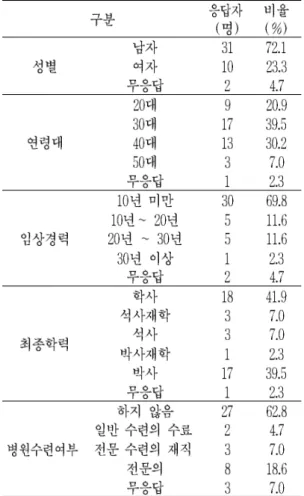
Table 1. Characteristics of Respondents
Fig. 1. The interest of respondents about the newest clinical research.
Fig. 2. The percentage of respondents who search the clinical research paper.
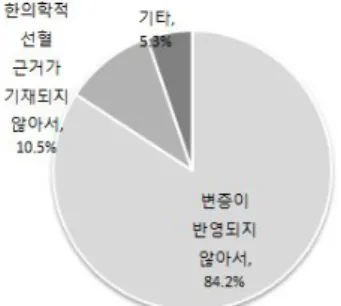
Fig. 3. The reason why negative respondents do not search the clinical research paper.
Fig. 4. The percentage of respondents who use the result of the clinical research paper.
Fig. 5. The reason why negative respondents thought the result of the clinical research is hard to use in practical treatment.
Fig. 6. The most essential area of research for the Korean medicine.
Fig. 7. The change of interest about the clinical research.
Fig. 8. The change of trend in the searching the clinical research paper.
Fig. 10. The change of percentage who use the result of the clinical research paper after the workshop.
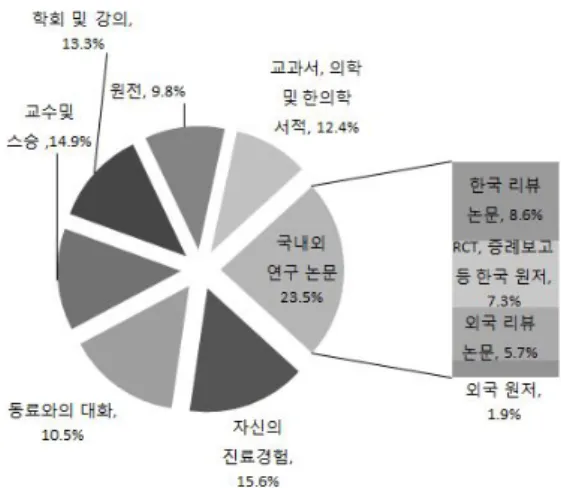
Fig. 10. The influence ratio of authority for the decision of clinical treatment.
Fig. 11. The effective EBM popularization program for clinician.
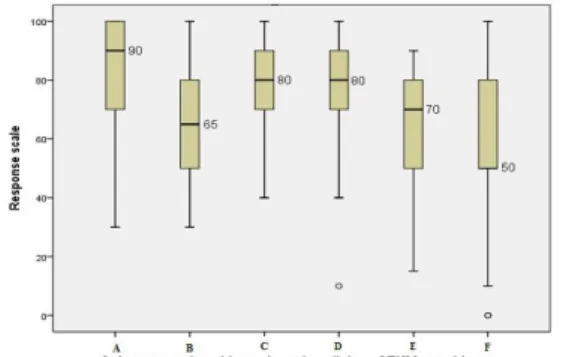
Fig. 12. Attitude towards EBM of traditional Korean medicine practitioners.