• 검색 결과가 없습니다.

Life-Threatening Simultaneous BilateralSpontaneous Tension Pneumothorax

N/A
N/A
Protected

Academic year: 2021

Share "Life-Threatening Simultaneous BilateralSpontaneous Tension Pneumothorax"

Copied!
4
0
0

로드 중.... (전체 텍스트 보기)

전체 글

(1)

Korean J Thorac Cardiovasc Surg 2011;44:253-256 □ Case Report □ DOI:10.5090/kjtcs.2011.44.3.253 ISSN: 2233-601X (Print) ISSN: 2093-6516 (Online)

− 253 −

*Department of Thoracic and Cardiovascular Surgery, Hana General Hospital

**Department of Family Medicine, Hana General Hospital

***Department of Radiology, Hana General Hospital

Received: June 15, 2010, Revised: March 17, 2011, Accepted: May 10, 2011

Corresponding author: Taegeun Rim, Department of Thoracic and Cardiovascular Surgery, Hana General Hospital, 566, Gagyeong-dong, Heung- deok-gu, Cheongju 361-260, Korea

(Tel) 82-43-230-6104 (Fax) 82-43-230-6644 (E-mail) [email protected]

C

The Korean Society for Thoracic and Cardiovascular Surgery. 2011. All right reserved.

CC
This is an open access article distributed under the terms of the Creative Commons Attribution Non-Commercial License (http://creative- commons.org/licenses/by-nc/3.0) which permits unrestricted non-commercial use, distribution, and reproduction in any medium, provided the original work is properly cited.

Life-Threatening Simultaneous Bilateral Spontaneous Tension Pneumothorax

− A case report −

Taegeun Rim, M.D.*, Joo Suck Bae, M.D.**, Yong Soo Yuk, M.D.***

Spontaneous pneumothorax is a common clinical problem in emergency care. However, the overall incidences of primary spontaneous pneumothorax has been reported from as low as 1.4% to 7.6%. The clinical findings of si- multaneous bilateral spontaneous pneumothorax can be variable. Clinical presentation is variable, ranging from mild dyspnea to tension pneumothorax. Bilateral tension pneumothorax can defined as cases where no tracheal deviation is detected in chest X-ray, and symptoms may be equal bilaterally. Herein, we present a case with simultaneous bilateral tension pneumothorax, severely deteriorated (i.e. with loss of consciousness, cyanosis, and hemodynamically unstable), that was successfully treated with immediate large-size needle decompression.

Key word: 1. Pneumothorax

CASE REPORT

An 18-year-old male transferred to the emergency depart- ment presented loss of consciousness, cyanosis, and deterio- rated vital signs. According to the rescue team transfer re- cords, he called the control center himself because he was home alone. He complained of aggravating dyspnea after eat- ing dinner and of sudden onset vomiting. During ambulance transfer, cyanosis was detected and supplemental oxygen was delivered by mask. The patient could not remember what happened after the arrival of the rescue team at his house and had no memory of his stay at the emergency room and in- tensive care unit (ICU).

Upon arrival to the emergency room, the patient presented with a cyanotic lip, stupor or semi-comatose mental state, and

severe tachyarrhythmia. The percutaneous oxygen saturation

level was very low, in the undetectable range. Endotracheal

intubation was performed immediately. After drawing blood

for an emergency laboratory study and portable chest X-ray,

cardiopulmonary resuscitation was performed for several

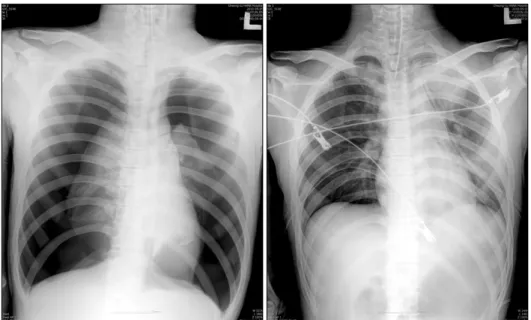
minutes. After confirmation of bilateral tension pneumothorax

(Fig. 1), a large bore needle (16 G) was inserted into the sec-

ond intercostal space of the mid-clavicular line to decompress

intrathoracic pressure. Immediately after insertion of the nee-

dle, percutaneously checked SaO

2

increased dramatically to

higher than 95%. Closed bilateral thoracostomy followed, us-

ing a 24 Fr chest tube. The patient was transferred to the

ICU for close monitoring of the patient’s mental state and

other parameters related to tension pneumothorax. The ABGA

results upon arrival and after insertion of the chest tube were

(2)

Taegeun Rim, et al

− 254 −

Fig. 1. X-ray upon admission to the emergency room, showing simul- taneous bilateral spontaneous pneu- mothorax, left. Post-tubing state, right.

Fig. 2. Endoscopic findings: giant bulla on right upper lobe (A), bulla on the left upper lobe (B), and another bulla on the left upper lobe (C).

a pH of 7.272, PCO

2

of 56.1 mmHg, PO

2

of 78.6 mmHg, and SaO

2

78.6%, and a pH of 7.373, PCO

2

of 42.7 mmHg, PO

2

of 171.3 mmHg, and a SaO

2

of 99.3%, respectively.

Within several hours after admission into the ICU, the pa- tient’s mental state and vital signs were restored to within normal limits. Two hours after admission into the ICU, endo- trachial intubation was removed and spontaneous breathing was maintained with an adequate SaO

2

level. The possibility of hypoxic brain damage was evaluated by a neurosurgeon, who confirmed that there were no significant sequela.

On the second day at the hospital, bilateral pneumothorax recurred during the application of continuous negative wall suction (-18 CmH

2

O). High resolution lung computed to- mography showed multiple bullae in bilateral upper lung

fields. A wedge resection was performed using bilateral video assisted thoracic surgery (VATS).

The operation was performed under general anesthesia with

double-lumen endotracheal intubation. To avoid hemodynamic

instability during the operation, the patient was positioned

with the head elevated 30 degrees (Semifowler’s position)

and with the legs slightly elevated, with both upper arms

extended. During the operation, to improve the operation field

view, the operation table was tilted to the contralateral side

(Fig. 2). A large bullae on the left lung and single giant bulla

on right upper lung were resected with an Endo-GIA linear

stapling device. One long thoracic drain (28 Fr) was inserted

bilaterally into the thoracic cavity after mechanical abrasion

of upper portion of the parietal pleura. The postoperative

(3)

Life-Threatening Simultaneous Bilateral Spontaneous Tension Pneumothorax

− 255 − Fig. 3. X-ray at discharge.

course was uneventful. For two years after the operation, there was no evidence of recurrence of pneumothorax on both sides (Fig. 3).

DISCUSSION

The incidence of simultaneous bilateral primary sponta- neous pneumothorax has been reported to be as low as 1.4%

to 7.6%. Simultaneous bilateral primary spontaneous pneumo- thorax can result in a severely deteriorated condition, usually requiring intubation or resuscitation. The reported causes of bilateral pneumothorax include trauma, tumor, and iatrogenic causes [1-3]. Other more rare causes have been reported, in- cluding catamenial pneumothorax, sarcoidosis, pregnancy, and radiation [4].

Simultaneous spontaneous bilateral tension pneumothorax is defined as when no tracheal shift occurs and when the degree of bilaterally lung collapse is similar in a chest X-ray.

Patients with simultaneously developed bilateral tension pneu- mothorax may deteriorate rapidly, and immediate decom- pression is recommended. A vicious cycle may occur, leading to a deteriorated condition, with a chain reaction consisting of lowered venous return, lowered preload, lowered cardiac out- put and so on. The patient under study experienced a crit- ically life threatened state, loss of consciousness, cyanosis, and tachyarrhythmia.

Clinical findings of spontaneous pneumothorax may vary from absence of symptoms to tension penumothorax. The treatment methods include needle aspiration, percutaneous catheter drainage, and tube thoracostomy [1-4]. Indication for surgical management of pneumothorax include continuous air leakage after insertion of chest tube, recurring pneumothorax on the same side, simultaneous bilateral pneumothorax, pneu- mothorax developed after pneumonectomy, and having an oc- cupational cause [2,4].

At present, Video-Assisted Thoracic Surgery (VATS) is the most frequently used form of surgery for treating pneumo- thorax [3]. Kim et al. reported a series of 66 patients that were randomized to treatment with either transaxillary mini- thoracotomy (TAMT) or VATS. The conclusion was that VATS presented no advantages over TAMT. There were sev- eral advantages to performing a bilateral single stage operation. First, a smaller incision was required when com- pared with TAMT, which generally resulted in less pain.

Postoperative pain was usually related to several compli- cations. Second, the cosmetic effect is superior to that of TAMT. Finally, most procedures are possible (mechanical pleurodesis, chemical pleurodesis, etc.).

Prospective studies of simultaneous bilateral spontaneous pneumothorax management are rare. Generally, cases of bi- lateral pneumothorax require definitive surgical therapy to re- duce the risk of recurrence [3,5]. This can be done either through VATS or open thoracotomy, depending on the sur- geon’s preference. Mechanical pleurodesis should be per- formed to reduce the recurrence rate.

Primary spontaneous pneumothorax frequently affects young, tall, and thin males. Our case presented the rare clinical sit- uation of simultaneous bilateral tension pneumothorax, and a decision was made to treat with immediate large size needle decompression at the emergency room by a properly trained doctor. The procedure was a critical step which restored this patient from life-threatening tension pneumothorax.

REFERENCES

1. Lee SC, Cheng YL, Huang CW, et al. Simultaneous bi-

lateral primary spontaneous pneumothorax. Respirology

2008;13:145-8.

(4)

Taegeun Rim, et al

− 256 − 2. Rivas de Andrés JJ, Jiménez López MF, Molins López-

Rodó L, et al. Guideline for the diagnosis and treatment of spontanesous pneumothorax. Arch Bronconeumol 2008;44:

437-48.

3. Kim ES, Sohn ST, Kang JY. Simultaneous bilateral sponta- neous pneumothorax. Korean J Thorac Cardiovasc Surg

2006;39:475-8.

4. Shields TW. General thoracic surgery, 6th ed. New York:

Williams & Wilkins. 2005;794-805.

5. Lewis RL. Simultaneous bilateral spontaneous pneumo-

thorax; a case report. Curr Surg 2002;59:99-100.

수치

Fig. 1. X-ray upon admission to  the emergency room, showing  simul-taneous bilateral sponsimul-taneous  pneu-mothorax, left

참조

관련 문서