pISSN 1738-6640 eISSN 2234-4020 http://dx.doi.org/10.6114/jkood.2020.33.3.125
Case Report / 증례
A Case of Charcot Neuroarthropathy Improved by Korean Medical Treatment Combined with Shudihuangkushen-tang and Haifu-san Wet Dressing
Hyun-Bum Lee 1 · Chang-Won Lee 1 · Eun-Chul Lim 2
1
Dept. of Oriental Ophthalmology and Otolaryngology and Dermatology, Dongseo Oriental Medical clinic
2
Dept. of Sasang constitutional medicine, Dongseo Oriental Medical clinic
熟地黃苦蔘湯과 海浮散 습윤드레싱을 병행한 한방치료를 통한 샤르코 신경관절병증 환자 호전 1례
이현범1· 이창원2· 임은철3
동서한방병원 한방안이비인후피부과(1전공의, 2전문의) 동서한방병원 사상체질과(3전문의)
Abstract
Objectives : Charcot neuroarthropathy(CN) is condition characterized by a progressive joint deformation with sensorial and autonomic neuropathy. This study is to report a case of CN improved by Korean medical treatment.
Methods : The patient’s left foot with CN was treated by Shudihuangkushen-tang, Haifu-san wet dressing, acupuncture and herbal acupuncture. We evaluated the progress by laboratory investigation, radiograph and photograph comparison, visual analogue scale(VAS) of edema and pain sensation.
Results : After treatment, VAS score of edema dropped from 6 to 1, of pain sensation slightly improved from 0 to 1. Average blood sugar level decreased and rebounded, but Hemoglobin A1c level improved from 9.5% to 7.7%. Improvement of the left foot was recognized from the radiograph and photograph comparison.
Conclusions : This study suggests Korean medicine is effective in treating CN, especially using Shudihuangkushen-tang, Haifu-san wet dressing.
Key words : Charcot neuroarthropathy, Diabetic foot ulceration, Charcot foot, Shudihuangkushen-tang, Haifu-san
ⓒ 2020 the Society of Korean Medicine Ophthalmology & Otolaryngology & Dermatology
This is an Open Access journal distributed under the terms of the Creative Commons Attribution Non-Commercial License
(http://creativecommons.org/license/by-nc/3.0/) which permits unrestricted non-commercial use, distribution, and reproduction in
any medium, provided the original work is properly cited.
Ⅰ. Introduction
Diabetic foot ulcer, also known as Charcot neuroarthropathy(CN), is a sensorial neuropathy, defined as a non-infectious and progressive invasion and destruction of bones, joints, soft tissues
1). CN is a result of peripheral neuropathies from diabetes, autonomic neuropathy, infections such as leprosy and HIV, drinking alcohol, tabes dorsalis, syringomyelia, rheumatoid arthritis, multiple sclerosis, traumatic damage, or abnormal bone metabolism
2). CN easily occur on midfoot, causing subluxation, dislocation, fracture and deformation of surrounding.
Diabetes is the most prominent cause of CN, of which annual incident rate is about 0.1-29%
worldwide. About 0.08-13% of world population is diabetic patients
3),For diabetic patients, CN is a long-term complication which damages foot and foot joints, resulting dislocation, instability, joint deformation, insensibility, joint alignment destruction, progressive fracture, and multiple joint dislocation. Ulceration may develop to myelitis and at worst amputation would be necessary
1).
In Korean medicine, CN can be comprehended in categories of wasting-thirst(消 渴) and digital gangrene(脫疽). Dongeuibogam(東 醫寶鑑) mentions digital gangrene is caused by accumulated toxin due to excessive indulgence in greasy and sweet food(膏粱珍味), sexual
overindulgence(房勞), drinking alcohol(酒毒), or developed as a long-term complication of wasting-thirst
4). Lingshu(靈樞) contains prognosis information of digital gangrene based on color and morphology, and mentions amputation surgery procedures when it threats patient’s life.
Dongeuisoosebowon(東醫壽世保元) classifies types of wasting-thirst, its complication patterns, and treatments based on constitutional type
5-7). There was a case report of 5 patients all with different disease or symptom, but same as Soyang(lesser yang person) type gangrene according to pattern identification(辨證), treated with same herbal prescription, Soyang type Liuweidihuang-tang(六味地黃湯)
6). However, there is no study of CN treatment with Korean medicine yet.
This study reports a case of CN as a complication of long-term diabetes improved by combined Korean medical treatment including Shudihuangkushen-tang(熟地黃苦蔘湯) and Haifu- san(海浮散) wet dressing.
Ⅱ. Objects & Methods
1. Objects
One patient with CN as a long-term complication of diabetes was studied. On May 2, 2020, the patient was fully explained the purpose of this study and agreed by consent form that his medical information would be used for this study and publication .
2. Evaluation methods 1) Diabetes
Corresponding author : Hyun-Bum Lee, Dept. of Oriental Ophthalmology and Otolaryngology and Dermatology, Dongseo Oriental Medical Clinic, Seoul 03726, Republic of Korea.
(Tel : 02-320-7807, E-mail : [email protected])
• Received 2020/7/6 • Revised 2020/7/20 • Accepted 2020/7/27
① Blood sugar test(BST)
While having hospital treatments, the patient’s blood sugar level was measured three times a day, 7AM, 3PM, 8PM. The earliest was fasting blood sugar, and the others were 2-hour postprandial blood sugar(PP2hr). BST results were averaged every 2 weeks.
② Hemoglobin A1c(HbA1c)
HbA1c was tested to precisely evaluate improvement and management of diabetes which initiated the foot neuroarthropathy
Fig. 1. X-ray image of AP (Fig. 1-A), lateral (Fig. 1-B), oblique (Fig. 1-C) view of the patient’s left foot on May 20, 2019.
Findings include partial amputation state of 1
stmetatarsal and phalanx, bony resorption and destroyed state of 2
nddistal metatarsal bone.
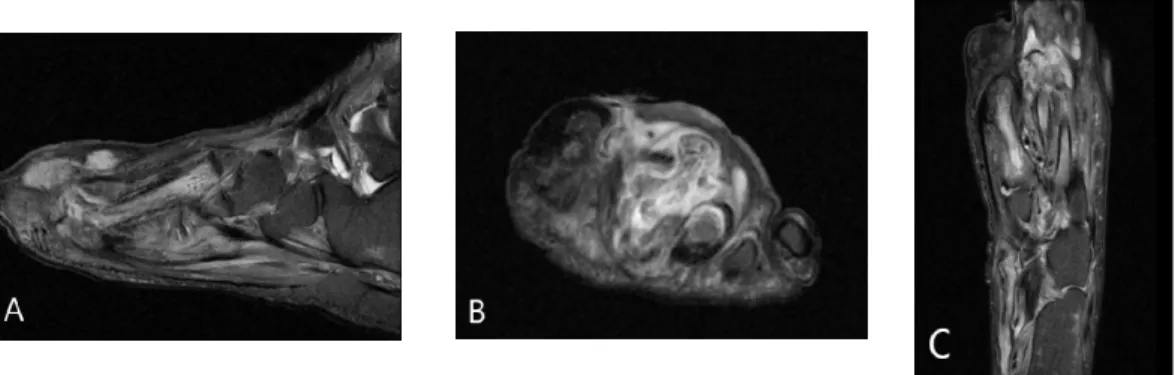
Fig. 2. MRI T2 image of sagittal (Fig. 2-A), coronal (Fig. 2-B), axial (Fig. 2-C) section view of the patient’s left foot on May 20, 2019.
Findings include abscess in dorsum of the left foot, mainly 2
nd, 3
rd, 4
thproximal phalanx area, which looks similar to osteomyelitis in 1
st,2
nd, 3
rdmetatarsal, 2
nd, 3
rdproximal phalanx of toes, fracture in 3
rdmetatarsal head.
in the first place.
2) Edema
Edema improvement was measured on visual analogue scale(VAS), 10 the worst, 0 the absence of edema.
3) Pain sensation
Improvement of paresthesia of the left foot
was measured by scoring pain on VAS when
acupuncture treatment was applied on affected
area, 10 the worst pain, 0 no pain.
4) X-ray and photograph
X-rays of the patient’s left foot before and after treatment were compared to evaluate improvement.
Photographs of the left foot were taken to observe treatment progress.
Ⅲ. Case report
1. Patient : ○○○ (M/59) 2. Chief complaint
1) Left foot edema : improved in the morning, worse at night with redness and heat.
2) Left foot paresthesia : insensible to pain on first, second and third toe fingers
3) Lt. foot ulceration
3. Onset : April, 2004 gradually recurred in 2018.
4. Past history 1) Diabetes 2) Hypertension
3) Diabetic foot(Left side)
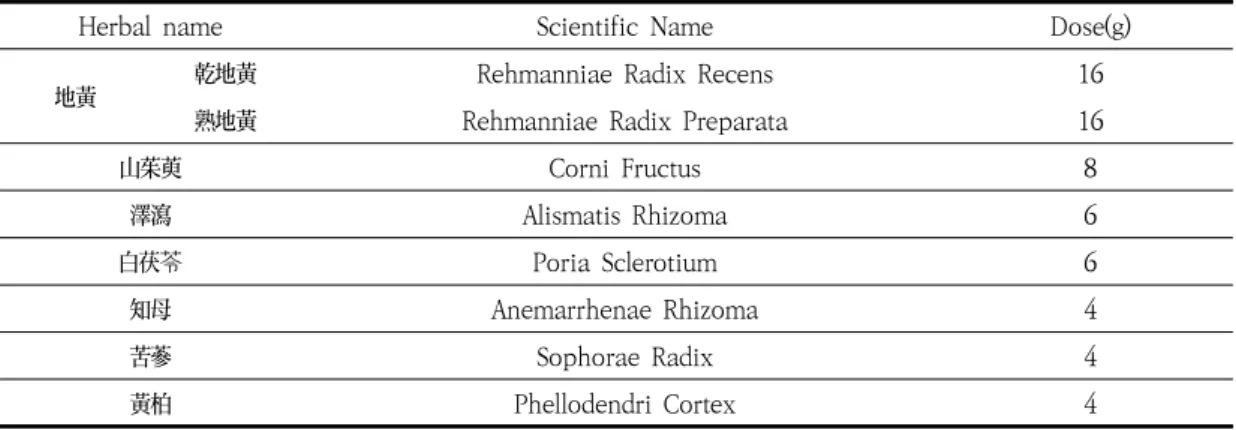
Table 1. Composition of Shudihuangkushen-tang
Herbal name Scientific Name Dose(g)
地黃 乾地黃 Rehmanniae Radix Recens 16
熟地黃 Rehmanniae Radix Preparata 16
山茱萸 Corni Fructus 8
澤瀉 Alismatis Rhizoma 6
白茯苓 Poria Sclerotium 6
知母 Anemarrhenae Rhizoma 4
苦蔘 Sophorae Radix 4
黃柏 Phellodendri Cortex 4
5. Family history 1) Brother : Lung cancer 2) Sister : Stomach cancer
6. Present illness
A 59-year-old male patient was diagnosed with diabetic foot on the left side and had an amputation surgery on distal interphlangeal joint of left first toe in 2004. After a gradual relapse of edema, paresthesia and ulceration on the left foot in 2018, he started Korean medical treatment on May 18, 2019.
7. Initial opinion
1) Hight/Weight : 179.6㎝/70.2㎏, lean body and upper excess and lower deficiency(上盛 下虛) type
2) Digestion : Normal 3) Appetite : Normal 4) Sleep : 6-7hours/day
5) Voiding : 6-7times/day, foamy 6) Defecation : 1time/2-3days, hard 7) Sweating : night sweating 8) Tongue diagnosis
① Tongue color : pale red tongue(淡紅舌)
② Texture and color of fur : white fur(白苔) ③ Dry mouth
9) Pulse diagnosis(wrist)
① Left chi(尺) sunken and slippery(沈滑) ② Right guan(關) floating and slippery(浮滑) 10) Pattern identification : Soyang type lower
wasting-thirst(少陽人 下消) based on ordinary symptom(素證), disease pattern(病 證), appearance and style of talking(容貌詞 氣) and physical appearance(體形氣像).
8. Examination results 1) Left foot X-ray(Fig. 1) 2) Left foot MRI(Fig. 2)
3) Clinical pathology(May 20, 2019)
① Hematology : RBC 4.02(4.29-5.70 10^6/㎕), Hb 11.4(13.3-16.6g/㎗), Hct 34.3(41.3-52.1%), MCV 85.3(86.1-101.9fL), RDW-SD 38.2 (39.9-52.2fl), RDW-CV 12.0(12.2-14.6%), Lympho 22.8(24.0-48.4%), ESR(Westergren Method) 70.0(0-15㎜/hr), Others : WNL ② Blood chemistry : Cholesterol Total
124.0(136-220㎎/㎗), HDL-Cholesterol 32.5 (40-87㎎/㎗), CK 55.0(58-348U/L), Glucose (PP2hrs) 254.0(60-140㎎/㎗), C-Peptide 1.86(1.10-4.40ng/㎖), Hb A1c-NGSP 9.5(≤
5.6), Hb A1c-IFCC 81.0(≤38), Hb A1c-eAG 226.0, Others : WNL
③ Urine analysis : RBC 1-3/HPF(0-2/HPF), Others : WNL
④ HBsAg(-), Ab(+)
9. Treatments 1) Herbal medicine
Shudihuangkushen-tang was prescribed and administered three times a day in decoction. For first 21 days Rehmanniae
Radix Preparata from the original formula of Shudihuangkushen-tang was substituted for Rehmanniae Radix Recens, and for the latter 33 days the herbal medicine was prepared according to the original formula(Table 1).
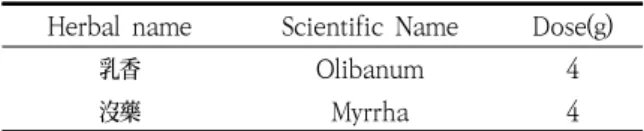
Table 2. Composition of Haifu-san
Herbal name Scientific Name Dose(g)
乳香 Olibanum 4
沒藥 Myrrha 4
2) Wet dressing
Wet dressing was daily practiced. After the ulceration area was wiped out with boric acid, hydrogen peroxide, povidone-iodine solution, and Haifu-san preparation were applied in order(Table 2).
3) Acupuncture
Acupuncture treatment was practiced two times a day. Size of 0.3×30㎜, stainless, standardized and disposable filiform needle(HL Medical HL-001 SERIES, Yeoju, Korea) were used.
Acupuncture technique was practiced based on the concept of Taegeuk acupuncture. Soyang type Taegeuk acupuncture treatment was applied, in which selected meridian points are HT3, KI3, SP3, LI11, LI4, ST36
8). After Haifu-san wet dressing, acupuncture treatment was also applied directly on the left foot ulcer area.
Infra-red light was applied to the patient’s
left foot for 20 minutes needle retention.
4) Herbal acupuncture
Anti-inflammatory herbal acupuncture was injected to the left foot ulceration area nine times from May 20 to June 3, and Jahageo herbal acupuncture, which consists of Hominis placenta, was injected seven times to the same area from June 4 to 20 in 2019. Both kinds of herbal acupuncture were supplied from Korean Pharmaco- puncture Institute.
10. Clinical progress
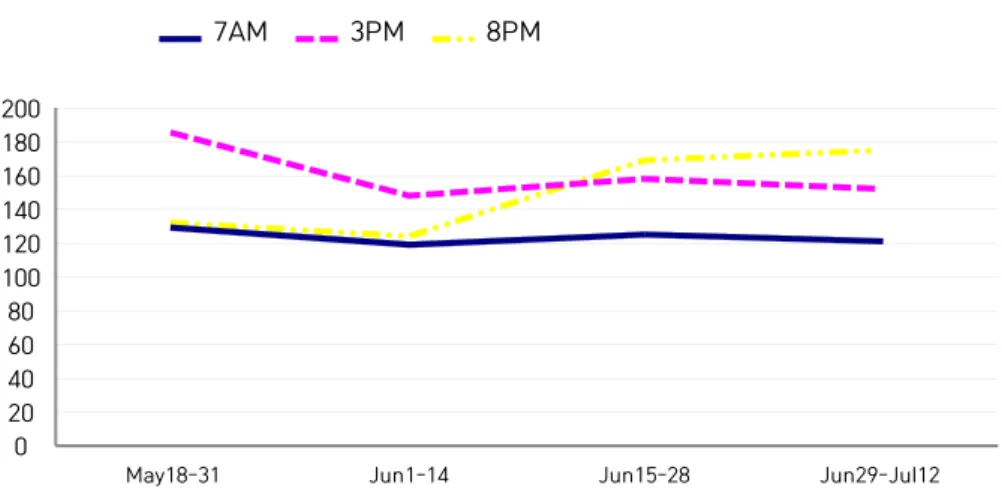
During treatment period, from May 18 to July 12 in 2019, blood sugar level decreased in the second quarter compared to the first quarter.
Then 7AM and 3PM blood sugar level fluctuated through the latter half, increased in the third and decreased in the forth quarter. 8PM blood sugar level consistently increased through the latter half, and it went up higher than the first quarter. HbA1c level was 9.5% at admission, but
0 20 40 60 80 100 120 140 160 180 200
May18-31 Jun1-14 Jun15-28 Jun29-Jul12
7AM 3PM 8PM
Fig. 3. Change of average blood sugar level
dropped to 7.7% when discharged(Fig. 3, Table 3).
Edema and pain sensation was scored 6 and 0 on VAS respectively. Edema gradually improved to 1 at the end of treatment. Pain sensation was not improving until he began to feel needle pricking stimulation on June 27 when acupuncture treatment was practiced on the foot ulcer area(Table 4). Pain sensation VAS score did not get better afterward.
When lateral view X-ray radiograph of at admission and before discharge were compared to each other, improvement of edema on the left foot could be found(Fig. 4). Photographs showed improvement of redness and edema as treatment proceeded(Fig. 5).
Table 3. Change of HbA1c
Date HbA1c(%)
May 20 9.5
June 21 7.7
Table 4. Clinical Progress of Edema and Pain Evaluated on VAS
Date Edema Pain
May 18 6 0
May 30 5 0
June 5 4 0
June 10 3 0
June 27 3 1
July 2 2 1
July 11 1 1