This is an Open Access article distributed under the terms of the Creative Commons Attribution Non-Commercial License (http: //creativecommons.org/licenses/by- nc/4.0/) which permits unrestricted non-commercial use, distribution, and reproduction in any medium, provided the original work is properly cited.
© 2020 THE KOREAN SOCIETY OF MYCOLOGY.
Accepted: December 07, 2020 Revised: September 28, 2020 Received: June 25, 2020 https://doi.org/10.4489/KJM.20200047 Kor. J. Mycol. 2020 December, 48(4): 491-498
OPEN ACCESS pISSN : 0253-651X eISSN : 2383-5249
RESEARCH NOTE
New Record of three Penicillium species
isolated from the Freshwater Environment in Korea
Hye Yeon Mun*, Yu Jeong Jeon, and Jaeduk Goh
Fungi Research Team, Microbial Research Department, Nakdonggang National Institute of Biological Resources, Sangju 37242, Korea
*Corresponding author: [email protected]
ABSTRACT
In this study, we aimed to observe the diversity of aquatic fungi by collecting deposits of soil, plants, and plant litter from streams and rivers. Three Penicillium strains were isolated from soil in streams. Based on the morphological characteristics and phylogenetic analysis using DNA sequences of the internal transcribed spacer, ß-tubulin and calmodulin genes, the isolates were identified as Penicillium guanacastense, P. saturniforme, and P. scabrosum.
These three fungi have not yet been reported in Korea.
Keywords: Freshwater environment, Penicillium guanacastense, P. saturniforme, P. scabrosum
The freshwater environment consists of various diverse microorganisms and provides plenty of habitat for fungi, such as plant litter, soil, and freshwater plants. In the environment, fungi play a role in controlling nutrient and carbon cycles as a decomposer [1].
The genus Penicillium belongs phylogenetically to Trichocomaceae, and the name is originated from penicillus, little brush by Link. Penicillium is a ubiquitous and widespread fungi, which can live in any environment such as soil, air, indoor and various foods, and produce beneficial secondary metabolite [2]. To our knowledge, over 100 species of Penicillium have been reported in Korea [3]. Recently, P. piscarium from Seungcheon reservoir and P. pasqualens and P. sanguifluum from Dokdo have been reported in Korea [3,4].
In this study, we isolated three Penicillium species from the freshwater environment in Korea. Through molecular phylogenetic analysis and morphological characterization, the three fungal strains were identified as Penicillium guanacastense, P. saturniforme, and P. scabrosum. Here, we present their mycological descriptions and phylogenetic relationships.
Fungal strains were collected from soil underwater at Namsaengi-mot in Jeju, Soyang-river in Chuncheon-si and Gamcheon in Gimcheon-si between 2016-2018 (Table 1). Soil samples were treated using the dilution plate method and then incubated at 20℃. Three-point inoculation was performed on potato dextrose agar (PDA; Difco, BD, Franklin Lakes, NJ, USA), Czapek yeast autolysate agar (CYA;
Czapek concentrate 10 mL, sucrose 30 g, yeast extract 5 g, K2HPO4 1 g, trace elements stock solution 1 mL,
agar 20 g, dH2O 1 L), yeast extract sucrose agar (YES;yeast extract 20 g, sucrose 150 g, MgSO4∙7H2O 0.5 g, trace element stock solution 1 mL, agar 20 g, dH2O 885 mL) and creatine sucrose agar (CREA; sucrose 30 g, creatine∙1H2O 3 g, K3PO4∙7H2O, MgSO4∙7H2O 0.5 g, KCl 0.5 g, FeSO4∙7H2O 0.01 g, bromocresol purple 0.05 g, trace element stock solution 1 mL, agar 20 g, dH2O 1 L) to observe the morphological characters of the isolated strains [2]. Colony diameter was measured after 7 days of inoculation, and morphological characteristics were observed using a model Eclipse Ni-U microscope (Nikon, Tokyo, Japan).
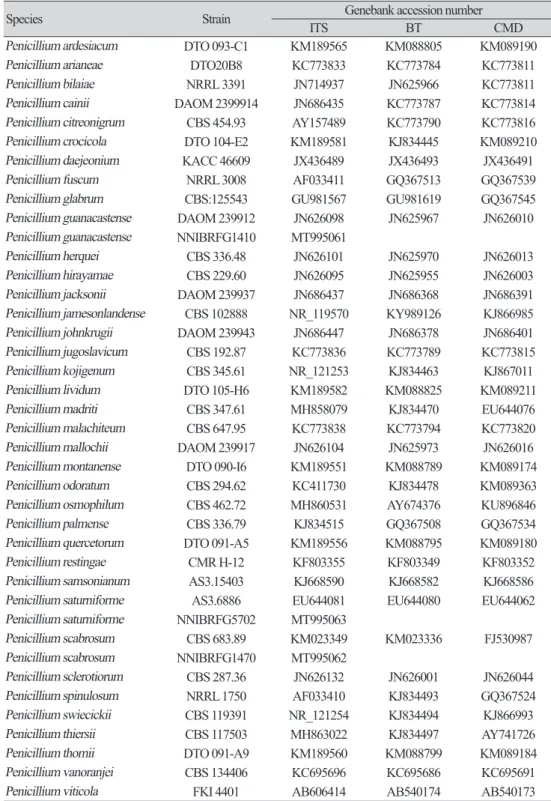
Fungal genomic DNA was isolated using the NucleoSpin Plant II DNA extraction Kit (Macherey- Nagel, Duren, Germany). For the identification of the fungi, amplification of an internal transcribed spacer (ITS) region using primers ITS1 (5�-TCCGTAGGTGAACCTGCGG-3�) and ITS4 (5�-TCCTCCGCTTATTGATATGC-3�), ß-tubulin gene using Bt2a (5�-GGTAACCAAATCGGTGCT GCTTTCG-3�) and Bt2b (5�-ACCCTCAGTGTAGTGACCCTTGGCG-3�) and calmodulin gene using cmd5 (5�-CCGAGTACAAGGARGCCTTC-3�) and cmd6 (5�-CCGATRGAGGTCATRACGTGG-3�) were performed [5]. Similarity searches of the DNA sequences were carried out using BLASTn algorithms available at the National Center for Biotechnology Information (NCBI). For the phylogenetic analysis, MEGA7 software was used [6]. A phylogenetic tree was constructed by the neighbor-joining (NJ) method with 1,000 bootstrap replications. Reference sequences of other fungi were obtained from GenBank at NCBI (Table 2).
Taxonomy
Penicillium guanacastense K.G. Rivera, Urb & Seifert, Mycotaxon 119, 315-28 (2012) [7] (Fig. 1 and 2).
Mycobank No.: MB563044 Description:
Colonies on PDA texture floccose to granular, slight radial sulcate, front olive green to dark green, reverse dark brown to orange, 4.5 mm on 7 days at 25℃; YES texture velutinous to fasciculate, sulcate, some yellow mycelium, front dark green to pale grayish green, reverse light green to light yellow, 5 mm on 7 days at 25℃; CYA texture velutinous, exudate present orange droplet, radial sulcate, front center white, middle whitish green, margin light lemon, reverse dark to light orange, 4 mm on 7 days at 25℃; CREA high acid production.
The conidiophore monoverticillate, smooth-walled, short stipes, hyaline; phialide 9.3-12 μm length×
3.8-4.46 μm width, cylindrical; conidia 2.77-4.47 μm diameter, globose to subglobose.
Phylogenetic section: Sclerotiora
Table 1. Environmental factors of sampling site.
Site Collection date Location GPS
Namsaengi-mot 2016.08.09 Jeju island N33°31'57.7˝E126°36'51.7˝
Gamcheon 2016.03.23 Gimcheon-si, Gyeongsongbuk-do N35°53'33.3˝E127°59'2.6˝
Soyang-river 2018.03.09 Chuncheon-si, Gangwon-do N37°59'01.0"N127°49'05.0"E
Table 2. GenBank accession numbers of isolates includes in this study.
Species Strain Genebank accession number
ITS BT CMD
Penicillium ardesiacum DTO 093-C1 KM189565 KM088805 KM089190
Penicillium arianeae DTO20B8 KC773833 KC773784 KC773811
Penicillium bilaiae NRRL 3391 JN714937 JN625966 KC773811
Penicillium cainii DAOM 2399914 JN686435 KC773787 KC773814
Penicillium citreonigrum CBS 454.93 AY157489 KC773790 KC773816
Penicillium crocicola DTO 104-E2 KM189581 KJ834445 KM089210
Penicillium daejeonium KACC 46609 JX436489 JX436493 JX436491
Penicillium fuscum NRRL 3008 AF033411 GQ367513 GQ367539
Penicillium glabrum CBS:125543 GU981567 GU981619 GQ367545
Penicillium guanacastense DAOM 239912 JN626098 JN625967 JN626010 Penicillium guanacastense NNIBRFG1410 MT995061
Penicillium herquei CBS 336.48 JN626101 JN625970 JN626013
Penicillium hirayamae CBS 229.60 JN626095 JN625955 JN626003
Penicillium jacksonii DAOM 239937 JN686437 JN686368 JN686391
Penicillium jamesonlandense CBS 102888 NR_119570 KY989126 KJ866985
Penicillium johnkrugii DAOM 239943 JN686447 JN686378 JN686401
Penicillium jugoslavicum CBS 192.87 KC773836 KC773789 KC773815
Penicillium kojigenum CBS 345.61 NR_121253 KJ834463 KJ867011
Penicillium lividum DTO 105-H6 KM189582 KM088825 KM089211
Penicillium madriti CBS 347.61 MH858079 KJ834470 EU644076
Penicillium malachiteum CBS 647.95 KC773838 KC773794 KC773820
Penicillium mallochii DAOM 239917 JN626104 JN625973 JN626016
Penicillium montanense DTO 090-I6 KM189551 KM088789 KM089174
Penicillium odoratum CBS 294.62 KC411730 KJ834478 KM089363
Penicillium osmophilum CBS 462.72 MH860531 AY674376 KU896846
Penicillium palmense CBS 336.79 KJ834515 GQ367508 GQ367534
Penicillium quercetorum DTO 091-A5 KM189556 KM088795 KM089180
Penicillium restingae CMR H-12 KF803355 KF803349 KF803352
Penicillium samsonianum AS3.15403 KJ668590 KJ668582 KJ668586
Penicillium saturniforme AS3.6886 EU644081 EU644080 EU644062
Penicillium saturniforme NNIBRFG5702 MT995063
Penicillium scabrosum CBS 683.89 KM023349 KM023336 FJ530987
Penicillium scabrosum NNIBRFG1470 MT995062
Penicillium sclerotiorum CBS 287.36 JN626132 JN626001 JN626044
Penicillium spinulosum NRRL 1750 AF033410 KJ834493 GQ367524
Penicillium swiecickii CBS 119391 NR_121254 KJ834494 KJ866993
Penicillium thiersii CBS 117503 MH863022 KJ834497 AY741726
Penicillium thomii DTO 091-A9 KM189560 KM088799 KM089184
Penicillium vanoranjei CBS 134406 KC695696 KC695686 KC695691
Penicillium viticola FKI 4401 AB606414 AB540174 AB540173
ITS: Internal transcribed spacer; BT: ß-tubulin gene; CMD: Calmodulin gene
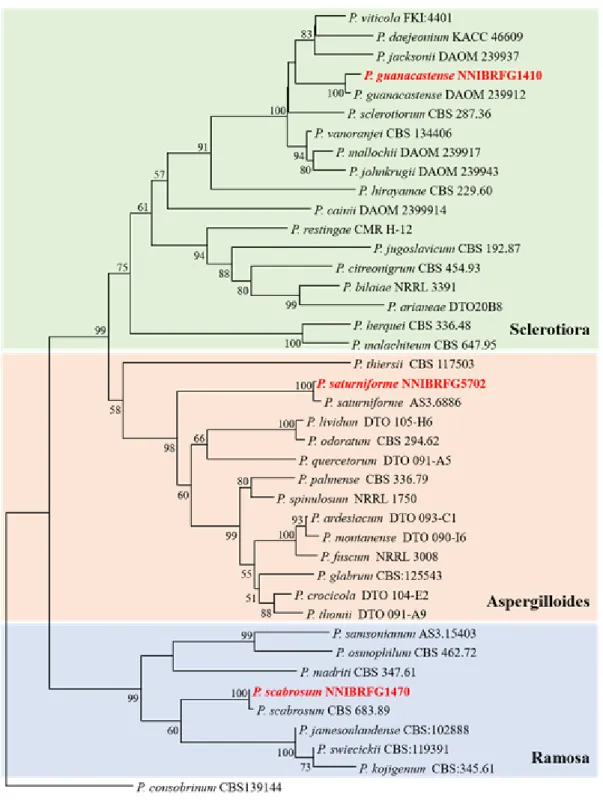
Fig. 1. Phylogenetic analysis using the neighbor-joining method based on internal transcribed spacer (ITS) region, ß-tubulin and calmodulin gene sequences of three Penicillium species. P. consobrinum was used to an outgroup. Bootstrap values more than 50% (1,000 replications) are shown at branches. The new isolates from the present study are shown in bold and red.
Habitat: Soil in stream
Specimen examined: Namsaengi-mot, Chocheon-uep, Jeju-do, Republic of Korea, 22 Mar 2016, NNIBRFG1410, Nakdonggang National Institute of Biological Resources
Note: NNIBRFG1410 is phylogenetically closely related to P. guanacastense within Sclerotiora clade.
The molecular data of NNIBRFG1410 is identical to the strain of P. guanacastense,with high similarity in the ITS, ß-tubulin and calmodulin sequence data, respectively. We confirm NNIBRFG1410 as P.
guanacastense based on the morphology and phylogeny, and report the freshwater environment. The morphology of NNIBRFG1410 and Ref. species are similar conidiophore, philade and conidia (Table 3).
Fig. 2. Penicillim guanacastense NNIBRFG1410. Colony shape on A, potato dextrose agar (PDA); B, Czapek yeast autolysate agar (CYA); C, creatine sucrose agar (CREA); D, yeast extract sucrose (YES); E, conidiophores and conidia. Scale bar is 10 μm.
Table 3. The morphology of Penicillium species.
Taxa Penicillium guanacastense Penicillium saturniforme Penicillium scabrosum
NNIBRFG1410 Ref [7] NNIBRFG5702 Ref [9] NNIBRFG1470 Ref [10]
Conidiophore monoverticillate, smooth-walled, short stipes, hyaline
monoverticillate, stipes septate, smooth to finely roughened,
mono or biverticillate,
smooth-walled mono or biverticillate, finely roughwalled, commonly with swollen apices
terverticillate, smooth-
walled bi- and terverticillate, a comparatively short
Rami 6.5–11.3 × 2.85–3.8 μm 10-20 × 2.5-4.0 μm
Metulae 10.15–13.18 × 3.3–3.79
μm 10–20 × 3.5–4.5 (–5.4)
μm 6.19–8.6 × 2.65–3.3 μm 15-25 × 2.5-4.0 μm, Phialide 9.3–12 x 3.8–4.46 μm ,
cylindrical 7–10(–16) × 2–3(– 4) µm, ampulliform with a collula
6.52–7.23 × 3.03–3.49
μm, cylindrical-shaped 7–11 × (2.0–) 2.5–3.5(–
4.0) μm, ampulliform with short collula
7.6–9.4 × 2.3–2.6 μm,
flash-shaped 7-11 × 2.0-2.5 μm, well-defined, abruptly narrowed collulum Conidia 2.77–4.47 μm diameter,
globose to subglobose 2.5–3.5 × 2–2.5 µm, globose to subglobose, finely roughened
3.19–3.94 μm diameter,
globose to subglobose (3.0–) 3.5–4.0 μm, sphaeroidal, ovoid to ellipsoidal
6.19–8.6 μm diameter,
globose to subglobose 2.4-3.2 μm, globose to subglobose, rough- walled
Penicillium saturniforme (L. Wang & W.Y. Zhuang) Houbraken & Samson, Studies in Mycology 70:
48 (2011)[8] (Fig. 1and 3).
≡Eupenicillium saturniforme L. Wang & W.Y. Zhuang, Mycopathologia 167 (6): 300 (2009).
Mycobank No.: MB541663 Description:
Colonies on PDA texture velutinous, radial slightly sulcate, front olive green to white, reverse pale yellow, 3 mm on 7 days at 25℃; YES texture floccose to fasciculate, slightly radial sulcate, front dark green to white, reverse light yellow, 3.5 mm on 7 days at 25℃; CYA texture floccose to granular, front dark green to white, reverse pale yellow, 2.5 mm on 7 days at 25℃
The conidiophore mono or biverticillate, smooth-walled; metulae 10.15-13.18 μm length×3.3-3.79 μ m width; phialide 6.52-7.23 μm length×3.03-3.49 μm width, cylindrical-shaped; conidia 3.19-3.94 μm diameter, globose to subglobose.
Phylogenetic section: Aspergilloides Habitat: Soil in the river
Specimen examined: Soyang-river, Chuncheon-si, Gangwon-do, Republic of Korea, 03 May 2018, NNIBRFG5702, Nakdonggang National Institute of Biological Resources
Fig. 3. Penicillim saturniforme NNIBRFG5702. Colony shape on A, potato dextrose agar (PDA); B, Czapek yeast autolysate agar (CYA); C, creatine sucrose agar (CREA); D, yeast extract sucrose (YES); E, conidiophores
Note: NNIBRFG5702 is phylogenetically closely related to P. saturniforme within Aspergilloides clade.
The molecular data of NNIBRFG5702 is identical to the strain of P. saturniforme,with high similarity in the ITS, ß-tubulin and calmodulin sequence data, respectively. We confirm NNIBRFG5702 as P. saturniforme based on the morphology and phylogeny, and report the freshwater environment. The morphology of NNIBRFG5702 and Ref. species are similar conidiophore, matulae, philade and conidia (Table 3).
Penicillium scabrosum Frisvad, Samson & Stolk, Persoonia 14 (2): 177 (1990)[9] (Fig. 1 and 4).
Mycobank No.: MB136735 Description:
Colonies on PDA texture floccose to fasciculate, radial sulcate, front pale green to dark green, reverse dark orange to light orange, 2.5 mm on 7 days at 25℃; YES texture floccose to granular, deeply radial sulcate, front grayish green to light moss green, reverse yellow, 2.5 mm on 7 days at 25℃; CYA texture floccose to granular, deeply radial sulcate, exudate pale yellow droplet, front light green, reverse dark grayish orange, 3.5 mm on 7 days at 25℃; CREA good acid production
The conidiophore terverticillate, smooth-walled; Rami 6.5-11.3 μm length×2.85-3.8 μm width;
metulae 6.19-8.6 μm length×2.65-3.3 μm width; phialide, 7.6-9.4 μm length×2.3-2.6 μm width, flash- shaped; conidia 6.19-8.6 μm diameter, globose to subglobose.
Fig. 4. Penicillim scabrosum NNIBRFG1470. Colony shape on A, potato dextrose agar (PDA); B, Czapek yeast autolysate agar (CYA); C, creatine sucrose agar (CREA); D, yeast extract sucrose (YES); E, conidiophores and conidia. Scale bar is 10 μm.
Phylogenetic section: Ramosa Habitat: Soil in the stream
Specimen examined: Gamcheon, Gimcheon-si, Gyeongsangbuk-do, Republic of Korea, 23 Mar 2016, NNIBRFG1470, Nakdonggang National Institute of Biological Resources
Note: NNIBRFG1470 is phylogenetically closely related to P. scabrosum within Ramosa clade. The molecular data of NNIBRFG1470 is identical to the strain of P. scabrosum,with high similarity in the ITS, ß-tubulin and calmodulin sequence data, respectively. We confirm NNIBRFG1470 as P. scabrosum based on the morphology and phylogeny, and report the freshwater environment. The morphology of NNIBRFG1470 and Ref. species are similar conidiophore, rami, matulae and philade. Conidia size of NNIBRFG1470 are bigger than Ref. species (Table 3).
ACKNOWLEDGEMENT
This work was supported by a grant from the Nakdonggang National Institute of Biological Resources (NNIBR), funded by the Ministry of Environment (MOE) of the Republic of Korea (NNIBR202001105).
REFERENCES
1. Goh J, Mun HY, Oh Y, Chung N. Four species of montagnulaceae unrecorded in Korea and isolated from plant litter in freshwater. Kor J Mycol 2016;44:263-70.
2. Visagie CM, Houbraken J, Frisvad JC, Hong SB, Klaassen CHW, Perrone G, Seifert KA, Varga J, Yaguchi T, Samson RA. Identification and nomenclature of the genus Penicillium.
Stud Mycol 2014;78:343-71.
3. Pangging M, Nguyen TTT, Lee HB. New records of four species belonging to Eurotiales from soil and freshwater in Korea. Mycobiology 2019;47:154-64.
4. Heo I, Hong K, Yang H, Lee HB, Choi YJ, Hong SB. Diversity of Aspergillus, Penicillium, and Talaromyces species isolated from freshwater environments in Korea. Mycobiology 2019;47:12-9.
5. Hong SB, Cho HS, Shin HD, Frisvad JC, Samson RA. Novel Neosartorya species isolated from soil in Korea. Int J Syst Evol Microbiol 2006;56:477-86.
6. Kumar S, Stecher G, Tamura K. MEGA7: Molecular evolutionary genetics analysis version 7.0 for bigger datasets. Mol Biol Evol 2016;33:1870-4.
7. Rivera KG, Díaz J, Chavarría-Díaz F, Garcia M, Urb M, Thorn RG, Louis-Seize G, Janzen DH, Seifert KA. Penicillium mallochii and P. guanacastense, two new species isolated from Costa Rican caterpillars. Mycotaxon 2012;119:315-28.
8. Houbraken J, Samson RA. Phylogeny of Penicillium and the segregation of Trichocomaceae into three families. Stud Mycol 2011;70:1-51.
9. Wang L, Zhung WY. Eupenicillium saturniforme, a new species discovered from northeast China. Mycopathologia 2009;167:297-305.
10. Frisvad JC, Samson RA, Stolk AC. A new species of Penicillium, P. scabrosum. Persoonia 1990;14:177-82.