The effectiveness of fire needling or warm needling treatment in clinical studies for the treatment of ankle sprains was reviewed using 4 international (PubMed, Cochrane library, EMBASE, CNKI) and 5 Korean databases (NDSL, RISS, KISS, OASIS, KTKP). Randomized controlled trials, that performed fire needling or warm needling treatment for ankle sprains until October, 2018 were retrieved (n = 8). All studies were performed in China, and 7 out of 8 studies were published within the last 5 years. There were 4 studies that used fire needling treatment, 3 studies used warm needling treatment, and 1 study used fire and warm needling treatment. The ashi-points and gallbladder meridian were the most frequently selected acupoint and meridian each. All intervention groups in the 8 studies showed statistically significant beneficial effects compared with control groups. The results of this study could provide preliminary data as the basis for well- designed randomized controlled trials on fire needling or warm needling treatment for ankle sprains.
©2020 Korean Acupuncture & Moxibustion Medicine Society. This is an open access article under the CC BY- NC-ND license (http://creativecommons.org/licenses/by-nc-nd/4.0/).
Article history:
Submitted: October 31, 2019 Revised: January 13, 2020 Accepted: January 31, 2020 Keywords:
acupuncture, ankle sprain, fire needling, warm needling, randomized controlled trial, systematic review
https://doi.org/10.13045/jar.2019.00332 pISSN 2586-288X eISSN 2586-2898
Review Article
Systematic Review of Fire Needling or Warm Needling Treatment for Ankle Sprain
Hong Je Ko 1 , Jae Hee Yoo 1 , Min Wook Kim 2 , Jeong Cheol Shin 1, *
1 Department of Acupuncture and Moxibustion Medicine, Dongshin University Mokpo Hospital of Korean Medicine, Mokpo, Korea 2 Department of Acupuncture and Moxibustion Medicine, Dongshin University Gwangju Hospital of Korean Medicine, Mokpo, Korea
ABSTRACT
Journal of Acupuncture Research
Journal homepage: http://www.e-jar.org
Introduction
Sprains are symptomatic of loosening or atrophy of the ligaments between joints, accompanied by pain or swelling in the local area.
In clinical practice, sprains of the ligaments around the ankle are common [1]. According to the 2017 Health Insurance Statistical Yearbook of the Korea Health Insurance Review and Assessment Service, about 1.9 million individuals presented with ankle sprains, and over 210 billion won has been spent annually [2]. Most ankle sprains recover almost completely [3]. However, if the ligaments do not heal fully, and continues to elongate or rupture, the stability of the ankle is lost, and the soft tissue around the ankle is repeatedly damaged. As a result, gait disorders arise, and complications such as joint instability, and cartilage damage remain in about 30% of people [4]. Therefore, the initial treatment of an ankle sprain is important [3]. Various Korean medicine treatments are available as an initial treatment for ankle joint sprains. In particular, acupuncture is a commonly used approach to treat ankle sprains [5].
Korean medicine treatments for an ankle sprain include manual acupuncture [6], auricular acupuncture [7], Dong-si acupuncture [8], acupotomy [9], burning acupuncture or heating-conduction acupuncture [10,11], bee venom acupuncture [12,13], blood- letting cupping treatment [14], direct moxibustion [15], and tendino-musculature taping [16].
It has been reported that warm needling had significant effects on the recovery mechanism of damaged ligaments [17]. In warm needling, mugwort is attached to the tip of the acupuncture needle and is burned to apply heat stimulation in the needling, aiding blood circulation [18,19]. Another approach is fire needling, which combines the concept of prolotherapy with acupuncture [20,21], which is applied to musculoskeletal disorders in the joints and ligaments. However, most of the previous studies [10,11,17,22-28]
on fire needling or warm needling treatment for ankle sprains were limited to animal studies (e.g., rats), and there were no case-control studies.
In the present study, the results of randomized controlled trials (RCTs) investigating the application of heated acupuncture
* Corresponding author. Jeong Cheol Shin
Department of Acupuncture and Moxibustion Medicine, Dongshin University Mokpo Hospital of Korean Medicine, Mokpo, Korea E-mail: [email protected]
ORCID: Hong Je Ko https://orcid.org/0000-0001-8732-0901, Jeong Cheol Shin https://orcid.org/0000-0002-3162-4620
©2020 Korean Acupuncture & Moxibustion Medicine Society. This is an open access article under the CC BY-NC-ND license (http://creativecommons.org/licenses/by-nc-
nd/4.0/).
treatments such as fire needling or warm needling for ankle sprains were reviewed to determine if these are effective treatments for ankle sprain injuries.
Materials and Methods
Data sources and eligibility criteria
This study was conducted to determine if heated acupuncture treatments, such as fire needling or warm needling treatments, are effective treatments for ankle sprains. For this review, RCT using fire needling or warm needling for ankle sprain, which were conducted until October 2018 were included in this study.
Only those RCT that conducted heated acupuncture treatments, such as fire needling or warm needling for ankle sprains, were included in this systematic review, and non-RCT (nRCT), case- control study (CCS), case series, case reports, in vivo or in vitro studies, literature reviews, and protocol studies were excluded.
There were no restrictions on the year of publication, language, inclusion of a control or the type of publication. All treatments included fire needling or warm needling treatment alone, or in combination with other treatments.
Data search
There were 4 international databases (PubMed, Cochrane library, EMBASE, and CNKI) and 5 Korean databases (KISS, NDSL, RISS, OASIS, and KTKP) used to retrieve relevant publications.
The following keywords were used for the database searches with minor adjustments for each database and language: (“ankle sprain” or “ankle injury” or “ankle pain”) and (“fire needling” or “fire needle” or “fire acupuncture” or “warm needling” or “warm needle”
or “warm acupuncture”). In order to increase the sensitivity of retrieval, plural search terms were considered. Search terms for control group were not considered.
Data collection and screening
Data collection and screening were performed independently by 2 researchers. Two researchers reviewed the original text, until they were in agreement (by involving a 3
rdresearcher where necessary).
Risk of bias
Two researchers independently evaluated the final selected studies using the Cochrane risk of bias tool [29]. In the case of disagreement between 2 independent researchers, a third researcher intervened, and the case was decided by consensus.
Results
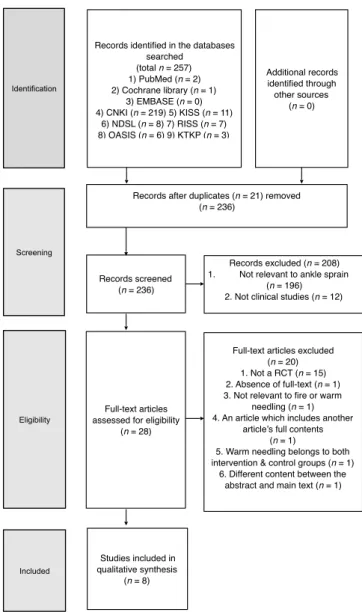
There were 257 studies initially retrieved in this study: 2 in PubMed, 1 in Cochrane library, 0 in EMBASE, 219 in CNKI, 11 in KISS, 8 in NDSL, 7 in RISS, 6 in OASIS, and 3 in KTKP. Of these, 21 were duplicated studies and were excluded. The titles and abstracts were checked, and a primary screening was conducted to exclude non-human clinical studies, and studies that were not related to ankle sprains. Then 208 studies were excluded through a primary screening. There were 28 studies remaining, which were read in full, resulting in 20 studies being excluded from this review (15 non-RCT studies, 1 non-verifiable study, 1 study that did not involve fire needling or warm needling treatments, 1 study that included some recently published data, 1 study that included warm needling treatment in the intervention group and the control
group, and 1 study where the abstract and the body of the text did not match). Finally, a total of 8 studies that fulfilled the inclusion and exclusion criteria were selected and a systematic review was conducted.
The data collecting and screening process are illustrated in Fig.
1 using the flow chart of preferred reporting items for systematic reviews and meta-analyses.
Country and year of publication
All 8 selected studies were published in China. By year, there was 1 study published in 2006, 3 studies published in 2018, 1 study published in 2017, 1 study published in 2015, and 2 published studies in 2013. There were 7 studies conducted in the last 5 years from 2013 to 2018 (Fig. 2).
Fig. 1. PRISMA flow diagram.
RCT, randomized controlled trials; PRISMA, preferred reporting items for systematic reviews and meta-analyses.
Identifi-cation
Records identified in the databases searched
(total n = 257) 1) PubMed (n = 2) 2) Cochrane library (n = 1)
3) EMBASE (n = 0) 4) CNKI (n = 219) 5) KISS (n = 11)
6) NDSL (n = 8) 7) RISS (n = 7) 8) OASIS (n = 6) 9) KTKP (n = 3)
Additional records identified through other sources
(n = 0)
Screening
Records after duplicates (n = 21) removed (n = 236)
Records screened (n = 236)
Records excluded (n = 208) 1. Not relevant to ankle sprain
(n = 196) 2. Not clinical studies (n = 12)
Eligibility Full-text articles assessed for eligibility
(n = 28)
Full-text articles excluded (n = 20) 1. Not a RCT (n = 15) 2. Absence of full-text (n = 1) 3. Not relevant to fire or warm
needling (n = 1) 4. An article which includes another
article’s full contents (n = 1)
5. Warm needling belongs to both intervention & control groups (n = 1) 6. Different content between the
abstract and main text (n = 1)
Included Studies included in qualitative synthesis
(n = 8)
Fig. 1. PRISMA flow diagram.
RCT, randomized controlled trials;
PRISMA, preferred reporting items for systematic reviews and meta- analyses.
Identification
Records identified in the databases searched (total n = 257) 1) PubMed (n = 2) 2) Cochrane library (n = 1)
3) EMBASE (n = 0) 4) CNKI (n = 219) 5) KISS (n = 11)
6) NDSL (n = 8) 7) RISS (n = 7) 8) OASIS (n = 6) 9) KTKP (n = 3)
Additional records identified through other sources
(n = 0)
Screening
Records after duplicates (n = 21) removed (n = 236)
Records screened (n = 236)
Records excluded (n = 208) 1. Not relevant to ankle sprain
(n = 196) 2. Not clinical studies
(n = 12)
Eligibility Full-text articles asse ssed for eligibility
(n = 28)
Full-text articles excluded (n = 20) 1. Not a RCT (n = 15) 2. Absence of full-text (n = 1) 3. Not relevant to fire or warm needli
ng (n = 1) 4. An article which includes another
article’s full contents (n = 1)
5. Warm needling belongs to both int ervention & control groups (n = 1) 6. Different content between the abs
tract and main text (n = 1)
Included Studies included in q ualitative synthesis
(n = 8)
Fig. 1. PRISMA flow diagram.
RCT, randomized controlled trials; P
RISMA, preferred reporting items for
systematic reviews and meta-analys
es.
Sample size of study
There were total 636 participants across the 8 studies which included 432 men, 196 women, and 8 dropouts. In each study, the total number of participants in the intervention, and control group was at least 62 and up to 100, with 3 studies with more than 50 and under 75, 4 studies with more than 75 and under 100, and 1 study with more than 100 participants (Fig. 3).
Intervention group treatment method
In the 8 selected studies, 4 studies included the fire needling treatment, 3 studies included the warm needling treatment, and 1 study that used both fire needling and warm needling treatments combined in the intervention group (Fig. 4).
Treatment number and period
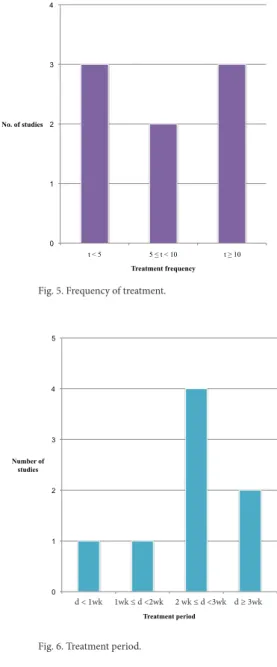
Regarding the number of times the treatment was performed, 3 studies treated their patients with under 5 times with fire or warm needling treatments (1 study treated their patients only once).
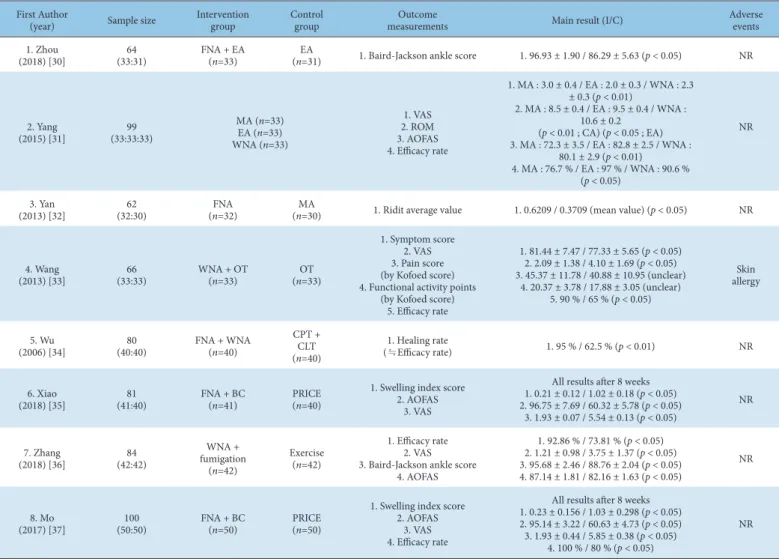
First Author
(year) Sample size Intervention
group Control
group Outcome
measurements Main result (I/C) Adverse
events 1. Zhou
(2018) [30] 64
(33:31) FNA + EA
(n=33) EA
(n=31) 1. Baird-Jackson ankle score 1. 96.93 ± 1.90 / 86.29 ± 5.63 (p < 0.05) NR
2. Yang
(2015) [31] 99
(33:33:33)
MA (n=33) EA (n=33) WNA (n=33)
1. VAS 2. ROM 3. AOFAS 4. Efficacy rate
1. MA : 3.0 ± 0.4 / EA : 2.0 ± 0.3 / WNA : 2.3
± 0.3 (p < 0.01)
2. MA : 8.5 ± 0.4 / EA : 9.5 ± 0.4 / WNA : 10.6 ± 0.2
(p < 0.01 ; CA) (p < 0.05 ; EA) 3. MA : 72.3 ± 3.5 / EA : 82.8 ± 2.5 / WNA :
80.1 ± 2.9 (p < 0.01) 4. MA : 76.7 % / EA : 97 % / WNA : 90.6 %
(p < 0.05)
NR
3. Yan
(2013) [32] 62
(32:30) FNA
(n=32) MA
(n=30) 1. Ridit average value 1. 0.6209 / 0.3709 (mean value) (p < 0.05) NR
4. Wang
(2013) [33] 66
(33:33) WNA + OT
(n=33) OT
(n=33)
1. Symptom score 2. VAS 3. Pain score (by Kofoed score) 4. Functional activity points
(by Kofoed score) 5. Efficacy rate
1. 81.44 ± 7.47 / 77.33 ± 5.65 (p < 0.05) 2. 2.09 ± 1.38 / 4.10 ± 1.69 (p < 0.05) 3. 45.37 ± 11.78 / 40.88 ± 10.95 (unclear)
4. 20.37 ± 3.78 / 17.88 ± 3.05 (unclear) 5. 90 % / 65 % (p < 0.05)
allergy Skin
5. Wu
(2006) [34] 80
(40:40) FNA + WNA
(n=40)
CPT + (n=40) CLT
1. Healing rate
(≒Efficacy rate) 1. 95 % / 62.5 % (p < 0.01) NR
6. Xiao
(2018) [35] 81
(41:40) FNA + BC
(n=41) PRICE
(n=40)
1. Swelling index score 2. AOFAS
3. VAS
All results after 8 weeks 1. 0.21 ± 0.12 / 1.02 ± 0.18 (p < 0.05) 2. 96.75 ± 7.69 / 60.32 ± 5.78 (p < 0.05)
3. 1.93 ± 0.07 / 5.54 ± 0.13 (p < 0.05)
NR
7. Zhang
(2018) [36] 84
(42:42)
WNA + fumigation
(n=42)
Exercise (n=42)
1. Efficacy rate 2. VAS 3. Baird-Jackson ankle score
4. AOFAS
1. 92.86 % / 73.81 % (p < 0.05) 2. 1.21 ± 0.98 / 3.75 ± 1.37 (p < 0.05) 3. 95.68 ± 2.46 / 88.76 ± 2.04 (p < 0.05) 4. 87.14 ± 1.81 / 82.16 ± 1.63 (p < 0.05)
NR
8. Mo
(2017) [37] 100
(50:50) FNA + BC
(n=50) PRICE
(n=50)
1. Swelling index score 2. AOFAS
3. VAS 4. Efficacy rate
All results after 8 weeks 1. 0.23 ± 0.156 / 1.03 ± 0.298 (p < 0.05) 2. 95.14 ± 3.22 / 60.63 ± 4.73 (p < 0.05) 3. 1.93 ± 0.44 / 5.85 ± 0.38 (p < 0.05)
4. 100 % / 80 % (p < 0.05)
NR
I, intervention group; C, control group; FNA, fire needling acupuncture; EA, electro-acupuncture; WNA, warm needling acupuncture; MA, manual acupuncture; OT, ointment treatment;
CPT, contusion paste therapy (ointment); CLT, contusion liquid therapy; BC, blood letting cupping; PRICE, protection·rest·ice·compression·elevation; AOFAS, American orthopedic foot and ankle score; VAS, visual analogue scale.
Table 1. Data of Included Studies.
Fig. 2. Summary of publication year.
0 1 2 3 4
2006 2013 2015 2017 2018
No. of publications
Publication year
Fig. 2. Summary of publication year.
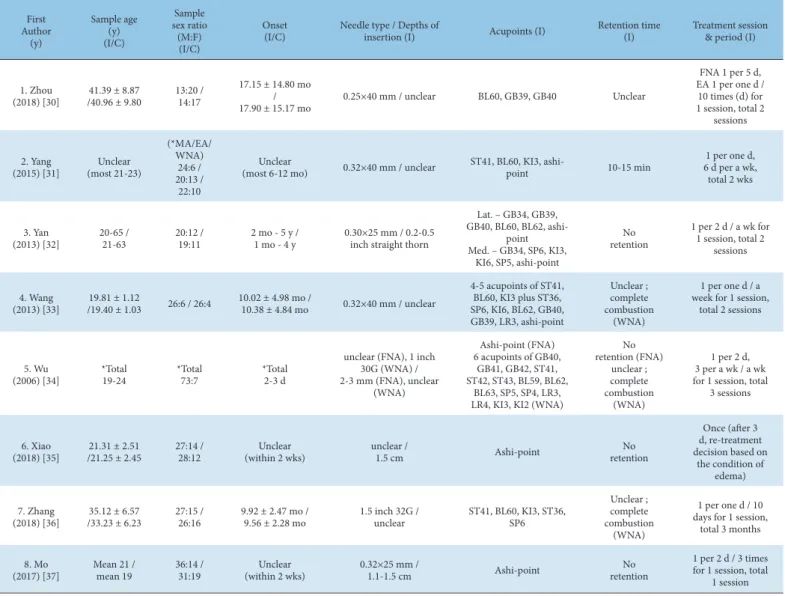
First Author (y)
Sample age (I/C) (y)
Sample sex ratio (M:F) (I/C)
Onset
(I/C) Needle type / Depths of
insertion (I) Acupoints (I) Retention time
(I) Treatment session
& period (I)
1. Zhou
(2018) [30] 41.39 ± 8.87
/40.96 ± 9.80 13:20 / 14:17
17.15 ± 14.80 mo
17.90 ± 15.17 mo / 0.25×40 mm / unclear BL60, GB39, GB40 Unclear
FNA 1 per 5 d, EA 1 per one d / 10 times (d) for 1 session, total 2
sessions
2. Yang
(2015) [31] Unclear (most 21-23)
(*MA/EA/
WNA) 24:6 / 20:13 /
22:10
Unclear
(most 6-12 mo) 0.32×40 mm / unclear ST41, BL60, KI3, ashi-
point 10-15 min 1 per one d,
6 d per a wk, total 2 wks
3. Yan
(2013) [32] 20-65 /
21-63 20:12 /
19:11 2 mo - 5 y /
1 mo - 4 y 0.30×25 mm / 0.2-0.5 inch straight thorn
Lat. – GB34, GB39, GB40, BL60, BL62, ashi-
point Med. – GB34, SP6, KI3,
KI6, SP5, ashi-point
retention No
1 per 2 d / a wk for 1 session, total 2
sessions
4. Wang
(2013) [33] 19.81 ± 1.12
/19.40 ± 1.03 26:6 / 26:4 10.02 ± 4.98 mo /
10.38 ± 4.84 mo 0.32×40 mm / unclear
4-5 acupoints of ST41, BL60, KI3 plus ST36, SP6, KI6, BL62, GB40, GB39, LR3, ashi-point
Unclear ; complete combustion
(WNA)
1 per one d / a week for 1 session,
total 2 sessions
5. Wu
(2006) [34] *Total
19-24 *Total
73:7 *Total
2-3 d
unclear (FNA), 1 inch 30G (WNA) / 2-3 mm (FNA), unclear
(WNA)
Ashi-point (FNA) 6 acupoints of GB40,
GB41, GB42, ST41, ST42, ST43, BL59, BL62,
BL63, SP5, SP4, LR3, LR4, KI3, KI2 (WNA)
retention (FNA) No unclear ; complete combustion
(WNA)
1 per 2 d, 3 per a wk / a wk for 1 session, total
3 sessions
6. Xiao
(2018) [35] 21.31 ± 2.51
/21.25 ± 2.45 27:14 /
28:12 Unclear
(within 2 wks) unclear /
1.5 cm Ashi-point No
retention
Once (after 3 d, re-treatment decision based on
the condition of edema) 7. Zhang
(2018) [36] 35.12 ± 6.57
/33.23 ± 6.23 27:15 /
26:16 9.92 ± 2.47 mo /
9.56 ± 2.28 mo 1.5 inch 32G /
unclear ST41, BL60, KI3, ST36, SP6
Unclear ; complete combustion
(WNA)
1 per one d / 10 days for 1 session,
total 3 months 8. Mo
(2017) [37] Mean 21 /
mean 19 36:14 /
31:19 Unclear
(within 2 wks) 0.32×25 mm /
1.1-1.5 cm Ashi-point No
retention
1 per 2 d / 3 times for 1 session, total
1 session I, intervention group; C, control group; FNA, fire needling acupuncture; EA, electro-acupuncture; WNA, warm needling acupuncture; MA, manual acupuncture.
Table 2. Characteristics of Intervention and Control Groups.
Fig. 4. The type of intervention group treatment (including combination treatment).
0 1 2 3 4 5
Fire needling Warm needling Fire needling plus Warm needling No. of
studies
Types of treatment
Fig. 4. The type of intervention group treatment.
Including combination treatment Fig. 3. Sample size of studies.
0 1 2 3 4 5
50 ≤ n < 75 75 ≤ n < 100 n ≥ 100
No. of studies
Sample size Fig. 3. Sample size of studies.
50 ≤ N < 75 75 ≤ N < 100 N ≥ 100
Fig. 7. Classification of studies by morbidity period.
0 1 2 3 4 5 6
Acute Chronic
No. of studies
Classification of studies by morbidity period Fig. 7. Classification of studies by morbidity period.
Fig. 5. Frequency of treatment.
0 1 2 3 4
t < 5 5 ≤ t < 10 t ≥ 10
No. of studies
Treatment frequency Fig. 5. Frequency of treatment.
Furthermore, 2 studies performed the treatment with more than 5 and under 10 times, and 3 studies treated their patients more than 10 times (Fig. 5).
Regarding the treatment period, there were 4 treatments for more than 2 weeks and under 3 weeks, 2 treatments for more than 3 weeks, 1 treatment for less than 1 week, and 1 treatment for more than 1 week and under 2 weeks (Fig. 6).
Classification by morbidity period
Of the 8 studies, 3 studies had acute ankle sprains within 2 weeks, and 5 studies had chronic ankle sprains of more than 1 month (Fig. 7).
Frequency of use of therapeutic acupoints and meridians
In analyzing the frequency of use of meridians, the acupoints of the gallbladder meridian (GB) were used 11 times, the bladder meridian (BL) was used 10 times, and the stomach meridian (ST) and kidney meridian (KI) were used 8 times each. The acupoints of the spleen meridian (SP) were used 6 times, and the liver meridian (LR) was used 3 times. In analyzing therapeutic acupoints used across the 8 studies, the ashi-point (tenderness point) was selected 7 times (ca.13.2%), while BL60 and KI3 were selected 5 times (ca.
9.4%). ST41 and GB40 were selected 4 times (ca.7.5%), and GB39, BL62, and SP6 were selected 3 times (ca.5.7%) each (Tables 3 and 4).
Evaluation index
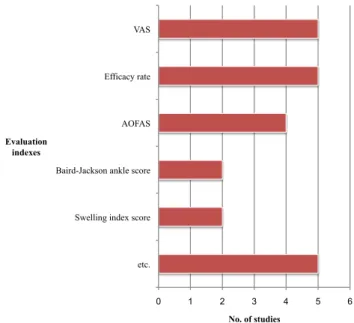
There were between 1 and 5 evaluation indexes used for each study. There were 5 studies that selected the Visual Analogue Scale (VAS), and the total efficacy rate. There were 4 studies that selected the American Orthopedic Foot and Ankle Score (AOFAS), and 2 studies that used the Baird-Jackson ankle score and the Swelling index score. The remaining evaluation indexes were used once (Fig. 8).
Treatment of control group
There were 2 studies each using electro-acupuncture, manual acupuncture, ointment patch, or Protection, rest, ice, compression, elevation (PRICE) as the control group. In addition, there was 1 study each that used exercise, and contusion paste and liquid remedy (Fig. 9).
Therapeutic effect
In all 8 studies, the intervention group showed beneficial results before and after evaluation compared with the control group. Yang [31] reported that electro-acupuncture and warm needling were statistically significantly more beneficial (using VAS, AOFAS, and total efficacy rate) in the treatment of ankle sprains when compared with manual acupuncture. However, after treatment, the VAS value was lower in the electro-acupuncture group than in the warm needling group, and the AOFAS value and the total efficacy rate were higher in the electro-acupuncture group than in the warm needling group. In the ROM index, the warm needling group showed a significant difference as compared with the manual acupuncture group and the electro-acupuncture group, respectively Wang [33] reported that the symptom score, VAS value, and efficacy rate for warm needling combination treatment showed this intervention significantly more beneficial than ointment treatment.
However, the pain score and functional activity points based on the Kofoed score for warm needling combination treatment
Fig. 6. Treatment period.
0 1 2 3 4 5
d<1w 1w≤d<2w 2w≤d<3w d≥3w
Number of studies
Treatment period Fig. 6. Treatment period.
d < 1wk 1wk ≤ d <2wk 2 wk ≤ d <3wk d ≥ 3wk
was less beneficial than the ointment treatment group. Except for the above-mentioned sections, the results of the 8 selected studies showed that the intervention group showed statistically significant improvement compared with the control group on all the evaluation indexes.
Adverse events
There were no reports of adverse events reported in 7 studies.
In the study by Wang [33], skin hypersensitivity was observed in 5 patients (2 cases during ointment treatment were reported in the
Frequency Name of acupoints
7 Ashi-point
5 BL60
5 KI3
4 ST41
4 GB40
3 GB39
3 BL62
3 SP6
2 GB34
2 KI6
2 SP5
2 ST36
2 LR3
1 GB41
1 GB42
1 ST42
1 ST43
1 BL59
1 BL63
1 SP4
1 LR4
1 KI2
53 Total 22 acupoints
Table 3. Frequency of Acupoints.
Frequency Name of meridians
11 Gallbladder meridian (GB)
10 Bladder meridian (BL)
8 Stomach meridian (ST)
8 Kidney meridian (KI)
6 Spleen meridian (SP)
3 Liver meridian (LR)
7 Ashi-point
53 Total 6 meridians and ashi-point
Table 4. Distribution of Selected Meridians.
Fig. 8. Evaluation indexes.
AOFAS, American orthopedic foot and ankle Score; VAS, visual analogue scale.
0 1 2 3 4 5 6
etc.
Swelling index score Baird-Jackson ankle score AOFAS Efficacy rate VAS
No. of studies Evaluation
indexes
Fig. 8. Evaluation indexes.
Fig. 9. Treatments of control group.
PRICE, protection·rest·ice·compression·elevation.
0 1 2 3
etc.
Exercise PRICE Ointment therapy Manual acupuncture Electro-acupuncture
No. of studies Type of control
group treatments
Fig. 9. Treatments of control group.
intervention group, and 3 cases in the control group).
Risk of bias assessment
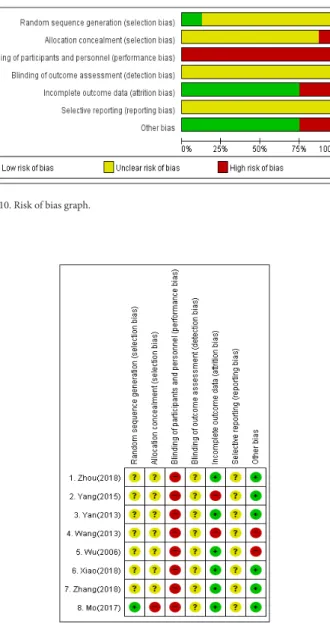
The risk of bias was assessed for 8 studies using the Cochrane risk of bias tool. The results of the bias risk assessment are plotted using the Revman program (Figs. 10 and 11).
Random sequence generation
In 1 low-risk study, random assignments were made using a lottery ticket. In the remaining 7 studies, the expression “random assignments” was used without describing how this was performed.
Since the randomization method was not specified, it was classified as an unclear risk.
Allocation concealment
One high-risk study was randomized using a raffle table with randomized ordering and was classified as high risk because there
was no concealment or safeguarding. The remaining studies were classified as an unclear risk because there was no mention of concealment order allocation.
Blinding of participant and personnel
All studies were classified as high risk because sham treatment was not used in any study. Due to the nature of the interventions (fire needling or warm needling) blinding of the participant and personnel was not possible
Blinding of the outcome assessment
There was no mention that the results were blinded to the evaluator in the evaluation of the study, so all 8 studies were classified as an unclear risk.
Incomplete outcome data
A total of 6 studies were classified as low risk, because the total number of participants in the intervention and control groups had no missing value before and after the start of the study. In 2 studies, the number of missing values was uneven in the intervention and control groups, and thus these studies were classified as high risk.
Selective reporting
All 8 studies were classified as an unclear risk because there was no mention of protocols and preplanning.
Other bias
In 2 studies, the treatment time of the ointment patch applied to the control group was not clear, therefore, it was classified as high risk, because there was a risk of other distortions. In the remaining studies, no additional bias risk was identified and thus the studies were classified as low risk.
Discussion
Fire needling is a treatment used for various conditions/diseases by heating the tip of a needle prior to inserting into a specific part of the body or acupoints. Fire needling uses “heat” as a therapy as an adjunct to the effects of acupuncture and moxibustion combined [1]. Warm needling is an acupuncture method that treats blocked meridians and acupoints by applying the power of moxibustion heat into the meridians, to strengthen energy and move the blood [1].
Recently, some studies have been conducted due to the increased interests in the treatments of fire needling or warm needling for ligament damage such as ankle sprains [22,23,28]. However, the effect of the treatments is still not clear and the numbers of RCT studies are lacking.
In this present study, fire needling or warm needling for ankle sprains was reviewed in 8 RCT. All 8 studies were published in China, with most published in the 2010s. Across the 8 RCT there were a total of 636 participants with more than 50% more males than females. This may be due males participating in more frequent and vigorous exercise.
As for interventions, there were 4 studies containing the fire needling treatment, 3 studies containing the warm needling treatment, and 1 study using the fire and warm needling treatment together. One study compared fire or warm needling treatments with other acupuncture treatments and, there were 2 studies that used blood-letting therapy as a combination therapy for the fire needling treatment. In addition, there was a study that did not mention the blood-letting therapy in the title or abstract.
It may be necessary to consider whether this therapy is used to remove exudates that flow out around the point after fire needling
Fig. 11. Risk of bias summary. (+) : Low risk of bias, (-) : high risk of bias, (?) : unclear risk of bias.
Fig. 11. Risk of bias summary. (+) : Low risk of bias, (-) : high risk of bias, (?) : unclear risk of bias.
Fig. 10. Risk of bias graph.
Fig. 10. Risk of bias graph.