J. Exp. Biomed. Sci. 13 (2007) 83–89
A Clinical Trial of Orally Administered Alkaline Reduced Water
Eun Ju Yang1, Jung Rye Kim1, Yong Seok Ryang1, Dong Heui Kim2, Young Kun Deung2, Seung Kyu Park3 and Kyu Jae Lee3,†
1Department of Biomedical Laboratory Science and Institute of Health Science, College of Health Science, Yonsei University, Wonju 220-710, Korea.
2Department of Basic Science, and 3Department of Parasitology and Institute of Basic Medical Science, College of Medicine, Yonsei University, Wonju 220-701, Korea
Effects of alkaline reduced water (ARW) on the scavenging of reactive oxygen species (ROS) and diabetes were recently reported. However, no studies have yet been investigated on general drinking effects. In this study, we examined 100 patients hospitalized for senile disease treatment and recuperation. All examinees received the ARW for 2 months.
WBC level was decreased from 6.34±1.9 (×109/L) to 5.66±1.7 (×109/L). SGPT level was decreased from 27.47±14 U/L to 23.95±8.8 U/L. Cholesterol level was increased from 167.9±32 mg/dl to 176.21±42 mg/dl within normal range.
However, the levels of potassium, adiponectin, SGOT and blood pressure showed no significant difference. The levels of growth hormone and homocysteine and mini-mental state examination also showed no significant difference. We suppose that the slight blood parameter trends indicate an improved physical condition induced by the ARW. Furthermore, we could found no harmful effect of the ARW in this study.
Key Words: Alkaline reduced water, Blood parameter, Clinical investigation, Human
INTRODUCTION
In general, alkaline reduced water (ARW) generated at the negative cathode plate in a water electrolyzer pool, has a high alkalinity and low oxidation-reduction potential (ORP). Before ionization, the water is purified by charcoal, membrane and UV filters to remove impurities such as chloride, microorganisms, and harmful chemicals. During ionization, the alkaline water generated at the cathode has a high molecular hydrogen saturation. The acidic water gene- rated at the anode has a high molecular oxygen saturation.
Four OH- ions and two H2 molecules are generated from four H2O molecules and our electrons reacting at the cathode.
The alkaline water generated from the electrolyzer has a high density of positive ion minerals and a high deoxi- dization potential, due to the low ORP. ARW has a pH of 7.5~10 and an ORP-50 of ~-500 mV. Tap water is H 6~7
and ORP-100~300 mV.
Shirahata et al (1997) reported that reactive oxygen species (ROS) are removed from ARW and proposed the active hydrogen theory. His theory proposes that the active hydrogen in ARW functions similar to superoxide dismutase (SOD) in preventing DNA breakage caused by ROS, and is the initiative for experimental ARW trials. Hanaoka (2001) reported that ARW's effects don't originate from its anti- oxidative effects, but rather, its support of other antioxidants (Hanaoka, 2001). Prior to this, ARW's antioxidative effects were thought to be its most effective characteristic (Chen, et al., 2003; Feig et al., 1994; Reid and Loeb, 1992). ROS oxidative stress can aggravate several diseases, such as:
cancer, diabetes, atopic dermatitis, hypertension, cardiova- scular disease, liver disease, senile disease and dementias (Cai and Harrison, 2000; Eid et al., 2002; Kagawa et al., 1997; Kim et al., 2002; Rho and Kim, 2002; Saller et al., 2001; Sedeek et al., 2003; Zekry et al., 2003). The atomic hydrogen, ORP, H2O cluster and alkalinity are all known to be important ARW functional elements. Among these, low degree ORP and hydrogen are presumed to be the biggest contributors to the antioxidative effect (Shirahata et al., 1997).
*Received: March 16, 2007 Accepted after revision: June 8, 2007
†Corresponding author: Kyu Jae Lee, Department of Parasitology, Wonju College of Medicine, Yonsei Univerisity, Wonju 220-701, Korea.
Tel: +82-33-741-0331, Fax: +82-33-731-6953 e-mail: [email protected]
Recent research has shown that ARW has diverse bene- ficial effects on diabetes, hyperlipidemia and abnormal intestinal fermentation (Lee et al., 2004; Park et al., 2004).
Based on these and other ARW effects, its usage has spread into the food and agriculture industries. On the other hand, there have been continuous skeptical problems regarding the safety of oral ARW administration. AWR might enhance gastric secretion, thereby negatively affecting the stomach.
Watanabe (1997) reported a pathologic change in rat cardiac muscle following oral ARW administration, and it seems that hyperkalemia might have been involved.
Until now, very few experiments have confirmed the clinical effects and safety of ARW. This experiment was performed to study several parameters related to oral ARW administration.
MATERIALS AND METHODS
1. Experimental group and oral ARW administration
In this study, we examined 100 patients (Table 1) hospi- talized for senile disease treatment and recuperation in Gyeongbuk Geriatric Provincial Hospital, Andongshi, Korea.
All examinees received 1.5 liters of ARW (pH 9.5, ORP -100 mV) a day for 2 months. The ARW was generated in an electrolyzer (BTM 500. Biontech Co. LTD).
2. Examination of blood parameters
Blood pressure was used as an evaluation of the patients' general condition. Each examinee had several blood para- meters measure before and after ARW treatment. Electro- lytes (kalium and potassium), liver enzymes [serum glu- tamic oxaloacetic transaminase (SGOT) and serum glutamic pyruvic transaminase (SGPT)], cholesterol, adiponectin and human growth hormone (HGH) were measured after blood centrifugation.
White blood cells (WBC) were measured by an automatic granular counter (XE-2100 Sysmex Co. Korea). Electrolytes were indirectly measured by ion selective electrodes (Hitachi
ISE, Toshiba ISE, Japan). Liver enzymes were measured by a kinetic UV method, and cholesterol levels were measure by the cholesterol reagent enzyme method (Toshiba-200FR, Japan). Adiponectin was detected by a cobra II counter (Packard, USA) after radioimmunoassay with the RIA kit (Linco Research. Inc., USA). Human Growth Hormone (HGH) was also detected on a cobra II counter after immu- noradiometric assay (IRMA) with the Daiich GH Kit (TFB, Japan). Homocysteine was detected by Axsym (Abbott, USA) with a fluorescence polarization immunoassay (FPIA) and the appropriate homocysteine reagents (Abbot, USA).
3. The mental state evaluation
The Korean mini-mental state examination (K-MMSE) score was used to evaluate the mental recognition in aged dementia patients. The K-MMSE is designed to evaluate memory, verbal, counting and concentration abilities (Lee, 2001). A perfect K-MMSE score is 30, and a score less than 24 is reason to infer dementia.
4. Statistical analysis
The data was analyzed by Sigma Plot 7.0 using the Student's t-test.
RESULTS
1. Blood parameter changes after oral ARW admini- stration
The white blood cell (WBC) count had a decreasing trend [6.34±1.9 (×109/L) to 5.66±1.7 (×109/L)] following two months of ARW treatment (Fig. 1). Potassium levels were no different (3.98±0.3 mmol/L before and 3.95±0.3 mmol/L after) (Fig. 2). SGOT (a liver enzyme) levels were not significantly different, going from 21.26±5.2 U/L before to 21.37±5.8 U/L after treatment. SGPT levels decreased slightly from 27.47±14 U/L to 23.95±8.8 U/L (Fig. 3).
Adiponectin was 14.87±8.23 µg/ml before and 15.11±
8.49 µg/ml after ARW treatment (Fig. 4). Cholesterol levels Table 1. Age and sex distribution of the 100 patients
Age
Sex 31~40 41~50 51~60 61~70 71~80 81~90 91~ Total
Female 0 1 4 11 19 23 4 62
Male 1 4 5 15 9 4 0 38
Total 1 5 9 16 28 27 4 100
appeared to increase slightly from 167.9±32 mg/dl to 176.21±42 mg/dl, though this is within the normal range (Fig. 5). Human growth hormone (HGH) was found to be 1.55±1.83 mg/ml before and 1.75±2.71 mg/ml after, again showing no significant difference (Fig. 6). Both systolic and diastolic blood pressure remained stable. The systolic blood pressure was 126.84±12.0 mmHg before and 124.74±9.05 mmHg after treatment. Diastolic was 73.16±8.2 mmHg before and 71.58±6.02 mmHg after treatment (Fig. 7).
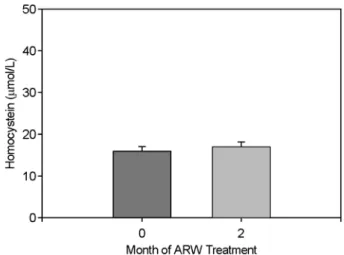
Homocysteine was 15.94±7.20 µmol/L before and 16.96±
7.73 µmol/L after treatment (Fig. 8).
2. The K-MMSE score
The K-MMSE score was 17.68±7.34 before ARW treat- ment. After two months of ARW treatment the K-MMSE Fig. 1. Peripheral blood mean WBC after ARW treatment. Bar
indicates mean ± standard deviation (n=19).
Fig. 2. Serum kalium levels after ARW treatment. Bar indicates mean ± standard deviation (n=19).
Fig. 4. Serum adiponectin concentrations after ARW treatment.
Bar indicates mean ± standard deviation (n=19).
Fig. 3. Serum SGOT and SGPT changes after ARW treatment.
Bar indicates mean ± standard deviation (n=19).
Fig. 5. Serum cholesterol levels after ARW treatment. Bar in- dicates mean ± standard deviation (n=19).
scores were not significantly different (17.79±7.63) (Fig. 9).
DISCUSSION
Leading a healthy life is of common interest in modern society. Oral ARW administration began in Japan and has been used for medical materials both in Japan and Korea for decades. Drinking ARW is increasing in popularity as new information on its positive biological effects is eluci- dated. ARW's primary beneficial mechanism is as an anti- oxidant (Chen et al., 2003; Feig et al., 1994; Hanaoka, 2001;
Reid and Loeb, 1992; Shirahata et al., 1997). In general, ROS are essential to life and disappear when they react. A ROS overdose can damage the human body and induce the development of several diseases (Cai and Harrison, 2000;
Eid et al., 2002; Kagawa et al., 1997; Kim et al., 2002; Rho and Kim, 2002; Saller et al., 2001; Sedeek et al., 2003;
Zekry et al., 2003). Although a conjecture has been made relating ARW to beneficial effects on several diseases, no clinical trial on the safety and general effects of ARW has been done. This research followed several basic wellness parameters after oral ARW administration. Though most of the data didn't change significantly, we were able to estimate the general effects by comparison to prior research and reports.
ARW has several features that make it distinct from general purified drinking water, such as small H2O cluster size and high H2 density. Given the nature of the ARW H2O cluster, ARW could pass through the smallest spaces at high speed, thus eliminating bodily waste. Recently, it has been Fig. 6. Serum human growth hormone levels after ARW treat-
ment. Bar indicates mean ± standard deviation (n=20).
Fig. 7. Systolic and diastolic blood pressure change after ARW treatment. Bar indicates mean ± standard deviation (n=19).
Fig. 8. Serum homocysteine concentrations after ARW treatment.
Bar indicates mean ± standard deviation (n=45).
Fig. 9. Mini-mental state examination (MMSE) scores after ARW treatment. Bar indicates mean ± standard deviation (n=38).
seen that ARW modulates intestinal immune function in an infected trematode (unpublished data). Because there are no added mineral or drug components in ARW, the water will at least not damage the human body and could have beneficial effects.
The serum WBC count showed a decreasing trend after ARW treatment in old-age hospitalized patients. WBC, in- cluding mast cells, plasma cells, monocytes and macro- phages, is part of the immune response and can move to a reaction site. An increased WBC count, within the normal range, indicates inflammation. A decreased WBC count, within the normal range, shows an alleviation of symptoms and is a sign of a healthy condition. Potassium, a serum electrolyte, did not change with ARW treatment. Watanabe (1997) reported that oral ARW administration caused hyper- kalemia and pathologic changes, such as WBC infiltration and heart muscle fibrosis in rats. Hyperkalemia is serious sign of risk in the aged, because it can cause ventricular fibrillation and atrioventricular blockage due to increasing intracellular potassium. This study showed normal pota- ssium levels after ARW treatment for 2 months. Watanabe presumed that an increased metabolism due to oral ARW administration and organic substances in the ARW might cause hyperkalemia. In a mouse model, inflammation or histological differences were observed when compared to the control group after ARW oral administration (Yang et al., 2006). Our research suggests that the intake of different foods might adjust any electrolyte disequilibrium.
SGOT is found in the liver, heart, kidney, brain and muscle while SGPT is mainly found in the liver (Little, 1970). Both of these intracellular enzymes increase in response to liver inflammation and liver cell necrosis (Little, 1970; Yoon et al., 1981). There was no change in SGOT though SGPT showed a decreasing trend within the normal range. Thus drinking ARW does not influence liver function.
Adiponectin and cholesterol both tended to increase after ARW treatment. Adiponectin is a cytokine released from adipose tissue that oxidizes lipids in muscle. Low blood adiponectin levels are related to obesity, atherosclerosis and hyperlipidemia (Lee et al., 2005). Cholesterol is involved in hormone synthesis, cellular maintenance, glucose meta- bolism, electrolyte balance, and sexual function. At high blood levels, however, it can cause atherosclerosis and cardiovascular disorder (Connor et al., 1994; Hayek et al., 1995). Cholesterol is supplied extrinsically (food intake)
and intrinsically (synthesis in the liver, adrenal gland, and other organs). The amount of cholesterol synthesis in liver depends on extrinsic cholesterol. Insufficient extrinsic chole- sterol results in enhanced liver cholesterol formation, HMG- CoA reductase elevation and increased LDL receptor pro- duction (Kienle et al., 1973; Watkinson et al., 1971). The slightly increasing cholesterol levels, within normal range, are conjectured to be a compensation for the decreased cholesterol from adiponectin lipid oxidation. We saw reduced serum cholesterol in OLETF rats after 8 months of ARW treatment (Jin et al., 2006). We also saw similar liver lipid metabolism results in broiler chickens after a one-month ARW treatment. RT-PCR for HMG-CoA reductase, (a cho- lesterol synthesis enzyme) and CYP7A1 (a cholesterol digestion enzyme) were liver lipid metabolism markers.
While serum cholesterol decreased, HMG-CoA reductase mRNA increased and CYP7A1 mRNA did not change (Unpublished data). ARW might reduce serum cholesterol and compensate for a lack of cholesterol synthesis due to an HMG-CoA reductase increase.
HGH is involved in protein synthesis, energy production and organ development, thus, it is a concern in aging and lipid degradation (Rogol, 1989). After ARW treatment, a slight increase in serum HGH was found, suggesting an increase in lipid degradation. Both systolic and diastolic blood pressure decreased within the normal range after 2 months of ARW treatment. Dementia results in chronic cognitive function failure. The MMSE (mini-mental state examination) is carried out to understand the degree of dementia (Garcia and Zanibbi, 2004; Lee, 2001). Homo- cysteine, a methionine metabolite related to brain atrophy, atherosclerosis and Alzheimer's disease, increases in pro- gressive dementia (Ellinson et al., 2004; Garcia and Zanibbi, 2004; Welch and Loscalzo, 1998). Neither a positive nor negative effect on dementia as measured by K-MMSE and homocysteine was observed.
We found that there were neither distinct beneficial nor harmful effects in aged patients due to ARW. All blood parameters measured in this study were within the normal range and differences were not statistically significant. Based on these results, ARW does not induce any bad effects and might lead to a favorable body condition. Until now, only limited data on the clinical effects of ARW oral administra- tion has been available. Further clinical trials are therefore needed.
REREFENCES
Cai H, Harrison DG. Endothelial dysfunction in cardiovascular diseases: the role of oxidant stress. Circ Res. 2000. 87: 840 -844.
Chen K, Thomas SR, Keaney JFJ. Beyond LDL oxidation: ROS in vascular signal transduction. Free Radic Biol Med. 2003.
35: 117-132.
Connor WE, Stone DB, Hodges RE. The interrelated effects of dietary cholesterol and fat upon human serum lipid levels. J Clin Invest. 1994. 43: 1691-1696.
Eid HM, Lyberg T, Larsen J, Arnesen H, Seljeflot I. Reactive oxygen species generation by leukocytes in populations at risk for atherosclerotic disease. Scand J Clin Lab Invest. 2002.
62: 431-439.
Ellinson M, Thomas JAP. A critical evaluation of the relationship between serum vitamikn B12, folate and total homucysteine with cognitive impairment in the elderly. J Hum Nutr Dietet.
2004. 17: 371-383.
Feig DI, Reid TM, Loeb LA. Reactive oxygen species in tumori- genesis. Cancer Res. 1994. 54: 1890s-1894s.
Garcia A, Zanibbi K. Homocysteine and cognitive function in elkerly people. CMAJ. 2004. 171: 897-904.
Hanaoka K. Antioxidant effects of reduced water produced by electrolysis of sodium chloride solution. J Appl Electrochem.
2001. 31: 1307-1313.
Hayek T, Masucci-Magoulas L, Jiang X, Walsh A, Rutin E, Bneslow JL. Decreased early atherosclerotic lesions in hyper- triglyceridemic mice expressing cholesteryl ester transgene. J Clin Invest. 1995. 96: 2071-2074.
Jin D, Ryu SH, Kim HW, Yang EJ, Lim SJ, Ryang YS. Anti- Diabetic Effect of Alkaline-Reduced Water on OLETF Rats.
Biosci Biotechnol Biochem. 2006. 70: 1-7.
Kagawa Y, Cha SH, Hasegawa K, Hamamoto T, Endo H. Regula- tion of energy metabolism in human cells in aging and diabetes: FoF(1), mtDNA, UCP, and ROS. Bionchem Bio- phys Res Commun. 1997. 26: 662-676.
Kienle MG, Varma RK, Muheim LJ, Yagen B, Caspi E. Reduction of 24 of lanosterol in the biosynthesis of cholesterol by rat liver enzymes. II. Stereochemistry of addition of the C-25 proton. J Am Chem Soc. 1973. 95: 1996-2001.
Kim JH, Kwon MJ, Lee SY, Ryu JD, Moon GS, Cheigh HS. The Effect of Kimchi Intake on Production of Free Radicals and Anti-oxidantive Enzyme actitivies in the Liver of SAM. J
Kor Soc Food Sci Nutr. 2002. 31: 109-116.
Lee HS, Choi JS, Kim WY. The Study on the Serum Levels of Risistin, Adiponectin, and Leptin in Obese Children. J Kor Nutr Soc. 2005. 38: 197-202.
Lee JH. Cause, evaluation and treatment of dementia-for primary care physician. J Kor Acad Fam Med. 2001. 22: 619-628.
Lee KJ, Park SK, Sung JS, Kim DH, Deung YK, Kim MC, Yang EJ, Lim SJ, Ryang YS, Kim HW, Effect of electrolyzed- reduced water: in vivo and in vitro examination and clinical trials. The 3rd Asia Pacific Conference on Evidence-Based Medicine (Hong Kong) 113 (2004).
Little DM. Postoperative hepatic function tests. Int Anesth Clin.
1970. 8: 203.
Park SK, Lee KJ, Yang EJ, Lim SJ, Ryang YS, Jin D, Kim HW, Deung YK, Kim DH, Effect of mineral-induced alkaline- reduced water: scavenging of reactive oxygen species, sup- pression of B16BL6 metastasis and decrease of blood glo- cose concentration. International Symposium on Current Topics in Biomedicine (Seoul) M-15 (2004).
Reid TM, Loeb LA. Mutagenic specificity of oxygen radicals pro- duced by human leukemia cells. Cancer Res. 1992. 52: 1082 -1086.
Rho KA, Kim MK. Age-related Changes of DNA Damage and Antioxidative Capacity in Rats. J Kor Nutr Soc. 2002. 35:
279-290.
Rogol AD. Growth hormone physiology, therapeutic use, and potential for abuse. Exerc Sport Sci Rev. 1989. 17: 353-377.
Saller R, Meier R, Brignoli R. The use of silymarin in the treatment of liver diseases. Drugs 2001. 61: 2035-2063.
Sedeek MH, Llinas MT, Drummond H, Fortepiani L, Abram SR, Alexander BT, Reckelhoff JF, Granger JP. Role of reactive oxygen species in endothelin-induced hypertension. Hyper- tension 2003. 42: 806-810.
Shirahata S, Kabayama S, Nakano M, Miura T, Kusumoto K, Gotoh M, Hayashi H, Otsubo K, Morisawa S, Katakura Y.
Electrolyzed-reduced water scavenges active oxygen species and protects DNA from oxidative damage. Biochem Biophys Res Commun. 1997. 234: 269-274.
Watanabe T, Kishikawa Y, Shirai W. Influence of alkaline ionized water on rat erythrocyte hexokinase activity and myocardium.
J Toxicol Sci. 1997. 22: 141-152.
Watkinson IA, Wilton DC, Rahimtula AD, Akhtar MM. The sub- strate activation in some pyridine nucleotide linked enzymic reactions. The conversion of desmosterol into cholesterol. Eur J Biochem. 1971. 23: 1-6.
Welch GN, Loscalzo J. Homocysteine and atherothrombosis. N Engl J Med. 1998. 338: 1042-1050.
Yang EJ, Lim SJ, Ryang YS, Lee SG, Kwon KR, Deung YK. The study on the safety of alkaline reduced water for drinking in the ICR mice. Newest Med J. 2006. 48: 11-17.
Yoon SY, Yoon DM, Park KW. Changes of Serum Transaminase
Levels after Open Heart Surgery. Kor J Anesthesiol. 1981.
14: 396-404.
Zekry D, Epperson TK, Krause KH. A role for NOX NADPH oxidases in Alzheimer's disease and other types of dementia?
IUBMB Life 2003. 55: 307-313.