Secular Trends in Pediatric Overweight and Obesity in Korea
Jae Hyun Kim
1,*, Jin Soo Moon
21Department of Pediatrics, Seoul National University Bundang Hospital, Seongnam; 2Department of Pediatrics, Seoul National University Children’s Hospital, Seoul, Korea
Over the previous decades, the prevalence of pediatric obesity has been increased in Korea as well as worldwide.
Pediatric obesity is associated with comorbidities in childhood and adulthood. We reviewed the prevalence of pediatric obesity using data from the National School Health Examination (NSHE) and the Korea National Health and Nutrition Examination Survey (KNHANES). Obesity was defined as a body mass index (BMI) ≥25 kg/m2; BMI
≥95th percentile for the corresponding sex and age in the 2007 growth charts for the NSHE; or BMI ≥95th percentile for the corresponding sex and age in the 2017 growth charts for the KNHANES. There was a slight discrepancy in the prevalence of obesity depending on the data source. The prevalence of obesity increased from 8.7% in 2007 to 15.0% in 2017 in the NSHE (in children aged 6–18 years) and from 8.6% in 2001 to 9.8% in 2017 in the KNHANES (in children aged 2–18 years). The increase in the prevalence of obesity was higher in boys and high school students. Accurate epidemiologic data analyzed using the new 2017 growth charts are essential in developing strategies for controlling obesity. Efforts to collect more reliable nationally representative data, including longitudinal studies, are warranted.
Key words: Pediatric obesity, Prevalence, Child, Adolescent, Korea
Received December 28, 2019 Reviewed January 21, 2020 Accepted February 13, 2020
* Corresponding author Jae Hyun Kim
https://orcid.org/0000-0002-0203-7443 Department of Pediatrics, Seoul National University Bundang Hospital, 82 Gumi-ro 173beon-gil, Bundang-gu, Seongnam 13620, Korea
Tel: +82-31-787-7287 Fax: +82-31-787-4054 E-mail: [email protected]
INTRODUCTION
The prevalence of pediatric obesity has increased worldwide over several decades.
1Pediatric obesity is a public concern because it is associated with comorbidities, such as type 2 diabetes mellitus (T2DM), dyslipidemia, hypertension, non-alcoholic fatty liver dis- ease, obstructive sleep apnea, polycystic ovary syndrome, and psy- chiatric problems in childhood.
2-6Obesity is also linked to in- creased health-related expenditure.
7Furthermore, children who are overweight or obese have a higher risk for obesity and related dis- orders in adulthood.
8-10High body mass index (BMI), including overweight and obesity, makes a significant contribution to disabil- ity-adjusted life-years in adults.
11An increasing prevalence of pediatric obesity has been reported in many countries. In the United States, the prevalence of obesity
and extreme obesity has markedly increased over the recent several decades.
12,13The prevalence of obesity and extreme obesity among children aged 2–19 years in the United States increased from 10.0%
and 2.6% in 1988–1994 to 17.2% and 6.0% in 2013–2014, respec- tively. In China, the prevalence of obesity has increased sharply over the last 30 years.
14In Korea, several studies on the prevalence of pediatric obesity have been reported.
15Oh et al.
16reported that the prevalence of obesity in children increased from 5.8% in 1998 to 9.7% in 2005. However, Nam et al.
17showed that the prevalence of overweight and obesity among children and adolescents be- tween 2001 and 2014 had plateaued. Prevalence studies on pediat- ric obesity using the new 2017 growth charts are not available. In this review, we discuss the up-to-date epidemiologic data on over- weight and obesity among Korean children and adolescents.
Copyright © 2020 Korean Society for the Study of Obesity
This is an Open Access article distributed under the terms of the Creative Commons Attribution Non-Commercial License (https://creativecommons.org/licenses/by-nc/4.0/) which permits unrestricted non-commercial use, distribution, and reproduction in any medium, provided the original work is properly cited.
eISSN 2508-7576
2017-03-16 https://crossmark-cdn.crossref.org/widget/v2.0/logos/CROSSMARK_Color_square.svg
Review
Secular Trends in Pediatric Overweight and Obesity in Korea
Jae Hyun Kim
1,*, Jin Soo Moon
21Department of Pediatrics, Seoul National University Bundang Hospital, Seongnam; 2Department of Pediatrics, Seoul National University Children’s Hospital, Seoul, Korea
Over the previous decades, the prevalence of pediatric obesity has been increased in Korea as well as worldwide.
Pediatric obesity is associated with comorbidities in childhood and adulthood. We reviewed the prevalence of pediatric obesity using data from the National School Health Examination (NSHE) and the Korea National Health and Nutrition Examination Survey (KNHANES). Obesity was defined as a body mass index (BMI) ≥25 kg/m2; BMI
≥95th percentile for the corresponding sex and age in the 2007 growth charts for the NSHE; or BMI ≥95th percentile for the corresponding sex and age in the 2017 growth charts for the KNHANES. There was a slight discrepancy in the prevalence of obesity depending on the data source. The prevalence of obesity increased from 8.7% in 2007 to 15.0% in 2017 in the NSHE (in children aged 6–18 years) and from 8.6% in 2001 to 9.8% in 2017 in the KNHANES (in children aged 2–18 years). The increase in the prevalence of obesity was higher in boys and high school students. Accurate epidemiologic data analyzed using the new 2017 growth charts are essential in developing strategies for controlling obesity. Efforts to collect more reliable nationally representative data, including longitudinal studies, are warranted.
Key words: Pediatric obesity, Prevalence, Child, Adolescent, Korea
Received December 28, 2019 Reviewed January 21, 2020 Accepted February 13, 2020
* Corresponding author Jae Hyun Kim
https://orcid.org/0000-0002-0203-7443 Department of Pediatrics, Seoul National University Bundang Hospital, 82 Gumi-ro 173beon-gil, Bundang-gu, Seongnam 13620, Korea
Tel: +82-31-787-7287 Fax: +82-31-787-4054 E-mail: [email protected]
SECULAR TRENDS OF OVERWEIGHT AND OBESITY
Nationally representative data from Korean children and adoles- cents have been collected through the National School Health Ex- amination (NSHE) and the Korea National Health and Nutrition Examination Survey (KNHANES). Both collection tools have strengths and weaknesses. For NSHE, a sufficient number of par- ticipants were enrolled every year. However, there were limitations, such as measurement errors and exclusion of children and adoles- cents not attending school. On the other hand, the use of trained personnel to perform anthropometric measures in KNHANES makes it reliable. However, due to the relatively small numbers of young participants, the prevalence of overweight and obesity might significantly vary by years.
The NSHE aims to generate baseline data related to health issues of students in elementary, middle, and high schools. The students are assessed annually under the supervision of the Ministry of Edu- cation.
18A two-stage, stratified, cluster sampling method was used in the NSHE to select a representative sample of students in Korea.
Recently, more than 80,000 students aged 6 to 18 years participated in the NSHE. The NSHE data was analyzed using the 2007 growth charts, which defined overweight as BMI ≥ 85th percentile and
<95th percentile for the corresponding sex and age, and obesity was defined as BMI ≥ 95th percentile for the corresponding sex and age or BMI ≥ 25 kg/m
2.
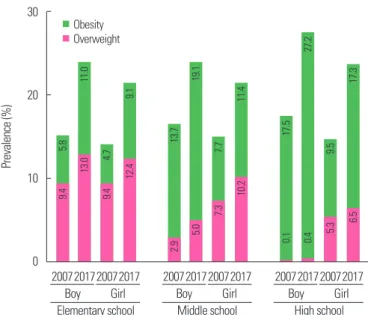
19The prevalence of overweight and obesi- ty increased from 15.3% to 23.7% over the last 10 years (Table 1, Fig. 1). The increasing tendency was observed in both boys and girls (Fig. 2). When stratified by sex and schools, boys and high school students showed a more significant increase in the preva- lence of overweight and obesity between 2007 and 2017 (Fig. 3).
There was an unexpected increase in the prevalence of overweight and obesity between 2008 and 2009, which was attributed to the application of a more appropriate sampling strategy in 2009. New 2017 growth charts were published in 2018, necessitating a reanal- ysis using the newly released growth charts.
20The 2017 growth charts for BMI were adjusted to lower 95th percentile line, because the previous version had a higher BMI percentile values in boys. In addition, the definition of obesity was changed to BMI ≥ 95th per- centile for the corresponding sex and age in the 2017 growth charts.
The prevalence of overweight and obesity among children and adolescents can be also obtained from the KNHANES data. The KNHANES is a cross-sectional survey that is conducted annually by the Korea Centers for Disease Control and Prevention and the Ministry of Health and Welfare.
21It collects nationally representa- tive data from a multi-stage, clustered, probability design. Recently,
Table 1. Prevalence of overweight and obesity in Korean children and adolescents Year
NSHE (6–18 yr) KNHANES (2–18 yr)
n Obesity (%) Overweight (%)
n Obesity (%) Overweight (%)
Boy Girl Total Boy Girl Total Boy Girl Total Boy Girl Total
2001 2,982 9.9 7.1 8.6 10.1 8.4 9.3
2005 1,922 9.6 8.6 9.1 8.8 9.0 8.9
2007 112,401 10.7 6.6 8.7 5.4 7.9 6.6 1,118 11.6 8.1 10.0 10.1 9.3 9.7
2008 122,289 10.4 6.3 8.4 5.4 7.8 6.6 2,325 10.9 7.9 9.5 11.5 8.9 10.3
2009 194,817 13.2 8.8 11.1 7.2 9.6 8.3 2,395 9.9 7.2 8.6 10.0 9.9 9.9
2010 188,352 13.9 9.1 11.7 6.7 9.3 7.9 1,984 12.1 8.2 10.3 9.3 8.7 9.0
2011 181,350 13.7 9.4 11.6 6.8 9.5 8.1 1,716 10.7 9.5 10.1 7.9 9.5 8.6
2012 87,253 14.0 11.2 12.6 5.9 8.8 7.3 1,530 9.3 8.1 8.7 9.9 8.6 9.3
2013 84,480 14.9 10.5 12.8 6.8 10.8 8.7 1,688 9.7 7.5 8.6 11.7 7.2 9.5
2014 82,581 15.1 10.5 12.9 6.6 9.8 8.1 1,390 10.6 8.0 9.4 8.6 10.1 9.3
2015 84,815 15.5 11.0 13.4 6.9 9.9 8.4 1,282 10.2 9.7 9.9 9.5 7.9 8.8
2016 82,883 17.1 11.2 14.3 7.2 9.7 8.4 1,570 10.9 9.5 10.2 8.2 7.1 7.7
2017 80,460 17.7 12.0 15.0 7.3 10.2 8.7 1,441 9.6 10.3 9.8 8.5 9.2 8.8
Diagnostic criteria for overweight and obesity were based on the 2007 growth charts19 for the NSHE and the 2017 growth charts20 for the KNHANES.
NSHE, National School Health Examination; KNHANES, Korea National Health and Nutrition Examination Survey.
Figure 1. Prevalence of overweight and obesity among Korean children and adolescents. NSHE: children aged 6–18 years, KNHANES: children aged 2–18 years. NSHE, National School Health Examination; KNHANES, Korea National Health and Nutrition Examination Survey.
25
20
15
10
5
0
Prevalence (%)
2001 2005 2007 2008 2009 2010 2011 2012 2013 2014 2015 2016 2017 Year
Obesity (NSHE) Obesity (KNHANES) Overweight (NSHE) Overweight (KNHANES)
data on overweight and obesity based on the 2017 growth charts was provided.
20,22The prevalence of overweight and obesity among children and adolescents aged 2 to 18 years in the KNHANES slight- ly increased from 17.9% in 2001 to 18.6% in 2017 (Table 1, Fig. 1).
In boys, the prevalence of obesity was unchanged, although over- weight slightly decreased. In girls, the prevalence of both over-
weight and obesity increased (Fig. 2). Interestingly, the prevalence of extreme obesity, which was BMI ≥ 120% of the 95th percentile, significantly increased from 1.2% to 2.1% between 2001 and 2013–
2014 (P=0.010).
17In Korea, the prevalence of obesity has increased over time.
However, the prevalence differs based on the data source and
Figure 2. Prevalence of overweight (A) and obesity (B) by sex and year among Korean children and adolescents. NSHE: children aged 6–18 years, KNHANES: children aged 2–18 years. NSHE, National School Health Examination; KNHANES, Korea National Health and Nutrition Examination Survey.B 20
15
10
5
0
Prevalence (%)
2001 2005 2007 2008 2009 2010 2011 2012 2013 2014 2015 2016 2017 Year
Boy (NSHE) Boy (KNHANES) Girl (NSHE) Girl (KNHANES) A 15
10
5
0
Prevalence (%)
2001 2005 2007 2008 2009 2010 2011 2012 2013 2014 2015 2016 2017 Year
Boy (NSHE) Boy (KNHANES) Girl (NSHE) Girl (KNHANES)
growth chart references for BMI. The collection of nationally rep- resentative data and the application of new growth charts are war- ranted for the generation of more accurate epidemiological data.
CHARACTERISTICS OF OBESITY IN KOREAN CHILDREN AND ADOLESCENTS
A recent report from the NSHE and the Korean Youth Health Risk Behavior On-line Survey revealed increased consumption of junk food, frequent skipping of breakfast among middle and high school students, increased sedentary time, and decreased consump- tion of vegetables over the last 5 years.
23According to the KNHANES, total caloric intake and fat intake increased between 2007 and 2015 in children and adolescents.
24Approximately 10% of middle and high school students performed vigorous physical activity for more than 30 minutes 5 days per week, and almost half of high school students slept less than 6 hours per day. According to the KNHANES, the daily time spent in moderate-to-vigorous physical activity has not changed between 2007 and 2015 among those aged 10–18 years.
24Low socioeconomic status was associated with obesity in children and adolescents using the KNHANES data.
25These are well-known risk factors for developing overweight and obesity in children and adolescents.
26-29Interestingly, these behavioral characteristics were more common among high school students, which is in line with
the rapidly increased prevalence of obesity in the same population group.
OBESITY-RELATED COMORBIDITIES
Obesity is associated with dyslipidemia, hypertension, non-alco- holic fatty liver disease, T2DM, and metabolic syndrome. Many studies link pediatric obesity and these diseases in the Korean pop- ulation. Lim et al.
30reported that obese children and adolescents had higher rates of metabolic syndrome, and higher levels of blood pressure, fasting plasma glucose, triglycerides, and low-density lipo- protein cholesterol and they had lower high-density lipoprotein cholesterol than normal-weight counterparts. The prevalence of metabolic syndrome in Korean children and adolescents increased from 4.0% in 1998 to 7.8% in 2007, in conjunction with an in- creased prevalence of obesity over this time period.
31Seo and Kim
32showed that the BMI z-score was a reliable marker for detecting metabolic syndrome. In another study, children and adolescents with obesity had elevated levels of glycated hemoglobin.
33Elevated alanine aminotransferase, a marker for non-alcoholic fatty liver dis- ease, was associated with obesity.
34Children and adolescents with obesity had a higher prevalence of elevated blood pressure and hy- pertension.
24However, most studies were cross-sectional and used the KNHANES data. Longitudinal follow-up cohort studies are scarce in Korea.
CONCLUSION
Pediatric obesity is associated with many comorbidities in child- hood and adulthood. In Korea, the prevalence of obesity has in- creased over time, although there is a slight discrepancy based on data source and the reference on BMI. Accurate epidemiologic data analyzed using the new 2017 growth charts are essential in de- veloping strategies for controlling obesity. Efforts to collect more reliable nationally representative data, including longitudinal stud- ies, are warranted.
CONFLICTS OF INTEREST
The authors declare no conflict of interest.
Figure 3. Secular changes in the prevalence of overweight and obesity from the National School Health Examination between 2007 and 2017 by sex and schools.
30
20
10
0
Prevalence (%)
2007 2017 2007 2017 Elementary school
Boy Girl
2007 2017 2007 2017 Middle school
Boy Girl
2007 2017 2007 2017 High school
Boy Girl
5.89.4 9.4 2.9 7.3 10.2 0.1 5.3 6.5
0.45.0
13.0 12.4
4.7 13.7 7.7 11.4 17.5 9.5 17.3
27.2
19.111.0 9.1
Obesity Overweight