서 론
난소암은 부인암 중 가장 흔한 사망원인이고2004년 한국 부인암 등록사업의 조사보고에 의하면 매년 증가하 는 추세에 있는 질환이다.
1)
상피성 난소암은 육안적 병 소를 최대한 제거하는 종양감축술후 복합항암화학요법또는 하는 것이 표준치료이다 이 치료로 초기
(CT PT) .
상피성 난소암 환자에서는80-90%의 완전 관해를 보이 고 진행성 병기, ( 3-4 )기 상피성 난소암에서도50%정도의 완전관해를 보이지만 진행성 상피성 난소암의 경우 에서 일차 항암화학요법이 실패하고 완전 관해 27%-40%
를 보이는 경우에서도 많은 경우에서 년 내에 재발하여3 결국 사망에 이르는 것으로 보고되어 있다. 이는 항암제 에 대한 저항성에 기인한 것이다.
2,3)
항암제를 투여하기 전에 각 환자가 어떤 약제에 반응 할 지 여부를 미리 예측할 수 있는 신뢰성 있는 체외검사
Vol. 23. No. 4, pp. 148 154, 2008∼
상피성 난소암에서 항암약물요법 (CT 또는 PT) 과 검사의 연관성
ATP-CRA
이천준 김원규,
고신대학교 의과 대학 부속 복음 병원 산부인과학 교실
Chun-June Lee, Won-Gue Kim
Department of Obstetrics and Gynecology, Kosin University College of Medicine, Busan, Korea
――― Abstract ――――――――――――――――――――――――――――――――――――――――
Background: The behavior of cancer can be very varied with different individual responses to chemotherapy.
Individualization is crucial to the optimization of chemotherapy. The individualized chemotherapy sensitivity test has been introduced to help in the selection of the appropriate drug for each individual patient but disappointing results achieved with old chemosensitivity tests. The development of the adenosine triphosphate based chemotherapy response assay(ATP-CRA) was designed to overcome the limitations of many in vitro chemotherapy sensitivity tests. The aims of this study were to predict accurately the ATP-CRA and a patient's clinical response to chemotherapy(CT(carboplatin, paclitaxel), PT(cisplatin, paclitaxel)) in epithelial ovarian cancer and to assess the clinical efficacy of the ATP-CRA.
Materials and Methods: The study was performed on 34 patients who is diagnosed initially the epithelial ovarian cancer for chemotherapy after operation at Gospel hospital of Kosin university between March 2005 and December 2007.
The ATP-CRA was evaluated the chemosensitivities of nine anticancer drugs for epithelial ovarian cancer. To investigate the correlation between ATP-CRA and clinical outcomes in patients with epithelial ovarian cancer, it was compared the clinical responses with the results of CSA retrospectively. Statistical analysis was performed using the Fisher's exact test.
Results: The mean chemosensitivity index(CI) tested by the ATP-CRA, were 186.4(carboplatin), 167.9(cisplatin) and 194.1(paclitaxel) respectively. The Cisplatin showed the most effective effect. The sensitivity and specificity of ATP-CRA were 96.4% and 50.0%. The positive and negative response prediction values were 90.0% and 75.0%. The accuracy rate was 88.2%. There was a significant relationship between the results of ATP-CRA and clinical responses(p
=0.04).
Conclusions: This study shows that ATP-CRA could be used clinically to predict chemoresponse in epithelial ovarian cancer. However, prospective randomized clinical trials in a larger patient cohort are warranted to confirm the clinical correlation of ATP-CRA.
―――――――――――――――――――――――――――――――――――――――――――――――――
Key words : Epithelial ovarian cancer, Chemotherapy, Adenosine triphosphate based chemotherapy response assay (ATP-CRA)
교신저자 이 천 준:
주소 : 602-702 부산광역시 서구 암남동34번지 고신대학교 복음병원 산부인과
TEL : 051-990-6463, 017-547-9547 FAX : 051-244-6939
E-mail : [email protected]
법들이 개발된다면 각 환자의 종양 특성에 따라 환자별 치료계획을 수립하는 것이 가능하게 되고 효과가 없는 약물은 제외시킴으로써 이로 인한 시간과 비용을 절감하 고 불필요한 부작용을 피할 수 있을 것이다 항암화학요. 법의 한계를 극복하고 반응률과 환자의 생존율을 향상시 키기 위하여 투약에 앞서 특정 환자에 대한 항암제의 잠 재적 활성도를 평가하기 위한 체외 약물 반응 측정법이 오래 전부터 연구개발 되었으나in vitro에서 많은 수의 암세포가 필요하고 정상조직이 암조직과 같이 혼재하므, 로 전체를 대변할 수 없고 많은 시간이 소요되며 항암약, 물에 대한 저항성과 감수성의 평가가 불분명해지는 등의 이유로 임상적으로 적용하는데 많은 한계가 있었다.
4-6)
Adenosine triphosphate based chemotherapy response 는 살아 있은 세포의 기본 에너지원인 assay (ATP-CRA)
를 측정하여 적은 표본조직에서도 쉽고 빠르게 세포 ATP
의 상태를 알아내는 방법으로 대사가 활발한 종양세포는 를 많이 분비하고 약물 투여 후 세포 활력이 감소하 ATP
면ATP수치가 감소하게 되는 원리를 이용하여 기존검 사의 한계를 극복한 것으로 알려져 있다.
7,8)
본 연구에서 는 이러한ATP-CRA를 이용하여 상피성 난소암에서 PT 또는CT항암화학요법시 항암제 감수성과 항암화학요법 과의 상관관계를 알아보고자 하였다.연구대상 및 방법 연구대상
1.
고신대학교 복음병원에서 2005년 월부터3 2007년 12 월까지 상피성 난소암으로 진단받고 수술 및 항암화학요 법으로 치료한 환자에서 본 연구에 동의한34예를 대상 으로 후향적으로 연구하였다 상피성 난소암이 최종 조. 직학적 결과이며, Karnofsky performance status 0-2,항암 화학요법을 회 이상 시행받은 환자만을 대상으로 선정3 하였다 수술 후 혈액이상 심장기능 신장 및 간기능 이. , , 상으로 등으로 항암화학요법을 제때에 못하거나 최소 차례이상 치료하지 못하는 환자는 제외하였고 복강내
3 ,
항암화학요법 등 추가적인 치료를 한 경우도 제외되었 다 난소암은 항암제 감수성검사와 관계없이. CT(일일 carboplatin 450 mg/m
2
와 paclitaxel 175mg/m2
21일 주기) 또는PT(일일50 cisplatin mg/m2
와 paclitaxel 175mg/m2
일 주기 항암화학요법을 시행하였다
21 ) .
항암제 감수성검사 방법
2. (ATP-CRA)
조직의 채취는 수술 직후 난소암에서 성장부위라고 생 각 되는 종양의 변연 부분을 약1×1×1cm정도를 취하 여 100 U/ml penicillin(Sigma, St Louis, MO, USA), 100ug/ml streptomycin(Sigma), 100 g/ml gentamycin (GIBCO BRL, Rockville, MD,USA), 2.5 g/ml amphotericin
그리고 소혈청
B (GIBCO BRL), 5% (FBS, GIBCO 이 포함된 배지 에 넣어 실험실로 이 BRL) (GIBCO BRL)
송하였다 채취된 조직의 일부를 이용하여 병리학 전문. 의의 조직학적 진단과 암세포의 정성적 정량적 확인 과, 정을 수행하였다 이송된 조직은 세척 정량. , , mincing을 거쳐dispase (Sigma), pronase (Sigma) 등의ECM분해 효 소와DNase (Sigma)를 처리하여37
o
C의 반응조건으로12 시간에서 16시간 반응시킨 뒤 세포여과(BD Falcon, 하여 세포를 수거하였다 수거된 세 Bedford, MA, USA) .포는 400 g에서 15분간 ficoll (1.077 g/ml) gradient 을 시행하였으며 충분한 양의 세포가 존재 centrifugation
할 경우 anti-CD45 Ab conjugated magnetic bead (Miltenyi 를 이용한 정상세포 제거과정 Biotech, Auburn, CA, USA)
을 수행하였다 분리된 세포들의 생존률은. trypan blue 으로 조사하였다
exclusion .
항암제 처리와ATP assay분리된 암세포를10% FBS가 포함된 IMDM (GIBCO BRL) 배지를 이용하여 로 희석하여 섬유아세포 2,000-20,000 viable cells/100 ml
등의 증식을 억제할 수 있는 well Ultra Low Attachment 에 (ULA) micro-plate(Costar, Cambridge, MA, USA)
로 분주하였다 분주된 세포에 미리 정해진 종류 triplicate .
의 항암제100 ml를 첨가하여48시간동안CO2배양기에 서 배양하였다. 3-6 well의 항암제 미처리 대조군은 배양 에 사용되는IMDM배지100 ml를 첨가 하였다 배양용. 기에는 정도관리를 위한3-6 well의 음성대조군 세포가( 포함되지 않은 배지만 분주 두 종류의 양성 대조군), (2.1
및 각 을 매검체마다 포
ng/ml ATP 5.6 ng/ml ATP) 3 well
함시켰다 처리한 항암제의 최종 농도는 각각의. peak 을 바탕으로 예비실험
plama concentration (data not 을 통해 결정한 농도이며 주로 검사되었던 항암제 shown)
의 처리 농도는 다음과 같다. Cyclophosphamide(10 μ g/ml), carboplatin(12 μg/ml), cisplatin(2.5 μg/ml), docetaxel(3.7μg/ml), etoposide(3.57 μg/ml), gemcitabine (16.9 μg/ml), oxaliplatin(2.9 μg/ml), paclitaxel(8.5 μ
항암제
g/ml), topotecan(0.0325μg/ml). 를 처리한 군과 처 리하지 않은 군에서 각각 세포를 용해시키고 세포 용해
액에 존재하는 ATP를 luciferin 및 과량의 luciferase 와 반응시켜 생성되는 (Roche, Mannheim, Germany) flash
를 측정하였다 type luminescence .
로 측정 Luminometer (Perkin Elmer, Boston, MA, USA) 되고 기록되는 측정값을 통해 항암제를 처리하지 않은 군에 비해 항암제를 처리한 군에서 발생한 암세포 사멸 정도(cell death rate)를 계산하였다.
Cell death rate (%) = (1 - mean luminescence in treated wells/mean luminescence in untreated control)×100
또한 모든 항암제 약물농도에서 세포가 죽은 를 합하% 여 chemosensitivity index (CI)를 구하였다(300 - sum of
% cell death rate at ×0.2, ×1, ×5 treated drug concentrations(TDC))
매 검체마다 회 또는 회 반복 측정된3 6 luminescence값 을 이용하여 검사 결과의 평균 변이계수(coefficient of 를 계산하였으며 음성 대조군 및 양성 대조 variation, CV)
군의 측정값을 확인하고 양성 대조군인, 5.6 ng/ml ATP 의 측정값이2.1 ng/ml ATP 측정값보다 높은 값을 보이 는지 확인하였다. Assay mean CV가30이상인 경우 두, 개의 양성 대조군 측정값이 역전된 경우 항암제 미처리, 대조군의 측정값이 양성 대조군인2.1 ng/ml ATP보다 작 은 경우 검사 실패로 간주하였다.
통계분석 3.
이 연구에서 ATP-CRA의 감수성와 임상적 반응의 상 관관계로 알기위해ATP-CRA의 감수성은CI에 대해 이 전에O’Meara 등
9)
이 연구한 결과를 토대로 하였고 복 합항암화학약물중 하나만이라도 cut-off 이하(<215)면 약물감수성(chomosensitive)로 간주하였다.또한 임상적 반응은 Rustin 등
10)
의 New guidelines to evaluate the response to treatment in solid tumors (ovarian를 이용하여 반응
cancer) (complete response, partial
과 불응 으로
response) (stable disease, progressive disease) 분류하였다 또한 잔류종양이 없는 경우 수술전 복합항. , 암약물 회 후 골반6 CT/MRI를 비교하여 재발 혹은 새로 운 병소가 없는 경우와CA 125가 정상일 경우(Fujirebio 에만 Diagnostics, Malvern, PA, USA; reference, 0-35 U/ml) 반응(effective)로 정의하였다.
통계분석은SPSS (version 12.0)으로Fisher's exact test 를 이용하여 분석하였다 모든 분석에서 유의수준은 값. p
이 0.05 이하일 때로 하였다.
결 과
환자의 임상병리학적 자료 1.
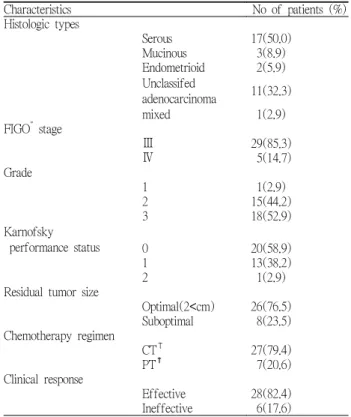
조직학적 유형은 장액성이 17 (50.0%)예 로 가장 많았 고 점액성 예, 3 (8.9%),자궁 내막양 예2 (5.9%), 미분류 선 암11 (32.3%),예 혼합형이 예1 (2.9%)이었다.
FIGO(International Federation of Gynecology and
병기는 기가 예 로 대부분이었고
Obstetrics) Ⅲ 29 (85.3%)
기가 예5 (14.7%)이었다 분화도는 이 예. 1 1 (2.9%), 2가
Ⅳ
예 이 예 이었다 수술 후 잔류종양
15 (44.2%), 3 18 (52.9%) .
이2cm이하가26 (76.5%)예 로 대부분이었고, 2cm이상 남 은 경우도 8예 (23.8%)이었다. Karnofsky performance
가 이 예 이 예 가 예
status 0 20 (58.9%), 1 13 (38.2%), 2 1
이었다 항암약물치료는 과
(2.9%) . CT(carboplatin
이 예 로 대부분이었고
paclitaxel) 27 (79.4%) , PT (cisplatin 과 paclitaxel)은 예7 (20.6%)이었다 임상적인 반응은 항. 암화학요법에 효과가 있었던 경우가28 (82.4%)예 이었고, 효과가 없었던 경우는 예6 (17.6%)이었다. (Table 1).
Table 1. Clinicopathologic characteristics
Characteristics No of patients (%)
Histologic types
Serous 17(50.0)
Mucinous 3(8.9)
Endometrioid 2(5.9) Unclassifed
adenocarcinoma 11(32.3)
mixed 1(2.9)
FIGO*stage
Ⅲ 29(85.3)
Ⅳ 5(14.7)
Grade
1 1(2.9)
2 15(44.2)
3 18(52.9)
Karnofsky
performance status 0 20(58.9)
1 13(38.2)
2 1(2.9)
Residual tumor size
Optimal(2<cm) 26(76.5) Suboptimal 8(23.5) Chemotherapy regimen
CT† 27(79.4)
PT☨ 7(20.6)
Clinical response
Effective 28(82.4) Ineffective 6(17.6) FIGO* :International Federation of Gynecology and Obstetrics CT† :Carboplatin and Paclitaxel
PT☨:Cisplatin and Paclitaxel
항암제 감수성검사 결과
2. (ATP-CRA)
난소암의 항암화학요법에 사용되는 개의 약제에 대9 해 항암제감수성 검사를 시행한 결과 전체적인 inhibition
는 였으며 의 평균
rate(×1 TDC) 26.7% . Cisplatin inhibition 가 로 가장 높게 나왔고 실제로 현재 가장 많이
rate 38.2% ,
쓰이는 platimun계열(cisplatin, carboplatin, oxaliplatin)과 일치하는 결과를 나타내었다 그러나. paclitaxel은 평균
로 나왔다 20.5% (Fig. 1).
의 평균 는 이 는
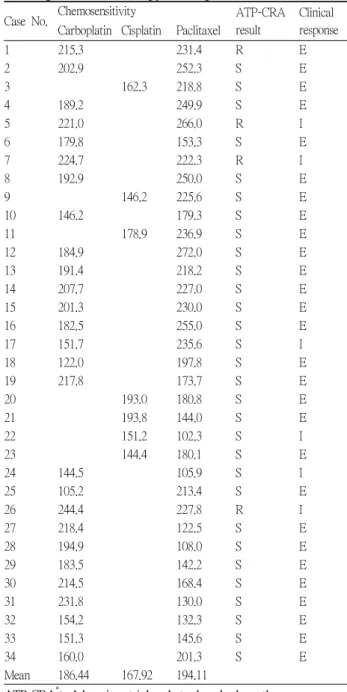
ATP-CRA CI carboplatin 186.4, cisplatin
은 로 나왔다 이하 의
167.9, paclitaxel 194.1 . Cut-off (<215) 약물감수성은 carboplatin사용한 27예중 21 (77.8%),예
은 예중 예 은 예중 예
cisplatin 7 7 (100%), paclitaxel 34 18 로 나왔다 이 가장 효과적인 항암제로 나 (52.9) . Cisplatin
왔으나 통계학적인 의의는 없었다(Table 2).
Fig. 1. Average inhibition rate in Adenosine triphosphate based chemotherapy response assay(×1, treated drug concentrations)
T:paclitaxel, P:cisplatin, C:carboplatin, CTX:cyclophosphamide, D:docetaxel, E:etoposide, G:gemcitabine, O:oxaliplatin, TOPO:
topotecan
항암제 감수성검사 결과와 또는 항
3. (ATP-CRA) CT PT
암약물치료 후 임상적 치료반응과의 상관관계 또는 항암화학 요법 후 실제로 반응을 보인
CT PT 28
예에서ATP-CRA결과chemoresistant(약물저항성 은 예) 1 였으며 약물감수성은, 27예이었다 항암화학요법 후 실. 제로 반응을 보이지 않았던 예에서 약물저항성은 예였6 3 으며 약물감수성은 예이었다, 3 .
검사의 예민도 는 특이도
ATP-CRA (sensitivity) 96.4%,
는 양성반응예측도
(specificity) 50.0%, (positive response
은 음성반응예측도
prediction value) 90.0%, (negative 은 였다 전체적인 검사의 response prediction value) 75.0% .
일치도는88.2%였다. ATP-CRA결과와CT또는PT항암
Table 2. ATP-CRA* result and clinical response of CT†or PT☨regimen chemotherapy in 34 patients
Case No. Chemosensitivity ATP-CRA result
Clinical response Carboplatin Cisplatin Paclitaxel
1 215.3 231.4 R E
2 202.9 252.3 S E
3 162.3 218.8 S E
4 189.2 249.9 S E
5 221.0 266.0 R I
6 179.8 153.3 S E
7 224.7 222.3 R I
8 192.9 250.0 S E
9 146.2 225.6 S E
10 146.2 179.3 S E
11 178.9 236.9 S E
12 184.9 272.0 S E
13 191.4 218.2 S E
14 207.7 227.0 S E
15 201.3 230.0 S E
16 182.5 255.0 S E
17 151.7 235.6 S I
18 122.0 197.8 S E
19 217.8 173.7 S E
20 193.0 180.8 S E
21 193.8 144.0 S E
22 151.2 102.3 S I
23 144.4 180.1 S E
24 144.5 105.9 S I
25 105.2 213.4 S E
26 244.4 227.8 R I
27 218.4 122.5 S E
28 194.9 108.0 S E
29 183.5 142.2 S E
30 214.5 168.4 S E
31 231.8 130.0 S E
32 154.2 132.3 S E
33 151.3 145.6 S E
34 160.0 201.3 S E
Mean 186.44 167.92 194.11
ATP-CRA*: Adenosine triphosphate based chemotherapy response assay
CT†:Carboplatin and Paclitaxel PT☨:Cisplatin and Paclitaxel
R: chemoresistant S: chemosensitive I: ineffective E: effective
Table 3. Correlation between result of APT-CRA* and clinical response to CT†or PT☨regimen chemotherapy(N=34)
APT-CRA Clinical response p value
Ineffective Effective
Chemoresistant 3 1
Chemosensitive 3 27 0.04
APT-CR*A: Adenosine triphosphate based chemotherapy response assay CT†:Carboplatin and Paclitaxel
PT☨:Cisplatin and Paclitaxel 0
5 10 15 20 25 30 35 40 45
%
T P C CTX D E G O TOPO
18.215.8 38.2
22.2 35
25.5 20.5
27.6 37.7 Avarage inhibiting rate
화학요법 후 치료반응과의 상관관계는 통계학적으로 의 의가 있는 것으로 나타났다(p =0.04)(Table 3).
고 찰
년대 등
1950 Black
11)
이 색소 환원 측정법을 개발한 이 래 수많은 항암제 감수성 검사법들이 개발되었고 현재 세포의 배양 방법이나 세포 측정 방법에 따라 크게 세포 활력 측정 염색 방사성 동위원소를 부착한 전구물질의, 세포내 섭취의 측정 대사물질의 측정 세포군락 형성의, , 측정의 네 가지 종류로 분류할 수 있다 그러나 많은 방. 법들이 연구 목적 혹은 임상 치료에서 사용이 되고 있지 만 많은 제한점들로 인해 널리 이용되지 못하고 있다.우선 종양조직 샘플이 과연 종양 전체를 대표할 수 있 는가의 문제인데 동일 종양내부에도 항암제 감수성이 다 른 세포군이 존재할 수 있기 때문이다 또한 같은 형태학. 적 특징을 나타내는 종양이라 할지라도 항암화학요법에 대한 반응은 환자 개개인에 따라 다양하게 나타날 수 있 으며 이러한 다양성은 종양 세포의 성장에 따라 획득되 는 유전체상의 특성에 기인하는 것으로 생각이 되며 의 메틸화 전사 후 변형 등의 기전으로 인해 더욱
DNA ,
복잡한 양상을 띄게 된다.
12,13)
또한 검사비용이 고가이 어서 모든 환자들을 대상으로 시행하려면 비용 효과 측- 면도 고려해야 한다 무엇보다도 중요한 것은 다양한 검. 사법들이 종양의 반응과 환자의 생존율이나 항암화학요 법으로 인한 부작용과 완전한 상관관계를 보이지 않는다 는 점이다 따라서 이렇게 다양한 비균질성을 극복하고. 항암화학요법의 반응을 높이는 것이 종양 치료자들의 주 된 관심사이다.는 이러한 많은 감수성 검사의 한계를 극복 ATP-CRA
하고자 고안되었다 결과를 빨리 볼 수 있고. , ATP-CRA 는 적은 조직에서도 수행할 수 있다.
14,15)
Ficoll gradient centrifugation, anti-CD45 antibody conjugated magnetic 등으로 beads, suspension culture with ultra low attachment 암세포내 정상세포를 제거하여 신뢰도를 높일 수 있다.
15,16)
국내에서는 이수앱지스㈜ (www.abxis.com)에서상용화하여 임상에서 적용 중이다.
등
Weisenthal
17)
은 임상 시험 결과를 비교하여 각 체외 약물 반응 측정법의 상대적인 장단점을 분석하였는데, 음성 예측정확도(negative predictive accuracy)는90-99%였고 양성 예측정확도(positive predictive accuracy)는
로서 측정법의 종류에 상관없이 종양축소에 효과 50-70%
적인 약물을 선택하는 것보다 약제 저항성을 나타내는 약물을 정확하게 식별해 내는 것이 더 신뢰도가 높다고 주장하였고 현재까지 나온 몇 가지 임상실험에서도 의 예측적 신뢰도가 우수한 것으로 보고되고 ATP-CRA
있고 약제 감수성보다 약제 저항성에 더 효과적이라 보, 고하였다.
15,17-19)
본 연구에서는 상피성 난소암에서 ATP-CRA가 수술 후CP또는PT항암약물치료에 대한 임상적 반응과의 연 관성에서 예민도는 96.4%, 양성반응예측도 90.0%, 전체 적인 검사의 일치도는88.2%였지만 특이도는 50.0%, 음 성반응예측도는 75.0%로 다소 떨어지는 것으로 나타났 다 이는 표본의 증례가 부족하여 생기는 것으로 판단된. 다.
항암제 감수성 검사가 비활성 약물과 활성 약물을 효 과적으로 구분하는 것은 분명해 보이지만 이것을 반드시 환자 생존율에 대한 정확한 예측으로 이어지지는 않는 문제점이 있다 임상적 타당성을 확보하기 위해서는 항. 암제 감수성 검사에서 저항성을 보이는 약물로 치료를 받은 환자가 낮은 생존율을 나타내고 감수성을 보인 약, 물로 치료를 받은 환자의 생존율이 향상된 연구 결과를 얻어야 한다. M enpä ää 등
20)
은 난소암 환자들을 대상으 로 최초의 전향적 무작위 임상시험을 하여 통상적인 항 암화학요법과 항암제 감수성 검사에 근거한 항암화학요 법의 효과를 비교하였는데 전체 생존율은 통상적인 항암 화학요법 군이59%, 항암제 감수성 검사에 근거한 항암 화학요법 군이62%로 통계적으로 유의한 차이가 없었고 완전관해에 도달한 비율은 항암제 감수성 검사에 근거한 항암화학요법 군이 유의하게 많았으나(p=0.03) 생존율 의 향상은 없었다고 보고하였다. Konecny등19)
은ATP측 정법을 이용하여 상피성 난소에서 임상적 반응은 유의한 상관관계를 보였고 체외 측정시, platinum에 감수성을 보 인 환자군은 저항성을 보인 환자에 비해 무병 생존율개월 과 전체 생존율
(28.5 vs 12.6 , p=0.033) (46.1 vs 17.6 개월, p=0.03)이 유의하게 향상되었다고 보고하였다 몇. 몇의 최근의 연구 결과들을 종합하면 항암제 감수성 검 사에 따라 항암제를 투여한 군과 통상적인 항암화학요법 군간의 생존율 차이를 보일 수는 있으나platinum에 반응 을 하지 않는 환자에서는 임상적 반응이나 생존율 향상 의 결과를 가져올 가능성이 없다고 보고하였다.
19,21,22)
따 라서 항암제 감수성검사는 임상시험에서 상당한 예측도 를 나타내었으나 본격적인 임상 적용은 아직 이루어지지않고 있고2004년 미국 임상암학회(ASCO)에서는 임상 시험 목적 이외에 항암제 감수성검사를 이용하여 각각의 환자에 투여할 항암제를 선택하는 것을 권고하지 않고 있다.
23)
상피성 난소암은10-30%가량platinum에 반응을 하지 않는 것을 보고되어 있는데 항암제 감수성검사로 이들을 조기에 발견하면 효과가 없는 약물을 제외시킴으로써 불 필요한 치료로 인한 약물 부작용을 줄이고 치료기간과 비용을 줄일 수 있고 환자 맞춤형 치료로 환자의 삻의 질 을 향상시킬 수 있을 것이다.
3,23)
등
Sharma
24)
은 재발성 난소암 환자들을 대상으로 ATP 검사법에 근거한 치료로59%의 반응률과 무진행 생존률 개월 전체 생존율 개월의 성적을 얻었다고 보고 6.6 , 10.4하였다. Loizzi등
25)
은 재발성 난소암 환자에서 항암제 감 수성검사에 근거한 항암화학요법을 시행한 후향적 연구 에서Platinum민감성 환자군에서는 전체 생존율이65%로platinum저항성 환자군의35%에 비해 생존율이 향상 되었다고 보고하였다. Orr등
26)
은 수술 후 어느 약물이, 낮은 저항 측정치를 보이는가에 따라 paclitaxel 혹은 중 하나를 계 항암제와 함께 cyclophosphamide platinum치료하였다 이 두 집단 간에 유의한 생존율 차이는 발견. 되지 않았지만 개인당 비용이 절감되었다.
본 연구에서도ATP-CRA가 수술 후CT및PT항암약 물치료에 대한 임상적 반응과의 연관성에서 높은 예민 도 높은 양성반응예측도 전체적인 검사의 정확도가 높, , 아 생존율 향상과 비용절감에 도움이 될 것으로 보이지 만 이와 같은 결과를 확증하기 위해서는 무작위 전향적 임상시험이 필요한 것이다 만일 이러한 노력이 성공을. 거둔다면 환자 맞춤형 항암화학요법의 시대가 도래할 수 있을 것으로 생각된다.
결 론
상피성 난소암에서ATP-CRA검사 후CT 및 PT 항암 화학요법으로 치료하여 임상적으로 다음과 같은 결과를 얻었다.
결과 평균 는 의
1. ATP-CRA CI carboplatin 186.4, cisplatin 는167.9, paclitaxel은194.1로 나왔으며, cisplatin이 가장 효과적인 항암제로 나왔으나 통계학적인 의의는 없었다.
검사의 예민도는 특이도는 양
2. ATP-CRA 96.4%, 50.0%,
성반응예측도는90.0%,음성반응예측도는75.0%였다 전. 체적인 검사의 일치도는 88.2%였다. ATP-CRA결과 와 임상적 치료반응과의 상관관계는 통계학적으로 의의 가 있는 것으로 나타났다 (p=0.04).
본 연구에서ATP-CRA는 상피성 난소암 환자에서 임 상적 치료반응을 예측할 수 있는 좋은 검사로 항암제선 택에 도움을 줄 것으로 보이나 많은 수의 증례를 통한 무 작위 전향적 임상시험이 필요할 것으로 생각된다 또한. 가 생존율의 향상이나 비용절감 및 부작용의 ATP-CRA
감소에 효과가 있는지에 대해서도 추가적인 연구가 필요 할 것으로 생각된다.
참고문헌
임상연구 한국 부인암 등록 사업 조사 보고서
1) : (2004. 1.
대한산부회지
1-2004. 12. 31) 50:28-78, 2007
2) McGuire WP, Hoskins WJ, Brady MF, Kucera PR, Partridge EE, Look KY, Clarke-Pearson DL, Davidson M:
Cyclophosphamide and cisplatin versus paclitaxel and cisplatin:
a phase III randomized trial in patients with suboptimal stage III/IV ovarian cancer (from the Gynecologic Oncology Group).
Semin Oncol 23:40-47, 1996
3) Ozols RF, Bundy BN, Greer BE, Fowler JM, Clarke-Pearson D, Burger RA, Mannel RS, DeGeest K, Hartenbach EM, Baergen R: Phase III trial of carboplatin and paclitaxel compared with cisplatin and paclitaxel in patients with optimally resected stage III ovarian cancer: a Gynecologic Oncology Group study. J Clin Oncol 21:3194-3200, 2003 4) Cree IA, Kurbacher CM: Individualizing chemotherapy for
solid tumors-is there any alternative? Anticancer Drugs 8:541-548, 1997
5) Weisenthal LM, Marsden JA, Dill PL, Macaluso CK: A novel dye exclusion method for testing in vitro chemosensitivity of human tumors. Cancer Res 43:749-757, 1983
6) Kern DH, Drogemuller CR, Kennedy MC, Hildebrand-Zanki SU, Tanigawa N, Sondak VK: Development of a miniaturized, improved nucleic acid precursor incorporation assay for chemosensitivity testing of human solid tumors. Cancer Res 45:5436-5441. 1985
7) Andreotti PE, Cree IA, Kurbacher CM, Hartmann DM, Linder D, Harel G, Gleiberman I, Caruso PA, Ricks SH, Untch M:
Chemosensitivity testing of human tumors using a microplate adenosine triphosphate luminescence assay: clinical correlation for cisplatin resistance of ovarian carcinoma. Cancer Res 55:5276-5282, 1995
8) Sevin BU, Peng ZL, Perras JP, Ganjei P, Penalver M, Averette HE: Application of an ATP-bioluminescence assay in human tumor chemosensitivity testing. Gynecol Oncol 31:191-204, 1988
9) O'Meara AT, Sevin BU: Predictive value of the ATP chemosensitivity assay in epithelial ovarian cancer. Gynecol Oncol 83:334-342, 2001
10) Rustin GJ, Quinn M, Thigpen T, du Bois A, Pujade-Lauraine E, Jakobsen A, Eisenhauer E, Sagae S, Greven K, Vergote I, Cervantes A, Vermorken J: Re:New guidelines to evaluate the response to treatment in solid tumors (ovarian cancer). J Natl Cancer Inst 96:487-488, 2004
11) Black MM, Spear FD: Effects of cancer chemotherapeutic agents on dehydrogenase activity of human cancer tissuein vitro. Am J Clin Pathol 23: 218-227, 1953
12) Kim RB, Leake BF, Choo EF, Dresser GK, Kubba SV, Schwarz UI, Taylor A, Xie HG, McKinsey J, Zhou S, Lan LB, Schuetz JD, Schuetz EG, Wilkinson GR: Identification of functionally variant MDR1 alleles among European Americans and African Americans. Clin Pharmacol Ther 70:189-99, 2001
13) Roses AD: Pharmacogenetics and drug development: the path to safer and more effective drugs. Nat Rev Genet 5:645-656, 2004
14) Moon YW, Choi SH, Kim YT, Sohn JH, Chang J, Kim SK, Park MS, Chung KY, Lee HJ, Kim JH: Adenosine triphosphate-based chemotherapy response assay (ATP-CRA)-guided platinum-based 2-drug chemotherapy for unresectable nonsmall-cell lung cancer. Cancer 109:1829-1835, 2007
15) Kim HA, Yom CK, Moon BI, Choe KJ, Sung SH, Han WS, Choi HY, Kim HK, Park HK, Choi SH, Yoon EJ, Oh SY: The use of an in vitro adenosine triphosphate-based chemotherapy response assay to predict chemotherapeutic response in breast cancer. Breast 17:19-26, 2008
16) Yamaue H, Tanimura H, Tsunoda T, Tani M, Iwahashi M, Noguchi K, Tamai M, Hotta T, Arii K: Chemosensitivity testing with highly purified fresh human tumour cells with the MTT colorimetric assay. Eur J Cancer 27:1258-1263, 1991
17) Weisenthal LM, Lippman ME. Clonogenic and nonclonogenicin vitro chemosensitivity assays. Cancer Treat Rep 69: 615-632, 1985
18) Andreotti PE, Cree IA, Kurbacher CM, Hartmann DM, Linder D, Harel G, Gleiberman I, Caruso PA, Ricks SH, Untch M: Chemosensitivity testing of human tumors using a microplate adenosine triphosphate luminescence assay: clinical correlation for cisplatin resistance of ovarian carcinoma.
Cancer Res. 55:5276-5282, 1995
19) Konecny G, Crohns C, Pegram M, Felber M, Lude S, Kurbacher C, Cree IA, Hepp H, Untch M: Correlation of drug response with the ATP tumorchemosensitivity assay in primary FIGO stage III ovarian cancer. Gynecol Oncol 77:258-263, 2000
20) M enpä ääJU, Heinonen E, Hinkka SM, Karnani P, Klemi PJ, Korpijaakko TA, Kuoppala TA, Laine AM, L hde MA,ä Nuoranne EK: The subrenal capsule assay in selecting chemotherapy for ovarian cancer: a prospective randomized trial.Gynecol Oncol 57:294-298, 1995
21) Nakada S, Aoki D, Ohie S, Horiuchi M, Suzuki N, Kanasugi M, Susumu N, Udagawa Y, Nozawa S: Chemosensitivity
testing of ovarian cancer using the histoculture drug response assay: sensitivity to cisplatin and clinical response.Int J Gynecol Cancer 15:445-452, 2005
22) Holloway RW, Mehta RS, Finkler NJ, Li KT, McLaren CE, Parker RJ, Fruehauf JP: Association between in vitro platinum resistance in the EDR assay and clinical outcomes for ovarian cancer patients.1: Gynecol Oncol 87:8-16, 2002 23) Schrag D, Garewal HS, Burstein HJ, Samson DJ, Von Hoff DD, Somerfield MR; American Society of Clinical Oncology Technology Assessment: chemotherapy sensitivity and resistance assays. J Clin Oncol 22:3631-3638, 2004 24) Sharma S, Neale MH, Di Nicolantonio F, Knight LA,
Whitehouse PA, Mercer SJ, Higgins BR, Lamont A, Osborne R, Hindley AC, Kurbacher CM, Cree IA: Outcome of ATP-based tumor chemosensitivity assay directed chemotherapy in heavily pre-treated recurrent ovarian carcinoma. BMC Cancer 3:19, 2003
25) Loizzi V, Chan JK, Osann K, Cappuccini F, DiSaia PJ, Berman ML: Survival outcomes in patients with recurrent ovarian cancer who were treated with chemoresistance assay-guided chemotherapy. Am J Obstet Gynecol 189:
1301-1307, 2003
26) Orr JW Jr, Orr P, Kern DH: Cost-effective treatment of women with advanced ovarian cancer by cytoreductive surgery and chemotherapy directed by an in vitro assay for drug resistance. Cancer J Sci Am 5:174-178, 1999