https://doi.org/10.9721/KJFST.2020.52.4.377
377
©The Korean Society of Food Science and Technology
Physicochemical qualities, antioxidant compounds, and activities of
six mini paprika cultivars
Seolji Baek1 and Youngjae Shin1,*
1Department of Food Engineering, Dankook University
Abstract Paprika is a popular vegetable with high visual appeal and desirable flavor, the health benefits of which are increasingly attracting interest. In this study, the physical qualities, antioxidant content, and activities of six mini paprika cultivars were investigated. Both the edible part (flesh) and the by-products were studied. The average total phenolics and total antioxidant activities were higher in the flesh than in the products. The total flavonoids of the flesh and the by-products were 16.41 and 37.80 mg/100 g FW, respectively. “YW glory” and “Raon yellow” flesh had the highest (245.52 mg/100 g FW) and lowest (179.96 mg/100 g FW) total phenolics among the six cultivars, respectively. However, the “RD glory” cultivar showed the highest total phenolic content (232.70 mg/100 g FW) among the by-product samples. The total phenolics in the flesh and by-products were highly correlated to the ABTS radical scavenging activity, with R=0.961 and 0.984, respectively.
Keywords: mini paprika, flavonoids, phenolics, antioxidant, correlation
Introduction
Recently, food consumption patterns have changed as a result of an increase in single-person households and changes in the structure of society and national living standards due to multiple factors (Statistics Korea, 2020; Lee et al., 2019). Led by single-person households, food consumption preference is shifting towards small quantity products with convenience and health (Lee et al., 2015; Cho et al., 2007). The popularity of miniature vegetables has increased and they are conveniently sized while maintaining the nutritional properties of their regular-sized counterparts. This results in more frequent consumption and larger cultivation areas (Hwang, 2019). Paprika (Capsicum annuum L.) is a rich source of phytochemicals, including carotenoid, tocopherol, and phenolic compounds, whose consumption is currently on the rise (Kim et al., 2011; Pérez-Gálvez and Mínguez-Mosquera, 2001).
Paprika is an annual plant that belongs to Solanaceae, Capsicum, and Annuum families (Jung and Hong, 2017). In general, paprika is initially green when not matured, and gradually becomes red as it matures. However, it can take on more colors depending on its variety, including red, orange, and yellow (Luitel and Kang, 2013). The bioactive compound content of paprika is dependent on its maturity, variety, and growing conditions (Hallmann and Rembiałkowska, 2012). Among bioactive compounds, phenolic compounds are strong antioxidants that can protect the human body from reactive
oxygen species (ROS). Antioxidants also reduce the levels of ROS related to oxidative stress-related diseases, such as cancer, aging, and inflammatory diseases (Nimse and Pal, 2015). ROS attacks all major biological molecules, including polyunsaturated fatty acid (PUFA), its target on the cell membrane. The oxidative damage of PUFA advances via an autonomous chain reaction, wherein free radicals cause extensive oxidative injury (Poljsak et al., 2013). Antioxidants inhibit this response and delay cell damage. Thus, they are highly regarded as physiologically active substances for the prevention of hypertension, diabetes, carcinogenesis, and aging (Hwang et al., 2020).
Paprika is normally consumed after removing the inedible parts of the vegetable, such as the stalk end, core, and seeds. According to Cho et al. (2007), vegetables comprise 53.1% of food waste, a much higher percentage than fruits (13.7%). Lee et al. (2012) conducted a study on the antioxidant compounds and activities of peels, that is, the inedible parts of fruits, in oranges, golden and green kiwifruits, tangerine, and Korean melon, among others. Similarly, Kabir et al. (2015) studied the antioxidant activities of the inedible parts of cabbage and broccoli. However, there is currently a lack of research on the properties of the inedible parts of paprika. Furthermore, previous studies have mainly focused on the antioxidant compounds and activities of paprika. Šaponjac et al. (2014) investigated the anticancer activity of paprika, while Go et al. (2020) focused on the antibacterial activity of paprika and Hwang et al. (2012) investigated the antioxidative activity of paprika. On the other hand, studies on miniature paprika (or mini paprika) have mainly focused its physicochemical quality with insufficient research on its antioxidant compounds and activities. In this study, six varieties of mini paprika are studied. The six mini paprika cultivars were divided into flesh and by-products, namely core and seeds, to comparatively measure the antioxidant compounds and activities and analyze the correlation among each *Corresponding author: Youngjae Shin, Department of Food
Engi-neering, Dankook University, Cheonan, Chungnam 31116, Korea Tel: +82-41-550-3562
Fax: +82-41-559-7868 E-mail: [email protected]
Received June 24, 2020; revised July 28, 2020; accepted July 29, 2020
antioxidative component in the different parts of mini paprika.
Materials and Methods
Materials for experiment
Mini paprika cultivars “RD glory”, “OE glory”, and “YW glory” were purchased from Saedanong Co., Ltd. (Hoengseong, Korea), and “Raon red”, “Raon orange”, and “Raon yellow” from Jinju Mini Paprika farm (Jinju, Korea). All cultivars were found at the commercially ripe stage at the time of the experiments. The flesh of the vegetables was analyzed on the day of purchase for physical quality analysis, such as length, color, firmness, pH, acidity, and sugar content. The mini paprika were then divided into flesh and by-products (core and seeds) (Fig. 1), frozen with liquid nitrogen at −196oC, and stored in a freezer at −25oC until analysis
of antioxidant compounds and activities. Color measurement
The color of the flesh was represented as L* value (lightness), a* value (redness), and b* value (yellowness) using a colorimeter (Chroma meter CR-400, Minolta, Tokyo, Japan). For each measurement, 10 samples were measured three times and the mean value was calculated. The Chroma meter was calibrated regularly using the white calibration plate (Y=87.8, x=0.3156, y=0.3229).
Soluble solid content, firmness, titratable acidity, pH, moisture content, and length
The firmness of the mini paprika flesh was measured using a fruit hardness tester (FHM-1, Dementra Co., Ltd., Tokyo, Japan). The fruit skin of 10 samples was penetrated using a 12Φ×10 mm cone probe, and the value was expressed in newtons (N). The soluble solid content, titratable acidity, and pH were measured using a mixture of the flesh homogenized with a blender (JB 3060, Braun Co., Kronberg Germany). The soluble solid content was measured using a digital refractometer (PAL-1, Atago Co., Ltd., Tokyo, Japan). The titratable acidity was determined by mixing 1 g of the mixture and 100 mL of distilled water and performing a neutralization titration with 0.1 N NaOH and 3-4 drops of 1% phenolphthalein solution. The measured titratable acidity was then converted to citric acid %. The pH was measured
using a pH meter (Starter300, Ohaus Co., Ltd., Parsippany, NJ, USA). To measure the moisture content of the fruit, samples of the flesh were weighed and stored in an incubator (IB-05G, Jeio Tech Co., Ltd., Seoul, Korea) at 70oC. The moisture content was measured and converted into percentages. The length was measured using a digital caliper (1108-150W, INSIZE Co., Ltd., Suzhou, China).
Extraction of samples
Ethanol (80%) was used as the solvent for extracting the flesh and by-products of the mini paprika cultivars. Briefly, 30 g of frozen samples were added to 300 mL of 80% ethanol. This mixture was then homogenized in a blender twice for 3 min and once for 2 min. The homogenized solution was filtered through a decompression filter using a Whatman #2 paper filter (Whatman International Ltd. Kent, UK). Then, the filtered solution was concentrated using a rotary evaporator (N-1000, Eyela, Tokyo, Japan) at 45oC and then stored at −20oC until analysis of antioxidant compounds and activities (Yang et al., 2019).
Total flavonoid content analysis
The total flavonoid content of the extracts from the flesh and by-products was measured by the colorimetric assay (Zulkifli et al., 2020). Briefly, 0.3 mL of 5% NaNO2 was added to a 15 mL test tube containing 4 mL of distilled water and 1 mL of diluted sample. The mixture was vortexed and left to stand for 5 min at room temperature. Then, 0.3 mL of 10% AlCl3 was added and the mixture was vortexed and left at room temperature for 6 min. Next, 2 mL of 1 N NaOH and 2.4 mL of distilled water were added to adjust the total volume to 10 mL. The optical density of this solution was measured at a wavelength of 510 nm using a spectrophotometer (Optizen POP, Mecasys, Daejeon, Korea). The standard calibration curve was measured using catechin as a standard, and the total flavonoid content was converted to and expressed in mg catechin equivalents (CE)/100 g fresh weigh (FW). Total phenolic content analysis
The total phenolic content of the flesh and by-product extracts was measured by the Folin-Ciocalteu colorimetric assay (Shin, 2012; Yang et al., 2019). Briefly, 0.2 mL of the Folin-Ciocalteu phenol reagent was added to a 15 mL test tube containing 2.6 mL of distilled water and 0.2 mL of diluted sample. The mixture was vortexed and left to stand at room temperature for 6 min. Next, 2 mL of 7% NaCO3 was added and the mixture was vortexed and left at room temperature in a dark place for 90 min. The optical density of this solution was measured at a wavelength of 750 nm using a spectrophotometer. The standard calibration curve was measured using gallic acid as a standard, and the total phenolic content was converted to and expressed in mg gallic acid equivalents (GAE)/100 g FW.
DPPH radical scavenging activity
The DPPH radical scavenging activity of the flesh and by-product extracts was measured using the methods described by Hwang et al. (2020) and Sridhar et al. (2019) with some modifications. Fig. 1. Flesh and by-product (core and seeds) parts of mini
The test solution containing 50 µL of diluted sample mixed with 2,950 µL of 0.2 mM DPPH solution was left to react at room temperature in a dark place for 30 min. The optical density of this solution was then measured at a wavelength of 517 nm using a spectrophotometer. The standard calibration curve was measured using vitamin C as a standard, and the antioxidant activity of the extract was converted to and expressed in mg vitamin C equivalents (VCE)/100 g FW.
ABTS radical scavenging activity
The ABTS radical scavenging activity of the flesh and by-product extracts was measured using the methods described by Floegel et al. (2011) and Sridhar et al. (2019) with some modifications. The test solution containing 20 µL of diluted sample mixed with 980 µL of the ABTS reaction solution was left to react at 37oC for 10 min. The optical density the solution was then measured at a wavelength of 734 nm using a spectrophotometer. The standard calibration curve was measured using vitamin C as a standard, and the ABTS radical scavenging activity was converted to and expressed in mg VCE/100 g FW.
Statistical analysis
For the statistical analysis of each experiment, analysis of variance (ANOVA) was performed using SPSS 20 program (SPSS Inc. Chicago, IL, USA), and Duncan’s multiple range test was used to analyze the significant differences (p<0.05). The correlation between the mean values of each factor was expressed using Pearson’s correlation coefficient.
Results and Discussion
Color
The color measurement results of the different mini paprika
varieties are shown in Table 1. The variety with the highest L* value (lightness) was “YW glory” with 65.43±0.48. The a* value (redness) of the two red varieties was 31.80±0.72 for “RD glory” and 29.18±0.96 for “Raon red”, with “RD glory” significantly higher. The b* value (yellowness) of the two yellow varieties was 42.63±0.97 for “YW glory” and 37.97±0.87 for “Raon yellow”, with “YW glory” significantly higher. A comparative study by Lee et al. (2016) on the characteristics of paprika by variety and color also showed that “RD glory” had higher a* value than “Raon red”, and “YW glory” had a higher b* value than “Raon yellow”. Soluble solid content, firmness, titratable acidity, pH, moisture content, and length
The soluble solid content, firmness, titratable acidity, pH, moisture content, and length of the mini paprika flesh are shown in Table 2. The soluble solid content of the mini paprika cultivars ranged from 9.20 to 11.5%. Kim et al. (2011) reported that the main free sugars of green and red paprika were fructose and glucose. According to Kang et al. (2008), the soluble solid content of larger paprika varieties, namely the “Special” and “Fiesta” varieties, ranged from 5.84 to 7.19%, indicating that the solid content of the mini paprika cultivars used in this experiment was higher, with a firmness of 4.20-5.22 N and a titratable acidity and pH of 0.52-0.66% and 4.90-5.19, respectively. According to Lee et al. (2017), the titratable acidity of red paprika is 0.8%, which is higher than our findings for mini paprika. However, the pH of 5.10 for the red paprika was similar to our findings for mini paprika, with a moisture content ranging from 85.18% to 90.80%. Jeong et al. (2006) studied the quality of paprika and found a moisture content of 89.80-90.92%, which is similar to our findings for mini paprika. The length of the mini paprika varieties ranged from 77.87 to 83.73 mm, with the “Raon orange” variety significantly longer than the “OE glory” and “YW glory” varieties. Table 1. Hunter L*,a*,b* color of mini paprika flesh
General name Cultivar name L* (Lightness) a* (Redness) b* (Yellowness)
Vinesweet RD glory 47.33±0.34f 31.80±0.72a 12.95±0.54f OE glory 58.36±0.67c 26.11±0.78c 32.43±1.30c YW glory 65.43±0.48a 13.28±1.08e 42.63±0.97a Raon Raon red 49.56±0.38c 29.18±0.96b 17.13±0.89e Raon orange 56.55±0.45d 22.31±0.47d 28.41±0.75d Raon yellow 62.60±0.52b 10.74±0.91f 37.97±0.87b
*RD: Red color, OE: Orange color, YW: Yellow color
Table 2. Soluble solid contents, firmness, titratable acidities, pH, moisture contents and length of mini paprika flesh General name Cultivar
name SSC (obrix) Firmness (N/12 mmØ) Titratable
acidity (%) pH SSC/TA ratio
Moisture contents (%) Length (mm) Vinesweet RD glory 11.50±0.07b 4.20±0.18d 0.66±0.02a 5.15±0.002b 17.42 85.36±0.11d 79.72±2.66ab OE glory 10.87±0.02c 5.04±0.23ab 0.54±0.02b 5.19±0.01a 20.13 85.18±0.12d 78.22±3.49b YW glory 11.07±0.13ab 5.22±0.29a 0.66±0.02ab 5.15±0.004b 16.77 85.42±0.12d 77.87±2.26b Raon Raon red 11.47±0.06a 4.48±0.02cd 0.66±0.02a 5.01±0.002c 17.38 88.79±0.15c 82.99±2.50ab Raon orange 9.87±0.16d 4.35±0.10d 0.54±0.02a 4.90±0.002e 18.28 89.90±0.14b 83.73±1.98a Raon yellow 9.20±0.04e 4.78±0.17bc 0.52±0.01b 4.90±0.003e 17.69 90.80±0.11a 82.15±2.18ab
Total flavonoid content
The total flavonoid content of the different mini paprika parts and varieties is shown in Fig. 2A. The by-products (core and seeds) showed a higher flavonoid content than the flesh. In particular, the flavonoid content of the by-products was significantly high in the “OE glory” and “YW glory” varieties, with 48.04±0.45 and 48.41±0.5 mg CE/100 g, respectively, and lowest in the “Raon orange” variety, with 26.84±0.21 mg CE/100 g FW. On the other hand, the flavonoid content of the flesh was significantly high in the “RD glory” and “YW glory” varieties, with 20.64±0.49 and 21.78±0.92 mg CE/100 g FW, respectively, and lowest in the “Raon red” and “Raon orange” varieties, with 12.85±0.33 and 11.70±0.74 mg CE/100 g FW, respectively.
Ribes-Moya et al. (2020) studied the flavonoids of paprika and found that the flavonoid content of the paprika varieties “Bola”, “ECU-944”, and “JalapenoM” was 88.54, 57.11, and 65.37 mg/kg FW, respectively, which is lower than our findings for mini paprika. Two flavonoids represent approximately 41% of total flavonoid content in paprika, namely quercetin and luteolin (Anotonio et al., 2018). According to Ribes-Moya et al. (2020), the “Serrano” variety had a higher content of luteolin and quercetin than myricetin, apigenin, and Kaempferol.
Total phenolic content
Paprika is rich in bioactive compounds with health promoting properties, including carotenoid, ascorbic acid, tocopherol, and Fig. 2. Total flavonoid contents (A) and total phenolic contents (B) of mini paprika by different parts. Vertical bars indicate standard deviation. Different letters are significant differences by Duncan’s multiple range test (p<0.05). *RD: Red color, OE: Orange color, YW: Yellow color
phenolic compounds (Barbosa et al., 2019). The total phenolic content of the mini paprika by part and variety is shown in Fig. 2B. In all varieties except “RD glory”, the flesh showed a significantly higher phenolic content than the by-products. The flesh of paprika is the part that is typically consumed and is the part with the highest phenolic content. The phenolic content of the flesh was highest in the “YW glory” variety, with 245.52±1.94 mg GAE/100 g FW. By contrast, the phenolic content of the by-products was highest in the “RD glory” variety, with 232.70±1.42 mg GAE/100 g FW. According to Kim et al. (2011), the total phenolic content in the flesh of red paprika cultivated in Korea was 731.75 mg CE/100 g DW, which is lower than that of mini paprika in this experiment.
DPPH radical scavenging activity
Using the DPPH method, the antioxidant activity of the mini paprika cultivars was found to be higher in the flesh than the by-products in all the samples (Fig. 3A). In the flesh, the “YW glory” variety showed the highest antioxidant activity, with 211.15±2.45 mg VCE/100 g FW, while the “Raon yellow” variety showed the lowest antioxidant activity, with 146.38±2.19 mg VCE/100 g FW. In the by-products, the “RD glory” and “YW glory” varieties showed the highest antioxidant activity, with 91.23±3.85 and 90.71±1.89 mg VCE/100 g FW, respectively, while the “Raon red”, “Raon orange”, and “Raon yellow” variety showed significantly low antioxidant activity, with 54.56±2.02, 54.35±0.76, and 53.03± 1.54 mg VCE/100 g FW, respectively. The changes in DPPH Fig. 3. DPPH free radical scavenging activities (A) and ABTS free radical scavenging activities (B) of mini paprika by different parts. Vertical bars indicate standard deviation. Different letters are significant differences by Duncan’s multiple range test (p<0.05). *RD: Red color, OE: Orange color, YW: Yellow color
radical scavenging activity showed a pattern similar to that of the total phenolic content, but opposite to that of the total flavonoid content. This implies that total phenols contribute more to DPPH radical scavenging activity than total flavonoids.
ABTS radical scavenging activity
The ABTS radical scavenging activity of the different mini paprika varieties are shown in Fig. 3B. In general, the antioxidant activity was found to be higher in the flesh than in the by-products. In the flesh, the “YW glory” variety showed the highest antioxidant activity, with 257.38±2.99 mg VCE/100 g FW, while the “Raon yellow” variety showed the lowest antioxidant activity, with 188.77±3.38 mg VCE/100 g FW. In terms of the by-products, the “RD glory” and “YW glory” varieties showed a significantly high antioxidant activity, with 216.15±3.34 and 211.11±1.87 mg VCE/100 g FW, respectively, while the “Raon red”, “Raon orange”, and “Raon yellow” varieties showed significantly low antioxidant activity, with 127.86±2.42, 127.72±1.58, and 136.13±2.00 mg VCE/100 g FW, respectively. In their analysis of the antioxidant activity of paprika, Hwang et al. (2012) found an ATBS content of 126.08 mg VCE/100 g in paprika, which is lower than in the flesh of mini paprika in our study. In both the flesh and by-products of mini paprika, the ABTS radical scavenging activity and DPPH radical scavenging activity showed a similar pattern.
Correlation
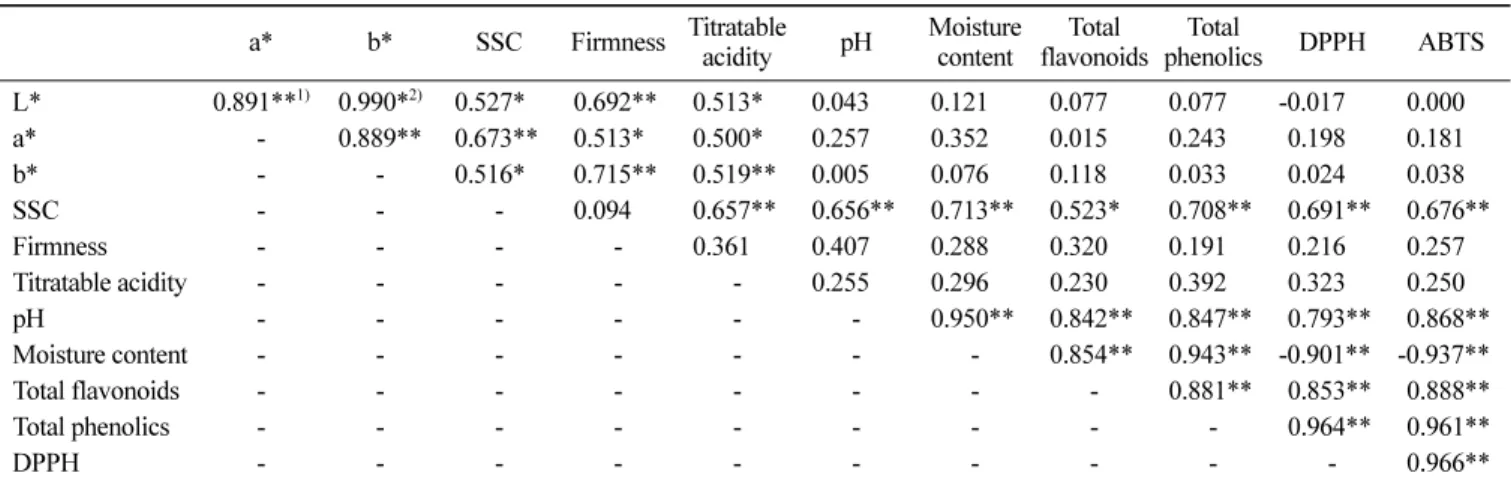
The physical quality of mini paprika flesh and the correlation between antioxidant compounds and activities are shown in Table 3. The correlation between antioxidant compounds and activities of the by-products is shown in Table 4. The total phenolic compounds, and the antioxidant compounds and activity in the flesh showed a strong correlation with total flavonoids (R=0.881), DPPH radical scavenging activity (R=0.964), and ABTS radical scavenging activity (R=0.961). Moreover, in the by-products, the total phenolic compounds and the antioxidant compounds and activities showed a strong positive correlation with total flavonoids (R=0.843), DPPH radical scavenging activity (R=0.922), and ABTS radical
scavenging activity (R=0.984). In general, fruits and vegetables show a high correlation between antioxidant compounds and activities (Kim and Shin, 2015; Yun et al., 2018; Hwang et al., 2019). Yoon et al. (2012) found a high correlation (R=0.712) for the antioxidant effect of green chili between the variety and the antioxidant compounds and activities. Similarly, Park et al. (2019) found that the correlation between the antioxidant compounds and activities of 12 sprout vegetables was very high, with R=0.926 and R=0.988, respectively. Moreover, Kim et al. (2006) found a high correlation between antioxidant compounds and activities in beans depending on the variety (R=0.67). This indicates that antioxidant compounds and activities are highly correlated. In addition, the correlation between SSC and antioxidant compounds or activities were as follows: total flavonoid (R=0.523), total phenolics (R= 0.708), DPPH radical scavenging activity (R=0.691), and ABTS radical scavenging activity (R=0.676). These results indicate that the antioxidant compounds and activities of mini paprika increased as the fruit matured.
Conclusion
This study measured and comparatively analyzed the color, soluble solid content, firmness, titratable acidity, pH, moisture content, length, antioxidant compound, and antioxidant activity of six varieties of mini paprika: “RD glory”, “OE glory”, “YW glory”, “Raon red”, “Raon orange”, and “Raon yellow”. The total Table 3. Pearson correlation among physical qualities, antioxidant compounds, and activities of mini paprika flesh
a* b* SSC Firmness Titratable acidity pH Moisture content Total flavonoids Total phenolics DPPH ABTS L* 0.891**1) 0.990*2) 0.527* 0.692** 0.513* 0.043 0.121 0.077 0.077 -0.017 0.000 a* - 0.889** 0.673** 0.513* 0.500* 0.257 0.352 0.015 0.243 0.198 0.181 b* - - 0.516* 0.715** 0.519** 0.005 0.076 0.118 0.033 0.024 0.038 SSC - - - 0.094 0.657** 0.656** 0.713** 0.523* 0.708** 0.691** 0.676** Firmness - - - - 0.361 0.407 0.288 0.320 0.191 0.216 0.257 Titratable acidity - - - 0.255 0.296 0.230 0.392 0.323 0.250 pH - - - 0.950** 0.842** 0.847** 0.793** 0.868** Moisture content - - - 0.854** 0.943** -0.901** -0.937** Total flavonoids - - - 0.881** 0.853** 0.888** Total phenolics - - - 0.964** 0.961** DPPH - - - 0.966**
Pearson correlation (R): **significance at p<0.01, *significance at p<0.05. DPPH: 2,2-diphenyl-1-picrylhydrazyl; ABTS: 2,2-azino-bis (3-ethylbenzothiazoline-6-sulfonic acid). L*: lightness, a*: redness, b*: yellowness
Table 4. Pearson correlation among physical qualities, antioxidant compounds, and activities of mini paprika by-products (core and seeds)
Total phenolics DPPH ABTS
Total flavonoids 0.843**1) 0.754** 0.881**
Total phenolics - 0.922** 0.984**
DPPH - 0.953**
Pearson correlation (R): **significance at p<0.01, *significance at p<0.05. DPPH: 2,2-diphenyl-1-picrylhydrazyl; ABTS: 2,2-azino-bis (3-ethylbenzothiazoline-6-sulfonic acid)
flavonoid content was significantly higher in the by-products than the flesh of the mini paprika cultivars. By contrast, the total phenolic content was significantly higher in the flesh than in the by-products. The antioxidant activity was measured by DPPH radical scavenging and ABTS radical scavenging activities, and both were higher in flesh than by-products. Moreover, there was a high correlation among antioxidant compounds and antioxidant activities in flesh and by-products. Compared to regular-size paprika, mini paprika in this study contained similar or higher antioxidant compounds and activities, indicating that they have high utility in terms of nutrition. Furthermore, the total flavonoid of mini paprika was higher in by-products, inedible parts, than flesh, the edible part. This indicates that the by-product parts such as core and seeds can be used as dried tea or dried chip as a snack. They can be also expected to be used for animal feed with high health functionality.
Acknowledgments
We would like to thank Yena Kim and Minji Joung for helping physical quality analysis.
References
Antonio AS, Wiedemann LSM, Junior VV. The genus Capsicum: a phytochemical review of bioactive secondary metabolites. RSC Adv. 8: 25767-25784 (2018)
Barbosa S, Campmajó G, Saurina J, Puignou L, Núñez O. Determi-nation of phenolic compounds in paprika by ultrahigh perfor-mance liquid chromatography-tandem mass spectrometry: Application to product designation of origin authentication by chemometrics. J. Agric. Food Chem. 68: 591-602 (2019)
Cho SD, Park JY, Kim EJ, Kim DM, Kim GH. Quality evaluation of fresh-cut products in the market. J. Korean Soc. Food Sci. Nutr. 36: 622-628 (2007)
Floegel A, Kim DO. Chung SJ, Koo SI, Chun OK. Comparison of ABTS/DPPH assays to measure antioxidant capacity in popular antioxidant-rich US foods. J. Food Compos. Anal. 24: 1043-1048 (2011)
Go SM, Kim HS, Park MR, Jeong RD. Antibacterial effect of non-thermal atmospheric plasma against soft rot bacteria on paprika. LWT-Food Sci. Technol. 117: 108600 (2020)
Hallmann E, Rembiałkowska E. Characterisation of antioxidant com-pounds in sweet bell pepper (Capsicum annuum L.) under organic and conventional growing systems. J. Sci. Food Agric. 92: 2409-2415 (2012)
Hwang ES. Effect of cooking methods on bioactive compound con-tents and antioxidant activities of brussels sprouts. J. Korean Soc. Food Sci. Nutr. 48: 1061-1069 (2019)
Hwang H, Kim YJ, Shin Y. Assessment of physicochemical quality, antioxidant content and activity, and inhibition of cholinesterase between unripe and ripe blueberry fruit. Foods 9: 690 (2020) Hwang H, Kim YJ, Shin Y. Influence of ripening stage and cultivar
on physicochemical properties, sugar and organic acid profiles, and antioxidant compositions of strawberries. Food Sci. Biotech-nol. 28: 1659-1667 (2019)
Hwang IG, Shin Y.J, Lee S, Lee J, Yoo SM. Effects of different cooking methods on the antioxidant properties of red pepper (Capsicum annuum L.). Prev. Nutr. Food Sci. 17: 286-292 (2012) Jeong CH, Ko WH, Cho JR, Ahn CG, Shim KH. Chemical
compo-nents of Korean paprika according to cultivars. Korean J. Food Preserv. 13: 43-49 (2006)
Jung HA, Hong JY. Change in quality characteristics of yellow paprika according to drying methods. Korean J. Food Preserv. 24:
1079-1087 (2017)
Kabir F, Tow WW, Hamauzu Y, Katayama S, Tanaka S, Nakamura S. Antioxidant and cytoprotective activities of extracts prepared from fruit and vegetable wastes and by-products. Food Chem. 167: 358-362 (2015)
Kang HM, Choi IL, Kim IS. Effect of cultural regions or methods on postharvest physiological characteristics and qualities of paprika fruits. J. Bio. Env. Con. 17: 325-329 (2008)
Kim DS, Lee KB. Physiological characteristics and manufacturing of the processing products of sprout vegetables. Korean J. Food Cookery Sci. 26:238-245 (2010)
Kim JA, Jung WS, Chun SC, Yu CY, Ma KH, Gwag JG, Chung IM. A correlation between the level of phenolic compounds and the antioxidant capacity in cooked-with-rice and vegetable soybean (Glycine max L.) varieties. Eur. Food Res. Technol. 224: 259-270 (2006)
Kim JS, Ahn JY, Ha TY, Rhee HC, Kim SA. Comparison of phy-tochemical and antioxidant activities in different color stages and varieties of paprika harvested in Korea. Korean J. Food Sci. Technol. 43: 564-569 (2011)
Kim YJ, Shin Y. Antioxidant profile, antioxidant activity, and physic-ochemical characteristics of strawberries from different cultivars and harvest locations. J. Korean Soc. Appl. Biol. Chem. 58: 587-595 (2015)
Lee HS, Hong JY, Choi YJ, Lee YS, Seo SJ, Shin SR. Characteris-tics in the components of the paprika by drying methods. Korean J. Food Preserv. 24: 497-504 (2017)
Lee JY, Choi SK, Seo JS. Evaluation of the nutrition status and met-abolic syndrome prevalence of the members according to the number of household members based on the Korea National Health and Nutrition Examination Survey (2013-2014). Korean J. Community Nutr. 24: 232-244 (2019)
Lee KI, Hwang YJ, Ban HJ, Lim SJ. Impact of the growth of single-person households on the food market and policy tasks. Korea Rural Economic Institute, Naju, Korea (2015)
Lee MY, Yoo MS, Whang YJ, Jin YJ, Hong MH, Pyo YH. Vitamin C, Total Polyphenol, Flavonoid Contents and Antioxidant Capac-ity of Several Fruit Peels. Korean J. Food Sci. Technol. 44: 540-544 (2012)
Lee SM, Kim JS, An CG, Park JS, Kim S. Assessment of paprika quality by instrumental parameters and sensory attributes. J. East Asian Soc. Dietary Life. 26: 34-43 (2016)
Luitel BP, Kang WH. Assessment of fruit quality variation in dou-bled haploids of minipaprika (Capsicum annuum L.). Hortic. Environ. Biotechnol. 54: 257-265 (2013)
Nimse SB, Pal D. Free radicals, natural antioxidants, and their reac-tion mechanisms. RSC Adv. 5: 27986-28006 (2015)
Park H, Shin Y, Kim YJ. Antioxidant contents and activities of twelve varieties of vegetable sprouts. Korean J. Food Sci. Tech-nol. 51: 207-213 (2019)
Pérez-Gálvez A, Mínguez-Mosquera MI. Structure-reactivity relation-ship in the oxidation of carotenoid pigments of the pepper (Cap-sicum annuum L.). J. Agric. Food Chem. 49: 4864-4869 (2001) Poljsak B, Šuput D, Milisav I. Achieving the balance between ROS
and antioxidants: when to use the synthetic antioxidants. Oxid. Med. Cell Longev. 2013: 956792 (2013)
Ribes-Moya AM, Adalid AM, Raigón MD, Hellín P, Fita A, Rodríguez-Burruezo A. Variation of flavonoids in a collection of peppers (Capsicum sp.) under organic and conventional cultiva-tion: effect of the genotype, ripening stage and growing system. J. Sci. Food Agric. 100: 2208-2223 (2020)
Šaponjac V, Četojević-Simin D, Ćetković G, Čanadanović-Brunet J, Djilas S, Mandić A, Tepić A. Effect of extraction conditions of paprika oleoresins on their free radical scavenging and anticancer activity. Open Chem. 12: 377-385 (2014)
Shin Y. Correlation between antioxidant concentrations and activities of Yuja (Citrus junos Sieb ex Tanaka) and other citrus fruits. Food Sci. Biotechnol. 21: 1477-1482 (2012)
Sridhar K, Charles AL. In vitro antioxidant activity of Kyoho grape
extracts in DPPH and ABTS assays: Estimation methods for EC50
using advanced statistical programs. Food Chem. 275: 41-49 (2019)
Statistics Korea. Korean statistical information service (KOSIS). Accessed 27 July 2020. http://kosis.kr/index/index/jsp. (2020) Yang H, Kim YJ, Shin Y. Influence of ripening stage and cultivar on
physicochemical properties and antioxidant compositions of aro-nia grown in South Korea. Foods 8: 598 (2019)
Yoon HJ, Lee S, Hwang IK. Effects of green pepper (Capsicum annuum var.) on antioxidant activity and induction of apoptosis in human breast cancer cell lines. Korean J. Food Sci. Technol.
44: 750-758 (2012)
Yun H, Lim S, Park H, Shin Y. Correlation between antioxidant compounds and activities of ‘Hibiscus sabdariffa’ teas from dif-ferent origins. J. East Asian Soc. Diet Life 28: 40-46 (2018) Zulkifli SA, Abd Gani SS, Zaidan UH, Halmi MIE. Optimization of
total phenolic and flavonoid contents of defatted pitaya (Hylocer-eus polyrhizus) seed extract and its antioxidant properties. Mole-cules 25: 787 (2020)