The Relation of Menarcheal Age to Anthropometric Profiles in Korean Girls
The aim of this study was to represent the trend of early menarche and to assess the association of age at menarche with anthropometric profiles of Korean children and adolescents. A cross sectional survey was conducted with 13,371 girls aged 10 to 18 yr, recruited nationwide from April, 2005 to March, 2006. Height, weight and waist
circumference of the subjects were measured; and the subjects self-reported their ages at menarche. We found that the menarcheal girls were taller (P<0.05 for the girls between 10 and 14 yr) and heavier (P<0.05 for the girls between 10 and 18 yr) than non-
menarcheal ones. Menarcheal girls also showed higher body mass index (BMI), and greater waist circumference than non-menarcheal ones. Significant differences were represented according to the age at menarche in terms of BMI, waist circumference, % body fat mass, waist hip ratio and neck circumference as well as height and weight (P<0.05). In
conclusion, girls who matured early were taller and heavier in early adolescence than those who matured later.
Key Words: Menarche; Korea; Body Composition; Anthropometry Ji-Yeong Kim1, In-Hwan Oh1,
Eun-Young Lee1, Chang-Mo Oh1, Kyung-Sik Choi1, Bong-Keun Choe1, Tai-Young Yoon1, Sung-Hee Shin2, and Joong-Myung Choi1
Department of Preventive Medicine & Medical Research Center for Bioreaction to Reactive Oxygen Species1, School of Medicine; Department of Psychiatric Nursing2, College of Nursing Science, Kyung Hee University, Seoul, Korea
Received: 20 December 2009 Accepted: 29 April 2010 Address for Correspondence:
Joong-Myung Choi, M.D.
Department of Preventive Medicine, School of Medicine, Kyung Hee University, 1 Hoegi-dong, Dongdaemun-gu, Seoul 130-701, Korea
Tel: +82.2-961-0318, Fax: +82.2-969-0792 E-mail: [email protected]
This research was supported by the grants from Division of Chronic Disease Surveillance, The Korea Centers for Disease Control and Prevention and from the Korean Pediatric Society.
DOI: 10.3346/jkms.2010.25.10.1405 • J Korean Med Sci 2010; 25: 1405-1410 Medicine General & Social Medicine
INTRODUCTION
There is a strong evidence of a downward secular trend in age at menarche in Europe and the USA during the last century, and in Japan and China during the past few decades (1). In Korea, there was a downward secular trend in pubertal timing, and age at menarche has been advanced by 2 yr during the last 80 yr (2).
Early age at menarche has been shown to be associated with increased adult body mass index (BMI) (3). Girls who experi- ence a relatively early age at menarche tend to be more obese as adults (4-12). During childhood and puberty, obese girls grow faster and have earlier menarche (13). Several longitudinal stud- ies have found a negative relation between age at menarche and adult weight-for-height (8-12, 14-16) by the analysis of BMI in all except one study (14). One research showed no association between age at menarche and adult BMI (5). Although the bio- logical mechanisms underlying the inverse association between menarcheal age and adult obesity are uncertain, it has been sug- gested that various endocrine factors influence both the rate of sexual maturation and the accumulation of body fat (8). Garn et al. (1986) found that women (20 to 35 yr old) who reported menarche before age of 11 yr old were 2 to 3 kg/m2 heavier than those who underwent menarche after 14 yr old. Other factors
across the life course may also explain the relation between age of menarche and adult BMI (16). Socioeconomic status at birth and in adult life, parity, current smoking, and alcohol intake are all associated with BMI in adult life (17). Social class is also neg- atively associated with age at menarche (12). But no studies of the association of age at menarche and adult BMI have taken all of these factors into account simultaneously (17). Since the early 19th century, secular changes have been described for age at menarche as well as for adult height (18). Several studies show that women with earlier menarche reach a shorter adult height compared with women who have menarche at a later age (4, 7, 12, 19-22). It has been believed that late maturers grow taller and leaner than early maturers but there have been only a few stud- ies to prove this relation in Korean population.
The aim of this study was to represent the trend of early men- arche and to assess the association of age at menarche with an- thropometric profiles of Korean children and adolescents.
MATERIALS AND METHODS Participants and procedures
This study was performed as a part of the fifth nationwide cross- sectional anthropometric survey for Korean children and ado-
lescents from April, 2005 to March, 2006 by Korea Centers for Disease Control and Prevention and the Korean Pediatric Soci- ety. All participants were informed about the procedures and aims of this study. Anyone who was reluctant to participate in this study was excluded. Children with growth hormone defi- ciency, growth related disorders, and other chronic debilitating conditions were also excluded from the study. Children with non-Korean parents were not included. Twins were also exclud- ed from the study. The sample was stratified by age and province.
Subjects were students at elementary, middle, and high schools across the nation. Data of the survey were collected from April, 2005 to March, 2006.
The questionnaire survey on the date of menarche was done either by self-reporting or by parents. A total of 13,371 girls aged 10 to 18 yr were recruited across the nationwide; of them, 9,840 girls aged 10 to 18 yr have experienced menarche at the time of study, but 3,531 girls aged 10 to 16 yr have not. All girls aged be- tween 17 and 18 yr experienced menarche. Informed consents were received from all subjects. This study was approved by the ethics panel of the institutions (KHUMC-IRB-2005001). Ages of all children were confirmed in records of school registry of birth date. Girls were categorized at interval of one year. The trained technicians measured stature and weight of subjects in light clothing and no shoes. Standing height was measured to the nearest 0.1cm using the standard measuring instrument (Har- penden Portable Stadiometer, Holtain Limited, Wales, UK). Weight of girls was measured using calibrated mechanical step-scales (GL-6000-20, CasKorea, Seoul, Korea). Weight was recorded to the 0.1 kg sensitivity. A total of randomly selected 1,006 girls from the whole samples were also examined for body fat and waist hip ratio using the instrument for body composition as- sessment (Bioelectrical Impedance Fatness Analyzer, Biospace, Seoul, Korea). The body composition was measured in the fast- ing status.
Statistical analysis
SAS (SAS institute Inc., Cary, NC, USA) version 9.1 was used to analyze the data. The distributions and means of study popula- tions were evaluated using descriptive statistics. The frequencies of menarche experience at current ages were calculated with chi- square test. We excluded girls who reported that their menarche, at age 7 yr old (n=3) and 8 yr old (n=11) from analyses. The dif-
ferences of anthropometric profiles in menarcheal girls accord- ing to menarcheal ages were analyzed by Analysis of Variance (ANOVA). Tukey’s multiple comparison test was applied to eval- uate differences between groups by ANOVA. Student t-test was used to investigate the differences between groups. P value at 0.05 or less was regarded as significant.
RESULTS
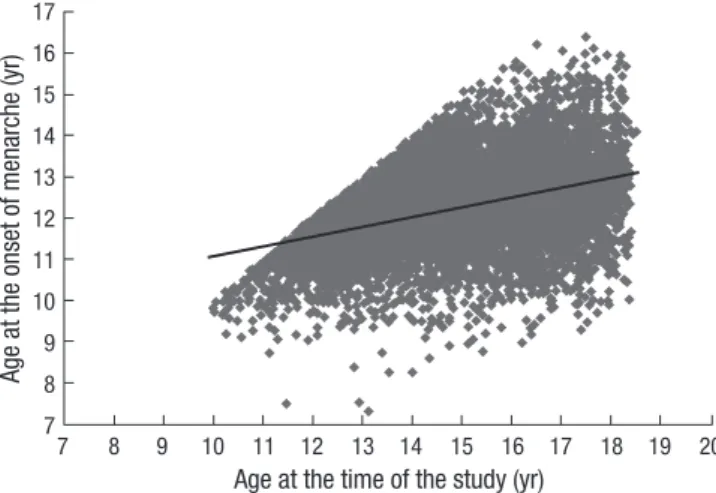
The age at menarche and the rate of menarche experience Older girls showed later onset of menarche and it was a statisti- cally significant finding (Table 1). Fig. 1 also supports the trend of menarche occurring at an early age. All the girls older than 17 yr among the subjects recruited for this study had already expe- rienced menarche. The largest number of girls experienced their menarche between the age 11 and 12 yr (Table 1).
Distribution of height, weight and body mass index in menarcheal girls according to age at menarche
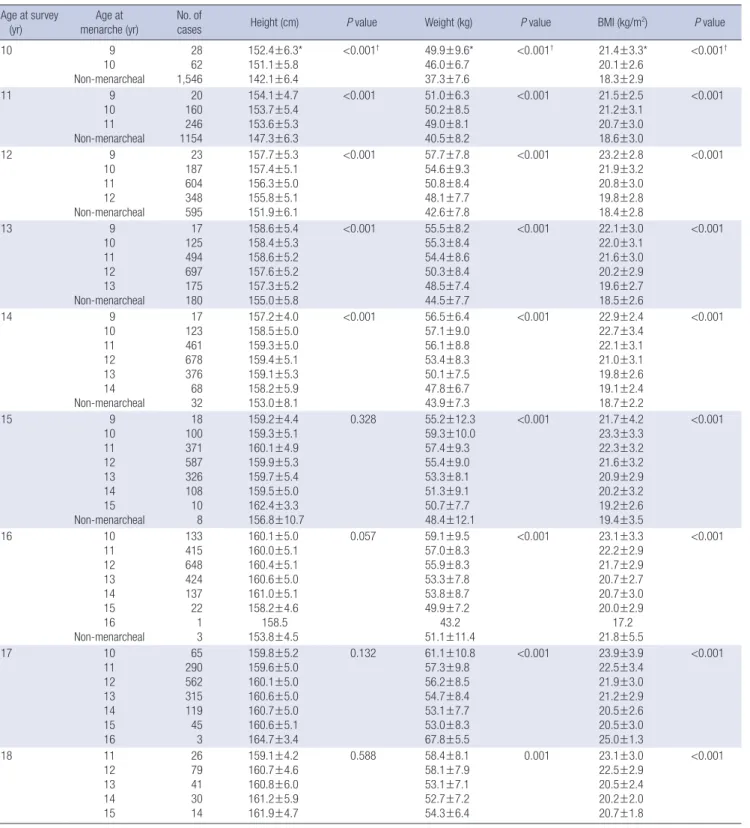
One way ANOVA represented statistically significant differenc- es in terms of height, weight and BMI (P<0.001) (Table 2). The girls that experienced menarche at an earlier age were taller and this difference depicted a statistical significance from the age of 10 to the age of 14 (Table 2). The difference of the mean weight was also analyzed and represented that menarcheal girls were heavier than non-menarcheal ones. From the age of 10 to 18, the menarcheal girls revealed significant differences with re-
Table 1. Comparison of age at menarche and the rate of menarche experience
Parameters Age at the time of the study (yr)
10 11 12 13 14 15 16 17 18
No. of menarcheal girls 90 430 1,160 1,515 1,719 1,524 1,773 1,414 207
No. of non-menarcheal girls 1,550 1,158 603 191 41 9 3 0 0
Rate of menarche experience (%) 5.5 27.1 65.8 88.8 97.7 99.4 99.8 100.0 100.0
Age at menarche (yr)* 9.7±0.5 10.5±0.6 11.1±0.7 11.6±0.8 11.9±1.0 12.0±1.1 12.1±1.1 12.2±1.1 12.6±1.1
*tested by ANOVA, P value<0.001.
Age at the onset of menarche (yr)
17 16 15 14 13 12 11 10 9 8 7
Age at the time of the study (yr)
7 8 9 10 11 12 13 14 15 16 17 18 19 20
Fig. 1. Trend of menarche occurring at an early age.
spect to the average weight (Table 2). There were also statisti- cally significant differences in the average BMI of menarcheal girls aged 10 to 18 (Table 2).
Percentage of body fat mass, waist hip ratio and neck circumference between menarcheal and non-menarcheal girls
Table 3 gives the comparison of the average % body fat mass, Table 2. Distribution of height, weight and BMI in menarcheal girls according to age at menarche
Age at survey
(yr) Age at
menarche (yr) No. of
cases Height (cm) P value Weight (kg) P value BMI (kg/m2) P value
10 9
10 Non-menarcheal
28 62 1,546
152.4±6.3*
151.1±5.8 142.1±6.4
<0.001† 49.9±9.6*
46.0±6.7 37.3±7.6
<0.001† 21.4±3.3*
20.1±2.6 18.3±2.9
<0.001†
11 9
10 11 Non-menarcheal
20 160 246 1154
154.1±4.7 153.7±5.4 153.6±5.3 147.3±6.3
<0.001 51.0±6.3 50.2±8.5 49.0±8.1 40.5±8.2
<0.001 21.5±2.5 21.2±3.1 20.7±3.0 18.6±3.0
<0.001
12 9
10 11 12 Non-menarcheal
23 187 604 348 595
157.7±5.3 157.4±5.1 156.3±5.0 155.8±5.1 151.9±6.1
<0.001 57.7±7.8 54.6±9.3 50.8±8.4 48.1±7.7 42.6±7.8
<0.001 23.2±2.8 21.9±3.2 20.8±3.0 19.8±2.8 18.4±2.8
<0.001
13 9
10 11 12 13 Non-menarcheal
17 125 494 697 175 180
158.6±5.4 158.4±5.3 158.6±5.2 157.6±5.2 157.3±5.2 155.0±5.8
<0.001 55.5±8.2 55.3±8.4 54.4±8.6 50.3±8.4 48.5±7.4 44.5±7.7
<0.001 22.1±3.0 22.0±3.1 21.6±3.0 20.2±2.9 19.6±2.7 18.5±2.6
<0.001
14 9
10 11 12 13 14 Non-menarcheal
17 123 461 678 376 68 32
157.2±4.0 158.5±5.0 159.3±5.0 159.4±5.1 159.1±5.3 158.2±5.9 153.0±8.1
<0.001 56.5±6.4 57.1±9.0 56.1±8.8 53.4±8.3 50.1±7.5 47.8±6.7 43.9±7.3
<0.001 22.9±2.4 22.7±3.4 22.1±3.1 21.0±3.1 19.8±2.6 19.1±2.4 18.7±2.2
<0.001
15 9
10 11 12 13 14 15 Non-menarcheal
18 100 371 587 326 108 10 8
159.2±4.4 159.3±5.1 160.1±4.9 159.9±5.3 159.7±5.4 159.5±5.0 162.4±3.3 156.8±10.7
0.328 55.2±12.3
59.3±10.0 57.4±9.3 55.4±9.0 53.3±8.1 51.3±9.1 50.7±7.7 48.4±12.1
<0.001 21.7±4.2 23.3±3.3 22.3±3.2 21.6±3.2 20.9±2.9 20.2±3.2 19.2±2.6 19.4±3.5
<0.001
16 10
11 12 13 14 15 16 Non-menarcheal
133 415 648 424 137 22 1 3
160.1±5.0 160.0±5.1 160.4±5.1 160.6±5.0 161.0±5.1 158.2±4.6 158.5 153.8±4.5
0.057 59.1±9.5
57.0±8.3 55.9±8.3 53.3±7.8 53.8±8.7 49.9±7.2 43.2 51.1±11.4
<0.001 23.1±3.3 22.2±2.9 21.7±2.9 20.7±2.7 20.7±3.0 20.0±2.9 17.2 21.8±5.5
<0.001
17 10
11 12 13 14 15 16
65 290 562 315 119 45 3
159.8±5.2 159.6±5.0 160.1±5.0 160.6±5.0 160.7±5.0 160.6±5.1 164.7±3.4
0.132 61.1±10.8
57.3±9.8 56.2±8.5 54.7±8.4 53.1±7.7 53.0±8.3 67.8±5.5
<0.001 23.9±3.9 22.5±3.4 21.9±3.0 21.2±2.9 20.5±2.6 20.5±3.0 25.0±1.3
<0.001
18 11
12 13 14 15
26 79 41 30 14
159.1±4.2 160.7±4.6 160.8±6.0 161.2±5.9 161.9±4.7
0.588 58.4±8.1
58.1±7.9 53.1±7.1 52.7±7.2 54.3±6.4
0.001 23.1±3.0
22.5±2.9 20.5±2.4 20.2±2.0 20.7±1.8
<0.001
*Mean±SD; †tested by ANOVA.
BMI, body mass index.
waist hip ratio and neck circumference between menarcheal and non-menarcheal subjects. Non-menarcheal girls depicted slimmer figures than menarcheal ones with significant differ- ence at the age of 11 to 13 (P<0.001). Table 4 depicts mean height, weight and BMI of menarcheal girls whose onset of menarche was within 365 days at the time of study.
DISCUSSION
Several studies have proven that girls with higher body weight, higher body mass index, more body fat, and greater height reach their menarche earlier (21, 23-26). It has been suggested that girls need to reach a critical weight or height for menarche to occur and that changes in dietary habits as observed in children may have caused this critical weight to be reached at an earlier age (18). Up to now it is unclear, however, whether energy in- take or specific nutritional components play a role, or whether nutrition affects menarche through its effect on accumulation of adipose tissue (18).
Girls who are lean before, during, and after puberty tend to have a later menarche than those who are fatter (27). Waist cir- cumference and abdominal sagittal diameter appear to be the best simple measures of visceral adipose tissue, and these indi-
ces are more consistently associated with several measures of cardiovascular risk, such as fasting and post glucose insulin lev- els (10).
Early maturers showed greater ponderosity and adiposity when compared with mid-onset or late maturers (10). The group of early maturers had a significantly greater waist circumference, visceral adiposity than mid-onset or late maturers but had no difference in the waist to hip ratio that is regional distribution of adipose tissue (10).
It has been addressed whether the associations of age at men- arche with adult BMI and obesity are related to childhood BMI.
According to Freedman et al. (28), underlying reason for the as- sociation of age at menarche with adult BMI is that childhood BMI drives or is at least permissive of the age at onset of sexual maturation and hence the age at menarche.
In the another literature published in 2005, Pierce and Leon noted that the association between age at menarche and mean adult BMI was only slightly confounded by early childhood BMI and that the relation between age at menarche and adult obesi- ty was not confounded at all by childhood BMI (17). The gains in several growth parameters in early maturers that is peak height velocity and height gained after menarche were offset by a brief- er period of prepubertal growth (10). Because early maturers started puberty 1.5 to 3.3 yr earlier than the mid-onset and late maturers, they lost several years of prepubertal growth which is 4-5 cm per year (10).
Girls who matured early were taller in early adolescence and shorter in early adulthood than those who matured later, despite having a greater peak height velocity and greater post menar- cheal increment in height (10). There is a vast amount of litera- ture reporting that women who reach their menarche at a later age will eventually grow taller compared with women who reach their menarche at an earlier age (18). This relation may be ex- plained by the earlier closure of epiphyseal growth plates be- cause of the increase in ovarian estrogens (7, 22). A delay in men- arche allows more growth of the long bones before the epiphy- Table 3. Comparison of proportion body fat mass, waist hip ratio and neck circumference between menarcheal and non-menarcheal girls
Age at survey (yr) Menarcheal girls (Number) Non-menarcheal girls (Number) P value
Body fat mass (%) 10
11 12 13 14
24.9±8.4*
25.7±7.3 24.6±7.0 26.5±6.8 20.1±2.9
(16) (94) (175) (199) (98)
23.1±8.3 22.1±7.4 22.6±6.5 22.1±6.8 19.2±3.1
(172) (134) (78) (33) (7)
0.405†
<0.001 0.039 0.001 0.182†
Waist hip ratio 10
11 12 13 14
0.87±0.03 0.87±0.04 0.84±0.04 0.84±0.05 0.81±0.03
(16) (94) (175) (199) (98)
0.86±0.04 0.84±0.04 0.82±0.03 0.81±0.03 0.81±0.02
(172) (134) (78) (33) (7)
0.243†
<0.001
<0.001
<0.001 0.954† Neck circumference (cm) 10
11 12 13 14
29.2±3.5 30.3±2.7 30.6±2.0 31.0±2.1 30.8±1.8
(16) (94) (175) (199) (98)
27.8±2.7 28.0±2.4 29.3±1.8 30.2±1.7 30.4±2.0
(172) (134) (78) (33) (7)
0.059†
<0.001
<0.001 0.034 0.558†
*Mean±SD; †NS: Not significantly different at P<0.05.
Table 4. Mean height, weight and BMI of menarcheal girls whose onset of menarche was within 365 days at the time of study
Age (yr) Height (cm) Weight (kg) BMI (kg/m2) Number of subjects
10 151.0±5.8* 46.3±7.0* 20.3±2.7* 81
11 153.4±5.4 48.9±8.1 20.7±3.0 348
12 155.7±5.0 48.9±8.0 20.1±2.9 721
13 157.0±5.1 48.9±7.8 19.8±2.8 528
14 158.4±5.6 48.6±7.4 19.3±2.5 225
15 159.8±4.9 49.0±5.8 19.2±2.3 58
16 159.0±5.1 49.6±4.2 19.7±2.4 8
*Mean±SD.
BMI, body mass index.
ses unite and results in a taller adult height (18). There is a Ko- rean study with the aim of measuring the trend in age at men- arche in Korea during the past few decades and the association of height with this trend (1). A total of 1061 Korean women born between 1920 and 1986 were randomly recruited from Ansan Cohort Study samples and separate school girl samples, and subjected to this analysis (1). In this research, mean menarche- al age decreased from 16.8 to 12.7 yr during the past 67 yr, cor- responding to -0.64 yr per decade, while height increased from 149.23 to 161.75 cm during the same period, showing an inverse relationship in the change of trend between height and mean age at menarche (1). In the conclusion of this study, authors sug- gested that the downward secular trend in age at menarche may reflect the secular change in physical growth in Korean women during the past 67 yr (1).
In our research, the menarcheal girls were taller and heavier than non-menarcheal ones. Menarcheal girls also showed high- er BMI and greater waist circumference than non-menarcheal ones. Non-menarcheal girls depicted slimmer figures than men- archeal ones with the analysis of percent body fat mass, waist hip ratio and neck circumference. Different groups of age at men- arche at the certain ages represented significant (P<0.001) dif- ferences in terms of BMI, waist circumference, percent body fat mass, waist hip ratio and neck circumference as well as height and weight. These results suggest that certain weight or height might exist for the occurrence of menarche.
The velocity of height of obese girls is faster and they grow taller than their normal weight peers during the puberty. It could affect that obese girls reach their menarche earlier and also reach final height earlier and stay shorter as adults compared to girls who were not obese in childhood. Georgiadis et al. (1997) con- cluded that adult height is independently associated with men- archeal age (Odds ratio, 0.52; 95% CI, 0.04-1.00; P=0.03), where- as BMI, place of birth or residence and educational level do not seem to play a role of comparable significance (22).
Our study also compared % body fat mass between menar- cheal and non-menarcheal girls and found that menarcheal girls had greater body fat mass. This result suggests that body com- position index including body fat mass might be a stronger fac- tor to the occurrence of menarche than simple growth in body size.
A few limitations should be noted. The present study was de- pendent on self-reported age at menarche, which implies that participants might not report accurately or younger girls may report menarcheal age more accurately, because the event was more recent. Older girls filled out the questionnaire related to the date of menarche. A questionnaire was sent to the parents of each student that was considered to be too young to recall the date of menarche through school nurses.
Nevertheless, some researches showed that recalled age at menarche was generally accurate both for teenagers and for
women up to 30 yr of age and older (29, 30). In the French co- hort, there are data on 549 women who answered the question on age at menarche twice with an 18-month interval. Of these women, 70.7 percent reported an identical age at first menstru- ation, and 98.5 percent reported an age at menarche within a year of that initially reported. These percentages did not differ for older compared with younger women (29). Must et al. (30) were able to compare the actual measured age at menarche and the reported age 33 yr later. They showed that the actual mean age at menarche did not differ from the recalled mean age at menarche which is 12.93 yr (95 percent confidence interval, 12.81-13.06) vs. 12.85 yr (95 percent confidence interval, 12.69- 13.00). Moreover, any misclassification was not dependent on the age at menarche.
One more limitation concerns the study design. We conduct- ed the cross-sectional study. This emphasizes the need for lon- gitudinal studies in the causal relationship between age of men- arche and anthropometric profiles.
In spite of the limitations mentioned above, this study has the several advantages over many earlier investigations. The strengths of this study include the fact that the study was relatively large and subjects were recruited across the nation, which implies that the obtained results from this study could be generalizable.
From the result of our research, the menarcheal girls showed taller and heavier figures than non-menarcheal ones. Menar- cheal girls also showed higher BMI and greater waist circumfer- ence than non-menarcheal ones. Non-menarcheal girls depict- ed slimmer figures than menarcheal ones in terms of % body fat mass, waist hip ratio and neck circumference.
In conclusion, girls who matured early were taller and heavi- er in early adolescence than those who matured later. Our data provide useful reference points for investigators and clinicians who are interested in the relationship between growth and sex- ual maturation of girls.
REFERENCES
1. Hwang JY, Shin C, Frongillo EA, Shin KR, Jo I. Secular trend in age at menarche for South Korean women born between 1920 and 1986: the Ansan study. Ann Hum Biol 2003; 30: 434-42.
2. Park MJ, Lee IS, Shin EK, Joung H, Cho SI. The timing of sexual matura- tion and secular trends of menarchial age in Korean adolescents. Korean J Pediatr 2006; 49: 610-6.
3. Parsons TJ, Power C, Logan S, Summerbell CD. Childhood predictors of adult obesity: a systematic review. Int J Obes Relat Metab Disord 1999;
23 Suppl 8: S1-107.
4. Sharma K, Talwar I, Sharma N. Age at menarche in relation to adult body size and physique. Ann Hum Biol 1988; 15: 431-4.
5. Wellens R, Malina RM, Roche AF, Chumlea WC, Guo S, Siervogel RM.
Body size and fatness in young adults in relation to age at menarche. Am J Hum Biol 1992; 4: 783-7.
6. St George IM, Williams S, Silva PA. Body size and the menarche: the Dune-
din Study. J Adolesc Health 1994; 15: 573-6.
7. Helm P, Münster K, Schmidt L. Recalled menarche in relation to infertil- ity and adult weight and height. Acta Obstet Gynecol Scand 1995; 74:
718-22.
8. Van Lenthe FJ, Kemper CG, Van Mechelen W. Rapid maturation in ad- olescence results in greater obesity in adulthood: the Amsterdam Growth and Health Study. Am J Clin Nutr 1996; 64: 18-24.
9. Power C, Lake J, Cole T. Body mass index and height from childhood to adulthood in the 1958 British born cohort. Am J Clin Nutr 1997; 66: 1094- 101.
10. Biro FM, McMahon RP, Striegel-Moore R, Crawford PB, Obarzanek E, Morrison JA, Barton BA, Falkner F. Impact of timing of pubertal matu- ration on growth in black and white female adolescents: the National Heart, Lung, and Blood Institute Growth and Health Study. J Pediatr 2001; 138: 636-43.
11. Laitinen J, Power C, Jarvelin MR. Family social class, maternal body mass index, childhood body mass index, and age at menarche as predictors of adult obesity. Am J Clin Nutr 2001; 74: 287-94.
12. Okasha M, McCarron P, McEwen J, Smith GD. Age at menarche: secular trends and association with adult anthropometric measures. Ann Hum Biol 2001; 28: 68-78.
13. Kim EK, Lee SH. Comparison of obesity and growth development in men- archeal and nonmenarcheal girls. J Korean Diet Assoc 2003; 9: 106-13.
14. Miller FJ, Billewicz WZ, Thomson AM. Growth from birth to adult life of 442 Newcastle upon Tyne children. Br J Prev Soc Med 1972; 26: 224-30.
15. Sherman B, Wallace R, Bean J, Schlabaugh L. Relationship of body weight to menarcheal and menopausal age: implications for breast cancer risk.
J Clin Endocrinol Metab 1981; 52: 488-93.
16. Power C, Parsons T. Overweight and obesity from a life course perspec- tive. A life course approach to women’s health. Oxford, United Kingdom:
Oxford University Press 2002; 304: 28.
17. Pierce MB, Leon DA. Age at menarche and adult BMI in the Aberdeen children of the 1950s cohort study. Am J Clin Nutr 2005; 82: 733-9.
18. Onland-Moret NC, Peeters PH, van Gils CH, Clavel-Chapelon F, Key T, Tjønneland A, Trichopoulou A, Kaaks R, Manjer J, Panico S, Palli D, Tehard B, Stoikidou M, Bueno-De-Mesquita HB, Boeing H, Overvad K,
Lenner P, Quirós JR, Chirlaque MD, Miller AB, Khaw KT, Riboli E. Age at menarche in relation to adult height: the EPIC study. Am J Epidemiol 2005; 162: 623-32.
19. Shangold MM, Kelly M, Berkeley AS, Freedman KS, Groshen S. Relation- ship between menarcheal age and adult height. South Med J 1989; 82:
443-5.
20. Baanders AN, De Waard F. Breast cancer in Europe: the importance of factors operating at an early age. Eur J Cancer Prev 1992; 1: 285-91.
21. Koprowski C, Ross RK, Mack WJ, Henderson BE, Bernstein L. Diet, body size and menarche in a multiethnic cohort. Br J Cancer 1999; 79: 1907-11.
22. Georgiadis E, Mantzoros CS, Evagelopoulou C, Spentzos D. Adult height and menarcheal age of young women in Greece. Ann Hum Biol 1997; 24:
55-9.
23. Meyer F, Moisan J, Marcoux D, Bouchard C. Dietary and physical deter- minants of menarche. Epidemiology 1990; 1: 377-81.
24. Moisan J, Meyer F, Gingras S. A nested case-control study of the correlates of early menarche. Am J Epidemiol 1990; 132: 953-61.
25. Maclure M, Travis LB, Willett W, MacMahon B. A prospective cohort study of nutrient intake and age at menarche. Am J Clin Nutr 1991; 54:
649-56.
26. Petridou E, Syrigou E, Toupadaki N, Zavitsanos X, Willett W, Trichopou- los D. Determinants of age at menarche as early life predictors of breast cancer risk. Int J Cancer 1996; 68: 193-8.
27. Brooks-Gunn J, Warren MP. Mother-daughter differences in menarcheal age in adolescent girls attending national dance company schools and non-dancers. Ann Hum Biol 1988; 15: 35-43.
28. Freedman DS, Khan LK, Serdula MK, Dietz WH, Srinivasan SR, Beren- son GS; Bogalusa heart study. The relation of menarcheal age to obesity in childhood and adulthood: the Bogalusa heart study. BMC Pediatr 2003; 3: 3.
29. Clavel-Chapelon F; E3N-EPIC group. European Prospective Investigation into Cancer. Evolution of age at menarche and at onset of regular cycling in a large cohort of French women. Hum Reprod 2002; 17: 228-32.
30. Must A, Phillips SM, Naumova EN, Blum M, Harris S, Dawson-Hughes B, Rand WM. Recall of early menstrual history and menarcheal body size:
after 30, how well do women remember? Am J Epidemiol 2002; 155: 672-9.