High-sensitivity C-reactive Protein Can Predict Major Adverse Cardiovascular Events in Korean Patients with Type 2 Diabetes
Inflammation is thought to play a role in the pathogenesis of major adverse cardiovascular events (MACE). It has been suggested that the measurement of markers of inflammation may aid in predicting the risk of such events. Here, the relationship between high- sensitivity C-reactive protein (hs-CRP) levels and MACE in Korean patients with type 2 diabetes is assessed. A retrospective cohort study was conducted as a follow-up among 1,558 patients with type 2 diabetes and without cardiovascular diseases over a mean period of 55.5 months. A Cox proportional-hazards model was used to determine whether increased hs-CRP levels are useful as a predictor for future MACE. The hazard ratio of MACE was 1.77 (95% CI; 1.16-2.71) in subjects who had the highest hs-CRP levels ( > 0.21 mg/dL) compared to subjects who had the lowest hs-CRP levels ( < 0.08 mg/dL), after adjusting for age, regular physical activity, current smoking, and duration of diabetes. The present results indicate that high hs-CRP levels can act as a predictor for the MACE occurrence in Korean patients with type 2 diabetes.
Key Words: C-Reactive protein; Diabetes Mellitus, Type 2; Cardiovascular Diseases;
Hazard Ratio Sangheun Lee1, In Tae Kim1,
Hyung Bok Park1, Yu Kyung Hyun1, Yoon Ji Kim1, Sun Ok Song1 and Hyeongjin Kim2
Departments of 1Internal Medicine and 2Endocrinology, College of Medicine, Kwandong University, Goyang, Korea
Received: 7 April 2011 Accepted: 29 August 2011 Address for Correspondence:
Hyeongjin Kim, MD
Division of Endocrinology, Department of Internal Medicine, Myungji Hospital, College of Medicine, Kwandong University, 55 Hwasu-ro, 14bun-gil, Dukyang-gu, Goyang 412-270, Korea Tel: +82.31-810-5419, Fax: +82.31-969-0500 E-mail: [email protected]
http://dx.doi.org/10.3346/jkms.2011.26.10.1322 • J Korean Med Sci 2011; 26: 1322-1327
INTRODUCTION
The presence of diabetes is an independent risk factor for ath- erosclerosis. Endothelial dysfunction, oxidative stress, and low- grade inflammation are major features in the pathophysiology of this disease (1). It has been shown that atherosclerosis in pa- tients with diabetes mellitus (DM) can lead to acute coronary artery disease, ischemic cerebral disease, and peripheral arteri- al disease (2). Because atherosclerosis is an inflammatory pro- cess, several plasma markers of inflammation have been evalu- ated as potential tools for the prediction of risk for cardiovascu- lar disease (3). For example, a high serum level of high-sensitiv- ity C-reactive protein (hs-CRP), a marker of systemic inflamma- tion and a mediator of atherosclerotic disease, has been corre- lated with an increased risk for cardiovascular disease (4-6).
Although it is generally accepted that hs-CRP levels can act as a predictor for cardiovascular disease in non-diabetic patients, there is a relative lack of data concerning the usefulness of hs- CRP levels when predicting the occurrence of cardiovascular diseases in Asian type 2 diabetic patients. Thus, the objective of this study was to clarify the independent clinical value of hs-CRP levels in the occurrence of major adverse cardiovascular event (MACE) in Korean type 2 diabetic patients.
MATERIALS AND METHODS Participants and study design
A retrospective cohort study was conducted involving 2,452 pa- tients between 30-70 yr of age with type 2 diabetes who were managed in the Endocrinology Department of Kwandong Uni- versity Myongji Hospital, Goyang, Korea. Serum hs-CRP levels were measured between January 2004 and December 2007 dur- ing hospital visits prior to the occurrence of MACE. After careful history taking and physical examination, 388 subjects were ex- cluded for the following reasons: previous cardiovascular dis- eases, type 1 diabetes, pregnancy, breast feeding, acute infec- tion or chronic inflammatory disease (upper or lower respira- tory infection, urinary tract infection, acute gastrointestinal in- fection, inflammatory bowel disease, osteoarthritis, rheumatoid arthritis, chronic hepatitis, gout, and bronchial asthma), or high baseline hs-CRP levels ( > 1 mg/dL) (7). MACE occurrence was identified using an electronic medical record system in the re- maining 2,064 subjects. All subjects were contacted by phone to confirm the occurrence of MACE. If the patients were con- firmed with MACE but had moved to another hospital, the rel- evant hospital was contacted so that data could be collected. The occurrence and non-occurrence of MACE were confirmed in 1,766 of the 2,064 subjects. The mean follow-up period was 55.5 (20-92) months.
Baseline measurements and definitions
Blood sampling and hemodynamic measurements were per- formed on all patients. Levels of hs-CRP were measured using a high-sensitivity assay (turbidity immune assay, Toshiba, Tokyo) with a detection limit of 0.01 mg/dL. DM was defined as a fast- ing blood glucose concentration of ≥ 126 mg/dL or as receiving anti-hyperglycemic drug treatment. Body mass index (BMI) was calculated by weight in kilograms divided by square of height in meters. Height, weight, and plasma levels of hs-CRP, fasting glu- cose, HbA1c, total cholesterol, triglycerides, and high-density lipoprotein (HDL)-cholesterol were measured simultaneously.
LDL-C was estimated using the equation developed by Friede- wald et al. (8) Regular physical activity was defined as over 150 min of exercise per week.
Myocardial infarction (MI) was defined according to the guide- lines of the American Heart Association/American College of Cardiology and included elevated cardiac enzymes and specific electrocardiogram changes (9). Percutaneous coronary inter- vention (PCI) was defined as needing percutaneous translumi- nal coronary angioplasty or stent insertion against significant stenosis of the coronary artery. A stroke was defined as rapidly- developing loss of brain function due to disturbance in blood supply to the brain. Additionally, according to the standard World Health Organization definition, a stroke is limited to a focal neu- rological deficit over 24 hr and cerebral hemorrhage on brain imaging was excluded (10). Peripheral vascular angioplasty, pe- ripheral vascular surgery, and amputation due to critical limb ischemia were considered to be peripheral vascular events. Car- diovascular death was limited to the diagnostic code I21-25 or I60-73 for the cause of death. Thus, MACE included cases of MI, coronary obstructive disease treated by PCI or CABG, stroke, other vascular diseases treated by angioplasty or vascular sur- gery, and cardiovascular death.
Statistical analyses
Several variables, including hs-CRP levels, fasting glucose, HbA1c, total cholesterol, triglycerides, HDL-cholesterol, and LDL-cho- lesterol were not normally distributed in the Shapiro-Wilk test.
Logarithmic transformation was used to normalize them and the variables were applied to the following analysis. A logistic regression analysis and a general linear model were used to com- pare trisected hs-CRP levels and clinical characteristics after ad- justing for age, sex, and duration of diabetes. The patients were divided into two groups according to whether MACE occurred or not and the clinical characteristics between the two groups were compared through a general linear model and a logistic regression analysis after adjusting for age, sex, and duration of diabetes. The hazard ratios were estimated for MACE according to the tertile of baseline hs-CRP levels after adjusting for age, sex, duration of diabetes, current smoking, physical activity, and to- tal cholesterol by Cox regression analysis.
Ethics statement
The present study was approved by the institutional review board (IRB) of Kwandong University Myongji Hospital (IRB approval number: 2011-022). The present study was exempted written informed consent and all the data collected from this study was kept confidential.
RESULTS
The clinical characteristics of the patients are shown in Table 1.
The mean hs-CRP level for the 1,766 subjects was 0.21 ± 0.22 mg/
dL and the median value was 0.13 mg/dL (interquartile range 0.05-0.28). Enrolled subjects were divided into three groups ac- cording to serum hs-CRP level (mg/dL); low (< 0.08 mg/dL), medium (0.08-0.21 mg/dL), and high (> 0.21 mg/dL). The low, medium, and high hs-CRP levels were 46.2%, 45.8%, and 48.6%
in women and there was no significant difference of sexual dis- tribution between the groups. The duration of DM and LDL- Table 1. Baseline characteristics of the study population
Characteristics
Tertile of plasma hs-CRP level (mg/dL)
P value Low
( < 0.08) Medium
(0.08-0.21) High ( > 0.21)
Number 590 593 583
hs-CRP (mg/dL)a,f 0.04 ± 0.02 0.13 ± 0.04 0.46 ± 0.21 < 0.001 Age (yr)d 55.5 ± 11.2 56.7 ± 11.2 58.1 ± 11.0 0.001
Gender (% women) 45.8 44.9 48.9 0.624
Duration of DM (yr) 6.0 ± 6.9 5.9 ± 7.0 6.1 ± 7.2 0.545 Smoking (%)
Current smokersd
Past smokersc 23.4
49.2 27.7
51.4 27.3
50.4 0.015
0.056
Physical activity (%)e 48.3 46.9 38.8 0.003
Weight (kg)d 63.4 ± 10.4 66.5 ± 11.1 66.4 ± 11.3 < 0.001 BMI (kg/m2)a 24.2 ± 2.9 25.3 ± 3.2 25.7 ± 3.6 < 0.001 Systolic BP (mmHg)b 125.6 ± 17.0 127.9 ± 17.8 127.8 ± 18.0 0.070 Diastolic BP (mmHg)d 79.2 ± 11.6 81.3 ± 11.6 80.6 ± 12.1 0.002 FBS (mM/L)a,f 8.45 ± 3.28 8.70 ± 3.09 9.41 ± 3.99 < 0.001 HbA1c (%)a,f 7.5 ± 2.1 7.9 ± 2.1 8.1 ± 2.2 < 0.001 TC (mM/L)b,f 4.90 ± 1.04 5.07 ± 1.17 5.08 ± 1.30 0.042 Triglyceride (mM/L)d,f 1.79 ± 1.36 2.08 ± 1.62 2.19 ± 1.61 < 0.001 HDL-C (mM/L)b,f 1.19 ± 0.31 1.14 ± 0.34 1.10 ± 0.33 < 0.001 LDL-C (mM/L)f 2.90 ± 0.97 2.98 ± 1.07 3.00 ± 1.11 0.394 Medication
ACE-I ARB Statin Aspirin Clopidogrel
5.2 20.9 16.2 16.4 5.1
7.8 17.6 18.6 16.2 8.2
5.9 19.8 17.1 14.1 5.9
0.176 0.316 0.573 0.246 0.102 Data are expressed as means ± SD and percentages. hs-CRP, C-reactive protein;
DM, diabetes mellitus; BMI, body mass index; BP, blood pressure; FBS, fasting blood glucose; TC, total cholesterol; HDL-C, high-density lipoprotein-cholesterol; LDL-C, low- density lipoprotein-cholesterol; ACE-I, angiotensin converting enzyme-inhibitor; ARB, angiotensin receptor blocker. aP value among 3 groups < 0.05. bP value of low vs medium hs-CRP group < 0.05. cP value of low vs high hs-CRP group < 0.05. dP val- ue of low vs medium and low vs high hs-CRP group < 0.05. eP value of low vs high and medium vs high hs-CRP group < 0.05. P value was estimated by a logistic re- gression analysis and a general lineal model after adjusting for age, sex, and duration of DM. fP was calculated from log-transformed data.
cholesterol level were not different between the groups. The re- sult showed no significant difference in frequency of angioten- sin converting enzyme-inhibitors, angiotensin receptor blocker, statin, aspirin and clopidogrel administration. However, age, weight, BMI, blood pressure, fasting blood glucose, HbA1c, to- tal cholesterol, and triglycerides increased in proportion to the level of hs-CRP. HDL-cholesterol showed an inverse proportion to the level of hs-CRP. The percentage of regular physical activi- ty was low in the high hs-CRP group compared with the other groups.
MACE was observed in 144 patients during the follow-up pe- riod (mean of 55.5 months). MI was seen in 19 patients; 106 pa-
tients were treated by PCI due to coronary arterial obstructive disease, and stroke occurred in 25 patients. All-cause death oc- curred in 50 patients; 15 of cardiovascular disease, 10 of malig- nancy, 13 of infectious diseases, 10 of other diseases, and two of unknown causes.
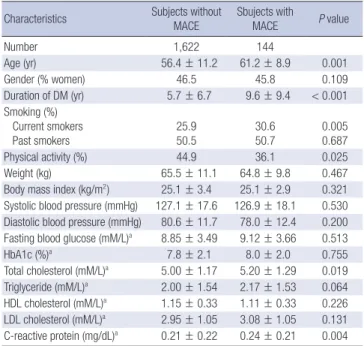
Subjects were divided into two groups according to whether MACE occurred or not. Age, duration of DM, current smoking, physical activity, total cholesterol, and hs-CRP levels were greater in subjects with MACE. There were no significant differences in gender, past smoking, BMI, blood pressure, fasting blood glu- cose, HbA1c, triglycerides, HDL-cholesterol, or LDL-cholesterol (Table 2). Compared with the low-level hs-CRP group, the me- dium- and high-level hs-CRP groups exhibited a trend towards an increased risk for MACE in a Cox model (Fig. 1). The crude hazard ratio was 1.44 (0.92-2.24) for the medium level hs-CRP group and 2.00 (1.31-3.04) for the high level hs-CRP group. After adjusting for age, sex, duration of DM, current smoking, physi- cal activity, and total cholesterol, the relative risk of MACE in- creased by 77% in the high-level hs-CRP group compared with the low-level hs-CRP group (1.16-2.71). The hazard ratio of MACE for the medium-level hs-CRP group compared with the low-lev- el hs-CRP group was not significant (Table 3).
DISCUSSION
The aim of this study was to examine the relationship between hs-CRP levels and the prognosis of MACE in patients with type 2 diabetes and without cardiovascular disease. The predictive value of baseline hs-CRP levels in the prognosis of MACE was Table 2. Baseline demographic data and clinical characteristics of 1,766 subjects
with MACE versus subjects without MACE Characteristics Subjects without
MACE
Sbujects with
MACE P value
Number 1,622 144
Age (yr) 56.4 ± 11.2 61.2 ± 8.9 0.001
Gender (% women) 46.5 45.8 0.109
Duration of DM (yr) 5.7 ± 6.7 9.6 ± 9.4 < 0.001 Smoking (%)
Current smokers
Past smokers 25.9
50.5 30.6
50.7 0.005
0.687
Physical activity (%) 44.9 36.1 0.025
Weight (kg) 65.5 ± 11.1 64.8 ± 9.8 0.467
Body mass index (kg/m2) 25.1 ± 3.4 25.1 ± 2.9 0.321 Systolic blood pressure (mmHg) 127.1 ± 17.6 126.9 ± 18.1 0.530 Diastolic blood pressure (mmHg) 80.6 ± 11.7 78.0 ± 12.4 0.200 Fasting blood glucose (mM/L)a 8.85 ± 3.49 9.12 ± 3.66 0.513
HbA1c (%)a 7.8 ± 2.1 8.0 ± 2.0 0.755
Total cholesterol (mM/L)a 5.00 ± 1.17 5.20 ± 1.29 0.019 Triglyceride (mM/L)a 2.00 ± 1.54 2.17 ± 1.53 0.064 HDL cholesterol (mM/L)a 1.15 ± 0.33 1.11 ± 0.33 0.226 LDL cholesterol (mM/L)a 2.95 ± 1.05 3.08 ± 1.05 0.131 C-reactive protein (mg/dL)a 0.21 ± 0.22 0.24 ± 0.21 0.004 Data are expressed as means ± SD and percentage. MACE, major adverse cardio- vascular event; DM, diabetes mellitus; HDL-C, high-density lipoprotein-cholesterol;
LDL-C, low-density lipoprotein-cholesterol. P was calculated adjusting for age, sex, and duration of diabetes by a general linear model and a logistic regression analysis.
aP was calculated from log-transformed data.
Table 3. Hazard ratios for MACE according to the tertile of baseline plasma C-reac- tive protein
Variables Total
subjects
Sbujects
with MACE Exp(B) P value CRP tertile
Low hs-CRP Medium hs-CRP High hs-CRP
590 593 583
33 (5.6) 47 (7.9) 62 (10.6)
1.0 1.36 1.77
0.181 0.009 Covariates
Age Sex Duration of DM Current smoking Physical activity Total cholesterol
0.001 0.294
< 0.001 0.064 0.042 0.187 Data are are expressed as number (%). MACE, major adverse cardiovascular event;
DM, diabetes mellitus. P value was calculated by Cox regression analysis.
Adusted risk of MACE-free survival
Hs-CRP (mg/dL)
Follow-up time (months)
Low CRP group
Medium CRP group High CRP group
590 (11) 531 (6) 507 (7) 435 (6) 331 (2) 210 (1) 70 (0) 9 (0) 593 (10) 522 (8) 492 (6) 426 (13) 331 (6) 222 (4) 83 (0) 22 (0) 583 (13) 514 (13) 475 (12) 405 (11) 300 (9) 192 (4) 79 (0) 24 (0) -0.07
0.08-0.21 0.22-
0 12 24 36 48 60 72 84 96
1.00
0.95
0.90
0.85
0.80
Fig. 1. Association between baseline C-reactive protein tertile and a risk for a Major adverse cardiovascular event (MACE). Risk estimates were calculated using a multi- variable Cox regression model, adjusting for age, sex, duration of DM, current smok- ing physical acitivity, and total cholesterol P value is <0.009 between low-level hs- CRP and high-level hs-CRP group.
lower than that of age or duration of DM, but higher than physi- cal activity, current smoking, and other conventional risk factors for cardiovascular disease.
Many prospective studies have shown that a high serum con- centration of LDL-cholesterol is a major risk factor for coronary heart disease (11). However, patients with type 2 diabetes show a characteristic lipid profile of normal or only slightly raised LDL- cholesterol (12). Increased small, dense LDL particles may per- form a more important role during the occurrence of macrovas- cular complications than the total concentration of LDL-choles- terol in type 2 diabetic patients (13). Indeed, in some cohorts of DM patients, total cholesterol and LDL-cholesterol levels were not associated with cardiovascular risk, whereas high triglycer- ide levels and low HDL-cholesterol concentrations were pow- erful predictors of coronary heart disease (14). The effect of hy- pertension in deaths from coronary heart disease is increased by 2-5-fold in diabetic patients and the United Kingdom Pro- spective Diabetes Study confirmed the beneficial effects of im- proved blood pressure control in type 2 diabetic patients (15).
However, the present findings showed no difference in baseline lipid profiles or blood pressure in patients with or without MACE.
Currently, the widespread use of lipid-lowering and anti-hyper- tensive agents in patients with type 2 diabetes may lower the value of baseline lipid profiles and blood pressure in the predic- tion of the risk for cardiovascular disease. Nevertheless, hs-CRP levels were more associated with MACE than lipid profiles or blood pressure. It is suggested that hs-CRP levels are less affect- ed by other confounding factors, such as medication, when de- termining risk of future cardiovascular events in type 2 diabetic patients.
It has been reported that hs-CRP levels are higher in patients with type 2 diabetes than in patients without DM (16). However, there were differences in the serum hs-CRP levels of subjects without diabetes based on ethnicity (17-19). In patients with type 2 diabetes this same tendency may exist. Mean values of hs-CRP levels in type 2 diabetic subjects have been reported to be 0.68 mg/dL in American Caucasians, 0.11 mg/dL in Japanese, and 0.19 mg/dL in Chinese populations (16, 20, 21). Median hs-CRP levels of Italian patients with type 2 diabetes were reported as 0.26 mg/dL (22). In the current study, mean and median hs-CRP levels in Korean patients with type 2 diabetes were 0.21 mg/dL and 0.13 mg/dL, respectively, suggesting that hs-CRP levels in European and American Caucasians may be 2-4 times higher than in Asian patients. Body weight may be an important factor in this difference. The average level of hs-CRP is quite different according to BMI and gender of the subjects (23). In fact, body weight influenced levels of hs-CRP in the current study and BMI ranges of Asian, European, and American patients with type 2 diabetes mellitus were 24 to 26, 26 to 31, and 31 to 35 in the above- mentioned reports. Thus, it is important that a clinician consider weight and ethnicity when using hs-CRP levels as a marker of
cardiovascular risk.
In non-diabetic Caucasians, it is known that hs-CRP levels of
> 0.3 mg/dL may have predictive qualities (24). In European and American type 2 diabetic patients, those with a level of 0.3 mg/
dL or greater had significantly higher relative risks for cardiovas- cular events, coronary heart disease, and cardiovascular mor- tality (22, 25, 26). In the present study, the hazard ratio for MACE was 1.47 (95% CI; 1.02-2.10) when considering the hs-CRP cut- off point of > 0.3 mg/dL. However, this cutoff point for cardio- vascular disease events is not appropriate for Asian patients with type 2 diabetes because only 22.3% of these patients exhibited an hs-CRP level of > 0.3 mg/dL and 69.7% of MACE occurred in the low risk group in this study (data not shown). To date, few studies have reported findings concerning hs-CRP levels and related cardiovascular events in Asian type 2 diabetic patients. In Japanese patients with type 2 diabetes, the highest tertile of hs- CRP levels ( > 0.11 mg/dL) had a relative risk of 1.31 (95% CI: 1.04- 1.67) for all-cause death and cardiovascular events (21). Here, the cutoff point for the highest hs-CRP tertile was 0.21 mg/dL and higher than that of Japanese patients with type 2 diabetes.
The difference in BMI between these studies may play a role in the findings (25.1 vs 23.7) but ethnic difference must also be con- sidered.
It has been reported that the more risk factors for metabolic syndrome are clustered, the greater the severity of coronary ar- tery disease will be (27). This may be applied to the extended dis- ease concept of MACE. Thus, a global risk assessment for cardio- vascular disease has meaningful implications for preventing fu- ture occurrences of MACE. Hs-CRP measurements might pro- vide information for a global risk assessment for cardiovascular disease. Patients with high hs-CRP levels should be made aware of an increased risk for MACE and be more closely monitored and treated. For patients with coronary artery disease, the re- duced rate of progression of atherosclerosis associated with in- tensive statin treatment, compared with moderate statin treat- ment, is related to greater reductions in the levels of both athero- genic lipoproteins and hs-CRP (28, 29). Moreover, in Korea, the early prescription of statins has been reported to improve prog- nosis in acute ischemic stroke cases (30).
Although this study used a large cohort of patients with type 2 diabetes, there are some limitations. This is a retrospective co- hort study; thus, some events might be omitted because of errors in medical records or patient memories. Secondly, only base- line data were analyzed in this study and it was not reflected in the outcome any change in cardiovascular risk factors and the administration of statin, aspirin, anti-platelet agent during the follow-up period. Additionally, the fact that baseline hs-CRP was not followed up could be also a limitation to analyze the outcome.
In conclusion, the high-level hs-CRP tertile of > 0.21 mg/dL is independently associated with the future incidence of MACE
in Korean patients with type 2 diabetes and without present car- diovascular disease. But, it did not suggest hazard ratio was pro- portional to hs-CRP level because the hazard ratio of MACE in subjects whose hs-CRP levels were > 0.3 mg/dL was lower than one in subjects whose hs-CRP levels were > 0.21 mg/dL.
REFERENCES
1. Hartge MM, Unger T, Kintscher U. The endothelium and vascular inflam- mation in diabetes. Diab Vasc Dis Res 2007; 4: 84-8.
2. Grundy SM, Benjamin IJ, Burke GL, Chait A, Eckel RH, Howard BV, Mitch W, Smith SC Jr, Sowers JR. Diabetes and cardiovascular disease:
a statement for healthcare professionals from the American Heart Asso- ciation. Circulation 1999; 100: 1134-46.
3. Ridker PM, Hennekens CH, Buring JE, Rifai N. C-reactive protein and other markers of inflammation in the prediction of cardiovascular dis- ease in women. N Engl J Med 2000; 342: 836-43.
4. Rost NS, Wolf PA, Kase CS, Kelly-Hayes M, Silbershatz H, Massaro JM, D’Agostino RB, Franzblau C, Wilson PW. Plasma concentration of C-re- active protein and risk of ischemic stroke and transient ischemic attack:
the Framingham Study. Stroke 2001; 32: 2575-9.
5. Ridker PM, Rifai N, Rose N, Buring JE, Cook NR. Comparison of C-reac- tive protein and low-density lipoprotein cholesterol levels in the predic- tion of first cardiovascular event. N Engl J Med 2002; 347: 1557-65.
6. Ridker PM, Stampfer MJ, Rifai N. Novel risk factors for systemic athero- sclerosis: a comparison of C-reactive protein, fibrinogen, homocysteine, lipoprotein(a), and standard cholesterol screening as predictors of periph- eral arterial disease. JAMA 2001; 285: 2481-5.
7. Kang ES, Kim HJ, Ahn CW, Park CW, Cha BS, Lim SK, Kim KR, Lee HC.
Relationship of serum high sensitivity C-reactive protein to metabolic syn- drome and microvascular complications in type 2 diabetes. Diabetes Res Clin Pract 2005; 69: 151-9.
8. Friedewald WT, Levy RI, Fredrickson DS. Estimation of the concentra- tion of low-density lipoprotein cholesterol in plasma, without use of the preparative ultracentrifuge. Clin Chem 1972; 18: 499-502.
9. Ryan TJ, Antman EM, Brooks NH, Califf RM, Hillis LD, Hiratzka LF, Ra- paport E, Riegel B, Russell RO, Smith EE 3rd, Weaver WD, Gibbons RJ, Alpert JS, Eagle KA, Gardner TJ, Garson A Jr, Gregoratos G, Smith SC Jr.
1999 update: ACC/AHA Guidelines for the Management of Patients with Acute Myocardial Infarction: Executive Summary and Recommendations:
A report of the American College of Cardiology/American Heart Associ- ation Task Force on Practice Guidelines (Committee on Management of Acute Myocardial Infarction). Circulation 1999; 100: 1016-30.
10. WHO MONICA Project Principal Investigators. The World Health Orga- nization MONICA Project (monitoring trends and determinants in car- diovascular disease): a major international collaboration. WHO MONI- CA Project Principal Investigators. J Clin Epidemiol 1988; 41: 105-14.
11. Grundy SM, Cleeman JI, Merz CN, Brewer HB Jr, Clark LT, Hunninghake DB, Pasternak RC, Smith SC Jr, Stone NJ; Coordinating Committee of the National Cholesterol Education Program. Implications of recent clin- ical trials for the National Cholesterol Education Program adult treat- ment panel III guidelines. J Am Coll Cardiol 2004; 44: 720-32.
12. Bierman EL. Atherogenesis in diabetes. Arterioscler Thromb 1992; 12:
647-56.
13. Wägner AM, Pérez A, Calvo F, Bonet R, Castellví A, Ordõñez J. Apolipo- protein(B) identifies dyslipidemic phenotypes associated with cardiovas- cular risk in normocholesterolemic type 2 diabetic patients. Diabetes Care 1999; 22: 812-7.
14. Laakso M, Lehto S, Penttilä I, Pyörälä K. Lipids and lipoproteins predict- ing coronary heart disease mortality and morbidity in patients with non- insulin-dependent diabetes. Circulation 1993; 88: 1421-30.
15. UK Prospective Diabetes Study Group. Tight blood pressure control and risk of macrovascular and microvascular complications in type 2 diabe- tes: UKPDS 38. BMJ 1998; 317: 703-13.
16. Wen J, Liang Y, Wang F, Sun L, Guo Y, Duan X, Liu X, Wong TY, Lu X, Wang N. C-reactive protein, gamma-glutamyltransferase and type 2 diabetes in a Chinese population. Clin Chim Acta 2010; 411: 198-203.
17. Sitzer M, Markus HS, Mendall MA, Liehr R, Knorr U, Steinmetz H. C-re- active protein and carotid intimal medial thickness in a community pop- ulation. J Cardiovasc Risk 2002; 9: 97-103.
18. Hashimoto H, Kitagawa K, Hougaku H, Shimizu Y, Sakaguchi M, Nagai Y, Iyama S, Yamanishi H, Matsumoto M, Hori M. C-reactive protein in an independent predictor of the rate of increase in early carotid athero- sclerosis. Circulation 2001; 104: 63-7.
19. Kang ES, Kim HJ, Ahn CW, Park CW, Cha BS, Lim SK, Kim KR, Lee HC.
Relationship of serum high sensitivity C-reactive protein to metabolic syn- drome and microvascular complications in type 2 diabetes. Diabetes Res Clin Pract 2005; 69: 151-9.
20. Palmieri V, Tracy RP, Roman MJ, Liu JE, Best LG, Bella JN, Robbins DC, Howard BV, Devereux RB; Strong Heart Study. Relation of left ventricu- lar hypertrophy to inflammation and albuminuria in adults with type 2 diabetes: the strong heart study. Diabetes Care 2003; 26: 2764-9.
21. Matsumoto K, Sera Y, Abe Y, Ueki Y, Tominaga T, Miyake S. Inflamma- tion and insulin resistance are independently related to all-cause of death and cardiovascular events in Japanese patients with type 2 diabetes mel- litus. Atherosclerosis 2003; 169: 317-21.
22. Bruno G, Fornengo P, Novelli G, Panero F, Perotto M, Segre O, Zucco C, Deambrogio P, Bargero G, Perin PC. C-reactive protein and 5-year sur- vival in type 2 diabetes: the Casale Monferrato Study. Diabetes 2009; 58:
926-33.
23. Piéroni L, Bastard JP, Piton A, Khalil L, Hainque B, Jardel C. Interpreta- tion of circulating C-reactive protein levels in adults: body mass index and gender are a must. Diabetes Metab 2003; 29: 133-8.
24. Pearson TA, Mensah GA, Alexander RW, Anderson JL, Cannon RO 3rd, Criqui M, Fadl YY, Fortmann SP, Hong Y, Myers GL, Rifai N, Smith SC Jr, Taubert K, Tracy RP, Vinicor F; Centers for Disease Control and Preven- tion; American Heart Association. Markers of inflammation and cardio- vascular disease: application to clinical and public health practice: a state- ment for healthcare professionals from the Centers for Disease Control and Prevention and the American Heart Association. Circulation 2003;
107: 499-511.
25. Soinio M, Marniemi J, Laakso M, Lehto S, Rönnemaa T. High-sensitivity C-reactive protein and coronary heart disease mortality in patients with type 2 diabetes: a 7-year follow-up study. Diabetes Care 2006; 29: 329-33.
26. Schulze MB, Rimm EB, Li T, Rifai N, Stampfer MJ, Hu FB. C-reactive pro- tein and incident cardiovascular events among men with diabetes. Dia- betes Care 2004; 27: 889-94.
27. Noh HJ, Kwon NH, Joo SB. Severity of coronary atherosclerosis: influence of metabolic syndrome risk factor clustering and hs-CRP. Korean Circ J
2006; 36: 802-8.
28. Nissen SE, Tuzcu EM, Schoenhagen P, Crowe T, Sasiela WJ, Tsai J, Ora- zem J, Magorien RD, O’Shaughnessy C, Ganz P; Reversal of Atheroscle- rosis with Aggressive Lipid Lowering (REVERSAL) Investigators. Statin therapy, LDL cholesterol, C-reactive protein, and coronary artery disease.
N Engl J Med 2005; 352: 29-38.
29. Ridker PM, Cannon CP, Morrow D, Rifai N, Rose LM, McCabe CH, Pfef-
fer MA, Braunwald E; Pravastatin or Atorvastatin Evaluation and Infec- tion Therapy-Thrombolysis in Myocardial Infarction 22 (PROVE IT-TIMI 22) Investigators. C-reactive protein levels and outcomes after statin ther- apy. N Engl J Med 2005; 352: 20-8.
30. Jo HJ, Park MJ, Cha JK. The changes of high sensitive C-reactive protein by atorvastatin 20 mg in acute ischemic stroke. J Korean Neurol Assoc 2007;
25: 70-4.
AUTHOR SUMMARY
High-sensitivity C-reactive Protein Can Predict Major Adverse Cardiovascular Events in Korean Patients with Type 2 Diabetes
Sangheun Lee, In Tae Kim, Hyung Bok Park, Yu Kyung Hyun, Yoon Ji Kim, Sun Ok Song and Hyeongjin Kim
Markers of inflammation is helpful for predicting the risk of cardiovascular disease. The relationship between high-sensitivity C-reactive protein (hs-CRP) levels and major adverse cardiac event (MACE) were compared in 1,558 Korean patients with type 2 diabetes and without cardiovascular diseases over a mean period of 55.5 months. The hazard ratio of MACE was 1.77 (95% CI;
1.16-2.71) in subjects who had the highest hs-CRP levels (> 0.21 mg/dL) compared to subjects who had the lowest hs-CRP levels (< 0.08 mg/dL), after adjusting for age, regular physical activity, current smoking, and duration of diabetes.