Chemical Characteristics in Fermented Cordycepin-enriched Cordyceps militaris
Hee-Young Ahn
1, Kyu-Rim Park
1, Yu-Ra Kim
3, Jae-Young Cha
2and Young-Su Cho
3*
1
Department of Medical Biosciences, Graduate School, Dong-A University, Busan 604-714, Korea
2
Technical Research Institute, Daesun Distilling Co., Ltd., Busan 619-951, Korea
3
Department of Biotechnology, Dong-A University, Busan 604-714, Korea
Received August 21, 2013 /Revised August 25, 2013 /Accepted August 28, 2013
The comparative effects of fibrinolytic, antioxidative activity and electrophoretical protein patterns with Cordyceps militaris powder (CM) and cordycepin-enriched Cordyceps militaris JLM0636 powder (CCM) and fermented cordycepin-enriched Cordyceps militaris JLM0636 powder by several microscopic organisms were investigated. In addition, nutritional materials such as mineral, protein, and fatty acids were also measured. The protein concentration was higher in CCM than that in CM. The protein concentration in fermented CCM was the highest in CCM treated by Aspergillus kawachii among the various samples. When total protein patterns of CM, CCM, and both fermented CCMs were analyzed by native- and SDS-PAGE, there were slightly varietal differences in electrophoretical protein patterns.
Major minerals were K, Ca, Mg, and Zn. Major fatty acids were palmitic acid, stearic acid, oleic acid, linoleic acid, and linolenic acid. Fibrinolytic activity was the highest in the fermented CCM by Bs treatment among the various samples. The α,α'-diphenyl-β-picrylhydrazyl (DPPH) radical scavenging activity was slightly stronger in the CCM treated with Aspergillus kawachii among the various samples;
however, these samples all exhibited relatively low levels of activity compared with the butylated hy- droxytoluene (BHT). These results may provide the basic data necessary to understand the biological activities and chemical characteristics of Cordyceps militaris JLM0636 powder fermented by several mi- croscopic organisms to develop functional foods.
Key words : Cordyceps militaris JLM0636, fermentation, fibrinolytic activity, antioxidative activity, cordycepin
*Corresponding author
*Tel : +82-51-200-7586, Fax : +82-51-200-7505
*E-mail : [email protected]
This is an Open-Access article distributed under the terms of the Creative Commons Attribution Non-Commercial License (http://creativecommons.org/licenses/by-nc/3.0) which permits unrestricted non-commercial use, distribution, and reproduction in any medium, provided the original work is properly cited.
Journal of Life Science 2013 Vol. 23. No. 8. 1032~1040 DOI : http://dx.doi.org/10.5352/JLS.2013.23.8.1032
서 론
오늘날 소비자들은 친환경적이고 자연 친화적으로 생산된 제품을 선호하고 있다. 특히, 발효 음료 시장에서도 역시 친환 경적인 것을 중요시 하고 있다. 발효는 효모와 누룩곰팡이, 유산균 등의 미생물들이 살기 위해 유기물을 분해하여 생활 에너지를 만들어 내는 작업이다. 발효과정을 거치게 되면 유 용성분의 증가, 새로운 생리활성 부여, 흡수율 증가, 잔류농약 의 감소 또는 제거, 유용한 장내 미생물의 증가 등 다양한 이점 을 지니고 있어 최근 들어 발효를 이용한 생물학적인 전환 방법이 산업체에 널리 사용되고 있다[6, 21].
발효관련 미생물에 관한 연구 또한 활발히 진행되고 있으 며, 이 균주들은 장내균총의 정상화, 유해세균의 정착억제에 따른 부패산물의 생성감소 및 질병예방, 면역기능의 강화, 콜 레스테롤 저하 등의 기능이 인정되고 있다[17]. 한편, 유산균,
효모, 바실러스, 곰팡이 등의 유익한 미생물을 이용한 발효기 술 진보로 다당체, 올리고당, 사포닌, 아미노산, 펩타이드, 피 틴산 등의 발효산물을 얻거나 또는 상호 간의 시너지 작용에 의해 생리활성효능이 상승되는 것으로 알려져 있다[9, 31].
동충하초(冬蟲夏草)는 겨울철에는 여러 종의 곤충에 기생 하였다가 여름이 되어 온도와 습도가 높아지면 곤충을 기주로 하여 자실체를 발생하거나 충체상에 포자를 형성하는 버섯의 한 종류이다. 중국의 고서들에 의하면 동충하초는 암질환, 간 질환, 폐질환, 뇌질환, 순환기 질환, 심장병, 당뇨병 등에 탁월 한 효과를 나타낼 뿐만 아니라, 현대실용 중약전에는 폐결핵, 노인쇠약성 만성결핵 빈혈, 허약체질 등을 치료한다고 나타나 있다. 최근에는 종양 억제율이 83%로 높은 항암효과 및 마약 중독의 해독제로서도 효과가 있는 것으로 보고되고 있다[5].
동충하초의 유용성분으로는 충초소(cordycepin), 충초산 (cordycepic acid), 아미노산, 다당류, 비타민 등이며[35], 그 중 주요 생리활성 성분인 cordycepin (3'-deoxyadenosine과 2' deoxycoformycin)은 면역증강과 항균작용, 항당뇨 작용, 고지 질혈증 개선작용 및 혈소판 응집억제 작용이 보고되어 있다 [12, 24, 27]. 우리나라의 경우 Paecilomyces japonica/P. tenuipes, Cordyceps militaris가 식품의 원료로, C. sinensis가 생약으로 허 용되어 있어 수요가 점점 증가되고 있는 추세이다[29].
따라서 본 연구에서는 cordycepin 고함유 동충하초 분말의
생리활성작용 상승을 목적으로 몇 종류의 유용 미생물을 이용 cordycepin 고함유 동충하초를 발효시켜 균 종간의 변화를 비 교 검토하고 건강식품 소재로 활용하기 위한 기초 자료를 얻 을 목적으로 실험을 수행하였다.
재료 및 방법
실험 재료 및 발효 조건
본 실험에 사용한 동충하초 동결건조 분말은 2010년 9월 청원농산(김해, 경남)으로부터 제공받아 사용하였다. C. milita- ris 분말(CM)과 육종에 의해 cordycepin 함유량을 높인 C. mil- itaris JLM0636 (CCM)을 실험재료로 사용하였고 모두 외관상 노란색을 띄었다. 동충하초 분말의 발효균주는 2 종의 유산균 Lactobacillus hilgardii (Lh), Lactobacillus acidophilus (La)와 1종 의 효모 Saccharomyces cerevisiae (Sc), 1 종의 바실러스 Bacillus subtilis (Bs), 4 종의 곰팡이 Aspergillus oryzae (Ao), Aspergillus kawachii (Ak) 및 Monascus purpureus (Mp), Rhizopus oryzae (Ro) 균주를 1차 적으로 선택하였다. 전배양 시킨 이들 각각의 균주를 cordycepin 고함유 동충하초 분말에 5% (v/w) 수준으 로 접종한 후 37℃에서 48 시간 고형발효 시켰으며, 발효 중간 에 발효물의 건조를 막기 위하여 멸균된 증류수를 약간씩 뿌 려주었다. 발효 후 60℃에서 6 시간 열풍 건조시킨 후 실험재 료로 사용하였다.
pH, 적정산도 및 단백질 농도
동충하초 분말과 cordycepin 고함유 동충하초 분말 및 발효 시킨 cordycepin 고함유 동충하초 분말을 1% (w/v) 농도로 추출한 수용액의 pH는 pH meter (Methrohm 691, Swiss)로 직접 측정하였고, 적정 산도는 시료액 10 ml에 각각 증류수 50 ml를 가한 후 잘 흔들어 1% phenolphthalein 용액 4~5 방울 떨어트리고 0.1 N NaOH로 적정한 후 그 소모량을 총 산도로 환산하였다. 추출물의 총 산도는 acetic acid 값인 0.0006을 계 산식에 적용하였다.
Total acidity (acetic acid, %, W/V)
=[(titrated 0.1 N NaOH ml×0.0006)/sample ml]×100 단백질 농도는 Lowry 방법[25]으로 540 nm에서 분광광도 계로 흡광도를 측정하고, bovine serum albumin을 표준시약 으로 사용하여 단백질 량을 측정하였다.
페놀성 화합물 함량 측정
페놀성 화합물의 함량은 Folin-ciocalteu's phenol reagent 를 이용하여 페놀성 물질이 phosphomolybdic acid와 반응하 여 청색을 나타내는 원리를 이용한 Folin-Denis법[30]으로 비 색시켜 spectrophotometer (Hitachi U-2900, Tokyo, Japan)의 760 nm에서 흡광도를 측정하였다. 이 때 함량은 tannic acid를 일정 농도(0-500 μg/ml)로 하여 시료와 동일한 방법으로 측정
한 표준곡선으로부터 계산하였다.
Flavonoid 함량 측정
Flavonoid 함량은 Jia 등의 방법[19]에 따라 각 시료의 추출 용매별 농도에 정제수와 5% NaNO
2용액 및 10% AlCl
3∙ 6H
2O를 잘 혼합하여 반응시킨 용액을 spectrophotometer (Hitachi U-2900, Tokyo Japan)의 510 nm에서 흡광도를 측정 하였다. 이 때 함량은 표준 물질로서 (+)-catechin hydrate을 일정 농도(20-200 μg/ml)로 시료와 동일한 방법으로 측정하여 작성한 표준곡선으로부터 계산하였다.
미네랄 함량 측정
동충하초 분말과 cordycepin 고함유 동충하초 분말 및 발효 시킨 cordycepin 고함유 동충하초 분말의 미네랄 함량은 AOAC 분석 방법[1]에 준하여 측정하였다. 즉, 각 시료 분말 1 g을 정확히 취해 550℃에서 3 시간 회화 시킨 후 6 N HCl에 용해시켜 완전히 산분해시켜 수욕상에서 산을 완전히 제거하 고, 이 건고물에 3 N HCl를 가하여 여과한 후 원소 종류에 따라 각각 일정비율로 희석하여 원자흡광 분광광도계(Analyst 300, Perkin Elmer, Norwalk CT, USA)를 이용하여 측정하였다.
지방산 조성 분석
지방산 분석은 Garces 및 Mancha 방법[18]으로 각 시료 분 말의 지질을 chloroform 및 methanol 혼합액(2:1)으로 추출 하였다. 추출된 지질 용액에 methanol:HCl (5:1, v/v%) 용액 으로 methylation 한 후 hexane으로 지방산 methylester를 추 출하여 Omega-Wax capillary column (30 m×0.25 μm, Supel- co, USA)을 사용하여 Gas chromatography (GC-17A, Shimaz- du, Koyto, Japan)로 지방산을 분석하였다. 지방산 분석 결과 는 각 지방산 표준물질과 동일한 retention time에 검출된 것 으로 하였으며, 이때 검출된 총 지방산의 면적에 대한 각 지방 산의 면적 비율(%)로 나타내었다.
Glutathione 함량 측정
Owens와 Belcher [28]의 방법에 따라 0.2 M Phosphate buf- fer (ph7.1) 2.5 ml, 1.0 mM EDTA 0.8 ml, 0.6 mM DTNB 0.03 ml, glutathione reductase (5 unit)와 시료 0.2 ml를 혼합한 후 412 nm에서 흡광도를 측정하고 0.2 mM NADPH 용액 0.1 ml를 첨가하여 30℃에서 5 분간 방치한 후 412 nm에서 흡광도 를 측정하였다. NADPH용액 첨가 전후의 흡광도 차이를 구하 여 작성된 표준곡선으로부터 glutathione 함량을 측정하였다.
Native-PAGE (Nondenaturring Polyacrylamide Gel Electrophoresis)에 의한 단백질 패턴 비교
동충하초 분말과 cordycepin 고함유 동충하초 분말 및 발효
시킨 cordycepin 고함유 동충하초 분말의 단백질패턴은
Davis 방법[15]에 따라 slab-type polyacrylamide gel을 사용 하였다. Native-PAGE의 gel 농도는 7.5%를 사용하였다. 즉 분 리 gel은 30% acrylamide, 0.8% bis-acrylamide, 1.5 M Tris- HCl buffer (pH 8.8), 0.05% TEMED 및 10% 과산화암모늄을 혼합하여 1 mm 두께로 만들어 사용하였다. 분리 gel 위에는 5% 농축 gel [30% acrylamide, 0.8% bis-acrylamide, 0.5 M Tris-HCl buffer (pH 6.8)을 만들어 5× sample buffer (312.5 mM Tris-HCl, pH 6.8), 50% glycerol, 0.05% bromophenol blue] 용액에 혼합한 시료를 농축 gel 내에 성형된 홀에 일정량 씩 주입하였다. 전기영동은 Tris-glycine 완충액(25 mM Tris, 192 mM glycine, pH 8.8) 하에서 1.5 mA/gel (cm)의 정전류를 통하여 행하고, 저온(4℃)에서 2 시간 통전시켰다. 영동이 완료 된 gel은 7% 초산액에 용해한 1% coomassie brilliant blue R-250으로 염색한 후 7% 초산액으로 충분히 탈색시켜 건조 및 사진촬영을 하였다.
SDS-PAGE (Sodium Dodecyl Sulfate Polyacrylamide Gel Electrophoresis)에 의한 단백질 패턴 비교
동충하초 분말과 cordycepin 고함유 동충하초 분말 및 발효 시킨 cordycepin 고함유 동충하초 분말의 단백질패턴은 Weber 및 Osbom 방법[32]에 준하였다. SDS-polyacrylamide gel의 조성은 10% acrylamide, 1.5 M Tris-HCl buffer (pH 8.8), 0.4% SDS (Sodium dodecyl sulfate), 10% 과산화암모늄 및 0.05% TEMED로 만들어 사용하였다. 농축 gel의 조성은 5%
acrylamide, 0.5 M Tris-HCl buffer (pH 6.8), 0.4% SDS, 0.05%
TEMED 였다. 시료단백질의 SDS 처리는 최종농도 2% SDS, 14.4 mM β-mercaptoethanol, 60 mM Tris-HCl buffer (pH 6.8), 25% glycerol 및 0.1% BPB 혼합액에서 100℃로 5분간 열처리 하였다. 전기영동은 Tris-glycine 완충액(25 mM Tris, 192 mM glycine, pH 8.3) 하에서 130-150 mA/gel (cm)의 정전 류를 통하여 1 시간 30 분간 하였다. 전기영동 후 gel은 고정액 (Methanol:Acetic acid:Water=10:10:80)에 1% coomassie bril- liant blue R-250을 첨가하고 10 시간 염색한 후 탈색액 (Methanol:Acetic acid:Water=10:10:80)으로 충분히 탈색시켜 건조 및 사진촬영을 하였다.
혈전용해 효소 활성 측정
동충하초 분말과 cordycepin 고함유 동충하초 분말 및 발효 시킨 cordycepin 고함유 동충하초 분말의 혈전용해 효소 활성 은 fibrin plate 법[2]을 변형하여 lysed zone으로 측정하였다.
Fibrin plate는 0.06% fibrinogen (Sigma, St. Louis MO, USA) 을 0.2 M borate buffer (pH 7.5)에 용해시킨 후 petri dish에 10 ml씩 분주하고 thrombin (5,000 unit, Sigma) 40 unit를 균 일하게 섞이도록 가하면서 균일한 두께의 fibrin clot를 형성시 킨 후 실온에서 30분간 방치한 후 사용하였다. 시료를 증류수 에 1% 농도로 용출시킨 후 여과(Whatman No. 2)하여 fibrin
plate 상에 50 μl씩 점적하여 37℃에서 3 시간 동안 반응시킨 후 생성된 투명환 부위의 직경을 측정하였다. 직경은 서로 수 직인 두 개의 지름을 측정하여 투명대의 면적을 구하였다.
DPPH법에 의한 항산화 활성 측정
동충하초 분말과 cordycepin 고함유 동충하초 분말 및 발효 시킨 cordycepin 고함유 동충하초 분말의 항산화 활성은 Blois 의 방법에 따라 측정하였다[4]. 즉 DPPH (α,α'-diphenyl-β -picrylhydrazyl) 용액은 100 ml 에탄올에 DPPH 16 mg을 녹 인 후 증류수 100 ml를 혼합하여 여과지(Whatman filter pa- per NO. 2)로 여과시켜 만들었다. DPPH 용액 5 ml에 일정 농도(0.5%)의 시료용액 1 ml을 혼합하여 실온에서 30 분간 반 응시킨 후 528 nm에서 흡광도의 감소를 측정하였다. 대조구인 시판항산화 BHT는 0.05%로 첨가하여 상기와 동일한 방법으 로 흡광도 감소를 측정하였다. DPPH free radical scavenging activity는 시료 첨가구와 무첨가구의 흡광도차를 백분율(%) 로 표시하였다.
DPPH free radical scavenging activity(%)
={1-(Abs/ Abc)}×100
Abc: Absorbance of control treatment at 528 nm Abs: Absorbance of sample treatment at 528 nm
통계처리
실험으로부터 얻어진 결과치는 one-way ANOVA 검정에 의한 평균치와 표준오차(mean±S.E.)로 표시하였다[16].
결과 및 고찰
pH, 적정산도 및 단백질 농도
동충하초 분말과 cordycepin 고함유 동충하초 분말 및 발효 시킨 cordycepin 고함유 동충하초 분말의 pH 범위는 4.72-7.38 였으며, Lh 균주발효에서 낮았고, Ao 균주발효에서 높았다.
산도는 Lh, La 및 Mp에서 각각 2.08%, 3.05% 및 1.80%로 대조 구의 동충하초 분말과 cordycepin 고함유 동충하초 분말의 1.17%, 1.74% 보다 높았다(Table 1).
단백질 농도는 동충하초 분말 0.78 mg/ml 보다 cordycepin
고함유 동충하초 분말이 1.49 mg/ml로 약 2배 높았으며, 발효
시킨 cordycepin 고함유 동충하초 분말 중 Ak와 Bs에서 1.61
mg/ml, 1.55 mg/ml로 cordycepin 고함유 동충하초 분말보다
약간 높았다(Table 1). 누에 번데기 단백질도 단백질 분해 효소
처리에 의해 단백질 추출량이 증가하였고, 미생물 유래 단백
질 분해효소 처리가 불용성 단백질의 추출에 효과적이였다는
보고도 있다[23]. 이전의 실험에서 곰팡이 균주에 의해 발효된
발효누에 분말 중의 단백질 농도는 균종에 따라서 차이가 있
었으며, 단백질 분해력이 높은 Bacillus 속 균주에 의한 발효
누에분말에서도 단백질 농도가 증가한 것으로 나타났다[11].
Table 1. pH, acidity and protein concentration of Cordyceps mili- taris powder (CM), Cordycepin-enriched Cordyceps mili- taris powder (CCM) and fermented CCM.
pH Acidity (%) Protein concentration (mg/ml) CCM CM
CCM+Lh CCM+La CCM+Sc CCM+Bs CCM+Mp
CCM+Ao CCM+Ak CCM+Ro
6.46±0.01 6.45±0.01 5.65±0.01 4.72±0.01 7.13±0.01 7.27±0.00 5.94±0.32 7.38±0.01 6.94±0.01 7.07±0.01
1.17±0.02 1.74±0.03 2.08±0.04 3.05±0.02 1.54±0.03 1.37±0.03 1.80±0.02 1.32±0.02 1.50±0.01 1.24±0.03
0.78±0.01 1.49±0.03 0.93±0.01 0.96±0.02 1.44±0.01 1.55±0.02 1.35±0.01 1.51±0.01 1.61±0.02 1.47±0.01 Values are mean±SE, n=3.
CM: Cordyceps militaris, CCM: Cordycepin-enriched Cordyceps militaris, CCM+Lh: CCM Fermented by Lactobacillus hilgardii, CCM+La: CCM Fermented by Lactobacillus acidophilus , CCM+Sc:
CCM Fermented by Saccharomyces cerevisiae, CCM+Bs: CCM Fermented by Bacillus subtilis, CCM+Mp: CCM Fermented by Monascus purpureus, CCM+Ao: CCM Fermented by Aspergillus oryzae, CCM+Ak: CCM Fermented by Aspergillus kawachii, CCM+Ro: CCM Fermented by Rhizopus oryzae .
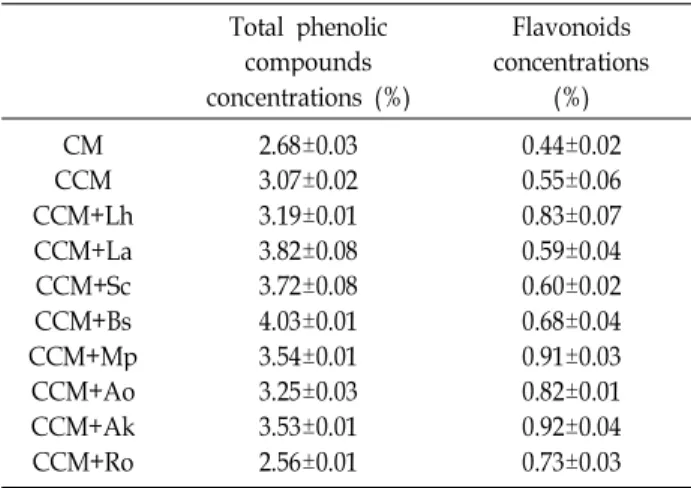
Table 2. Concentrations of polyphenolic compounds and fla- vonoids of Cordyceps militaris powder (CM) and Cordycepin-enriched Cordyceps militaris powder (CCM) and fermented CCM.
Total phenolic compounds concentrations (%)
Flavonoids concentrations
(%) CM
CCM+Lh CCM CCM+La CCM+Sc CCM+Bs CCM+Mp
CCM+Ao CCM+Ak CCM+Ro
2.68±0.03 3.07±0.02 3.19±0.01 3.82±0.08 3.72±0.08 4.03±0.01 3.54±0.01 3.25±0.03 3.53±0.01 2.56±0.01
0.44±0.02 0.55±0.06 0.83±0.07 0.59±0.04 0.60±0.02 0.68±0.04 0.91±0.03 0.82±0.01 0.92±0.04 0.73±0.03 Values are mean±SE, n=3.
Abbreviations are the same as in Table 1.
따라서 동충하초 분말의 단백질은 Bacillus, Aspergillus와 같은 미생물 유래 단백질 분해효소 분비에 의해 단백질 함량이 증 가함으로서 향 후 기능성식품 개발시 안전성 및 기호성 측면 에서의 활용 가능성에 대해서도 고려해 볼 만하다.
Polyphenolic compounds 함량
페놀성 물질은 식물계에 널리 분포되어 있는 2차 대사산물 의 하나로서 다양한 구조와 분자량을 가진다. 이들은 phenolic hydroxyl기를 가지기 때문에 단백질 및 기타 거대 분자들과 결합하는 성질을 가지며, 항산화 작용, 간 기능 보호 작용, 혈 중 지질 저하 작용 등이 알려져 있다[7]. 본 실험에서 사용한 동충하초 분말과 cordycepin 고함유 동충하초 분말의 poly- phenolic compounds 함량은 각각 2.68% 및 3.07% 였으나, 발 효시킨 cordycepin 고함유 동충하초 분말 중 Bs 균주, La 균주 및 Sc 균주에서 4.03%, 3.82% 및 3.72% 순으로 높았고, Ro 균주 2.56%를 제외하고는 대부분의 균주에서 발효에 의해 약간씩 높아진 결과를 얻었다(Table 2). Cha 등의 연구[8]에서도 한방 생약재 중에 들어있는 폴리페놀 화합물 함량의 변화를 관찰하 기 위하여 버섯 균사체로 한방 생약재의 열수 추출물을 발효 시킨 결과 정향, 후박, 닥나무껍질 등 14 종이 발효 후 폴리페 놀 함량이 증가됨을 확인하였다.
Flavonoid 함량
천연 항산화성 물질 중 대표적인 flavonoid는 혈압강하효 과, 당뇨병과 galactosemia의 억제효과, 적혈구 세포 응고의
감소효과, rheumatic fever의 예방효과, 항균 활성, 항산화 효 과, 항염증 작용, 콜레스테롤 저하 작용, 지방간 억제 작용 등 이 보고되어 있으며, 여러 종양 세포의 성장 및 분화를 저해시 키는 효과도 다수 보고되어 있다[10]. 이러한 flavonoid는 담황 색 또는 노란색을 띠고 있는 색소화합물로서 자연에서 유리상 태로 존재하기도 하나 대개는 rhamnose, glucose, rutinose 등 의 당과 결합한 배당체로 존재하는 것으로 알려져 있다[3]. 본 연구 결과에서는 동충하초 분말과 cordycepin 고함유 동충하 초 분말에 flavonoid가 각각 0.44% 및 0.55% 함유되었으나, 발효시킨 cordycepin 고함유 동충하초 분말에서는 모든 발효 균주에서 이보다 높은 수치를 확인하였다(Table 2). Ak균주 발효에서 0.92%로 높았고, 다음으로는 Mp 균주발효 0.91%, Lh 균주발효 0.83% 순으로 나타났다. 대부분의 자원에서 poly- phenolic compounds 함량이 flavonoids 보다 많이 함유 되어 있으며, 대체로 polyphenolic compounds 함량이 많은 시료가 flavonoids의 함량도 많이 함유하고 있다[14]. 본 실험에서도 polyphenolic compounds 함량이 flavonoids보다 3배 이상 많 아 flavonoids 이외의 다른 polyphenolic compounds가 함유 되어 있는 것을 암시하는데, 황기, 오미자, 소엽, 맥문동, 갈근, 산수유, 오갈피, 음양곽, 해동피에서도 비슷한 결과가 보고되 었다[14].
미네랄 함량
동충하초 분말과 cordycepin 고함유 동충하초 분말 및 발효
시킨 cordycepin 고함유 동충하초 분말을 측정한 결과는
Table 3과 같다. 미네랄 성분 조성은 K, Mg, Ca, Na, Fe, Zn로
나타났으며, 전체적으로 K, Mg, Ca 순으로 높은 비율을 차지
하였다. 동충하초 분말보다 cordycepin 고함유 동충하초 분말
이 모든 성분에서 높은 수치를 나타냈으며, 또한 발효시킨 cor-
Table 3. Mineral concentration of Cordyceps militaris powder (CM) and Cordycepin-enriched Cordyceps militaris powder (CCM) and
fermented CCM. (ppm)
K Mg Ca Na Fe Zn
CCM CM CCM+Lh CCM+La CCM+Sc CCM+Bs CCM+Mp
CCM+Ao CCM+Ak CCM+Ro
28.63±1.38 92.36±0.23 88.98±0.94 106.1±0.61 110.7±0.24 113.4±1.20 104.7±0.51 110.8±0.46 108.9±0.94 109.4±1.45
19.86±0.10 31.22±0.12 25.44±0.09 33.48±0.10 31.36±0.09 32.72±0.04 32.60±0.12 35.04±0.13 32.64±0.13 32.75±0.18
8.43±0.68 33.06±0.12 24.02±0.30 33.52±0.20 30.19±0.07 31.47±0.27 32.01±0.16 37.53±0.12 33.51±0.24 34.48±0.03
3.83±0.29 4.03±0.11 14.64±0.38
5.81±0.35 17.82±0.34 24.09±0.42 5.13±0.09 5.34±0.12 5.30±0.23 5.31±0.02
1.03±0.05 1.69±0.27 1.63±0.13 2.01±0.20 2.07±0.31 1.89±0.28 1.85±0.25 1.90±0.30 1.94±0.27 2.19±0.12
0.45±0.01 0.93±0.01 0.87±0.01 1.10±0.01 1.04±0.01 1.01±0.01 1.08±0.01 1.19±0.01 1.06±0.01 1.08±0.01 Values are mean±SE, n=3.
Abbreviations are the same as in Table 1.
Table 4. Fatty acid compositions of Cordyceps militaris powder (CM) and Cordycepin-enriched Cordyceps militaris powder (CCM)
and fermented CCM. (% for area of total fatty acids)
CM CCM CCM
Lh La Sc Bs Mp Ao Ak Ro
14:0 16:0 16:1, n-9 18:1, n-9 18:0 18:2, n-6 18:3, n-3
20:0 22:0
35.5 2.6 N.D 20.6 N.D 28.2 N.D 13.1 N.D
37.0 3.8 13.6 3.1 39.6 1.0 N.D 2.0 N.D
24.4 3.3 2.0 9.8 24.4 36.1 N.D N.D N.D
21.9 2.9 2.0 9.3 24.0 21.5 18.4 N.D N.D
22.5 2.5 1.8 8.5 22.2 19.5 16.5 6.5 N.D
25.1 3.3 11.3 2.2 27.3 6.5 20.6 3.6 N.D
25.8 3.5 10.4 2.2 N.D 30.2 20.2 7.8 N.D
29.1 3.6 11.4 2.8 N.D 30.2 N.D 22.9 N.D
25.0 3.8 2.4 9.2 27.2 20.4 N.D 7.9 4.1
22.4 4.0 10.0 2.4 25.9 1.0 20.6 8.4 5.1 Values are mean±SE, n=3. Abbreviations are the same as in Table 1.
N.D: Not Detected
dycepin 고함유 동충하초 분말의 대부분에서 이보다 높은 수 치를 보였다. 발효시킨 cordycepin 고함유 동충하초 분말 중에 서 K은 Bs 균주발효가 113.4 ppm, Mg은 Ao 균주발효가 35.04 ppm, Ca은 Ao 균주 발효가 37.53 ppm으로 높은 수치를 나타 냈으며, 이상의 결과와 같이 많이 함유된 K, Mg, Ca, Fe 등은 인체에 중요한 필수 미네랄 성분으로 영양적인 측면에서도 매우 중요 하며, 특히 순환기계질환의 발병과 진행과정에 밀 접하게 관련된 중성지질과 콜레스테롤의 혈중 지질수준 개선 에 유익한 효과를 가지며, 혈압 강하, 인슐린 분비 및 작용에 필수적인 역할을 하여 당뇨병을 개선하는 등 생활습관병에도 유익한 작용을 하는 미네랄성분으로 인식되고 있다[26].
지방산 함량
동충하초 분말과 cordycepin 고함유 동충하초 분말의 주요 지방산 성분으로 palmitic acid (16:0)가 35.5% 및 37.0%, oleic acid (18:1)가 28.2% 및 39.6%, stearic acid (18:0)가 20.6% 및 13.6% 순으로 함유 되어 있었다(Table 4). 동충하초 분말은 포 화 지방산과 불포화 지방산이 58.7%, 41.3%이며 그 중 n-9 계
열의 oleic acid가 28.2%를 함유하고 있었다. 또한 cordycepin 고함유 동충하초 분말도 포화지방산 54.3%와 불포화지방산 45.7%로 포화지방산의 비율이 많았지만 그 중 불포화지방산 n-9 계열의 oleic acid가 39.6%를 차지하고 있었다.
발효시킨 cordycepin 고함유 동충하초 분말은 전체적으로 포화 지방산의 비율이 줄어들고 불포화 지방산의 비율이 높아 짐을 확인하였다(Table 4). 포화 지방산인 palmitic acid와 stearic acid의 비율이 줄고, 불포화 지방산인 linoleic acid (18:2)와 linolenic acid (18:3)가 높은 비율을 차지하였다. 특히 linoleic acid에서 발효 전인 cordycepin 고함유 동충하초 분말 1.0% 보다 Lh 균주 발효에서 36.1%로 약 36배 증가하였고, linolenic acid에서는 발효 전인 cordycepin 고함유 동충하초 분말 2.0% 보다 Ao 균주 발효에서 22.9%로 약 22배 증가를 보였다. 이 결과로 동충하초의 종류와 발효균주에 따라 지방 산 조성 비율이 많이 달라질 수 있다는 것을 알 수 있었다.
Yun [34]은 동충하초 자실체가 성장하면서 지방산을 흡수 이
용해 조성에 많은 차이를 줄 수가 있다고 보고 했으며 이는
미생물에 의해 발효시킨 cordycepin 고함유 동충하초 분말인
Fig. 1. Glutathione concentration of Cordyceps militaris powder (CM) and Cordycepin-enriched Cordyceps militaris pow- der (CCM) and fermented CCM. Abbreviations are the same as in Table 1. Values are mean±SE, n=3.
A B
SDS-PAGE Native-PAGE
Fig. 2. Electrophoretic patterns of Cordyceps militaris powder (CM) and Cordycepin-enriched Cordyceps militaris pow- der (CCM) and fermented CCM using SDS- (A) and na- tive- (B) polyacrylamide gel electrophoresis. Standard proteins, a: molecular weight 200 kDa, b: 115 kDa, c:
97.4 kDa, d: 66 kDa, e: 45 kDa, f: 31 kDa, g: 21.2kDa, I: 14.4kDa. 1: Standard, 2: Cordyceps militaris , 3: Cordyce- pin-enriched Cordyceps militaris, 4: CCM Fermented by Lactobacillus hilgardii, 5: CCM Fermented by Lactobacillus acidophilus, 6: CCM Fermented by Saccharomyces cer- evisiae, 7: CCM Fermented by Bacillus subtilis, 8: CCM Fermented by Monascus purpureus, 9: CCM Fermented by Aspergillus oryzae, 10: CCM Fermented by Aspergillus kawachii, 11: CCM Fermented by by Rhizopus oryzae . 본 실험과 일치하였다.
글루타치온 함량
Glutathione은 생체 내에서 항산화와 관련된 물질로서 세포 의 독성을 경감시켜 생체산화, 즉 세포노화를 억제시킴으로써 각종 질환의 유발을 예방하는 것으로 알려져 있다[33]. 본 실험 의 연구결과 Sc 균주 발효와 Ao 균주 발효가 각각 33.7 ㎍/ml 및 30.1 μg/ml 로 발효전인 cordycepin 고함유 동충하초분말 22.3 μg/ml보다 약 1.5배 높았다. 한편, 간장질환 개선효과가 있는 것으로 알려진 glutathione 고함유 유용미생물 균종(효 모)과 발효에 의한 conversion 기능의 탐색으로 glutathione 고함유 건강보조식품 개발은 간장질환의 개선과 예방 및 치료 에 유용한 연구결과를 얻을 수 있을 것으로 판단된다.
발효 동충하초 분말의 Native-PAGE 및 SDS-PAGE에 의한 단백질 패턴 비교
동충하초 분말과 cordycepin 고함유 동충하초 분말 및 발효 시킨 cordycepin 고함유 동충하초 분말의 단백질을 Native- PAGE로 비교분석 한 결과 Fig. 5와 같다. 발효 전과 비교 해 볼 때 ‘*’부근의 단백질 밴드가 발효시킨 cordycepin 고함유 동충하초분말(4번~11번)에서는 거의 관찰되지 않는 점으로 보아 발효 과정 중에 단백질 분해가 일어나는 것으로 보여 진다. 그리고 9번에서 ‘**’부근에 새로운 단백질이 검출되었으 며, 이는 발효균주와 동충하초와의 bioconversion 영향이라 사료된다. 한편, Kang 등[20]은 누에 장면과 단명 품종의 유충 체액 단백질(Major hemolymph protein)을 native-PAGE로 비 교한 결과 새로운 단백질의 출현뿐만 아니라 전체적인 단백질 량의 증대가 뚜렷하다고 하였다.
동충하초 분말과 cordycepin 고함유 동충하초 분말 및 발효 시킨 cordycepin 고함유 동충하초 분말의 SDS-PAGE 상의 전 기영동 패턴을 분석 한 결과는 Fig. 5와 같다. 66 kDa 부근에
전체적으로 단백질 밴드가 검출되었고, 발효 전인 3번에 비해 발효 후 4번, 5번의 단백질 밴드의 발현량이 감소하였으며, 9번에서 45 kDa 부근에 새로운 단백질 밴드가 검출되었다.
이는 Aspergillus oryzae 균주 발효에 의해 분자량이 작은 단백 질 패턴이 관찰되어 cordycepin 고함유 동충하초 단백질의 분 해가 이루어졌음을 알 수 있었다.
혈전용해 활성
자연계에 존재하는 Bacillus subtilis, Fusarium pallidoroserum,
Katsuwonus pelamis, Streptococcus aureus 미생물 유래나 청국
장, 된장, 멸치젓갈, natto(nattokinase) 및 절임식품인 shio-
kara (katauwokinase)와 같은 발효식품 유래의 혈전용해제 개
발이 많이 이루어져 왔다[22]. 동충하초 분말과 cordycepin 고
함유 동충하초 분말 및 발효시킨 cordycepin 고함유 동충하초
분말을 물 추출하여 혈전용해 활성을 측정한 결과 모두 혈전
용해 활성이 있는 것으로 나타났다(Fig. 3). Cordycepin 고함
유 동충하초 분말에서 14.1 unit 로, 동충하초 분말의 6.4 unit
보다 약 2.2배 높은 활성을 나타내었다(Fig. 4). 동충하초의 주
요 생리활성 성분인 cordycepin (3'-deoxyadenosine)은 아데
노신 리보오스 잔기의 3번째 탄소에 산소가 결핍된 구조로
혈소판 응집억제 작용[12]이 보고되어 있다. Cordycepin 고함
유 동충하초 분말을 유용미생물로 발효시킨 결과 Bs 균주 발
효에서 혈전용해 활성이 17.1 unit으로 높게 나왔으며, Lh 균
주 발효에 의해서는 7.2 unit으로 낮은 혈전용해 활성이 나왔
0 hr 3 hr 6 hr
Fig. 3. Fibrinolytic activities of Cordyceps militaris powder (CM) and Cordycepin-enriched Cordyceps militaris powder (CCM) (A, B, C) and fermented CCM (D, E, F). D.W: Distilled Water, CM: Cordyceps militaris powder, CCM: Cordycepin-enriched Cordyceps militaris powder. 1: Cordycepin-enriched Cordyceps militaris, 2: CCM Fermented by Lactobacillus hilgardii, 3: CCM Fermented by Lactobacillus acidophilus, 4: CCM Fermented by Saccharomyces cerevisiae, 5: CCM Fermented by Bacillus subtilis, 6: CCM Fermented by Monascus purpureus, 7: CCM Fermented by Aspergillus oryzae, 8: CCM Fermented by Aspergillus kawachii, 9:
CCM Fermented by Rhizopus oryzae .
Fig. 4. Fibrinolytic activities Cordyceps militaris powder (CM) and Cordycepin-enriched Cordyceps militaris powder (CCM) and fermented CCM. Abbreviations are the same as in Table 1. Values are mean±SE, n=3.
Fig. 5. DPPH free radical scavenging activities of Cordyceps mili- taris powder (CM) and Cordycepin-enriched Cordyceps militaris powder (CCM) and fermented CCM. Abbrevia- tions are the same as in Table 1. Values are mean±SE, n=3.
다. 전보에서 Bacillus subtilis 균주 발효에 의해 누에분말의 혈 전용해 활성이 높았으며, 발효 시 균주의 접종 농도에 따라서 도 활성이 다른 것으로 보아 균주에 의한 영향이 큰 것으로 사료되어 진다[11]. 이처럼 발효식품의 주요 미생물인 Bacillus 속 균주들은 단백질 분해능뿐만 아니라 혈전용해 효소 활성도 높아 혈관계 질환 관련 건강기능식품 소재로 많이 활용되고 있는 가운데 본 실험에 사용된 Bacillus subtilis 균주에서도 단 백질 분해력과 혈전 용해력이 높아 cordycepin 고함유 동충하 초 분말을 발효시킨 시료에서 활성이 높게 나온 것으로 사료
된다.
DPPH free radical에 의한 전자공여 활성
DPPH는 비교적 안정한 free radical로서, ascorbic acid, to-
copherol, polyhydroxy 방향족 화합물, 방향족 아민류에 의해
환원되어 짙은 자색이 탈색되는 원리를 이용하여 항산화 활성
을 측정하는데, 이러한 DPPH법은 식물 추출물의 항산화 활성
을 간단히 측정할 수 있는 동시에 실제 항산화 활성과도 연관
성이 매우 높기 때문에 많이 이용되고 있다[13]. 동충하초 분말 과 cordycepin 고함유 동충하초 분말 및 발효시킨 cordycepin 고함유 동충하초 분말 수용성 추출물(1%)의 DPPH free-radi- cal scavenging activity를 측정한 결과 대조구로 사용한 시판 항산화제인 BHT 0.5% 처리구에서 가장 높은 항산화 활성을 나타내었고, 발효시킨 cordycepin 고함유 동충하초 분말에서 는 항산화 활성이 균주 종류에 관계없이 거의 비슷하게 나왔 지만, Lh 균주 발효와 Ak 균주 발효가 다른 균주에 의해 발효 된 분말보다 약간 항산화 활성이 높게 나타났다.
감사의 글
본 연구는 동아대학교 연구비 지원에 의해 이루어졌습니다.
References