Sungho Mun 문`성`호 Member·Seoul National Univ. of Science and Technology·Associate Professor·Corresponding Author (E-mail : [email protected])
1. INTRODUCTION
A falling weight deflectometer (FWD) test, which is performed by dropping a certain amount of mass and
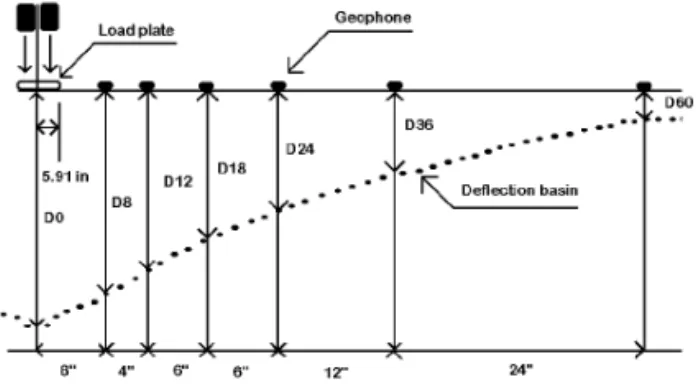
measuring the surface deflections at several points, is most widely used for evaluating the layered material properties of pavement structures as shown in Fig. 1.
Int. J. Highw. Eng. Vol. 19 No. 1 : 73-80 FEBRUARY 2017 https://doi.org/10.7855/IJHE.2017.19.1.073
ABSTRACT
PURPOSES : This paper presents a comparison study between dynamic and static analyses of falling weight deflectometer (FWD) testing, which is a test used for evaluating layered material stiffness.
METHODS : In this study, a forward model, based on nonlinear subgrade models, was developed via finite element analysis using ABAQUS. The subgrade material coefficients from granular and fine-grained soils were used to represent strong and weak subgrade stiffnesses, respectively. Furthermore, the nonlinearity in the analysis of multi-load FWD deflection measured from intact PCC slab was investigated using the deflection data obtained in this study. This pavement has a 14-inch-thick PCC slab over fine- grained soil.
RESULTS : From case studies related to the nonlinearity of FWD analysis measured from intact PCC slab, a nonlinear subgrade model- based comparison study between the static and dynamic analyses of nondestructive FWD tests was shown to be effectively performed; this was achieved by investigating the primary difference in pavement responses between the static and dynamic analyses as based on the nonlinearity of soil model as well as the multi-load FWD deflection.
CONCLUSIONS : In conclusion, a comparison between dynamic and static FEM analyses was conducted, as based on the FEM analysis performed on various pavement structures, in order to investigate the significance of the differences in pavement responses between the static and dynamic analyses.
Keywords
falling weight deflectometer, nonlinear subgrade model, stress-state model, pavement structure, finite element method
Corresponding Author : Sungho Mun, Associate Professor The Road Pavement Research Division, No.43, Seoul National University of Science and Technology, 232, Gongneung-ro, Nowon-gu, Seoul, 01811, Korea
Tel : +82.2.970.9014
E-mail : [email protected]
International Journal of Highway Engineering http://www.ksre.or.kr/
ISSN 1738-7159 (print) ISSN 2287-3678 (Online)
Received Jan. 16. 2017 Revised Jan. 23. 2017 Accepted Jan. 24. 2017
Nonlinear Subgrade Model-Based Comparison Study between the Static and Dynamic Analyses of FWD Nondestructive Tests
노상의 비선형 모델에 근거한 비파괴 FWD 시험에 있어 정적과 동적 거동의 비교연구
In order to simulate the FWD test, many researchers had applied a multi-layered linear elastic theory (Foinquinos and Rosset, 1995; Kim and Mun, 2008; Yi and Mun, 2009).
However, the multi-layered linear elastic theory is not appropriate for the study of the behavior of subgrade under pavements because of its inability to account for stress-state dependence of soils.
Rather, the finite element method (FEM) is the most accurate means for calculating pavement response. Finite element models are able to simulate the results of proven theories such as the multi-layered elastic theory and, further, allow the possibility of adding more complicated material models, such as stress-state dependent subgrade model, to pavement analysis.
Several finite element programs have been developed for pavement structural analyses, such as ILLI-PAVE and MICH-PAVE for flexible pavements and ILLI-SLAB for rigid pavements. The ILLI-PAVE computer program considers an axisymmetric structure for finite mesh generation and the stress-state dependent modulus for granular materials and fine-grained soils. The principal stresses in granular and fine-grained soils are changed at the end of iterations into a Morhr-Coulomb failure envelope if the deviatoric stress exceeds the failure envelope.
In this study, a commercially available finite element program, ABAQUS, was used to compute pavement responses based on dynamic analysis. The development of a procedure for determining stress-state dependent properties of subgrade from multi-load deflections requires a forward model that can predict stresses in the subgrade under varying upper layer conditions. Based on the literature review on pavement response models and nonlinear material models of subgrade, the ABAQUS finite element program was selected as the pavement response model, using Universal model’ s
stress-state dependent model for subgrade. Dynamic analysis was performed using ABAQUS with axisymmetric finite element representation of a pavement structure. Details of the finite element analysis are described below. Figure 2 shows the input loading history to simulate the FWD load. A haver- sine wave form with 0.03 second duration was used.
A pavement system is modeled with an infinite boundary in the lateral direction and with semi-infinite depth for the subgrade layer. Since the area near the load is subjected to high stresses and strains compared to the boundary medium, the surface region of the model uses smaller element than those of the subgrade.
Due to the complexities involved in the analysis of deflections measured near joints or edges in PCC pavements, it is assumed that FWD tests were performed in the middle of a slab. This assumption makes axisymmetric representation of the load and pavement more realistic. The deflections were calculated at seven sensor locations: 0, 8, 12, 18, 24, 36, and 60 inches (D0, D8, D12, D24, D36, and D60) from the center of load (Fig. 1).
ABAQUS has been proven suitable for pavement analysis by many researchers. Kuo et al.(1995) conducted a comprehensive study of various FEM pavement analysis program sand showed that the ABAQUS program yields results comparable to those of other programs. Zaghoul and White(1993) successfully employe dABAQUS for 3-D dynamic analysis of intact flexible pavements .Three- dimensional rigid pavement analyses using ABAQUS were also performed by Kuo et al.(1995), Mallela and George(1994), and Zaghloul et al.(1993). In addition, Uddin et al.(1995) investigated the behavior of a jointed concrete Fig. 1 Sensor Spacing and FWD Testing Configuration
Fig. 2 Normalized Load Used for Dynamic Analysis
pavement under a standard FWD load with discontinuities, such as joint deterioration and transverse cracking, using ABAQUS with 3-D dynami canalysis.
ABAQUS provides many element and material models that are useful for pavement analysis. For example, the infinite element model may be used to model the infinite horizontal and vertical boundaries of a pavement profile with static, harmonic, and transient dynamic loading and thermal gradient conditions. In the case of a material model, ABAQUS is available with linear elastic, nonlinear elastic, viscoelastic, plastic, and modified elastic. In this study, the finite element method using ABAQUS is applied to analyze pavement systems with dynamic loads, an axisymmetric structure, and a nonlinear subgrade model.
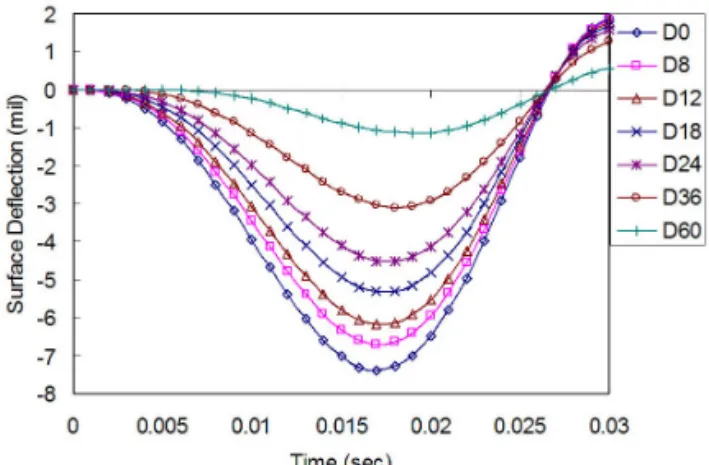
Figure 3 shows deflection time histories generated from ABAQUS dynamic analysis. The transient data are able to provide more information on the pavement condition than peak deflections only. However, due to the complexities involved in analyzing deflection time histories, peak deflections are used in this study for assessing the subgrade nonlinearity.
The primary objective of this study is to develop an analysis method that enables the estimation of subgrade modulus from deflection measurements on intact PCC slabs before rehabilitation. Several rehabilitative techniques have continually proved to be an effective method for managing aged and deteriorated PCC pavements (Thompson, 1999; Mun and Kim, 2009). To accomplish this objective, nonlinear behavior of subgrade under multi-level FWD loads was investigated using finite element analysis. Thus, the FEM program, which has a capability of nonlinear subgrade analysis as well as FWD dynamic simulation, is required in this study.
The remainder of this paper is organized as follows.
Section 2 presents details of the nonlinear stress-state dependent models of subgrade materials. Section 3 describes the nonlinear phenomena of subgrade in PCC pavement systems when multi loading levels of FWD testing are applied on the PCC pavements. Section 4 discusses the comparison study of static versus dynamic analysis of FWD.
Finally, section 5 contains the concluding remarks.
2. STRESS-STATE DEPENDENT SUBGRADE MODELS
The theory of linear elasticity has been widely used to describe the behavior of subgrade soil in pavement structures.
Whether a more complicated nonlinear model is necessary or not depends on the nature of the problem. For example, the analysis of intact PCC pavements under typical highway traffic does not require a nonlinear model for subgrade (Kim et al., 2000). However, when the PCC slab is broken, the same load increases stresses in subgrade and nonlinear subgrade models may be more warranted. In general, stresses in unbound layers in pavements are underestimated for these layers when the linear elastic model is employed for these layers. Additionally, Ullidtz (1998) described the importance of the nonlinear analysis in subgrade layer. It is found that the intermediate granular layer having a lower modulus than the subgrade when a linear elastic subgrade in a backcalculation was taken. Quite a few nonlinear models have been suggested by researchers. In this section, these models are briefly described for granular and fine-grained soils.
2.1. Granular Soil
The resilient modulus in granular materials has been known to be stress-state dependent. Several models have been developed for analyzing the characteristics of granular materials.
The model has been the most popular in representing the stress-state dependency of granular materials. The resilient modulus is expressed as a function of the bulk stress as follows:
Fig. 3 Transient Deflections Calculated by ABAQUS Dynamic Analysis
(1)
where is the resilient modulus; is the bulk stress (= ); and are the regression constants determined from the repeated triaxial loading test results (Huang, 2004).
The contour model proposed by Brown and Pappin (1981) expressed the shear and volumetric stress-strain relations for granular materials using the stress path to simulate the actual pavement conditions. Due to the complication of the contour model, it is difficult to use it as a practical model in characterizing granular materials. Brown and Pappin also emphasized the importance of effective stress, which is influenced by pore pressure in partially or totally saturated materials.
Uzan (1985) proposed the modified stress-state dependent model expressed in terms of both deviatoric and bulk stresses, as shown below. Uzan’ s model can account for the shear stress effect on the resilient modulus.
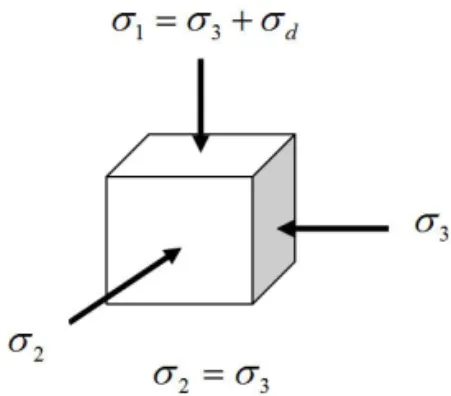
where is the bulk stress; is the deviatoric stress (=
) as defined in Fig. 4; , , and are the regression constants.
Elliot and David (1989) provided an improved model to represent the stress dependent behavior of granular materials above failure state. When the deviatoric stress exceeds the stress at failure state, the modulus of granular material tends to decrease with increasing deviatoric stress. The developed model is as follows:
where A is the mR
3; , , and m are the regression constants; R is the stress/strength ratio.
The UT-Austin model (Pezo, 1993) shown below is obtained from the following procedure:
(1) measure axial strain and stress during a triaxial test, (2) calculate moduli from the relationship between strain and stress with varying loads, and
(3) do multi regression to find coefficients (e.g., , , and ).
Finally, the model included in the parameter prediction the confining pressure and the deviatoric stress instead of the bulk stress.
where , , , and are the regression constants.
The universal model introduced by Witczak and Uzan (1988) is applicable to a wide range of unbound materials having both c and shear strength parameters. The universal model is shown as follows:
where is the atmospheric pressure; , , and are the regression coefficients.
The comparison of measured and predicted moduli of granular materials showed that the universal model improved the accuracy of prediction of resilient modulus significantly (Santha, 1994). In case of fine-grained material, it is recommended to use this model when test data has a series of confining pressure. In this study, the universal model is used for simulating granular subgrade materials as well as fine- grained subgrade materials through assigning the parameter to zero value in the ABAQUS program of FEM analysis. The next section discusses fine-grained subgrade models in details.
2.2. Fine-grained Soil
The resilient modulus of fine-grained soil is usually dependent on the deviatoric stress and moisture content. In general, it decreases with the increase in deviatoric stress (stress-softening effect). The moisture content affects the resilient modulus of fine-grained soil more significantly than that of granular material (Thadkamalla and George, 1992).
(2)
Fig. 4 Principal Stresses on a Finite Soil Element
(3)
(4)
(5)
The bilinear model based on repeated axial load test shows that the resilient modulus drastically decreases as the deviatoric stress increases up to breakpoint, and then slightly decreases.
However, Yoder and Witczak (1975) indicated that the resilient modulus increases with the deviatoric stress above break point. This breakpoint enables to characterize the type of subgrade soil and indicate the material response from loading condition (Thompson and Elliot, 1985).
As a simple model shown below, the following power model was proposed to predict stress-softening effect of a subgrade soil. Since the deviatoric stress decreases with depth within the subgrade, the resilient modulus varies with depth.
The above Eq. (7) can be also obtained from Eq. (5), based on setting the parameter of into zero.
3. NONLINEARITY USING FWD MULTI- LEVEL LOADS
To predict the stress-state dependence of subgrade soils under PCC slabs, a multi-level load FWD test may be used.
The underlying assumption is that the stress state of subgrade after rehabilitation can be reproduced by applying a higher FWD load on a PCC slab prior to rehabilitation. The multi- level loads and backcalculated subgrade moduli allow the
establishment of a stress-state dependent subgrade modulus relationship that may be used to predict the subgrade response after rehabilitation (see Fig. 5).
The significance of nonlinearity in the analysis of multi- load FWD deflections should be considered to determine whether multi-level loads cause enough nonlinearity in the subgrade. According to AASHTO (1993), the ratio of loads will be equal to the deflection ratio if the material is linear.
That is,
where is the load 1; is the load 2; is the measured deflection at a radial distance under FWD load 1;
is the measured deflection at a radial distance under FWD load 2.
The nonlinearity in the analysis of multi-load FWD deflection measured from intact PCC slab has been investigated using the deflection data measured from US 29.
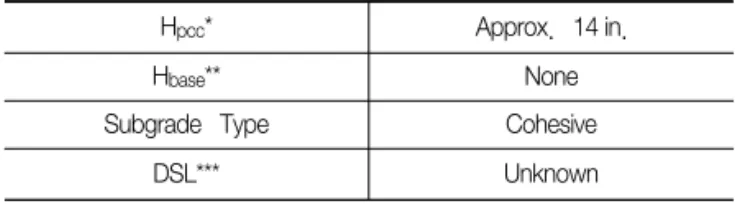
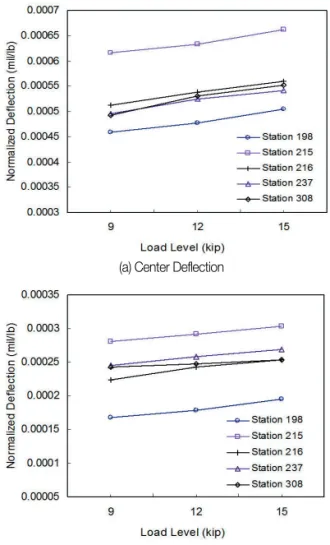
This pavement has a 14 inch thick PCC slab over fine- grained soil (see Table 1). To determine the amount of nonlinearity in the deflections, the center and seventh deflections were normalized with respect to the load level and plotted against the load level. In such a plot, the deviation from a horizontal line indicates the amount of nonlinearity in the system.
The data from five stations of field testing have been analyzed and are plotted in Fig. 6. It appears that nonlinear behavior is exhibited in all the stations in varying degrees.
The degree of nonlinearity was calculated by dividing the difference in the normalized deflections under 9 and 15 kip loads by the deflection under the 9 kip load. The highest degree of nonlinearity was found to be around 14 % (Fig. 7).
Based on this analysis, the multi-level loads (9, 12, and 15 kip FWD loads) cause sufficiently high stresses in subgrade (6)
(7)
Fig. 5 Rubblized Concrete by Resonant Frequency Breaker
or (8)
Table 1. Layer Information and Locations in the Tested Pavement
H
pcc* Approx. 14 in.
H
base** None
Subgrade Type Cohesive
DSL*** Unknown
Note : *PCC thickness; **Base layer thickness; ***Depth to a stiff layer