†: 이 연구는 2013년 동국대학교 경주캠퍼스 연구년 지원에 의하여 수행하였음.
Corresponding author: Wen-Dong Yu, Dept. of Landscape Architecture, Graduate School, Dongguk University, Gyeongju 780-714, Korea, Tel.: +82-10-2696-6669, E-mail: [email protected]
경주 역사유적지구 매력성 평가지표 개발 연구
†강태호*․우문동**
*동국대학교 경주캠퍼스 조경학과․**동국대학교 대학원 조경학과
A Study on the Landscape Attractions Evaluative Systems of Gyeongju Historic Heritage Sites
Kang, Tai-Ho*․Yu, Wen-Dong**
*Dept. of Landscape Architecture, Dongguk University-Gyeongju
**Dept. of Landscape Architecture, Graduate School, Dongguk University
ABSTRACT
This study is an evaluation index development research based on the Gyeongju Historic Heritage Sites to identify the attractive properties of Gyeongju that have helped determine the competitiveness of this historical city. Through literature reviews on these attractive factors of historic urban landscape, the Vienna memos(UNESCO, 2005) and the International Cultural Tourism Charter(ICOMOS, 1999), two professional investigations were conducted following a backup group of attraction indexes that had been received prior. In the end, 22 attraction indexes were chosen in the Urban Historical and Cultural area, the Heritage Resources area, and the Urban Environment area with three aspects based on the analysis of Importance(M), Standard deviation(SD), Content Validity Ratio(CVR), Agreement, and convergence. These indicators will be useful basic information for improving the city's historic charms. In the future, these indicators can be used as a basis for evaluating the characteristic charms of Gyeongju, through which the charm of Gyeongju can be re-recognized.
Key Words: Attractive Factors, History and Culture, Heritage Resources, Urban Environment
국문초록
이 연구는 경주역사유적지구를 대상으로 역사도시경주의 경쟁력을 좌우하는 도시의 매력요인들을 규명하기 위한 평가지표를 개발하고자 수행하였다. 이를 위해 역사문화 관광자원의 매력요인에 대한 선행연구와 UNESCO, ICOMOS 등이 정한 국제 기준을 검토하여 평가지표 후보군을 도출한 후 1차, 2차 전문가 조사를 실시하였으며, 조사 결과에 대한 중요도(M), 표준편차(SD), 내용타당도 지수(CVR), 합의도, 수렴도 등의 분석을 통하여 최종적으로 도시의 역사․문화적 영역, 유산자원적 영역, 환경적 영역 등 3가지 평가분야와 22개 평가지표가 선정되었다. 이들 지표는 역사도시의 매력을 제고하기 위한 유용한 기초자료가 될 것으로 판단된다. 따라서 역사도시 경주는 이들 지표를 바탕으로 매력도 평가를 실시하고, 평가 결과를 역사도시 관리에 적극적으로 이용할 필요가 있다.
주제어: 매력요인, 역사문화, 유산자원, 도시환경
Ⅰ. 서론
21세기에 들어 역사도시에 대한 관심이 높아지면서 역사도 시의 문화 유적지 등에 대한 관광매력은 타 관광자원에 비해 점차 증가하고 있다.
경주는 신라천년의 고도로서 유네스코가 인정하고 있는 세 계적인 역사도시이자 문화관광 유적도시이다. 하지만 이러한 찬란한 문화역사유적에도 불구하고, 현재 경주의 현실은 부정 적으로 나타나고 있다. 경주시의 재정자립도는 19.9%(Statistics Korea, 2014)이며, 매년 상주인구가 감소하고 있다. 최근에는 경주를 찾는 관광객의 수 또한 매년 감소하는 것으로 나타나고 있는 실정이다. 이는 국민소득과 교육수준 향상 및 주 5일제 근 무의 확산으로 인한 관광수요가 증가하고 있는 국내외적 상황 에도 불구하고, 경주의 도시이미지가 주는 매력이 감소하였고, 타 도시의 경쟁력 강화로 인한 관광객이 분산되었기 때문이다.
따라서 본 연구는 이와 같은 배경 하에 도시내 문화유산자원 이 가장 집중된 ‘경주 역사유적지구'를 대상으로 역사도시 경주 의 경쟁력을 좌우하는 도시의 매력요인들을 규명하고자 하였 다. 또한 이 매력지표 선정을 통한 고도경주에 대한 매력 특성 을 재인식할 수 있는 계기를 마련하고, 도시 경쟁력을 증진시 키기 위한 기초자료 수집을 목표로 수행하였다.
Ⅱ. 연구방법
1. 연구 대상지
본 연구의 대상으로 경주에 소재한 ‘경주역사유적지구'를 선 정하였다. 경주는 신라 천년의 고도로서 노천 박물관이라고 불 릴 만큼 가치가 있는 사찰, 석불 등 많은 사적지와 유물이 곳곳 에 산재해 있어 찬란했던 당시의 문화와 예술 그리고 왕조의 영화를 느낄 수 있다. 특히 경주역사유적지구는 신라천년(B.C 57~A.D 935)의 고도(古都)인 경주의 역사와 문화를 고스란히 담고 있는 불교유적, 왕경(王京)유적이 잘 보존되어 있으며, 이 미 세계유산으로 등록된 일본의 교토, 나라의 역사유적과 비교 하여 유적의 밀집도, 다양성에 있어 더욱 뛰어난 유적도시로 평가된다.
2000년 12월 세계유산으로 등록된 경주역사유적지구는 신라 의 역사와 문화를 한눈에 파악할 수 있을 만큼 다양한 유산이 산재해 있는 종합역사지구로서, 유적의 성격에 따라 모두 5개 지구로 나뉘어져 있다. 불교미술의 보고인 남산지구, 천년왕조 의 궁궐터인 월성지구, 신라왕들의 고분군 분포지역인 대능원 지구, 신라불교의 정수인 황룡사지구, 왕경 방어시설의 핵심인 산성지구로 구분되어 있으며, 52개의 지정문화재가 세계유산지 역에 포함되어 있다. 따라서 이 지구에 대한 독특한 매력 특성
은 노천 박물관으로서의 교육성, 신라천년고도로서의 역사성 및 문화성, 불교미술에 대한 예술성, 유산자원의 다양성 및 독 특성에 있다.
2. 기존 문헌자료의 검토 1) 기존 연구의 검토
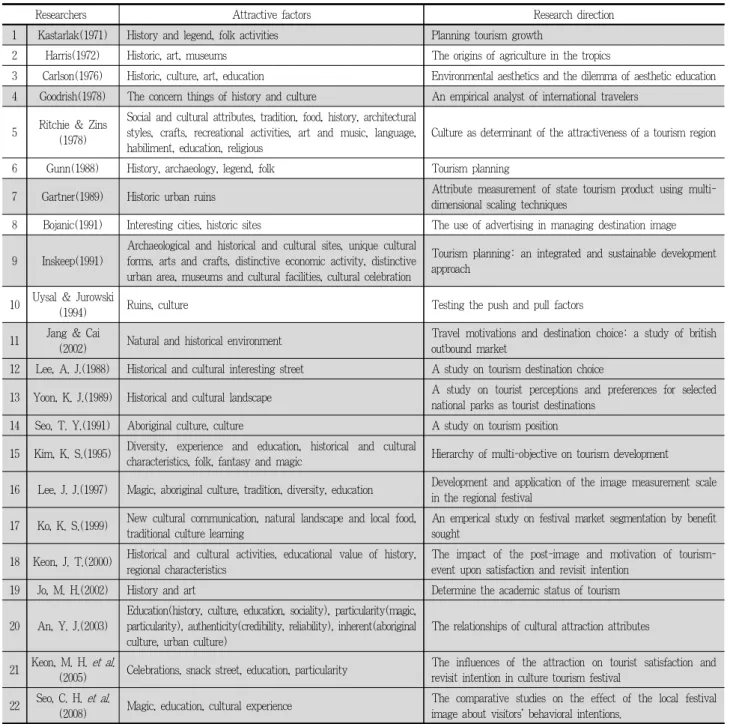
근래에 들어 관광매력에 대한 매력요인 도출과 측정을 위한 연구가 많이 이루어지고 있으나, 연구자들의 주관적인 관점에 따라 문화관광의 매력속성이 다르게 제시되고 있는 실정이다.
국내외 학자들의 관광지 매력요인에 관한 선행연구 중 역사문 화자원과 연관된 매력요인을 위주로 정리하였다.
2) 국제원칙의 검토
본 연구에서 역사도시 매력속성에 관한 ‘국제문화관광헌장 '(ICOMOS, 1999), ’비엔나 메모랜덤' 제8조, 제16조, 제23조 (UNESCO, 2005), ‘역사도시경관에 관한 권고안' 제9조(UNESCO, 2011), ‘세계문화유산의 UNESCO 등재기준'(UNESCO, 1972) 등 국제원칙을 검토한 후, 역사도시에 대한 매력속성을 선정하 였다.
3. 조사방법 및 분석방법 1) 조사방법 및 설문지 구성
본 조사의 목적은 역사도시 경주의 매력성 평가 지표를 선정 하여 역사도시 경주에 대한 매력 특성을 재인식하기 위한 것이 다. 역사도시 매력성을 평가하기 위한 설문항목은 과거연구에 근거하여 관련항목을 선정한 후, 이에 대한 전문가 집단의 검 토를 거쳐 역사도시 경주의 매력 특성에 맞는 항목을 선정하였 다. 다음으로 구체적인 역사도시 매력성 평가분야와 하위속성 에 대한 후보지표를 선정하였다.
평가분야는 도시의 역사․문화 영역, 유산자원 영역, 환경 영역으로 구성하였고, 이 세 분야를 평가하기 위한 하위 후보 지표는 기존연구와 국제원칙에서 사용된 하위속성을 대상으로 27개 항목이 선정되었다. 이를 바탕으로 2014년 7월 10일부터 20일까지 E-mail을 통하여 100명의 예비 전문가에게 1차 조사 를 실시하였으며, 32명이 참여하여 응답비율은 32%이다. 수집한 자료를 분석한 후 2014년 7월 22일부터 27일까지 정리된 설문 지를 1차 조사 시 참여한 32명 전문가에게 다시 발송한 후 30 명의 회신 자료를 수집하였으며, 응답비율은 94%이다.
1차 설문지는 응답자의 기초사항(학력수준, 전공, 직업, 관련 분야 종사시간) 및 도시의 역사․문화 영역 5개 문항, 유산자 원 영역 12개 문항, 환경 영역 10개 문항으로 구성되었으며, 2 차 설문지는 도시의 역사․문화 영역 5개 문항, 유산자원 영역
8개 문항, 도시 환경 영역 9개 문항으로 구성되었다. 평가분야 후보지표에 대한 응답자의 동의 정도는 5단계의 Likert 척도를 이용하여 표시하도록 하였다. 5단계 척도는 1=‘매우 낮음', 2=
‘낮음', 3=‘보통', 4=‘높음', 5=‘매우 높음'으로 구성되었다.
2) 분석 방법
전문가 1차, 2차 조사에서 수집된 자료는 다음과 같은 방법 으로 타당도를 분석하였다.
(1) 내용 타당도 검증
내용 타당도는 Lawshe(1975)가 제시한 내용 타당도 비율 (CVR: Content Validity Ratio)을 통해 검증하였다. CVR은 패널 수에 따라 최소값을 제시하고 있으며, 최소값 이상이 되 었을 때 문항에 대한 내용 타당도가 있는 것으로 판단된다.
여기서는 ‘필요하다'라고 응답한 전문가들의 수, 즉 본 연 구에서 설문항목에 대한 Likert 5점 척도에서는 4, 5점에 응답 자의 빈도수를 의미하며,N은 전체 응답한 전문가의 인원수를 의미한다(Kwon, 2008).
(2) 타당도 검증
전문가 조사 기법의 타당도는 전문가의 의견수렴과 합의 정 도를 분석함으로써 제시할 수 있다(Lee, 2001). 수렴도는 의견 이 한 점에서 모두 수렴하였을 때, 0의 값을 가지며, 의견의 편 차가 클 경우 그 값이 커진다. 합의도는 과 가 일치하여 완전 합의됐을 때 1의 값을 기지며, 의견의 편차가 클 경우 수 치가 감소한다. 즉, 수렴도는 0에 가까울수록, 합의도는 1에 가 까울수록 문항이 타당함을 의미하는 것이다.
합의도=
; 수렴도=
Q: 사분위 계수, Mdn: 중위수
자료 분석은 SPSS 18.0 통계프로그램을 사용하였으며, 수집 된 자료는 평균(M), 표준편차(SD), 중위수(Mdn), 사분범위 계수(Q1, Q3), 내용 타당도 지수(CVR) 등으로 분석하였다. 일 반적인 타당도 지수에 대한 절대적인 기준은 없으나, 상관계수 에 의한 내용 타당도 준거에서 ‘0.40~0.60은 타당도가 있다',
‘0.60~0.80은 타당도가 높다'(Koo 2007)고 제시하고 있어 본 연구에서는 CVR값이 0.40 이상이면 본 연구의 구조 속에서는 타당한 평가지표로 인정받을 수 있는 것으로 판단하였다. 그리
고 전문가 패널들의 의견이 일치하여 응답결과를 수용할 수 있 는 기준값은 응답 평균 3.50 이상, 합의도 0.75 이상, 수렴도 0~
0.5 사이로 정하였다.
Ⅲ. 결과 및 고찰
1. 매력성 평가지표 후보군 선정
매력요인은 특정 목적지나 장소의 특성 내지는 속성과 관련된 것으로써 일단 관광객들이 여행을 떠나겠다는 의사결정을 내린 후에 특정 목적지 선택에 영향을 주는 요인을 말한다(Sharpley, 1997). 따라서 경주역사유적지구의 매력특성으로 노천 박물관으 로서의 교육성, 신라천년 고도로서의 역사성 및 문화성, 불교미 술에 대한 예술성, 유산자원의 다양성 및 독특성을 선정하였다.
본 연구에서는 기존 연구와 UNESCO, ICOMOS 등 국제 원 칙을 검토하여 경주역사유적지구가 가지고 있는 매력특성을 결합하여 선정한 지표들의 특성을 포함하며, 평가영역은 도시 의 역사․문화 영역, 유산자원 영역, 환경 영역 세 분야이다.
기존연구를 분석한 결과, 관광매력에 대한 연구 중 역사문화 자원을 대상으로 한 사례는 많지 않으며, 대부분 관광지의 매 력요인 중 역사문화자원 요인을 언급하는 정도에 그치고 있다.
따라서 본 연구는 이상에서 연구된 속성들을 참고하여 역사도 시경주의 특성을 규명하고자 한다(Table 1 참조).
국제문화관광헌장(ICOMOS, 1999)에서 ‘관광매력은 주로 자 연유산과 문화유산, 다양성과 현존하는 문화로 구성되고 있다.' 라고 명시하고 있어 평가지표로 ‘유산자원의 다양성', ‘유산자 원의 매력성', ‘사회․문화․경제의 활력'을 선정하였으며, 비엔 나 메모랜덤(UNESCO, 2005) 제8조, 제16조, 제23조에서 도시 의 환경 영역을 명시하고 있으므로, 평가지표에 ‘특징적인 도시 구성요소', ‘역사도시의 환경수준', ‘사회․문화․경제의 활력', ' 특징적인 도시계획 및 예술 디자인'을 선정하였다.
그리고 역사도시경관에 관한 권고안(UNESCO, 2011) 제9조 를 검토하여 ‘유적지의 자연 특성', ‘도시 환경', ‘기초시설', ‘토 지 및 공간이용', ‘시지각적 느낌', ‘특징적인 도시구성요소', ‘사 회․문화․경제의 활력', ‘유산자원의 다양성'이 평가지표로 선 정되었다. 세계문화유산등재기준(UNESCO, 1972)에서 ‘독특한 예술성 및 미학성', ‘유산자원의 영향력', ‘유산자원의 독특성',
‘유산자원의 희귀성', ‘유산자원의 역사성', ‘특징적인 대표성',
‘전통적인 혹은 특징적인 건축', ‘역사적으로 중요한 연관성'을 평가지표로 선정하였다(Table 2 참조).
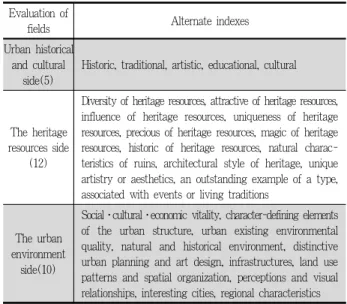
Table 1과 Table 2를 검토한 결과를 바탕으로 역사도시의 매 력특성 평가지표 후보군의 도출 과정은 Table 3 및 Table 4와 같다. 이 과정을 통하여 최종 평가지표 후보군이 선정되었다.
역사도시의 매력평가는 도시의 역사․문화 영역, 유산자원 영
Researchers Attractive factors Research direction 1 Kastarlak(1971) History and legend, folk activities Planning tourism growth
2 Harris(1972) Historic, art, museums The origins of agriculture in the tropics
3 Carlson(1976) Historic, culture, art, education Environmental aesthetics and the dilemma of aesthetic education 4 Goodrish(1978) The concern things of history and culture An empirical analyst of international travelers
5 Ritchie & Zins (1978)
Social and cultural attributes, tradition, food, history, architectural styles, crafts, recreational activities, art and music, language,
habiliment, education, religious Culture as determinant of the attractiveness of a tourism region
6 Gunn(1988) History, archaeology, legend, folk Tourism planning
7 Gartner(1989) Historic urban ruins Attribute measurement of state tourism product using multi-
dimensional scaling techniques
8 Bojanic(1991) Interesting cities, historic sites The use of advertising in managing destination image
9 Inskeep(1991) Archaeological and historical and cultural sites, unique cultural forms, arts and crafts, distinctive economic activity, distinctive urban area, museums and cultural facilities, cultural celebration
Tourism planning: an integrated and sustainable development approach
10 Uysal & Jurowski
(1994) Ruins, culture Testing the push and pull factors
11 Jang & Cai
(2002) Natural and historical environment Travel motivations and destination choice: a study of british outbound market
12 Lee, A. J.(1988) Historical and cultural interesting street A study on tourism destination choice
13 Yoon, K. J.(1989) Historical and cultural landscape A study on tourist perceptions and preferences for selected national parks as tourist destinations
14 Seo, T. Y.(1991) Aboriginal culture, culture A study on tourism position
15 Kim, K. S.(1995) Diversity, experience and education, historical and culturalcharacteristics, folk, fantasy and magic Hierarchy of multi-objective on tourism development
16 Lee, J. J.(1997) Magic, aboriginal culture, tradition, diversity, education Development and application of the image measurement scale in the regional festival
17 Ko, K. S.(1999) New cultural communication, natural landscape and local food,
traditional culture learning An emperical study on festival market segmentation by benefit sought
18 Keon, J. T.(2000) Historical and cultural activities, educational value of history,regional characteristics The impact of the post-image and motivation of tourism- event upon satisfaction and revisit intention
19 Jo, M. H.(2002) History and art Determine the academic status of tourism
20 An, Y. J.(2003) Education(history, culture, education, sociality), particularity(magic, particularity), authenticity(credibility, reliability), inherent(aboriginal
culture, urban culture) The relationships of cultural attraction attributes
21 Keon, M. H. et al.(2005) Celebrations, snack street, education, particularity The influences of the attraction on tourist satisfaction and revisit intention in culture tourism festival
22 Seo, C. H.et al.
(2008) Magic, education, cultural experience The comparative studies on the effect of the local festival image about visitors` behavioral intentions.
Table 1. Attractive factor of cultural tourism resources
역, 환경 영역 세 분야에 각각 5개, 12개, 10개의 후보지표가 선 정되었다(Table 5 참조).
2. 전문가 협의를 통한 평가지표 도출
도출된 평가 영역에 대한 각 평가 지표의 내용 타당성 및 검 증을 위하여 전문가 인식조사를 실시하였다.
역사도시경주의 매력성 평가지표에 대한 전문가 1차와 2차 조사 결과는 Table 6과 같다.
1차 전문가 조사에서 3개 평가영역에 대한 중요도가 대체로 높게 나타났다. 역사․문화 영역에서는 다른 영역에 비하여 모 든 지표가 높은 평균값을 보이고 있어, 역사․문화를 중요하게 인식하고 있는 것으로 나타났으며, 유산자원 영역에서는 유산자 원의 매력성의 평균이 4.63으로 가장 높게 나타났고, 이에 비해 특징적인 대표성은 평균 2.13으로 가장 낮게 나타났다. 도시 환 경 영역에서는 사회․문화․경제적 활력과 시지각적 느낌의 평 균이 4.63으로 가장 높게 나타났으며, 토지 및 공간 이용은 평균 2.13으로 가장 낮게 나타났다. 평가영역별 표준편차는 0.34에서
International principles Contents Variable
A International Cultural Tourism Charter (ICOMOS, 1999)
The natural and cultural heritage, diversities and living cultures are major tourism attractions.
• Diversity of heritage resources
• Attractive of heritage resources
• Social․cultural․economic vitality
B Vienna Memorandum(UNESCO, 2005)
8: The historic urban landscape is embedded with current and past social expressions and developments that are place-based. It is composed of character-defining elements.
• Character-defining elements of the urban structure
16: Taking into account the emotional connection between human beings and their environment, their sense of place, it is fundamental to guarantee an urban environmental quality of living to contribute to the economic success of a city and to its social and cultural vitality.
• Urban environmental quality
• Social․cultural․ economic vitality 23: Spatial structures in and around historic cities are to be enhanced
through urban design and art as they are key elements of the renaissance
of historic cities • Distinctive urban planning and art design
C
Recommendation on the Historic Urban
Landscape (UNESCO,2011)
9: This wider context includes notably the site’s topography, geomorphology, hydrology and natural features; its built environment, both historic and contemporary; its infrastructures above and below ground; its open spaces and gardens, its land use patterns and spatial organization; perceptions and visual relationships; as well as all other elements of the urban structure. It also includes social and cultural practices and values, economic processes and the intangible dimensions of heritage as related to diversity and identity.
• Natural characteristics of ruins
• Urban existing environment
• Infrastructures
• Land use patterns and spatial organization
• Perceptions and visual relationships
• Character-defining elements of the urban structure
• Social․cultural․economic vitality
• Diversity of heritage resources
D UNESCO Cultural Selection criteria (UNESCO, 1972)
“represents a masterpiece of human creative genius" • Unique artistry or aesthetics
“exhibits an important interchange of human values, over a span of time, or within a cultural area of the world, on developments in architecture or
technology, monumental arts, town-planning, or landscape design" • Influence of heritage resources
“to bear a unique or at least exceptional testimony to a cultural tradition or to a civilization which is living or which has disappeared" •
Uniqueness of heritage resources Precious of heritage resources Historic of heritage resources
“is an outstanding example of a type of building, architectural, or technological
ensemble or landscape which illustrates a significant stage in human history" • An outstanding example of a type
“is an outstanding example of a traditional human settlement, land-use, or sea-use which is representative of a culture, or human interaction with the environment especially when it has become vulnerable under the impact of irreversible change"
• Traditional human settlement or human interaction
“is directly or tangibly associated with events or living traditions, with ideas, or
with beliefs, with artistic and literary works of outstanding universal significance" • Associated with events or living traditions Table 2. Historic urban landscape attractive index according to international principles
0.86 사이로 분포되어 전문가 1차 조사의 평가지표들이 대체로 수렴되고 있는 것으로 나타났다. 수렴도를 살펴보면 유산자원 의 역사성(0.63>0.50)은 수렴되지 않음을 보여 주고 있다. 내용 타당도를 보면 유산자원의 역사성(-0.31), 유산 건축양식(-1.00), 역사적 중요한 연관성(0.25), 토지 및 공간 이용(-1.00)은 0.4 이하로 나타났으며, 합의도는 유산자원의 역사성(0.58)이 0.75 이하로 나타났다. 분석 결과와 같이, 유산의 건축양식, 특징적인 대표성, 역사적으로 중요한 연관성, 토지 및 공간 이용 등 5개 평가지표가 삭제되었으며, 1차 전문가 평가 결과에 따라 3개 영 역, 27개의 평가지표에서 3개 영역, 22개의 평가지표로 수정
되었다. 수정된 지표로 2차 전문가 설문을 시행하였다.
2차 전문가 조사 결과는 각 지표에서 평균 4.06~4.81 사이 로 분포되어 표준편차는 0.40~0.72 사이로 나타났고, 수렴도는 0~0.50 사이로 나타났으며, 내용 타당도는 0.69 이상이고, 합의 도는 0.75 이상으로 나타났다. 2차 전문가들의 의견을 참고하여 3개 영역 22개의 지표 적합성 분석 결과가 모두 기준값 이상으 로 나타났으므로 평가지표로서 적합한 것으로 분석되었다.
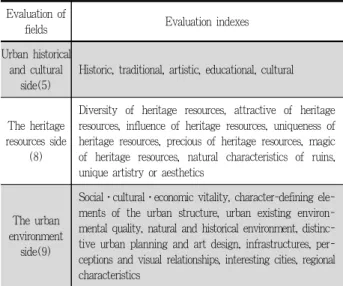
이상의 분석을 통하여 최종적으로 개발된 역사도시경주의 매력성 평가지표는 도시의 역사․문화 영역에서 역사성, 전통 성, 예술성, 교육성, 문화성 총 5개가 선정되었으며, 유산자원
Authors Attractive factors
1 ● ●
2 ● ● ●
3 ● ● ● ●
4 ● ●
5 ● ● ● ● ●
6 ● ● ●
9 ● ● ●
10 ●
14 ● ●
15 ● ● ●
16 ● ● ●
17 ● ● ●
18 ● ●
19 ● ●
20 ● ● ● ●
21 ● ●
22 ● ●
Historic Traditional Artistic Educational Cultural Urban historical and cultural side
(Serial number of researchers Refer to Table 1) Table 3. Historical and cultural attractive index
Category Researchers
A B C D 7 8 9 10 11 12 13 15 17 18 20 21 22
The heritage resources
side
Diversity of heritage resources ● ● ●
Attractive of heritage resources ●
Influence of heritage resources ●
Uniqueness of heritage resources ●
Precious of heritage resources ●
Magic of heritage resources ● ● ● ●
Historic of heritage resources ●
Natural characteristics of ruins ● ● ● ● ●
Architectural style of heritage ●
Unique artistry or aesthetics ●
An outstanding example of a type ●
Associated with events or living traditions ●
The urban environment
side
Social․cultural․economic vitality ● ● ●
Character-defining elements of the urban structure ● ● ●
Urban existing environmental quality ● ●
Natural and historical environment ● ● ●
Distinctive urban planning and art design ● ●
Infrastructures ●
Land use patterns and spatial organization ●
Perceptions and visual relationships ●
Interesting cities ●
Regional characteristics ● ● ●
(Serial number of researchers Refer to Table 1 and Table 3)
Table 4. Attractive index on Heritage resources and urban environment
Evaluation of
fields Alternate indexes
Urban historical and cultural
side(5) Historic, traditional, artistic, educational, cultural
The heritage resources side
(12)
Diversity of heritage resources, attractive of heritage resources, influence of heritage resources, uniqueness of heritage resources, precious of heritage resources, magic of heritage resources, historic of heritage resources, natural charac- teristics of ruins, architectural style of heritage, unique artistry or aesthetics, an outstanding example of a type, associated with events or living traditions
The urban environment
side(10)
Social․cultural․economic vitality, character-defining elements of the urban structure, urban existing environmental quality, natural and historical environment, distinctive urban planning and art design, infrastructures, land use patterns and spatial organization, perceptions and visual relationships, interesting cities, regional characteristics Table 5. The evaluation indexes selection of candidate group
영역에서 유산자원의 다양성, 유산자원의 매력성, 유산자원의 영향력, 유산자원의 독특성, 유산자원의 희귀성, 유산자원의 신 기성, 유적지의 자연특성, 독특한 예술성 혹은 미학성 등 총 8 개가 선정되었다. 도시 환경 영역에서는 사회․문화․경제적
Evaluation
of fields Alternate indexes Expert inquiry 1 Expert inquiry 2
M SD CVR Agreement Convergence M SD CVR Agreement Convergence
Urban historical and cultural
side
Historic 4.88 0.34 1.00 1.00 0.00 4.81 0.40 1.00 1.00 0.00
Traditional 4.50 0.51 1.00 0.78 0.50 4.53 0.51 1.00 0.80 0.50
Artistic 4.38 0.49 1.00 0.75 0.50 4.41 0.50 1.00 0.75 0.50
Educational 4.78 0.42 1.00 1.00 0.00 4.69 0.47 1.00 0.80 0.50
Cultural 4.25 0.44 1.00 0.94 0.13 4.44 0.50 1.00 0.75 0.50
heritageThe resources
side
Diversity of heritage resources 4.03 0.59 0.69 1.00 0.00 4.25 0.44 1.00 0.94 0.13
Attractive of heritage resources 4.63 0.49 1.00 0.80 0.50 4.63 0.49 1.00 0.80 0.50
Influence of heritage resources 4.00 0.51 0.75 1.00 0.00 4.16 0.45 0.94 1.00 0.00
Uniqueness of heritage resources 4.38 0.49 1.00 0.75 0.50 4.31 0.47 1.00 0.75 0.50
Precious of heritage resources 4.25 0.67 0.75 0.75 0.50 4.34 0.55 0.94 0.75 0.50
Magic of heritage resources 3.81 0.54 0.50 0.94 0.13 4.06 0.44 0.88 1.00 0.00
Historic of heritage resources 3.09 0.78 -0.31 0.58 0.63 Delete
Natural characteristics of ruins 4.19 0.69 0.69 0.75 0.50 4.22 0.66 0.75 0.75 0.50
Architectural style of heritage 2.75 0.44 -1.00 0.92 0.13
Unique artistry or aesthetics 4.25 0.67 1.00 0.75 0.50 4.28 0.63 0.81 0.75 0.50
An outstanding example of a type 2.13 0.61 -1.00 0.88 0.13
Delete Associated with events or living traditions 3.63 0.49 0.25 0.75 0.50
The urban environment
side
Social․cultural․economic vitality 4.63 0.49 1.00 0.80 0.50 4.47 0.51 1.00 0.75 0.50
Character-defining elements of the urban structure 4.03 0.86 0.56 0.75 0.50 4.19 0.64 0.75 0.75 0.50
Urban existing environmental quality 4.50 0.72 1.00 0.80 0.50 4.41 0.71 0.75 0.80 0.50
Natural and historical environment 4.50 0.51 1.00 0.78 0.50 4.44 0.50 1.00 0.75 0.50
Distinctive urban planning and art design 4.13 0.61 0.75 0.94 0.13 4.19 0.54 0.88 0.94 0.13
Infrastructures 4.38 0.49 1.00 0.75 0.50 4.38 0.49 1.00 0.75 0.50
Land use patterns and spatial organization 2.13 0.61 -1.00 0.88 0.13 Delete
Perceptions and visual relationships 4.63 0.49 1.00 0.80 0.50 4.59 0.50 1.00 0.80 0.50
Interesting cities 4.50 0.51 1.00 0.78 0.50 4.50 0.51 1.00 0.78 0.50
Regional characteristics 4.16 0.77 0.56 0.75 0.50 4.25 0.72 0.69 0.75 0.50
Table 6. The results of expert inquiry
Evaluation of
fields Evaluation indexes
Urban historical and cultural
side(5) Historic, traditional, artistic, educational, cultural
The heritage resources side
(8)
Diversity of heritage resources, attractive of heritage resources, influence of heritage resources, uniqueness of heritage resources, precious of heritage resources, magic of heritage resources, natural characteristics of ruins, unique artistry or aesthetics
The urban environment
side(9)
Social․cultural․economic vitality, character-defining ele- ments of the urban structure, urban existing environ- mental quality, natural and historical environment, distinc- tive urban planning and art design, infrastructures, per- ceptions and visual relationships, interesting cities, regional characteristics
Table 7. The final selection of evaluation indexes 활력, 특징적인 도시구성요소, 역사도시 현존 환경 수준, 자연
적․역사적 환경, 특징적인 도시계획 및 예술 디자인, 기초 시 설, 시지각적 느낌, 흥미로운 지역적 특성 등 총 9개가 선정되 었다(Table 7 참조).
Ⅳ. 결론
본 연구는 전문가 조사를 통하여 역사도시경주의 매력속성을 규명하기 위한 평가지표를 개발하기 위하여 수행하였다. 역사도 시 경주의 매력성 평가지표는 도시의 역사․문화 영역에서 역사 성, 전통성, 예술성, 교육성, 문화성 등 총 5개 지표이며, 유산자 원 영역에서는 유산자원의 다양성, 유산자원의 매력성, 유산자원 의 영향력, 유산자원의 독특성, 유산자원의 희귀성, 유산자원의 신기성, 유적지의 자연특성, 독특한 예술성 혹은 미학성 등 총 8 개의 지표로 나타났다. 도시의 환경 영역에서는 사회․문화․
경제적 활력, 특징적인 도시구성요소, 도시의 환경 수준, 자연적 역사적 환경, 특징적인 도시계획 및 예술 디자인, 기초 시설, 시 지각적 느낌, 흥미로운 지역적 특성 등 총 9개 지표이다.
이들 지표의 구체적인 연구결과는 다음과 같다.
첫째, 도시의 역사․문화 영역을 살펴보면 전문가 1차 조사 결과 에서 역사성(4.88), 전통성(4.50), 예술성(4.38), 교육성(4.78), 문화성 (4.25)을 나타났으며, 2차 조사 결과는 역사성(4.81), 전통성(4.53), 예술성(4.41), 교육성(4.69), 문화성(4.44)으로 나타나, 역사성과 교 육성이 도시의 역사․문화 영역에서 가장 중요한 지표가 된다.
둘째, 유산자원 영역에서는 전문가 1차 조사 결과, 유산자원의 역사성(3.09), 유산의 건축양식(2.75), 특징적인 대표성(2.13), 역사 적 중요한 연관성(3.63)으로 나타났으며, 2차 조사 결과는 유산 자원의 다양성(4.25), 유산자원의 매력성(4.63), 유산자원의 영향 력(4.16), 유산자원의 독특성(4.31), 유산자원의 희귀성(4.34), 유 산자원의 신기성(4.06), 유적지의 자연특성(4.22), 독특한 예술성 혹은 미학성(4.28)으로 나타나, 유산자원의 매력성, 독특성, 희귀 성이 유산자원 영역에서 가장 중요한 지표임을 알 수 있다.
셋째, 도시의 환경 영역의 전문가 1차 조사 결과는 가장 낮게 나타난 ‘토지 및 공간 이용'(2.13)을 제외하고, 2차 조사를 실시 한 결과, 사회․문화․경제적 활력(4.47), 특징적인 도시구성요 소(4.19), 도시의 환경 수준(4.41), 자연적 역사적 환경(4.44), 특징적인 도시계획 및 예술 디자인(4.19), 기초 시설(4.38), 시 지각적 느낌(4.59), 흥미로운 도시(4.50), 지역적 특성(4.25)으 로 나타나, 사회․문화․경제적 활력, 자연적 역사적 환경, 시지 각적 느낌, 흥미로운 도시가 가장 중요한 지표가 된다.
본 연구의 지표 선정 과정은 부분적이지만, 연구자의 주관적 인 판단이 연구결과에 영향을 미칠 수 있어 연구의 한계가 있 다. 따라서 본 연구에서 선정된 지표들은 경주와 같은 역사도 시의 매력성을 제고하기 위한 기초자료로 이용될 수 있도록 객 관성을 확보할 수 있는 지속적인 연구가 필요하다고 판단된다.
References
1. An, Y. J.(2003) The Relationships of Cultural Attraction Attributes, Interpretation, and Tourist Satisfaction. M.S. Thesis, Dong A University, Busan, Korea.
2. Bojanic, D. C.(1991) The use of advertising in managing destination image. Tourism Management 12: 352-355.
3. Carlson, A.(1976) Environmental aesthetics and the dilemma of aesthetic education. Journal of Aesthetic Education 10: 69-82.
4. Gartner, W. C.(1989) Techniques image: Attribute measurement of state tourism product using multidimensional scaling techniques. Journal of Travel Research 4(1): 1-15.
5. Goodrich, J. M.(1977) Benefit bundle analysis: An empirical analyst of international travelers. Journal of Travel Research 16(2): 6-9.
6. Gunn, Clare A.(1988) Tourism Planning(2nd ed.). New York: Taylor and Francis.
7. Harris, David R.(1972) The origins of agriculture in the tropics: Eco- logical analysis affords new insights into agricultural origins and suggests
a fresh evaluation of the limited archaeological evidence. American Scientist 60(2): 180-193.
8. ICOMOS(1999) International Cultural Tourism Charter.
9. Inskeep, E.(1991) Tourism Planning: An Integrated and Sustainable Development Approach. New York: John Wiley and Sons.
10. Jang, S. and L. Cai(2002) Travel motivations and destination choice: a study of British outbound market. Journal of Travel & Tourism 13(3): 111-133.
11. Jeong, H. Y.(2002) The Influences of the Attraction on Tourist Satis- faction and Revist Intention in Tourism-event. M.S. Thesis, Dong A University, Busan, Korea.
12. Jo, M. H.(2002) Determine the academic status of tourism. Tourism and Leisure Studies 14(3): 3-14.
13. Kastarlak, B.(1971) Planning tourism growth. Cornell Hotel and Restau- rant Administration Quarterly 11: 26-33.
14. Keon, J. T.(2000) The Impact of the Post-Image and Motivation of Tourism-event upon Satisfaction and Revisit Intention. Ph. D. Thesis, Daegu University, Daegu, Korea.
15. Keon, M. H. and K. E. Lee(2005) The influences of the attraction on tourist satisfaction and revisit intention in culture tourism festival.
Tourism Management Studies 24.
16. Kim, K. S.(1995) Hierarchy of Multi-Objective on Tourism Develop- ment. Ph. D. Thesis, Geongki University, Seoul, Korea.
17. Ko, H. S. and Y. C. Baek(1999) An emperical study on festival market segmentation by benefit sought. Hotel Management Studies 9(1): 46-64.
18. Koo, Y. C.(2007) Development and Validity Analysis of Restructuring Criteria for Private Colleges and Universities. Ph. D. Thesis, KonKuk University, Seoul, Korea.
19. Kwon, T. I.(2008) Study on Drawing Priority of the Influence Factors of Tourist Resort Remodeling Business: Delphi Technic &Analytic Hierarchy Process. Ph. D. Thesis, Sejong University, Seoul, Korea.
20. Lee, A. J.(1988) A Study on Tourism Destination Choice. Ph. D. Thesis, Sejong University, Seoul, Korea.
21. Lee, Z. S.(2001) Research Methods 21: Delphi Method. Seoul: Education Science Society.
22. Lee. J. J.(1997) Development and Application of the Image Measure- ment Scale in the Regional Festival. Ph. D. Thesis, Geongki University, Seoul, Korea.
23. Ritchie, J. R. B. and M. Zins(1978) Culture as determinant of the attractive- ness of a tourism region. Annals of Tourism Research 5(2): 252-267.
24. Seo, C. H. and H. S. Ko(2008) The comparative studies on the effect of the local festival image about visitors’ behavioral intentions. Hotel Management Studies 17(1): 217-234.
25. Seo, T. Y.(1991) A Study on Tourism Position. Ph. D. Thesis, Inha University, Incheon, Korea.
26. Sharpley, R. and J. Sharpley(1997) Rural Tourism: An Introduction.
London: International Thomson Business Press.
27. UNESCO(1972) Operational Guidelines for the Implementation of the World Heritage Convention.
28. UNESCO(2005) Vienna Memorandum.
29. UNESCO(2011) Recommendation on the Historic Urban Landscape.
30. Uysal, M. and C. Jurowski(1994) Testing the push and pull factors.
Annals of Tourism Research 21(4): 844-846.
31. Yoon, K. J.(1989) A Study on Tourist Perceptions and Preferences for Selected National Parks as Tourist Destinations. Ph. D. Thesis, Konkuk University, Seoul, Korea.
Received Revised Accepted 3인익명 심사필 : : :
15 September, 2014 27 October, 2014 25 November, 2014 25 November, 2014
(1st) (2nd)