― 435 ―
Korean J. Appl. Entomol.
*Corresponding author. E-mail: [email protected]
고추를 가해하는 담배나방[ Helicoverpa assulta (Guen ée)]의 효과적 방제를 위한 쌀좀알벌( Trichogramma evanescens Westwood)과 미생물제제의 종합생물방제 효과
김근섭ㆍ허혜정ㆍ박정아ㆍ유용석1ㆍ함은혜1ㆍ강성영1ㆍ권기면1ㆍ이건형1ㆍ김용균*
안동대학교 생명자원과학과, 1(주) 나비스 중앙연구소
Efficacy of an Integrated Biological Control of an Egg Parasitoid,
Trichogramma evanescens Westwood, and Microbial Insecticide Against the Oriental Tobacco Budworm, Helicoverpa assulta (Guen ée) Infesting Hot Pepper
Geunseob Kim, Hyejung Heo, Junga Park, Yongsuk Yu1, Eunhye Hahm1, Sungyoung Kang1, Kimyeon Kwon1, Keonhyung Lee1 and Yonggyun Kim*
Department of Bioresource Sciences, Andong National University, Andong 760-749, Korea
1Agricultural Environment Research Center, NABIS Co., Ltd., Moongyeong, Korea
ABSTRACT : Due to internal feeding behavior, the oriental tobacco budworm, Helicoverpa assulta (Guenée), infesting hot pepper has been regarded to be effectively controlled by targeting egg and neonate larval stages just before entering the fruits. This study aimed to develop an efficient biological control method focusing on these susceptible stages of H. assulta. An egg parasitoid wasp, Trichogramma evanescens Westwood, was confirmed to parasitize the eggs of H. assulta. A mixture of Gram-positive soil bacterium, Bacillus thuringiensis subsp. kurstaki, and Gram-negative entomopathogenic bacterium, Xenorhabdus nematophila ANU101, could effectively kill neonate larvae of H. assulta. A sex pheromone trap monitored the occurrence of field H. assulta adults. The microbial insecticide mixture was proved to give no detrimental effects on immature development and adult survival of the wasp by both feeding and contact toxicity tests. A combined treatment of egg parasitoid and microbial pesticide was applied to hot pepper fields infested by H. assulta. The mixture treatment of both biological control agents significantly decreased the fruit damage, which was comparable to the chemical insecticide treatment, though either single biological control agent did not show any significant control efficacy. This study also provides morphological and genetic characters of T. evanescens.
KEY WORDS : Trichogramma evanescens, Bacillus thuringiensis, Xenorhabdus nematophila, Helicoverpa assulta, Integrated biological control
초 록 : 고추를 가해하는 담배나방(Helicoverpa assulta (Guenée))의 최적 방제 적기는 과실 내부로 침투하기 이전 시기인 알과 어린 유충으로 인식되고 있다. 본 연구는 담배나방의 이러한 감수성 발육시기를 대상으로 하는 효과적 생물적 방제 기술을 개발하는 데 목표를 두었다. 쌀좀알벌(Trichogramma evanescens Westwood)은 알기생봉으로 담배나방 알도 기생시키는 것이 본 연구를 통해 관찰되었다. 그람양성균인 토양 곤충병원세균(Bacillus thuringiensis subsp. kurstaki)과 그람음성균인 곤충병원세균(Xenorhabdus nematophila ANU101)은 어린 담배나방 유충을 대상으로 상호 협력적 병원력을 발휘하였다. 고추 포장의
담배나방 성충 발생은 페로몬트랩을 통해 모니터링하였다. 혼합 미생물제제는 접촉과 섭식 독성 분석 모두에서 쌀좀알벌의 유충 발육과 성충 생존에 영향을 주지 않는 것으로 판명되었다. 담배나방 성충 발생이 성페로몬 트랩으로 확인된 시기에 고추포장에 쌀좀알벌과 미생물제제의 혼합 처리가 실시되었다. 혼합 생물방제 처리는 화학농약과 비슷한 수준으로 과실의 피해를 현저히 감소시킨 반면, 단독 생물방제 처리는 효과가 현저히 낮았다. 아울러 본 연구는 쌀좀알벌의 형태적 및 유전적 특징을 분석했다.
검색어 : 쌀좀알벌, 비티, 곤충병원세균, 담배나방, 종합생물방제
담배나방(Helicoverpa assulta Guenée)은 담배와 고추 경작지에 서식하면서 각 기주의 상품성과 직결되는 담배 잎과 고추 열매에 피해를 주는 일차 해충이다. 이 해충의 성페로몬 조성이 밝혀지면서 성페로몬을 이용한 효과적 발생 모니터링이 가능하여졌다(Cork et al., 1992; Park et al., 1994). 성페로몬 트랩과 유아등 자료 모두 동일하게 담배나방은 연중 3회 성충 발생 피크를 나타냈고, 이에 따른 유충의 발생 및 작물 피해가 뒤따랐다(Yang et al., 2004). 이를 방제하기 위해 다양한 화학 및 생물 약제가 투입되고 있지만, 유충의 섭식습성(고추의 경우 과실 내 부 가해), 약제 저항성 발현 능력(Lee and Boo, 1993a,b) 및 성충의 이동 잠재력 등으로 효과적 해충 관리가 어려운 실정이다.
고추에 발생하는 담배나방의 경우 대부분의 유충기간 은 과실 내부에 존재하며, 기주 표면에 서식하면서 외부로 노출된 발육시기가 알과 갓 부화한 1령충으로 이 시기가 효과적 방제의 초점이 될 수 있다. 이를 뒷받침하여 주는 관찰 자료로서 담배나방의 성충 발생 최성기 이후 8-9월의 고추 피해는 이전 발생 시기의 피해율에 비해 비교적 낮은 데, 이는 이 시기에 알기생봉의 일종인 Trichogramma sp.
의 발생이 급격하게 높아짐에 따른 자연계 생물적 방제 요인에 기인되는 것으로 해석되고 있다(Choi et al., 1975;
Han, 1993).
알벌과(Trichogrammatidae)는 좀벌상과(Chalcidoidea) 에 속하며 80속 620종을 포함하고 있는 다양한 분류군 으로 체장이 0.2-1.5 mm의 소형 곤충이다. 이 가운데 Trichogramma와 Oligosita의 두 속이 각각 145종 및 110 종으로 개체수가 알벌과 전체의 약 40%를 차지하고 있다 (Pinto and Sthouthamer, 1994). Trichogramma는 알기생 봉으로 구성되며 전 세계에 분포하는 속으로 나방류는 물론이고 딱정벌레, 파리류, 노린재류, 멸구류, 벌목류 및 풀잠자리류를 포함한 넓은 기생 범위를 보이고 있다(Pinto and Sthouthamer, 1994). 성충의 체장은 0.2-0.3 mm이며
단독 또는 집단으로 지름이 0.3-4 mm의 기주알에 기생한 다(Pinto, 1997; Schmidt, 1994). 기주 인식과 수용여부는 기주 표면의 성질과 내부 상태를 각각 촉각과 산란관에 분포하는 감각기를 이용하여 일련의 행동적 기작으로 이 뤄지게 된다(Schmidt, 1994). 일단 기주 표면에 이르게 되면, 암컷은 촉각의 탐색활동을 시작하고 알 내부 상태를 판단하기 위해 난각의 구멍을 뚫게 된다(Klomp and Teerink, 1962; Salt, 1935). 이때 산란관의 말단에 분포하 는 감각기들은 알 내부의 산란 촉진물질의 존재를 감지하 게 된다(LeRalec and Wajnberg, 1990; Nettles et al., 1983; Qin and Wu, 1988; Rajendram, 1978). 적당한 기주 로 판단되면 촉각이 기주 알의 표면 곡선 정도로 유추한 기주 크기를 바탕으로 암컷은 산란수를 결정하게 된다 (Schmidt and Smith, 1985, 1987). 이 Trichogramma는 중요한 생물적 방제인자로서 전 세계적으로 농생태계에 매년 3,200만 ha에 처리되고 있다(Li, 1994). 이들은 비교적 사육이 용이한 저곡해충인 보리나방(Sitotroga cerealella), 알락명나방류(Anagasta kuehniella), 명나방류(Corcyra cephalonica)를 이용하여 사육되었으며, 이후 현재는 대 체기주 또는 기내배양 조건에서 단가를 절감한 대량사육기 술이 개발되었다(Flanders, 1930; Li, 1994; Smith, 1996).
Trichogramma를 이용한 해충 방제 기술은 다양한 해충 방제 기술과 접목하여 혼용이 가능함으로 종합해충방제 에 널리 이용되고 있다.
본 연구는 생물적 방제인자인 쌀좀알벌(T. evanescens Westwood)과 미생물제제를 각각 담배나방 알과 유충을 대상으로 처리하는 종합생물방제 기술을 이용하였다. 이 를 위해 먼저 쌀좀알벌의 담배나방 알 기생 능력을 확인하 였다. 또한 살충력이 높은 미생물제제를 개발하기 위해 두 병원세균을 혼합한 미생물제를 이용하였다. 아울러 본 연구는 이러한 복합 생물방제 처리의 효율을 높이기 위해 성페로몬을 이용한 방제 적기 모니터링 기술을 시도 하였다.
재료 및 방법
시험곤충
고추포장에 발생한 담배나방 유충을 채집하여 실내 (25±1℃, 16:8 h (L:D))에서 고추 열매를 먹이로 사육하였 다. 성충은 10% 설탕물을 급여했으며, 담배 잎과 유리컵 에 각각 산란을 유도하였다. 이후 산란된 알과 부화한 1령충을 대상으로 각각 기생 및 약제 노출 실험을 실시하 였다.
쌀좀알벌은 줄알락명나방 알을 기주로 사육하였으며, 시험은 (주) 나비스의 쌀좀알벌 제품을 이용하였다. 본 제품은 낱개당 약 200마리의 기생된 알(23±1℃에서 기생 후 7일 경과)을 포함하였으며, 야외 처리 전 8-10℃에 냉장 보관(3일 이내)하였다.
미생물제제
Bacillus thuringiensis subsp. kurstaki (Bt)는 (주) 고려 바이오에서 공급받았으며, 제제 내 32,000 IU/mg 세균 및 포자와 독소를 포함했다. Xenorhabdus nematophila ANU101 (Xn) 균주는 Park et al. (1999)에 의해 분리되었 으며, tryptic soy broth (Difco, Detroit, MI, USA) 배지를 이용하여 25℃에서 48시간 배양한 후, 동결건조기(Bondiro ISE, Ilsin Co., Busan, Korea)를 이용하여 제제화하였다.
이때 제제 내 Xn은 5.0×10⁹ cfu/mg 세균 및 배양액 물질을 포함했다.
쌀좀알벌의 외부형태 관찰
성충 암수의 촉각 및 산란관을 위상차현미경(BX41, Olympus, Japan) 및 주사전자현미경(SEM, S-2500C, Hitachi, Japan)을 사용하여 관찰하였다. SEM 관찰을 위해 양면테 이프를 이용하여 성충을 시료대에 부착시켰다. 이 시료를 60℃ 오븐에 10분 동안 건조시켰다. 이후 Spurr Coater CP 3030 SCD 005/Baltec을 사용하여 금으로 도포한 뒤 주사현미경으로15-25 KV에서 관찰하였다.
약제 접촉 독성 분석
담배나방 방제 약제인 노발루론 액상수화제((주) 한국 삼공, 서울) 2,000 ppm, 디플루벤주론 액상수화제((주) 동방아그로, 서울) 2,500 ppm, 펜발러레이트 유제((주) 동방아그로) 1,000 ppm 및 본 연구에서 개발하는 미생물 제제 농도별 혼합액을 증류수로 준비했다. 이 처리 용액에
상기에 기술한 쌀좀알벌 제품 낱개를 실험단위로 3반복씩 5초간 침지 처리하였으며, 이후 실내에서 음건하였다. 처리 된 쌀좀알벌은 25℃에서 사육하면서 성충 출현을 일별로 10일간 계수하여 반복당 총 출현 성충 합계로 분석하였다.
약제 섭식 독성 분석
접촉 독성 실험에서 준비된 약제를 쌀좀알벌 성충 섭식 독성 분석에 이용하였다. 본 시험을 위해 새로이 고안된 시험관(Fig. 4A 참조)에 처리 약제가 포함된 40% 설탕물 을 먹이로 공급하면서 쌀좀알벌에게 24시간 섭식 처리하 였다. 이후 순수한 40% 설탕물을 먹이로 공급하였다. 각 시험관은 실험단위로 10-20 마리의 성충 쌀좀알벌을 포함 하였다. 각 약제 처리는 3반복하였으며, 1일후 성충 생존 수를 계수하였다.
미생물제제 생물검정
담배나방 1령충을 대상으로 생물검정을 실시하였다. 상 기의 약제에 고추를 1분간 침지시킨 후 건조시켜 시험유 충에 24시간 섭식 처리하였다. 이후 처리 반복 당 10마리 유충을 이용하였고, 각 처리는 3반복 실시하였다. 처리된 유충은 25℃에서 사육되었으며 처리 3일 후 반복별 생존 수를 계수하였다.
포장 약제살포 실험
포장은 3개 지역(상주, 점촌, 문경)에 담배나방이 발생 하는 고추밭을 선정하였다. 지역별로 상주 포장은 무처리 와 미생물 처리를 배치하였고, 점촌은 기생봉과 기생봉 + 미생물제제 그리고 문경은 화학농약 처리지역이 배치 되었다. 각 지역은 조사기간 동안 모두 유사한 성페로몬 포획밀도(약 1마리/트랩/일)를 보였다. 각 처리 포장은 15 평(50 m2)으로 각 포장은 다시 3개의 반복으로 나뉘어 각 반복당 10개의 고추를 선발하여 전체 고추에 비해 피해 과의 밀도를 측정한 후 피해율로 나타냈다. 쌀좀알벌의 처리농도는 15평당 750개의 기생알을 투여하였다.
미생물제제는 Bt +Xn (1,000+2,000 ppm)을 15평에 7.5 L 살포하였다. 화학약제는 펜발러레이트 유제((주) 동방 아그로) 1,000 ppm을 미생물제제 처리와 동일한 살포량 이 투입되었다.
통계분석
SigmaPlot (Systat Software, Inc., Point Richmond, CA,
(A) (B)
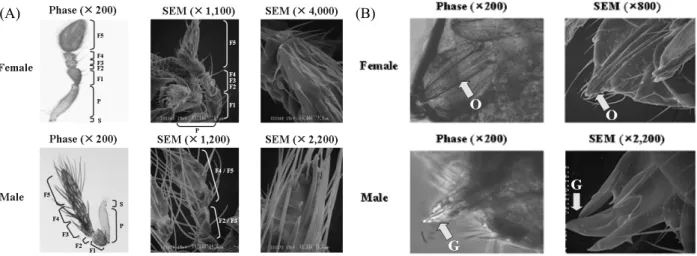
Fig. 1. Morphological characters of both female and male Trichogramma evanescens. (A) Antennal structure analyzed by a phase contrast microscope (‘Phase’, BX41, Olympus, Japan) and a scanning electron microscope (‘SEM’, S-2500C, Hitachi, Japan), where S = scape, P = pedicel, F = flagellomere, and C = club. (B) External reproductive organs. Arrows indicate female ovipositor (‘O’) and male genitalia (‘G’) structures.
(A) GGATCACCTG TATTAATTTC TAATATTGCT ATTTTAGGAG TACCTTTATT AGCTATTACT CCTATTCTTT
ATATAGCATT TAGTAGCATT CATGGTGGTA CTATTAACTT TATTTGAGCT ATATTACTTA ATCAACATTT
CCCACGTATA GTAGAAAATG GTTCAGTAGA TATTACTACT GTAGGTATTA CTGATCGAAA ATTTTGATTT
AATAATATAA GAGCAGGAAC TTTAGCTATT ATTATTAATA CTGCATTCTT TTTAAATACA TTTGGACATC
GTTTTTGACT TGGATGAACA TTCTCACTTC TACGATTAAA ATTATTATTA TCATTTTTCG CTGAAGTTTA
TTTACCCTCA GTTTACCCCC ATTTAGCTGG TAATTTATCA TCTTTACCTG ATCCTGCAGG TATTTTAATT
TCTTTAACTT CCCTCTCCTC AATTTCATCT TTTGATCAAA TTTTAGCCGG TGGAGGTGAT T T A C C G G G
70 140 210 280 350 420 488 (B)
Matched genes NCBI GenBank
accession number
CO-I of T. evanescens
Match score Identity (%) E value
CO-I (Spodoptera frugiperda) U72974 732 97 0.0
CO-I (Spodoptera exempta) DQ092370 632 93 4×10-178
CO-I (Schinia oleaqina) EU768966 551 88 1×10-153
Fig. 2. Nucleotide sequence (A) of cytochrome oxidase I (‘CO-I’) of Trichogramma evanescens and its similarity to other known CO-I genes (B). The DNA sequence was deposited to NCBI GenBank with accession number of FJ440999.
USA) 프로그램을 사용하여 평균 ± 표준편차 값을 도식화 하였다. 처리 효과를 판별하기 위해 실험 관측치를 SAS 프로그램(SAS institute, 1989)을 사용하여 PROC GLM 에 의한 two-way ANOVA 분석을 실시하였다. 모든 처리 평균은 Type I error = 0.05에서 최소유의차검정에 의해 비교하였다.
결 과
쌀좀알벌의 형태적 및 유전적 특징
쌀좀알벌의 암수 구분은 촉각과 외부 생식기 형태에서 뚜렷하게 나타났다(Fig. 1). 암수 촉각은 모두 7마디의
구조를 보였다. 이들 사이에 기절과 병절 모양은 유사하 나, 편절에서 뚜렷한 차이를 보였다(Fig. 1A). 다양한 감각 기 구조가 전자현미경 분석으로 나타났다. 이들은 긴털형, 센털형, 유두상 및 함몰형의 감각기 구조를 포함했다. 암 컷 촉각의 말단부위가 굵은 곤봉 모양인 반면, 수컷은 말단으로 진행되면서 가늘어지며, 암컷에 비해 상대적으 로 많은 긴 감각털을 지녔다.
암컷의 산란관은 복부 배마디 끝에 함입되어 있으며, 생식공의 구조가 뚜렷하게 보였다(Fig. 1B). 반면 수컷의 외부생식기는 복부말단으로부터 돌출된 모양을 나타냈다.
쌀좀알벌의 cytochrome oxidase I의 부분 서열이 밝혀 졌다(Fig. 2A). 이 부위가 GenBank에 등록된 곤충 종들의 cytochrome oxidase I과 높은 염기서열 상동성을 보였다 (Fig. 2B).
Fig. 3. Toxicity tests of biological and chemical insecticides on development of Trichogramma evanescens in the parasitized host eggs of Cadra cautella Walker. The parasitized eggs (4 days old at 25℃) were soaked in the insecticide solutions for 1 min and maintained at 25℃ until the wasp emergence for 10 days.
An experimental unit consisted of 200 parasitized eggs. Each treatment was replicated three times. ‘UT’, ‘Con’, ‘C1’, ‘C2’,
‘C3’, ‘Bt’, and ‘Xn’ represent untreated, water control, novaluron (500 ppm), diflubenzuron (1,000 ppm), fenvalerate (1,000 ppm), Bacillus thuringiensis, and Xenorhabdus nematophila, respectively.
Different letters above standard deviation bars indicate significant differences among means at Type I error = 0.05 (LSD test).
(A) (B)
Fig. 4. Toxicity tests of biological and chemical insecticides on adult survival of Trichogramma evanescens by feeding assay. (A) A test tube shape used for the assay. Each test tube contained 10-20 adults, which represents an experimented unit. Test chemical was fed for 24 h and then replaced by 40% sucrose solution. (B) Mortality was assessed at 3 days after the treatment. Each treatment was replicated three times. ‘C1’, ‘C2’, ‘Bt’ and ‘Xn’ represent diflubenzuron (1,000 ppm), fenvalerate (1,000 ppm), Bacillus thuringiensis, and Xenorhabdus nematophila, respectively. Different letters above standard deviation bars indicate significant differences among means at Type I error = 0.05 (LSD test).
담배나방 방제 약제의 쌀좀알벌 유충 발육과 성충 생존에 미치는 효과
쌀좀알벌에 대한 담배나방 방제 약제들의 접촉 독성을 분석하였다(Fig. 3). 고추에 발생하는 담배나방을 대상으 로 등록된 화학약제와 본 연구에서 혼합처리로 개발하려 는 미생물제제가 분석 대상이었다. 형태적 특징으로 구분
된 쌀좀알벌의 암수 비율은 암컷이 약 60-70%로 높았다.
접촉 실험은 쌀좀알벌이 기생된 알(기생 후 7일)을 분석 약제에 침지함으로 처리되었다. 모든 미생물제제의 처리 는 쌀좀알벌의 발육과 우화에 영향을 주지 않았다. 그러나 화학약제 처리 가운데 키틴합성억제제인 디플루벤주론은 뚜렷한 발육 억제효과를 나타냈다.
쌀좀알벌 성충을 대상으로 담배나방 방제 약제들의 섭 식 독성 분석이 이뤄졌다(Fig. 4). 모든 미생물제 처리는 기생봉 성충의 생존력에 영향을 주지 않았지만, 피레스로 이드 계통의 화학농약인 펜발러레이트는 100%의 섭식 치사효과를 나타냈다.
쌀좀알벌과 미생물제제의 혼합 처리에 의한 담배나 방 방제효과
두 종의 곤충병원세균인 Bt와 Xn의 1령 담배나방에 대한 혼합 방제 효과를 분석했다(Fig. 5). Xn의 경우 단독 으로는 섭식 살충 효과를 보이지 않았으나, Bt와 혼합할 경우 Bt 단독에 비해 살충효과를 뚜렷하게 증가시켰다.
실내에서 고추 표면과 유사한 유리 표면에 산란된 담배 나방 알을 쌀좀알벌에 노출시킨 결과 뚜렷한 기생효과가 관찰되었다. 그러나, 담배 잎에 산란된 알은 거의 기생되 지 않았다. 현미경으로 관찰하여 보면, 담배에 산란된 알 은 담배 잎의 강모 사이에 놓여 이들 털 길이에 비해 비교 적 크기가 작은 쌀좀알벌이 알 표면으로 접근이 어려웠다. 이상의 결과를 토대로 담배나방의 발생이 관찰된 고추 포장에서 7-8월에 쌀좀알벌과 혼합미생물제제를 함께 일 주일 간격으로 3회(7월 24일, 7월 31일, 8월 7일) 처리하
Fig. 5. Additive effect of two microbial insecticides on neonate larvae of Helicoverpa assulta. Xenorhabdus nematophila (‘Xn’, 10 ppm) and Bacillus thuringiensis (‘Bt’, 10 ppm) were treated on tobacco leaves (1×1 cm), which were then provided to the larvae for 24 h and then replaced with untreated tobacco leaves.
Mortality was assessed at 3 days after treatment. Each replica- tive consisted of 10 larvae. Each treatment was replicated three times. Different letters above standard deviation bars indicate significant differences among means at Type I error = 0.05 (LSD test).
Fig. 6. Control efficacy of a mixture treatment of egg parasitoid, Trichogramma evanescens (‘PAR’), and bacterial mixture (‘BAC’) of Bacillus thuringiensis (1000 ppm) and Xenorhabdus nematophila (2000 ppm) against Helicoverpa assulta infesting hot pepper in fields. The control efficacy of the biological agents was com- pared with that of a chemical treatment using 1000 ppm of fen- valerate (‘FEN’). The efficacy was estimated from fruit damage.
In fields, 30 hot pepper plants were selected based on a rando- mized block design with three replications. In each replication, both total and damaged fruits were counted. Different letters above standard deviation bars indicate significant differences among means at Type I error = 0.05 (LSD test).
였다(Fig. 6). 이 기간 동안 성페로몬 트랩에 포획된 담배 나방 밀도는 트랩당 매일 1마리 이상으로 나타났다. 최종 처리 1주일 후 고추 열매 피해를 분석하였다. 처리별로 상이한 방제 효과가 나타났다(F = 7.75; df = 4, 13; P =
0.0020). 실내 실험과 다르게 쌀좀알벌 또는 미생물제제 의 단독 처리는 무처리와 유사한 낮은 효과를 보였다.
그러나 이들의 혼합 처리는 화학농약 처리와 유사한 수준
의 방제 효과를 나타냈다.
고 찰
본 연구에서는 쌀좀알벌(T. evanescens)을 이용하여 담 배나방을 방제하려 하였으며, 여기에 미생물살충제를 혼 용한 종합생물방제 기술을 개발하는 데 목적을 두었다. 이를 위해 우선 본 연구에 이용된 쌀좀알벌의 생물학적 특징을 결정하였다. 촉각의 형태적 구조를 살펴보면, 다른 Trichogramma의 종들에서 나타난 구조와 유사하게 기절 (scape), 병절(pedicel)과 5마디의 편절(flagellum)로 이뤄 졌다(Voegelé et al., 1975; Olson and Andow, 1993;
Amornsak et al., 1998; Cônsoli et al., 1999). 특별히 본 연구는 쌀좀알벌의 암컷은 촉각 구조 가운데 편절 끝마디 가 비대한 곤봉모양의 clava 구조를 지니고 있음을 관찰하 였다. 촉각의 모든 마디에서 털모양의 감각기가 관찰되지 만, clava에 분포하는 감각기 수가 다른 마디에 비해 많은 것을 알 수 있었다. 유사한 Trichogramma의 촉각 미세구 조 연구에서 살펴보면, 이러한 감각기는 크게 6개 종류로 나뉠 수 있다(Cônsoli et al., 1999). 첫째로, 무공성털감각 기로서 길이가 40 μm로서 내부에 관상체 구조를 지닌 수상돌기가 분포한 전형적 기계적 감각기 구조를 지니는 것으로 알려지고 있다(McIver, 1975; Barlin and Vinson, 1981). 특별히 이들의 숫자가 전체 촉각 마디에 많이 분포 하여 암컷이 기주를 탐색할 때 자신의 위치 및 외부 움직 임을 인식하는 데 중요한 기능을 하리라 여겨진다. 둘째 로, 단공성센털감각기로서 길이가 약 10 μm로서 편절 clava의 아랫면에 분포하는 것으로 알려진다(Olson and Andow, 1993). 셋째로 다공성털감각기로서 clava의 아랫 면에 다수 존재한다. 그러나 이들의 숫자는 Trichogramma 종에 따라 특이적인 것으로 알려지고 있다(Voegelé et al., 1975). 이들의 미세구조를 살펴보면, 미각적 기능을 소유하리라는 것을 짐작할 수 있다(Isidora et al., 1996).
이에 대한 기생능력관련 여부는 논란이 있지만, 일부 기생 봉에서는 기주 기피물질의 탐색과 관련이 있는 것으로 여겨지고 있다(Ohta et al., 1994). 넷째로 다공성원추형감 각기로서 길이가 2 μm의 작은 막대 구조를 지니고 있으 며, 내부 수상돌기의 구조로 미뤄 후각 기능을 담당하는 것으로 판명되고 있다(Amornsak et al., 1998). 다섯째로 다공성판상형감각기로서 길이가 약 25 μm, 두께가 약 2 μm의 띠 모양으로 편절 clava 마디에 분포하고 있다.
Doutt (1964)는 이 구조가 장거리 후각 통신에 이용되는
감각기로서 기주 탐색에 이용될 수 있다고 제시하였다.
끝으로 다공형함몰형감각기로서 약 0.3 μm 구멍 내부에 존재한다. 이 감각기의 촉각에 분포와 숫자는 종특이적이 며, 쌀좀알벌의 경우 2개가 존재하며 편절 4, 5번째 마디 에 위치하는 것으로 알려지고 있다(Voegelé et al., 1975).
본 연구에서는 암수 각각에서 편절 4, 5번째 마디에서 관찰되었다.
산란관의 구조는 원통형 바늘 모양으로 외피에 둘러싸 여져 있었다. 이러한 구조는 일반적으로 벌목 곤충의 산란 구조와 유사하며(Smith, 1970), 복부 8, 9마디 아랫면에서 기원한 2쌍의 valvifer와 3쌍의 valvulae로 이뤄진다(Le Ralec and Wajnberg, 1990). 본 연구에서는 분석되지 않 았지만 이러한 산란관 표면에는 화학감각기가 존재할 것 이고 기주의 영양상태를 감지하는 것으로 여겨지며, 또한 기계적 감각기의 존재가 알려지는 데, 이는 기주의 배자발 육 상태를 물리적 자극으로 감지하는 것으로 해석되고 있다(Vinson, 1994).
쌀좀알벌은 담배나방의 알을 기생시킬 수 있는 것이 실내 분석으로 관찰되었다. 그러나 이러한 기생은 알이 고추 잎이나 열매와 같이 매끄러운 표면에 산란되었을 때 가능하였지만, 담배 잎과 같이 가시나 털이 많은 구조 에서는 기생봉의 활동이 제약을 받기 때문에 기생이 불가 능하였다. 국내에서 담배나방 알에 대한 알기생봉은 명충 알벌(T. chilonis)로서 야외 및 실내 기생성이 판명되었다 (Nandihalli, 1994). 또한 이 기생봉을 유인하는 카이로몬 성분이 피기생자의 성페로몬, 표피층 왁스물질 및 기주 식물의 휘발성분이 관여한다는 것이 보고되었다(Boo and Yang, 1998, 2000). 그러나 담배나방 알에 대한 쌀좀알벌 의 기생은 본 연구가 최초 보고로 파악되고 있다. 국내 야외 환경에 쌀좀알벌이 존재한다고 본다면, 이러한 야외 쌀좀알벌의 담배나방 알에 대한 기생 여부도 분석이 아울 러 진행되어야 한다. 비교적 소형이면서 종다양성이 풍부 한 Trichogramma의 정확한 종 동정을 위해서는 분자생물 학적 기술을 이용할 필요가 있다. 이를 위해 쌀좀알벌에 대한 유전지표로서 미토콘드리아의 cytochrome oxidase I의 염기서열이 본 연구를 통해 밝혀졌다. 아울러 명충알 벌의 본 영역에 대한 차이를 구분할 수 있다면, 이를 이용 하여 야외 피기생체에서 쌀좀알벌의 기생 여부 및 기생 밀도를 명충알벌과 구분지어 결정할 수 있다. 물론 기타 다른 알기생봉의 존재도 아울러 조사될 필요가 있다. 여기 에서 알기생봉의 기주범위에 관련지어 곤충 알의 면역 기능을 검토해볼 필요가 있다. 나비목 유충의 경우 다양한 면역 관련 유전자의 발현으로 세포성 및 체액성 면역을
발휘하게 한다(Tanaka et al., 2008). 곤충의 알도 일부 면역 관련 유전자의 발현이 유도된다는 것이 밝혀졌고 (Gorman et al., 2004), 정확한 기작은 알 수 없지만, Manduca sexta 알에 기생한 쌀좀알벌의 상당 부분(약 36%)이 치사되어 기생봉에 대한 방어 기작이 알에 존재 한다는 것이 받아들여지고 있다(Abdel-lateil and Hilker, 2008). 이러한 기주 알의 방어 기작에 대해서 Trichogramma 종들이 독샘물질로 억제하려 한다는 것이 보고되었다 (Strand and Pech, 1995).
혼합 미생물제제인 Bt와 Xn이 담배나방 어린 유충에 대 해서 상호 병원력 상승효과를 보였다. Bt는 포자형성기에 균체내에 δ-내독소라는 독소단백질을 생성한다(Hoffmann et al., 1988; Van Rie et al., 1989). δ-내독소의 작용기작은 이 독소단백질이 곤충의 장내 알칼리성 소화액(pH 10 이상)에서 용해되고 여기에 단백질 분해효소의 작용에 의해 활성화되면서 비롯된다. 활성화된 독소단백질은 중 장세포 막 수용체(120 kDa aminopeptidase-N 또는 210 kDa cadherin 유사체)에 부착되고 세포막의 투과성을 변 화시켜 중장세포를 파괴하게 한다(Gahan et al., 2001;
Gill and Ellar, 2002; Rajagopal et al., 2002). 곤충병원세 균인 Xn은 그람음성균으로 장내세균과(Enterobacteriacea) 에 분류된다(Akhurst, 1980). 이 세균은 최근 해충에 유용한 방제인자로서 주목받고 있는 곤충병원선충인 Steinernema carpocapsae와 공생하는 생활사를 보이게 된다(Kaya and Gaugler, 1993). 즉, 운동성이 있는 감염태 선충이 기주를 찾게 되면, 기주곤충의 개구부인 입, 항문 및 기문 등을 통해 체내로 들어오고 이후 표피세포층을 뚫고 곤충 혈강 으로 들어가게 되고 자신의 특이적 장내 공생세균인 Xn을 곤충 혈강으로 내보내게 된다(Forst et al., 1997). 혈강으 로 나온 세균은 자신과 선충기주를 보호하기 위해 곤충의 면역을 억제시키게 된다(Park and Kim, 2000). 면역기능 이 억제된 곤충기주 체내에서 세균 증식이 이뤄지면서 세균으로부터 나오는 독소단백질과 더불어 기주곤충의 패 혈증을 유발하여 치사시키게 된다(Dunphy and Webster, 1984, 1991; ffrench-Constant et al., 2005). 이때 치사된 곤충의 체내는 대부분 선충 유래 곤충병원선충으로 단일 세포군을 형성하면서 이들이 분비하는 소화효소 작용으 로 곤충 조직의 소화를 촉진시키고, 외부로부터 타 미생물 체의 감염을 억제하기 위해 다양한 항생제가 분비되어 선 충기주가 증식에 최적의 환경을 갖추도록 한다(Boemare, 2002). Xn에 의한 면역억제 기작은 곤충의 세포성 면역과 체액성 면역반응 모두를 겨냥하는 것으로 밝혀지고 있다(Ji and Kim, 2004; Kim et al., 2005). 파밤나방(Spodoptera
exigua)의 경우 세균이나 선충 침입에 대해서 혈구 포식작 용, 소낭형성 및 피낭형성의 세포성 면역반응을 발현하는 것으로 확인되었다(Park and Kim, 2007; Shrestha and Kim, 2007a). 또한 파밤나방은 체액성 면역반응으로 라이 소자임이나 세크로핀과 같은 항생단백질이 세균 침입에 대해서 발현되었다(Bae and Kim, 2003; Ji and Kim, 2004). 일련의 곤충 면역반응은 외래인자에 대한 인식과 더불어 이에 대한 국부호르몬에 의한 면역신호 중개반응 이 궁극적으로 세포성 및 체액성 면역반응을 유기시키게 된다(Gillespie et al., 1997). 이러한 면역중개인자로서 널리 알려진 것이 탄소수 20개의 산화지방산인 아이코사 노이드류이다(Stanley, 2000). 세포막 주성분인 인지질로 부터 이 분자의 글리세롤 골격의 두 번째 탄소에 붙어있는 불포화지방산인 아라키도닉산(20:4n-6)을 PLA2의 sn-2 촉매반응을 통해 유리시킨다(Dennis, 1994, 1997). 이후 다양 한 산화효소(cyclooxygenase, lipoxygenase 및 epoxygenase) 의 작용에 따라 서로 다른 아이코사노이드류를 형성하게 된다(Stanley, 2006). 아이코사노이드류는 세균은 물론이 고 진균 및 원생동물에 이르기까지 다양한 병원체의 침입 에 대해서 면역 중개 역할을 담당하게 된다(Lord et al., 2002; Garcia et al., 2004). 최근에는 바이러스 침입에 대해서도 아이코사노이드류는 면역중개 역할을 하는 것 으로 보고되었으며, 이는 바이러스 침입에 대한 방어기작 으로서 페놀옥시다제(phenoloxidase: PO)의 활성이 중요 성을 갖는다는 측면에서 이해되고 있다(Büyükgüzel et al., 2007). PO와 아이코사노이드류의 기능적 상관성이 파밤나방을 비롯한 일부 곤충류에서 보고되었다(Park and Kim, 2003). 즉, 불활성 상태의 페놀옥시다제 전구물 질인 proPO가 PO로 활성화되는 과정에서 여러 종류의 serine proteases가 관여하게 된다(Shrestha and Kim, 2007b). 이 과정에서 아이코사노이드류 가운데 프로스타 글란딘류가 혈구의 편도세포가 함유하고 있는 proPO를 세포붕괴과정을 통해 혈장으로 방출되게 하고, 이후 serine proteases에 의해 PO로 활성화된다는 아이코사노 이드류의 중개 기능이 밝혀졌다(Shrestha and Kim, 2008). 활성화된 PO는 다양한 세포성 면역반응을 일으키 는 데 이용되게 된다.
곤충의 면역작용은 미생물제제의 살충효과 제고에 걸 림돌이 된다. 즉, 곤충의 면역작용을 억제시킬 수 있다면, 이러한 생물제제의 효과를 극대화할 수 있다. 유약호르몬 이 파밤나방을 포함한 나비목 곤충의 세포성면역 반응을 억제시킨다는 보고가 있다(Clark et al., 2005; Nalini et al., 2007). 유약호르몬 동력제인 피리프록시펜을 처리한
파밤나방은 Bt 미생물제제에 대해서 훨씬 감수성이 증가 하는 것으로 보고되었다(Kwon and Kim, 2007). 또한 PLA2 억제자로 알려진 benzylideneacetone을 처리한 결 과 파밤나방의 Bt에 대한 감수성이 높아졌다(Kwon and Kim, 2008). 이상의 결과를 종합하면, 곤충면역억제 인자 와 미생물제 혼합 처리에 따라 보다 효과적 미생물제제의 개발이 기대될 수 있다는 것을 제시하고 있다.
이들 곤충병원세균이 곤충의 혈강에서 높은 살충효과 를 보이지만, 이들 세균을 단독으로 섭식 처리할 경우 장내에서 혈강으로 전달이 이뤄지지 않아 살충효과를 거 의 보여주지 않았다. 그럼으로 이들 세균을 이용한 생물농 약개발을 위해서는 환경에 안정한 세균 제제화 기술 개발 이 이뤄져야 하며, 또한 곤충병원선충 이외에 혈강으로 전달하여 주는 대체 전달인자가 필요하다. 먼저 이들 세균 이 살충(또는 면역억제) 성분을 합성하여 배양액속으로 분비한다면 또한 이 분비된 물질이 환경에 비교적 안정하 다면 세균 보다는 이들 세균의 배양액을 응용하는 것이 이들 세균의 생물농약 산업화로 응용하는 데 높은 가능성 을 열어 줄 수 있겠다. 또한 섭식을 통해 장내로 들어온 이들 살충성분을 혈강으로 전달할 인자로서 선충 대신에 Bt를 혈강전달 인자로 선정하여 이에 대한 협력효과를 기대해 볼 수 있다. 이러한 가설들 위에 본 연구는 담배나 방에 대해서 Bt와 Xn의 협력 효과를 분석하였고, Bt 단독 에 비해 혼합처리가 현격하게 높은 치사율을 보인 것은 Xn에 기인된 협력작용으로 해석할 수 있다. 즉, Bt의 중장 세포 독성이 중장 내강과 혈강을 이어주는 결과를 초래하 였을 것이고, 이에 따라 혼합 처리된 곤충병원세균 Xn이 혈강으로 침입하여 패혈증을 유발함으로 높은 병원력을 초래했을 것으로 사려된다. 이러한 설명은 파밤나방 처리 에서 실험적으로 증명되어, 혼합 처리 후 일정 섭식처리 시간 경과에 따라 혈강에서 Xn의 검출을 확인하였다 (Jung and Kim, 2006).
본 연구는 담배나방 알에 대한 쌀좀알벌의 기생능력과 어린 유충에 대한 효과적 살충효과를 지닌 혼합 미생물제 제를 연결하여 종합생물방제 기술을 시도하였고, 야외 조건에서 이들의 단독처리 보다 뚜렷하게 높은 방제효과 를 나타냈다. 본 연구는 이러한 종합 생물방제제 처리를 시도하기 전에 이들이 상호 복합처리가 가능한지를 약제 노출 시험을 통해 입증하였다. 즉, 미생물제제들은 쌀좀알 벌의 발육과 성충의 생존력에 전혀 영향을 주지 않는 상호 혼용 가능성을 확인하였다. 즉, 이들 종합생물방제 기술의 상승 효과는 쌀좀알벌이 기생시키지 못하여 생존된 알에 서 부화되어 나온 담배나방을 미생물제제가 치사시킴을
통해 초래되었을 것으로 사려된다. 앞에서 기술한 Xn과 Bt는 동일한 곤충병원세균이면서 상호 작용점이 달라 상 승효과를 주는 것과 같이, 쌀좀알벌과 미생물제제도 대상 곤충의 상이한 발육태를 공략함으로 이상적 복합 생물제 제로서 이해될 수 있다. 특별히 쌀좀알벌은 다양한 해충 방제 기술과 이상적 복합처리가 가능한 생물적 방제 기술 로서(Hassan, 1994; Jung et al., 2005) 보다 다양한 생물방 제 기술들과 혼용이 가능하리라 예상된다. 본 연구는 또한 성페로몬을 이용한 담배나방의 성충 발생 모니터링을 추 적하여 쌀좀알벌과 미생물제제의 복합처리 방제적기를 결정하게 하는 것이 보다 본 기술을 효과적으로 적용할 수 있다고 제시한다.
사 사
본 연구는 2008년도 제16차 중소기업청의 산학공동기 술개발지원사업으로부터 지원받아 수행되었다. 김근섭 은 교육부 2단계 BK21사업에서 지원받았다.
Literature Cited
Abdel-latief, M. and M. Hilker. 2008. Innate immunity: eggs of Manduca sexta are able to respond to parasitism by Trichogramma evanescens. Insect Biochem. Mol. Biol. 38: 136-145.
Akhurst, R.J. 1980. Morphological and functional dimorphism in Xenorhabdus spp., bacteria symbiotically associated with the insect pathogenic nematodes Neoaplectana and Heterorhabditis.
J. Gen. Microbiol. 121: 303-309.
Amornsak, W., B. Cribb and G. Gordh. 1998. External morphology of antennal sensilla of Trichogramma australicum Girault (Hyme- noptera: Trichogrammatidae). Int. J. Insect Morph. Embryol. 27:
67-82.
Bae, S. and Y. Kim. 2003. Lysozyme of the beet armyworm, Spodoptera exigua: activity induction and cDNA structure. Comp.
Biochem. Physiol. 135B: 511-519.
Barlin, M.R. and S.B. Vinson. 1981. Multiporous plate sensilla in antennae of the Chalcidoidea (Hymenoptera) Int. J. Insect Morph. Embryol. 10: 29-42.
Boemare, N. 2002. Biology, taxonomy and systematics of Photo- rhabdus and Xenorhabdus, pp. 35-56. In Entomopathogenic nematology, eds. by R. Gaugler. CABI Publishing, New York.
Boo, K.S. and J.P. Yang. 1998. Olfactory response of Trichogramma chilonis to Capsicum annum. J. Asia-Pac. Entomol. 1: 123-129.
Boo, K.S. and J.P. Yang. 2000. Kairomones used by Tricho- gramma chilonis to find Helicoverpa assulta eggs. J. Chem.
Ecol. 26: 359-374.
Büyükgüzel, E., H. Tunaz, D. Stanley and K. Büyükgüzel. 2007.
Eicosanoids mediate Galleria mellonella cellular immune response to viral infection. J. Insect Physiol 53: 99-105.
Clark, K.D., Y. Kim and M.R. Strand. 2005. Plasmatocyte sensi- tivity to plasmatocyte spreading peptide (PSP) fluctuates with the larval molting cycle. J. Insect Physiol. 51: 587-596.
Cônsoli, F.L., E.W. Kitajima and J.R.P. Parra. 1999. Sensilla on the antenna and ovipositor of the parasitic wasps Trichogramma galloiz Zucchi and T. pretiosum Piley (Hym., Trichogrammatidae).
Microsc. Res. Tech. 45: 313-324.
Dennis, E.A. 1994. Diversity of group types, regulation, and func- tion of phospholipase A2. J. Biol. Chem. 269: 13057-13060.
Dennis, E.A. 1997. The growing phospholipase A2 superfamily of signal transduction enzymes. Trends. Biochem. Sci. 22: 1-2.
Doutt, R.L. 1964. Biological characteristics of entomophagous adults. pp. 145-167. In Biological control of insect pests and weeds. eds. by P. Debach. Reinhold, New York.
Dunphy, G.B. and J.M. Webster. 1984. Interaction of Xenorhabdus nematophilus subsp. nematophilus with the haemolymph of Galleria mellonella. J. Insect Physiol. 30: 883-889.
Dunphy, G.B. and J.M. Webster. 1991. Antihemocytic surface components of Xenorhabdus nematophilus var. dutki and their modification by serum of nonimmune larvae of Galleria mellonella. J. Invertebr. Pathol. 58: 40-51.
ffrench-Constant, R.H., N. Waterfield and P. Daborn. 2005. In- secticidal toxins from Photorhabdus and Xenorhabdus, pp. 239- 253. In Comprehensive molecular insect science, eds. by L.I.
Gilbert, I. Kostas and S.S. Gill. Elsevier, New York.
Flanders, S.E. 1930. Mass production of egg parasites of the genus Trichogramma. Hilgardia 4: 145-167.
Forst, S., B. Dowds, N. Boemare and E. Stackebrandt. 1997.
Xenorhabdus and Photorhabdus spp.: bugs that kill bugs. Annu.
Rev. Microbiol. 51: 47-72.
Gahan, L.J., F. Gould and D.G. Heckel. 2001. Identification of a gene associated with Bt resistance in Heliothis virescens.
Science 293: 857-860.
Garcia, E.S., E.M.M. Machado and P. Azambuja. 2004. Effects of eicosanoid biosynthesis inhibitors on the prophenoloxidase- activating system and microaggregation reactions in the hemolymph of Rhodnius prolixus infected with Trypanosoma rangeli. J.
Insect Physiol. 50: 157-165.
Gill, M. and D. Ellar. 2002. Transgenic Drosophila reveals a functional in vivo receptor for the Bacillus thuringiensis toxin Cry1Ac1. Insect Mol. Biol. 11: 619-625.
Gillespie, J.P., M.R. Kanost and T. Trenczek. 1997. Biological mediators of insect immunity. Annu. Rev. Entomol. 42: 611-643.
Gorman, M.J., P. Kankanala and M.J. Kanost. 2004. Bacterial challenge stimulates innate immune responses in extra-embryonic tissues of tobacco hornworm eggs. Insect Mol. Biol. 13: 19-24.
Hassan, S.A. 1994. Strategies to select Trichogramma species for use in biological control. pp. 55-71. In Biological control with egg parasitoids, eds. by E. Wajnberg and S.A. Hassan. 286 pp.
CAB International, Wallingford, PA.
Hoffmann, C., H. Vanderbruggen, H. Hofte, J. Van Rie, S. Jansens and H. Van Mellaert. 1988. Specificity of Bacillus thuringiensis- endotoxins is correlated with the presence of high-affinity binding sites in the brush border membrane of target insect midgets.
Proc. Natl. Acad. Sci. USA 85: 7844-7848.
Ishidora, N., F. Bin and S.B. Vinson. 1996. Morphology of antennal gustatory sensilla and glands in some parasitoid Hymenoptera with hypothesis on their role in sex and host recognition. J.
Hym. Res. 5: 200-239.
Ji, D. and Y. Kim. 2004. An entomopathogenic bacterium, Xeno- rhabdus nematophila, inhibits the expression of an antibacterial peptide, cecropin, of the beet armyworm, Spodoptera exigua.
J. Insect Physiol. 50: 489-496.
Jung, J.K., J.H. Park, D.J. Im and T.M. Han. 2005. Parasitism of Trichogramma evanescens and T. ostriniae (Hymenoptera:
Trichogrammatidae) to eggs of the asian corn borer, Ostrinia furacalis (Lepidoptera: Pyralidae). Kor. J. Appl. Entomol. 44:
43-50.
Jung, S. and Y. Kim. 2006. Synergistic effect of Xenorhabdus nematophila K1 and Bacillus thuringiensis subsp. aizawai against Spodoptera exigua (Lepidoptera: Noctuidae). Biol. Control 39:
201-209.
Kaya, H.K. and R. Gaugler. 1993. Entomopathogenic nematodes.
Annu. Rev. Entomol. 38: 181-206.
Kim, Y., D. Ji, S. Cho and Y. Park. 2005. Two groups of ento- mopathogenic bacteria, Photorhabdus and Xenorhabdus, share an inhibitory action against phospholipase A2 to induce host im- munodepression. J. Invertebr. Pathol. 89: 258-264.
Klomp, H. and B.J. Teerink. 1962. Host selection and number of eggs per oviposition in the egg parasite Trichogramma embryo- phagum Htg. Nature 195: 1020-1021.
Kwon, S. and Y. Kim (2007) Immunosuppressive action of pyri- proxyfen, a juvenile hormone analog, enhances pathogenicity of Bacillus thuringiensis subsp. kurstaki against diamondback moth, Plutella xylostella (Lepidoptera: Yponomeutidae). Biol. Control 42: 72-76.
Kwon, B. and Y. Kim (2008) Benzylideneacetone, an immuno- suppressant, enhances virulence of Bacillus thuringiensis against beet armyworm (Lepidoptera: Noctuidae). J. Econ. Entomol. 101:
36-41.
Le Ralec, A. and E. Wajnberg. 1990. Sensory receptors of the ovipositor of Trichogramma maidis [Hym.: Trichogrammatidae].
Entomophaga 35: 293-299.
Li, L.Y. 1994. Worlwide use of Trichogramma for biological control on different crops: a survey, pp. 37-53. In Biological control with egg parasitoids, eds. by E. Wajnberg and S.A.
Hassan. CAB international, Wallingford, PA.
Lord, J.C., S. Anderson and D.W. Stanley. 2002. Eicosanoids mediate Manduca sexta cellular response to the fungal pathogen Beauveria bassiana: a role for lipoxygenase pathway. Arch.
Insect Biochem. Physiol. 51: 46-54.
McIver, S.B. 1975. Structure of cuticular mechanoreceptors of arthropods. Annu. Rev. Entomol. 20: 381-397.
Nalini, M., Y. Lee and Y. Kim. 2007. Pyriproxyfen inhibits hemocytic phagocytosis of the beet armyworm. Spodoptera exigua. Kor. J. Pesti. Sci. 11: 164-170.
Nandihalli, B.S. 1994. Ecology of an egg parasitoid, Trichogramma chilonis Ishii, and a larval parasitoid, Campoletis chlorideae Uchida, of the Oriental tobacco budworm, Helicoverpa assulta (Guenée). PhD thesis. pp. 106. Seoul National University, Seoul, Korea.
Nettles, W.C. Jr., R.K. Morrison, Z.N. Xie, D. Ball, C.A. Shenkir and S.B. Vinson. 1983. Effect of cations, anions and salt con- centrations on oviposition by Trichogramma pretiosum in wax eggs. Entomol. Exp. Appl. 33: 283-289.
Ohta, I., K. Miura and M. Kobayashi. 1994. Effect of the scale- hair of the common cutworm egg mass on the oviposition behavior of Trichogramma chilonis Ishii (Hymenoptera: Trichogrammatidae).
Appl. Entomol. Zool. 29: 608-609.
Olson, D.M. and D.A. Andow. 1993. Antennal sensilla of female Trichogramma nubilale (Ertle and Davis) Hymenoptera: Tricho- grammatidae) and comparisons with other parasitic Hymenoptera.
Int. J. Insect Morph. Embryol. 22: 507-520.
Park, Y. and Y. Kim. 2000. Eicosanoids rescue Spodoptera exigua infected with Xenorhabdus nematophila, the symbiotic bacteria to the entomopathogenic nematode Steinernema carpocapsae. J.
Insect Physiol. 46: 1469-1476.
Park, Y. and Y. Kim. 2003. Xenorhabdus nematophilus inhibits p-bromophenacyl bromide (BPB)-sensitive PLA2 of Spodoptera exigua. Arch. Insect Biochem. Physiol. 54: 134-142.
Park, Y. and Y. Kim. 2007. An entomopathogenic bacterium, Xenorhabdus nematophila, induces insect immunosuppression by inhibiting phospholipase A2. J. Basic Life Res. Sci. 7: 31-37.
Pinto, J.D. 1997. Taxonomia de Trichogrammatidae (Hymenoptera) com énfase nos géneros que parasitam Lepidoptera, pp. 13-39.
In Trichogramma e o controle biológico aplicado, eds. by J.R.P.
Parra and R.A. Zucchi. FEALQ, Piracicaba.
Pinto, J.D. and R. Stouthamer. 1994. Systematics of the Trichogram- matidae with emphasis on Trichogramma. pp. 1-36. In Bio- logical control with egg parasitoids, eds. by E. Wajnberg and S. A. Hassan. CAB International, Wallingford, PA. USA.
Qin, J.D. and Z.X. Wu. 1988. Studies on cultivation of Tricho- gramma in vitro: ovipositional behaviour and larval nutritional requirements of T. dendrolimi. Coll INRA 43: 379-387.
Rajagopal, R., S. Sivakumar, N. Agrawal, P. Malhotra and R.K.
Bhatnagar. 2002. Silencing of midgut aminopeptidase N of Spo- doptera litura by double-stranded RNA established its role as Bacillus thuringiensis toxin receptor. J. Biol. Chem. 277: 46849- 46851.
Rajendram, G.F. 1978. Oviposition behavior of Trichogramma californicum on artificial substrates. Ann. Entomol. Soc. Am.
71: 92-94.
SAS Institute. 1989. SAS/STAT User’s Guide, Release 6.03. Ed.
Cary, N.C.
Salt, G. 1935. Experimental studies in insect parasitism. III. Host selection. Proc. R. Entomol. Soc. Lond. 117: 413-435.
Schmidt, J.M. 1994. Host recognition and acceptance by Tricho- gramma, pp. 165-200. In Biological control with egg para- sitoids, eds. by E. Wajnberg and S.A. Hassan. CAB Interna- tional, Wallingford, PA.
Schmidt, J.M. and J.J.B. Smith. 1985. Host volume and measure- ment by the parasitoid wasp Trichogramma minutum: the roles of curvature and surface area. Entomol. Exp. Appl. 39: 213-221.
Schmidt, J.M. and J.J.B. Smith. 1987. Measurement of host cur- vature by the parasitoid wasp Trichogramma minutum, and its effect on host examination and progeny allocation. J. Exp. Biol.
129: 151-164.
Shrestha, S. and Y. Kim. 2007a. An entomopathogenic bacterium, Xenorhabdus nematophila, inhibits hemocyte phagocytosis of Spodoptera exigua by inhibiting phospholipase A2. J. Invertebr.
Pathol. 96: 64-70.
Shrestha, S. and Y. Kim. 2007b. Factors affecting the activation of hemolymph prophenoloxidase of Spodoptera exigua (Lepidoptera:
Noctuidae). J. Asia-Pac. Entomol. 10: 131-135.
Shrestha, S. and Y. Kim. 2008. Eicosanoids mediate prophenolo- xidase release from oenocytoids in the beet armyworm Spo- doptera exigua. Insect Biochem. Mol. Biol. 38: 99-112.
Smith, E.L. 1970. Evolutionary morphology of the external insect genitalia. 2. Hymenoptera. Ann. Entomol. Soc. Am. 63: 1-27.
Smith, S.M. 1996. Biological control with Trichogramma: advances, successes, and potential of their use. Annu. Rev. Entomol. 41:
375-406.
Stanley, D. 2000. Eicosanoids in invertebrate signal transduction systems. Priceton University Press, New Jersey.
Stanley, D. 2006. Prostaglandins and other eicosanoids in insects:
biological significance. Annu. Rev. Entomol. 51: 25-44.
Strand, M.R. and L.L. Pech. 1995. Immunological basis for com- patibility in parasitoid host relationships. Annu. Rev. Entomol.
40: 31-56.
Tanaka, H., J. Ishibashi, K. Fujita, Y. Nakajima, A. Sagisaka, K.
Tomimoto, N. Suzuki, M. Yoshiyama, Y. Kaneko, T. Iwasaki,
T. Sunagawa, K. Yamaji, A. Asaoka, K. Mita and M. Yamakawa.
2008. A genome-wide analysis of genes and gene families in- volved in innate immunity of Bombyx mori. Insect Biochem.
Mol. Biol. (In press).
Van Rie, J., S. Jansens, H. Hofte, D. Degheele and H. Van Mellaert. 1989. Specificity of Bacillus thuringiensis-endotoxins.
Importance of specific receptors on the brush border membrane of the midgut of target insects. Eur. J. Biochem. 186: 239-247.
Vinson, S.B. 1994. Physiological interactions between egg para- sitoids and their hosts. pp. 201-217. In Biological control with egg parasitoids, eds. by E. Wajnberg and S.A. Hassan. CAB International, Wallingford, PA.
Voegelé, J., J. Cals-Usciati, J.P. Pihan and J. Daumal. 1975. Struc- ture de l’antenne des Trichogrammes. Entomophaga 20: 161-169.
(Received for publication November 7 2008;
revised November 7 2008; accepted November 28 2008)