수확 전 LED, 형광등, UV-C 조사가 로켓 샐러드 내 글루코시놀레이트 함량에 미치는 영향
이혜진ㆍ천진혁ㆍ김선주*
충남대학교 생물환경화학과
*Corresponding author: [email protected]
The aim of this study was to investigate the effect of different light sources on the levels of glucosinolates (GSLs) in rocket salad (Eruca sativa L.). The light sources used in the study were: natural light (Control-1 or 2), red light-emitting diodes(LEDs), blue LEDs, mixed red and blue LEDs (R+B LEDs), white LEDs, fluorescent lamps (FL), and fluorescent lamps plus UV-C (FL+UV-C). Two separate experiments were conducted [Experiment I: Control-1, Red LED, Blue LED, Mix (R+B) LED and Experiment II: Control-2, White LED, FL, FL+UV-C]
because of the limited number of growth chambers in our laboratory. The rate of increase in the length of rocket salad leaves was the highest under red LEDs and, FL confirming that red LED and, FL affect the growth of rocket salad. We separated and identified seven types of GSLs from the rocket salad:glucoraphanin, diglucothiobeinin, glucoerucin, glucobrassicin, dimeric 4-mercaptobutyl GSL, 4-methoxyglucobrassicin, and gluconasturtiin. The highest total GSL contents in Eexperiment I was found in plants grown under in red LEDs (4.30 μmol∙g-1 dry weight, DW), and the lowest under blue LEDs (0.17 μmol∙g-1 DW). The highest total GSL contents in Experiment II was found in plants grown under FL (13.45 μmol∙g-1 DW), and the lowest in FL+UV-C (0.39 μmol∙g-1 DW). Especially in Experiment II, the content of dimeric 4-mercaptobutyl, which has a strong aroma and spicy flavor in rocket salad, was higher under FL and white LEDs than in Control-2, increasing by approximately 14.9 and 3.2- fold respectively. Therefore, light sources such as red LEDs, white LEDs and FL affected the accumulation of GSLs in rocket salad.
본 연구는 농림축산식품부·해양수산부·농촌진흥청 · 산림청 Golden Seed 프로젝트 사업 (311022-05- 5-SB020) 에 의해 이루어 진 것임.
HORTICULTURAL SCIENCE and TECHNOLOGY 35(2):178-187, 2017
URL: http://www.kjhst.org pISSN : 1226-8763 eISSN : 2465-8588
This is an Open-Access article distributed under the terms of the Creative Commons Attribution NonCommercial License which permits unrestricted non-commercial use, distribution, and reproduction in any medium, provided the original work is properly cited.
Copyrightⓒ2017 Korean Society for Horticultural Science.
OPEN ACCESS Received:
Revised:
Accepted:
February 16. 2016 August 2. 2016 December 20. 2016
Abstract
Additional key words: fluorescent lamp, glucosinolates, HPLC analysis, light emitting diode (LED), UV-C
Effects of Pre Harvest Light Treatments (LEDs, Fluorescent Lamp, UV-C) on Glucosinolate Contents in Rocket Salad ( Eruca sativa)
Hye-Jin Lee, Jin-Hyuk Chun, and Sun-Ju Kim*
Department of Bio-Environmental Chemistry, Chungnam National University, Daejeon 34134, Korea
서 언
Rocketsalad(Eruca sativa)는 지중해가 원산지이며 배추과(Brassicaceae) 채소에 속한다. 이탈리아에서는 ‘rucola’, 독일에서 는 ‘ackerrauke’, 일본에서는 ‘kibanasuzushiro’로 알려져 있다(Kimetal., 2006). 또한 rocketsalad의 잎은 고추냉이처럼 맵고 알싸한 맛과 향이 나는데 보통 샐러드로 이용되며, 이탈리아에서는 스파게티, 파스타, 피자 등에 사용되고 있다(Jirovertzetal., 2002). 특히 매운 맛은 rocketsalad의 glucosinolates(GSLs)와 그 분해산물인 4-mercaptobutylisothiocyanate(ITC)와 관련이 깊으며 항발암성, 항균, 항박테리아 효과가 있다(Fenwicketal., 1983). 이외에도 비료 3요소(N, P, K) 양액 처리에 따른 rocket salad 내 총 GSLs 함량이 N의 비율이 낮을수록 높아지고, P의 비율이 높을수록 높아지며, K의 비율에 따라 총 GSLs 함량 변화 는 뚜렷한 경향을 나타내지 않은 것으로 보고되었다(Chunetal., 2015).
GSLs는 황과 질소를 함유하고 있는 배추과 식물의 2차 대사산물이다. GSLs는 아미노산으로부터 생합성되고 aliphatic, indolyl, aromaticGSLs로 구분된다(Faheyetal., 2001). GSLs는 myrosinase에 의해 가수분해되어 각각 isothiocyanate, nitrile, thiocyanate와 glucose로 전환된다(Fenwicketal., 1983). 특히 isothiocyanates는 종양을 저해하는 성질을 가지고 있으며 간암, 위암, 폐암 등에 효과가 있을 뿐만 생체방어반응에 관여 한다(ZhangandTalalay, 1994; TalalayandZhang, 1996). 현재까지 연 구 결과에 의하면 rocketsalad에는 7종류(glucoraphanin, sinigrin, diglucothiobeinin, glucoerucin, glucobrassicin, dimeric 4-mercaptobutyl-GSL, 4-methoxyglucobrassicin)의 GSLs가 존재하는 것으로 보고되어 있다(Kimetal., 2007).
재배환경 요소 중 하나인 광은 식물의 생장 및 2차 대사산물 합성에 관여한다(Leeetal., 2014). 작물 재배 연구에 주로 이용 되는 메탈할라이드 램프는 발광효율이 낮고 수명이 짧으며, 형광등은 발광효율이 20% 수준으로 광합성에 유효한 스펙트럼이 적다(Parketal., 2012). 이러한 문제를 보완하기 위해 개발된 발광 다이오드(LightEmittingDiode, LED)는 수명이 길고 전력 소모량이 적어 경제적이다(Hwangetal., 2004). 특히 적색 LED는 광합성에서 엽록소가 흡수하는 파장인 660nm에 가까워 식 물 생장에 필수적이며 케일에 적색 LED를 조사하였을 때 GSLs 함량이 증가하는 것으로 보고되어 있다(Lefsrudetal., 2008; Massaetal., 2008). 최근에는 LED와 작물을 이용해 단색광을 주는 것만이 아닌 red, blueLED을 적절히 혼합하여 사용한다.
고추냉이(Wasabiajaponica)의 경우 redLED와 blueLED을 단일 파장으로 처리했을 때보다 R+B(Red+Blue)을 처리한 고추 냉이의 생물체량이 각각 약 1.6, 3.2배 높았다(Kimetal., 2013). 자외선(Ultra-violet, UV)은 파장에 따라 UV-A(320-400nm), UV-B(280-320nm), UV-C(200-280nm)로 나눠진다(Schenketal., 2011). 그 중 UV-C는 광화학 반응을 일으켜 식물체 DNA 손상을 가한다고 알려져 있다(DanonandGallois, 1998). 낮은 수준의 UV-C 조사는 페놀 화합물, 폴리아민 등 다양한 2 차 대사산물의 생성을 유발시키고, 이러한 2차 대사산물은 항균 활성을 가지거나 작물의 품질에 영향을 끼친다(Jansenetal., 2008). 수확 후 단감(Diospyroskakicv. Fuyu)에 UV-C를 2분간 조사하였을 때 착색이 증진되고 2차 대사산물 중 하나인 carotenoid 함량이 증가하였다(Choi, 2011).
현재까지 LED 조사가 식물체의 생장이나 대사물질(베타 카로틴, 전분 등) 함량에 미치는 실험 결과는 많이 보고되었지만 (Wuetal., 2007; Wangetal., 2009), 다양한 LED광원뿐만 아니라 자연광(온실재배)과 비교하여 식물체 내 GSL 함량을 분석 한 결과는 거의 없다. 또한 UV-C는 수확 후 과채류 표면의 미생물 오염 방지에 관한 연구에 집중되었다. 따라서 본 실험에서 는 rocketsalad의 GSL 생합성 과정에 영향을 끼치는 인공광원[RedLED, BlueLED, Mix (Red+Blue) LED, WhiteLED, FluorescentLamp] 및 UV-C를 조사하여 식물체 생장과 체내에 축적된 GSL 함량을 조사하였다.
재료 및 방법 용매
Acetonitrile(CH3CN)과 methanol(CH3OH)은 J.TBakerChemicalCo.(Phillipsburg, NJ, USA)것을 구입하였다. Sodium
acetate(NaC2H3O2·3H2O)은 SamchunPureChemicalCo., Ltd.(Pyeongtaek, Korea)것을 사용하였다. 컬럼 충진물인 DEAE- SephadexA-25는 GEHealthcare Bio-SciencesAB(Uppsala, Sweden), sinigrin(2-propenylGSL)과 arylsulfatase(type H-1, EC3.1.6.1)는 Sigma-AldrichChemicalCo.(StLouis, MO, USA) 제품을 사용하였다.
시료 채취 및 재배 환경
2015년 2월 20일, rocketsalad ‘ODYSSEY’(SakataSeedCompany, Yokohama, Japan) 종자를 충남대학교 농업생명과학대 학 유리온실에서 플러그 트레이(plugtray72 홀)에 원예 상토를 넣고 1차(실험 I), 2월 25일에는 2차(실험 II) 파종(0DAS, days aftersowing, 파종 후 경과 일수)하였다. 본 광원 조사 실험은 6종류의 인공광원을 조사하기 위한 식물생장기 대수의 제한 때문 에 [실험 I]과 [실험 II]로 구분하여 수행하였다. Rocketsalad 종자는 충남대학교 농업생명과학대학 유리온실에서 플러그 트레 이(plugtray72 홀)에 원예용 상토(high, Punongbedsoil, Gyeongju, Korea)를 채운 후 물을 뿌리고 난 다음 작은 홈을 파고 파 종한 후 다시 상토로 가볍게 덮어주고 손가락으로 눌러 주었다. 햇볕을 차단하고, 수분의 증발을 막기 위하여 신문지로 덮고 그 늘진 곳에 놓고 싹을 틔운 다음 이틀 후에 신문지를 걷어내고, 트레이는 햇빛이 잘 비치는 곳으로 옮겨두었다. 관수는 파종 후 이식 전(21DAS)까지 이틀에 한 번 지하수를 주며 재배하였다. 유묘 이식은 22DAS(실험 I, 3월 13일; 실험 II, 3월 18일)에 50 유묘 중 12 유묘를 선별하여 포트(14.5 × 14.5 × 16cm3)에 같은 상토를 넣고 이식하였다. 이식한 포트(14.5 × 14.5 × 16cm3) 는 햇빛이 잘 비치는 곳에 두었다. 유리온실 내 온도가 28ºC 이상이면 포트를 바람이 통하고 선선한 외부로 옮겨두고 저녁에는 다시 유리온실에 넣어 두어 재배하였다. 온실 재배(0-41DAS) 동안 식물체 포트는 무작위적으로 배치하여 관수를 할 때 마다 시계 방향으로 이동 시켜서 재배 환경을 동일하게 하였다.
실험에 사용된 광원은 자연광(Control-1 또는 2), RedLED(640nm), BlueLED(430nm), Mix(R+B) LED(RedLED+Blue LED), WhiteLED, FluorescentLamp(FL), FluorescentLamp+UV-C(FL+UV-C) 7종류이었다. 41DAS(실험 I, 4월 1일; 실 험 II, 4월 5일)에 자연광(Control-1 또는 2) 실험용 식물체는 계속해서 유리온실에서 재배하고, 인공광원 실험용 식물체는 식 물생장환경조절장치(growthchamber)로 포트 채 옮겨 RedLED, BlueLED, Mix(R+B) LED(실험 I), WhiteLED, FL, FL+UV-C(실험 II)를 5일(41-46DAS) 동안 조사하고, 지상부만을 46DAS에 수확하였다. ‘Mix(R+B) LED’의 혼합 비율은 Red: Blue=7: 3이었다. 식물생장환경조절장치 내부 환경은 모든 광원에서 온도 24/15ºC, 습도 55%, 광주기(명기/암기; 16/8 h)로 처리하였다. 처리 광량은 모든 실험구에서 동일하게 180μmol/m2·s로 조절하였고, LED광은 식물체 상부에서, FL과 UV-C는 측면에서 조사하였다. 또한, UV-C는 5일 동안 암조건 상태일 때, 2분간 조사하였다. 각 광원의 광량이 식물체에 균 등하게 조사되도록 포트를 하루에 한 번씩 시계방향으로 이동시켜 주었다. 수확한 직후 잎의 생체중(freshweight)과 길이를 측 정한 후 3차 증류수 순으로 깨끗이 씻고 수분을 제거하여 알루미늄 호일로 포장한 후 -70ºC 급속 초저온 냉동고에 보관하여 동 결 건조한 후에 막자와 막자사발로 분말화 하였다.
GSL 추출
건조한 분말 시료 100mg을 칭량하여 2.0mL-Eppendorftube에 넣고 70%(v/v) boilingmethanol(1.5mL)을 넣고 진동혼합 (vortex) 하였다. 그 후 항온수조(70ºC)에서 5분간 조(crude) GSLs를 추출하고, 원심분리(12,000rpm, 10min, 4ºC)한 후에 상층 액은 시험관에 수거하였다. 동일한 과정으로 2번 더 반복한 후 각 상층액을 합하였다.
Mini-column 충진용 DEAESephadexA-25는 3차 초순수에 녹여 분액여두에 넣은 다음 3차 초순수가 거의 빠져나간 다 음에 sodiumacetate(0.5M)로 H+ 형태로 활성화 시켰다. 출구를 탈지면으로 막은 mini-column(1,000μLpipettip)에 활성화 된 DEAESephadexA-25를 넣은 후 GSL 조추출물을 기포가 생기지 않게 주의하며 pasteurpipet으로 로딩 하였다. 추출물이 다 빠지면 3차 초순수 2mL를 로딩 하여 mini-column에 남아있는 불순물을 제거하였다. 3차 초순수가 다 빠져나가면 파라핀
필름(paraffinfilm)으로 컬럼 아래 부분을 막고 arylsulfatasesolution75μL을 넣고, mini-column 위 부분을 파라핀 필름으로 막고 16-18시간 동안 상온에서 정치하였다. 다음 날 2.0mL-Eppendorftube에 3차 초순수(0.5mL × 3회)로 desulfo(DS)- glucosinolate를 용출시켰다. 용출시킨 시료는 0.45μmhydrophilicPTFEsyringefilter(직경 13mm)로 필터한 후, HPLC용 vial 병에 넣어 냉장 보관하였다.
HPLC 분석
GSL 분석은 InertsilODS-3column(150x3.0mmI.d., particlesize3μm)과 가드 컬럼은 InertsilODS-2cartridgeGuard columnE(10x2.0mmI.d., particlesize5μm)(GLScience, Tokyo, Japan)을 장착한 HPLCsystem(AgilentTechnologies1200 series, CA, USA)를 사용하였다. 검출 파장(detectionwavelength)은 227nm, 컬럼 온도는 40ºC, 유량(flowrate)은 0.4mL·min-1로 설 정하였다. 시료는 자동주입기(automaticinjector)를 사용하여 10.0μL 주입하였다. 이동상 용액은 용매 A(3차 초순수)와 용매 B(acetonitrile, CH3CN)를 사용하였다. 용매 B는 첫 시작부터 2분까지는 0%로 유지시키고 7분까지 0%에서 10%로 증가시키 고, 16분까지는 10%에서 31%로 증가시켰다. 19분까지는 31%를 유지시키고 21분까지 31%에서 0%로 감소, 27분까지 0%를 유지시켰다. 각 GSL 성분은 외부표준물질인 sinigrin의 HPLC 피크 면적과 각 성분의 면적을 비교하여 그 값에 responsefactor 를 곱하여 정량화(μmol·g-1DW)하였다.
LC-ESI-MS 분석에 의한 DS-GSL 동정
각 DS-GSLs 성분은 4000QTrapLC-ESI-MS/MSsystem(AppliedBiosystemsInstrument)를 사용하였으며, 분석 컬럼 은 InertsilODS-3column(150x3.0mmI.d., particlesize3μm)을 사용하였다. 가드 컬럼은 InertsilODS-2cartridgeGuard columnE(10x2.0mmI.D., particlesize5μm)(GLScience, Tokyo, Japan)를 사용하였다. 스캔시간(scantime)은 1.0s, 컬럼 온 도는 40ºC로 설정하였다. 스캔범위(scanspectra)는 m/z100-1,000, 검출 파장(detectionwavelength)은 227nm, 유량(flow rate)은 0.4mL·min-1로 설정하였다. 시료는 자동 시료주입기(automaticinjector)를 사용하여 10.0μL 주입하였다.
통계분석
HPLC 분석 결과는 MicrosoftOfficeExcel2010을 이용하여 각 성분에 대한 함량의 평균값과 3반복의 표준편차를 구하였 다. 통계처리 프로그램은 Windows용 IBMSPSS21Statistics을 사용하였다. 유의수준은 0.05 이하로 설정하였고, Tukey 검정 을 시행하여 유의성을 검증하였다.
결과 및 고찰
[실험 I] ‘Red LED’, ‘Blue LED’, ‘Mix LED’의 조사에 따른 생장 효과
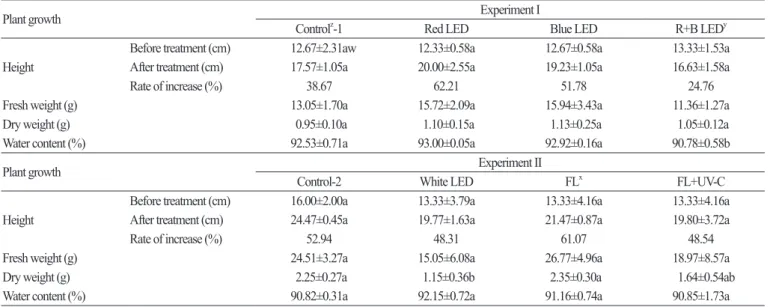
광원[Control-1, RedLED, BlueLED, Mix(R+B) LED]이 다른 광질을 5일간 처리 하에서 식물체 길이는 ‘RedLED’(62.21) 에서 증가율이 가장 높았고, ‘Mix(R+B) LED’(24.76%)에서 증가율이 가장 낮았다(Table1). 생체중은 ‘RedLED’(15.72)와
‘BlueLED’(15.94g)가 높았으며 두 처리구는 큰 차이를 보이지 않았다. 수분함량은 ‘RedLED’(93.0) > ‘BlueLED’(92.92) >
‘Control-1’(92.53) > ‘Mix(R+B) LED’(90.78%) 순으로 감소했다. ‘RedLED’의 수용체인 피토크롬(phytochrome)은 식물의 발아, 묘종의 발달과 개화까지 식물의 다양한 생리학적 반응에 관여하고(Bottoetal., 1996), ‘BlueLED’는 상추의 잎 두께 촉진 (Johkanetal., 2010)등 잎의 기능과 관련있다. 따라서 식물체에 조사된 광질과 이들을 흡수하는 광수용체의 종류에 따라 작물
의 생장반응이 다르게 나타난다(LeeandKim, 2014). 상기와 같이 ‘RedLED’와 ‘BlueLED’ 조사는 식물체의 발아, 잎 두께, 개 화 등 작물의 생리적 영향을 주었지만, 본 실험에서는 ‘RedLED’와 ‘BlueLED’ 간 유의적인 생육 차이는 없었다.
[실험 II] ‘White LED’, ‘FL’, ‘FL+UV-C’의 조사에 따른 생장 효과
광원(Control-2, WhiteLED, FL, FL+UV-C)이 다른 광질을 5일간 처리 하에서 식물체 길이는 ‘FL’(61.07)에서 가장 높은 증가율을 보였으며, ‘WhiteLED’(48.31%)에서 가장 낮은 증가율을 보였다(Table1). 생체중은 ‘FL’(26.77)에서 가장 높았으며
‘WhiteLED’(15.05g)에서 가장 낮았다. 형광등 조사는 LED 광원에 비해 광파장 대역이 다양하기 때문에 작물의 생육에 좋다 고 보고되었다(Parketal., 2012). 수분함량은 ‘WhiteLED’(92.15) > ‘FL’(91.16) > ‘FL+UV-C’(90.85) > ‘Control-2’(90.82%) 순으로 감소했다. 인공광원에 따른 rocketsalad의 생장은 집단 간의 차이는 있었으나 통계학적 유의성은 거의 나타나지 않았 다(p <0.05).
GSL 분리 및 동정
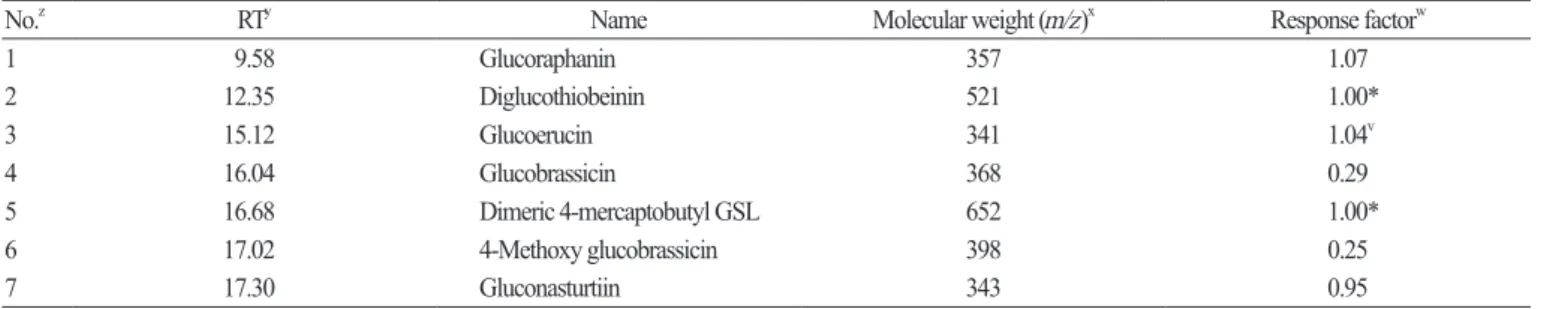
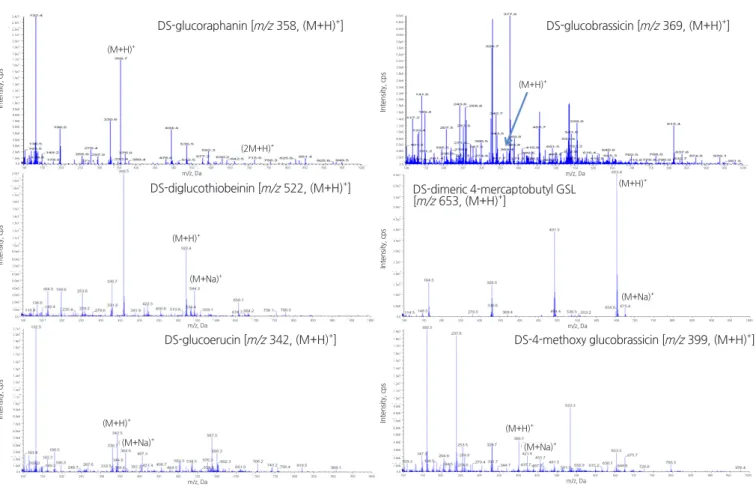
Rocketsalad 내 GSLs를 HPLC와 LC-ESI-MS로 분석한 결과, 기존의 발표된 rocketsalad의 GSLs는 glucoraphanin, sinigrin, diglucothiobeinin, glucoerucin, glucobrassicin, dimeric4-mercaptobutyl-GSL, 4-methoxyglucobrassicin로 보고 되었지만(Kimetal., 2007), 본 실험에서는 7종류의 GSLs(glucoraphanin, diglucothiobeinin, glucoerucin, glucobrassicin, dimeric4-mercaptobutylGSL, 4-methoxyglucobrassicin, gluconasturtiin)를 분리 및 동정하였다(Table2, Fig. 1. andFig. 2.).
[실험 I] ‘Red LED’, ‘Blue LED’, ‘Mix LED’의 조사에 따른 GSL 함량
광원[Control-1, RedLED, BlueLED, Mix(R+B) LED]이 다른 광질을 5일간 처리 하에서 각 GSL 성분 별 함량 범위는 glucoraphanin(0.10), diglucothiobeinin(0.11), glucoerucin(0.22), glucobrassicin(0.06), dimeric4-mercaptobutylGSL(0.03-
Plant growth Experiment I
Controlz-1 Red LED Blue LED R+B LEDy
Height
Before treatment (cm) 12.67±2.31aw 12.33±0.58a 12.67±0.58a 13.33±1.53a
After treatment (cm) 17.57±1.05a 20.00±2.55a 19.23±1.05a 16.63±1.58a
Rate of increase (%) 38.67 62.21 51.78 24.76
Fresh weight (g) 13.05±1.70a 15.72±2.09a 15.94±3.43a 11.36±1.27a
Dry weight (g) 0.95±0.10a 1.10±0.15a 1.13±0.25a 1.05±0.12a
Water content (%) 92.53±0.71a 93.00±0.05a 92.92±0.16a 90.78±0.58b
Plant growth Experiment II
Control-2 White LED FLx FL+UV-C
Height
Before treatment (cm) 16.00±2.00a 13.33±3.79a 13.33±4.16a 13.33±4.16a
After treatment (cm) 24.47±0.45a 19.77±1.63a 21.47±0.87a 19.80±3.72a
Rate of increase (%) 52.94 48.31 61.07 48.54
Fresh weight (g) 24.51±3.27a 15.05±6.08a 26.77±4.96a 18.97±8.57a
Dry weight (g) 2.25±0.27a 1.15±0.36b 2.35±0.30a 1.64±0.54ab
Water content (%) 90.82±0.31a 92.15±0.72a 91.16±0.74a 90.85±1.73a
zControl-1 or 2, grown in the greenhouse.
yMix (R+B) LED, Red + Blue (R:B=7:3).
xFL, Fluorescent Lamp.
wWithin each column, values follow by the same letters are not significantly different at p ≤ 0.05, using Tukey’s multiple-range test.
Mean ± standard deviation.
Table 1. Plant growth (n=3) of rocket salad grown with different lights for five days
3.40), 4-methoxyglucobrassicin(0.10-0.29), gluconasturtiin(0.11μmol·g-1DW)으로 나타났다(Table3). Kalesprouts 재배 시
‘LED’와 ‘Far-red’에 따른 총 aliphaticGSL 함량을 조사한 결과, ‘Far-red’(3.50) > ‘BlueLED’(2.94) > ‘Dark’(2.80) > ‘Red LED’(2.64) > ‘WhiteLED’(2.48μmol·g-1DW) 순으로 감소했다(CarvalhoandFolta, 2014). 그러나 본 실험에서 총 GSL 함량
No.z RTy Name Molecular weight (m/z)x Response factorw
1 9.58 Glucoraphanin 357 1.07
2 12.35 Diglucothiobeinin 521 1.00*
3 15.12 Glucoerucin 341 1.04v
4 16.04 Glucobrassicin 368 0.29
5 16.68 Dimeric 4-mercaptobutyl GSL 652 1.00*
6 17.02 4-Methoxy glucobrassicin 398 0.25
7 17.30 Gluconasturtiin 343 0.95
zNo., the elution order in HPLC analysis.
yRT, retention time (min).
xAs a desulfo-glucosinolate.
wThe international organization for standardization (ISO 9167-11992). *Undecided by the ISO.
vAccording to Clarke (2010).
Table 2. Glucosinolates identified using LC-ESI-MS in rocket salad
Fig. 1. HPLC chromatograms of glucosinolates extracted from rocket salad grown under natural sun-light (A, Control-2) and fluorescent lamps (B). Peak numbers refer to the glucosinolates listed in Table 2.
A
B
Retention Time (min)
Intensity (mAU)
5 10 15 20 25
1 2 3 4
6 5
7
5 10 15 20 25
1
3 4 6 5
300
250
200
150
100
50
0 25
20
15
10
5
0
Fig. 2. Mass spectra of glucosinolate(GSL) isolated from rocket salad.
Experiment I
No.z RTy Name Control-1 Red LED Blue LED R+B LED
1 9.58 Glucoraphanin NDx 0.10±0.12aw ND ND
2 12.35 Diglucothiobeinin ND 0.11±0.12a ND ND
3 15.12 Glucoerucin ND 0.22±0.17a ND ND
4 16.04 Glucobrassicin 0.06±0.00a 0.06±0.00a 0.06±0.00a 0.06±0.00a
5 16.68 Dimeric 4-mercaptobutyl GSL 0.03±0.06a 3.40±3.76a ND 0.05±0.05a
6 17.02 4-Methoxy glucobrassicin 0.11±0.05a 0.29±0.17a 0.11±0.02a 0.10±0.02a
7 17.30 Gluconasturtiin ND 0.11±0.05a ND ND
Total 0.20±0.10a 4.30±4.16a 0.17±0.01a 0.21±0.04a
Experiment II
No. RT Name Control-2 White LED FL FL+UV-C
1 9.58 Glucoraphanin 0.08±0.08b 0.20±0.05ab 0.45±0.19a ND
2 12.35 Diglucothiobeinin ND 0.04±0.08b 0.23±0.03a ND
3 15.12 Glucoerucin 0.07±0.06b 0.17±0.02b 0.57±0.12a ND
4 16.04 Glucobrassicin 0.06±0.00a 0.06±0.00a 0.08±0.00a 0.06±0.01a
5 16.68 Dimeric 4-mercaptobutyl GSL 0.54±0.48b 1.91±1.65b 11.12±2.12a 0.08±0.14b
6 17.02 4-Methoxy glucobrassicin 0.16±0.03a 0.39±0.31a 0.38±0.01a 0.14±0.11a
7 17.30 Gluconasturtiin ND 0.14±0.25ab 0.62±0.29a 0.11±0.19ab
Total 0.90±0.61b 2.91±2.26b 13.45±1.85a 0.39±0.44b
zNo., the elution order of glucosinolate.
yRT, retention time (min).
xND, not detected.
wWithin each column, values follow by the same letters are not significantly different at p<0.05, using Tukey’s multiple-range test (n=3).
Mean ± standard deviation.
Table 3. Glucosinolate contents (μmol/g dry wt.) in rocket salad grown with different lights for five days DS-glucoraphanin [m/z 358, (M+H)+]
DS-diglucothiobeinin [m/z 522, (M+H)+]
DS-glucoerucin [m/z 342, (M+H)+]
DS-glucobrassicin [m/z 369, (M+H)+]
DS-dimeric 4-mercaptobutyl GSL [m/z 653, (M+H)+]
DS-4-methoxy glucobrassicin [m/z 399, (M+H)+]
Intensity, cpsIntensity, cpsIntensity, cps Intensity, cpsIntensity, cpsIntensity, cps
(M+H)+
(2M+H)+
(M+H)+
(M+Na)+
(M+H)+
(M+Na)+
100 150 200 250 300 350 400 450 500 550 600 650 700 750 800 850 900 950 1000
m/z, Da
0.0 1.0e6 2.0e6 3.0e6 4.0e6 5.0e6 6.0e6 7.0e6 8.0e6 9.0e6 1.0e7 1.1e7 1.2e7 1.3e7 1.4e7 1.5e7 1.6e7 1.7e7 1.8e7 1.9e7 2.0e7 2.1e7 0.0 1.0e6 2.0e6 3.0e6 4.0e6 5.0e6 6.0e6 7.0e6 8.0e6 9.0e6 1.0e7 1.1e7 1.2e7 1.3e7 1.4e7 1.5e7 1.6e7 1.7e7 1.8e7 1.9e7 2.0e7
100 150 200 250 300 350 400 450 500 550 600 650 700 750 800 850 900 950 1000
m/z, Da
0.0 1.0e6 2.0e6 3.0e6 4.0e6 5.0e6 6.0e6 7.0e6 8.0e6 9.0e6 1.0e7 1.1e7 1.2e7 1.3e7 1.4e7 1.5e7 1.6e7 1.7e7 1.8e7 1.9e7 2.0e7 2.1e7 2.2e7 2.3e7 2.4e7
100 150 200 250 300 350 400 450 500 550 600 650 700 750 800 850 900 950 1000
m/z, Da
(M+H)+
(M+H)+ (M+H)(M+H)++
(M+Na)+
(M+H)+ (M+Na)+
100 150 200 250 300 350 400 450 500 550 600 650 700 750 800 850 900 950 1000
m/z, Da
100 150 200 250 300 350 400 450 500 550 600 650 700 750 800 850 900 950 1000
m/z, Da
100 150 200 250 300 350 400 450 500 550 600 650 700 750 800 850 900 950 1000
m/z, Da
0.0 1.0e6 2.0e6 3.0e6 4.0e6 5.0e6 6.0e6 7.0e6 8.0e6 9.0e6 1.0e7 1.1e7 1.2e7 1.3e7 1.4e7 1.5e7 1.6e7 1.7e7 1.8e7 1.9e7 0.0 5.0e6 1.0e7 1.5e7 2.0e7 2.5e7 3.0e7 3.5e7 4.0e7 4.5e7 5.0e7 5.5e7 6.0e7 6.5e7 0.0 2.0e5 4.0e5 6.0e5 8.0e5 1.0e6 1.2e6 1.4e6 1.6e6 1.8e6 2.0e6 2.2e6 2.4e6 2.6e6 2.8e6 3.0e6 3.2e6 3.4e6 3.6e6 3.8e6 4.0e6 4.2e6 4.4e6 4.6e6
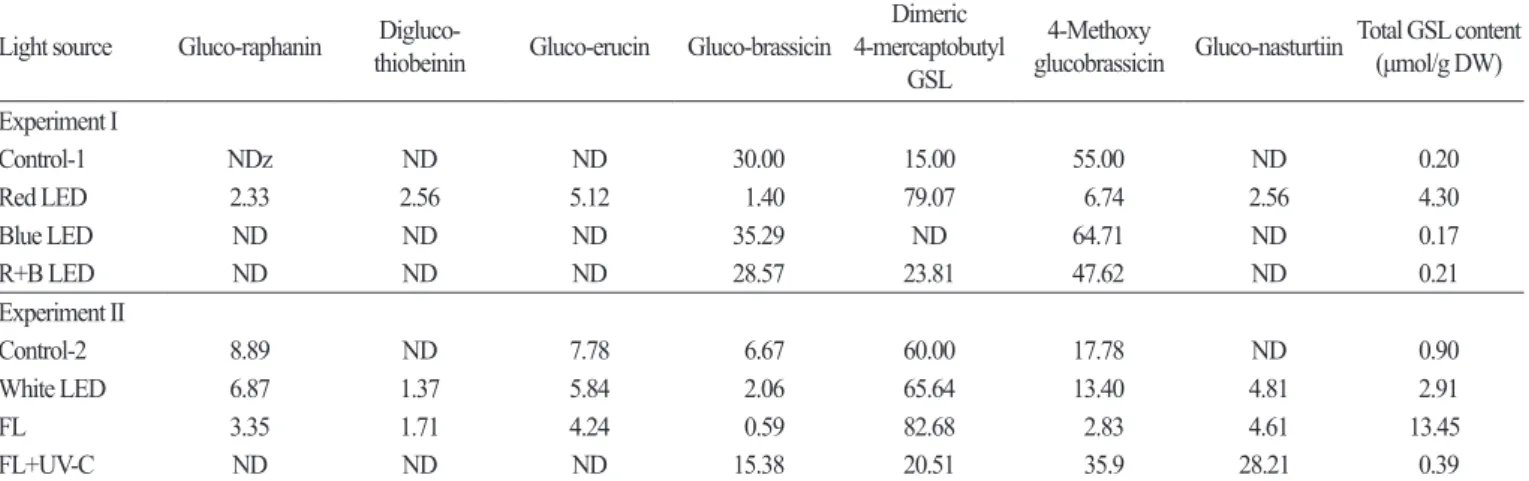
은 ‘Control-1’(0.20)과 비교하였을 때, ‘Red LED’(4.30)에서는 약 21.4배 높았고, ‘Blue LED’(0.17)과 ‘Mix(R+B) LED’(0.21μmol·g-1DW)에서는 약간 감소하거나 같았다. 현재까지 연구결과에 의하면 ‘RedLED’는 콩의 묘에서 베타 카로틴 및 항산화도를 증가시킨다고 보고했다(Wuetal., 2007). 본 실험도 ‘RedLED’ 조사에 따라 ‘Control-1’에서는 검출되지 않았 던 glucoraphanin, diglucothiobeinin, glucoercin, gluconasturtiin이 증가하였다. ‘RedLED’의 총 GSL 함량 중 가장 높은 비율 을 나타낸 성분은 dimeric4-mercaptobutylGSL으로 전체의 79%를 차지하였으며, 4-methoxyglucobrassicin 이 6%로 그 다 음으로 높은 비율을 차지하였다(Table4). 따라서 [실험 I]을 비교 분석해 본 결과, ‘RedLED’에서 재배한 rocketsalad가 기능적 으로 가치가 높을 것으로 판단된다.
[실험 II] ‘White LED’, ‘FL’, ‘FL+UV-C’의 조사에 따른 GSL 함량
광원(Control-2, White LED, FL, FL+UV-C)이 다른 광질을 5일간 처리 하에서 각 성분 별 함량 범위는 glucoraphanin(0.08-0.45), diglucothiobeinin(0.04-0.23), glucoerucin(0.07-0.57), glucobrassicin(0.06-0.08), dimeric 4-mercaptobutylGSL(0.08-11.12), 4-methoxyglucobrassicin(0.14-0.39), gluconasturttin(0.11-0.62μmol·g-1DW)으로 나 타났다. CarvalhoandFolta (2014)는 ‘far-red’, ‘RedLED’, ‘BlueLED’, ‘WhiteLED’에서 kalesprouts 의 indolylGSLs 함량 을 비교한 결과, ‘White LED’(0.09μmol·g-1 DW)는 다른 광원(평균 0.15)보다 약 40% 낮았다. 또한 glucobrassicin은
‘Dark’(0.18)에서 보다 ‘WhiteLED’(0.06μmol·g-1DW)에서 67% 낮았다고 보고하였다. 하지만 본 실험에서는 indolylGSLs로 분류되는 4-methoxy glucobrassicin과 glucobrassicin을 비교해 본 결과, ‘White LED’(0.39, 0.06μmol∙g-1 DW)가
‘Control-2’(0.16, 0.06)보다 2.4배 증가하거나 동일하였다. 본 실험에서 총 GSL 함량은 ‘FL’(13.45) > ‘WhiteLED’(2.91) >
‘Control-2’(0.90) > ‘FL+UV-C’(0.39μmol∙g-1DW) 순으로 감소하였다. 이 결과는 ‘FL’가 ‘WhiteLED’에 비해 ‘RedLED’와
‘BlueLED’의 파장을 포함하여 광파장 대역이 다양하기 때문인 것으로 사료되며, 상추에 ‘FL’와 ‘WhiteLED’를 조사한 실험 에서도 안토시아닌 함량이 ‘WhiteLED’보다 ‘FL’ 처리구에서 약 3배 정도 높았다(Parketal., 2012). 또한, ‘WhiteLED’와 ‘FL’ 조사에 따라 ‘Control-2’에서는 검출되지 않았던 diglucothiobeinin, gluconasturtiin이 증가하였다. 수확할 때 rocketsalad에서 강한 향기와 매운 맛을 내는 것과 관련(Bennettetal., 2002)이 있는dimeric4-mercaptobutylGSL이 ‘FL’에서 총 GSL 함량의 82%를 차지하였으며, ‘Control-2’와 ‘WhiteLED’는 각각 60%, 65%, ‘FL+UV-C’에서 20.51%를 차지하였다.
Choi(2011)에 의하면 ‘부유’ 단감을 수확 후 UV-C를 조사하였을 때 2차 대사산물인 carotenoid 함량이 증가하였다고 보고 하였다. 그러나 본 실험에서는 식물에 치명적이지 않는 UV-C 조사 수준이라고 보고된 시간(매일 2분)을 조사하였지만 총 GSL 함량이 ‘Control-2’의 약 43.4% 수준이었다. 또한, ‘FL’과 비교해 보았을 때 동일한 ‘FL’의 16시간의 노출이 있었지만 총 GSL Light source Gluco-raphanin Digluco-
thiobeinin Gluco-erucin Gluco-brassicin Dimeric 4-mercaptobutyl
GSL
4-Methoxy
glucobrassicin Gluco-nasturtiin Total GSL content (μmol/g DW) Experiment I
Control-1 NDz ND ND 30.00 15.00 55.00 ND 0.20
Red LED 2.33 2.56 5.12 1.40 79.07 6.74 2.56 4.30
Blue LED ND ND ND 35.29 ND 64.71 ND 0.17
R+B LED ND ND ND 28.57 23.81 47.62 ND 0.21
Experiment II
Control-2 8.89 ND 7.78 6.67 60.00 17.78 ND 0.90
White LED 6.87 1.37 5.84 2.06 65.64 13.40 4.81 2.91
FL 3.35 1.71 4.24 0.59 82.68 2.83 4.61 13.45
FL+UV-C ND ND ND 15.38 20.51 35.9 28.21 0.39
zND, not detected.
Table 4. Individual glucosinolate proportions (%) of the total glucosinolate content in rocket salad grown with different lights for five days