한국정보통신학회논문지 Vol. 23, No. 9: 1038~1048, Sep. 2019
DEVS 형식론 기반의 선박 항해 모델링 및 시뮬레이션 (I)
: 항해 시뮬레이션 아키텍처 설계와 선박 핵심 장비 및 에이전트 모델링
우상민1·이장세2·황훈규3*
Vessel and Navigation Modeling and Simulation based on DEVS Formalism : Design for Navigation Simulation Architecture with Modeling for Critical Systems and Agents of Vessel
Sang-Min Woo
1· Jang-Se Lee
2· Hun-Gyu Hwang
3*1
Researcher, Division of Embedded System Development, GS E&C Corp., Seoul, 03159 Korea
2
Professor, Division of Maritime IT Engineering, Korea Maritime and Ocean University, Busan, 49112 Korea
3*
Senior researcher, Division of Ocean ICT & Advanced Materials Technology Research, Research Institute of Medium & Small Shipbuilding, Busan, 46757 Korea
요 약
최근, 선박의 항해 안전을 지원하기 위한 다양한 시스템이 개발되고 있다. 이러한 시스템의 유용성을 검증하기 위 해서는 실제 선박에 탑재하여 운용해보는 것이 가장 이상적이나 현실적으로는 많은 어려움이 존재한다. 그 대안으로 모델링 및 시뮬레이션(M&S) 기법을 적용한 유용성 검증 방법이 요구된다. 현실과 가장 가까운 선박 조종 시뮬레이 터(FMSS)는 구축비용이 수억에서 수십억에 달하는 등 매우 고가이고, 운용을 위한 전문 인력이 필요하다는 한계가 존재한다. 이러한 이유로, 본 논문에서는 이산사건 시스템 명세(DEVS) 형식론 기반의 선박 항해 모델링 및 시뮬레이 션을 통한 항해 안전 지원 시스템을 검증하기 위한 방법을 제안한다. 그 첫 단계로 SES/MB 프레임워크를 기반으로 항해 시뮬레이션 아키텍처를 설계하고, DEVS 형식론을 기반으로 선박 핵심 장비 및 항해사 에이전트를 모델링하는 것에 관한 내용을 기술한다. 이러한 내용을 바탕으로 선박 항해 시뮬레이션 시스템을 구현하고, 다양한 시나리오를 통해 충돌회피 시뮬레이션 등과 같은 항해 안전 지원 요소의 효과도 평가가 가능할 것으로 판단된다.
ABSTRACT
Recently, various systems have been developed to support ship navigation safety. In order to verify the usefulness of such a system, it is most ideal to try it on a real vessel, but there are many difficulties. As an alternative, usability verification methods applied with modelling and simulation (M&S) techniques are required such as FMSS, which is closest to reality, is very expansive to construct, and there needs the specialized operator. For this reason, this paper proposes a method to verify the navigation safety support system by modeling and simulation techniques based on the Discrete Event System Specification (DEVS) formalism. As a first step, we designed the navigation simulation architecture based on the SES/MB framework, and details on modelling ship core equipment and navigator agents based on the DEVS. Through this, we are able to implement the navigation simulation system for vessels, and evaluate the effectiveness of navigation safety support elements such as collision avoidance, etc. using developed scenarios.
키워드
: 이산사건 시스템 명세, 항해 시뮬레이션, 선박 핵심 장비 모델링, 에이전트 기술, 충돌회피
Keywords
: Discrete event system specification (DEVS), navigation simulation, vessel`s critical system modeling, agent technology, collision avoidance
Received 18 July 2019, Revised 26 July 2019, Accepted 2 August 2019
* Corresponding Author Hun-Gyu Hwang(E-mail:[email protected], Tel:+82-51-974-5500)
Senior researcher, Division of Ocean ICT & Advanced Materials Technology Research, Research Institute of Medium & Small Shipbuilding, Busan, 46757 Korea
Open Access
http://doi.org/10.6109/jkiice.2019.23.9.1038
print ISSN: 2234-4772 online ISSN: 2288-4165This is an Open Access article distributed under the terms of the Creative Commons Attribution Non-Commercial License(http://creativecommons.org/li-censes/
Ⅰ. 서 론
해상교통량이 증가함에 따라 선박사고 발생수도 급 증하고 있으며, 이를 예방하기 위한 기술적 대책 마련이 시급한 실정이다. 해양수산부의 해양 사고 통계에 따르 면 지난 5년간(2013~2017년) 연평균 1,833건의 사고가 발생하였고[1], 2017년은 총 2,582건으로 전년 대비 11.9% 증가한 것으로 나타났다. 이러한 사고는 경계 소 홀과 같은 인적과실(human error)이 원인으로, 과거부터 이를 저감하기 위한 항해 안전 지원 시스템의 필요성이 대두되었다. 이러한 이유로 인적과실을 예방하고 이를 통해 해양사고를 감소시키기 위하여 선박 충돌 위험에 대한 항해 의사결정 지원이나 위험 상황 경고를 제공하 는 시스템 개발 등 여러 연구가 진행되고 있다[2-5].
한편, 선박 항해 안전 향상을 위한 각종 지원 시스템 의 개발에 있어 해당 시스템이 실제 적용된 경우, 인적 오류가 감소되는 효과가 있는지를 검증하는 과정이 반 드시 요구되지만, 여기에는 많은 어려움이 존재한다.
(1) 실제 선박을 활용한 검증은 개발 시스템의 탑재 및 테스트 지원이 가능한 선박을 모색하는 것이 매우 어려 울 뿐 아니라 막대한 비용이 소요된다. (2) 선박 조종 시 뮬레이터(FMSS, full-mission ship-handling simulator) 의 경우에는 상대적으로 비용은 저렴하나 교육 등의 목 적에 특화되어 있기 때문에 항해 데이터 연동에 제약점 을 가진다. 또한, (3) 항해 관련 지식을 가지고 있지 않은 경우에는 선박 조종 시뮬레이터를 활용한 검증에 많은 어려움이 있다[4-8].
이러한 이유로 소프트웨어 기반 모델링 및 시뮬레이 션 기법을 적용한 후, 항해 데이터를 모사 및 생성하여 특정 목적으로 활용하는 다양한 연구가 진행된바 있다 [7-9]. 본 논문에서는 선박 항해 시뮬레이션을 위하여 SES/MB (system entity structure / model base) 프레임워 크를 기반으로 시뮬레이션 아키텍처를 설계하고, 이를 구성하는 요소인 선박 핵심 장비와 항해 에이전트를 DEVS(discrete event system specification, 이산사건시 스템명세) 형식론을 기반으로 모델링하는 것에 관한 내 용을 다룬다. 본 연구는 보다 경량화된 선박 항해 시뮬 레이션을 위한 기반 연구가 되는 것으로, 각종 선박 및 항해 안전 요소의 유용성 평가 등 다양한 목적으로 활용 가능하다.
Ⅱ. 관련 연구
2.1. SES/MB 프레임워크
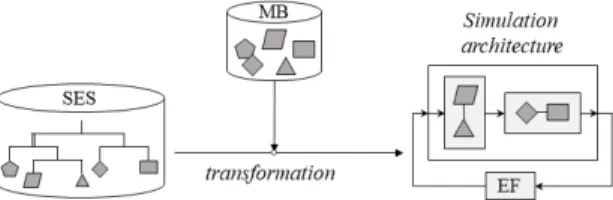
SES/MB 프레임워크는 각종 지식이 포함된 구조적 지식 표현 기법으로, 복잡한 시스템 구조의 설계 및 분 석을 계층적으로 용이하게 하고, 계획-생성-평가(plan- generate-evaluate) 패러다임을 제공하는 M&S 환경이 며, 기본적으로 그림 1과 같이 SES와 MB로 구성되어 시뮬레이션 아키텍처를 구성한다. SES는 복잡한 시스 템의 구조를 체계적으로 표현할 수 있는 구조를 의미하 며, 표현하는 모델의 구성 관계, 종류, 결합구조, 제약조 건 등의 특정 형식으로 표현한 것으로 선언적 성격을 가 진다. 또한, MB는 시스템의 행위적·동역학적 특성을 나 타내며, 기호적인 표현 수단을 제공하는 절차적 성격을 가진 모델로 구성된다[10].
Fig. 1 A conceptual diagram of the SES/MB framework
2.2. DEVS 형식론
SES/MB 프레임워크 요소 중, MB의 구성을 위해서 DEVS 형식론을 활용하는데, 이는 시간에 따른 동적인 변화와 이산적인 사건에 따른 상태 전이의 명세가 가능 하고, 시뮬레이션 구성 모델들을 효율적으로 표현할 수 있는 특징을 가진다. 기본적으로 DEVS는 연속적인 시 간상에서 입력 사건에 의해 상태가 전이 되거나 시간의 흐름에 따른 내부적인 상태 전이에 대한 시스템의 동적 인 변화를 기술하기 위한 것으로, 상태의 전이는 입력, 상태, 출력, 시간의 흐름 등의 함수들에 의한 상호작용 으로 이루어진다. 또한, DEVS 모델은 대상으로 하는 시 스템의 동작을 수학적으로 기술한 것으로 원자(atomic) 모델, 결합(coupled)모델로 구분되며, 이러한 두 모델을 사용하여 상태 전이에 대한 표현과 시스템 모델의 모듈 화가 가능하다. 본 논문에서는 이 중, 원자 모델을 활용 하여 시뮬레이션 아키텍처를 모델링하며, 원자 모델을 정리하여 표현하면 식 (1)과 같다[10].
M = < X, S, Y, δ ext, δ int, λ , ta > (1)
원자 모델은 세 가지의 집합과 네 가지의 함수로 표 현되는데, X는 발생 사건에 관한 입력 변수들의 집합, Y 는 출력 변수들의 집합, S는 상태 변수들의 집합을 의미 하고, δ ext는 시스템 외부 입력 변수에 따라 모델의 상 태를 변화하는 외부상태 전이 함수, δ int는 시간 진행 함 수 ta에 의해 설정된 시간의 경과 시 모델 내부의 상태 를 변화하는 내부상태 전이 함수, λ 는 내부 및 외부상태 전이 시 출력되는 출력함수를 의미한다.
2.3. 에이전트 기술
에이전트는 자율의사결정을 위해 IF-THEN 형태로 이루어진 규칙들을 가진 지식베이스(KB, knowledge base)를 기반으로 추론, 정보 교환 등을 수행하는 지능 적 요소를 의미한다[8]. 또한, 그림 2와 같이 에이전트는 지식베이스 모델로부터 최적의 해를 찾기 위한 추론엔 진(IE, inference engine) 모델이 분리된 구조를 가진다.
일반적으로 에이전트는 시뮬레이션 아키텍처 내에서 인간에 의해 수행되어야 하는 행동에 관한 지식을 가진 개체(모델)가 된다[11].
Fig. 2 A conceptual diagram of agent with KB and IE
Ⅲ. 항해 시뮬레이션 아키텍처 설계
3.1. 선박 핵심 장비 정의
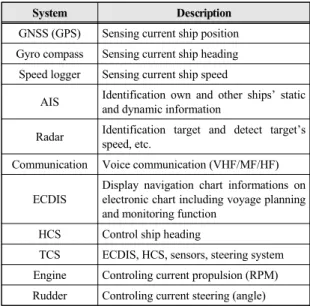
본 논문에서는 국제해사기구(IMO, International maritime organization) 해상인명안전협약(SOLAS, safety of life at sea)의해 의무탑재가 규정된 항해통신장비를 대상으로 주요 기능 및 특성을 분석하고 모델링한다. 해당 장비의 목록과 주요 기능 및 특성을 표 1에 정리하였다. 주요 장 비로는 GNSS(GPS), 자이로 콤파스, 선속계(speed log), 선박자동식별장치(AIS, automatic identification system), 레 이더, 무선통신장비, 전자해도표시장치(ECDIS, electronic chart display and information system), 선수방위제어장
치(HCS, heading control system), 항적제어장치(TCS, track control system), 엔진, 조타기(rudder) 등이 식별되 었다[4-7].
System Description
GNSS (GPS) Sensing current ship position Gyro compass Sensing current ship heading Speed logger Sensing current ship speed
AIS Identification own and other ships’ static and dynamic information
Radar Identification target and detect target’s speed, etc.
Communication Voice communication (VHF/MF/HF)
ECDIS
Display navigation chart informations on electronic chart including voyage planning and monitoring function
HCS Control ship heading
TCS ECDIS, HCS, sensors, steering system Engine Controling current propulsion (RPM) Rudder Controling current steering (angle) Table. 1 A list of critical systems in vessel
특히, TCS는 선박의 자동항해(autopilot)를 위한 장비 로써 그림 3과 같이 선수방위뿐 아니라 항로 계획에 따 라 조타기를 제어하여 자동으로 항로를 추종하는 기능 을 한다. 이를 위해서 ECDIS, HCS, GPS, 자이로 콤파 스, 조타기의 연동을 고려한 모델링이 요구된다. 본 논 문에서는 최근 활발하게 연구되고 있는 자율운항선박 이나 충돌 회피 알고리즘의 검증을 위해서 TCS 및 관련 요소의 모델링에 상대적으로 큰 비중을 두었다.
Fig. 3 A conceptual diagram of TCS
3.2. 계층적 시뮬레이션 아키텍처 설계
SES/MB를 기반으로 선박 핵심 장비와 항해사 및 조
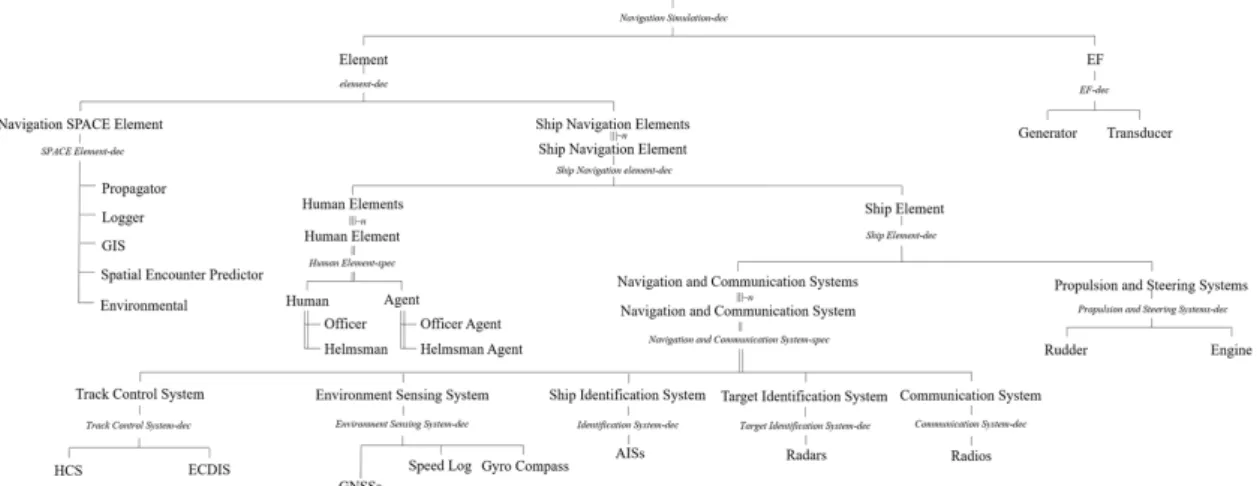
타수 에이전트를 모델링을 수행하였고, 그림 4와 같이 항해 시뮬레이션을 위한 계층구조적 아키텍처를 설계 하였다. 실험 틀(EF, experimental frame)의 경우, 시뮬 레이션을 위한 기본적인 요소를 포함한다. 시뮬레이션 아키텍처의 요소(element)는 크게 항해 공간요소(navigation SPACE element)[12]와 선박 항해 요소(ship navigation elements)로 구성된다.
항해 공간요소는 항해 환경에 관련된 부분을 처리하 기 위한 모델로, 선박의 센서 데이터를 기록 및 갱신하 는 로거(logger), 새로운 좌표 및 선수방위를 계산하는 공간 예측기(SEP, spatial encounter predictor), 갱신된 선박의 정보를 지도에 업데이트하는 GIS 모델로 구성 된다.
선박 항해 요소는 다시 인적 요소(human element)와 선박 요소(ship element)로 나누어진다. 인적 요소는 기 본적으로 인간과 에이전트로 나뉘며, 항해를 위한 인적 요소인 항해사(officer)와 조타수(helmsman)의 속성을 선택할 수 있도록 구성된다. 또한, 선박 요소는 전자적 인 통신을 담당하는 항해통신장비(navigation and communication systems)와 선박의 추진과 조향을 담당 하는 추진조향장비(propulsion and steering systems)로 이루어진다.
항해통신장비로는 HCS와 ECDIS를 포함하는 TCS 를 비롯하여 선박 및 주변 환경을 감지하는 환경 탐지 장치(ESS, environment sensing system), 타선박의 위치, 속도, 선수방위 등을 식별하고 본 선박의 정보를 송신하 는 선박 식별 장치(SIS, ship identification system), 물표
탐지를 위한 물표 감지 장치(target identification system) 와 타선박과의 교신을 위한 통신장치(communication system)로 구성된다. 마지막으로 추진조향장비는 선박 의 방향을 제어하기 위한 조타기와 속력을 제어하기 위 한 엔진으로 이루어진다. 본 논문에서는 편의상 각 모델 (장비)의 수준(depth)을 한 단계 높여서 그룹화하여 표 현한다. 예를 들어, TCS는 ECDIS와 HCS를 포함하는 개념이며, ESS는 GPS, 선속계, 자이로 콤파스를 포함하 여 지칭한다.
Ⅳ. 선박 핵심 장비 및 에이전트 모델링
4.1. 각 모델 간 관계 정의(가지치기 및 포트 연결) 앞서 설계한 계층구조적 아키텍처인 SES를 기반으 로 가지치기(pruning)를 통해 다양한 시뮬레이션 환경 의 구성이 가능하며, 이를 PES(pruned entity structure) 라고 한다. 그 후, 포트 연결(port coupling) 과정을 통해 각 구성 모델간의 관계 정의를 해주어 동역학적 특성을 부여하게 되고, 이를 통해 한 계층 높은 시뮬레이션이 가능하게 된다.
본 논문에서는 자선(own ship)과 타선(target ship) 3 척, 총 4척의 선박 모델을 대상으로 항해 시뮬레이션을 수행하도록 하는 상황을 기준으로 동역학적 아키텍처를 설계한다. 가지치기 과정을 통해 PES를 도출하였으며, 도출된 PES를 구성하는 각 모델간의 포트 연결 과정을 통해 그림 5와 같은 동역학적 시뮬레이션 아키텍처를
Fig. 4 The designed SES for hierarchical simulation architecture
도출하였다. 각 상위 모델의 정의와 가지치기 조건은 다 음과 같다.
1) EF : DEVS 기반 시뮬레이션에서 필요한 요소들을 기 본적으로 포함한다.
2) Element : 항해 시뮬레이션에서 각종 요소들을 선택 및 포함한다.
2-1) Navigation SPACE Element : 항해 시뮬레이션에서 필요한 공간적·환경적 부가 요소들을 포함한다.
2-2) Ship Navigation Elements : 자선과 타선을 포함하 여 총 4척의 선박을 생성한다.
2-2-1) Human Elements : 항해시 충돌 상황 등과 같은 위험 회피를 위해 항해사 에이전트와 그 명령을 따르 는 조타수 에이전트를 선택한다.
2-2-2) Ship Elements : 선박 탑재장비를 선택 및 포함한다.
2-2-2-1) Navigation and Comm. Systems : 항해 시뮬레 이션을 위한 최소 요소인 TCS, ESS, SIS를 선택한다.
2-2-2-2) Propulsion and Steering Systems : 선박을 제어 하기 위한 조타기와 엔진이 기본적으로 포함된다.
4.2. 시뮬레이션 아키텍처 구성 모델 기능 명세 설계한 시뮬레이션 아키텍처 내 각 구성요소는 고유 의 기능을 수행하도록 모델링 및 설계하였으며, 각 모 델의 주요 기능 정의와 의사코드는 다음과 같다. 상태 (phase) 값에 따른 상태전이(hold-in) 및 다른 모델로 출 력 값을 전달하여 시뮬레이션의 각 루프가 진행된다.
1) EF(experiment frame) 모델
- Generator: 시뮬레이션 시스템에서 초기 설정된 선 박의 정보(위도, 경도, 속도, 선수방위, 타각)를 입력 으로 가하여 시뮬레이션 시작을 제어한다.
Experiment frame - Generator external transition function
when receive value on input port from Transducer model if phase is “wait”
if (value == “simulation stop”) hold-in “passive”
internal transition function
if phase is “busy” hold-in “wait”
output function if phase is “busy”
output: send the ships initialization message to output port
- Transducer: 시뮬레이션의 분석을 위해 생성되는 정
보를 수신 및 기록하며, 종료를 제어한다.
Fig. 5 The constitutive models with relations for the simulation architecture
Experiment frame - Transducer external transition function
when receive value on input port from Logger model if phase is “active”
if (value == “simulation ships”)
Save(); // ships data (position, heading etc.) hold-in “active”
else if (value == “stop”) hold-in “passive”
internal transition function if phase is “passive”
hold-in “passive”
output function if phase is “passive”
output: send the stop message to output port
2) Navigation SPACE element 모델
- Logger : 각 선박의 센서에서 감지되는 정보(위도, 경도, 속도, 선수방위), 추진조향장비의 정보(타각, 엔진 값), 선박식별정보(AIS)를 수신하여 갱신하고 1초 후의 시뮬레이션 선박 위치 계산을 위해 SEP 모델로 정보를 전달한다.
SPACE Model - Logger external transition function
when receive value on input port from Generator, Sensors and SEP model
if phase is “wait”
if (value == “simulation stop”) hold-in “passive”
else if (value == “ship initialization”) hold-in “sending sensor”
else if (value == “sensor”) hold-in“receiving”
else if (value == “SEP value”)
update the receiving SEP value hold-in “sending GIS”
else if phase is “receiving”
update the receiving sensors, rudder, engine and AIS value // position, heading, velocity, rudder
if (value == AIS) hold-in “sending Propagator”
else hold-in “sending SEP”
internal transition function
if phase is “sending sensor” hold-in “receiving”
if phase is “receiving”
if phase is “sending SEP” hold-in “wait”
if phase is “sending Propagator” hold-in “wait”
if phase is “sending GIS” hold-in “wait”
if phase is “passive” hold-in “passive”
output function
if phase is “sending sensor”
output: send the sensor message to output port else if phase is “receiving”
output: send the sensor message to output port else if phase is “sending SEP”
output: send the sensor message to output port else if phase is “sending Propagator”
output: send the AIS message to output port else if phase is “sending GIS”
output: send the GIS message to output port else if phase is “passive”
output: send the simulation stop message to output port
- SEP(spatial encounter predictor) : 각 선박 모델들의 위치정보 및 타각 변경에 따른 선수방위 변화를 계 산하고 Logger 모델로 전달한다.
SPACE Model – Spatial Encounter Predictor external transition function
when receive value on input port from Logger model, calculate the position and heading information of each ship // Position after 1 second
hold-in “calculating”
internal transition function if phase is “calculating”
hold-in “wait”
output function if phase is “calculating”
output: send the ship location and heading message to output port
- GIS(Geographic Information System]) : 항해 환경 정보를 2D 지도에 갱신한다.
SPACE Model – GIS external transition function
when receive value on input port from Logger model, update GIS information
hold-in “updating”
internal transition function if phase is “updating”
hold-in “passive”
output function output: none
- Propagator : 각 선박 모델들의 AIS 정보를 수신하여 영향 범위 내에 있는 다른 선박에 전달한다.
SPACE Model – Propagator external transition function
when receive value on input port from Logger model calculate thepropagation range of AIS
// Propagation range within 30 km (VHF Communication) hold-in “propagating”
internal transition function if phase is “propagating”
hold-in “passive”
output function
if phase is “propagating”
output: send the propagation message (AIS) to output port
- Environment : 항해 환경 날씨의 변화 및 시간적 변
화를 설정하는 모델로서 파고와 풍속을 SEP 모델로
전달한다.
SPACE Model – Environment external transition function
when receive value on input port from SEP model, setup the environment // wind, wave and height hold-in “setup”
internal transition function if phase is “setup”
hold-in “passive”
output function if phase is “setup”
output: send the set message (environment) to output port
3) Human elements(에이전트) 모델
- Officer : ECDIS 모델로부터 받은 충돌위험 정보 데 이터를 타선박과의 항법 규칙에 의해 분석한 결과 를 Helmsman 모델로 전달한다.
Agents - Officer Agent KB (Knowledge Base) external transition function
when receive value on input port from Officer IE model rule 1: if located on the port and look at the starboard of target ship
Then report is Maintain hold-in “normal”
rule 2: if located on the port and look at the port of target ship if (sl.location <= 30) Then report is Fine
else if (sl.location <= 60)Then report is Broad else if (sl.location <= 112.5) Then report is Converging hold-in “avoid”
rule 3: if located on the starboard and look at the starboard of target ship
Then report is Maintain hold-in “normal”
rule 4: if located on the starboard and look at the port of target ship
if (sl.location <= 30) Then report is Fine else if (sl.location <= 60) Then report is Broad
else if (sl.location <= 112.5) Then report is Converging hold-in “avoid”
rule 5: if located on the bow and look at the bow of target ship Then report is Head-On
hold-in “avoid”
rule 6: if located on the stern and look at the stern of target ship Then report is Overtaking
hold-in “avoid”
internal transition function
if phase is “normal” hold-in “normal”
if phase is “avoid” hold-in “avoid”
output function
if phase is “normal” || “avoid”
output: send the report data message to output port
Agents - Officer IE (Inference Engine) external transition function
when receive value on input port from ECDIS model, check the COLREGs rule
request condition leveling Hold-in “request”
internal transition function if phase is “request”
hold-in “interfacing”
output function if phase is “request”
output: send the ship location message to output port
- Helmsman : Officer 모델로부터 받은 명령에 따라 선박의 타각을 결정하여 Rudder 모델을 제어한다.
Agents - Helmsman Agent (Knowledge Base) external transition function
when receive value on input port from Helmsman IE model rule 1: if order data is maintain
Then order is Maintain rule 2: if order data is fine h.rudder = 15;
Then order is Turning rule 3: if order data is broad h.rudder = 20;
Then order is Turning rule 4: if order data is conversing h.rudder = 30;
Then order is Turning rule 5: if order data is head-on h.rudder = 10;
Then order is Turning rule 6: if order data is overtaking h.rudder = 10;
Then order is Turning hold-in “decision-making”
internal transition function if phase is “decision-making”
hold-in “passive”
output function
if phase is “decision-making”
output: send the order data message to output port
Agents - Helmsman IE (Inference Engine) external transition function
when receive value on input port from Officer model, check the order request condition leveling
Hold-in “request”
internal transition function if phase is “request”
hold-in “interfacing”
output function if phase is “request”
output: send the order message to output port
4) Propulsion and Steering Systems 모델
- Rudder : 선박의 타각을 갱신하고 Logger 모델로 송 신하며, ECDIS 및 Agent 모델로부터의 타각 제어 명령에 따라 타각을 변경한다.
Propulsion and Steering Systems - Rudder external transition function
when receive value on input port from HCS and Agent model update the rudder value
Hold-in “updating”
internal transition function if phase is “updating”
hold-in “passive”
output function if phase is “updating”
output: send the rudder value to output port
- Engine : 시나리오에 따라 설정된 선박의 엔진 값을 갱신하고 Logger 모델로 송신한다.
Propulsion and Steering Systems - Engine external transition function
when receive value on input port from Logger model update the engine value
Hold-in “updating”
internal transition function if phase is “updating”
hold-in “passive”
output function if phase is “updating”
output: send the engine value to output port
5) TCS 모델
- ECDIS : ESS, SIS 모델로부터 정보(선박의 위치, 선 수방위, 속력)를 수신하여 타선박과의 충돌위험도 계산, 교차항적 거리 계산, 곡선항적을 제어하는 모 델이다. 또한, 충돌위험도가 설정된 임계값을 초과 하면 항해사 에이전트에게 위험 대상 선박의 정보 (위치, 선수방위, 속도)를 전달한다.
- HCS : ECDIS 모델로부터 타각 제어 명령에 따라 변 침점(way-point)까지 선수방위를 제어하는 모델로 네 가지 모드를 가진다. 첫째, “HCS 모드”는 시뮬레 이션 선박의 타가 HCS에 의해서만 조종된다. 둘째,
“Curved 모드”는 다음 변침점로 가기 위한 곡선항 적을 수행하며 ECDIS로부터 변경 타각은 수신하여 조타를 수행한다. 셋째, “Cross 모드”는 선박이 침로 에서 정해진 범위(교차항적 거리)를 벗어났을 때 재 진입하기 위하여 ECDIS로부터 변경 타각을 수신하 여 타를 조종한다. 넷째, “Agent 모드”는 조타수 에 이전트에 의해서 타를 조종하게 되며, HCS는 조종 이 끝날 때까지 대기한다.
Track Control System - HCS external transition function
when receive value on input port from ECDIS model if phase is “wait”
if (value.mode == “HCS”) HCS(); hold-in “HCS”
else if (value.mode == “curved track control”) Curved(); hold-in “curved”
else if (value.mode == “cross track control”) Cross(); hold-in “cross”
else if (value.mode == “agent”) agent(); hold-in “agent”
if phase is “curved” || “cross” || “agent”
mode change to the HCS mode Hold-in “HCS”
internal transition function if phase is “HCS”
hold-in “wait”
else if phase is “curved” || “cross” || “agent”
hold-in the phase //curved, cross, agent output function
if phase is “HCS”
output: send the HCS rudder value to output port else if phase is “curved”
output: send the curved rudder value to output port else if phase is “cross”
output: send the cross rudder value to output port Track Control System - ECDIS
external transition function
when receive value on input port from Sensors, AISs and Agent model
if phase is “wait”
if (value == “sensors”) update(); hold-in “updating”
// update simulation ships position, heading, velocity else if (value == “AIS”)
if (CR() > Threshold) hold-in “collision risk” //calculate CR else if (value == “Agent”) hold-in “manual”
//manual steering by agent
internal transition function if phase is “updating”
hold-in “wait”
if phase is “collision risk”
hold-in “wait”
else if phase is “manual”
hold-in “wait”
output function
if phase is “collision risk”
output : send the collision information to output port else if phase is “manual”
output : send the manual information to output port
6) ESS 모델
- GPS : 시뮬레이션 선박 모델의 GPS 좌표정보(위도, 경도)를 탐지하고 갱신 및 전달한다.
Sensors - GPS
external transition function
when receive value on input port from Logger model update the GPS information of each ship hold-in “updating”
internal transition function if phase is “updating”
hold-in “passive”
output function if phase is “updating”
output: send the GPS information to output port
- Gyro compass : 시뮬레이션 선박 모델의 선수방위 를 감지하여 갱신 및 전달한다.
Sensors – Gyro compass external transition function
when receive value on input port from Logger model, update the Gyro compass information of each ship hold-in “updating”
internal transition function if phase is “updating”
hold-in “passive”
output function if phase is “updating”
output: send the Gyro compass information to output port
- Speed Log : 시뮬레이션 선박 모델의 속도를 감지하 여 갱신하고 Logger 모델로 전달한다.
Sensors – SpeedLog external transition function
when receive value on input port from Logger model, update the SpeedLog information of each ship hold-in “updating”
internal transition function if phase is “updating”
hold-in “passive”
output function if phase is “updating”
output: send the SpeedLog information to output port
7) SIS 모델
- AIS : 각 선박 모델들의 AIS 정보(위도, 경도, 속도, 선수방위 등)를 갱신하고 Logger 모델로 전달하며, Propagator 모델로부터 수신범위 내에 있는 타선박 의 AIS 정보 수신하는 모델이다.
AISs – A AIS
external transition function
when receive value on input port from Sensors model if (value == “sensors”) hold-in “updating”
else if (value == “propagation”) hold-in “sending”
internal transition function if phase is “updating”
hold-in “passive”
else if phase is “sending”
hold-in “passive”
output function if phase is “updating”
output: send the AIS information to output port if phase is “sending”
output: send the propagation information (AIS of other ships) to output port
요약하면 생성한 4척의 선박에는 각각 항해사와 조 타수 에이전트가 포함되고, 항해통신장비로는 TCS, ESS, SIS 모델이 선택되었으며, 추진조향장비로는 조타 기, 엔진 모델이 포함된다. 이때, 항해사와 조타수 에이 전트는 지식베이스와 추론 엔진 모델을 기반으로 각 장 비 모델에서 발생하는 데이터를 활용하여 위험 상황에 대해 침로 변경 등과 같은 의사결정을 수행한다.
Ⅴ. 결 론
최근, 해양 선박사고의 증가로 인해 항해시 인적 오류 를 저감하여 항해 안전을 지원하기 위한 각종 시스템의 개발되고 있다. 이러한 시스템을 개발하고 그 유용성을 검증하기 위해 가장 좋은 방법은 실제 선박에 적용하여 충분한 실증을 통해 시험하는 것이다. 그러나 이는 막대 한 비용이 소요되며, 선박의 운항에 있어 치명적인 위협 요소가 될 수 있다. 예를 들어, 실제 선박을 기반으로 개 발한 충돌회피 지원 시스템을 검증하기 위해서는 충돌 위험을 모사해야하고, 이는 매우 위험한 상황을 초래할 수 있다. FMSS를 활용하여 검증하는 방법도 마찬가지 로 여러 가지 항해 시나리오에 대해 충분한 시험을 위해 서는 비용이 상당히 소요되고, 전문 지식을 가진 운용자 가 요구된다.
이러한 문제를 해소하기 위하여 본 논문에서는 모델
링 및 시뮬레이션 기법의 적용을 통해 항해 안전 지원
시스템의 유용성을 검증하기 위한 접근 방법을 제시하
였다. 그 첫 단계로, SES/MB 프레임워크를 기반으로 항
해 시뮬레이션 아키텍처를 설계하였고, DEVS 형식론 을 기반으로 선박의 주요 장비와 승무원의 특성을 고려 한 모델링을 수행하였다. 이를 통해, 컴퓨터 기반의 항 해 시뮬레이션을 위한 토대를 마련하였으며, 현재, 이를 바탕으로 하는 항해 시뮬레이션 시스템을 구현하는 중 에 있으며, 안전지원 시스템의 충돌 위험도 분석 및 회 피 알고리즘 등을 검증하기 위한 시나리오를 개발한 후, 사례 연구를 통해 유용성을 확인할 예정이다.
ACKNOWLEDGEMENT
This work was supported by the Technology Innovation Program (20000721, Development of Autopilot applicated collision avoidance technology for medium and large vessel) funded By the Ministry of Trade, Industry & Energy (MOTIE, Korea)
References
[ 1 ] Ministry of Fishery, Statistics report of marine accidents in 2017, Ministry of Fishery, Korea, 2018.
[ 2 ] H. G. Hwang, I. S. Shin, J. S. Lee and Y. H. Yu, “A design of navigation simulation system for verification of MSPs,” in Proceedings of the Korean Society of Marine Engineering Spring Conference, p. 283, 2014.
[ 3 ] I. S. Shin, H. G. Hwang, J. S. Lee and Y. H. Yu, “A development of simulation system based on scenario for evaluation of e-Navigation MSP,” Journal of the Korean Society of Marine Engineering, vol. 39, no. 1, pp. 86-93, Jan.
2015.
[ 4 ] I. S. Shin, “A study on the usability evaluation of navigation assistance service in e-Navigation MSP,” Ph. D.
dissertation, Korea Maritime and Ocean University, Busan, Korea, 2016.
[ 5 ] H. G. Hwang, B. S. Kim, I. S. Shin, J. S. Lee and Y. H. Yu,
“An evaluation of effectiveness for providing safety navigation supporting service : focused on route plan sharing service,” Journal of the Korea Institute of Information and Communication Engineering, vol. 21, no.
3, pp. 620-628, Mar. 2017.
[ 6 ] H. G. Hwang, B. S. Kim, I. S. Shin, J. S. Lee and Y. H. Yu,
“An Evaluation of Effectiveness for Providing Safety Navigation Supporting Service : Focused on CPA/TCPA Information Supplying Service,” Journal of the Korea Institute of Information and Communication Engineering, vol. 21, vol. 9, pp. 1788-1795, Sep. 2017.
[ 7 ] M. R. Yi, “Study of situation prediction simulation for navigation information system of ship,” Journal of the Korea Society for Simulation, vol. 19, no. 3, pp.127-135, Jun, 2010.
[ 8 ] M. R. Yi, “Design of the Neuro-Fuzzy based System for Analyzing Collision Avoidance Measures of Ships”, Journal of Korean institute of intelligent systems, vol. 27 no.
2, pp. 113-118, Apr. 2017.
[ 9 ] Y. Xue, D. Clelland, B. S. Lee, and D. Han, “Automatic simulation of ship navigation,” Ocean Engineering, vol. 38, no. 17-18, pp.2290-2305, Dec. 2011.
[10] B. P. Zeigler, H. Praehofer, and T.G. Kim, Theory of Modeling and Simulation, 2nd Edition. Academic Press, 2000
[11] B. P. Zeigler, Object-oriented Simulation with Hierarchical, Modular Models : Intelligent Agents and Endomorphic systems, Academic Press, 1990.
[12] B. P. Zeigler, “Exploiting HLA and DEVS To Promote Interoperability and Reuse in Lockheed’s Corporate Environment,” Simulation, vol. 73, no. 5, pp.288-295, Nov.
1999.
우상민(Sang-Min Woo)
2016년 : 한국해양대학교 IT공학부 컴퓨터정보공학전공 (공학사) 2019년 : 한국해양대학교 대학원 컴퓨터공학과 (공학석사) 2015년 ~ 2017년 : ㈜지씨에스씨 연구원
2017년 ~ 2019년 : 중소조선연구원 해양IT융복합소재연구본부 연구원 2019년 ~ 현재 : GS건설(주) 임베디드시스템개발팀 사원
※관심분야 : ICT 융합 기술, 모델링 및 시뮬레이션, 해상조난안전기술, 항해통신장비
이장세(Jang-Se Lee)
1997년 : 한국항공대학교 컴퓨터공학과 (공학사) 1999년 : 한국항공대학교 컴퓨터공학과 (공학석사) 2003년 : 한국항공대학교 컴퓨터공학과 (공학박사)
2013 ~ 2014년 : Duke High Availability Assurance Lab. Duke University (Visiting Scholar) 2004년 ~ 현재 : 한국해양대학교 해사IT공학부 교수
※ 관심분야 : 컴퓨터보안, 지능시스템, 모델링 및 시뮬레이션, 시스템 생존성 분석, e-Navigation 기술
황훈규(Hun-Gyu Hwang)
2009년 : 한국해양대학교 IT공학부 (공학사)
2011년 : 한국해양대학교 대학원 컴퓨터공학과 (공학석사) 2016년 : 한국해양대학교 대학원 컴퓨터공학과 (공학박사) 2013년 ~ 2016년 : 한국해양대학교 IT공학부 강사
2016년 ~ 현재 : 중소조선연구원 해양IT융복합소재연구본부 선임연구원
※관심분야 : 해양ICT융합기술, 선박 네트워크, 정보보안, 모델링 및 시뮬레이션, 신뢰성 분석