- 435 -
Physicochemical and Functional Properties of Collagen Powder from Skate ( Raja Kenojei ) Skins
Jinhan Shon1 and Jong-Bang Eun1†
1
Department of Food Science and Technology Institute of Agricultural Science and Technology, Chonnam National University, Gwangju 500-757, Korea
홍어껍질로부터 추출한 콜라겐의 물리화학적 및 기능적 특성
손진한1․은종방1†
1전남대학교 식품공학과․농업과학기술연구소
Abstract
Physicochemical and functional properties of collage from skate skin (Raja Kenojei) are examined depending on pH and NaCl concentration in the medium. The solubility decreased as NaCl concentration increased but, turbidity increased as concentration of collagen increased. Oil-holding capacity and water-holding capacity were similar to other fish skin collagens. Emulsion activity, creaming stability, and viscosity were lowest at where pH levels were isoelectric point regions of collagens. However, the higher pH values at 7.0-9.0 caused increasing foam expansion, foam viscosity, and gel strength. These results indicated that collagen from skate skin could be used as a functional ingredient for food and industrial applications.
Key words:collagen; skate (Raja Kenojei) skin; functional properties; emulsion activity
Introduction
1)
Collagen is the most abundant protein of animal origin derived proteins, is precursor of gelatin, which is generally found in skin, bone, tendon, vascular system and other connective tissues (1). Collagen has been widely used in food, as a pharmaceutical and photographic agent, and in cosmetic materials and the consumption has increased with development of new industrial applications (2). Collagen is a major component of extracellular matrices and has the function of improving, elasticity, consistency, stability of foods, and strength and resistance in tissue (3). The physicochemical and functional properties of peptides are highly influenced by their molecular structure and weight, which are greatly affected by processing conditions. The degree of conversion of collagen into gelatin is related to
†Corresponding author. E-mail:[email protected], Phone:82-62-530-2145, Fax:82-62-530-2149
the severity of both the pretreatment and the extraction processes, which depends on pH, temperature, and extraction time (4). Various organic acids have been in the pretreatment of fish skin extraction for its mild hydrolysis on skin such as calcium hydroxide (5), acetic acid (6), and citric acid (7).
The inconsistency in functionality can be cause by differences in gelatin or collagen sources and processing conditions. Main sources of collagens are bovine and porcine wastes. Fish bones and skins are becoming increasingly relevant as other sources of collagen (8). However, collagen and gelatin peptide from bovine and porcine materials can be a food allergen. As an approach to develop new collagen and gelatin materials having modified allergenicity, it was considered that aquatic animal collagens could be an alternative and source of collagen and gelatin obtained in an environmentally-friendly manner. Several marine species have been examined as a source of raw material for collagens from Baltic cod (Gadus morhus) (9,10), chub mackerel (11), ocellate puffer fish
(Takifugu rubripes) (12), and paper nautilus (Argonauta argo, Linnaeus) (13).
Skate species are benthic animals living in the deep seas.
Skate (Raja Kenojei) is a favorite dish in South Korea. Skate byproducts are generated in large amounts from skins and bones and are disposed as waste during processing. Recently, there has been interest in investigating possible means of making more effective use of underutilized resources and industrial wastes. In this regard, skate skin has been recognized as potential food ingredients because of its excellent nutritional values and functional properties, and ability to form gels and films. However, there is insufficient scientific information in literature about physicochemical and functional properties of skate skin for effective utilization.
Therefore, the objective of the present study was to examined the physicochemical and functional properties of collagen, such as, solubility, turbidity, oil-holding capacity and water-holding capacity, emulsifying and foaming properties, and gelling properties (viscosity and gel strength).
Materials and Methods
Materials
Skate (Raja Kenojei) skins used in the present study were obtained from a local skate processing plant (Naju, South Korea). Skate skins were immediately flash frozen in liquid nitrogen and stored at -20℃ until the experiment. Acetic acid was obtained from Sigma Chemical Co (St. Louis, MO, USA).
Sodium dodecyl sulphate was purchased from Bio-Rad Laboratories (hercules, CA, USA). All other reagents were analytical grade.
Manufacture of collagen powder
The skate skin collagen extracted according to the method of Montero and Gomez-Guillen (4) with a slight modification.
The frozen skate skins were defrosted and were thoroughly washed with tap water to remove impurities. The cleaned skate skins were cut into small pieces (5 × 5 cm2) to facilitate liming and soaked with 5 volumes of alkali solution (0.1 N NaOH) to remove non-collagenous proteins and subcutaneous tissue at a solid to solution ratio of 1:5 (v/w) for 24 h at 4℃ and washed 5 times with distilled water (DW) to remove alkali. The NaOH solution was also used to provide optimal condition for collagen extraction and to eliminate the strong fishy odor and raise the pH. The washed skins were extracted with 10 volumes (v/w) of 0.5 M acetic acid
for 48 h and filtered with multi layer cheesecloth. The extracts were centrifuged at 15,000 x g for 1 h at 4℃. The supernatants were mixed and salted out by adding NaCl to a final concentration of 5% (w/v) and centrifuged to precipitate 2 times at 15,000 x g for 1 h at 4℃. The resultant precipitate was mixed with 5 volumes (v/w) of DW and centrifuged 2 times at 15,000 x g for 1 h at 4℃ and lyophilized to obtain acid soluble collagen powder. Collagen samples were stored in the sealed containers at -20℃ until needed.
Proximate analysis and pH measurement
The proximate analysis of collagen powder was determined in triplicate by AOAC (1995) methods (moisture (%), 934.01;
fat (%), 920.39; protein (%), 988.05; ash (%), 942.05) (14).
Ten grams of collagen powder was homogenized with 90 mL of DW for 30 sec using a Biomixer (Hamilton Beach, Washington, NC, USA) and pH values were measured in triplicate using a pH meter (Mettler Toledo, MP120, Schwerzenbach, Switzerland).
Functional properties Solubility (SO)
The SO of the skate skin collagen was determined according to Shon and Haque with a slight modification (15).
A 0.5 g sample of powder was dissolved into a centrifuge tube containing 5 mL of NaCl in 0.5 M acetic acid at various concentrations of 0, 2, 4, 6, 8, 10, and 12% (w/v) to obtain the final NaCl concentrations of 0, 1, 2, 3, 4, 5, and 6%
(w/v). The tubes were weighed, covered with marble and allowed to stand undisturbed for 5 min after vortexing for 30 sec. The tubes were then centrifuged for 10 min at 32,000 x g at 22℃. The supernatant was removed completely with a thin needle and the tubes were dried in a microwave oven (1000W Emerson, St Louis, MO, USA) for 3 min and weighed. The SO was expressed by the formula:
Insolubility (%) = 100 (weight of insoluble sample) / sample weight
Solubility (%) = 100 - insolubility (%) Oil-holding capacity (OHC)
The OHC was conducted according to Shon and Haque (15). One milliliter of peanut oil was mixed with 50 mg of collagen powder in centrifuged tubes and the tube was weighed. The mixture was vortexed for 30 sec and centrifuged for 30 sec at 32,000 x g (22℃). The oil layer was removed completely from the top of the tube using a syringe and the
tubes were reweighed. The OHC was calculated as the difference between the weight of oil added and the weight of oil separated at the top of the tube.
Water-holding capacity (WHC)
The WHC was conducted as described by Shon et al. (16) with some modifications. Two milliliters of 10% collagen solution (w/v) at neutral pH 7.0 were pipeted into the tared centrifuged tubes (T1). The tubes were covered with marble and heated at boiling water bath (97℃) for 10 min. After cooling in tap water for 5 min, the tubes were wiped with filter paper. The marbles were removed and the tubes weighed (T2). The tubes were centrifuged 10 min at 1,000 x g and then the tubes weighed (T3) after inverting to drain for 10 min. The WHC was expressed by the formula:
WHC (%) = 100 (T3-T1) / T2-T1
Turbidity
Skate skin collagen was dispersed by vortexing for 1 h at concentrations of 0.5, 1.0, 2.0, 5.0, and 10.0% (w/v) in DW and the absorbance was measured at 600 nm (model UV-1201; Shimadzu Co., Kyoto, Japan). The measured absorbance was expressed as the dispersion opacity or turbidity of the collagen sample.
Emulsifying properties
The turbidimetric method of Pearce and Kinsella (17) was used to determine emulsion activity (EA) of collagen powder.
Twenty milliliters of (0.1%, w/v) powder dispersions at pHs of 1.0, 3.0, 5.0, 7.0, and 9.0, and 0.1 M of sodium phosphate were mixed with 6 mL peanut oil in a commercial mixer (Hamilton Beach, Washington, NC, USA) at maximum speed.
A 50 µL aliquot of the emulsion was pipetted from the bottom of the container at 0 and 10 min and mixed with 5 mL of 0.1% (w/v) sodium dodecyl sulfate. Absorbance of emulsions was measured at 600 nm with a spectrophotometer (model UV-1201; Shimadzu Co.). The absorbance measured immediately after emulsion formation (0 min) was expressed as EA.
Creaming stability (CS)
The CS was conducted according to Shon et al. (16).
The CS was determined by the height of the clear liquid at bottom, which was measured after 24 h. Just after preparation of emulsions, measured amounts of emulsions were poured into the graduated cylinder and stored in a
refrigerator (4℃) for 24 h and the height of the clear liquid at bottom was recorded as CS.
Gelling properties Viscosity
The viscosity was determined as described by Montero and Gomez-Guillen (4) with some modifications. The viscosity was determined in 10% (w/v) dispersions of the collagen powders at pH 1.0, 3.0, 5.0, 7.0, and 9.0 in DW.
Collagen dispersions were heated at 60℃ and the viscosity measured with a computerized Brookfield digital viscometer (Model DV-Ⅱ, Brookfield Engineering Laboratories Inc.) using a No.1 spindle (Model RVT) at 20 rpm starting at 40 ± 1℃. Viscosity of collagen powder was expressed in centipoises (cps) units.
Gel strength (GS)
The GS was determined as described by Montero and Gomez-Guillen (4) with some modifications. The GS was determined in 10% (w/v) collagen gel at pH 1.0, 3.0, 5.0, 6.0, 7.0, and 9.0 in DW. Collagen dispersions were heated at 60℃ for 16 to 18 h and stored in refrigerator (7℃) to allow gelation. After gelling sample, the GS measured at 8 to 9℃ on an Instron model 4501 Universal Testing Machine (Instron Co., Canton, MA, USA) with a load cell of 5 kN, cross-head speed 1 mm/s, equipped with a 1.27-cm-diameter flat-faced cylindrical Teflon plunger. Maximum force (in g), taken when the plunger had penetrated 4 mm into the gelatin gels, are averages of 3 determinations.
Statistical analysis
The experiments were conducted using a one-way analysis of variance (ANOVA) with triplicate. The data were analyzed using the general linear models (PROC GLM) procedure.
Means were separated using Fisher’s protected least significance test at p<0.05. The statistical analysis was conducted using the SAS Statistical Program, version 8.1 (SAS Institute, Cary, NC, USA) for the Windows environment (SAS, 2001) (18).
Results and Discussion
Proximate analysis and pH
Table 1 show the proximate analysis and pH of the collagen extracted from skate skins. The mean values of collagen of moisture, protein, fat, and ash content was 7.01 ± 0.15, 86.4
± 1.57, 0.35 ± 0.05, and 3.38 ± 0.40, respectively, as determined immediately after preparation of the lyophilized powder from freshly separated collagen (Table 1). The moisture content of collagen extracted from brownbanded bamboo shark skin was 7.77 % (19). Protein contents of other fish skin collagen were blacktip shark (89.8%) and brown backed toadfish skin (90.3%), respectively (20, 21). Fat and ash contents were blacktip shark (0.17 and 0.58%) (20), brown backed toadfish (1.3 and 8.4%) (21), and Nile perch skin (6.8 and 6.0%) (6), respectively. The pH of the collagen extracted from skate skin was 7.30 ± 0.05 (Table 1). The differences in composition and pH were probably due to the difference in purification steps, fish species, and the type and strength of acids employed during the extraction procedures (22). For effective utilization of the skate skin collagen, lipid and ash should be removed from the solid byproducts. Therefore, skate skin collagen could to be a good raw material for collagen because of its low ash and fat content.
Table 1. Proximate analysis and pH value of collagen powder extracted from skate skin1)
Moisture (%) 7.01 ± 0.15
Total protein (%) 86.4 ± 1.57
Fat (%) 0.35 ± 0.05
Ash (%) 3.38 ± 0.40
pH 7.30 ± 0.05
1)Values represent means of 3 replications ± standard deviations.
Solubility (SO)
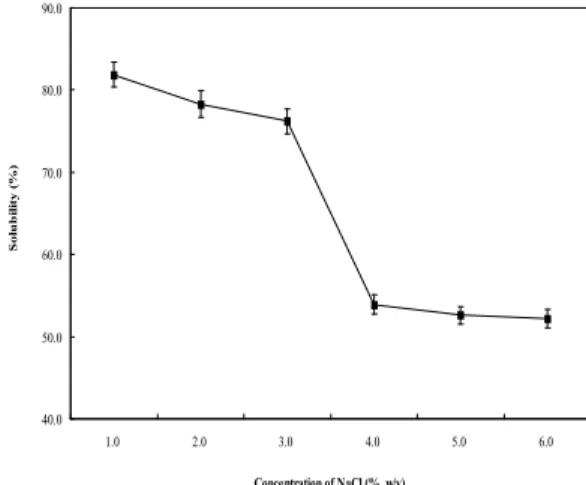
The effect of NaCl concentrations on SO of collagen extracted from skate skin is shown in Fig. 1. The SO of skate skin collagen in 0.5 M acetic acid of collagens was slowly decreased in the presence of NaCl up to 3.0%. A sharp decrease in SO was observed with NaCl concentration above 3.0%. A slight decrease in SO was also observed with further increase in NaCl concentration between 5.0 and 6.0%
(Fig. 1). The SO of collagens from the skin of trout, hake, bigeye snapper (Priacanthus tayenus), and bigeye snapper (P. marcracanthus) in acetic acid solution generally decreased with increasing NaCl concentrations (23, 3, 24, 25). The decrease in SO of collagens might be due to the salting out phenomenon which occurred at relatively low NaCl concentrations (26). An increase in ionic strength causes a reduction in protein SO by an enhanced hydrophobic- hydrophobic interaction between protein chains and aggregation, and the competing for water of ionic salts,
leading to the induced protein precipitation (27). Pepsin soluble collagens (PSC) generally had higher SO than acid soluble collagens (ASC) at the same NaCl concentration.
This might be due to the partial hydrolysis of high molecular weight cross-linked molecules by pepsin (28). In addition, the differences in compositions and molecular species between ASC and PSC fractions might result in such different characteristics. Our result indicated that collagen fraction was still more than 50% soluble in the presence of NaCl up to 6.0%. The SO is one of the most important physicochemical and functional properties of proteins. A low SO may cause an unattractive appearance and a sandy mouthfeel of the final product (29). Soy protein concentrate was markedly less soluble than the hydrolysates, having only 20% SO. Our result indicated that a high SO of skate skin collagen may have many potential applications in formulated food systems. A previous study indicated that collagen SO of hake (Merluccius L.) was higher in skin collagen (93.1%) than in muscle collagen (74.4%) (28). The difference in SO might be due to a difference in age of fish, fish species, and/or different methodology (30).
40.0 50.0 60.0 70.0 80.0 90.0
1.0 2.0 3.0 4.0 5.0 6.0
Concentration of NaCl (%, w/v)
Solubility (%)
Fig. 1. Solubility of collagen solution from skate skin in 0.5 M acetic acid with different NaCl concentrations.
Values represent means of 3 replications ± standard deviations.
Oil holding capacity (OHC)
The OHC of collagen from skate skin was 15.4 ± 0.41%
(Table 2). The OHC is an important functional characteristic that influences the taste of a product (31). The OHC may help enhance sensory properties, such as flavor retention and mouth-feel. It is also significantly correlated with bulk density (32), and important characteristic that influences flow property and dispersibility. The OHC is attributed to physical entrapment of the oil, and the higher bulk density of the protein, the greater the OHC (32). Our previous report
indicated that OHC of acid whey powder was 27.4% (15).
The OHC of the other proteins were acid-soluble collagen from refiner discharge (7.75 mL/g) (22), soy protein isolate (2 to 10 mL/g) (33), and Atlantic salmon muscle hydrolysates (2.86 to 7.07 mL/g) (34). A previous report indicated that OHC of partially purified collagen (PPC) from refiner discharge (7.75 mL/g) was lower than that of acid-soluble collagen (ASC) from refiner discharge. This difference in OHC might be due to the presence of elastin in PPC and a difference in a ratio intermolecular cross-linking, such as hydroxylation of proline (35).
Table 2. Oil-holding capacity and water-holding capacity of collagen extracted from skate skin1)
Oil-holding capacity (%) Water-holding capacity (%)
15.4 ± 0.41 87.9 ± 0.36
1)Values represent means of 3 replications ± standard deviations.
Water holding capacity (WHC)
The WHC test is to measure the ability of the protein to imbibe and retain water against gravitational force within a protein matrix (34). The effect of neutral pH 7.0 on WHC of collagen from skate skin is shown in Table 2. The WHC of skate skin collagen was 87.9 ± 0.36% at neutral pH.
The WHC of collagen was still retained of 88.0% of entrapped water after 10 min centrifugation at 1,000 x g. Our previous report indicated that WHC of acid whey powder was 86.0%
(16). The WHC found in present study was lower than that reported by Montero et al. (1999) (24), who examined the WHC (about 120.0%) of hake (Merluccius merluccius L.) skin collagen at pH 3.0. The hake (Merluccius merluccius L.) skin collagen had maximum WHC at pH reached to 3.0 and decreased pH levels ranging from 4.0 to7.0 (24). The WHC could be affected by water physically entrapped within unfolding proteins and depends on the degrees of denaturation (36). The water holding properties of protein is therefore conceivably related to its swelling which would impact SO, viscosity and gelation. The WHC is also an important functional characteristic that influences the taste of products and may help enhance sensory properties, such as flavor retention and mouth-feel (31). It is also significantly correlated with bulk density (32) and an important characteristic that influences flow property and dispersibility.
The WHC of the other proteins were acid-soluble collagens from refiner discharge (8.58 mL/g) (22) and soy protein isolate (3 to 8 mL/g) (33). This difference may be due to the high swelling ability of collagen (37) along with the differences
of size, shape, hydrophilic-hydrophobic balance of amino acids in the protein molecule and the physicochemical environment such as pH, ionic strength, and temperature (35).
Turbidity
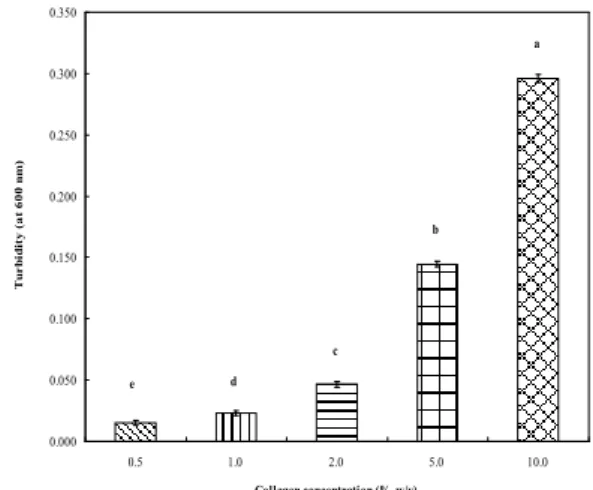
Turbidity of skate skin collagen dispersion at different concentrations in DW is determined (Fig. 2). Turbidity increased with concentration for collagen dispersions increased (Fig. 2). Turbidity of collagen extracted from skate skin was considerably low value of 0.298 ± 0.04 at 10%
collagen dispersion (Fig. 2). Turbidity or dispersion opacity value reflects concentration of residual lipid and other colloidal material that were present in collagen. The total fat content of skate skin collagen was 0.35 ± 0.05, as determined immediately after preparation of the lyophilized powder from freshly separated collagen. Turbidity values are largely dependent on efficiency of the clarification (filtration) process. Lower turbidity of collagens indicates greater dispersibility. Heating the collagen dispersion at 60℃ for 30 min might be increased turbidity due to protein aggregation (4). Residual lipid in collagen has been recognized as being detrimentally impacted emulsifying and foaming properties and flavor qualities. Therefore, removal of residual lipids from collagen resulted in improves functionalities such as emulsifying and foaming properties.
0.000 0.050 0.100 0.150 0.200 0.250 0.300 0.350
0.5 1.0 2.0 5.0 10.0
Collagen concentration (%, w/v)
Turbidity (at 600 nm)
a
b
c e d
Fig. 2. Turbidity of collagen powder (2%, w/v) from skate skin at different NaCl concentrations in distilled water.
Dissimilar letters above bars indicate significant difference (p<0.05).
Emulsifying properties Emulsion activity (EA)
The skate skin collagen had the lowest EA at pH 7.0 (pI region of collagen), followed by 9.0 (Table 3). The EA increased at pHs values above or below this region. Our results disagreed with previous study reported that EA and emulsion
stability (ES) of filefish and cod skin collagen was higher in alkali pH regions than acidic pH regions (38). The lowest EA at pH 7.0 may be due to increased protein-protein interaction resulting in low surface hydrophobicity and decreased net charge, and solubility of proteins. There was significant difference in EA at different pH values (p<0.05).
The EA is based on the proteins ability to adsorb, spread and stabilize the oil/water interface. The EA and ES of proteins correlated linearly with surface hydrophobicity (15).
Protein SO also plays an important role in emulsification because rapid migration to and adsorption at the interface are critical (39). Many factors such as hydrophilic- hydrophobic balance, protein concentration, temperature, and pH affect formation and properties of protein gels (40).
Hydrophobic bond is contributed to ES of protein-lipid complex. Heat induced covalent interaction and tenacious aggregation conceivably reduced EA.
Table 3. Emulsifying properties of collagen extracted from skate skin1)
pH
1.0 3.0 5.0 7.0 9.0
EA 0.482±0.05ab 0.489±0.04a 0.492±0.08a 0.437±0.04c 0.462±0.04b CS 75.4±0.41a 74.8±0.39ab 74.0±0.36ab 70.5±0.38c 73.0±0.36b
1)Values represent means of 3 replications ± standard deviations.
Abbreviations EA and CS represent emulsion activity and creaming stability, respectively.
a-cmeans within the same row with different superscripts are significantly different (p<0.05) among pH values.
Creaming stability (CS)
The emulsion creaming stability (CS) of the collagen powder, expressed as stability rating (SR), is shown in Table 3. Variation in CS with pH follows a similar pattern to that of EA. The CS was least at pH 7.0 and the alteration of pH from 7.0 to 5.0, 3.0, 1.0, and 9.0 increased the CS. These results suggested that the CS of the emulsion strongly depends on the electrostatic nature of collagen protein (16). There was significant difference in CS at different pH values (p<0.05). At pH 7.0, which is close to the isoelectric pHs of collagen proteins, the net charges of proteins are diminished and repulsive forces among the molecules are eliminated.
Gelling properties Viscosity
The effects of pH variations on viscosity in DW are shown in Fig. 3. The viscosity of collagen was highest (4.02 cP) at pH 3.0 and decreased up to pH 7.0 (2.78 cP), and increased
thereafter (3.08 cP). It was probably due to the increase in charge repulsion at the side chain residues protein became protonated. Viscosity is the main factor that affects physicochemical and functional properties of a collagen and gelatin. The viscosity of collagen from skate skins with at different pH levels was small (p<0.05) (Fig. 3). There was little, though in some cases significant, difference in the viscosity, which varied from 4.02 to 2.78 cP for pH 3.0 and pH 7.0, respectively (Fig. 3). Viscosity of skate skin collagen was less compared with collagen from squid skins (42).
Viscosity is partially controlled by molecular weight and molecular size distribution rather than the amino acid composition of the collagen (43). Our results agreed with previous study that reported that viscosity of filefish and cod skin collagen was lowest at pH 7.0 (38) and minimum collagen viscosity observed at pH values of 6.0-8.0 (44). A previous study indicated that apparent viscosity decreased progressive pH ranging from 1.0 to 7.0 for collagen from hake skin except for pH 3.0 (24). Collagens have a minimum viscosity at the pI range. Thus, the viscosity improved when acid soluble collagen was adjusted to pH values of 2.0-3.0. A previous report indicated that megrim skin collagen showed higher viscosity at 25℃ compared to 40 and 60℃ (4). The high viscosity can be accounted for by the high proportion of β- and γ-chains, resulting in a higher average molecular weight (45).
2.00 2.50 3.00 3.50 4.00 4.50
1.0 3.0 5.0 7.0 9.0
pH
Viscosity (cP)
a
b
bc
c
d
Fig. 3. Viscosity of collagen powder (10%, w/v) at different pH levels in distilled water.
Dissimilar letters above bars indicate significant difference (p<0.05).
Gel strength (GS)
The GS of collagen extracted from skate skin at different pH levels is shown in Fig. 4. The GS of collagen was highest (163.4.1 g) at pH 6.0 and decreased at pH values above or below this region. This might be because the molecular weight
decreased slowly in the neutral region compared with alkali and acid conditions (46). It was probably due to the increase in charge repulsion at the side chain residues protein became protonated. The gel strength is a measure of the hardness, stiffness, strength, firmness, and compressibility of the gel at a particular temperature and is influenced by concentration and molecular weight (47). The GS is related to its imino acid and glycine content, and gelatins derived from fish collagens are weak with low melting points, compare with mammalian collagens. The low GS of skate skin collagens may be due to the lower amino acid (proline and glycine) concentrations compared with other fish and mammals (48).
Hydroxyproline content is important for some functional properties of collagen-derived gelatins. Rheological properties and gel strength of gelatin also increased as the amount of hydroxyproline increases (49).
100 110 120 130 140 150 160 170 180
1.0 3.0 5.0 6.0 7.0 9.0
pH
Gel strength (g)
a
b
b b
c d
Fig. 4. Gel strength of collagen powder (10%, w/v) at different pH levels in distilled water.
Dissimilar letters above bars indicate significant difference (p<0.05).
Previous report also suggested that the gel strength is dependent on the isoelectric point (pI) and it can be controlled by adjusting the pH (50). Gelation occurs when native globular collagen proteins are denatured (unfolded) in the presence of heat. Generally, gels formed with heating at low pH (6.0) are more coagulated and less elastic than gels formed at pH 7.0 to 9.0. More compact and stiffer gels can be formed by adjusting the pH of the gelatin close to its pI, where the proteins will be more neutral and thus the gelatin polymers are closer to each other. The pI region of collagen is pH values of 6.0-9.0 (51). Gelation property is one of the numerous desirable functional attributes of food proteins. The denatured proteins aggregate and form three-dimensional matrices that entrap and hold water to produce the gel. Many
factors such as temperature, protein concentration, pH, salt concentration, calcium concentration, ionic strength, and free sulfhydryl concentration affect formation and properties of protein gels (40). Solution pH dramatically affects heat induced collagen powder gelation. However, pH effects are interrelated with other compositional factors.
Summary
Effect of pH and the presence of NaCl on physicochemical and functional properties of collagen from skate (Raja Kenojei) skin were determined. Various physicochemical and functional properties such as solubility, turbidity, water- holding capacity and oil-holding capacity, emulsifying and foaming properties, and gelling properties (viscosity and gel strength) of collage from skin are analyzed in terms of pH and NaCl concentration in the medium. Skate skin collagen had similar physicochemical and functional properties compared to other marine fish skin collagens. Emulsion activity, creaming stability, and viscosity were lowest at where pH levels were isoelectric point regions of collagens.
However, the higher pH values at 7.0-9.0 caused increasing foam expansion, foam viscosity, and gel strength. The skate skin collagen was better in terms of the solubility, oil-holding capacity, and water-holding capacity than other fish skin collagens. The emulsifying properties and foaming properties were comparable to other collagens. Skate skin, which is presently considered to be a waste product, could be effectively used as a natural gelatin and collagen sources.
Related study addresses the effect of processing conditions on physicochemical and functional properties of collagen powder from skate (Raja Kenojei) skins (53).
Acknowledgement
This study was supported by Korea Research Foundation.
It was also partially supported by Institute of Agricultural Science and Technology of Chonnam National University.
References
1. Liu, H.Y., Ding, L. and Guo, S.D. (2007) Studies on collagen from the skin of channel catfish (Ictalurus punctaus). Food Chem., 101, 621-625
2. Woo, J.W., Yu, S.J., Cho, S.M., Lee, Y.B. and Kim, S.B. (2008) Extraction optimization and properties of
collagen from yellowfin tuna (Thunnus albacares) dorsal skin. Food Hydrocolloid, 22, 879–887
3. Jongjareonrak, A., Benjakul, S., Visessanguan, W. and Tanaka, M. (2005) Isolation and characterization of collagen from bigeye snapper (Priacanthus macracanthus) skin. J. Sci. Food Agric., 85, 1203-1210
4. Montero, P. and Gomez-Guillen, M.C. (2000) Extracting conditions for Megrim (Lepidorhombus boscii) skin collagen affect functional properties of the resulting gelatin. J. Food Sci., 65, 434-438
5. Cho, S.M., Gub, Y.S. and Kim, S.B. (2005) Extracting optimization and physical properties of yellowfin tuna (Thunnus albacares) skin gelatin compared to mammalian gelatins. Food Hydrocolloid, 19, 221-229 6. Muyonga, J.H., Cole, C.G.B, Duodub, K.G. (2004)
Extraction and physicochemical characterisation of Nileperch (Lates niloticus) skin and bone gelatin. Food Hydrocolloid, 18, 581-592
7. Gimenez, B., Turnay, J., Lizarbe, M.A., Montero, P. and Gomez-Guillen, M.C. (2005) Use of lactic acid for extraction of fish skin gelatin. Food Hydrocolloid, 19, 941-950
8. Nalinanon, S., Bebjakul, S., Visessanguan, W. and Kishimura, H. (2007) Use of pepsin for collagen extraction from the skin of bigeye snapper (Priacanthus tayenus). Food Chem., 104, 593-601
9. Sadowska, M., Kolodziejska, I. and Niecikowska, C.
(2003) Isolation of collagen from skins. Food Chem., 105, 1302-1306
10. Skierka, E. and Sadowska, M. (2007) Food Chem., 105, 1302-1306
11. Nagai, T. and Suzuki, N. (2000) Isolation of collagen from fish waste material skin, bone and fins. Food Chem., 68, 277-281
12. Nagai, T., Araki, Y. and Suzuki, N. (2002a) Collagen of the skin of ocellate puffer fish (Takifugu rubripes).
Food Chem., 78, 173-177
13. Nagai, T. and Suzuki, N. (2002b) Preparation and partial characterization of collagen from paper nautilus (Argonauta argo, Linnaeus) outer skin. Food Chem., 76, 149-153
14. A.O.A.C. (1995) Official methods of analysis. 15th ed., Association of Official Analytical Chemists, Washington, D.C, USA
15. Shon, J. and Haque Z.U (2007a) Functional attributes of native and thermized sour and sweet whey. Int. J.
Dairy Technol., 60, 135-142
16. Shon, J., Lee, S.H., Lee, F.Z., Lee, B.D. and Eun, J.B.
(2007b) The effect of heating on the physicochemical and functional properties of acid whey compared to sweet whey. Food Sci. Biotechnol., 16: 836-842
17. Pearce, K.N. and Kinsella, J.E. (1978) Emulsifying properties of proteins: evaluation of a turbidimetric technique. J. Agric. Food Chem., 26., 716-723 18. SAS (2001) SAS User’s Guide, SAS Companion for the
Microsoft Windows Environment (Version 8.1).
Statistical Analysis Systems Institute, Cary, NC, USA 19. Kittiphattanabawon, P., Benjakul, S., Visessanguan, W., Kishimura, H. and Shahidi, F. (2010a) Isolation and characterisation of collagen from the skin of brownbanded bamboo shark (Chiloscyllium punctatum).
Food Chem., 119, 1519-1526
20. Kittiphattanabawon, P., Benjakul, S., Visessanguan, W.
and Shahidi, F. (2010b) Isolation and properties of acid- and pepsin-soluble collagen from the skin of blacktip shark (Carcharhinus limbatus). Eur. Food Res. Technol., 230, 475-483
21. Senaratne, L.S., Park, P.J. and Kim, S.K. (2006) Isolation and characterization of collagen from brown backed toadfish (Lagocephalus gloveri) skin. Bioresource Technol., 197, 19-197
22. Kim, J.S. and Park, J.W. (2005) Partially purified collagen from refiner discharge of pacific whiting surimi processing. J. Food Sci., 70, C511-C516
23. Kittiphattanabawon, P., Benjakul, S., Visessanguan, W., Nagai, T. and Tanaka, M. (2005) Characterisation of acid-soluble collagen from skin and bone of bigeye snapper (Priacanthus tayenus). Food Chem., 89, 363-372 24. Montero, P., Gomez-Guillen, M.C. and Borderias, A.J.
(1999) Functional characterization of muscle and skin collagenous material from hake (Merluccius merluccius L.). Food Chem., 65, 55-59
25. Montero, P., Jimennez-Colmenero, F. and Borderias, J.
(1991) Effect of pH and the presence of NaCl on some hydration properties of collagenous material from trout (Salmo irideusGibb) muscle and skin. J. Sci. Food Agric., 54, 137-146
26. Asghar, A. and Henrickson, R.L. (1982) Chemical, biochemical, functional and nutritional characteristics of collagen in food system. In: Advances in food research, Chichester, C.O., Mrata, E.M. and Schweigert B.S.
(Editor), Academic Press, London, UK. Vol. 28.
p.237-273
27. Damodaran, S. (1996) Amino acids, peptides, and
proteins. In: Fennema, O.R. (Editor), Food Chemistry, Marcel Dekker, New York, NY, USA. p.321-429 28. Montero, P., Borderias, J., Turnay, J. and Leyzarbe, M.A.
(1990) Characterization of hake (Merluccius merluccius L.) and trout (Salmoirideus Gibb) collagen. J. Agric. Food Chem., 38, 604-609
29. Petersen, B.R. (1981) The impact of the enzymatic hydrolysis process on recovery and use of proteins. In:
Enzymes and Food Processing. Elsevier Applied Science Publishers, London, UK. p.149-175
30. Sikorski, Z.W. and Borderias, J. (1994) Collagen in the muscles and skin of marine animals. In: Seafood proteins, Sikorski, Z.W., Pan, B.S. and Shahide, F. (Editor), Chapman and Hall, New York, NY, USA. p.58-70 31. Haque, Z.U. (1993) Influence of milk peptides in
determining the functionality of milk proteins: A review.
J. Dairy Sci., 76, 311-320
32. Jelen, P. (1973) Whipping studies with partially delactosed cheese whey. J. Dairy Sci., 56, 1505 33. Yim, M.H. and Lee, J.H. (2000) Functional properties
of fractionated soy protein isolates by proteases from meju. Food Sci. Biotechnol., 9, 253-257
34. Kristinsson, H.G. and Rasco, B.A. (2000) Biochemical and functional properties of Atlantic salmon (Salmo salar) muscle proteins hydrolyzed with various alkaline proteases. J. Agric. Food Chem., 48, 657-66
35. Sathe, S.K. and Salunkhe, D.K. (1981) Functional properties of the Great Northern Bean (Phaseolus vulgaris L.) proteins: emulsioning, foaming, viscosity, and gelation properties. J. Food Sci., 46, 71-74 36. Fiora, F.A., Pilosof, A.M.R. and Bartholomai, G.B.
(1990) Physicochemical properties of soybean proteins related to flow, viscoelastic, mechanical and water- holding characteristics of gels. J. Food Sci., 55, 133-136 37. Sadowska, M. and Rudzki, J. (1987) The chemical and functional properties of meat collagen. Lebnsm-Wiss Technol., 20, 171-173
38. Kim, S.K., Kang, O.J. and Kwak, D.C. (1993) Physicochemical characteristics of filefish and cod skin collagen. J. Korean Agric. Chem. Soc., 36, 163-171 39. Chobert, J.M., Bertrand-Harb, C. and Nicolas, M.G.
(1988) Solubility and emulsifying properties of caseins and whey proteins modified enzymatically by trypsin.
J. Agric. Food Chem., 36, 883-892
40. Mangino, M.E. (1984) Physicochemical aspects of whey protein functionality. J. Dairy Sci., 67, 2711-2722 41. Kinsella, J.E. (1981) Functional properties of proteins:
Possible relationships between structure and function in foams. Food Chem., 7, 273-288
42. Kolodziejska, I., Sikorski, Z.E. and Niecikowska, C.
(1999) Parameters affecting the isolation of collagen from squid (Illex argentinus) skins. Food Chem., 66, 153-157 43. Sperling, L.H. (1985) Introduction to physical polymer science. John Wiley and Sons, New York, NY, USA 44. Stainsby, G. (1952) Viscosity of diluted gelatin solutions.
Nature, 169, 662-665
45. Ogawa, M., Portier, R.J., Moody, M.W., Bell, J., Schexnayder, M.A. and Losso, J.N. (2004) Biochemical properties of bone and scale collagens isolated from the subtropical fish black drum (Pogonia cromis) and sheepshead seabream (Archosargus probatocephalus).
Food Chem., 88, 495-501
46. Grossman, S. and Bergman, M. (1992) Process for the production of gelatin from fish skin. USA. Patent No.
5, 093,474
47. Ockerman, H.W. and Hansen, C.L. (1988) Glue and gelatin. In: Animal by-product processing. Ellis Horwood Ltd., Chichester, England
48. Cho, S.H., Jahncke, M.L. and Eun J.B. (2004) Nutritional composition and microflora of the fresh and fermented skate (Raja Kenojei) skins. Int. J. Food Sci. Nutr., 55, 45-51
49. Gilsenan, P.M. and Ross-Murphy, S.B. (2000) Rheological characterization of gelatins from mammalian and marine sources. Food Hydrocolloid, 14, 191-195
50. Gudmunsson, M. and Hafsteinsson, H. (1997) Gelatin from cod skin as affected by chemical treatments. J. Food Sci., 62, 37-39
51. Foegeding, E., Lanier, T.C. and Hultin, H.O. (1996) Characteristics of edible muscle tissue. In: Food Chemistry, Fennema, O.R. (Editor), Marcel Dekker, New York, NY, USA. p.879-942
52. Shon, J. and Eun, J.B. (2010). The effect of processing conditions on functional properties of collagen powder from skate (Raja Kenojei) skins. Food Sci. Biotechnol., Submitted
(접수 2010년 2월 3일, 수정 2010년 6월 1일, 채택 2010년 6월 4일)