서 론
생태계 교란종으로 지정된 배스(환경부, 1998년)는 우 리나라의 하천 및 호수생태계에서 급격하게 증가하여 생
태계 먹이연쇄(Food chain)에 큰 영향을 끼치는 것으로 보고되고 있다(NIER, 2011). 북미가 원산지인 배스는 호 수 및 흐름이 느린 정체성 수역에서 주로 서식하는 대형 육식어종으로서 포식압(Predation pressure)이 매우 강해 어류, 양서류, 갑각류 등 다양한 먹이를 섭식하며, 최대
10만개 이상 산란하여 증식력이 높다(Wheeler and Allen, 2003; Hill and Cichra, 2005; Almeida et al., 2012).
배스의 강한 포식성 및 확산에 의한 생태계 교란 사
─ 541 ─
국내 중대형 인공호에서 외래종인 배스(Micropterus salmoides)의 분포 특성 및 서식지의 이화학적 수질
김현맥1,2・길지현2・이의행3・안광국1,
*
1충남대학교 생명시스템과학대학 생물과학과, 2국립환경과학원 자연평가연구팀,
3한국농어촌공사 농어촌연구원
Distribution Characteristics of Largemouth Bass (Micropterus salmoides) as an Exotic Species, in Some Medium-to-Large Size Korean Reservoirs and Physico-chemical Water Quality in the Habitats.
Kim, Hyun-Mac
1,2, Ji-Hyon Kil
2, Eui-Haeng Lee
3and Kwang-Guk An
1,* (
1Department of Biological Science, College of Biological Sciences and Biotechnology, Chungnam National University, Daejeon 305-764, Korea;
2Ecosystem Assessment Division, National Institute of Environmental Research, Inchon 404-708, Korea;
3Rural Research Institute, Korea Rural Community Corporation, Ansan 462- 908, Korea)
Abstract The objective of this study was to understand the distribution characteristics of largemouth bass as an exotic species in relation to water chemistry. The survey was conducted in 10 reservoirs in Korea that showed different properties in size, location and eutrophic state. Total number of fish species observed in the artificial reservoirs was 52 (13 family) and the relative abundance of the bass was 13% of the total, which is the third dominant species in the whole sample. The relative abundance of bass was the highest in the Pyungtak reservoir (60%), whereas the Daechung reservoir showed the lowest abundance (only 3%). Although no significance difference statistically were founded in the relationship between bass abundance and water quality parameters. The reservoir trophic state showed some relationships. As result, the higher abundance was observed in hypertrophic reservoirs that located in the esturine regions compared to other large and medium reservoirs classified as meso- or eutrphic state. In conclusion, bass distribution in the reservoir ecosystem can not be directly explained by water chemistry only but other environmental factors should be considered.
Key words: Micropterus salmoides, exotic species, trophic state, nutrient, reservoir
ⓒ The Korean Society of Limnology. All rights reserved.
This is an open-access article distributed under the terms of the Creative Commons Attribution Non-Commercial License (http://creativecommons.org/licenses/by-nc/3.0/), which permits unrestricted non-commercial use, distribution, and reproduction in any medium, provide the original work is properly cited.
Manuscript received 6 November 2013, revised 15 November 2013, revision accepted 18 November 2013
* Corresponding author: Tel: +82-42-821-6408, Fax: +82-42-821-9690, E-mail: [email protected]
례들은 전세계적으로 많은 국가들에서 보고되고 있다.
과테말라의 아틸란호수에서는 배스의 도입으로 대부분 의 토착어종들이 사라진 사례가 있으며(Zaret and Paine,
1973), 남아프리카에서는 3종의 토착어종이 멸종하였다 (Brown et al., 2009). 쿠바에서는 배스 도입에 의해 토착
어류의 개체수가 현저히 감소하였으며, 어류의 개체군 감 소는 말라리아 모기의 증가를 가져와 주민의 말라리아 감염율이 크게 증가하였다(Lasenby and Kerr, 2000). 이 러한 배스에 의한 생태계 교란은 캐나다, 일본, 유럽 등 세계 각국에서 보고되고 있으며(Lasenby and Kerr, 2000;Yasunori and Tadashi, 2003; Wasserman et al., 2011;
Almeida et al., 2012), 원산지인 미국 내에서도 원서식지
가 아닌 지역으로 확산되어 생태계교란 사례가 발생하고 있다(Findlay et al., 2000; Brown et al., 2009). 우리나라 의 배스는 식량자원 확보 및 자원조성을 목적으로 1973 년도에 미국 루지애나 주로부터 수산청에 의해 최초 도 입되었다. 1973년 토교지, 1975년 조종천, 1976년 팔당 호 등에 방류되었으며, 현재는 전국의 하천 및 댐에 적 응하며 빠르게 확산되었다(Lee et al., 2009).원서식지인 북미에서 배스는 작은입배스에 비해 부영 양호에 서식하고 있는 것으로 알려져 있으나 (Bowman,
1994; Lasenby and Kerr, 2000), 수질이 악화된 지역에
서 배스의 생존율이 낮게 나타나기도 한다. Tucker etal. (2000)은 수질환경이 악화된 지역의 당년생 배스의
겨울철 생존율이 수질이 양호한 지역에 비해 90%가 낮 게 나타난 사례를 보고하였다. 또한 Stuber et al. (1982) 은 배스가 용존산소 1 mg L-1이하의 조건에서는 치명 적인 영향을 받으며, pH 5.0 이하의 조건에서는 산란하 지 않고, 100 ppm 이상의 탁도가 유지되는 지역에서는 당년생 배스가 확인되지 않는 것으로 보고하였다. 국내 의 배스 관련 연구로는 군집의 종간 유연관계에 관련한 연구 (Hong and Son, 2003), 식이물 (Ko et al., 2008; Leeet al., 2009)
및 유전다양성에 관련한 연구 (Lee et al.,2008)들에 대한 보고만이 존재하여 기초적 생태연구가
절실한 상황이다. 특히 배스는 수중 내에서 개체군이 조 절 될 수 있는 천적집단이 부족하여 지속적인 개체군 증가가 예상되고 있으며 이에 대한 개체군 조절방안이 요구되고 있다(Hong and Son, 2008).배스가 서식하는 우리나라의 대부분 호수는 인위적으 로 축조된 인공호로서, 자연호에 비하여 시공간적인 수 질변동이 크며(Wetzel, 1990; Han et al., 2010), 몬순 시 기의 집중강우에 따라 역동적으로 영향을 받는다(An et
al., 2001). 특히 하절기 집중강우에는 유입 수계로부터
비점오염원의 무기성 부유물과 영양염류 등의 유입이증가하며 (An and Shin, 2005) 이러한 질소 (N)와 인 (P) 등 무기 영양염류의 증가는 조류의 유기물 광합성을 증 가시켜 어류의 먹이연쇄 과정에 직접적으로 영향을 주 는 것으로 알려져 있다 (Welch and Lindell, 1992; Gray
et al., 2002).
본 연구에서는 우리나라 인공호의 크기 및 부영양 상 태(Trophic state)가 다른 10개 호수를 대상으로 계절적 이∙화학적 수질 변이 특성을 분석하고, 배스의 서식에 미치는 상대적 영향을 분석하여 국내에서 침입성 외래 어종으로 분류되고 있는 배스의 개체군 조절관리방안 수립을 위한 기초자료로 활용하고자 하였다.
재료 및 방법
1.
조사 기간 및 조사 지점본 연구에서는 전국에 분포하는 10개 인공호를 선정 하였으며, 2011년 몬순강우 전기 (Premonsoon) 및 강우 후기(Postmonsoon)에 각각 현장에서 어류 조사를 실시 하였다. 조사 시기는 수온이 상승하여 어류의 활동이 활 발하고, 아시아 몬순장마에 의한 집중호우의 영향이 적 은 4월~5월기인 강우전기 및 9월~10월의 강우후기에 채집하였다. 우리나라의 10개 인공호 및 세부 조사지점 현황은 아래와 같다.
[대상 인공호 및 세부조사지점]
충주호 (CjR) : S1 충주시 종민동, S2 제천시 한수면 탄 지리, S3 제천시 한수면 상노리
대청호 (DcR) : S1 대전시 동구 대청동, S2 옥천군 동이 면 석탄리, S3 옥천군 동이면 석탄리
안동호 (AdR) : S1 안동시 와룡면 라소리, S2 안동시 도 산면 서부리, S3 안동시 와룡면 오천리
파로호(PrR) : S1 양구군 양구읍 하리, S2 양구군 양구읍 월명리, S3 화천군 간동면 구만리
춘천호 (CcR) : S1 화천군 화천읍 하리, S2 화천군 하남 면 서오지리, S3 춘천시 서면 오월리
팔당호 (PdR) : S1 광주시 퇴촌면 도마리, S2 광주시 남 종면 분원리, S3 남양주시 조안면 진중리
장성호(JsR) : S1 장성군 북하면 덕재리, S2 장성군 북하 면 쌍웅리, S3 장성군 북하면 덕재리
평택호(PtR) : S1 평택시 현덕면 권관리, S2 아산시 영인 면 구성리, S3 평택시 오성면 당거리
낙동강하류(NdR) : S1 부산시 강서구 봉림동, S2 부산시 사하구 하단동, S3 부산시 강서구 죽림동
충주호와 대청호, 안동호, 파로호는 저수용량 10억t 이 상의 대형 댐호이며, 춘천호, 팔당호, 장성호는 비교적 저수용량이 적은 중소형 댐호이다. 낙동강하류와 평택 호, 주남저수지는 하구역에 위치하고 있다.
2.
조사방법 및 분석 항목어류의 채집 도구로는 투망 (Casting net, 망목 7×7
mm), 족대 (Kick net, 망목 4×4 mm), 정치망 (Fyke net,
망목 5×5 mm, 높이 2.4 m, 길이 20 m, 외통발)을 이용하 였으며, 투망과 족대는 60분 조사를 원칙으로 하였고, 정 치망은 24시간 동안 설치한 후 어획물을 수거하였다. 각 지점에서 채집된 어류는 현장에서 Kim and Park (2002),Kim et al. (2005)에 의거해 동정하였으며, 외래어종을 제
외하고 방생하였다. 체장이 20 mm 이하의 동정이 불가 능한 치어의 경우 조사결과에서 제외하였으며 목록은Nelson (2006)의 분류체계를 따랐다. 이화학적 수질자료
는 환경부 물환경정보시스템의 자료를 사용하였으며,2009부터 2011년까지 총인 (Total phosphorous, TP), 총
질소(Total nitrogen, TN), 생물학적 산소요구량(Biologi-cal oxygen demand, BOD), 화학적 산소요구량 (Chemi- cal oxygen demand, COD) 등 14개 수질항목을 분석하
였다. 각 수질변수에 대한 상관관계를 파악한 후, 일원배 치 분산분석 (One way Analysis of Variance) 및 다중비 교분석 (Multiple Comparisons)을 실시하였다 (SPSS ver18).
결과 및 고찰
1.
조사지역의 이・화학적 수질 특성본 조사지역의 3년간의 이화학적수질을 분석한 결과 유기물 오염지표 및 염양염류 모두 하구역 댐에서 비교 적 높게 나타났으며, 조사 지역 중 평택호에서 수질이 가장 악화된 것으로 나타났다. 전체 조사지역에서 유기 물 오염의 지표가 되는 BOD와 COD는 각각 1.9±1.4
mg L
-1, 4.5±2.5 mg L
-1로 확인되었으며 TP와 TN은 각각 58±47μg L-1, 2.2±1.3 mg L
-1로 나타났다. 비교 적 수질환경이 양호한 지역은 안동호, 충주호, 파로호 등 으로 확인되었으며, 유기물 오염지표 및 염양염류 농도 가 모두 평택호 (BOD 4.2±3.1 mg L-1, COD 9.5±3.2 mg L
-1, TP 134.0±69.3
μg L-1, TN 5.6±2.0 mg L
-1)에
서 가장 높게 나타났다 (Fig. 1). Shin et al. (2003)은 평 택호가 유입하천(황구지천 등)의 부영양화로 수질이 악 화되어 있으며, 이는 하수처리수와 미처리된 생활하수의 지역적 영향이 큰 것으로 보고하였다. 본 연구의 다중비 교 결과 낙동강하류, 평택호, 주남저수지 등의 하류지역 저수지는 대형댐호와 중형댐호에 비해 악화된 수질 특 성을 나타냈다 (Table 1). Carlsen의 부영양화지수 (TSI) 분석에서도 평택호, 낙동강하류, 주남저수지는 부영양호
-
과영양호의 단계에 있는 것으로 확인되었으며, 대청호 와 팔당호도 부영양 상태에 있는 것으로 확인되었다.2.
어류분포 특성전체 10개 호수 어류조사결과 총 13과 52종 7,657개 체가 조사되었으며, 피라미, 참몰개, 누치, 블루길, 배스 등의 어류가 우점하고 있는 것으로 나타났다. 대청호, 안 동호 등의 대형댐호에서는 참몰개와 피라미가 우점하고 Fig. 1. Water chemistry of biological oxygen demand (BOD),
chemical oxygen demand (COD), total nitrogen (TN), and total phosphorus (TP) in the ten artificial reservoirs where fishes were sampled.
BOD(mg LCOD(mg L-1)TN(mg L-1)TP(μg L-1) 4.0 2.0 0.0 14.0 12.0 10.0 8.0 6.0 4.0 2.0 0.0 10.0 8.0 6.0 4.0 2.0 0.0 300 250 200 150 100 50 0
CjR DcR AdR PrR CcR PdR JsR PtR NdR JnR
있는 것으로 나타났으며, 중형호에서는 누치와 블루길이 우점하고 있는 것으로 조사되었다 (Table 2). 평택호, 낙 동강하류, 주남저수지 등의 하류지역에서는 배스와 블루 길에 의한 외래종 우점현상이 강하게 나타났다. 각 호수 별로는 상대적 수질 및 물리적서식지가 양호한 파로호
(24종)에서 가장 많은 종이 조사되었고, 특정 종이 대량
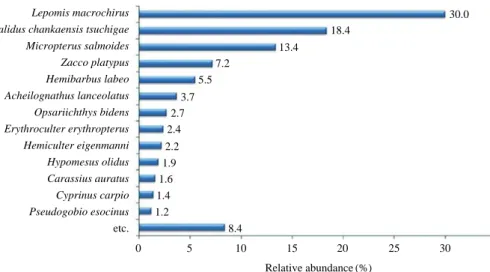
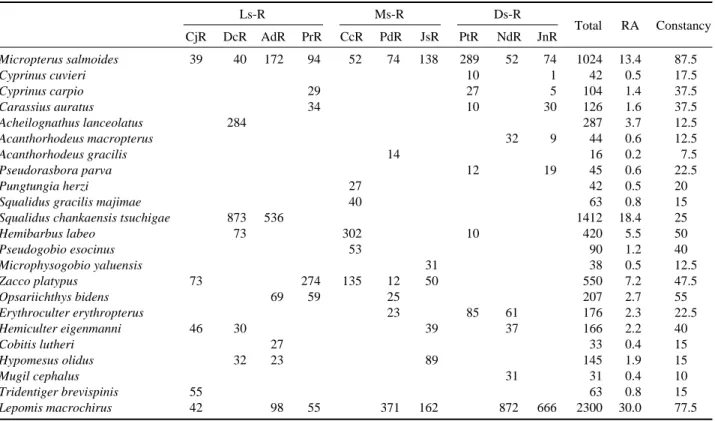
포획된 대청호에서 가장 많은 개체가 조사되었다. 전체 적으로 종별 상대풍부도는 외래어종인 블루길(30.0%)이 가장 높게 나타났고, 배스(13.4%)는 3번째로 높은 상대 풍부도를 나타냈다(Fig. 2). 각 조사지점에서의 출현여부 에 따라 산정되는 항존도는 배스 (87.5%), 블루길 (87.5%), 끄리 (55.0%), 누치 (50.0%), 피라미 (47.5%) 등의 순
으로 나타났다. 두 번째로 높은 상대풍부도를 나타낸 참 몰개는 1차 조사시 안동호와 대청호에서 대량 포획 되 었으며 일부 지점에서 높은 상대풍부도를 나타냈으나, 항존도는 25.0%로 상대적 낮게 나타났다.내성도 길드 분석 결과 팔당호, 평택호, 낙동강하구, 주남저수지에서는 95% 이상이 내성종이 조사되었으며, 민감종의 비율은 춘천호(6.0%)와 장성호(4.6%)에서 상 대적 높은 것으로 나타났다 (Fig. 3). 섭식길드 분석결과 충식종의 비율은 양호한 생태계에서 높게 나타나는 것 으로 알려져 있으나, 국내에서는 외래종인 블루길이 충
Table 1. The statistical differences of physico-chemical water quality, based on the one-way analysis of variance (ANOVA) in the three
types of the reservoirs.
Ls-R Ms-R Ds-R
F-statistics p-values
M (SD) M (SD) M (SD)
Temp. 12.9 (2.1)
A15.3 (1.5)
B17.0 (1.1)
B19.34 0.00**
pH 7.7 (0.3)
A8 (0.2)
B7.9 (0.2)
AB5.10 0.01*
DO mg L
-19.5 (0.9) 10.4 (1.4) 10.1 (0.7) 2.80 0.07
BOD mg L
-11.1 (0.5)
A1.3 (0.6)
A3.7 (1.1)
B40.83 0.00**
COD mg L
-12.6 (0.5)
A3.8 (1.0)
B8.2 (1.4)
C117.01 0.00**
SS mg L
-14.0 (1.4)
A6.5 (2.5)
A18.7 (7.1)
B36.28 0.00**
TN mg L
-11.7 (0.4)
A1.8 (0.6)
A3.3 (2.0)
B6.48 0.01*
NH
3-N mg L
-10.1 (0.04)
A0.1 (0.03)
A0.7 (0.63)
B12.01 0.00**
NO
3-N mg L
-11.2 (0.3) 1.2 (0.6) 1.7 (1.2) 1.40 0.28
TP
μg L-123.6 (5.4)
A48.5 (17.5)
A110.1 (50.8)
B23.87 0.00**
PO
4-P μg L
-16.9 (3.8)
A5.6 (4.3)
A47.8 (33.1)
B16.78 0.00**
Cond.
μS cm-1152.0 (39.2)
A123.0 (50.0)
A460.7 (192.1)
B28.15 0.00**
Chl-a
μgL-15.5 (4.6)
A12.1 (8.6)
A33.6 (24.3)
B10.99 0.00**
Ls-R==large-size reservoirs (CjR, DcR, AdR, PrR), Ms-R==Medium-size reservoirs (CcR, PdR, JsR), Ds-R==down-stream reservoirs (PtR, NdR, JnR);
Significant statistical differences (p⁄0.05): A⁄B⁄C
Table 2. Total number of species and the number of individuals from all fishes vs. the proportions (relative abundance, individuals) of Micropterus salmoides.
Reservoirs Total number of Total number of The proportion of Micropterus salmoides
species on all fishes individuals Individuals RA (%)
CjR 14 285 39 13.7
DcR 20 1470 40 2.7
AdR 22 1023 172 16.8
PrR 24 618 94 15.2
CcR 23 703 52 7.4
PdR 11 546 74 13.6
JsR 18 581 138 23.8
PtR 19 481 289 60.1
NdR 14 1146 52 4.5
JnR 7 804 74 9.2
Total 52 7657 1024 13.4
CjR==Chungju Reservoir, DcR==Daecheong Reservoir, AdR==Andong reservoir, PrR==Paro Reservoir, CcR==Chuncheon Reservoir, PdR==Paldang Reservoir, PtR==Pyeongtaek Reservoir, JsR==Jangseong Reservoir, NdR==Nakdong River Estuary, JnR==Junam Reservoir, RA==Relative abundance
식종으로 분류되어 있으며, 블루길이 확산된 지역에서 충식종의 비율이 높게 나타나므로 향후 섭식분석에서는 외래종의 포함여부에 관한 논의가 필요할 것으로 판단 된다.
3.
배스 분포 특성배스는 평택호 (60.1%)에서 가장 높은 상대풍부도를 나타냈으며, 다음으로는 장성호 (23.8%)에서 비교적 높
Fig. 2. The relative abundance of fish species dominated in the ten reservoirs.
Fig. 3. The relative comparisons of tolerance guilds (sensitive species, intermediate species, and tolerant species) and trophic guilds (insectivore species, omnivore species, and carnivoir species) in ten reservoirs.
Zacco platypus Hemibarbus labeo Acheilognathus lanceolatus Opsariichthys bidens Erythroculter erythropterus Hemiculter eigenmanni Hypomesus olidus Carassius auratus Cyprinus carpio Pseudogobio esocinus etc.
7.2 5.5 3.7 2.7 2.4 2.2 1.9 1.6 1.4 1.2
8.4
0 5 10 15 20 25 30 35
Relative abundance (%)
50 40 30 20 10 0
CjR DcR AdR PrR CcR PdR JsR PtR NdR JnR Total CjR DcR AdR PrR CcR PdR JsR PtR NdR JnR Total
CjR DcR AdR PrR CcR PdR JsR PtR NdR JnR Total
CjR DcR AdR PrR CcR PdR JsR PtR NdR JnR Total CjR DcR AdR PrR CcR PdR JsR PtR NdR JnR Total
CjR DcR AdR PrR CcR PdR JsR PtR NdR JnR Total
100 80 60 40 20 0 100 80 60 40 20 0 100 80 60 40 20 0 100
80 60 40 20 0 120 100 80 60 40 20 0
Sensitive species(%) Insectivore species(%)Omnivore species(%)Carnivore species(%)
Intermediate species(%)Tolerant species(%)
은 것으로 조사되었다. 안동호에서도 많은 개체가 포획 되었으나 종 다양도와 풍부도가 상대적으로 높아 상대 풍부도는 장성호보다 낮게 산정되었다. 2007년 평택호
의 어류상이 제시된 Kim et al. (2008)의 연구에서는 배 스의 상대풍부도가 9.5%로 나타나 본 조사와는 큰 차 이를 보였다. 이는 배스 증가에 의한 결과로 해석될 수
Table 3. The domininant species, relative abundance (RA), and constancy values (the number of site occurred/total number of sites) in
three types of the reservoirs.
Ls-R Ms-R Ds-R
CjR DcR AdR PrR CcR PdR JsR PtR NdR JnR Total RA Constancy
Micropterus salmoides 39 40 172 94 52 74 138 289 52 74 1024 13.4 87.5
Cyprinus cuvieri 10 1 42 0.5 17.5
Cyprinus carpio 29 27 5 104 1.4 37.5
Carassius auratus 34 10 30 126 1.6 37.5
Acheilognathus lanceolatus 284 287 3.7 12.5
Acanthorhodeus macropterus 32 9 44 0.6 12.5
Acanthorhodeus gracilis 14 16 0.2 7.5
Pseudorasbora parva 12 19 45 0.6 22.5
Pungtungia herzi 27 42 0.5 20
Squalidus gracilis majimae 40 63 0.8 15
Squalidus chankaensis tsuchigae 873 536 1412 18.4 25
Hemibarbus labeo 73 302 10 420 5.5 50
Pseudogobio esocinus 53 90 1.2 40
Microphysogobio yaluensis 31 38 0.5 12.5
Zacco platypus 73 274 135 12 50 550 7.2 47.5
Opsariichthys bidens 69 59 25 207 2.7 55
Erythroculter erythropterus 23 85 61 176 2.3 22.5
Hemiculter eigenmanni 46 30 39 37 166 2.2 40
Cobitis lutheri 27 33 0.4 15
Hypomesus olidus 32 23 89 145 1.9 15
Mugil cephalus 31 31 0.4 10
Tridentiger brevispinis 55 63 0.8 15
Lepomis macrochirus 42 98 55 371 162 872 666 2300 30.0 77.5
Ls-R==large-size reservoirs, Ms-R==Medium-size reservoirs, Ds-R==down-stream reservoirs; CjR==Chungju Reservoir, DcR==Daecheong Reservoir, AdR==Andong reservoir, PrR==Paro Reservoir, CcR==Chuncheon Reservoir, PdR==Paldang Reservoir, PtR==Pyeongtaek Reservoir, JsR==Jangseong Reservoir, NdR==Nakdong River Estuary, JnR==Junam Reservoir
Table 4. Correlation coefficients (r) of tolerance guilds (sensitive species, intermediate species, and tolerant species) in relation to the water quality parameters.
Sensitive Species (SS) Intermediate Species (IS) Tolerant Species (TS)
r (p-values) r (p-values) r (p-values)
pH
-0.18 (0.61) -0.58 (0.08)0.60 (0.07)
DO
-0.07 (0.84) -0.63* (0.05)0.64* (0.05)
BOD
-0.53 (0.11) -0.40 (0.26)0.44 (0.21)
COD
-0.40 (0.25) -0.48 (0.16)0.51 (0.13)
SS
-0.37 (0.29) -0.50 (0.14)0.53 (0.11)
TN
-0.37 (0.30) -0.35 (0.32)0.38 (0.28)
NH
3-N
-0.19 (0.60) -0.34 (0.34)0.36 (0.31)
NO
3-N
-0.45 (0.19) -0.22 (0.55)0.25 (0.48)
TP
-0.23 (0.52) -0.48 (0.16)0.50 (0.14)
PO
4-P
-0.39 (0.27) -0.37 (0.29)0.40 (0.25)
Cond.
-0.46 (0.18) -0.38 (0.27)0.42 (0.23)
Chl-a
-0.48 (0.16) -0.41 (0.24)0.44 (0.20)
TSI (Chl-a)
-0.63 (0.05) -0.33 (0.32)0.38 (0.27)
*Correlation is significant at the 0.05 level.
있으나, 어류조사 방법에 차이가 있어 상대적 비교는 어 렵다. 기존의 조사결과는 정치망에 의해만 어류조사가 이루어 졌기 때문에 배스의 상대풍부도는 일부 과소평 가 되었을 가능성이 높다. 각 호수에서 조사된 어종 중 상대풍부도가 높은 6종을 선별하였을 때 배스는 전체 조사지역에서 높은 상대풍부도를 나타내고 있는 것으로 나타나 가장 다양한 환경에서 서식하고 있는 것으로 나
타났다. 또한 항존도 분석에서도 배스는 가장 높게 나타 났으며, 가장 높은 상대풍부도를 나타낸 블루길도 높은 항존도를 나타냈다. 외래어종인 배스와 블루길이 토착어 종에 비해 월등히 많은 지역에서 확인되어 교란외래어 종의 확산은 빠른 것으로 판단된다. 배스는 정치망에 잘 포획되지 않는 특성이 있는 것으로 알려져 있으며, 본 조사에서도 정치망이 포함되어 있기 때문에 배스의 상
Fig. 4. Scatter plots of sensitive species and tolerant species against the water quality parameters of COD, TN, TP and TSI (Chl-a).
4 3 2 1 0
7 6 5 4 3 2 1 0
7 6 5 4 3 2 1 0
7 6 5 4 3 2 1 0
60 40 20 0
120 100 80 60 40 20 0
120 100 80 60 40 20 0
120 100 80 60 40 20 0
0 2 4 6 8 10
COD (mg L-1)
0 1 2 3 4 5 6
TN (mg L-1)
0 20 40 60 80 100 120 140
TP (μg L-1)
35 40 45 50 55 60 65 70
TSI (Chl-a)
35 40 45 50 55 60 65 70
TSI (Chl-a)
0 20 40 60 80 100 120 140
TP (μg L-1)
0 1 2 3 4 5 6
TN (mg L-1)
0 2 4 6 8 10
COD (mg L-1)
Sensitive speciesSensitive species(%)Sensitive species(%)Sensitive species(%) Tolerant speciesTolerant species(%)Tolerant species(%)Tolerant species(%)
대풍부도는 일부 과소평가되었을 가능성이 있다.
4.
수질특성과 어류군집 및 배스 관계 분석조사지역의 3년간의 이화학적수질 분석 결과와 어류 내성도 길드분석 결과를 상관분석 하였을 때, 대부분의 수질항목 및 TSI (Chl-a)는 내성도 길드분석 결과와 유 의한 상관관계를 나타내지 않았다 (Table 4). 하지만 각 수질항목 및 TSI (Chl-a)에 따른 내성도 길드의 비율 분 포는 삼각형 및 역삼각형의 형태를 나타냈으며, 수질이 악화된 지역에서는 민감종 비율과 내성종 비율이 수질 의 영향을 크게 영향을 받고 있는 것으로 나타났다(Fig.
4). Kim et al. (2013)은 유수역의 어류 길드와 수질항목
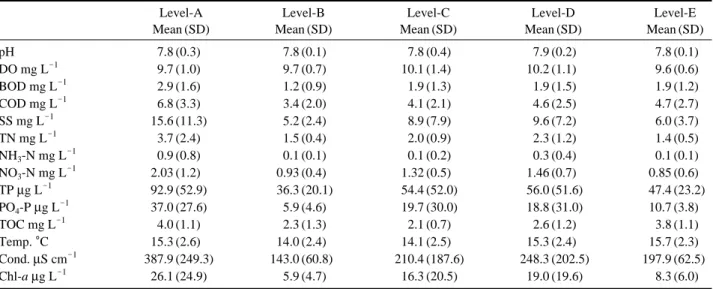
의 분석에서 동일한 결과를 확인한 바 있으며, 어류 내 성도 군집은 수질이 양호한 지역에서 물리적 서식지의 영향을 크게 받고, 수질이 악화된 지역에서는 수질의 영 향을 크게 받는 것으로 보고하였다.전제 조사지점을 배스의 상대풍부도에 따라 5단계로 대별하여 각 단계별 수질을 분석한 결과, 대부분의 수질 항목은 배스의 상대풍부도가 50% 이상인 지역에서 가 장 악화된 것으로 나타났다(Table 5). 하지만 이는 수질 이 가장 악화된 것으로 분석된 평택호의 영향이 큰 것 으로 판단되며, 배스의 상대풍부도 50% 미만 지점들에 서는 뚜렷한 경향이 나타나지는 않았다.
조사지역의 수질자료 및 TSI (Chl-a)와 배스 상대풍부 도를 분석한 결과 NH3
-N과 TN이 유의한 상관관계를
나타냈으나, 이는 평택호에서 높에 나타난 NH3
-N 수치
의 영향이 큰 것으로 판단된다. 배스의 상대풍부도가 가 장 높게 조사된 평택호는 암모니아성질소의 수치가1.55±1.32 mg L
-1로서 다른 호수들의 평균(0.11±0.35mg L
-1)보다 10배 이상 높게 나타났다. 다른 수질항목
및 TSI (Chl-a) 간에는 유의한 상관관계가 확인되지 않 았으며 산점도 분석에서도 경향성을 나타내지 않았다(Table 6).
Table 5. The abundance level (A-E) of bass (M. salmoides) in relation to physico-chemical water quality parameters. The relative abundance (RA) level of bass is as follows; A (⁄50%), B (⁄25%), C (⁄10%), D (⁄0.01%), and E (0%).
Level-A Level-B Level-C Level-D Level-E
Mean (SD) Mean (SD) Mean (SD) Mean (SD) Mean (SD)
pH 7.8 (0.3) 7.8 (0.1) 7.8 (0.4) 7.9 (0.2) 7.8 (0.1)
DO mg L
-19.7 (1.0) 9.7 (0.7) 10.1 (1.4) 10.2 (1.1) 9.6 (0.6)
BOD mg L
-12.9 (1.6) 1.2 (0.9) 1.9 (1.3) 1.9 (1.5) 1.9 (1.2)
COD mg L
-16.8 (3.3) 3.4 (2.0) 4.1 (2.1) 4.6 (2.5) 4.7 (2.7)
SS mg L
-115.6 (11.3) 5.2 (2.4) 8.9 (7.9) 9.6 (7.2) 6.0 (3.7)
TN mg L
-13.7 (2.4) 1.5 (0.4) 2.0 (0.9) 2.3 (1.2) 1.4 (0.5)
NH
3-N mg L
-10.9 (0.8) 0.1 (0.1) 0.1 (0.2) 0.3 (0.4) 0.1 (0.1)
NO
3-N mg L
-12.03 (1.2) 0.93 (0.4) 1.32 (0.5) 1.46 (0.7) 0.85 (0.6)
TP μg L
-192.9 (52.9) 36.3 (20.1) 54.4 (52.0) 56.0 (51.6) 47.4 (23.2)
PO
4-P
μg L-137.0 (27.6) 5.9 (4.6) 19.7 (30.0) 18.8 (31.0) 10.7 (3.8)
TOC mg L
-14.0 (1.1) 2.3 (1.3) 2.1 (0.7) 2.6 (1.2) 3.8 (1.1)
Temp. � C 15.3 (2.6) 14.0 (2.4) 14.1 (2.5) 15.3 (2.4) 15.7 (2.3)
Cond. μS cm
-1387.9 (249.3) 143.0 (60.8) 210.4 (187.6) 248.3 (202.5) 197.9 (62.5)
Chl-a
μg L-126.1 (24.9) 5.9 (4.7) 16.3 (20.5) 19.0 (19.6) 8.3 (6.0)
SD==standard deviation
Table 6. The pearson’s correlation analysis of M. salmoides (RA
==relative abundance) in relation to water quality para-
meters and TSI (Chl-a).
M. salmoides (RA)
Correlation coefficient (r)/Probability (p)
pH
-0.01 (0.99)DO 0.11 (0.77)
BOD 0.51 (0.13)
COD 0.55 (0.10)
SS 0.47 (0.17)
TN 0.71* (0.02)
NH
3-N 0.90** (0.00)
NO
3-N 0.56 (0.09)
TP 0.53 (0.12)
PO
4-P 0.45 (0.19)
Cond. 0.53 (0.12)
Chl-a 0.55 (0.10)
TSI (Chl-a) 0.31 (0.38)
*. Correlation is significant at 0.05 level, **. Correlation is significant at 0.01 level.
체 어류군집에 비해 수질의 영향을 적게 받는 것으로 나타났다. 배스의 분포 특성은 이화학적 수질도 중요하 지만, 이보다는 여러 타 요인들 (물리적 서식지 특성, 이 용 가능한 먹이양, 경쟁관계 생물)에 의해 더 영향 받을 것으로 추정된다. Hoyer and Canfield (1996)는 호수의 표면 넓이와 수량, 영양상태 및 수생식물의 비율이 배스 의 상대풍부도에 미치는 영향에 대한 연구를 보고하였 으며, 호수의 영양상태는 성체와 당년생의 상대풍부도에 상이한 영향을 미치는 것으로 설명하였다. 본 연구의 결 과에서는 배스의 발달단계가 고려되지 않았으며 향후 연구에서는 배스의 발달단계에 따른 분석이 고려되어야 할 것으로 판단된다.
적 요
본 연구에서는 2011년 우리나라 10개의 중대형 인공 호에서 배스의 우점도에 의한 외래종 영향 및 이에 대 한 어류 군집 구조 분석을 실시하였고, 이들이 출현하는 호수에 대한 이화학적 수질특성을 분석하였다. 10개 인 공호에서 출현한 어류는 13과 52종이었으며, 배스의 상 대 풍부도는 전체 어종들 중 13%를 차지하여, 출현한 어류들 중 3번째로 높게 우점하는 것으로 나타났다. 이 런 결과는 향후 배스가 수체내에서 최상위 포식자로서 의 포식압 및 생태적 지위 특성 때문에 많은 인공호들 에서는 본 배스의 외래종 번성에 의한 생태계 교란 효 과가 극대화 될 수 있음을 제시하였다. 전체 조사 대상 인공호들 중 평택호에서 배스의 상대 풍부도는 60%로 서 가장 높게 나타난 반면, 대청호에서 풍부도는 3%로 서 가장 낮게 나타났다. 배스 서식지에 대한 이∙화학적 수질분석 결과에 따르면, COD는 평균 4.5±2.5 mg L-1 였고, 총인 (TP) 농도는 0.058±0.047 mg L-1