ISSN 1225-6552, eISSN 2287-7630 https://doi.org/10.7853/kjvs.2020.43.3.173
< Original Article >
Veterinary Service
Available online at http://kjves.org
*Corresponding author: Won-Il Kim, E-mail. [email protected] ORCID https://orcid.org/0000-0002-0465-0794
PRRS 양성농장의 사육단계별 구강액과 혈액을 이용한 PRRSV와 항체 검출 비교
김정희1,3ㆍ손재국2ㆍ김원일3
*
도드람양돈농협 동물병원1, 무럭이농장2, 전북대학교 수의과대학3
Comparison of PRRSV and antibody detection in oral fluid and serum samples from different age categories of PRRSV endemic farms
Jung-Hee Kim
1,3, Jae Guk Son
2, Won-Il Kim
3*
1Dodram Pig Farmers Cooperative Veterinary Clinic, Daejeon 35377, Korea
2Muruki Farm, Sunchang 56016, Korea
3College of Veterinary Medicine, Jeonbuk National University, Iksan 54596, Korea (Received 3 September 2020; revised 14 September 2020; accepted 14 September 2020)
Abstract
The objective of this study was to evaluate the usefulness of detection of PRRSV and PRRSV-specific antibodies in oral fluids for monitoring of PRRSV infection in endemic farms. The level of PRRSV and anti-PRRSV antibodies in serum and oral fluids was evaluated in five age groups of pigs (6, 9, 12, 16 weeks of age and gilts). The samples (25 serums and 5 oral fluids/per a farm) were collected from 5 different farms endemically infected by PRRSV. Both serum and oral fluid samples were tested for PRRSV by quantitative reverse-transcription polymerase chain reaction (qRT-PCR) and for anti-PRRSV antibodies by two commercial PRRSV ELISA kits. ELISA mean s/p ratios (2.98 vs 1.63) and positive rate (84.0% vs 68.8%) of the oral fluid samples showed significantly higher levels but had similar pat- terns to the seroprofile of the blood samples. The PRRSV positive rate of oral fluid and serum samples was 40.0% and 44.0% respectively. In conclusion, the use of oral fluids for PRRS monitoring in en- demic farms is strongly recommended.
Key words : Porcine reproductive and respiratory syndrome, Pen-based oral fluid, Serum samples, ELISA, qRT-PCR
서 론
돼지 생식기 호흡기 증후군(porcine reproductive and respiratory syndrome; PRRS)은 PRRS 바이러스가 원인 체이며 다양한 약독화 백신이 존재함에도 불구하고 여전히 양돈 산업에서 컨트롤하기 어려운 만성적, 전 염성 그리고 경제적으로 중요한 질병이다(Gerber 등, 2013). PRRS 바이러스는 농장의 모든 생산 단계에서 경제적 손실을 야기하고 있다(Baron 등, 1992; Hirose
등, 1995; Holtkamp 등, 2011). PRRS 바이러스는 두 가 지(type 1-유럽형, type2-북미형) 종류의 유전자형으로 구분되고 Lelystad와 VR2332가 각각 표준균주로 간주 된다(Kuhn 등, 2016). 2013∼2016년 국내의 631개 PRRS 양성농장들로부터 분리된 PRRS 바이러스와 2003-2010 년 분리된 200개의 한국 야외주 그리고 113개 외래주 와 백신주의 ORF5와 7의 염기서열을 분석한 결과 단 독 감염(유럽형 38.4%, 북미형 37.4%) 또는 혼합감염 (24.2%) 상태를 보였으며 Lelystad 또는 VR2332 균주 와는 83%까지 상동성이 일치했다(Kang 등, 2018). 농 장의 효과적인 PRRS 컨트롤 전략에서 PRRS 모니터
Fig. 1. Growing pigs interacting with a cotton rope attached to the pen divider (A) and oral fluid harvested from the cotton rope (B).
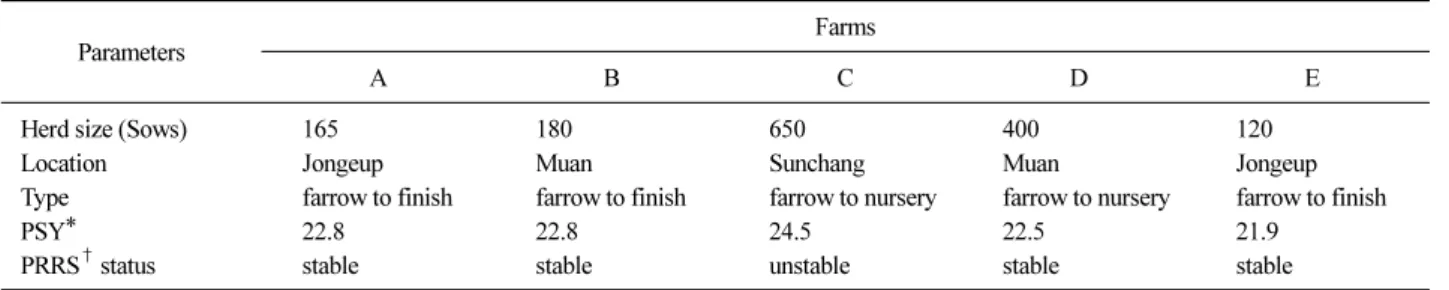
Table 1. Farm characteristics and performance parameter for five different farm in 2019 Parameters
Farms
A B C D E
Herd size (Sows) 165 180 650 400 120
Location Jongeup Muan Sunchang Muan Jongeup
Type farrow to finish farrow to finish farrow to nursery farrow to nursery farrow to finish
PSY* 22.8 22.8 24.5 22.5 21.9
PRRS† status stable stable unstable stable stable
*PSY, the number of weaned piglets per sow per year. †PRRS status (Holtkamp et al., 2011), positive unstable / positive stable / provisional negative / negative.
링은 중요한 요소이며 구강액 시료는 번식 돈군에서 PRRS 모니터링과 컨트롤 프로그램을 위한 대안적인 진단 시료이다(Kittawornrat 등, 2014; Trang 등, 2014).
구강액은 타액과 점막 삼출물의 혼합물이다. 타액은 귀밑, 턱밑, 혀밑, 침샘 뿐만 아니라 입술, 혀, 구개, 볼, 인두에 위치한 소수 침샘에 의해 생산 된다(Humphrey 등, 2001). 점막 삼출물은 구강과 잇몸의 점막 그리고 혈청 유래 항체들로 구성 된다(McKie 등, 2002). 구강 액에서 PRRSV 존재는 1997년 처음 보고됐으며 실험 감염된 어린 돼지의 구강 스왑에서 바이러스가 분리 되었다(Wills 등, 1997a). 또한 구강인두 시료에서 PRRSV 를 분리한 실험도 보고되었다(Wills 등, 1997b). 과거 PRRS 모니터링에서 혈청 시료들을 많이 이용해 왔었 다. 그러나 몇 가지 문헌들에 의하면 구강액을 이용한 방법은 PRRSV 조사를 위해 많은 이점을 가지고 있다 (Cuong 등, 2014; De Regge와 Cay, 2016). 구강액을 이 용한 PRRSV 진단은 혈청 시료보다 민감도가 우수하 고 오랜 기간 동안 바이러스를 검출할 수 있는 장점이 있다(Kittawornrat 등, 2010; Goodell 등, 2013). 돈방 단 위 구강액 시료는 동일한 돈방에서 풀링된 혈액 시료 와 비교했을 때 더 높은 RT-PCR 양성 결과를 보였다 (Goodell 등, 2013; Olsen 등, 2013). 폴란드에 위치한 3 개(A, B, C)의 농장에서 육성돈을 대상으로 구강액과 풀링된 혈액 시료를 이용한 PRRSV RT-PCR 검사 결과 A농장은 바이러스가 진단되지 않았고 B농장은 구강 액 80.9%, 혈액 58.3% 그리고 C농장은 구강액 92.8%, 혈액 75.0%의 양성률을 보였다(Biernacka 등, 2016).
혈액 채취는 침습적이고 돼지에게 조직 손상을 일으 킬 수 있는 반면 구강액 채취는 조직 손상이 거의 없 다(Woonwong 등, 2018). 따라서 본 연구는 국내 PRRS 양성 농장들에서 사육단계별 돼지로부터 채집한 개체 별 혈액과 돈방단위 구강액 시료 사이의 PRRSV와 PRRSV 특이 항체 진단 결과를 비교하여 오랫동안 진
단 시료로 이용한 개체별 돼지의 혈액을 돈방단위 구 강액 시료로 대체 가능한지를 평가하는 것이다.
재료 및 방법
공시재료
최근 1년 이내 PRRS 바이러스 감염 경력이 있는 5 농가를 선정했다(Table 1). 각 농장의 사육단계별(6주, 9주, 12주, 16주, 후보돈) 가장 작은 체중을 보이는 1 개의 돈방을 선정하고 5두씩 25두(전체 125두)의 돼지 혈액과 멸균된 면 로프를 이용하여 1개씩 5개(전체 25 개)의 구강액 시료들을 실험에 사용하였다(Fig. 1). 구 강액 시료채취를 위해 히프라의 CIVTESTⓇ SUIS ORAL FLUIDS 키트(로프, 장갑, 코니컬 튜브, 지퍼백 등)를 사용했다. 선정된 돈방(20∼25두) 안에서 돼지 어깨 높이의 위치에 멸균된 면 로프를 30분간 매달았다. 30 분 후 키트에 동봉된 한 쌍의 라텍스 장갑을 착용 및 로프를 제거하고 멸균 지퍼백 안에 넣고 손으로 짜내
Table 2. Results of testing oral fluids and serum by qRT-PCR for porcine reproductive and respiratory syndrome virus (PRRSV) in five commercial farms
Farm Sample
Age
6 w 9 w 12 w 16 w gilts
A Serum >35 >35 26.9* >35 >35
Oral fluid >35 >35 32.4* >35 >35
B Serum >35 >35 >35 32.5† >35
Oral fluid >35 >35 >35 >35 >35
C Serum 26.9* 25.2* 33.5* >35 >35
Oral fluid 34.4* 33.4* >35 33.3* >35
D Serum 23.1* 24.6* 32.8* >35 >35
Oral fluid 32.7* >35 28.5* >35 >35
E Serum 25.3* 23.8* 32.5* >35 >35
Oral fluid 31.9* 31.0* 31.3* 32.8* >35
*type 1 PRRSV, †type 2 PRRSV.
어 5 mL 이상의 타액을 추출했다. 추출된 타액을 코 니컬 튜브에 옮겨 담고 아이스팩이 동봉된 아이스박 스와 함께 보관한 상태로 실험실로 가지고와서 실험 을 진행했다.
PRRSV 항원 검사
혈액은 사육단계별 5개씩 pooling 하고 구강액은 개 별로 항원 검사를 진행했다. 제조사의 지침에 따라 MagMAXTM Viral RNA Isolation kit (Ambion, Applied Biosystems, Life Technologies, Inc., Carlsbad, CA, USA) 를 사용하여 구강액과 혈청에서 viral RNA를 추출했 다. 추출한 RNA는 one-step qRT-PCR kit (Prime-Q PCV2, PRRSV Detection Kit, GeNet Bio Inc., Daejun, Korea) 를 사용하여 7500 Fast Real-Time PCR system (Applied Biosystems, Foster City, CA)를 이용하여 kit의 사용법 에 맞게 바이러스 농도를 측정했다. PRRSV 양성 시 료는 threshold cycle (Ct) 값이 35 또는 그 이하 값이며 standard curve는 TCID50/mL을 알고 있는 PRRSV를 이 용하여 측정하였고 이를 기반으로 Ct값을 TCID50/mL 값으로 변환했다.
PRRSV 항체 검사
상품화된 Bionote PRRSV Antibody ELISA kit (BioNote Inc., Korea)와 IDEXX PRRSV Oral Fluid Antibody ELISA kit (IDEXX Laboratories, USA)를 사용하여 혈 액과 구강액 시료에서 PRRSV 항체 검사를 개체별로 진행했다. ELISA S/P ratio 수치는 0.4 이상일 때
PRRSV 항체 양성으로 판단했다.
통계 처리
데이터 수집 및 분류는 엑셀파일(Microsoft Excel 2016)을 활용했고 GraphPad Prism vesion 8.01 (Graphpad Software, CA, USA)를 이용하여 그래프를 그렸다. 돈 방 단위의 구강액과 혈액의 PRRS ELISA S/P ratio 관 계는 Spearman’s correlation (a non-parametric test) 분 석법을 이용하여 P<0.05 수준에서 검증했다.
결 과
농장 사육단계별 항원 분석
전체 구강액과 혈액의 항원 양성률은 각각 40.0%
(10/25), 44.0% (11/25)의 결과를 보였으며 유전자형은 B농장(북미형)을 제외하고 모두 유럽형으로 나타났다 (Table 2). A농장은 12주의 구강액과 혈액에서만 B농 장은 16주의 혈액에서만 항원 양성 결과를 보였다. C 농장은 6주, 9주의 구강액과 혈액은 동일한 양성 결과 를 보인 반면 12주는 혈액에서만 16주는 구강액에서 만 양성으로 나타났다. D농장은 6주, 12주의 구강액과 혈액은 동일한 양성 결과를 보인 반면 9주는 혈액에 서만 양성으로 나타났다. E농장은 6주, 9주, 12주의 구강액과 혈액은 동일한 양성 결과를 보인 반면 16주 는 구강액에서만 양성으로 나타났다.
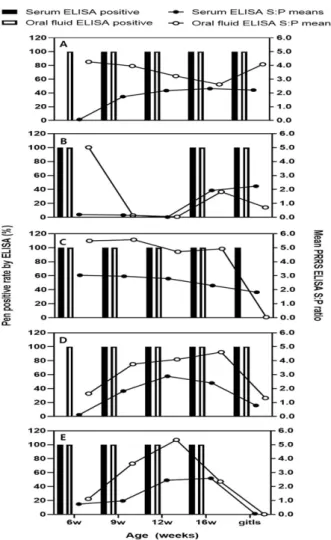
Fig. 2. Mean PRRSV ELISA S/P ratios of 5 farms in 6, 9, 12, 16 weeks of age and gilts from serum and oral fluid samples. S/P ratios of
>0.4 are considered positive.
Fig. 3. Correlation of between mean S/P ratios for oral fluid and se- rum samples per pen in five farms as a summary statistic (Spearman’s correlation coefficient, r=0.611).
Fig. 4. Average S/P ratio and positive rate for oral fluid and serum samples of among the five farms at different age groups based on IDEXX PRRS OF Ab test and Bionote PRRS Ab test results, re- spectively. The values of average S/P ratio of individual oral fluid and serum samples show similar pattern at different age groups.
농장 사육단계별 항체 분석
5개 농장의 사육단계별 돈방 단위 PRRS ELISA S/P ratio 패턴은 유사했고 혈액보다 구강액 시료에서 높 은 항체가 결과를 보였다(Fig. 2). 구강액과 혈액의 ELISA S/P ratio 수치를 Spearman’s correlation을 이용 해서 비교했을 때 상당히 강한 상관관계가 나타났다 (P=0.0012, r=0.611) (Fig. 3). 돈방 단위 항체 양성률 역시 전반적으로 혈액(80.0%)보다 구강액(84.0%) 시료 에서 높게 나타났다(Fig. 4). A농장과 D농장의 경우 6 주령 돼지의 혈액에서 항체 음성, 구강액 시료에서 항 체 양성으로 나타난 반면에 C농장의 경우 후보돈 구 간에서 구강액은 항체 음성, 혈액은 양성 결과를 보였 다. B농장의 9주, 12주 구간과 E농장의 후보돈 구간에 서 구강액과 혈액 모두 항체 음성의 동일한 결과를 보 였다. 돈방 단위와 개체별 혈액 시료는 각각 80.0%
(20/25), 68.8% (86/125)의 항체 양성률을 기록했다.
고 찰
구강액은 동시에 많은 돼지들의 시료를 채취 할 수 있기 때문에 PRRS 모니터링을 위한 좋은 도구이다.
이 실험에서 돈방 단위 구강액은 혈액과 매우 유사한 패턴의 항체 결과를 나타냈다. 차이점은 같은 일령에 서 구강액 시료의 S/P ratio 수치가 혈액보다 높다는 것이며 IDEXX PRRS Oral Fluids Ab Test와 관련된 보 고에서 유사한 결과가 나타났다(IDEXX, 2013). 돈방 단위에서 돼지 1두의 혈액 시료가 항체 양성이면 구 강액 시료는 항상 양성 결과를 보였다. 따라서 구강액 은 PRRS 바이러스에 상재 감염된 농장에서 PRRS 모 니터링할 때 일반적인 혈청을 대체할 수 있는 신뢰할 수 있고 유용한 시료이다. 기대와 마찬가지로 구강액
시료 채취는 모든 구간(6주, 9주, 12주, 16주 그리고 후보돈)에서 쉽고 편하게 그리고 돼지에게 스트레스 또는 손상을 유발하지 않고 혼자서 할 수 있다. 다만 6주령 이하의 어린 자돈들의 경우 로프의 접근성이 떨어지고 동일한 시간 로프를 물더라도 구강액의 양 이 적게 모이기 때문에 1시간 이상 소요되는 경우도 발생했다.
B농장의 경우 6, 9, 12주령 항체 음성을 유지했고 16주령 북미형 항원에 감염되면서 항체 양성 전환이 일어났다. 16주령이 감염 초기 단계이기 때문에 혈액 에서만 바이러스를 감지했고 구강액은 음성으로 나타 났다. 앞선 연구들에 따르면 PRRSV 감염 초기 단계 에서는 구강액 보다 혈액에서 바이러스 검출 가능성 이 높게 나타났다. 일부 후보돈들은 순치 말기 단계에 서 재감염으로 인한 급성 PRRSV 감염을 보이고 타액 에서 바이러스가 배설되지 않았기 때문에 구강액에서 바이러스가 검출되지 않았다. 따라서 급성 감염 시점 은 구강액 보다 혈액 시료에서 더 좋은 진단 결과를 나타냈다(Woonwong 등, 2017). 급성 PRRSV 감염 돼 지들은 구강액 시료보다 혈청에서 PRRSV RNA가 더 많이 나타났다(Gerber 등, 2013; Pepin 등, 2015). 구강 액 시료는 초기 단계의 감염을 나타내는 3∼7주령보 다 말기 단계의 감염을 보이는 8∼28주령 시점일 때 더 빈번하게 바이러스를 진단했다(Decorte 등, 2015).
C농장의 경우 PRRS 음성을 유지하다가 시료 채취 시점 약 2달 전 임신 말기돈에서 PRRS 바이러스 감염 이 나타났고 자돈에 수직감염과 수평감염이 계속 일 어나고 있었기 때문에 구강액과 혈액 시료 모두에서 항원 양성률이 높게 나타났다. D와 E농장의 경우 농 장내 PRRS 바이러스 순환감염이 6주령부터 12∼16주 령까지 계속 지속되고 있는 상황으로 C농장과 마찬가 지로 두 시료 모두에서 항원이 잘 검출됐다. 앞선 연 구들에 따르면 돈방 단위에서 바이러스혈증을 보이는 돼지 비율이 일정 이상 되어야만 구강액 시료에서 바 이러스 진단 가능성이 증가했다. 돈방 단위에서 돼지 들의 40% 이상이 바이러스혈증을 보인다면 구강액 시료를 이용한 PRRSV 감염 진단율은 70% 이상으로 나타난 반면에 PRRSV 유병률이 낮을 경우 돈방 단위 구강액은 적합하지 않을 수도 있다(Woonwong 등, 2018). 돈방 단위에서 혈청의 항원 양성률이 30%를 넘을 때 구강액의 진단율은 100%에 도달할 수 있다 (De Regge와 Cay, 2016).
현재 돼지농장에서 PRRS 바이러스 모니터링을 위 한 조사 방법으로 개체로부터 혈액 시료를 채취한다.
진단을 위해 필요한 시료 수 그리고 소요되는 노동력 과 시간을 고려한다면 경제적 관점에서 종종 손해일 수 있다. 토착화된 PRRS 바이러스 감염 농장에서 돈 방 단위 기준 구강액 시료의 RT-PCR 결과는 혈액 시 료 결과와 77% 일치했다(Prickett 등, 2008). 개별 웅돈 에 대한 혈액과 구강액 시료를 비교한 결과 감염 7일 째 동일한 항원 양성 결과를 보였고 감염 14일과 21 일은 구강액에서 더 높은 양성률을 보였다. 실험 21일 동안 PCR을 이용한 PRRS 바이러스 진단에서 전반적 으로 구강액 시료가 혈액보다 더 우수한 결과를 나타 냈다(Kittawornrat 등, 2010). 이로 볼 때 돼지 농장 내 PRRS 바이러스 모니터링을 위한 구강액 시료의 이용 은 혈액 시료를 대체해서 활용할 수 있을 것으로 판단 된다.
결 론
본 연구는 1년 이내 PRRS 바이러스 감염 경력이 있 는 5개의 농장에서 혈액과 구강액 시료들을 대상으로 real-time PCR과 ELISA 방법으로 PRRS 바이러스 항 원 검출과 항체의 혈청학적 평가를 실시했다. 개체별 혈액의 항체 양성률은 68.8% (86/125)로 나타났고 돈 방 단위 혈액의 항원 양성률은 44.0% (11/25), 항체 양 성률은 80.0% (20/25) 결과를 보였다. 돈방 단위 구강 액의 항원 양성률은 40.0% (10/25), 항체 양성률은 84.0% (21/25)로 나타났다. 돈방 단위의 구강액 시료 를 이용한 항원, 항체 검사는 혈액과 거의 동일한 수 준의 양성률 결과를 보였다. 따라서 PRRSV 감염이 토착화된 국내 농장들에서 구강액 시료는 PRRS 바이 러스의 직접적인 검출을 위한 목적 뿐만 아니라 돈군 의 면역 상태를 모니터링 하기 위한 목적으로 충분히 활용할 수 있다.
감사의 글
이번 연구는 농림축산식품부의 재원으로 농림식품 기술기획평가원 가축질병대응기술개발사업의 지원을 받아 연구되었습니다(118093-03).
CONFLICT OF INTEREST
No potential conflict of interest relevant to this article was reported.
ORCID
Jung-Hee Kim, https://orcid.org/0000-0003-1231-1052 Jae Guk Son, https://orcid.org/0000-0002-7429-5169 Won-Il Kim, https://orcid.org/0000-0002-0465-0794
REFERENCES
Baron T, Albina E, Leforban Y, Madec F, Guilmoto H, Plana Duran J, Vannier P. 1992. Report on the first outbreaks of the porcine reproductive and respiratory syndrome (PRRS) in France. Diagnosis and viral isolation. Ann Rech Vet 23: 161-166.
Biernacka K, Karbowiak P, Wróbel P, Charęza T, Czopowicz M, Balka G, Goodell C, Rauh R, Stadejek T. 2016. Detec- tion of porcine reproductive and respiratory syndrome virus (PRRSV) and influenza A virus (IAV) in oral fluid of pigs. Res Vet Sci 109: 74-80.
Cuong NV, Carrique-Mas J, Thu HTV, Hien ND, Hoa NT, Nguyet LA, Anh PH and Bryant JE. 2014. Serological and virological surveillance for porcine reproductive and respiratory syndrome virus, porcine circovirus type 2 and influenza A viruses among smallholder swine farms of the Mekong Delta, Vietnam. J Swine Health Prod 22:
224-231.
Decorte I, Campe WV, Mostin L, Cay AB, Regge ND. 2015.
Diagnosis of the Lelystad strain of porcine reproductive and respiratory syndrome virus infection in individually housed pigs: comparison between serum and oral fluid samples for viral nucleic acid and antibody detection. J Vet Diagn Invest 27: 47-54.
Gerber PF, O’Neill K, Owolodun O, Wang, C, Harmon K., Zhang J, Halbur PG, Zhou L, Meng XJ, Opriessnig T. 2013.
Comparison of commercial real-time reverse transcription- PCR assays for reliable, early, and rapid detection of heterologous strains of porcine reproductive and respira- tory syndrome virus in experimentally infected or non- infected boars by use of different sample types. J Clin Microbiol 51: 547-556.
Goodell CK, Prickett J, Kittawornrat A, Zhou F, Rauh R, Nelson W, O’Connell C, Burrell A, Wang C, Yoon KJ, Zimmerman JJ. 2013. Probability of detecting influenza A virus sub- types H1N1 and H3N2 in individual pig nasal swabs and pen-based oral fluid specimens over time. Veterinary Micro-
biology 166: 450-460.
Hirose O, Kudo H, Yoshizawa S, Hiroike T, Nakane T. 1995.
Prevalence of porcine reproductive and respiratory syn- drome virus in Chiba prefecture. J Jpn Vet Med Assoc 48: 650-653.
Holtkamp DJ, Polson DD, Torremorell M, Morrison B, Classen DM, Becton L, Henry S, Rodibaugh MT, Rowland RR, Snelson H, Straw B, Yeske P, Zimmerman J. 2011.
Terminology for classifying the porcine reproductive and respiratory syndrome virus (PRRSV) status of swine herds. Tierarztl Prax Ausg G Grosstiere Nutztiere 39:
101-112.
Humphrey SP, Williamson RT. 2001. A review of saliva: normal composition, flow, and function. J Prosthet Dent 85: 162- 169.
IDEXX. 2013. PRRS oral fluids Ab Test. Principle of oral fluid collection for the IDEXX PRRS oral Fluid Antibody Test. https://www.idexx.com/pdf/en_us/livestock-poultry/
Oral-Fluids-FAQs.pdf. Accessed 22th October 2016.
Kang H, Yu J, Shin J, Kang A, Kim W, Lee C, Lee J, Cho I. Choe S, Cha S. 2018. Geographic distribution and molecular analysis of porcine reproductive and respiratory syndrome viruses circulating in swine farms in the republic of Korea between 2013 and 2016. BMC Vet Res 14: 160.
Kittawornrat A, Panyasing Y, Goodell C, Wang C, Gauger P, Harmon K, Rauh R, Desfresne L, Levis I, Zimmerman J. 2014. Porcine reproductive and respiratory syndrome virus (PRRSV) surveillance using pre-weaning oral fluid samples detects circulation of wild-type PRRSV. Vet Microbiol 168: 331-339.
Kittawornrat A, Prickett J, Chittick W, Wang C, Engle M, Johnson J, Patnayak D, Schwartz T, Whitney D, Olsen C, Schwartz K, Zimmerman J. 2010. Porcine reproductive and respiratory syndrome virus (PRRSV) in serum and oral fluid samples from individual boars: Will oral fluid replace serum for PRRSV surveillance? Virus Res 154:
170-176.
Kuhn JH, Lauck M, Bailey AL, Shchetinin AM, Vishnevskaya TV, Bao Y, Ng TF, LeBreton M, Schneider BS, Gillis A, Tamoufe U, Diffo JLD, Takuo JM, Kondov NO, Coffey LL, Wolfe ND, Delwart E, Clawson AN, Postnikova E, Bollinger L, Lackemeyer MG, Radoshitzky SR, Palacios G, Wada J, Shevtsova ZV, Jahrling PB, Lapin BA, Deriabin PG, Dunowska M, Alkhovsky SV, Rogers J, Friedrich TC, O’Connor DH, Goldberg TL. 2016. Reor- ganization and expansion of the nidoviral family Arteri- viridae. Arch Virol 161: 755-768.
McKie A, Vyse A, Maple C. 2002. Novel methods for the de- tection of microbial antibodies in oral fluid. The Lancet Infectious Diseases, 2: 18-24.
Olsen C, Wang C, Christopher-Hennings J, Doolittle K, Harmon KM, Abate S, Kittawornrat A, Lizano S, Main R, Nelson EA, Otterson T, Panyasing Y, Rademacher C, Rauh R, Shah R, Zimmerman J. 2013. Probability of detecting Porcine reproductive and respiratory syndrome virus in-
fection using pen-based swine oral fluid specimens as a function of within-pen prevalence. J Vet Diagn Invest 25: 328-335.
Pepin BJ, Kittawornrat A, Liu F, Gauger PC, Harmon K, Abate S, Main R, Garton C, Hargrove J, Rademacher C, Ramirez A, Zimmerman J. 2015. Comparison of specimens for detection of porcine reproductive and respiratory syn- drome virus infection in boar studs. Transbound Emerg Dis 62: 295-304.
Prickett JR, Kim WI, Simer R, Yoon KJ, Zimmerman J. 2008.
Oral-fluid samples for surveillance of commercial grow- ing pigs for porcine reproductive and respiratory syn- drome virus and porcine circovirus type 2 infections. J Swine Health Prod. 16: 86-91.
Regge ND and Cay B. 2016. Comparison of PRRSV nucleic acid and antibody detection in pen-based oral fluid and in- dividual serum samples in three different age categories of post-weaning pigs from endemically infected farms.
PLoS One 11: e0166300.
Trang NT, Hirai T, Yamamoto T, Matsuda M, Okumura N, Giang NT, Lan NT and Yamaguchi R. 2014. Detection of porcine reproductive and respiratory syndrome virus in oral fluid from naturally infected pigs in a breeding herd. J Vet Sci 15: 361-367.
Wills RW, Zimmerman JJ, Yoon KJ, et al. 1997a. Porcine re- productive and respiratory syndrome virus: a persistent infection. Vet Microbiol 55: 231-240.
Wills RW, Zimmerman JJ, Yoon KJ, et al. 1997b. Porcine re- productive and respiratory syndrome virus: routes of excretion. Vet Microbiol 57: 69-81.
Woonwong Y, Kedkovid R, Arunorat J, Sirisereewan C, Nedumpun T, Poonsuk K, Panyasing Y, Poolperm P, Boonsoongnern A, Thanawongnuwech R. 2018. Detection of PRRSV cir- culation using oral fluid samples for nursery manage- ment in endemically PRRSV-infected farms. Thai J Vet Med 48: 85-94.