• 검색 결과가 없습니다.

Variant Identification in Platanus occidentalis L. Using SNP and ISSR Markers

N/A
N/A
Protected

Academic year: 2021

Share "Variant Identification in Platanus occidentalis L. Using SNP and ISSR Markers"

Copied!
9
0
0

로드 중.... (전체 텍스트 보기)

전체 글

(1)

Variant Identification in Platanus occidentalis L. Using SNP and ISSR Markers

Jin Young Lee

1

, Mu Seok Han

2

and Chang Seob Shin

1

*

1

Department of Forest Science, Chungbuk National University, Cheongju 361-763, Korea

2

Division of Forest Tree Improvement, Korea Forest Research Institute, Suwon 441-847, Korea

Abstract - The purpose of this study was to identify the variant of Platanus occidentalis, whose bark looks white, also can be classified as P. occidentalis and to examine its genetic difference from the general P. occidentalis. For the variant identification of P. occidentalis, SNP and ISSR analysis were used in this study. Thirteen samples of P. occidentalis white variant were collected in Cheongju and 24 samples of normal P. occidentalis obtained in Cheongju, Pyongtaek, Ansan, Suwon, Osan and Jincheon area. ITS 1 and ITS 2 sequences of white variants were identical with those of P. occidentalis.

We could not find any sequence difference between normal and white P. occidentalis. So we concluded that the white variant belongs to normal P. occidentalis even their bark is white and peeled easily. By ISSR test, 98 amplicons were acquired using 10 primers. P. occidentalis and white P. occidentalis showed different band patterns from the UBC #834.

According to the result of Nei (1979)’s genetic distance analysis, the members of white P. occidentalis were grouped more tightly than the members of normal P. occidentalis. The UPGMA dendrogram shows that the variant and P. occidentalis divided widely into two groups. These results show that the phenotype of P. occidentalis white variant is caused by genetic factors rather than by environmental factors.

Key words - Primer, Genetic distance, Dendrogram, Amplicon, White Platanus

*Corresponding author. E-mail : [email protected]

Introduction

In Korea, there are 3 types of tree species that are of Platanaceae and, of these, P. occidentalis is a deciduous broadleaf tree that belongs to Rasales, Platanaceae. It is native to North America and is commonly called Platanus and it is often referred to as a “bell tree” for its small bell-like fruits. Because the P. orientalis spp. has excellent transplanting capability and greenery, it is a species that is planted often as roadside trees and, in particular, P. orientalis spp. is pre- valently planted as roadside trees and trees for greeneries.

Trees that are planted as ornamental trees for their high horticultural value are in lot of cases planted for the aesthetic beauty of the flowers; however, they are also often used as ornamental trees for the beauty of the bark or the overall shape of the tree. Since the bark sometimes cracks or splits away as the tree grows, it can be considered to be undergoing continuous changes during the lifetime of the tree. For P.

occidentalis whereas its cracked outer layers are relatively loosely attached to the bark and therefore are easily eliminated, the unaesthetic outer layers that are not loosely attached to the bark can degrade the aesthetics of the tree and also can serve as a haven for the sycamore lace bugs (Corythucha ciliata).

As shown, the outer barks of most of P. occidentalis are not easily eliminated and stay intact, however, a P. orientalis spp.

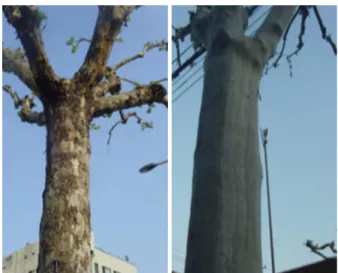
was discovered where - while the brown colored outer bark are all eliminated and only the white colored inner bark remains - the entire tree trunk appears as if it has been painted white, whereby attracting visual attention with a high aesthetic value (Fig. 1). For the P. orientalis spp. that has white bark provides a neat groomed image with its smooth tree trunk and is also easily eye-catching, it was deemed suitable to be used as a landscaping material for the locations that are for attracting traffic flow.

The sycamore lace bugs that live on P. orientalis spp. suck

juices from the leaves and cause damages and turn leaves into

dark yellow in color whereby harming the aesthetics of urban

landscape (Park et al., 2007). In addition, sycamore lace bugs

(2)

Fig. 1. P. occidentalis with general bark (left) and White bark (right).

spend winter as adult insects and use rough tree bark as a hiding place and in April come out from the cracks in the bark and move towards the top areas, and if the bark, which act as a hiding place for them, can be eliminated, then it could be expected that the damages caused by sycamore lace bugs would be reduced as well. In order to utilize this variant species that is deemed to have horticultural values and is also resistance to bugs as a genetic resource, it would be necessary, first, to examine whether the differences are attributable to organic differences or environmental conditional differences.

SNP refers to the variations of DNA sequencing caused by the change in the single nucleotides of the two alleles, and it is useful for analyzing the relationship between the alleles and phenotypes (Jorde, 2000). Although initially it was used in the higher plants including crops and a few species, nowadays it is used in animals as well and has been garnering attention as the next generation marker (Gupta et al., 2001).

The ISSR marker was first developed by Zietkewicz et al.

(1994) during their effort to create genome map through the proliferation of DNA, and this is a way to amplify the sequencing between two SSRs. This method can be used even in cases where genetic information is deficient, as in P. occidentalis, and, since it uses only 1 primer, the manipulation of experi- ments is rather simple.

Due to the fact that it was difficult to conduct morphological identification of the variant individual bodies, which were white in external appearance as a result of the brown colored

bark being stripped off, because of the variations in the leaf shapes and in the number of bell-shaped fruits, analyses of genetic information in order to accurately ascertain the species were necessary. As such, this study attempted to test - among the P. orientalis spp. planted as roadside trees - whether the individual bodies that had all of the brown colored outer bark eliminated and their entire tree trunks were appearing white in color were of the similar species as P. occidentalis by using the SNP (Single Nucleotide Polymorphism) and ISSR (Inter- Simple Sequence Repeat) molecular markers, and our study also attempted to investigate the differences of genetic charac- teristics between P. occidentalis and P. orientalis spp. that has white bark.

Materials and Methods

Materials

P. orientalis spp. (hereinafter referred to as “white platanus”), which appear to be variant individual bodies with white bark, and typical P. occidentalis were used in the testing (Fig. 1).

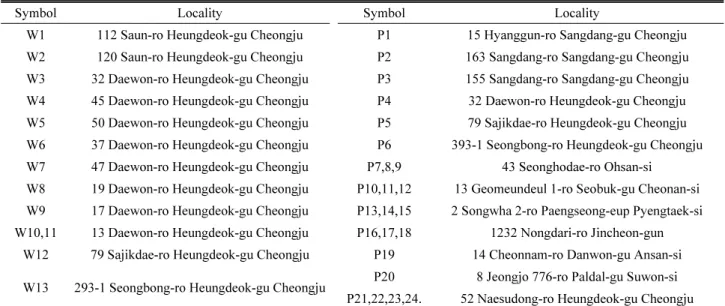
As shown in Table 1, 13 test samples of white platanus with all of their brown colored outer layers eliminated were collected in the City of Cheongju and a total of 24 test samples of typical P. occidentalis were collected in the Cities of Cheongju, Pyeongtaek, Ansan, Suwon, Osan and Jincheon. After collection, the test samples were packaged to prevent any mix-ups and were kept in a freezer at -20℃.

Extraction of Genomic DNA

In order to extract the DNA of white platanus and P.

occidentalis, test samples were acquired from the 37 individual bodies and the leaves of about 2-3 g that were stored in a freezer were triturated by using liquid nitrogen, and then through the CTAB method, the DNA was isolated.

Selection of Primer SNP PCR

Because the genetic information of P. occidentalis was

deficient, the primers that were used for other species were

applied. The primer for the division of P. occidentalis (Cemmamo

and Cafasso, 2002) and the primer sets for amplifying non-

coding portions were used (Table 2).

(3)

Table 1. Locality of P. occidentalis

Symbol Locality Symbol Locality

W1 112 Saun-ro Heungdeok-gu Cheongju P1 15 Hyanggun-ro Sangdang-gu Cheongju W2 120 Saun-ro Heungdeok-gu Cheongju P2 163 Sangdang-ro Sangdang-gu Cheongju W3 32 Daewon-ro Heungdeok-gu Cheongju P3 155 Sangdang-ro Sangdang-gu Cheongju W4 45 Daewon-ro Heungdeok-gu Cheongju P4 32 Daewon-ro Heungdeok-gu Cheongju W5 50 Daewon-ro Heungdeok-gu Cheongju P5 79 Sajikdae-ro Heungdeok-gu Cheongju W6 37 Daewon-ro Heungdeok-gu Cheongju P6 393-1 Seongbong-ro Heungdeok-gu Cheongju W7 47 Daewon-ro Heungdeok-gu Cheongju P7,8,9 43 Seonghodae-ro Ohsan-si

W8 19 Daewon-ro Heungdeok-gu Cheongju P10,11,12 13 Geomeundeul 1-ro Seobuk-gu Cheonan-si W9 17 Daewon-ro Heungdeok-gu Cheongju P13,14,15 2 Songwha 2-ro Paengseong-eup Pyengtaek-si W10,11 13 Daewon-ro Heungdeok-gu Cheongju P16,17,18 1232 Nongdari-ro Jincheon-gun

W12 79 Sajikdae-ro Heungdeok-gu Cheongju P19 14 Cheonnam-ro Danwon-gu Ansan-si

W13 293-1 Seongbong-ro Heungdeok-gu Cheongju P20 8 Jeongjo 776-ro Paldal-gu Suwon-si P21,22,23,24. 52 Naesudong-ro Heungdeok-gu Cheongju W: White bark, P: General bark.

ISSR PCR

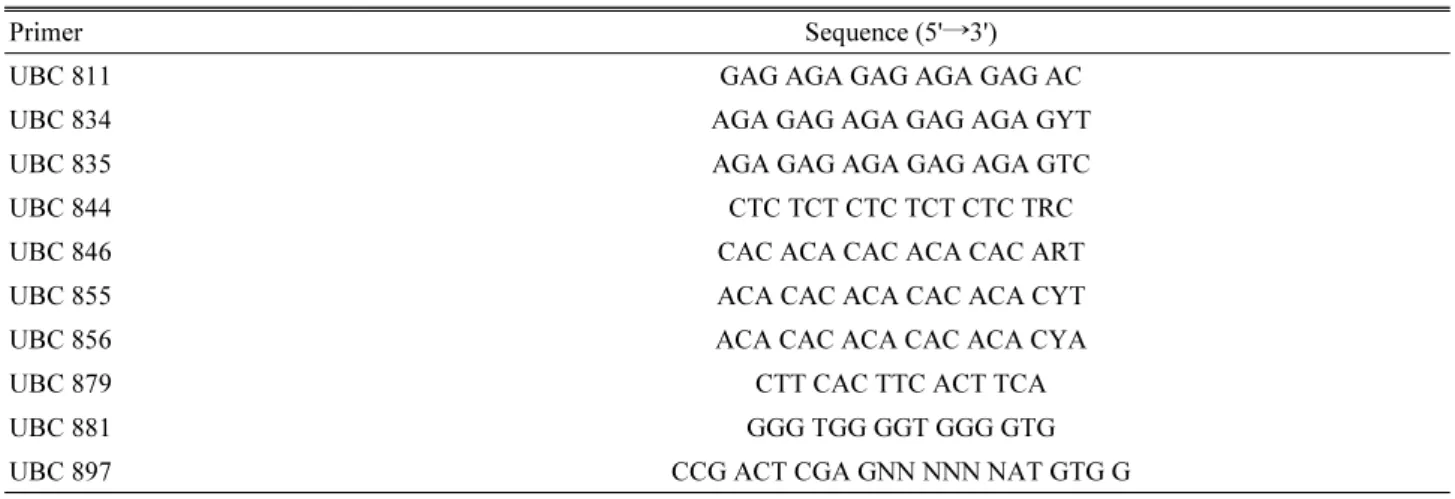
Among the extracted DNA samples, 4 samples were randomly selected and conducted PCR analyses against the UBC (Uni- versity of British Columbia) 800 quadrant 100 primers. After electrophoresis, by comparing the amplification patterns of amplified fragments, 10 samples that had excellent repro- ducibility and displayed polymorphism and, of which the amplification products are clearly distinguishable, were selected, and PCR analyses were conducted against the entire 37 individual bodies (Table 3).

PCR Conditions and Electrophoresis

The PCR reaction mixture was comprised - by using AccuPower

PCR PreMix from Bioneer - of 10 ng template DNA, 0.6 μM ISSR Primer, 1.5 mM MgCl

2

, 250 μM dNTP Mix, 10 mM Tris-HCl (PH 9.0), 1 U Tag DNA Polymerase and 30 mM KCl for every 20 ㎕ of reaction mixture, and, regarding the SNP PCR conditions, after a 5 minute pre- treatment at 94 ℃ and after repeating 30 times of 30 seconds at 94℃ 1 minute at 55℃ and 45 seconds at 72℃, amplifi- cation reaction was amplified for the final time for 7 minutes at 72 ℃.

Regarding the ISSR PCR conditions, after a 5 minute pre- treatment at 94℃ and after repeating 45 times of 30 seconds at 94℃ 30 seconds at 50℃ or 30 seconds at 55℃ and 60

seconds at 72℃, amplification reaction was amplified for the final time for 10 minutes at 72℃. By using a 1% agarose gel and by performing electrophoresis for 90 minutes at 60 V, the band patterns were analyzed at the UV trance illuminator level and photographed.

Sequence Analysis SNP Analysis

For an analysis of base sequencing 10 ㎕ of the leftover after the electrophoresis - among the amplified fragments obtained after PCR - was put through a purification processing by using the GeneAll Expin PCR SV protocol. The purified PCR amplified fragments were diluted into a third level purified water and were analyzed using an ABI RPISM

3730 XL analyzer. The base sequencing analyzed through a sequencing analysis software was obtained in text documents and *.abl format documents. The obtained base sequencing was classified by primers, and the *.abl files were loaded using the Clustal X 1.83 software and by arranging in an array the SNP was confirmed.

ISSR Analysis

Regarding the amplified fragments, the data for two types

of phenotypes (Appearance: 1, No appearance: 0) was pro-

cessed, based on the presence of bands, via a binary scale. By

(4)

Table 2. Primer for SNP markers and sequences

No. primer sequence Reference

1   F: CAT TAC AAA TGC GAT GCT CT

Taverlet et al.,1991.

R: TCT ACC GAT TTC GCC ATA TC

2   F: CAT TAC AAA TGC GAT GCT CT R: GGG GAT AGA GGG ACT TGA AC

3   F: CAT TAC AAA TGC GAT GCT CT R: ATT TGA ACT GGT GAC ACG AC

4   F: CGA AAT CGG TAG ACG CTA CG R: TCT ACC GAT TTC GCC ATA TC

5   F: CGA AAT CGG TAG ACG CTA CG R: GGG GAT AGA GGG ACT TGA AC

6   F: CGA AAT CGG TAG ACG CTA CG R: ATT TGA ACT GGT GAC ACG AC

7   F: ATT TGA ACT GGT GAC ACG AC R: GGG GAT AGA GGG ACT TGA AC

8 F: GGT TCA AGT CCC TCT ATC CC

R: ATT TGA ACT GGT GAC ACG AC

9 F: AAG CGG AAT TTG TGC TTG T

Lee et al., 1994.

R: TAG ACA TCG GTA CTC CAG TGC

10 F: AAC ATT CCC ACC AAG CCT AAT C R: ATG AGA ACG ACA CAA CTG GCA A

11 F: TCC GTA GGT GAA CCT GCG C

Kaundun and Matsumoto, 2003 R: TCC TCC GCT TAT TGA TAT GC

12 F: CCT TGG GGT TAT CCT GCA CT

White et al.,1990.

R: ACT GCA ATT TTA GAG AGA CGC G

13 F: GGA GAA GTC GTA ACA AGG TTT CCG

Cemmamo and Cafasso, 2002.

R: ATC CTG CAA TTC ACA CCA AGT ATC G

14 F: ATC CTT TAC TCA GTG AAT GAG

Shinozaki et al.,1986.

R: GCT TTA GTC TCT GTT TGT GG

Table 3. List of ISSR primer codes and sequence employed for this analysis

Primer Sequence (5' →3')

UBC 811 GAG AGA GAG AGA GAG AC

UBC 834 AGA GAG AGA GAG AGA GYT

UBC 835 AGA GAG AGA GAG AGA GTC

UBC 844 CTC TCT CTC TCT CTC TRC

UBC 846 CAC ACA CAC ACA CAC ART

UBC 855 ACA CAC ACA CAC ACA CYT

UBC 856 ACA CAC ACA CAC ACA CYA

UBC 879 CTT CAC TTC ACT TCA

UBC 881 GGG TGG GGT GGG GTG

UBC 897 CCG ACT CGA GNN NNN NAT GTG G

(5)

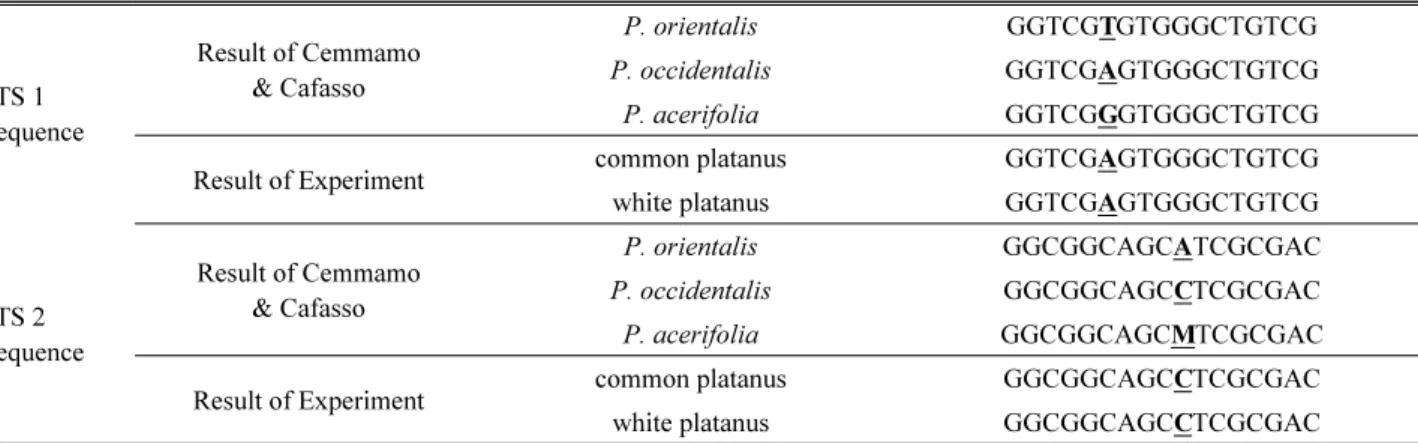
Table 4. ITS 1 and 2 sequence of analyzed Platanus species

ITS 1 sequence

Result of Cemmamo

& Cafasso

P. orientalis GGTCG TGTGGGCTGTCG

P. occidentalis GGTCG AGTGGGCTGTCG

P. acerifolia GGTCG GGTGGGCTGTCG

Result of Experiment common platanus GGTCG AGTGGGCTGTCG white platanus GGTCG AGTGGGCTGTCG

ITS 2 sequence

Result of Cemmamo

& Cafasso

P. orientalis GGCGGCAGC ATCGCGAC

P. occidentalis GGCGGCAGC CTCGCGAC

P. acerifolia GGCGGCAGC MTCGCGAC

Result of Experiment common platanus GGCGGCAGC CTCGCGAC white platanus GGCGGCAGC CTCGCGAC using the POPGENE program, the genetic distance of each

individual body was calculated through the calculation method of Nei & Li (1979), and the phylogenetic relation- ships among the populations were prepared in a dendrogram by using the UPGMA (Unweighted Pair-Group Method using Arithmetic Average) method, and the genetic similarities of each of the individual bodies were examined.

Results and Discussion

In order to ascertain through molecular markers what species the variant individual body that appears white in color with the outer bark peeled off was and in order to investigate the dif- ferences of genetic characteristics between typical P. occidentalis and this variant individual body, 24 individual bodies of typical P. occidentalis and 13 individual bodies of white platanus that had all of their brown colored outer bark eliminated were used as test samples.

SNP Analysis

In order to verify the species of the variant individual bodies in which the outer bark layers were all eliminated, SNS analysis was conducted. Among the 14 primer sets (Table 2) used in SNP analysis, bands were ascertainable in the primers developed by Cemmamo and Cafasso (2002) for the amplification of the ITS region, and it was possible to obtain sequencing by purifying the area.

As a result of analysis, as shown in Table 4, both the P.

occidentalis and white platanus were seen as being consistent in terms of Adenine, A, in the ITS 1 region, and in the ITS 2

region as well both the P. occidentalis and white platanus were seen as being consistent in terms of Cytosine, C, whereby making it possible to ascertain that the variant individual bodies in which the outer bark layers are all eliminated and are white in color were also P. occidentalis.

In addition, although sequencing was obtained through the amplification of the non-coding areas of chloroplast DNA of P. occidentalis, it was not possible to find the markers that are tied together in common in accordance with the tree bark (Fig. 2).

ISSR Analysis

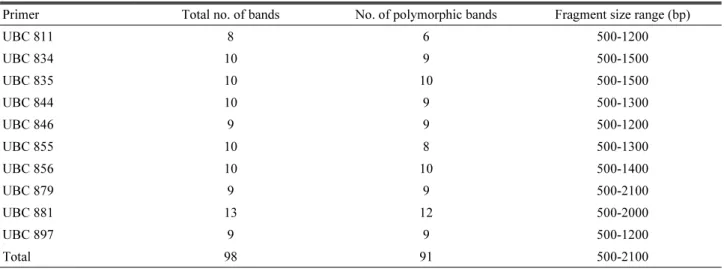
In order to test the genetic differences between P. occidentalis and the variant individual bodies, an ISSR analysis was carried out. As shown in Table 5, as a result of ISSR analysis by using the UBC 800 quadrant primers, it was possible to verify the presence of bands where polymorphism appears clearly in 10 primers, including UBC 811, 834, 835, 844, 846, 856, 779, 881, 897, etc., and in 500~2,100 bp, a total of 98 amplifi- cation products were obtained. Of these 98 amplification products, 7 bands that accounted for about 7.1% were all seen in common in all individual bodies, and the total number of bands that were polymorphistic and showed differences in terms of DNA arrays between individual bodies was seen to be 91.

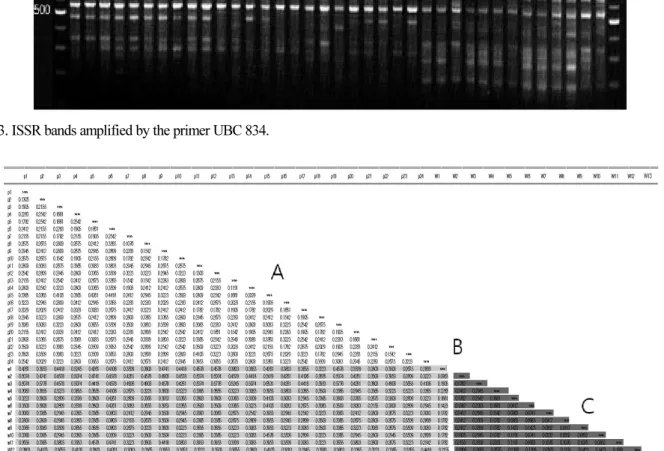
In particular, in the UBC 834 primer, a tendency of separ-

ation between the population of typical P. occidentalis and

the population of white platanus that had outer layers eliminated

was seen. In the case of UBC 834 primer, there were a total of

10 bands that appeared as a result of amplification in 550,

(6)

Fig. 2. Automatic sequencing profile of the P. occidentalis Variant (W5).

Table 5. List of 10 ISSR primers and the result for P. occidentalis

Primer Total no. of bands No. of polymorphic bands Fragment size range (bp)

UBC 811 8 6 500-1200

UBC 834 10 9 500-1500

UBC 835 10 10 500-1500

UBC 844 10 9 500-1300

UBC 846 9 9 500-1200

UBC 855 10 8 500-1300

UBC 856 10 10 500-1400

UBC 879 9 9 500-2100

UBC 881 13 12 500-2000

UBC 897 9 9 500-1200

Total 98 91 500-2100

700, 750, 800, 850, 900, 1000, 1100, 1300 and 1500 bp, and, of these, common bands were seen in 550 bp, and there were 9 bands that were polymorphistic. Although there might be differences in terms of resolution, as compared to the typical P. occidentalis, the white individual bodies did not show bands in 850, 900, 1000, 1100, 1300 and 1500 bp, whereby displaying a tendency in which the typical P. occidentalis and

white platanus separated (Fig. 3).

As a result of obtaining -based on the total of 98 amplified

fragments obtained from 10 primers- a dissimilarity index matrix

through the genetic distance of Nei (1972), the individual

bodies of the white platanus population were seen to be geneti-

cally closer than the individual bodies of the P. occidentalis

population.

(7)

Fig. 3. ISSR bands amplified by the primer UBC 834.

Fig. 4. UPGMA dendrogram showing the relationships among 37 population, based on data of genetic distance obtained by ISSR.

In regard to the genetic distance, the distance between white individual bodies W7 and W8 showed the closest genetic relationship with 0.041, and the P19 (collected in Ansan) of the typical P. occidentalis and white individual body W3 were seen to be the farthest with 0.577. In a comparison in terms of inter populations, the average genetic distance of the white platanus individual body population was seen to be 0.181 (Part C of Fig. 4), the typical P. occidentalis individual body population was 0.259 on average (Part A of Fig. 4), and the average genetic distance between the individual bodies of the white platanus and typical P. occidentalis was seen to be 0.364 (Part B of Fig. 4). As such, the individual bodies of the white platanus population were genetically closer than the individual bodies of the typical P. occidentalis population, and the genetic distance between the typical P. occidentalis

and the white platanus was found to be relatively distant.

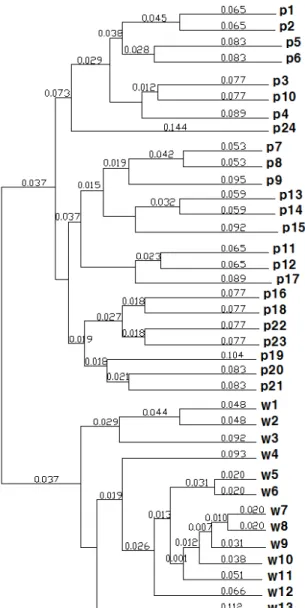
In addition, as a result of conducting a cluster analysis using the genetic distance in accordance with the UPGMA method as shown in Fig. 5, the white platanus individual bodies were largely clustered together, whereby becoming fractionized as an independent binary population. As such, the white platanus was deemed to have a genetic uniqueness, and it was deemed to be determined by genetic factors rather than the environment, regardless of the collection areas.

In conclusion, because variations were seen in the leaf

shapes and in the number of bell-shaped fruits of the white

platanus, which seems to be a variant of P. occidentalis,

assessments based on the types were difficult to be carried

out; therefore, white platanus was identified as P. occidentalis

through the results of conducting SNP analyses.

(8)

Fig. 5. UPGMA dendrogram showing the relationships among 37 population, based on data of genetic distance obtained by ISSR.

White platanus, by displaying a tendency of separating from the typical P. occidentalis in the UBC 834 through ISSR analysis, was found to show differences in terms of genetics as compared to the typical P. occidentalis. In addition, as a result of a cluster analysis using the genetic distance, based on the fact that the clustering of white individual bodies was observed, P. occidentalis that has white bark has a genetic uniqueness and this was confirmed as being attributable to the genetic factors rather than the environment.

“Gene center theory” of Vavilov (1926) is that there are more recessive individual bodies in occur places farther away.

Thus, white platanus is the same species with P. occidentalis but it is estimated to be propagated that individual bodies expressed recessive gene are propagated by unsexual pro- pagation.

Acknowledgements

This work was supported by the research grant of the Chungbuk National University in 2010.

Literature Cited

Cemmamo, P. and D. Cafasso. 2002. Molecular markers as a tool for the identification of hybrid plane tree. Delpinoa.

44:89-94.

Gupta, P.K., J.K. Roy and M. Prasad. 2001. Single nucleotide polymorphisms (SNPs): a new paradigm in molecular marker technology and DNA polymorphism detection with emphasis on their use in plants. Current Sci. 80(4):524-535.

Jorde, L.B. 2000. Linkage disequilibrium and the search for complex disease gene. Genoime Res. 10:1432-1444.

Kaundun, S.S. and S. Matsumoto. 2003. Identification of pro- cessed japanese tea based on polymorphism generated by STR-RFLP analysis. J. Agric. Food Chem. 51: 1765-1771.

Lee, J.S., E.W. Noh, S.S. Jang, S.K. Lee, E.R. Noh and D.K.

Lee. 1994. . Korean J. Breed. 26(4):335-339.

Nei, M. and W.H. Li. 1979. Mathematical model for studying genetic variation in terms of restriction endonuclease. Proc.

Natl. Acad. Sci. USA. 76:5269-5273.

Park, H.C., K.K. Kim, Y.G. Kim, S.M. Lee, H.J. Son, I.S. Choi and T.S. Shin. 2007. Control effect of the newly developed insecticidal protectant on Sycamore lace bug, Corythucha ciliata (Hemiptera: Tingidae). J. Life Science. 17(6):828-830.

Shinozaki, K., M. Ohme, M. Tanaka, T. Wakasugi, N.

Hayshida, T. Matsubayashi, N. Zaita, J. Chunwongse, J.

Obokata, K. Yamaguch Shinozaki, C. Ohto, K. Torazawa, B.Y. Meng, M. Gugita, H. Deno, T. Kamogashira, K.

Yamada, J. Kusuda, F. Takaiwa, A. Kato, N. Tohdoh, H.

Shimada, and M. Sugiura. 1986. The complete nucleotide sequence of the tobacco chloroplast genome; it gene organi- zation and expression. EMBO J. 5:2043-2049.

Vavilov, N. I. 1926. Studies on the origin of cultivated plants.

Bull. Appl. Bot. Leningrad. 16:1-248.

White, T.J., T. Bruns, S. Lee and J.W. Taylor. 1990. Amplifi-

(9)

cation and direct sequencing of fungal ribosomal RNA genes for phylogenetics, In PCR Protocals: A guide to methods and amplication. Academic Press. pp. 315-322.

Zietkiewicz, E., A. Rafalski and D. Labuda. 1994. Genome finger-

printing by simple sequence repeat (SSR)-anchored polymerase chain reaction amplification. Genomic. 20:176-183.

(Received 23 May 2012 ; Revised 21 June 2012 ; Accepted 24 June 2012)

수치

Fig. 1. P. occidentalis with general bark (left) and White bark  (right).
Table 1. Locality of P. occidentalis
Table 3. List of ISSR primer codes and sequence employed for this analysis
Table 4. ITS 1 and 2 sequence of analyzed Platanus species ITS 1 sequence Result of Cemmamo & Cafasso P
+4

참조

관련 문서