Optimized Recipe for Cookies with Dried Danggue Powder Determined by Response Surface Methodology
Nami Joo, Sun-Mee Lee† and Hee Sun Jeong1 Dept. of Food & Nutrition, Sookmung Women's University
1Graduate School of Professional Studies Traditional Culture and Arts, Sookmyung Women's University
당귀분말을 첨가한 냉동쿠키 제조 조건의 최적화
주나미․이선미†․정희선1
숙명여자대학교 식품영양학과, 1숙명여자대학교 전통문화예술대학원 식생활문화전공
Abstract
This study was conducted to develop a recipe for a nutritional cookie containing Danggue powder, and to achieve an optimal ingredient composition and texture that would appeal to consumers of all ages. To reduce its content, wheat flour was partially substituted with Danggue in the formulation. Response surface methodology was used to analyze the measured results and showed 16 experimental points, including 2 replicates for the Danggue powder, brown sugar, and butter ingredients. The compositional and functional properties were measured, and these values were applied to a mathematical model. A canonical form and perturbation plot showed the influence of each ingredient on the final product. The sensory evaluation results indicated significant differences between samples for color (p<0.01), flavor (p<0.01), texture (p<0.05), and overall quality (p<0.05). As a result, the optimal ingredient levels for sensory quality were determined as 4.83 g of Danggue powder, 70.46 g of brown sugar, and 86.08 g of butter.
Key words : Danggue powder, cookie, response surface methodology, optimization, sensory evaluation.
†Corresponding author : Sun-Mee Lee, Tel : +82-2-710-9471, Fax : +82-22-710-9479, E-mail : [email protected]
Introduction
Danggue (Angelica gigas Nakai) is a plant of the Umbelli- ferae family in Angelica (Yuk & An 1973). The plant is usually picked and dried before its flowers bloom and is com- monly found in central and northern Korea. It has been used to treat bed cough, sterility, swelling and to help our bodies keep warm as a traditional Korean medicine (Shin 1986). It contains vitamin B12, folic acid and iron helping to build blood cells as well as vitamin E which helps to reduce in- flammation, increase immunity and strengthen the liver(Park 2002).
Also Danggue is reported to have anti-cancer properties especiallyfor liver cancer (Ham et al 1996) and the polysa- ccharides and minerals in the pectin are seem to stimulate the human immune system (Ahn et al 1996). So far, there have been studies on Danggue as a perfume or as a medical in- gredient, however there is only Hondonbyung (Choi & Kim
2006) which studied the possibility of Danggue as a food ingredient.
Cookies are sweet small cakes that are widely consumed as food, appreciated for their taste, versatility, convenience, long shelf life, texture and appearance. The use of natural ingre- dients, exhibiting additional properties and providing specific health benefits beyond traditional nutrients, is a very attractive way to design new food products, with an important market niche presently exhibiting pronounced growth (Luisa et al 2007).
The objectives of this study were to partially replace wheat flour in the formulation of cookies with different amounts of onion powder and to perform a systematic inve- stigation of how different process conditions influence phy- sicochemical properties of cookies with lotus root powder using response surface methodology (RSM), as well as to de- termine the optimal conditions for producing lotus root coo- kies, and to provide reliable experimental data for the baking process in developing new types of functional foods (Kim et al 2007).
Material and Methods
1. Material
The Danggue powder used in this experiment was obtained from Song-sang food (Korea). Confectionary flour was Dae- han Flour Mills (Daehan, Korea) cake flour. Also, salt-free butter was used along with baking powder, brown sugar (CJ, Korea), salt (Sempio, Korea) and eggs (Younglim, Korea).
2. Experiment Design
The Design Expert 7 Program was used for all research plans, data analysis and optimization analysis on cookies with Danggue powder. Three factors were chosen as independent variables which were the content level of Danggue powder as a partial replacement for flour, sugar and butter, and as de- pendent variables, chromaticity (L, a, b), spread ratio, hard- ness and sensory evaluation (color, appearance, flavor, texture and overall quality) were chosen. The maximum and mini- mum ranges of Danggue powder, sugar and butter were deter- mined to be 3~12 g, 40~80 g, and 80~120 g respectively from preexamination. The experimental points of Central Com- posite consist of the most central point, ±α point (axial point) and ±1 level point (factorial point), and between these expe- rimental points, there exists an iterative point for the selection of a model and the verification of fitness lack. Accordingly, when each established scope was inputted, forming 16 experi- mental points, 2 iterative points were selected through the establishment of replication (Seo et al 2006). The Formula for cookies with Danggue powder is as seen in Table 1.
3. Cookie Preparation and Baking
Danggue cookies were prepared according to the AACC
Table 1. Formula for cookie
Ingredients Weight(g)
Danggue powder 3~12
Wheat flour 138~147
Brown sugar 40~80
Butter 80~120
Whole egg 30
Baking powder 1
Salt 1
method 1052 (AACC 1995)with modification. To begin, butter was added to sugar and salt which was then creamed in a mixer (Model K5SS, Kitchen Aid Co., Joseph, Michigan, U.S.A) equipped with awire whip beater and set at the 4th- speed setting for 3 min. Egg was added to the mix using a flat beater with intermittent scraping of the creamed mass every 1 min. Afterward, wheat flour, Danggue powder and baking powder were added to the creamed mass over a period of 1 min during mixing at a low speed setting of the machine. The completed dough was aged for 1 hour in a 4℃ refrigerator and then sheeted to a thickness of 20, 15, 12, and 8 mm with the help of a rolling pin. The cookies were cut out with a cookie die of diameter 4 cm and transferred to a lightly greased baking tray. The cookies were baked at 165℃ for 13 min in a convection oven (RSF-22, Rinnai Co., Incheon, Korea). The baked cookies were cooled to room temperature for 1 hour.
The cookie samples were removed from the baking sheet and placed in an air tight plastic bag for analysis.
4. Color Measurement
The color values (L, a and b value) of Danggue cookies were measured using a colorimeter (Colormeter CR-200, Mi- nolta Co., Japan). The colorimeter was calibrated using a stan- dard white plate with L, a and b values of 97.26, -0.07 and +1.86, respectively. Three measurements were made for each sample.
5. Spread Factor Measurement
The spread factor was measured according to AACC 10-52 and was calculated as follows:
Spread factor = Average diameter of cookie (mm/EA) Average height of cookie (mm/EA)
6. Texture Analysis
A rheometer (Compac-100, Sun Scientific Co., Ltd., To- kyo, Japan) mounted with a plunger (adapter No. 4) was used.
The adapter was pressed 5 mm into the centre of each sample, then moved upward to the plunger at a speed of 140 mm/
min.The hardness unit was expressed in dyne/cm2.
7. Sensory Evaluation
Sensory evaluation was done according to the seven-point
hedonic scale. Processed Danggue cookie was evaluated for its sensoryquality by a 16-student panel at Sookmyung Wo- man's University. All panelists were conversant with the fac- tors governing the quality of the product. The Danggue cookie prepared for each test sample was assigned a random 4 digit number. The panelists were asked to evaluate the color, appea- rance, flavor, texture and overall quality of the cookies by awarding a score ranging from 1 (dislike extremely) to 7 (like extremely).
8. Optimization
Through numerical optimization of a Canonical Model and graphical optimization, the optimal quantities of Danggue pow- der, sugar and butter were determined with the optimal point selected using point prediction.For numerical optimization, the goal area was set according to the coefficients of the standard canonical modelcorresponding to the highest sensory test re- sults.
The optimal point showing the highest desirability was selected after acquiring the desirability through the following formula.
Here, D is the overall desirability, d is each desirability and n is the number of reponses.
9. Statistical Analysis
Statistical analysis of variance (ANOVA) and multiple re- gression were performed using the Design-Expert 7 program (Stat-Easy Co., Minneapolis). The results included the signi- ficance of the model and of each of its terms in the model equation, the estimated model coefficients, the coefficient of determination, and the lack of fit test.
Result and Discussion
1. Physical Characteristics
Using Central Composite Design, the results of physical mea- surements from 16 conditions with 3 variables are obtained as in Table 2 with the purpose of optimizing the manufacturing conditions for Daggue powder cookies. The model equations and, the coefficients of determination of the model equation are given in Table 3.
1) Color Value
The values of (L), (a) and (b) were in the ranges of 56.71~
68.94, 4.29~7.54, and 19.15~24.86, respectively. The analy- sis of (L) shows that lightness decreased significantly (p<
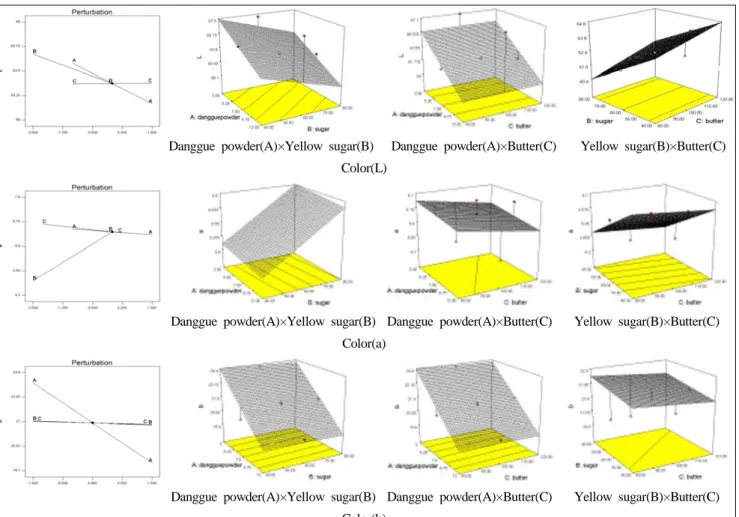
0.01) with an increase in Danggue powder and sugar, but that there was little influence with additional butter. The evalua- tion of (a) values showed that increased sugar significantly (p<0.05) increased redness in cookies. The (b) values of coo- kies were hardly influenced by the amounts of sugar and butter. On the other hand, the (b)value was significantly re- duced with additional Danggue powder. The (b) value is also very significant (p<0.0001). Shown in Fig. 1 is the response surface for the effect of Danggue powder, sugar and butter on color (L, a, b) on the cookies. Similar results in the (L) value of cookies made with green tea (Shin & Roh 1999) or Bam- boo leaf powder (Lee et al 2006) were also reported showing the effects of ingredients manifesting differences in chroma- ticity.
These browning reactions which take place at the cookie surface are understood to result from the browning reactions for caramelization and the composition ratio with amino com- pounds during the baking process.
2) Spread Ratio
Correlation between ingredients and the spread ratio of the cookies was significant (p<0.0001). It was shown that the more sugar and butter was added, the more the cookie spread ratio increased (Fig. 2).
Singh and Mohamed reported that the spread factor was decreased with increased protein in cookies (Singh & Mo- hamed 2007). Replacement of soft wheat flour with onion pow- der resulted in cookies with higher spread factor (Kim et al 2007). The spread factor was also influenced by the rheolo- gical properties and moisture content of the dough. In addition, Ko and Joo reported that substitution of Jinuni bean powder increased the cookie spread factor and suggested that the replacement might have interfered with gluten formation in the sample (Ko & Joo 2005).
3) Hardness
Correlation between ingredients and cookie hardness was significant (p<0.01). It was shown that the hardness of coo- kies was in proportion to the added amount of sugar, but in- versely proportional to the added amount of butter (Fig. 2).
According to Park et al (2005), cookie hardness results during
Table 2. Experimental data under various composition of Danggue powder, brown sugar, butter and their physical properties of Danggue cookie
Sample No.
Variable levels Responses
Danggue powder (g)
Brown sugar (g)
Butter (g)
Light- ness
Redn- ess
Yellow- ness
Spread atio
Hardness (dyne/cm2)
1 3 40 80 67.26 5.39 24.69 4.91 333056
2 12 40 80 59.90 5.75 21.01 4.71 302525
3 3 80 80 61.88 7.54 24.67 5.61 1083634
4 12 80 80 58.04 5.90 19.15 5.21 1041956
5 3 40 120 68.94 4.29 24.86 5.64 316728
6 12 40 120 59.43 4.81 19.21 5.68 277855
7 3 80 120 62.79 7.24 24.31 7.14 674207
8 12 80 120 56.71 6.85 19.86 7.05 221112
9 3 60 100 67.04 4.72 24.14 5.77 260148
10 12 60 100 67.07 4.90 19.78 5.77 252567
11 7.5 40 100 64.74 4.31 20.93 5.65 353834
12 7.5 80 100 61.47 5.45 21.60 6.41 523021
13 7.5 60 80 62.17 6.01 21.33 5.32 655411
14 7.5 60 120 61.79 5.86 21.74 5.88 411582
15 7.5 60 100 62.66 6.03 21.81 5.89 243970
16 7.5 60 100 62.72 5.71 21.65 5.90 237365
1) L (white + 100↔ 0 black), a (red + 60 ↔ -60 green), b (yellow + 60 ↔ -60 blue).
Table 3. Analysis of predicted model equation for the physical characteristics of Danggue cookie
Responses Model R-squared F-value P-value
Prob > F Equation of on terms of pseudo component
L Linear 0.6028 6.07 0.0093** 67.79 - 2.68A - 1.94B + 0.041C
a Linear 0.5385 4.67 0.0220*** 5.67 - 0.097A + 0.84B - 0.15C
b Linear 0.9250 49.31 <0.0001*** 21.92 - 2.37A - 0.11B - 0.087C Spread ratio Linear 0.8651 25.65 <0.0001*** 5.78 - 0.065A + 0.48B + 0.56C
Hardness Quadratic 0.9366 9.84 0.0058** 3.001 - 57175.80A + 1.960B - 1.515C - 53171.13AB - 52469.88AC - 1.487BC - 73508.22A2+ 1.086B2+ 2.036C2
1) A : Danggue powder, B : Brown sugar, C: Butter.
2) 0<R2<1, close to 1 means more significant.
3) *
p<.05, ** p<.01, *** p<.001.
manufacturing when it is influenced by moisture from supple- mental Ingredients.
2. Sensory Evaluation
The values of color, appearance, flavor, texture and overall
quality were in the ranges of 2.67~5.67, 2.67~5.67, 2.17~
5.33, 3.17~4.83 and 2.50~5.17, respectively (Table 4). The Danggue cookies showed significant results for color (p<0.01), flavor (p<0.01), texture (p<0.05), and overall quality (p<0.05).
However, appearance was not significant (p<0.05). The model
Danggue powder(A)×Yellow sugar(B) Danggue powder(A)×Butter(C) Yellow sugar(B)×Butter(C) Color(L)
Danggue powder(A)×Yellow sugar(B) Danggue powder(A)×Butter(C) Yellow sugar(B)×Butter(C) Color(a)
Danggue powder(A)×Yellow sugar(B) Danggue powder(A)×Butter(C) Yellow sugar(B)×Butter(C) Color(b)
Fig. 1. Response surface for the effect of Danggue powder(A), yellow sugar(B), butter(C) on color of Danggue cookie.
Danggue powder(A)×Yellow sugar(B) Danggue powder(A)×Butter(C) Yellow sugar(B)×Butter(C) Spread ratio
Danggue powder(A)×Yellow sugar(B) Danggue powder(A)×Butter(C) Yellow sugar(B)×Butter(C) Hardness
Fig. 2. Response surface and perturbation plot for the effect of Danggue powder(A), yellow sugar(B), butter(C) on physical characteristics of Danggue cookie.
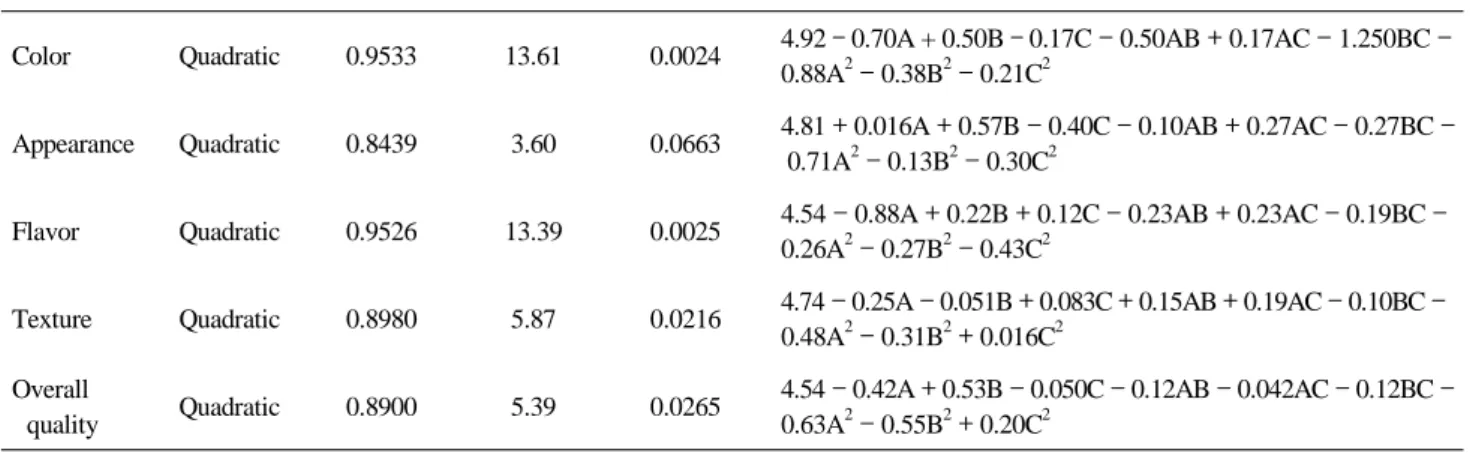
equations and coefficients of determination of the model equations are given in Table 5.
Specifically regarding color, it was shown that as more
Table 4. Experimental data under various composition of Danggue powder, brown sugar, butter and sensory properties of Danggue cookie
Sample No.
Variable level Responses
Danggue powder (g) Brown sugar (g) Butter (g) Color Appearance Flavor Texture Overall quality
1 3 40 80 3.50 3.00 3.83 4.33 2.83
2 12 40 80 2.83 3.00 2.17 3.17 2.50
3 3 80 80 5.67 5.17 5.33 4.33 4.50
4 12 80 80 2.83 4.33 2.67 3.50 3.67
5 3 40 120 2.83 2.67 4.00 4.50 3.50
6 12 40 120 2.67 3.33 3.17 3.83 3.00
7 3 80 120 4.83 3.33 4.67 3.83 4.67
8 12 80 120 2.83 4.00 3.00 4.00 3.67
9 3 60 100 4.50 4.50 5.17 4.33 4.67
10 12 60 100 3.17 4.17 3.17 4.33 3.17
11 7.5 40 100 4.00 4.50 4.33 4.67 3.67
12 7.5 80 100 4.67 5.33 4.00 4.33 4.33
13 7.5 60 80 4.50 5.67 3.83 4.83 5.17
14 7.5 60 120 4.50 3.83 4.17 4.83 4.33
15 7.5 60 100 5.33 4.17 4.83 4.67 4.33
16 7.5 60 100 5.33 4.50 4.67 4.50 4.67
Table 5. Analysis of predicted model equation for the sensory characteristics of Danggue cookie
Responses Model R-squared F-value P-value
Prob > F Equation of on terms of pseudo component
Color Quadratic 0.9533 13.61 0.0024 4.92 - 0.70A + 0.50B - 0.17C - 0.50AB + 0.17AC - 1.250BC - 0.88A2- 0.38B2- 0.21C2
Appearance Quadratic 0.8439 3.60 0.0663 4.81 + 0.016A + 0.57B - 0.40C - 0.10AB + 0.27AC - 0.27BC - 0.71A2- 0.13B2- 0.30C2
Flavor Quadratic 0.9526 13.39 0.0025 4.54 - 0.88A + 0.22B + 0.12C - 0.23AB + 0.23AC - 0.19BC - 0.26A2- 0.27B2- 0.43C2
Texture Quadratic 0.8980 5.87 0.0216 4.74 - 0.25A - 0.051B + 0.083C + 0.15AB + 0.19AC - 0.10BC - 0.48A2- 0.31B2+ 0.016C2
Overall
quality Quadratic 0.8900 5.39 0.0265 4.54 - 0.42A + 0.53B - 0.050C - 0.12AB - 0.042AC - 0.12BC - 0.63A2- 0.55B2+ 0.20C2
1) A : Danggue powder, B : Brown sugar, C: Butter.
2) 0<R2<1, close to 1 means more significant.
3) * p<.05, ** p<.01.
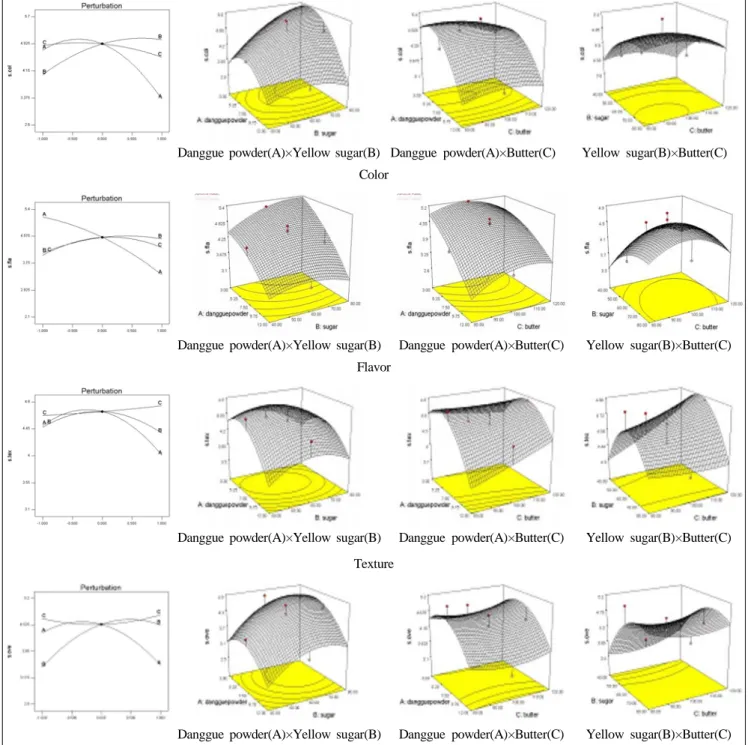
Danggue powder was added, the preference in color decreased (Fig. 3). Cookie texture was found to be influenced by butter in general. A similar result in the texture of cookies made
with Yam powder was also reported (Joo et al 2008). As for overall quality, it was shown that as the content of Danggue powder increased, the preference in overall quality decreased (Fig. 3). It was found that when additional Danggue powder is reduced, the Sensory evaluation value improves. To add Danggue to food besides its use in traditional medicine, it is
Danggue powder(A)×Yellow sugar(B) Danggue powder(A)×Butter(C) Yellow sugar(B)×Butter(C) Color
Danggue powder(A)×Yellow sugar(B) Danggue powder(A)×Butter(C) Yellow sugar(B)×Butter(C) Flavor
Danggue powder(A)×Yellow sugar(B) Danggue powder(A)×Butter(C) Yellow sugar(B)×Butter(C) Texture
Danggue powder(A)×Yellow sugar(B) Danggue powder(A)×Butter(C) Yellow sugar(B)×Butter(C) Overall palatability
Fig. 3. Response surface and perturbation plot for the effect of Danggue powder(A), yellow sugar(B), butter(C) on sensory characteristics of Danggue cook.
required that its taste and scent be softened without damaging its physiology benefits.
3. Optimization
The optimal amounts of Danggue powder, sugar and butter were selected through numerical optimization on a canonical
Danggue powder(A)×Yellow sugar(B) Danggue powder(A)×Butter(C) Yellosugar(B)×Butter(C) Fig. 4. Response surface plot for optimization mixture on desirability of Danggue cookie.
Danggue powder(A)×Yellow sugar(B) Danggue powder(A)×Butter(C) Yellosugar(B)×Butter(C) Fig. 5. Overlay plot of common area for the optimization mixture of Danggue cookie.
model and through graphical optimization. All the significant items shown in the sensory evaluation were determined by their maxima, from which the response formula determined by the modeling was utilized. And the numerical point was selected through numerical optimization (Fig. 4) and graphical optimization (Fig. 5). The optimal point with the highest desi- rability was deduced through point prediction, and the pre- dicted optimal values were 4.83 g of Danggue powder and 70.46g of sugar for every 86.08 g of butter.
4. Conclusions
Central Composite Design was used for the purpose of optimizing the manufacturing conditions for Danggue powder cookies. The compositional and physical properties were measured, and these values were applied to a mathematical model. A canonical form and perturbation plot showed the influence of each ingredient on the final mixture product. The sensory evaluation results showed significant values in color (p<0.01), flavor (p<0.01), texture (p<0.05) and overall quality (p<0.05). As a result, the optimal sensory ratio was deter- mined to be 4.83 g of Danggue power, and 70.46 g of sugar for every 86.08 g of butter.
As a result of this study, Danggue cookies are considered to be competitive in functionality, quality and preference. Op-
timization to determine the mixing ratio satisfying consumer preferences and theirwill be the subject of further needed re- search.
References
Ahn KS, Sim WS, Kim HM, Han SB, Kim IH (1996) Immu- nostimulating components from the root of Angelica gigas Nakai. Korean J Pharmacogn 27: 254-261.
American Association of Cereal Chemists AACC Approved Methods of the AACC. 9th ed (1995) American of Cereal Chemists. St. Paul, MN. P 1052.
Choi EJ, Kim HS (2006) Acceptance of hondonbyung with different mixing ratio of leaf and root of Angelicae pow- der. Korean J Food Cookery Sci.22: 88-95.
Ham MS, Kim SS, Hong JS, Lee JH, Chung EK, Park YS, Lee HY (1996) Screening and comparison of active sub- stances of Angelica gigas Nakai produced in Kangwon and Angelica acutiloba Kitagawa produced in Japan. Korean J Appl Microbiol Biotechnol 24: 624-629.
Joo NM, Lee SM, Jung HS, Park SH, Song YH, Shin JH, Jung HA (2008) Optimization of cookie preparation by addition of yam powder. Korean J Food Preserv 15: 49-57.
Kim HR, Seog EJ, Lee JH (2007) Effects of onion powder
and baking temperature on the physicochemical properties of cookies. Korean J Food Sci Nutr 12: 160-166.
Lee JY, Ju JC, Park HJ, Heu ES, Choi SY, Shin JH (2006) Quality characteristics of cookies with bamboo leaves pow- der. Korean J Food & Nutr 19: 1-7.
Luisa G, Ana PB, Ana M, Jos E, Anabela R (2007) Chlorella vulgaris biomass used as colouring source in traditional butter cookies. Innovative Food Science and Emerging Te- chnologies 8: 433-436.
Park BH, Cho HS, Park SY (2005) A study on the antioxi- dative effect and quality characteristics of cookies made with Lycii fructus powder. Korean J Food Cookery Sci 21: 94-102.
Park YS (2002) Traditional Oriental medicine pharmacology comment, Academy Publisher, Seoul. Republic of Korea.
pp 122-123.
Seo MJ, Jung SJ, Jang MS (2006) Optimization of ingredient mixing ratio for preparation of steamed foam cake with barley (Hordeum vulgare L.) sproutling powder. Korean J Food Cookery Sci 22: 815-824.
Shin GM, Roh SH (1999) A Study on the texture of cookie depending the quality of green tea. Culinary Research 5:
133-146.
Shin MG (1986) Color clinic phytologym, Nam San Dang., Seoul. Republic of Korea. p 221-223.
Singh M, Mohamed A (2007) Influence of gluten-soy protein blends on the quality of reduced carbohydrates cookies.
Lebensm-Wiss u-Technol 40: 353-360.
Yuk CS, An DG (1973) Modern phytology. Gyomunsa, Seoul.
Republic of Korea. p 158.
(2009년 1월 8일 접수, 2009년 4월 3일 채택)