Response of the Growth Characteristics and Phytochemical Contents of Pepper (Capsicum annuum L.) Seedlings with Supplemental LED
Light in Glass House
Md. Obyedul Kalam Azad, Ik Jo Chun, Jeong Hak Jeong, Soon Tae Kwon, and Jae Moon Hwang*
Department of Horticulture and Breeding, School of Bioresource Sciences, Andong National University, Andong 760-749, Korea
Abstract. This research was conducted to evaluate the effect of supplemental light-emitting diode (LED) light on growth characteristics and phytochemical content of pepper (Capsicum annuum L.) seedling using LED blue (470 nm, B), red (660 nm, R), blue + red (BR), far red (740 nm, FR) and UV-B (300 nm) light treatment, and without artificial light. Photon flux of LED light was 49, 16, 40, 5.0 and 0.82µmol m−2 s−1 for B, R, BR, FR, and UV-B light, respectively, during experiment. Supplemental LED light duration was 16 hr day−1 and UV-B light duration was 10 min. per day after sunset up to 15 days (12 days after germina- tion) of plants age. In our research, growth characteristics and phytochemical content of pepper seedlings were greatly influenced by supplemental LED light compare to control treatment. Red light increased the number of leaves, number of nodes, leaf width and plant fresh weight by 34%, 27%, 50% and 40%, respec- tively. Blue light increased the leaf length by 13%, and stem length and length of inter node were increased by 17% and 34%, respectively under grown far red light. After 15 days of light treatments phytochemical concentrations of pepper plants were significantly changed. Blue light enhanced the total anthocyanin and chlorophyll concentration by 6 times and 2 times, respectively. Red light increased the total phenolic com- pound at least two folds meanwhile far red light reduced the ascorbic acid and antioxidant activity 31% and 66%, respectively compared to control treatment.
Key words : anthocyanin, antioxidant activity, ascorbic acid, baby leaf vegetables, chlorophyll, growth status, light quality, phenolic compound
Introduction
Sunlight is one of the most important factors for green plants because their process of photosynthesis cannot be done without the light. However, sometimes the inten- sity of sunlight is not enough for plants to grow well, and plants cannot obtain long or strong enough light because of continuous overcast and rainy days. Especially, this kind of problem is serious in greenhouse production for vegetables, since there are many structures and cover- ings. The measure of solving the light scarcity for veg- etable growth is to supplement light using artificial light source.
Light-emitting diodes (LEDs) present a versatile alter-
native for articial greenhouse lighting with numerous advantages. It is also affecting phyto-chemical concen- trations (Kopsell and Kopsell, 2008) as well as growth of plants. It is widely understood that light quality could positively affect phytochemical accumulation (Vergeer et al., 1995). UV-A induction of anthocyanins accumulation was observed in lettuce (Tsormpatsidis et al., 2008), and blue (B) light increased levels of anthocyanins in tomato (Giliberto et al., 2005), carotenoids in coffee (Ramalho et al., 2002) and ascorbic acid in lettuce and Komatsuna. In contrast, in cranberry fruits, red light seems to be most effective in anthocyanin production (Zhou and Singh, 2002).
However, most studies examined only a few selected light qualities at one time and there are no reports exam- ining the effects of all the important components of light quality (UV-B, B, R and FR) affecting pepper growth
*Corresponding author: [email protected]
*Received March 21, 2011; Revised August 25, 2011;
*Accepted September 1, 2011
and/or phytochemical accumulation in plants growing in glass house. Furthermore, information on light quality, quantity to growth and phytochemical production of pep- per vegetables will help us in designing the greenhouse light environment to obtain vegetables with enhanced phytochemical concentrations. Pepper was selected for its usage of a baby leafy vegetable and richness of phy- tochemical.
Materials and Methods
1. Plant materials and growing condition
Pepper seeds (cultivar: Younggo 4 no. germination % 96) were sown in a plastic nursery box (length 60 cm, width 30 cm and depth 3 cm) and distance among the seedlings were 4 cm, containing a commercial soil mix- ture in a growth chamber (DF-95 G-1248, Dea san Engg.
Co. Lab. Equip., Korea). Temperature was maintained at 30oC and relative humidity was 50% during germination in growth chamber. Two boxes (two replications) were subjected (10 days after seeding) to each supplemental light treatment (as described below) inside the green house. This experiment was carried out from July to August in 2010 at Andong National University glass house, South Korea.
2. Supplemental light treatments
A LED light panel consist of 20 LED sticks (20 LED bulb on a stick) with a main controller (LPRS Series, Good Feeling Co. Ltd., Korea). LEDs were used for sup- plemental light source and placed horizontally 25 cm above the plant canopy. The experiments composed of six treatments with different supplementary LEDs wave- lengths: red (R) 660 nm, blue (B) 470 nm, far red (FR) 740 nm, a combination of blue and red light (BR mixed B 1 : R 1 in energy ratio), UV-B 300 nm, and natural light treatment (NL, without any supplementary light- ing) as a control. Photon flux added by supplemental LEDs for B, R, (BR), FR, and UV-B were 49, 16, 40, 5.0, and 0.82µmol m−2 s−1, respectively. Photoperiod of UV-B treatment was ten minutes per day after sunset. Photoperiod of the other treatments was 16 hours per day (05:00 to 21:00). To prevent light contamination, non reflective black unwoven fabric was placed inside frame.
3. Measurements
At 27 days after germination of pepper (15 days after providing the supplemental light) 10 seedlings of each box were collected to evaluate the growth characteristics such as stem length, length of 2nd inter node, number of node, leaf length, leaf width and plant fresh weight.
Ascorbic acid, total chlorophyll content, anthocyanin accumulation, phenolics compounds and total antioxidant activity were analyzed to determine the phytochemical contents with 10 samples of each plot.
4. Determination of ascorbic acid
A modified protocol reported by Gahler et al. (2003) was used. Fresh samples (10 g) were mixed with 40 ml of 5% Meta phosphoric acid and blended to extract ascorbic acid. The mixtures were shaken at 250 rpm for 5 minutes and then centrifuged at 3,000 ×g for 10 minutes.
The supernatants were used to determine the concentra- tion of ascorbic acid using the HPLC system equipped with C18 column (Agilent Tech. 1200 Series), sample inject 3µml, maintained at 30oC. Extract was eluted with mobile phase (HCN 5%, DI water 95 % with 0.1% for- mic acid) at a flow rate of 0.5 mL/minutes, run time 10 minutes. The absorbance of the eluant was measured at 254 nm and concentrations were determined against ascorbic acid standards (Mallinckrodt baker, Inc., Phil- lipsburg, NJ) and expressed as mg/g FW.
5. Total phenolic compounds
The method of Singleton and Rossi (1965) was used to determine total phenolic compounds. Freeze-dried samples (50 mg) were extracted with 10 ml 80% meth- anol and shaken at 240 rpm for 16 h. After filtering, 50µl of the methanolic extract was then mixed with 350µl of H2O and 200µl of 2 N Folin-Ciocalteu reagents (Sigma Chemical Co., St. Louis, Mo). The mixture was incu- bated for 1 h in 1.0 ml of 10% Na2CO3 at 25oC.
Absorbance of the incubated mixture was then meas- ured at 735 nm using a UV 5000 VIS NIR spectropho- tometer (Varian Tech., Australia) with a standard curve to estimate gallic acid (Sigma Chemical Co., St. Louis, MO) equivalent (GAE) concentrations. Total phenolic compound was expressed as milligram of gallic acid equivalents (GAE) per gram (mg GAE/g DW) of sample.
6. Anthocyanins
The extraction protocols described by Revilla et al.
(1998) were used. Freeze-dried samples (30 mg) were extracted with 5 ml 2% HCl in methanol for 36 h. The liquid extract was separated by centrifugation at 1446 ×g for 15 minutes. For each sample, separate 400µl ali- quots of extract were diluted to 2.0 ml with two different buffer solutions: potassium chloride buffer (0.025 M, pH 1.0) and sodium acetate buffer (0.4 M, pH 4.5). After 15 minutes reaction, both solutions were filtered (0.2µm pore size) and the absorbance was measured at 515 nm, where maximum absorption was confirmed in separate scans taken with a UV-5000 VIS NIR spectrophotometer (Varian Tech., Australia) and 700 nm for haze correction.
Total anthocyanins concentrations were expressed as cyaniding-3-glucoside equivalent values, following the protocol described by Giusti and Wrolstad (2005).
7. Total chlorophyll
Fresh leaf tissue (100 mg) was extracted in 5 ml N, N dimethylformamide overnight. The absorbance of extrac- tion solution was measured at 647 nm and 664 nm using a UV-5000 VIS NIR spectrophotometer (Varian Tech., Australia). Chlorophyll concentration was calculated using the equations described by Moran (1982).
8. Total antioxidant activity (TAA)
250 mg of freeze dried plant material of each accession were ground and dissolved in 10 ml of 80% acetone.
Sample extracts were rotated for 1 h in the dark and cen- trifuged at 5400 g for 10 minutes. The supernatant was used to measure the antioxidant activity.
The TAA values were estimated by the trolox equiv- alent antioxidant capacity (TEAC) assay (Sigma Aldrich;
Antioxidant assay kit, catalog number CS 0790). We
measured the relative capacity of antioxidants to scav- enge the ABTS+ radical compared to the antioxidant potency of trolox (water-soluble Vit. E) as a standard.
The method used was based on Millar and Rice-Evans (1996) modified by Lister and Wilson (2001). The absor- bance was measured at 405 nm using a plate reader (Molecular Devices Spectra Max M2 Micro plate Reader). The antioxidant capacities of samples were measured (mmol TE/g) against a trolox standard.
Results and Discussion
1. Effect of supplemental light qualities on growth of pepper seedlings
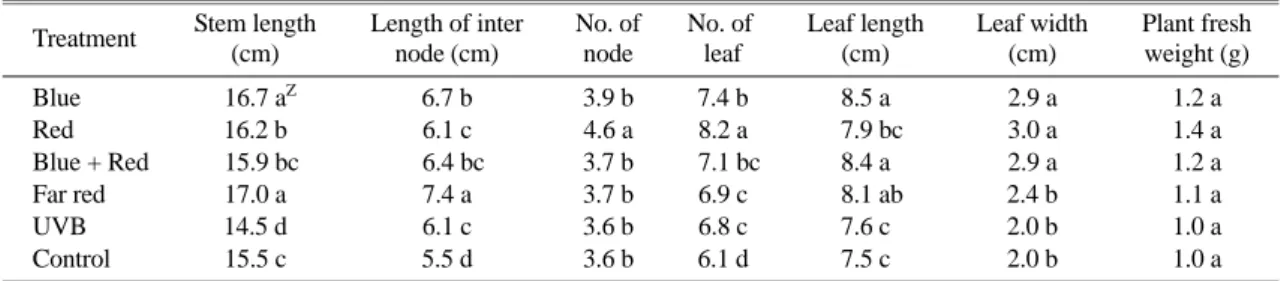
Growth characteristics of pepper seedlings were greatly influenced by different supplemental LED light treat- ments (Table 1). The leaf number, number of node, leaf width and plant fresh weight increased significantly by 34%, 27%, 50% and 40%, respectively with the supple- mental R light compared to control treatment. Supple- mental B light increased the leaf length, stem length, length of inter node, number of node, leaf width, plant fresh weight and leaf length by 21%, 15%, 21%, 8%, 45%, 13%, and 20%, respectively. Compared to control, FR light increased the stem length and length of inter node by 17% and 34%, respectively. BR light increased the leaf number, stem length, leaf length about 16%, 9%, and 12%, respectively.
Plants that increase stem extension in response to shad- ing are said to exhibit a shade avoidance response. As shading increases, the R: FR ratio decreases. The higher the far red content, higher the rate of stem extension (Taiz and Zeiger, 2002). In our research FR light treat- ment elongated the inter nod. Lowering R/FR acts as a signal for plants promote shoot elongation, which is a
Table 1. Effect of supplemental LED light qualities on the growth of pepper seedlings.
Treatment Stem length (cm)
Length of inter node (cm)
No. of node
No. of leaf
Leaf length (cm)
Leaf width (cm)
Plant fresh weight (g)
Blue Z16.7 aZ 6.7 b 3.9 b 7.4 b 8.5 a 2.9 a 1.2 a
Red 16.2 b 6.1 c 4.6 a 8.2 a b7.9 bc 3.0 a 1.4 a
Blue + Red b15.9 bc b6.4 bc 3.7 b b7.1 bc 8.4 a 2.9 a 1.2 a
Far red 17.0 a 7.4 a 3.7 b 6.9 c b8.1 ab 2.4 b 1.1 a
UVB 14.5 d 6.1 c 3.6 b 6.8 c 7.6 c 2.0 b 1.0 a
Control 15.5 c 5.5 d 3.6 b 6.1 d 7.5 c 2.0 b 1.0 a
ZMean separation within columns by DMRT at 5% level.
response likely to enhance light- foraging capacity (Fran- klin, 2008), and cell wall- modifying mechanisms are vital regulatory points for control of this elongation responses (Sasidharan et al., 2008). Blue light stimulates closed leaflet to open, and red light followed by darkness causes open leaflets to close. Blue light is very important for the growth and development of higher plants, because blue-light photoreceptors participate in many events of photomorphogenesis (Christie and Briggs, 2001). Sup- plementing blue light promotes dry matter production in several plant species, including pepper (Brown et al., 1995), spinach (?), radish (?) and lettuce (Yorio et al., 2001).
Red light may increase starch accumulation in several plant species by inhibiting the translocation of photosyn- thates out of leaves (Saebo et al., 1995). In contrast, blue light is important in the formation of chlorophyll (Senger, 1982), chloroplast development (Akoyunoglou and Anni, 1984), stomatal opening (Zeiger, 1984), enzyme synthe- sis (Senger, 1982). Physiological responses to spectral changes can vary among dierent plant species (Senger, 1982). Basic plant research has demonstrated that spe- cific light wavelength may affect plant physiology, such as germination, stem growth (Parks et al., 2001) and bio- mass production (Kim et al., 2004). Red light is impor- tant for shoot and stem elongation, phytochrome responses and changes in plant anatomy (Schuerger et al., 1997). In contrast, blue light is important in chlorophyll biosynthe- sis, stomatal opening, enzyme synthesis, maturation of chloroplast and photosynthesis (Tibbits et al., 1983). It is known that chlorophyll has the second distinct absorption peak in the vicinity of 450 nm (blue light region) other than the first peak in the vicinity of 660 nm (red light region) in its light absorption spectrum. The blue light is
also indispensible for the morphologically healthy plant growth. Blue and red LEDs light have been used for studies in many areas of photo biological research such as photosynthesis, chlorophyll synthesis (Tripathy and Brown, 1995) and morphogenesis (Brown et al., 1995).
2. Effect of supplemental light qualities on phytochemicals accumulation of pepper seedling
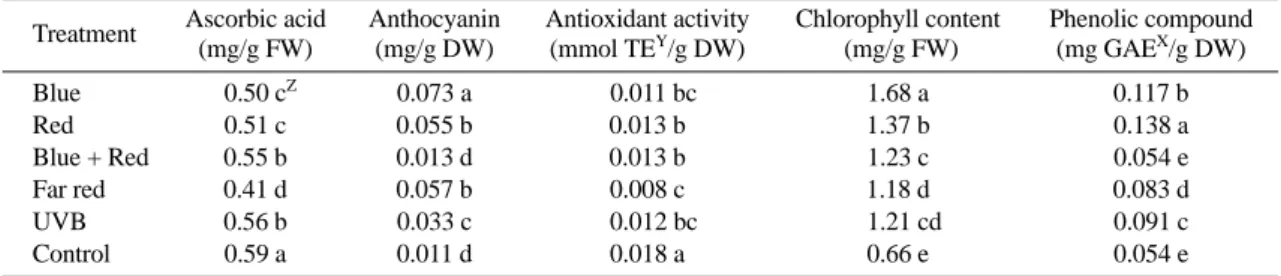
Phytochemicals concentrations in pepper were signif- icantly affected by different light quality treatments (Table 2). Anthocyanin and chlorophyll contents were increased 6 folds and 2 folds of pepper seedlings grown under blue LED light treatments compared to control, respectively. Red light also increased the Anthocyanin accumulaton, cholorophyll content and total phenolic compound about 5 folds, 2 folds and 2.5 folds, respec- tively. Blue, red and far red LEDs light reduced the ascorbic acid at least 14%, 13%, and 31% compared with control treatment, respectively. Antioxidant activity was also reduced about 39%, 55%, and 33% with supplemen- tal blue, far red, and UV-B light, respectively.
Blue light has been shown to be one of the most effec- tive wavelengths regulating anthocyanin biosynthesis in tomato, and cyptochrome acts as blue light photoreceptor corresponding to this response (Giliberto et al., 2005).
Another study employing monochromatic light had shown that blue light promoted gene expression of CHS (chal- cone synthase) and DFR (dihydroflavonol-4-reductase) which regulates the anthocyanins pathway (Meng et al., 2004). In pea seedlings, chlorophyll in leaves increased rapidly when seedlings were radiated by blue light (Ming et al., 2007). Blue light is important for chloroplast devel- opment, chlorophyll formation and stomata opening (Sen- ger, 1982). In amaranths vegetables anthocyanins and
Table 2. Effect of supplemental light qualities on phytochemical content of pepper seedlings.
Treatment Ascorbic acid (mg/g FW)
Anthocyanin (mg/g DW)
Antioxidant activity (mmol TEY/g DW)
Chlorophyll content (mg/g FW)
Phenolic compound (mg GAEX/g DW)
Blue Z0.50 cZ 0.073 a b0.011 bc 1.68 a 0.117 b
Red 0.51 c 0.055 b 0.013 b 1.37 b 0.138 a
Blue + Red 0.55 b 0.013 d 0.013 b 1.23 c 0.054 e
Far red 0.41 d 0.057 b 0.008 c 1.18 d 0.083 d
UVB 0.56 b 0.033 c b0.012 bc b1.21 cd 0.091 c
Control 0.59 a 0.011 d 0.018 a 0.66 e 0.054 e
ZMean separation within columns by DMRT at 5% level.
YTE = Trolox Equivalent; XGAE = Gallic Acid Equivalent.
total chlorophyll concentration increased with supple- mental blue light by 168% and 19%, respectively (Azad, 2011).
In our research, anthocyanin and chlorophyll concen- tration increased with supplemental blue light, confirm- ing that increasing blue light fraction could stimulate anthocyanin accumulation and chlorophyll contents in pepper. Red light increased the cytokinin level which may stimulate the synthesis of phenolics compound (Qamaruddin and Tillberg, 1989). Red light is important for photosynthetic apparatus development and may increase starch accumulation in several plant species by inhibiting the translocation of photosynthesis in birch leaves (Saebo et al., 1995). Far-red radiation was reported to facilitate the antioxidant activity of rice hulls (Lee et al., 2003). Illumination with red resulted in 32% higher contents of phenolic compounds in aura leaves (Akvile et al., 2009).
In our study, ascorbic acid and antioxidant activity were reduced with supplemental light treatments but pre- vious research shown that supplemental B light or a com- bination of supplemental R and B lights (RB treatment), compared with the control, significantly increased the ascorbic acid concentration in leaf lettuce (Ohashi-Kaneko et al., 2007). More studies are needed to clarify the mech- anisms.
Literatures Cited
1. Akoyunoglou, G. and H. Anni. 1984. Blue light eect on chloroplast development in higher plants. In: Sen- ger H, ed. Blue light eects in biological systems. Ber- lin: Springer-Verlag. 397-406.
2. Akvile, U., S. Giedre, B. Ausra, R. Vytautas, S. Gin- tare, S. Kristina, S. Jurga, D. Pavelas, and Z. Arturas.
2009. The effect of light quality on the antioxidant properties of green barely leaves. Scientific works of the Lithuanian institute of horticulture and Lithuanina University of agricuoture. Sodininkyste IR darzininkyste.
Lithuanina, 28 Feb. p. 153-161.
3. Azad Md. Obyedul Kalam. 2011. Effects of supple- mental LED light qualities on the physiology and phy- tochemicals of leafy baby vegetables in glass house.
Master thesis, Andong National University, South Korea.
4. Brown, C.S., A.C. Schuerger, and J.C. Sager. 1995.
Growth and photomorphogenesis of pepper plants under red light-emitting diodes with supplemental blue or far-red lighting. J. Amer. Soc. Hort. Sci. 120:808-
813.
5. Christie, J.M. and W.R. Briggs. 2001. Blue light sens- ing in higher plants. J. Biol. Chem. 276:11457-11460.
6. Franklin, K.A. 2008. Shade avoidance. New Phytol.
179:930-944.
7. Gahler, S., K. Otto, and V. Bohm. 2003. Alterations of vitamin C, total phenolics, and antioxidant capacity as affected by processing tomatoes to different products.
J. Agric. Food Chem. 51:7962-7968.
8. Giliberto, L., G. Perrotta, P. Pallara, J.L. Weller, P.D.
Fraser, P.M. Bramley, A. Fiore, M. Tavazza, and G.
Giuliano. 2005. Manipulation of the blue light photo- receptor cryptochrome 2 in tomato affects vegetative development, flowering time and fruit antioxidant con- tent. Plant Physiol. 137:199-208.
9. Giusti, M.M. and R.E. Wrolstad. 2005. Characteriza- tion and measurement of anthocyanins by UV-Visible spectroscopy. In: Wrolstad, R.E., Acree, T.E., Decker, E.A., Penner,M.H., Reid, D.S., Schwartz, S.J., Shoe- maker, C.F., Smith, D., Sporns, P. (Eds.), Handbook of Food Analytical Chemistry: Pigments, Colorants, Fla- vors, Texture, and Bioactive Food Components. John Wiley & Sons, Hoboken, N.J. p. 19-31.
10. Kopsell, D.A. and D.E. Kopsell. 2008. Genetic and environmental factors affecting plant lutein/zeaxan- thin. Agro Food Ind. Hi-Tech. 19:44-46.
11. Kim, H.H., G.D. Goins, R.M. Wheeler, and J.C. Sager.
2004. Green light supplementation for enhanced let- tuce growth under red and blue light emitting diodes.
Hortscience. 39:1617-1622.
12. Lee, S.C., J.M. Kim, S.M. Jeong, DR. Kim, J.U. Ha, and K.C. Nam. 2003. Effect of far-infrared radiation on the antioxidant activity of rice Hulls. Journal of Agricultural and Food Chemistry. 51:4400-4403.
13. Lister, E. and P. Wilson. 2001. Measurement of total phenolics and ABTS assay for antioxidant activity. Crop Research Institute, Lincoln, New Zealand.
14. Meng, X.C., T. Xing, and X.J. Wang. 2004. The role of light in the regulation of anthocyanin accumulation in Gerbera hybrida. J. Plant Growth Regul. 44:243- 250.
15. Millar, N.J. and C. Rice-Evans. 1996. Spectrophoto- metric determination of antioxidant activity. Redox Rep.
2:161-171.
16. Ming, C.W., Y.H. Chi, M.J. Chii, T.W. Yuh, Y.W. Chih, H.C. Ho, and M.C. Hung. 2007. A novel approach of LED light radiation improves the antioxidant activity of pea seedlings. Food Chemistry. 101:1753-1758.
17. Moran, R. 1982. Formulate for determination of chlo- rophyllous pigments extracted with N, N-dimethylfor- mamide. Plant Physiol. 69:1376-1381.
18. Ohashi-Kaneko, K., M. Takase, N. Kon, K. Fujiwara, and K. Kurata. 2007. Effect of light quality on growth and vegetable quality in leaf lettuce, spinach and komat-
suna. Environ. Control Biol. 45:189-198.
19. Parks, B.M., K.M. Folta, and E.P. Spalding. 2001.
Photocontrol of stem growth.Current opinion in Plant Biology. 4:436-440.
20. Qamaruddin, M. and E. Tillberg. 1989. Rapid effects of red-light on the isopentenyladenosine content in scots pine seeds. Plant Physiol. 91:5-8.
21. Ramalho, J.C., N.C. Marques, J.N. Semedo, M.C. Matos, and V.L. Quartin. 2002. Photosynthetic performance and pigment composition of leaves from two tropical species is determined by light quality. Plant Biol. 4:
112-120.
22. Revilla, E., J.M. Ryan, and G. Martin-Ortega. 1998.
Comparison of several procedures used for the extrac- tion of anthocyanins from red grapes. J. Agric. Food Chem. 46:4592-4597.
23. Saebo, A., T. Krekling, and M. Appelgren. 1995. Light quality affects photosynthesis and leaf anatomy of birch plantlets in vitro. Plant Cell Tissue Organ Cul- ture. 41:177-185.
24. Sasidharan, R., C.C. Chinnappa, L. Voesenek, and R.
Pierik. 2008. The Regulation of cell wall extensibility during shade avoidance: a study using two contrasting ecotypes of Stellaria longipes. Plant Physiol. 148:1557- 1569.
25. Schuerger, A.C., C.S. Brown, and E.C. Stryjewski. 1997.
Anatomical features of pepper plants (Capsium annuum L.) grown under red lightemitting diodes supple- mented with blue or far-red light. Annals of Botany.
79:273-282.
26. Senger, H. 1982. The effect of blue light on plants and microorganisms. Photochemistry and Photobiology.
35:911-920.
27. Singleton, V.L. and J.A. Rossi. 1965. Colorimetry of total phenolics (in grapes and wine) with phosphomo-
lybdic-phosphotungstic acid reagents. Am. J. Enol.
Viticult. 16:144-158.
28. Tibbits, T.W., D.C. Morgan, and J.J. Warrington, 1983.
Growth of lettuce, spinach,mustard and wheat plants under four combinations of high pressure sodium, metal halide and tungsten halogen lamps at equal PPFD.
Journal of American Horticultural Science 108:622- 630.
29. Taiz and E. Zeiger. 2002. Plant physiology. Third edi- tion. In Chapter 17 and 18:375-421.
30. Tripathy, B.C. and C.S. Brown. 1995. Root-shoot interaction in the greening of wheat seedlings grown under red light. Plant Physiology 107:407-411.
31. Tsormpatsidis, E., R.G.C. Henbest, F.J. Davis, N.H.
Battey, P. Hadley, and A. Wagstaffe. 2008. UV irradi- ance as a major influence on growth, development and secondary products of commercial importance in lollo rosso lettuce revolution grown under polyethylene films. Environ. Exp. Bot. 63:232-239.
32. Vergeer, L.H.T., T.L. Aarts, and J.D. Degroot. 1995.
The wasting disease and the effect of abiotic factors (light-intensity, temperature, salinity) and infection with labyrinthula-zosterae on the phenolics content of zostera- marina shoots. Aquat. Bot. 52:35-44.
33. Yorio, N.C., G.D. Goins, H.R. Kagie, R.M. Wheeler, and J.C. Sager. 2001. Improving spinach, radish, and lettuce growth under red light-emitting diodes (LEDs) with blue light supplementation. HortScience. 36:380- 383.
34. Zeiger, E. 1984. Blue light and stomatal function. In:
Senger H, ed. Blue light eects in biological systems.
Berlin: Springer-Verlag. 484-494.
35. Zhou, Y. and B.R. Singh. 2002. Red light stimulates flowering and anthocyanin biosynthesis in American cranberry. Plant Growth Regul. 38:165-171.
LED 보광처리가 고추(Capsicum annuum) 묘의 생장과 Phytochemical 함량에 미치는 영향
Md. Obyedul Kalam Azad·전익조·정정학·권순태·황재문*
국립안동대학교 생명자원과학부 원예육종학 전공
적 요. 본 연구는 LED(light-emitting diode) 보광이 온실에서 키운 어린 고추의 생장과 식물성 화학 물질(phytochemical) 함량에 미치는 영향을 조사하였다. 처리한 LED광원은 청색광(470nm), 적색광 (660nm), 청색 + 적색광, 근적색광(740nm), 그리고 자외선(UV-B 300nm)이며. 실험기간 중의 이들 광원 의 Photon flux는 각각 49, 16, 40, 5.0, 그리고 0.82µmol m−2s−1이었다. LED 광은 낮 동안 16시간이 며 UV-B 는 일몰 후 10분간 발아 후 12일간 매일 처리되었다. 실험 결과, 광처리는 무처리에 비하여 고추의 생장과 식물성 화학물질(phytochemical) 함량에 상당한 변화를 보였다. 적색광 처리는 고추의 엽 수, 마디수, 엽폭과 생체중을 각각 약 34%, 27%, 50%와 40% 증가되었다. 청색광 처리도 엽장을 약 13% 증가시켰고, 근적색광 처리에 의해 경장과 절간장을 각각 17%와 34% 정도 증가시켰다. 파종 15일
에 수확한 고추 잎의 총 안토시아닌(anthocyanin)과 엽록소(chlorophyll) 함량은 청색광 처리에서 무처리 에 비해 각각 6배와 2배가 증가하였다. 적색광은 총 페놀성화합물(phenolic compound) 함량을 최소 2배 로 증가시켰으며, 반면에 근적색광은 아스코르빅 산(ascorbic acid)과 항산화능(antioxidant activity)을 각 각 31%와 66%를 감소시켰다.
주제어 : 광질, 생장상, 아스코르빅 산, 안토시아닌, 어린 잎채소, 클로로필, 페놀화합물, 항산화능