Characteristic Changes in Korean Native Cattle Spermatozoa Frozen-Thawed with L-Cysteine and/or Catalase
Sang-Hee Lee1, Kyung-Jin Lee1, Jea-Seok Woo3, Seung-Hwan Lee3, Hee-Tae Cheong2, Boo-Keun Yang1 and Choon-Keun Park1,†
1College of Animal Life Sciences, Kangwon National University, Chuncheon 200-701, Korea
2School of Veterinary Medicine, Kangwon National University, Chuncheon 200-701, Korea
3National Institute of Animal Science, Hanwoo Experiment Station, Pyeongchang 232-952, Korea
ABSTRACT
The objective of this study was to evaluate the characteristics of Korean Native Cattle sperm frozen-thawed with L-cysteine and/or catalase. The semen from bulls was collected by the artificial vagina method, and Triladyl containing 20% egg-yolk and/or L-cysteine (L), catalase (C) and L-cysteine + catalase was added to the diluted semen for cryopreservation. The results showed that sperm viability was significantly higher in the L-cysteine + catalase (69.49
± 3.16%) group than in the control (60.5 ± 3.94%) group (p<0.05). Acrosome damage was significantly lower in the L-cysteine (17.12 ± 1.08%) group than in the control (21.46 ± 1.14%), catalase (20.54 ± 0.76%), and L-cysteine + catalase (19.29 ± 0.65%) groups (p<0.05). In addition, the level of intact mitochondria in the spermatozoa was significantly higher in the L-cysteine (58.65 ± 1.39%) group than in the control (50.63 ± 2.37%) group (p<0.05). The hydrogen peroxide level in the frozen-thawed sperm was significantly lower in the L-cysteine (3.74 ± 1.66%), catalase (4.65 ± 1.87%), and L-cysteine + catalase (8.11 ± 2.15%) groups than in the control (13.22 ± 1.6%) group (p<0.05).
The glutathione level was significantly higher in the L-cysteine (1.33 ± 0.03%) group than in the control (1.08 ± 0.06
%), catalase (1.05 ± 0.02%) and L-cysteine + catalase (1.11 ± 0.03%) groups (p<0.05). In conclusion, L-cysteine and catalase could protect the membrane of Korean Native Cattle sperm from damage during sperm cryopreservation. Espe- cially, L-cysteine was more effective for keeping acrosomes and mitochondria intactness during sperm cryopreservation.
(Key words : L-cysteine, catalase, cryopreservation, sperm ability, Korean Native Cattle)
* This work was supported by "Cooperative Research Program for Agriculture Science & Technology Development (Project No. PJ907008)"
Rural Development Administration, Republic of Korea.
†Correspondence : [email protected]
INTRODUCTION
Cryopreservation of bull semen has been widely used as an essential tool of the livestock industry, particularly in conjunc- tion with the diffusion of genetic material and the banking of genome resources to preserve precious transgenic lines; how- ever, freezing and thawing processes lead to the generation of reactive oxygen species (ROS) that impair post-thaw motility, viability, intracellular enzyme, fertility, and sperm functions (Zhao and Buhr, 1995; Aitken et al., 1998).
The most common ROS generated by spermatozoa are su- peroxide anion (O2—), hydrogen peroxide (H2O2) and hydroxy lradical (—OH). H2O2 is the most toxic ROS for the spermatozoa of most species because of its ability to penetrate biological membranes (Aitken, 1995). During cryopreservation polyunsa- turated fatty acids (PUFA) in the sperm plasma membrane
undergo peroxidation, which results in the for mation of ROS (Jones and Mann, 1977). Differences in fatty acid composition and lipid class ratios in spermatozoa among species are impor- tant factors to consider in freezing spermatozoa.
The seminal plasma has antioxidant systems composed of catalase (CAT) and reduced glutathione (GSH; Aitken and Baker, 2004; Gadea et al., 2004; Jang et al., 2008); which antioxidants are cytoplasmic, however, this antioxidant ability is restricted due to small cytoplasmic droplet by spermiogenesis small cytoplasmic droplet component that contains antioxidants to scavenge oxidants in sperm. Thus, the antioxidant capacity of sperm may be insufficient to prevent LPO during the freeze- thawing process. Mammalian cells can only utilize cysteine for the enhancement of intracellular glutathione biosynthesis and it has been shown to penetrate the cell membrane easily both in vitro and in vivo (Mazor et al., 1996). L-cysteine, as a precursor
of glutathione, has been shown to enhance intracellular gluta- thione production both in vivo and in vitro (Jeyendran et al., 1989) and to prevent hydrogen peroxide-mediated loss of sperm motility in bulls (Bilodeau et al., 2001). Also, L-cysteine has been shown to prevent loss of motility, viability, and membrane integrity during sperm liquid storage or in the frozen state (Szczesniak-Fabianczyk et al., 2003). In addition, it has impro- ved porcine oocyte maturation and fertilization in vitro (Jeong and Yang, 2001).
Catalase catalyzes the decomposition of H2O2 into water and oxygen, thus removing an initiator of chain reactions leading to lipid peroxidation and to the formation of other reactive radicals (Aitken, 1995). Catalase is necessary for decomposition of the toxic product hydrogen peroxide (H2O2) produced during the course of anaerobic metabolism of spermatozoa (Salisbury and Lodge, 1963). Thus, addition of catalase enzyme to semen extenders to overcome the increased production of H2O2 has received the attention of studies dealing with preservation of semen. Supplementation of the extender with catalase has resulted in the improvement of sperm parameters in several species (Rocaetal., 2005; Michaeletal., 2007); however, there are no reports about the efficacy of enzymatic antioxidant catalase and non-enzymatic antioxidant L-cysteine for cryopre- servation of the spermatozoa of Korean Native Cattle. Therefore, this study was conducted to investigate the effects of L-cysteine and catalase on the characteristics of the frozen-thawed sperm of Korean native cattle.
MATERIALS AND METHODS
1. Semen Collection
For all experiments herein, Korean native cattle semen was collected using an artificial vagina and a teaser at the Hanwoo (Korean Native Cattle) Experiment Station, National Institute of Animal Science, Rural Development Administration, Korea.
The collected semen (volume: 5∼15 ml; density: 2∼10 × 108 ml; live ratio >75%) was diluted with TRILADYL® (KRUUS, Cat. No. 340244, Denmark) containing 20% (v/v) egg-yolk.
Then, the bull semen was transferred to the laboratory at 4∼ 5℃ within 2 hour for experiments.
2. Sperm Cryopreservation and Thawing
Before the freezing process, Triladyl containing 20% (v/v) egg-yolk and/or L-cysteine (L; 10 mM), catalase (C; 200 IU),
and L-cysteine + catalase (L + C; 10 mM + 200 IU) were added to the diluted semen. A second dilution to provide a concentration of 2 × 10⁷ sperm per ml was performed with an aliquot of semen diluted with the same freezing extender used in the first dilution. The sperm were loaded into 0.5 ml straws in are frigerator at 4℃. These straws were placed 10 cm above a liquid nitrogen surface where the temperature was approxi- mately —120℃. After cooling for 10 min, all straws were immersed directly into liquid nitrogen (—196℃) for storage.
For the experiments, frozen semen straws were thawed for 45 sec in a 37℃ waterbath. The thawed semen samples were immediately transferred into microtubes of 1.5 ml and diluted with Beltsville Thawing Solution (BTS) by centrifugation at 1,500 rpm for 5 min. The sperm pellets were assessed for con- centration and resuspended in BTS buffer of 1 ml.
3. Sperm Characteristics Assay
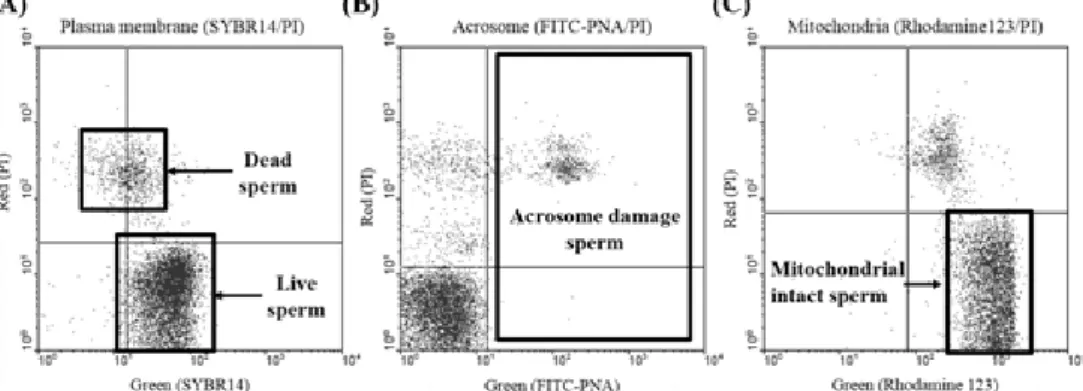
The LIVE/DEAD® sperm Viability Kit (Molecular Probes, Eugene, OR, USA) was used in a fluorescence-based assay to analyze sperm viability. Membrane-permanent SYBR 14 nucleic acid stain labels live sperm with green fluorescent tags, and membrane-impermanent propidium iodide (PI) labels the nucleic acids of membrane-compromised sperm with red fluorescent tags. Diluted semen samples in BTS buffer were prepared in light-tight tubes. A final SYBR-14 concentration of 40 nM was achieved through addition of 2 μl of diluted SYBR-14 dye to each sample of diluted semen. After incubation for 10 min at 37℃, 2 μl of PI was added to the sample of diluted semen to produce a final PI concentration of 2 μM. The diluted semen samples were incubated for 10 min at 37℃ under lightproof conditions. Stained sperm was analyzed by flow cytometry (Fig. 1A).
Sperm acrosome integrity was analyzed by fluorescein iso- thiocyanate-conjugated peanut agglutinin (FITC-PNA) and PI double stain. Post-thaw semen was diluted with phosphate buffered saline (PBS) and the fluorescent probes were added to a 1 ml aliquot of semen with the addition first of 1 μl FITC- PNA. After incubation for 10 min at 37℃, 2 μl of PI was added to the sample of diluted semen to produce a final PI concen- tration of 2 μM. The diluted semen samples were incubated for 10 min at 37℃ under lightproof conditions. Thereafter, the stained semen was centrifuged at 1,500 rpm for 5 min. The sperm pellets were resuspended in 1 ml of PBS. Stained sperm were analyzed by flow cytometry (Fig. 1B).
Fig. 1. Methods of flow cytometry analysis for assessing bull sperm physiology. Viability was analysis using the plasma membrane integrity, up black box was means dead sperm (PI positive sperm) and low black box means live sperm (SYBR14 positive sperm) (A), acrosome damage was analysis FITC-PNA and PI doubling staining methods, black box means acrosome damage sperm (FITC-PNA positive sperm) (B), Mitochondrial integrity was measured using the Rhodamine123 and PI double staining, black box show mitochondrial intact sperm (C)
To evaluate sperm mitochondrial activation, Rhodamine 123 (Sigma, Cat. No. R8004, USA) and PI double stain were used.
Semen samples diluted in PBS were prepared in light-tight tubes. A final Rhodamine 123 concentration of 0.53 mM was achieved through addition of 2 μl of diluted Rhodamine 123 dye to each sample of diluted semen. After incubation for 10 min at 37℃, 2 μl of PI was added to the sample of diluted semen to produce a final PI concentration of 2 μM. The diluted semen samples were incubated for 10 min at 37 ℃ under light- proof conditions. Thereafter, the stained semen was centrifuged at 1,500 rpm for 5 min. The sperm pellets were resuspended in 1 ml of PBS. Stained sperm was analyzed by flow cytometry (Fig. 1C).
The sperm hydrogen peroxide (H2O2) level was analyzed by carboxy-2’,7’-Dichlorofluorescin diacetate (carboxy-DCFDA) and PI double stain. Post-thaw semen was diluted with PBS containing bovine serum albumin (BSA) and the fluorescent probes were added to a 1 ml aliquot of semen with the addition first of 1 μl carboxy-DCFDA. After incubation for 40 min at 37℃, 2 μl of PI was added to the sample of diluted semen to produce a final PI concentration of 2 μM. The diluted semen samples were incubated for 10 min at 37℃ under lightproof conditions. Thereafter, the stained semen was centrifuged at 1,500 rpm for 5min. The sperm pellets were resuspended in 1 ml of PBS. Stained sperm were analyzed by flow cytometry (BD FACS Calibur; BD, USA). The sperm hydrogen peroxide (H2O2) level was evaluated as stained (positive) or non-stained (negative) by carboxy-DCFDA (Fig. 2).
To evaluate the sperm glutathione (GSH) level, an analysis
was carried out using Cell TrackerTM Red CMTPX (Invitrogen, Cat. No. C34552, USA) single stain. Semen samples diluted in PBS were prepared in light-tight tubes. A final Cell TrackerTM Red CMTPX concentration of 1 μM was achieved through addition of 1 μl of diluted Cell TrackerTM Red CMTPX dye to each sample of diluted semen. After incubation for 1 hour at 37℃, the stained semen was centrifuged at 1,500 rpm for 5 min. The sperm pellets were resuspended in 1 ml of PBS.
Stained sperm were analyzed by flow cytometry. The sperm GSH level was evaluated as stained (positive) or non-stained (negative) by Cell TrackerTM Red CMTPX (Fig.3).
4. Flow Cytometry Analysis
Flow cytometry analysis was performed by using a FACS caliber flow cytometer (BD FACS Calibur; BD, USA). Forward scatter (FSC), side scatter (SSC), green fluorescence (FL1), and red fluorescence (FL2) were measured and collected for each
Fig. 2. Histogram from flow cytometry for spermatozoa stained with carboxy-DCFDA. Negative : non-stained; Positive: stained
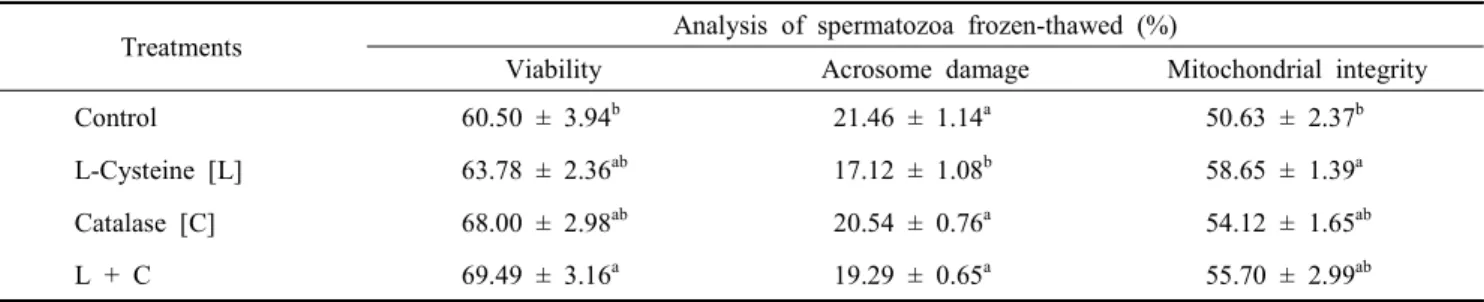
Table 1. Characteristics of spermatozoa cryopreserved with catalase and/or L-cysteine in Korean Native Cattle
Treatments Analysis of spermatozoa frozen-thawed (%)
Viability Acrosome damage Mitochondrial integrity
Control 60.50 ± 3.94b 21.46 ± 1.14a 50.63 ± 2.37b
L-Cysteine [L] 63.78 ± 2.36ab 17.12 ± 1.08b 58.65 ± 1.39a
Catalase [C] 68.00 ± 2.98ab 20.54 ± 0.76a 54.12 ± 1.65ab
L + C 69.49 ± 3.16a 19.29 ± 0.65a 55.70 ± 2.99ab
a,b Figures with different superscripts indicate significant differences from each other treatment group (p<0.05).
Fig. 3. Histogram from flow cytometry for spermatozoa stained with Cell TrackerTM Red. Negative : non-stained; Positive : stained.
sample. FSC indicated the size of spermatozoa whereas SSC indicated the granularity. FSC and SSC parameters were gated, and only events with scatter characteristics similar to sperm cells were analyzed for fluorescence (Nagy et al., 2003) among the total of 10,000 sperm cells.
5. Statistical Analysis
Statistical analysis was performed with analysis of variance (ANOVA) using SAS (version 9.1, SAS Institute Inc., Cary, NC, USA). Data are presented as mean ± standard error of the mean (S.E.M.). Differences in the mean values of sperm damage after treatment with various treatment conditions were processed using Duncan’s multiple range tests. Differences were consi- dered significant when p<0.05.
RESULTS
The characteristics of Korean Native Cattle sperm frozen- thawed with catalase (10 mM) and/or L-cysteine (200 IU) are shown in Table 1. Sperm viability was significantly higher in the L-cysteine + catalase (69.49 ± 3.16%) group than in the control (60.5 ± 3.94%) group (p<0.05). When acrosome integrity
was evaluated by acrosome membrane damage in frozen-thawed sperm, the proportion of damaged acrosomes was significantly (p<0.05) lower in the L-cysteine (17.12 ± 1.08%) group than in the control (21.46 ± 1.14%), catalase (20.54 ± 0.76%) and L-cysteine + catalase (19.29 ± 0.65%) groups. In addition, mito- chondrial membrane integrity was significantly (p<0.05) higher in the L-cysteine (58.65 ± 1.39%) group than in the control (50.63 ± 2.37%) group.
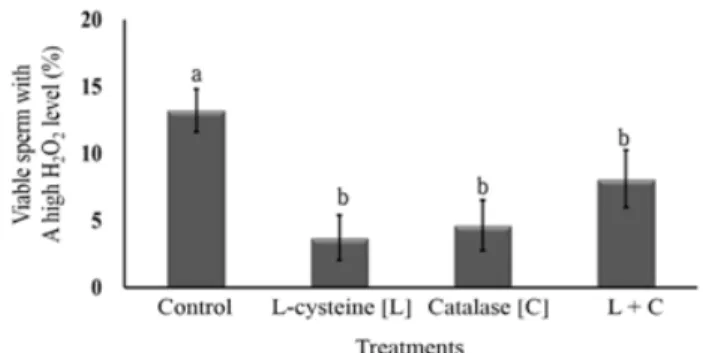
The sperm hydrogen peroxide (H2O2) level was significantly (p<0.05) lower in the L-cysteine (3.74 ± 1.66%), catalase (4.65
± 1.87%) and L-cysteine + catalase (8.11 ± 2.15%) groups than in the control (13.22 ± 1.6%) group (Fig. 4). Fig. 5 shows the flow cytometry analysis of the difference in hydrogen peroxide (H2O2) intensity of the frozen-thawed bull sperm. On the other hand, the GSH level was significantly (p<0.05) higher in the group with L-cysteine (1.33 ± 0.03%) than in the control (1.08
± 0.06%), catalase (1.05 ± 0.02%) and L-cysteine + catalase (1.11 ± 0.0%) groups as shown in Fig. 6. The flow cytometry analysis of the differences in GSH intensity of the frozen- thawed bull sperm is shown in Fig. 7.
DISCUSSION
Fig. 4. H2O2 levels in Korean Native Cattle sperm frozen-thawed with L-cysteine and/or catalase.
Fig. 5. Hydrogen peroxide (H2O2) intensity of Korean Native Cattle sperm frozen-thawed with L-cysteine and/or catalase.
a,b Bars with different super scripts indicate significant diffe- rences from each other treatment group (p<0.05).
Fig. 6. Glutathione intensity of Korean Native Cattle sperm frozen- thawed with L-cysteine and/or catalase. a,b Bars with diffe- rent super scripts indicate significant differences from each other treatment group (p<0.05).
Fig. 7. Flow cytometric analysis of glutathione intensity of frozen- thawed Korean Native Cattle sperm.
In this study, an evaluation was made of the effectiveness of L-cysteine and/or catalase on viability, acrosome integrity, mitochondrial integrity, H2O2 level, and glutathione level in frozen-thawed spermatozoa of Korean native cattle. It is well known that sperm cryopreservation is important as a valuable tool for creating effective semen banking. It is reported that
spermatozoa motility, viability and acrosome integrity are greatly affected by the freezing-thawing procedure (Donnelly et al., 2001; Lee et al., 2011).
Spermatozoa contains high concentrations of PUFA, which reactivity is high to LPO, which causes to a subsequent loss of sperm motility, plasma, acrosome and mitochondrial mem- brane integrity, and fertilizing ability of the sperm (Chen et al., 1993; Aitken and Fisher, 1994; Lee et al., 2011).
The protective antioxidant system are broken out preferen- tially in cytoplasmic of sperm, but sperm cells was removed most of their cytoplasmic droplet during the spermiogenesis. As a result, spermatozoa was had less cytoplasmic droplet compo- nent containing antioxidants which sperm was easily damaging to ROS and LPO; therefore, sperm are susceptible to LPO during cryopreservation and thawing (Alvarez and Storey, 1989;
Storey, 1997).
L-cysteine has an effect to eliminate to ROS in the intra- cellular protective mechanism, which inhibits capacitation and protects membrane damage in mammal sperm (Johnson et al., 2000). In the spermatozoa of many species, L-cysteine also plays a major role as a protection of plasma damage. Under physiological conditions, protection of mammalian spermatozoa against oxidative stress is provided by an enzymatic antioxidant system, mainly represented by superoxide dismutase (SOD) and CAT present in spermatozoa and the seminal plasma of diffe- rent species including bulls (Hermelo et al., 1987; de Almeida et al., 1989; Thiangtum et al., 2009).
Spermatozoa are susceptible to oxidative damage under oxi- dative stress. This damage can be prevented by supplementation of the semen extender with antioxidants (Sikka, 2004). Our results showed that antioxidant supplementation after thawing prevented a decrease of sperm viability and an increase of membrane damage under oxidant stress, and the combination of L-cysteine and catalase significantly improved viability of bull spermatozoa after cryopreservation.
A variety of scavengers are present in spermatozoa and seminal plasma including L-cysteine, GSH, GSH-PX, and cata- lase (Alvarez and Storey, 1989; Jeulin et al., 1989), which remove alkoxyl and peroxyl radicals and thus protect sperm viability and functions against oxidative damage (Baker et al., 1996; Aitken and Baker, 2004). In the present study, it is clearly shown that L-cysteine produces better results for acro- somal integrity, mitochondrial integrity, and glutathione level compared with the other groups. The addition of L-cysteine
exhibited significant cryoprotective activity on certain sperm parameters such as post-thaw motility and acrosomal and overall morphological integrity, which is similar to the results from studies performed with boar (Szczesniak-Fabianczyk et al., 2003; Funahashi and Sano, 2005), ram (Agarwal et al., 2004), and goat (Aboagla and Terada, 2003) semen.
Based on these results, we can hypothesize that L-cysteine displayed a protective influence on the functional integrity of acrosomes and mitochondria, thereby improving post-thawed sperm viability. The L-cysteine play a role to positive effects on many sperm ability such as membrane stabilizers, antioxi- dants and several factors. For example, L-cysteine can reactivate ROS and catalyze the detoxification of H2O2 and other super- oxides (Meister, 1992). Improvement of frozen bull sperm might be explained in this research by L-cysteine. Because GSH level is decreased during the cryopreservation process, addition of L-cysteine which play a precursor of intracellular glutathione in freezing solution is beneficial for frozen-thawed bull semen (Bilodeau et al., 2001). In addition, L-cysteine reduce the lipid peroxidation, which produces free radicals, and thus decrease sperm damage from ROS (Watson 2000; Cha- tterjee et al., 2001). Besides being active as a glutathione precursor, L-cysteine can also exert a protective effect in the extracellular milieu, primarily due to its nucleophilic and anti- oxidant properties (De Flora et al., 2001). As catalase activates the decomposition of H2O2 into water and oxygen, the gene- ration of radicals by Fe2+ is less efficient in the presence of this enzyme. The blocking of this pathway reduces the negative effects of H2O2 and other radicals, which are known to decrease sperm motility (O'Flaherty et al., 1997; Bilodeau et al., 2001).
In conclusion, L-cysteine and catalase are effective in protecting against membrane damage of the sperm of Korean native cattle during cryopreservation, and especially L-cysteine was more effective for acrosome - and mitochondrial integrity in cryo- preservation of the sperm of Korean Native Cattle.
REFERENCES
Aboagla EM and Terada T. 2003. Trehalose-enhanced fluidity of the goat sperm membrane and its protection during free- zing. Biol. Reprod. 69: 1245-1250.
Agarwal A, allella KP, Allamaneni SS and Said TM. 2004.
Role of antioxidants in treatment of male infertility: an overview of the literature. Reprod. Biomed. Online 8: 616-
627.
Aitken J and Fisher H. 1994. Reactive oxygen species gene- ration and human spermatozoa: the balance of benefit and risk. Bioessays 16: 259-267.
Aitken RJ. 1995. Free radicals, lipid peroxidation and sperm function. Reprod. Fertil. Dev. 7: 659-668.
Aitken RJ and Baker MA. 2004. Oxidative stress and male reproductive biology. Reprod. Fertil. Dev. 16: 581-588.
Aitken RJ, Gordon E, Harkiss D, Twigg JP, Milne P, Jennings Z and Irvine DS. 1998. Relative impact of oxidative stress on the functional competence and genomic integrity of hu- man spermatozoa. Biol. Reprod. 59 :1037-1046.
Alvarez JG and Storey BT. 1989. Role of glutathione peroxi- dase in protecting mammalian spermatozoa from loss of motility caused by spontaneous lipid peroxidation. Gamete Res. 23: 77-90.
Baker HW, Brindle J, Irvine DS and Aitken RJ. 1996. Pro- tective effect of antioxidants on the impairment of sperm motility by activated polymorphonuclear leukocytes. Fertil.
Steril. 65: 411-419.
Bilodeau JF, Blanchette S, Gagnon C and Sirard MA. 2001.
Thiols prevent H2O2-mediated loss of sperm motility in cryo- preserved bull semen. Theriogenology 56: 275-286.
Chatterjee S, de Lamirande E and Gagnon C, 2001. Cryopreser- vation alters membrane sulfhydryl status of bull spermatozoa:
protection by oxidized glutathione. Mol. Reprod. Dev. 60:
498-506.
Chen Y, Foote RH and Brockett CC. 1993. Effect of sucrose, trehalose, hypotaurine, taurine, and blood serum on survival of frozen bull sperm. Cryobiology 30: 423-431.
de Almeida M, Gazagne I, Jeulin C, Herry M, Belaisch-Allart J, Frydman R, Jouannet P and Testart J. 1989. In-vitro pro- cessing of sperm with autoantibodies and in-vitro fertilization results. Hum. Reprod. 4: 49-53.
De Flora S, Izzotti A, D'Agostini F and Balansky RM. 2001.
Mechanisms of N-acetylcysteine in the prevention of DNA damage and cancer, with special reference to smoking-rela- ted end-points. Carcinogenesis 22: 999-1013.
Donnelly ET, Steele EK, McClure N and Lewis ES. 2001.
Assessment of DNA integrity and morphology of ejacula- ted spermatozoa from fertile and infertile men before and after cryopreservation. Hum. Reprod. 16: 1191-1199.
Funahashi H and Sano H. 2005. Select antioxidants improve the function of extended boar semen stored at 10 degrees.
Theriogenology 63: 1605-1616.
Gadea J, Selles E, Marco MA, Coy P, Matas C, Romar R and Ruiz S. 2004. Decrease in glutathione content in boar sperm after cryopreservation: Effect of the addition of reduced glutathione to the freezing and thawing extenders. Therio- genology 62: 690-701.
Hermelo MP, Amador M, Alvarez R and Alonso A. 1987. Sli- mming treatment efficiency and changes in serum lipids and lipoproteins in obese adolescents. Exp. Clin. Endocrinol.
90: 347-360.
Jang HY, Jung YS, Cheong HT, Kim JT, Park CK, Kong HS, Lee HK and Yang BK. 2008. Effects of cell status of bovine oviduct epithelial cell (BOEC) on the development of bovine IVM/IVF embryos and gene expression in the BOEC used or not used for the embryo culture. Asian-Aust. J. Anim. Sci.
21: 980-987.
Jeong, BS and Yang X. 2001. Cysteine, glutathione, and Percoll treatments improve porcine oocyte maturation and fertiliza- tion in vitro. Mol. Reprod. Dev. 59: 330-335.
Jeulin C, Soufir JC, Weber P, Laval-Martin D and Calvayrac R. 1989. Catalase activity in human spermatozoa and seminal plasma. Gamete Res. 24: 185-196.
Jeyendran RS, Van der Ven HH, Rachagan SP, Perez-Peleaz M and Zaneveld LJ. 1989. Semen quality and in-vitro fertili- zation. Aust. N.Z.J. Obstet. Gynaecol. 29: 168-172.
Johnson LA, Weitze KF, Fiser P and Maxwell WMC. 2000.
Storage of boar semen. Anim. Reprod. Sci. 62: 143-172.
Jones R and Mann T. 1977. Toxicity of exogenous fatty acid peroxides towards spermatozoa. J. Reprod. Fertil. 50: 255- 260.
Lee KJ, Seo GB, Lee YS, Yoo HJ, Cheong HT, Lee SH, Yang BK and Park CK. 2011. Effect of methyl-beta-cyclodextrin (MBCD) on cryopreservation of bull spermatozoa. Reprod.
Dev. Biol. 35:295-300.
Mazor D, Golan E, Philip V, Katz M, Jafe A, Ben-Zvi Z and Meyerstein N. 1996. Red blood cell permeability to thiol compounds following oxidative stress. Eur. J. Haematol. 57:
241-246.
Meister A. 1992. On the antioxidant effects of ascorbic acid and glutathione. Biochem. Pharmacol. 44: 1905-1915.
Michael A, Alexopoulos C, Pontiki E, Hadjipavlou-Litina D,
Saratsis P and Boscos C. 2007. Effect of antioxidant supple- mentation on semen quality and reactive oxygen species of frozen-thawed canine spermatozoa. Theriogenology 68: 204- 212.
Nagy S, Jansen J, Topper EK and Gadella BM. 2003. A triple- stain flow cytometric method to assess plasma- and acrosome- membrane integrity of cryopreserved bovine sperm imme- diately after thawing in presence of egg-yolk particles. Biol.
Reprod. 68: 1828-1835.
O'Flaherty C, Beconi M and Beorlegui N. 1997. Effect of natu- ral antioxidants, superoxide dismutase and hydrogen peroxide on capacitation of frozen-thawed bull spermatozoa. And- rologia 29: 269-275.
Roca J, Rodriguez MJ, Gil MA, Carvajal G, Garcia EM, Cuello C, Vazquez JM and Martinez EA. 2005. Survival and in vitro fertility of boar spermatozoa frozen in the presence of superoxide dismutase and/or catalase. J. Androl. 26: 15-24.
Salisbury GW and Lodge JR. 1963. Respiratory quotients of bovine spermatozoa. J. Reprod. Fertil. 5: 195-202.
Sikka SC. 2004. Role of oxidative stress and antioxidants in andrology and assisted reproductive technology. J. Androl.
25: 5-18.
Storey BT. 1997. Biochemistry of the induction and prevention of lipoperoxidative damage in human spermatozoa. Mol.
Hum. Reprod. 3: 203-213.
Szczesniak-Fabianczyk B, Bochenek M, Smorag Z and Ryszka F. 2003. Effect of antioxidants added to boar semen extender on the semen survival time and sperm chromatin structure.
Reprod. Biol. 3: 81-87.
Thiangtum K, Pinyopummin A, Hori T, Kawakami E and Tsu- tsui T. 2009. Effect of catalase and superoxide dismutase on motility, viability and acrosomal integrity of frozen-thawed cat spermatozoa. Reprod. Domest. Anim. Suppl. (44), 2: 369- 372.
Watson PF. 2000. The causes of reduced fertility with cryo- preserved semen. Anim. Reprod. Sci. 60-61: 481-492.
Zhao Y and Buhr MM. 1995. Cryopreservation extenders affect calcium flux in bovine spermatozoa during a temperature challenge. J. Androl. 16: 278-285.
(Received: 2014. 5. 20/ Reviewed: 2014. 5. 23/ Accepted: 2014. 6. 18)