광량 및 TiO
2
나노튜브 길이별 광활성 연구: Cr(VI)환원 및 수소제조주현규*, 심은정*, 이재민**, 윤재경*
†*한국에너지기술연구원 수소에너지센터, **연세대학교 화공생명공학과
Effect of TiO
2
Nanotube Length on Photocatalytic Activity with Different Light Intensities: Cr(VI) Reduction andHydrogen Production
HYUNKU JOO*, EUNJUNG SHIM*, JAEMIN LEE**, JAEKYUNG YOON*
†*Hydrogen Energy Research Center, Korea Institute of Energy Research 71-2 Jang-dong, Yusong-gu, Daejeon 305-343, Korea
**Dept. of Chemical and Biomolecular. Engr., Yonsei Univ., 262 Seongsanno, Seodaemun-gu, Seoul 120-749, Korea
ABSTRACT
Anodized tubular TiO
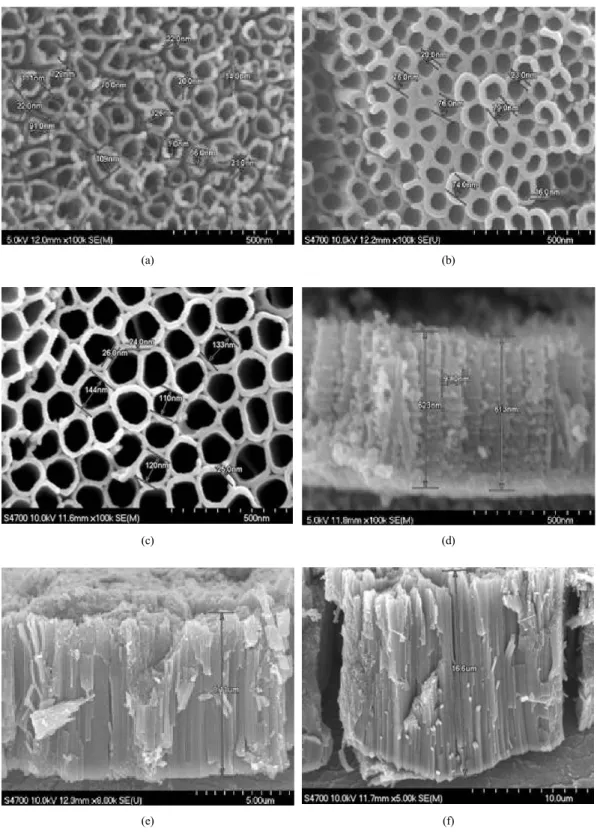
2electrodes (ATTEs) with three noticeably different lengths are prepared to determine their optimum length for the photo-driven activity in the reaction of Cr(VI) reduction and hydrogen evolution. The ATTEs with ethylene glycol have longer TiO
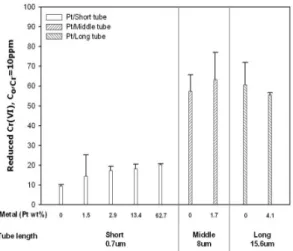
2tubes (7-15.6 μm) than those with hydrfluoric acid (0.6-0.8 μm). These samples, which differ only in the length of the tubes, with a wall thickness of ca. 20 nm, consist mainly of an anatase crystalline phase after heat treatment at 650℃, since the anatase crystallites at the tube walls do not undergo transformation into rutile phase, due to the constraints imposed by the wall thickness. Among them, the medium size (ca. 8 μm) tubes provide the optimum conditions, irrespective of the light intensity, which is explained in terms of the correlation between the amount of photons and the adsorbed electron acceptors and their location. Photocatalytic Cr(VI) reduction leads to ca. 60%
reduction of Cr(VI) even under 1 sun irradiation with the medium-sized anodized TiO
2tubes, but only ca.
20% with the short- and long-sized tubes. For hydrogen evolution, tubes longer than 8 μm do not exhibit better performance with any light intensity.
KEY WORDS : Anodization(양극산화), Immobilized titania(고정화 티타니아), Photoanode(광어노드), Ecomaterials(친환경재료), Cr(VI) reduction(6가크롬 환원), Hydrogen(수소)
†
![Fig. 4 Cr(VI) reduction with different anodized TiO 2 tubes under 1 sun irradiation ([Cr(VI)]O = 10 ppm at pH 3)](https://thumb-ap.123doks.com/thumbv2/123dokinfo/5112772.575061/7.799.85.373.114.828/fig-cr-reduction-different-anodized-tio-tubes-irradiation.webp)