Introduction
Cancer is the most devastating non-communicable disease responsible for approximately 9.6 million deaths in 2018 worldwide (1, 2). Although its mortality rate has been decreased in developed countries, cancer has become leading cause of death due to increased mortality rate in developing countries for the past couple of decades (3, 4), and cancer is considered as the most important hurdle to overcome for human being to extend life expectancy.
Traditional treatment options for cancer include surgery, radiotherapy, and chemotherapy. Surgery can be applied only on localized solid tumors, and the other regimens suffer from the inevitable side-effects including leukopenia, neutropenia, thrombocytopenia and anemia severely degrading patient’s quality of life (5, 6). To overcome
such limitations, tumor-specific therapy, for example, antibody-based immunotherapy was implemented, but low efficacy and tumor resistance have been the issue (7). Antibody-drug conjugates (ADCs) composed of an antibody and chemotherapeutics such as trastuzumab emtansine (Kadcyla®) have been developed and showed improved therapeutic efficacy (8), but multidrug resistance also became an issue for ADCs (9, 10).
Another way to improve therapeutic efficacy of cancer treatment is to arm antibodies with radioisotopes.
There have been two FDA-approved antibody-based radiopharmaceuticals, which are Baxxar® and Zevalin®, for the treatment of lymphoma, both utilizing radioisotopes with beta radiation. However, their therapeutic efficacy is not satisfactory and consequently one of them (Baxxar®) was withdrawn from the market in 2014. The efforts to
Received: December 12, 2019 / Revised: December 26, 2019 / Accepted: December 28, 2019
Correspnding Author : Chi Soo Kang, Division of Applied RI, Korea Institute of Radiological and Medical Sciences, 75 Nowon-ro, Nowon-gu, Seoul, Korea 10812, Tel: +82-2-970-1623, Fax: +82-2-970-1986, E-mail: [email protected].
Targeted alpha therapy (TAT) for cancer using metallic radioisotopes
Chi Soo Kang*, Kyo Chul Lee, Yong Jin Lee
Division of Applied RI, Korea Institute of Radiological and Medical Sciences, 75 Nowon-ro, Nowon-gu, Seoul, Korea 01812.
https://doi.org/10.22643/JRMP.2019.5.2.135
Copyright©2019 The Korean Society of Radiopharmaceuticals and Molecular Probes
ABSTRACT Targeted alpha therapy (TAT) based on metallic radionuclides has attracted a lot of attention lately due to its impressive therapeutic efficacy displayed in couple of clinical studies for cancer. Representative metallic radionuclides emitting alpha-particle include 225Ac, 213Bi, and 227Th, and there have been variety of TAT formulations based on different targeting moiety and chelating agents. In this review, we introduce strategies to label metallic radioisotopes with biomolecules and look at some of recent preclinical and clinical results of TAT for cancer.
Key Word: Targeted alpha therapy (TAT), metal chelators, Ac-225, Bi-213, Th-227
find more effective cancer therapeutics turned researcher’s attention to radioisotopes emitting alpha-particles, which are known to have energy around 5~8 MeV that is 100 to 1000 times higher energy than beta radiation and short path length (50~80 µm) consequently providing high linear energy transfer (LET). Therefore, alpha-particles can cause irreversible double-strand DNA breaks on tumors while avoiding unwanted damages on normal tissues provided they are deposited within or close proximity to the cancer cells (11). Recent FDA-approval and success of 223RaCl2
(Xofigo®) for castration-resistant prostate cancer with bone metastases indicate the potential of alpha-particle emitting radioisotopes for cancer treatment. To develop targeted alpha-particle emitting radiopharmaceuticals using biomolecules such as peptides and antibodies as a targeting moiety, the radioisotopes should be labeled efficiently in a mild condition to prevent damages on the biomolecules.
Furthermore, the labeled complex should be stable enough not to lose the radioisotopes to reduce side-effects caused by radiation exposure on non-targeted tissues. Researchers have worked hard for decades to develop chelators with mild labeling conditions, which satisfy aforementioned prerequisites, and indeed we are starting to see more promising results on clinical trials using targeted alpha therapy (TAT) on cancers lately.
In this paper, we review development of TAT using various metallic radioisotopes for cancer. Radiolabeling strategies as well as preclinical and clinical results are
introduced for the most frequently studied alpha-particle emitting metallic radioisotopes.
Actinium-225 (
225Ac)
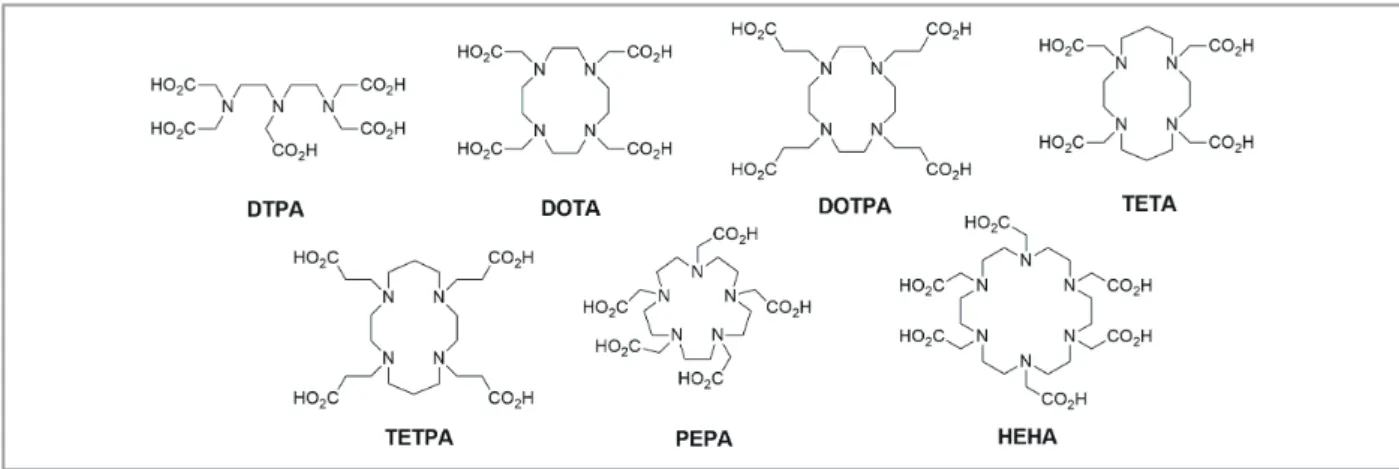
Ac-225 is one of the most studied alpha-particle emitting radioisotopes in the application of targeted cancer therapy due to its ideal physical characteristics including relatively long decay half-life (9.9 d), which matches with biological half-life of typical antibodies, and high energy (6.0 MeV alpha-particle) that can effectively damage cancer cells (12). Various different chelators were developed and tested for the fast and stable labeling of 225Ac (Figure 1), but 1,4,7,10-tetraazacyclododecane-1,4,7,10-tetraacetic acid (DOTA) has been used almost exclusively as the 225Ac chelator in preclinical and clinical studies (13-15).
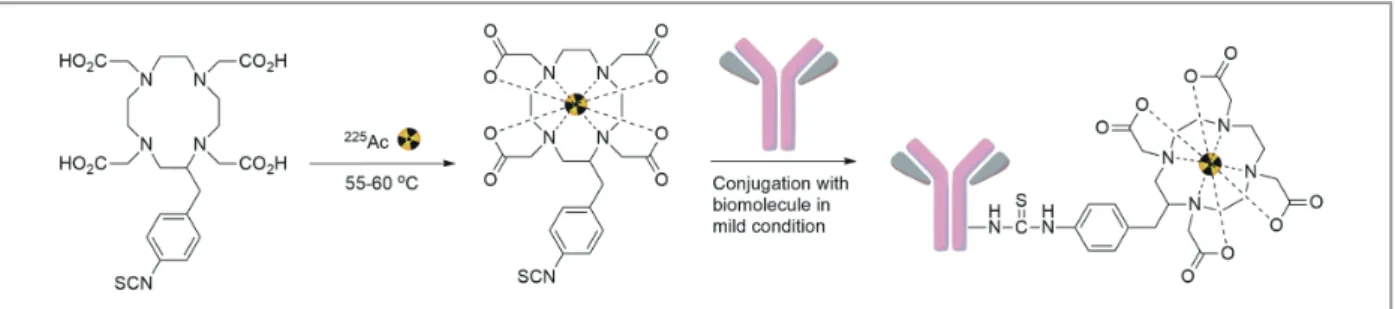
Radiolabeling of 225Ac using DOTA as a chelator for the development of radiopharmaceuticals normally takes place in two steps. In the first step, DOTA with functional group is labeled with 225Ac at around 55-60°C, and the labeled DOTA is conjugated with biomolecules in the second step to avoid degradation of the biomolecules in the harsh labeling condition (Figure 2).
Although DOTA has been almost exclusively utilized as a 225Ac chelator in preclinical and clinical studies, its labeling conditions, efficiency, and the stability of the labeled complex are far from perfect. Since thermodynamic
Figure 1. Ac-225 chelators in preclinical and clinical studies.
stability of DOTA-metal complex is inversely proportional to the ionic radius of metal ion, the stability of a complex with a large metal is normally low. For this reason, 225Ac- DOTA complex might not be stable enough because 225Ac is the largest one among trivalent metals (16). Furthermore, kinetic stability of a metal complex would be reduced in diluted condition in vivo, the effort to develop better 225Ac chelators continue (16). Figure 3 shows recently developed
225Ac chelators.
Joint research team from Germany and Canada recently developed a new 225Ac chelator named Bispa2, which is composed of two picolinic acids, and it was found that 10-4 of Bispa2 had 100% labeling efficiency within 30 min when reacted with 40 kBq of 225Ac at room temperature, and 225Ac-Bispa2 maintained stable complex in human serum for 7 days (17). Another research group from the USA and Canada developed a new 225Ac chelator called Macropa consisting of diaza-18-crown-6 with two picolinic acids. Macropa also showed fast complexation kinetics (100% labeling within 5 min) when 59 µM of Macropa was reacted with 26 kBq of 225Ac at room temperature.
Furthermore, 225Ac-Macropa was stable in human serum
for 7 days and in vivo (mouse) for 5 h (18). Based on the results from aforementioned researches, it could be concluded that the labeling efficiency and stability of
225Ac complex would improve with increasing number of coordination group. However, this is not always the case as Kelly JM et al. found out (19). They prepared prostate specific membrane antigen (PSMA) targeting peptide conjugated with DOTA-based chelator named EuK-106, which has twelve coordination groups (Figure 3). It was found that labeling efficiency of EuK-106 with 225Ac was less than 10% even at high temperature (95°C). Therefore, it seems a lot of research should be done to develop optimal
225Ac chelators. Nonetheless, many successful preclinical results have been reported using 225Ac for the treatment of various cancers. For instance, a research group from Technical university of Munich in Germany recently developed a conjugate composed of a DOTA and a peptide called F3, which can targets nucleolin highly expressed in some cancer cells. They found a 225Ac-DOTA-F3 treated group had extended median survival duration (95 days) compared to a PBS treated control group (60 days) using subcutaneous peritoneal carcinomatosis mouse models
Figure 2. Typical 225Ac labeling procedure for biomolecule-based radiopharmaceuticals.
Figure 3. New 225Ac chelators in preclinical studies.
(20). Another group from Germany directly compared therapeutic efficacy of beta and alpha-particle emitting radionuclides using pancreatic cancer xenografted mouse models. They prepared 225Ac- or 177Lu-labeled DOTATOC targeting somatostatin receptor overexpressed in pancreatic cancers and showed 225Ac-DOTATOC exhibited better tumor growth inhibition resulting in prolonged survival of mouse models compared to the ones treated with
177Lu-DOTATOC (21). The researchers also provided experimental proof that alpha-particle resulted in more DNA double-strand breaks (DSB) than beta radiation. A joint research from Wake forest school of Medicine in the U.S. and the People’s hospital of Zhengzhou university in China recently showed the great therapeutic efficacy of 225Ac using glioblastoma mouse models (22). They synthesized 225Ac-labeled peptide (225Ac-DOTA-Pep- IL) which selectively binds to glioblastoma and showed treatment of 225Ac-DOTA-Pep-IL on orthotopic mouse models resulted in much longer median survival time (41 days) compared to the control (23 days). Almost all of the preclinical and clinical studies using 225Ac have exploited DOTA as a chelator. However, there is a risk for radiation toxicity on normal tissues caused by dissociated daughter radionuclides, such as 221Fr and 213Bi. One way to prevent such a risk is to trap all the possible daughter radionuclides in a nanoparticle, and a group from Delft University of Technology in Netherlands showed possibility of trapping
221Fr (69% retention) and 213Bi (53% retention) from 225Ac in polymersomes (23). However, more study should be done to improve retention percentage and to resolve rapid clearance of the large polymersomes from blood
circulation.
While a lot of successful preclinical studies have come out, an outstanding clinical result on the treatment of patients with metastatic prostate cancer using 225Ac-labeled PSMA-617 (225Ac-PSMA-617) was reported recently.
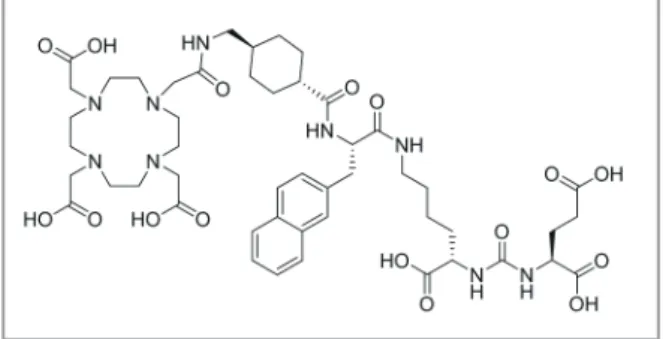
PSMA-617 is composed of DOTA conjugated with PSMA-targeting peptide unit (Figure 4). PSMA is an enzyme located in a cell’s membrane, and it consists of protease, apical, and C-terminal domains where apical domain forms binding pocket and shows high binding affinity with amino acid sequence of glutamate-urea- lysine (24). It is known the existence of aromatic group in PSMA-617 increases the binding affinity to PSMA and helps internalization (25). Recent clinical trial using
225Ac-PSMA-617 on metastatic prostate cancers showed encouraging outcome for targeted therapy based on alpha- particle emitting radionuclides and favorably compared with targeted therapy using beta radiation. The patients who did not have any therapeutic benefits with treatment of
177Lu-PSMA-617 showed complete response on imaging and dramatic decline of prostate specific antigen (PSA) level after treatment of 225Ac-PSMA-617 (26). There is also couple of clinical trials being prepared for the treatment of acute myeloid leukemia and refractory multiple myeloma using 225Ac-lintuzumab.
Bismuth-213 (
213Bi)
Bi-213 also can be chelated by traditional chelators such as DOTA and diethylenetriaminepentaacetic acid (DTPA).
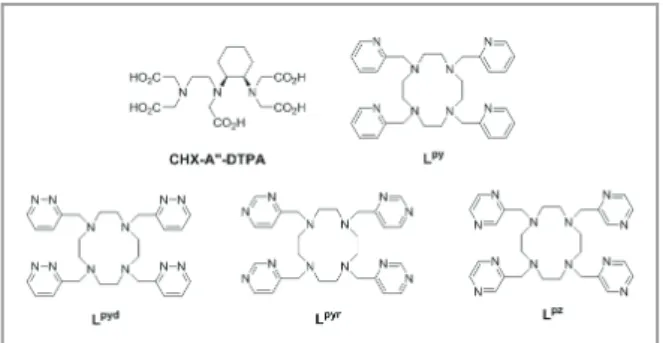
Especially DTPA analogue CHX-Aʺ-DTPA (Figure 5) was shown to have great labeling efficiency and complex stability with 213Bi, so it has been used in many preclinical studies. However, the efforts to develop 213Bi chelators with better performance continues, and a research group from Los Alamos National Laboratory in the U.S.
recently developed series of 213Bi chelators (Figure 5) with
Figure 4. Structure of PSMA-617.
increased number of nitrogen compared to typical chelators and showed the potential to be utilized for 213Bi-specific chelators (27). Development of radiopharmaceuticals using 213Bi is actively progressing, and they are proven to be effective in preclinical studies for many different kinds of cancers. For example, CHX-Aʺ-DTPA conjugates of antibodies labeled with 213Bi were shown to have great therapeutic effect on mouse tumor models of multiple myeloma, pancreatic cancer, and ovarian cancer (28-30).
Clinical studies using 213Bi are also in progress, and some produced promising results. Kratochwil C et al. used 213Bi- DOTATOC, which specifically binds to somatostatin receptor, for the treatment of neuroendocrine cancer patients with liver metastases who had no response when treated with 90Y/177Lu-DOTATOC. It was found the treatment of
213Bi-DOTATOC resulted in enduring responses with low acute hematotoxicity and chronic kidney toxicity (31). In another study, 213Bi-labeled Substance P, which specifically binds to neurokinin type I receptor highly expressed in glioblastoma multiforme (GBM), was evaluated in GBM patients. It was shown the patients treated with
213Bi-Substance P had prolonged overall survival time demonstrating the therapeutic efficacy of 213Bi (32). More recently, Autenrieth ME et al. performed a pilot study using
213Bi-labeled cetuximab in patients with bladder cancer and found there were no significant side-effects caused by the treatment (33).
Similar to 213Bi, 212Bi could be chelated using DOTA and DTPA. However, due to high energy gamma ray (2.6 MeV) produced by 208Tl, a daughter nuclide of
212Bi, development of radiopharmaceuticals using 212Bi is not practical considering high radiation exposure to the patients.
Terbium-149 (
149Tb)
Tb-149 has no daughter radionuclides that emit alpha- particles, so there is no concern about radiotoxicity as long as 149Tb itself is not dissociated from the labeled complex. Therefore, 149Tb has great potential to be utilized in TAT. However, 149Tb has relatively short half-life (4.1 h) compared to other alpha-particle emitting radioisotopes, and 83% of the energy is emitted by electron capture while only 16.7% is emitted by alpha-particle when it decays.
Furthermore, high energy (1.4 GeV) proton beam is required to produce 149Tb by irradiation on tantalum (Ta) target. Therefore, 149Tb is not easily accessed radioisotope and consequently it is not frequently studied for the development of radiopharmaceuticals. Anyhow, it can be chelated by the traditional chelators like DOTA or DTPA.
Only handful number of preclinical studies has been done, but with promising results, for the evaluation of 149Tb- applied radiopharmaceuticals. For example, treatment of 149Tb-labeled rituximab on lymphoma-xenografted mouse model resulted in prolonged tumor-free survival of more than 120 days among 85% of the experimental group while the untreated control mice had to be sacrificed within 37 days due to the clear development of lymphoma (34). In another study, 149Tb-labeled folate was treated in cervical carcinoma-xenografted mice, and it was found the treatment inhibited tumor growth and resulted in increased average survival time of mice (43 days) compared to untreated control mice (21 days) (35). There has been no clinical study using 149Tb.
Figure 5. Chelators used for 213Bi labeling.
Radium-223 (
223Ra)
Ra-223 is the first alpha-particle emitting radioisotope that obtained FDA-approval for the treatment of cancer in the form of 223RaCl2 (Xofigo®). Since Xofigo® does not have actual targeting biomolecule in the formulation, it is difficult to say the treatment of Xofigo® is a TAT. However, due to similar chemical property of 223Ra with calcium, its uptake in the bone is very high. Furthermore, bone marrow toxicity by the radiation is known to be lower compared to other beta-emitting radiopharmaceuticals because of the short emission range of alpha-particle (36). Ra-223Cl2
treatment in several phase I and II studies has been shown that administration of multiple doses of 100 kBq/kg or single dose of 250 kBq/kg were well tolerated in the bone metastatic patient with castration-resistant prostate cancer or breast cancer (37-39). Moreover, it was found 223RaCl2
treatment resulted in prolonged overall survival time (14.9 months) of patients with castration-resistant prostate cancer and bone metastases compared to placebo group (11.3 months) (40). It seems that alpha therapy using 223RaCl2
is a promising option for the patients with bone metastatic castration-resistant prostate cancer to relive bone pain and extend survival time. However, larger clinical studies should be done to concretely confirm the therapeutic effect of 223RaCl2 treatment.
Thorium-227 (
227Th)
Th-227 is the parent radionuclide of 223Ra, and it also emits alpha-particle which could be applied in the TAT. Th- 227 has much longer half-life (18.7 days) than other alpha- particle emitting radionuclides frequently investigated in the therapeutic applications for cancer such as 213Bi (46 min) and 211At (7.2 hrs). Therefore, it is more feasible to be exploited in clinical settings. Furthermore, production of 227Th is practically unlimited because 227Th generator
could be prepared easily where 227Th is produced by thermal neutron irradiation of 226Ra (41). Consequently,
227Th attracted a lot of attention from researchers recently, and many preclinical studies have been done for years.
In the early stage of investigations, DOTA was used as the chelator for 227Th, and its antibody conjugates using rituximab and trastuzumab exhibited promising in vitro and in vivo results (42-45). However, it was found octadentate chelator 3,2 hydroxypyridinone (3,2-HOPO) was better in labeling with 227Th and maintaining more stable complex compared to DOTA, and recent investigations using 227Th have done with 3,2-HOPO. For example, Hagemann UB et al. recently prepared CD70-binding and mesothelin- targeting antibodies labeled with 227Th using 3,2-HOPO and showed promising anti-cancer effects using mouse xenograft models of renal cell carcinoma (46) and cancers expressing mesothelin (47), respectively. With successful preclinical results, a few phase I clinical studies using 227Th- labeled antibody conjugates targeting prostate cancer, non- Hodgkin’s lymphoma, ovarian cancer, and mesothelioma are in progress or in the stage of recruiting patients.
Conclusion
Although mortality rate of cancer in developed countries has decreased for decades, it is still considered one of the most difficult diseases to overcome. Therapeutic strategies beyond the traditional treatment options have been employed to improve therapeutic efficacy as well as to reduce side-effects. Such new strategies include treatments using antibody drug conjugates and targeted radiation therapy using radionuclides with beta (β) radiation.
These treatment options somehow showed improved therapeutic efficacy in the clinic, but the results was far from satisfaction. In search for better therapeutic strategies to treat cancer, researchers have turned their attention to alpha-particle emitting radionuclides, which have much
higher energy and shorter path-length compared to beta radiation that could maximize therapeutic efficacy and minimize side-effects. Targeted radiation therapy using alpha-particle emitting metallic radionuclides including
225Ac, 213Bi, and 227Th has shown impressive results in preclinical as well as in clinical studies on various cancers.
Especially the clinical result reported by Kratochwil C et al. on the treatment of metastatic prostate cancer patients using peptide labeled 225Ac (26) was quite impressive and attracted a lot of attention. Furthermore, new metal chelators for prompt labeling and increased stability are being developed actively to resolve radiation toxicity problem caused by dissociated radionuclides. Provided by chelation chemistry for such large metals is well understood and appropriate chelators are developed, TAT using metallic radionuclides will be major option for cancer treatment in the near future.
Acknowledgments
This study was supported by a grant of the Korea Institute of Radiological and Medical Sciences (KIRAMS), funded by Ministry of Science and ICT (MSIT), Korea (No.
50461-2019, No. 50537-2019). The authors declare no conflict of interest.
References
1. Bray F, Ferlay J, Soerjomataram I, Siegel RL, Torre LA, Jemal A. Global cancer statistics 2018: GLOBOCAN estimates of incidence and mortality worldwide for 36 cancers in 185 countries. CA Cancer J Clin 2018;68:394- 424.
2. Ferlay J, Colombet M, Soerjomataram I, Mathers C, Parkin DM, Pineros M, Znaor A, Bray F. Estimating the global
cancer incidence and mortality in 2018: GLOBOCAN sources and methods. Int J Cancer 2019;144:1941-1953.
3. Maule M, Merletti F. Cancer transition and priorities for cancer control. Lancet Oncol 2012;13:745-746.
4. Harding MC, Sloan CD, Merrill RM, Harding TM, Thacker BJ, Thacker EL. Transitions from heart disease to cancer as the leading cause of death in US States, 1999-2016. Prev Chronic Dis 2018;15:E158.
5. Oun R, Moussa YE, Wheate NJ. The side effects of platinum-based chemotherapy drugs: a review for chemists.
Dalton Trans 2018;47:6645-6653.
6. Langendijk JA, Doornaert P, Verdonck-de Leeuw IM, Leemans CR, Aaronson NK, Slotman BJ. Impact of late treatment-related toxicity on quality of life among patients with head and neck cancer treated with radiotherapy. J Clin Oncol 2008;26:3770-3776.
7. Carvalho S, Levi-Schaffer F, Sela M, Yarden Y.
Immunotherapy of cancer: from monoclonal to oligoclonal cocktails of anti-cancer antibodies: IUPHAR review 18. Br J Pharmacol 2016;173:1407-1424.
8. Lambert JM, Chari RV. Ado-trastuzumab emtasine (T- DM1): an antibody-drug conjugate (ADC) for HER2- positive breast cancer. J Med Chem 2014;57:6949-6964.
9. Barok M, Joensuu H, Isola J. Trastuzumab emtansine:
mechanisms of action and drug resistance. Breast cancer Res 2014;16:209.
10. Li G, Guo J, Shen B-Q, Yadav DB, Sliwkowski MX, Crocker LM, Lacap JA, Phillips GDL. Mechanisms of acquired resistance to trastuzumab emtansine in breast cancer cells. Mol Cancer Ther 2018;17:1441-1453.
11. Sgouros G. Alpha-particles for targeted therapy. Adv Drug Deliv Rev 2008;60:1402-1406.
12. Scheinberg DA, McDevit MR. Actinium-225 in targeted alpha-particle therapeutic applications. Curr Radiopharm 2011;4:306-320.
13. Deal KA, Davis IA, Mirzadeh S, Kennel SJ, Brechbiel MW. Improved in vivo stability of actinium-225 macrocyclic complexes. J Med Chem 1999;42:2988- 2992.
14. McDevitt MR, Ma D, Simon J, Frank RK, Scheinberg DA.
Design and synthesis of 225Ac radioimmunopharmaceuticals.
Appl Radiat Isot 2002;57:841-847.
15. Chappell LL, Deal KA, Dadachova E, Brechbiel MW.
Synthesis, conjugation, and radiolabeling of a novel bifunctional chelating agent for 225Ac radioimmunotherapy applications. Bioconjug Chem 2000;11:510-519.
16. Thiele NA, Wilson JJ. Actinium-225 for Targeted α Therapy: Coordination Chemistry and Current Chelation Approaches. Cancer Biother Radiopharm 2018;33:336- 348.
17. Comba P, Jermilova U, Orvig C, Patrick BO, Ramogida CF, Rück K, Schneider C, Starke M. Octadentate Picolinic Acid-Based Bispidine Ligand for Radiometal Ions.
Chemistry 2017;23: 15945-15956.
18. Thiele NA, Brown V, Kelly JM, Amor-Coarasa A, Jermilova U, MacMillan SN, Nikolopoulou A, Ponnala S, Ramogida CF, Robertson AKH, Rodríguez-Rodríguez C, Schaffer P, Williams C Jr, Babich JW, Radchenko V, Wilson JJ. An Eighteen-Membered Macrocyclic Ligand for Actinium-225 Targeted Alpha Therapy. Angew Chem Int Ed Engl 2017;56:14712-14717.
19. Kelly JM, Amor-Coarasa A, Nikolopoulou A, Kim D, Williams C Jr, Vallabhajosula S, Babich JW. Assessment of PSMA targeting ligands bearing novel chelates with application to theranostics: Stability and complexation kinetics of 68Ga3+, 111In3+, 177Lu3+ and 225Ac3+. Nucl Med Biol 2017;55:38-46.
20. Essler M, Gärtner FC, Neff F, Blechert B, Senekowitsch- Schmidtke R, Bruchertseifer F, Morgenstern A, Seidl C.
Therapeutic efficacy and toxicity of 225Ac-labelled vs.
213Bi-labelled tumour-homing peptides in a preclinical mouse model of peritoneal carcinomatosis. Eur J Nucl Med Mol Imaging 2012;39:602-612.
21. Graf F, Fahrer J, Maus S, Morgenstern A, Bruchertseifer F, Venkatachalam S, Fottner C, Weber MM, Huelsenbeck J, Schreckenberger M, Kaina B, Miederer M. DNA double strand breaks as predictor of efficacy of the alpha- particle emitter 225Ac and the electron emitter 177Lu for
somatostatin receptor targeted radiotherapy. PLoS One 2014;9:e88239.
22. Sattiraju A, Solingapuram Sai KK, Xuan A, Pandya DN, Almaguel FG, Wadas TJ, Herpai DM, Debinski W, Mintz A. IL13RA2 targeted alpha particle therapy against glioblastomas. Oncotarget 2017;8:42997-43007.
23. Wang G, de Kruijff RM, Rol A, Thijssen L, Mendes E, Morgenstern A, Bruchertseifer F, Stuart MC, Wolterbeek HT, Denkova AG Retention studies of recoiling daughter nuclides of 225Ac in polymer vesicles. Appl Radiat Isot 2014;85:45-53.
24. Afshar-Oromieh A, Babich JW, Kratochwil C, Giesel FL, Eisenhut M, Kopka K, Haberkorn U. The Rise of PSMA Ligands for Diagnosis and Therapy of Prostate Cancer. J Nucl Med 2016;57(Suppl 3):79S-89S.
25. Benešová M, Schäfer M, Bauder-Wüst U, Afshar- Oromieh A, Kratochwil C, Mier W, Haberkorn U, Kopka K, Eder M. Preclinical Evaluation of a Tailor-Made DOTA-Conjugated PSMA Inhibitor with Optimized Linker Moiety for Imaging and Endoradiotherapy of Prostate Cancer. J Nucl Med 2015;56:914-920.
26. Kratochwil C, Bruchertseifer F, Giesel FL, Weis M, Verburg FA, Mottaghy F, Kopka K, Apostolidis C, Haberkorn U, Morgenstern A. 225Ac-PSMA-617 for PSMA-Targeted α-Radiation Therapy of Metastatic Castration-Resistant Prostate Cancer. J Nucl Med 2016;57:1941-1944.
27. Wilson JJ, Ferrier M, Radchenko V, Maassen JR, Engle JW, Batista ER, Martin RL, Nortier FM, Fassbender ME, John KD, Birnbaum ER. Evaluation of nitrogen- rich macrocyclic ligands for the chelation of therapeutic bismuth radioisotopes. Nucl Med Biol 2015;42:428-438.
28. Teiluf K, Seidl C, Blechert B, Gaertner FC, Gilbertz KP, Fernandez V, Bassermann F, Endell J, Boxhammer R, Leclair S, Vallon M, Aichler M, Feuchtinger A, Bruchertseifer F, Morgenstern A, Essler M. α-Radioimmunotherapy with 213Bi-anti-CD38 immunoconjugates is effective in a mouse model of human multiple myeloma. Oncotarget 2015;6:4692-4703.
29. Bryan RA, Jiang Z, Jandl T, Strauss J, Koba W, Onyedika C,
Morgenstern A, Bruchertseifer F, Epstein AL, Dadachova E. Treatment of experimental pancreatic cancer with 213-Bismuth-labeled chimeric antibody to single-strand DNA. Expert Rev Anticancer Ther 2014;14:1243-1249.
30. Gustafsson-Lutz A, Bäck T, Aneheim E, Hultborn R, Palm S, Jacobsson L, Morgenstern A, Bruchertseifer F, Albertsson P, Lindegren S. Therapeutic efficacy of α-radioimmunotherapy with different activity levels of the 213Bi-labeled monoclonal antibody MX35 in an ovarian cancer model. EJNMMI Res 2017;7:38.
31. Kratochwil C, Giesel FL, Bruchertseifer F, Mier W, Apostolidis C, Boll R, Murphy K, Haberkorn U, Morgenstern A. 213Bi-DOTATOC receptor-targeted alpha- radionuclide therapy induces remission in neuroendocrine tumours refractory to beta radiation: a first-in-human experience. Eur J Nucl Med Mol Imaging 2014;41:2106- 2119.
32. Krolicki L, Bruchertseifer F, Kunikowska J, Koziara H, Królicki B, Jakuciński M, Pawlak D, Apostolidis C, Mirzadeh S, Rola R, Merlo A, Morgenstern A. Prolonged survival in secondary glioblastoma following local injection of targeted alpha therapy with 213Bi-substance P analogue. Eur J Nucl Med Mol Imaging 2018;45:1636- 1644.
33. Autenrieth ME, Seidl C, Bruchertseifer F, Horn T, Kurtz F, Feuerecker B, D'Alessandria C, Pfob C, Nekolla S, Apostolidis C, Mirzadeh S, Gschwend JE, Schwaiger M, Scheidhauer K, Morgenstern A. Treatment of carcinoma in situ of the urinary bladder with an alpha-emitter immunoconjugate targeting the epidermal growth factor receptor: a pilot study. Eur J Nucl Med Mol Imaging 2018;45:1364-1371.
34. Beyer GJ, Miederer M, Vranjes-Durić S, Comor JJ, Künzi G, Hartley O, Senekowitsch-Schmidtke R, Soloviev D, Buchegger F. Targeted alpha therapy in vivo: direct evidence for single cancer cell kill using 149Tb-rituximab.
Eur J Nucl Med Mol Imaging 2004;31:547-554.
35. Müller C, Reber J, Haller S, Dorrer H, Köster U, Johnston K, Zhernosekov K, Türler A, Schibli R. Folate
receptor targeted alpha-therapy using terbium-149.
Pharmaceuticals (Basel) 2014;7:353-365.
36. Liepe K, Shinto A. From palliative therapy to prolongation of survival: 223RaCl2 in the treatment of bone metastases.
Ther Adv Med Oncol 2016;8:294-304.
37. Nilsson S, Parker C, Haugen I, Lokna A, Aksnes A, Bolstad B, O’Bryan-Tear G, Bruland OS. Radium-223 chloride, a first-in-class alpha-pharmaceutical with a benign safety profile for patients with castration resistant prostate cancer (CRPC) and bone metastases: combined analysis of phase I and II clinical trials. J Clin Oncol 2010;28:4678.
38. Nilsson S, Balteskard L, Fossa S. Phase I study of alpharadin2 (223Ra), and a-emitting bone-seeking agent in cancer patients with skeletal metastases. Eur J Nucl Med 2004;31:370.
39. Nilsson S, Franzen L, Parker C, Tyrrell C, Blom R, Tennvall J, Lennemas B, Petersson U, Johannessen DC, Sokal M, Pigott K, Yachnin J, Garkavij M, Strang P, Harmenberg J, Bolstad B, Bruland OS. Bone-targeted radium-223 in symptomatic, hormone-refractory prostate cancer: a randomised, multicentre, placebo controlled phase II study. Lancet Oncol 2007;8:587-594.
40. Parker C, Nilsson S, Heinrich D, Helle SI, O’Sullivan JM, et al. Alpha emitter radium-223 and survival in metastatic prostate cancer. N Engl J Med 2013;369:231-223.
41. Zalutsky MR, Zhao XG, Alston KL, Bigner D. High- level production of alpha-particle-emitting 211At and preparation of 211At-labeled antibodies for clinical use. J Nucl Med 2001;42:1508-1515.
42. Melhus KB, Larsen RH, Stokke T, Kaalhus O, Selbo PK, Dahle J. Evaluation of the binding of radiolabeled rituximab to CD20-positive lymphoma cells: an in vitro feasibility study concerning low-dose-rate radioimmunotherapy with the α-emitter 227Th. Cancer Biother Radiopharm 2007;22:469-479.
43. Larsen RH, Borrebaek J, Dahle J, Melhus KB, Krogh C, Valan MH, Bruland OS. Preparation of 227Th-labeled radioimmunoconjugates, assessment of serum stability and antigen binding ability. Cancer Biother Radiopharm
2007;22:431-437.
44. Dahle J, Borrebaek J, Jonasdottir TJ, Hjelmerud AK, Melhus KB, Bruland OS, Press OW, Larsen RH. Targeted cancer therapy with a novel low-dose rate α-emitting radioimmunoconjugate. Blood 2007;110:2049-2056.
45. Heyerdahl H, Abbas N, Sponheim K, Mollatt C, Bruland O, Dahle J. Targeted alpha therapy with 227Th- trastuzumab of intraperitoneal ovarian cancer in nude mice. Curr Radiopharm 2013;6:106-116.
46. Hagemann UB, Mihaylova D, Uran SR, Borrebaek J, Grant D, Bjerke RM, Karlsson J, Cuthbertson AS.
Targeted alpha therapy using a novel CD70 targeted thorium-227 conjugate in in vitro and in vivo models of renal cell carcinoma. Oncotarget 2017;8:56311-56326.
47. Hagemann UB, Ellingsen C, Schuhmacher J, Kristian A, Mobergslien A, Cruciani V, Wickstroem K, Schatz CA, Kneip C, Golfier S, Smeets R, Uran S, Hennekes H, Karlsson J, Bjerke RM, Ryan OB, Mumberg D, Ziegelbauer K, Cuthbertson AS. Mesothelin-Targeted Thorium-227 Conjugate (MSLN-TTC): Preclinical Evaluation of a New Targeted Alpha Therapy for Mesothelin-Positive Cancers. Clin Cancer Res 2019;25:4723-4734.