* Corresponding author : Moon Baek Chang, Department of Animal Science and Technology, Chung-Ang University, Anseong, 456-756, Republic of Korea. Tel: +82-0-31-670-3029, Fax: +82-675-7481, E-mail: [email protected]
대두박 대체 부산물 위주의 TMR 사료가 반추위 내 미생물의 In Vitro 발효특성에 미치는 영향
배귀석1․김은중2․송태호1․송태화3․박태일3․최낙진4․권찬호5․장문백1*
1중앙대학교 동물생명공학과, 2경북대학교 축산학과, 3국립식량과학원,
4전북대학교 동물자원과학과, 5경북대학교 말특수동물학과
Effect of Byproducts Supplementation by Partically Replacing Soybean Meal to a Total Mixed Ration on Rumen Fermentation Characteristics In Vitro
Gui Seck Bae1, Eun Joong Kim2, Tae Ho Song1, Tae Hwa Song3, Tae Il Park3, Nag Jin Choi4, Chan Ho Kwon5 and Moon Baek Chang1*
1Department of Animal Science and Technology, Chung-Ang University, Anseong, 456-756, Republic of Korea,
2Department of Animal Science, Kyungpook National University, Sangju 742-711, Republic of Korea, 3National Institute of Crop Science, Rural Development Administration, Iksan 570-080, Republic of Korea, 4Department of Animal Science, Chonbuk National University, Jeonju, 561-756, Republic of Korea, 5Department of Horse and Exotic Animal Science,
Kyungpook National University, Sangju 742-711, Republic of Korea
ABSTRACT
This study was performed to evaluate the effects of replacing basic total mixed ration (TMR) with fermented soybean curd, Artemisia princeps Pampanini cv. Sajabal, and spent coffee grounds by-product on rumen microbial fermentation in vitro. Soybean in the basic TMR diet (control) was replaced by the following 9 treatments (3 replicates): maximum amounts of soybean curd (SC); fermented SC (FSC); 3, 5, and 10% FSC + fermented A. princeps Pampanini cv. Sajabal (1:1, DM basis, FSCS); and 3, 5, 10% FSC + fermented coffee meal (1:1, DM basis, FSCC) of soybean. FSC, FSCS, and FSCC were fermented using Lactobacillus acidophilus ATCC 496, Lactobacillus fermentum ATCC 1493, Lactobacillus plantarum KCTC 1048, and Lactobacillus casei IFO 3533. Replacing dairy cow TMR with FSC treatment led to a pH value of 6 after 8 h of incubation-the lowest value measured (p<0.05), and FSCS and FSCC treatments were higher than SC and FSC treatment after 6 h (p<0.05). Gas production was higher in response to 3% FSC and FSCC treatments than the control after 4–10 h. Dry matter digestibility was increased 0–12 h after FSC treatment (p<0.05) and was the highest after 24 h of 10% FSCS treatment. NH3-N concentration was the lowest after 24 h of FSC treatment (p<0.05). Microbial protein content increased in response to treatments that had been fermented by the Lactobacillus spp. compared to control and SC treatments (p<0.05). The total concentration of volatile fatty acids (VFAs) was increased after 6–12 h of FSC treatment (p<0.05), while the highest acetate proportion was observed 24 h after 5% and 10%
FSCS treatments. The FSC of propionate proportion was increased for 0–10 h compared with among treatments (p<0.05). The highest acetate in the propionate ration was observed after 12 h of SC treatment and the lowest with FSCS 3% treatment after 24 h. Methane (CH4) emulsion was lower with A. princeps Pampanini cv. Sajabal and spent coffee grounds treatments than with the control, SC, and FSC treatments. These experiments were designed to replace the by-products of dairy cow TMR with SC, FSC, FSCS, and FSCC to improve TMR quality. Condensed tannins contained in FSCS and FSCC treatments, which reduced CH4
emulsion in vitro, decreased rumen microbial fermentation during the early incubation time. Therefore, future experiments are required to develop a rumen continuous culture system and an in vivo test to optimize the percentages of FSC, FSCS, and FSCC in the TMR diet of the dairy cows.
(Key words : Fermented soybean curd byproducts, Artemisia princeps Pampanini cv. Sajabal, Spent coffee grounds, Gas production, in vitro)
Ⅰ. 서 론
최근 국제 가축사료용 곡물과 조사료 가격은 지구 온난 화에 의한 기상이변과 바이오 연료 생산을 위한 곡물 수요 증가, 유가 상승에 의한 물류비 그리고 중국 축산산업 확 장 등 다양한 요인 등에 의해 지속적으로 증가하고 있는 실정이다(Meehl et al., 2000; Han et al., 2012; Tang and Xiong, 2012). 국내 축산업의 경우 배합사료원과 조사료의 수입의존도가 높아 생산성 향상을 위한 경쟁력에 장애가 되고 있는 실정이며(Kim et al., 2007), 가축사료비 절감을 위한 농․식품부산물을 이용한 사료개발에 대한 연구가 지 속적으로 이루어지고 있는 실정이다(Park et al., 2011).
가축의 사료원으로 사용될 수 있는 농․식품부산물로써 비지는 대두에 포함되어 있는 가용성단백질이 제거되어 있 지만, 가공공정에 따라 조단백질 25~50%, 조지방 12~20%, 가용무질소물 33~34%, 조섬유 10~13% 함유하고 있으며, 반추가축에 대한 가소화영양소 총량이 84.99%로 영양학적 가치가 매우 높다(Shin and Lee, 2002; National Institute of Animal Science, 2012). 반추가축 사료원으로써 커피박 (spent coffee grounds)은 단백질 함량이 낮고 조지방과 조 섬유 함량이 높아 반추가축의 TMR사료원으로 이용이 가 능하며(Campbell et al., 1976; National Institute of Animal Science, 2012; Senevirathne et al., 2012), 커피의 가공방법 인 열수 추출 과정에서 커피박에 잔존하는 항산화 물질인 polyphenolic과 nonpolyphenolic 성분에 대한 연구도 이루어 지고 있다(Delgado-Andrade et al., 2005). 또한 열수 추출 커피박은 TMR 내 10% 이하 첨가할 경우 건물섭취량 및 소화율에 영향 미치지 않아 반추가축 사료원으로 이용이 가능하다(Xu et al., 2007). 사자발약쑥은 오랜 기간 동안 지혈, 천식, 소화기 장애 치료 등을 목적으로 사용되고 있 는 자생약초이다. 특히 사자발약쑥에 다량 함유 물질로 eupatilin과 jaceosidin은 동물 체내에서 항산화 효과가 높은 것으로 알려져 있으며(Tan et al., 1998; Hong et al., 2007), Kim et al. (2012)의 보고에 의하면 웅추 사료 내 미생물발 효 사자발약쑥 첨가 시 장내 Lactobacillus spp. 함량은 증 가하였고 Salmonella spp. 함량은 감소하였을 뿐만 아니라 육질이 향상되었다고 하였다. 반면 커피박과 사자발약쑥에 포함되어 있는 condensed tannin은 반추위 내 섬유소분해 미생물들의 carboxymethyl cellulase(CMCase)와 xylanase 효 소활력 감소에 의해 섬유소 분해율을 감소시키며(Barry et al., 1986; Barahona et al., 2006), 병원성 미생물 발육 저해 및 살균효과 그리고 반추위 내 메탄생성 박테리아의 생육 을 억제하는 특성을 가지고 있다(Min et al., 2003; Tavendale
et al., 2005; Hess et al., 2006).
따라서, 본 연구는 Lactobacillus spp.를 접종하여 발효된 농․식품부산물인 비지, 커피박 그리고 사자발약쑥의 젖소 급여용 TMR에 수준별 첨가에 의한 반추위 내 미생물 발 효 특성에 미치는 영향을 조사하기 위하여 in vitro 시험을 실시하였다.
Ⅱ. 재료 및 방법 1. 실험계획
본 실험에 사용된 대조구는 soybean, corn그리고 ryegrass 를 이용한 기본 섬유질배합 사료(TMR)에 대하여 비지 (soybean curd byproducts, SC)와 유용미생물발효 비지 (fermented soybean curd byproducts, FSC)와 FSC + 유용미 생물 발효 사자발약쑥 부산물[fermented SC and Artemisia princeps Pampanini cv. Sajabal, 1:1(w/w DM basis), FSCS], FSC + 유용미생물발효 커피박[fermented SC and spent coffee grounds, 1:1 (w/w DM basis), FSCC]을 제조하였다.
각 FSCS와 FSCC 처리구는 3, 5 그리고 10%를 기본 TMR 에 사료원으로 이용하였다. 모든 처리구의 배합비는 대두 박 우선으로 대체한 후 corn과 ryegrass 배합수준을 미세조 절하여 시험사료를 제조하였으며, 대조구를 포함하여 9처 리 3반복으로 in vitro 시험을 실시하였다.
2. 시험사료의 제조
FSC, FSCS 그리고 FSCC의 미생물 발효는 Lactobacillus spp.인 L. acidophilus ATCC 496, L. fermentum ATCC 1493 (American Type Culture Collection: Virginia, US), L.
plantarum KCTC 1048 (Korean Collection Type Culture, Daejeon, Korea), and L. casei IFO 3533 (Korea Food Research Institute, Daejeon, Korea) 4균종을 각 MRS broth (Difco, Madrid, Spain) 10 g, sucrose 10 g 그리고 980 mL 증류수와 제조된 배지 1 L에 건물 650 g의 각 시험 사료원료 혼합 후 109cfu/mL의 각 Lactobacillus spp. 균주를 2 mL씩 접종하여 36°C에서 24시간 동안 배양 후 시험 TMR 사료원을 제조 하였다. 각 기본 TMR 및 시험사료 중 SC 처리구는 가소화 영양소총량을 79%로 하였고 조단백질 함량은 18.90~19.06%
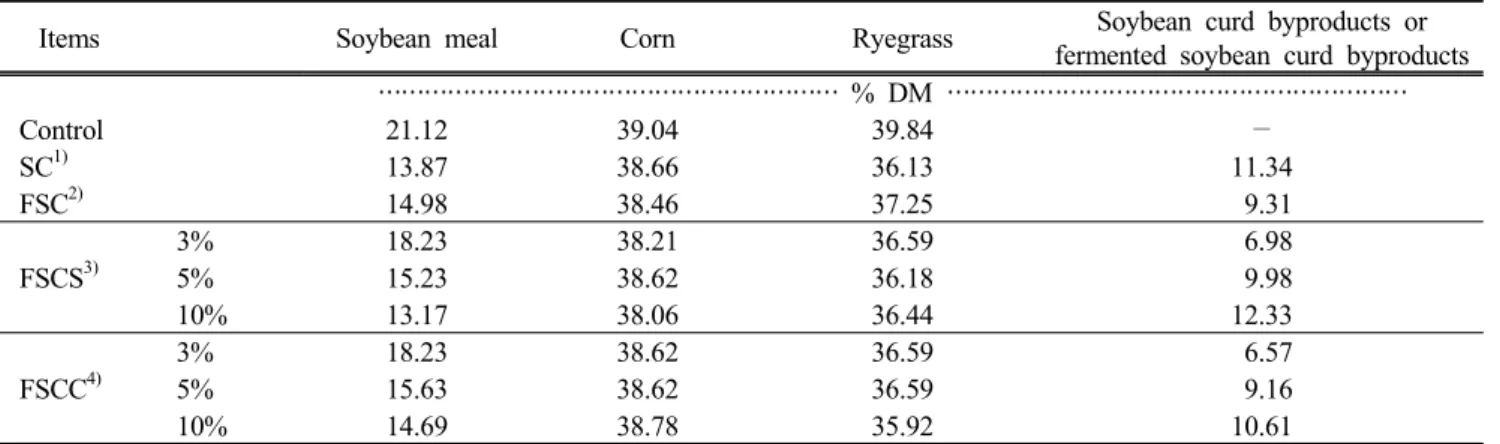
로 하였다. 기본 TMR 원료에 대하여 각 처리구들에 대하 여 SC, FSC, FSCS 3, 5, 10% 그리고 FSCC 3, 5, 10% 최 대 대체 함량 이용하여 배합비를 작성하였으며(Table 1), 대 조구 및 시험사료에 대한 일반성분은 Table 2와 같다.
Table 1. Feed formulation of experimental diets
Items Soybean meal Corn Ryegrass Soybean curd byproducts or fermented soybean curd byproducts
……… % DM ………
Control 21.12 39.04 39.84 -
SC1) 13.87 38.66 36.13 11.34
FSC2) 14.98 38.46 37.25 9.31
FSCS3)
3% 18.23 38.21 36.59 6.98
5% 15.23 38.62 36.18 9.98
10% 13.17 38.06 36.44 12.33
FSCC4)
3% 18.23 38.62 36.59 6.57
5% 15.63 38.62 36.59 9.16
10% 14.69 38.78 35.92 10.61
1)SC: soybean curd byproducts.
2)FSC: fermented soybean curd byproducts.
3)FSCS: mixture of soybean curd byproducts and Artemisia princeps Pampanini cv. Sajabal (5:5, dry matter basis).
4)FSCC: mixture of soybean curd byproducts and spent coffee grounds (5:5, dry matter basis).
Table 2. Chemical composition of experimental diets1)
Items Control SC2) FSC3) FSCS4) FSCC5)
3% 5% 10% 3% 5% 10%
……… % ………
Dry matter 87.78 88.61 88.49 88.64 88.66 88.66 88.58 88.54 88.58 Crude protein 19.06 18.91 19.02 18.99 18.93 18.90 18.97 18.98 18.95 Ether extract 3.36 4.21 4.03 4.13 4.11 4.05 4.12 4.11 4.18 Crude fiber 10.00 10.62 10.64 10.82 10.78 10.93 10.72 10.74 10.70 Crude ash 5.96 5.42 5.48 5.44 5.43 5.52 5.47 5.42 5.37
NFE6) 49.41 49.46 49.32 49.25 49.40 49.27 49.31 49.28 49.38
NFC7) 53.18 54.64 54.28 54.41 54.58 54.40 54.53 54.46 54.57
NDF8) 24.70 26.45 26.15 26.77 26.77 27.07 26.68 26.67 26.65
ADF9) 13.25 13.56 13.63 13.76 13.85 14.04 13.67 13.65 13.64
Ca 0.08 0.10 0.09 0.10 0.10 0.10 0.10 0.10 0.10
P 0.24 0.24 0.24 0.25 0.25 0.24 0.25 0.25 0.25
1)Total digestible nutrients: 79%, crude protein: 18.90~19.06% of control and experimental diets.
2)SC: Soybean curd byproducts.
3)FSC: Fermented soybean curd byproducts
4)FSCS: Mixture of soybean curd byproducts and Artemisia princeps Pampanini cv. Sajabal (5:5, dry matter basis).
5)FSCC: Mixture of soybean curd byproducts and spent coffee grounds (5:5, w/w, dry matter basis).
6)NFE: Nitrogen free extract.
7)NFC: Non fiber carbohydrate.
8)NDF: Acid detergent fiber.
9)ADF: Neutral detergent fiber.
3. 접종액 및 in vitro 시험 준비
In vitro 시험을 위한 반추위 내 미생물 접종액 제조는 cannular가 장착된 젖소의 반추위 내에서 채취한 반추위내 용물을 8겹의 cheesecloth로 거른 후 보온병을 이용하여 실 험실로 운반 후 artificial saliva (McDougall, 1948)와 1:1로 혼합하였고 39°C에서 CO2 gas를 주입하여 혐기상태를 유 지하였다. 1 mm screen이 장착된 분쇄기 (Cyclotech tm
1093, FOSS, DK-3400 Hilleod, Denmark)를 이용하여 분쇄 된 TMR 사료 (40 g/L)와 혼합하여 rubber stopper를 장착 후 shaking water bath (100 rpm)를 이용하여 39°C에서 24시 간 동안 계대배양을 실시하였다. 배양이 끝난 후 반추위 미생물 혼합액은 2,500 rpm에서 15분간 원심분리하여 상층 액만을 채취하여 접종액으로 이용하였다.
In vitro 배양은 serum bottle (150 mL)에 대조구와 각 시 험사료를 건물 1.7 g과 혐기적 방법 (Miller and Wolin,
Table 3. Effect of fermented soybean curd byproducts with Artemisia princeps Pampanini cv. Sajabal or spent coffee grounds on ruminal pH in vitro
Incubation
time (h) Control SC1) FSC2) FSCS3) FSCS FSCS FSCC4) FSCC FSCC
SEM5) P value
3% 5% 10% 3% 5% 10%
0 7.06 7.06 7.06 7.07 7.06 7.07 7.06 7.06 7.06 0.004 0.5618 2 7.00ab 7.01a 7.01a 6.99ab 7.00ab 7.00ab 6.98ab 6.98ab 6.99ab 0.021 0.0572 4 6.78bc 6.77bcd 6.73d 6.85a 6.84a 6.84a 6.74cd 6.74cd 6.78bc 0.015 0.0002 6 6.83a 6.67cd 6.61d 6.75b 6.76b 6.76b 6.73bc 6.75b 6.63d 0.021 0.0001 8 6.71a 6.68ab 6.53d 6.58cd 6.56cd 6.59cd 6.55cd 6.53cd 6.59cd 0.027 0.0024 10 6.75a 6.63b 6.61bc 6.57cd 6.55d 6.55d 6.57cd 6.58bcd 6.62bc 0.020 0.0001 12 6.50a 6.45bcd 6.48ab 6.47ab 6.47ab 6.47ab 6.42cd 6.42cd 6.42d 0.016 0.0280 24 6.64abc 6.65ab 6.67a 6.63abc 6.66ab 6.65ab 6.64abc 6.62bc 6.61c 0.016 0.1735
1)SC: Soybean curd byproducts.
2)FSC: Fermented soybean curd byproducts.
3)FSCS: Mixture of soybean curd byproducts and Artemisia princeps Pampanini cv. Sajabal (5:5, dry matter basis).
4)FSCC: Mixture of soybean curd byproducts and spent coffee grounds (5:5, w/w, dry matter basis).
5)SEM: Standard error of the mean.
The lowercase letters above the spots indicate statistical significance; mean values with different letters are significantly different (p<0.05).
1974)을 이용하여 artificial saliva (McDougall, 1948) 100 mL 주입 후 CO2 gas 주입과 반추위 내 미생물 접종액 (5%, v/v)을 주입 하였으며, rubber stopper와 알루미늄 고 정장치를 이용하여 밀봉하였다. 접종 후 배양은 39°C incubator를 이용하였으며, 각 시료의 채취는 0, 2, 4, 6, 8, 10, 12 그리고 24 시간대에 실시하였다. 각 시간대에 채취 된 시료 중 gas 생성량은 gas 측정장치 (model PSGH- 28PCCA, DECO Co., Seoul, Korea)와 digital 압력 측정기 (DPT-03, Daeil Information Co., Seoul, Korea)를 이용하여 측정하였다. Gas 샘플은 vial에 주사기를 이용하여 포집하 여 -70°C에 보관 후 gas chromatography (7890B GC, Agilent Technologies, California, USA)에 Carbosphere 80/
100 column (Alltech Inc., Deerfield, Illinois, USA)을 이용하 여 CH4 gas 함량을 측정하였다. 이후 샘플들은 2,500rpm에 서 15분간 원심분리 후 상층액을 이용하여 pH를 측정하였 고 분석을 위해 -20°C에서 저장 후 NH3-N (Chaney and Marbach, 1962), volatile fatty acid (VFA) (Erwin et al., 1961)과 microbial protein synthesis (Lowry et al., 1951)를 측정하였다. 분리된 내용물은 건물소화율, neutral detergent fiber (NDF) 소화율 (Van Soest et al., 1991)을 측정하였고, undegradable protein (UDP)는 조단백질분석기 (Kjeltec 2300, FOSS, DK-3400 Hilleod, Denmark)를 이용하여 분석하였다 (AOAC, 1984).
4. 통계처리
반추위 내 미생물발효 특성에 대한 0, 2, 4, 6, 8, 10, 12 그리고 24시간대의 각 결과의 pH, gas 생성량, DM소화율,
NDF소화율, UDP 함량, NH3-N, 미생물단백질 합성량, VFA, Acetate/Propionate 비율 그리고 CH4 gas 생성량은 각 처리구의 샘플의 반복수에 대해 LSMEANS를 이용하여 MIXED procedure SAS program package (SAS, 1999)를 이 용하였으며, 각 처리구들의 평균에 대한 F-test (p<0.05)를 실시하였다.
Ⅲ. 결과 및 고찰 1. pH의 변화
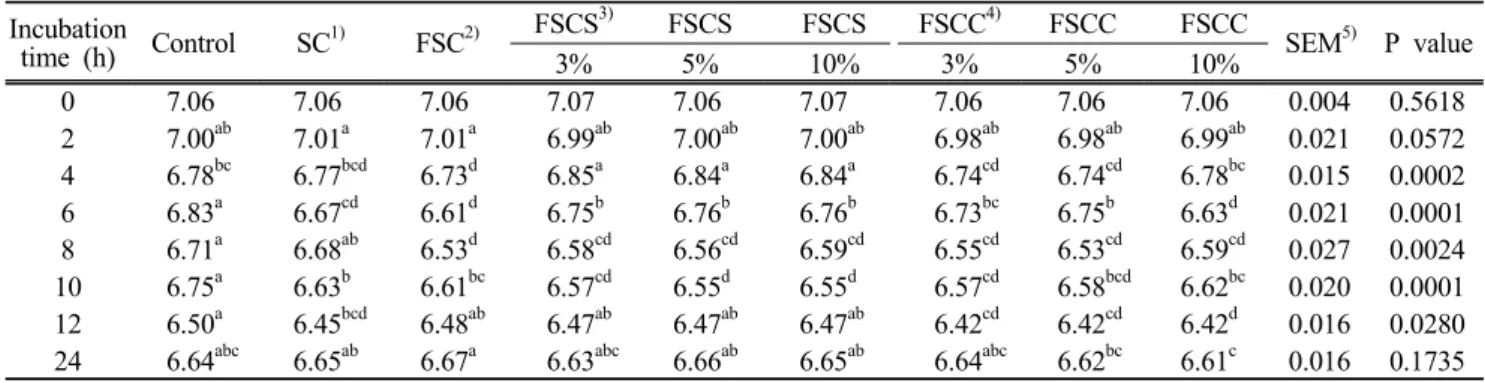
대조구와 모든 처리구에서 배양기간 동안 pH 수준은 6.42~7.07로 반추위 내 적정 수준을 유지하였다. 배양 2시 간대에서 대조구는 모든 처리구 보다 높았으나 (p<0.05), 처 리구간에는 차이가 없었다. 배양 4시간대에서 FSC 처리구 가 가장 높았으며 (p<0.05), FSCS 처리구에서 다음으로 높 은 결과를 나타내었다 (p<0.05). 배양 6~8시간대에 FSCS와 FSCC 처리구는 대조구에 비해 낮았고 SC와 FSC 처리구 에 비해 높은 결과를 나타내었다 (p<0.05). 배양 8시간대에 서 FSC와 처리구가 가장 낮은 결과를 나타내었으며 (p<0.05), FSCS와 FSCC 처리구 간에는 차이가 없었다. 배 양 10시간대 각 FSCS 5, 10% 처리구와 FSCC 5, 10% 처 리구에서 가장 낮은 결과를 나타내었고 (p<0.05), 배양 12 시간대 FSC와 FSCS 처리구는 대조구에 비해 낮은 pH수준 을 나타내었지만 (p<0.05) FSCC 처리구에 비해 유의적으로 높은 pH수준을 유지하였다. FSC와 FSCC 3% 처리구의 경 우 배양 24시간대 가장 높은 결과를 나타내었다 (p<0.05) (Table 3). 이와 같은 결과는 대조구에 SC 및 FSC 대체에
Table 4. Effect of fermented soybean curd byproducts with Artemisia princeps Pampanini cv. Sajabal or spent coffee grounds on gas production in vitro
Incubation
time (h) Control SC1) FSC2) FSCS3) FSCS FSCS FSCC4) FSCC FSCC
SEM5) P value
3% 5% 10% 3% 5% 10%
……… mL ………
0 - - - - - - - - - - -
2 7.48 7.48 7.48 7.49 7.49 7.49 7.48 7.48 7.48 0.334 0.8638 4 30.39b 30.73ab 31.99a 22.26d 22.21d 27.75c 22.45d 20.44e 18.50f 0.529 0.0001 6 48.47d 59.60a 61.93a 51.33c 56.33b 67.70b 55.73b 56.60b 57.40b 1.568 0.0001 8 88.66d 112.17b 127.40a 104.67bc 109.28bc 110.31bc 109.28bc 110.06bc 110.31bc 3.021 0.0001 10 107.23e 165.80a 169.33a 151.23bc 151.10bc 153.00b 141.80c 138.07c 140.67c 3.651 0.0001 12 156.00e 205.13d 233.53a 224.33b 224.00b 225.90b 205.60c 208.67c 209.00c 2.172 0.0001 24 269.07b 259.63d 242.97f 269.00b 269.30b 277.80a 263.40cd 259.47d 251.30e 1.834 0.0001
1)SC: Soybean curd byproducts.
2)FSC: Fermented soybean curd byproducts.
3)FSCS: Mixture of soybean curd byproducts and Artemisia princeps Pampanini cv. Sajabal (5:5, dry matter basis).
4)FSCC: Mixture of soybean curd byproducts and spent coffee grounds (5:5, dry matter basis).
5)SEM: Standard error of the mean.
The lowercase letters above the spots indicate statistical significance; mean values with different letters are significantly different (p<0.05).
의해 non fiber carbohydrate (NFC) 함량이 대조구에서 53.18% 보다 높은 54.28~54.64% 때문으로 사료되며 (Sievert and Shaver, 1993; Valadares et al., 1999; Ishida et al., 2012), 배양 초기 8시간대까지 FSCS와 FSCC 처리구는 커피박과 사자발약쑥의 높은 NDF 함량과 condensed tannin 에 의해 높은 pH 수준을 유지한 것으로 사료된다 (Barry et al., 1986). Xu et al. (2007)의 보고에 의하면 거세면양을 이 용한 in vivo 시험에서 TMR 사료 원을 커피박 10% 수준 까지 대체하여 급여 시 12시간 후 반추위 내 pH 수준에 영향을 미치지 않는다고 하였지만, FSCS와 FSCC 처리구 에서 배양 초기 시험사료 내 FSC에 의해 대조구에 비해 낮은 pH 수준을 유지하였다. 배양 6시간대까지 SC와 FSC 처리구에 비해 높은 pH를 유지한 것은 condensed tannin의 반추위 내 미생물 발효 저해 효과 때문이며, 이후 반추위 내 섬유소 분해활력이 높아졌기 때문으로 사료된다.
2. Gas 생성량 변화
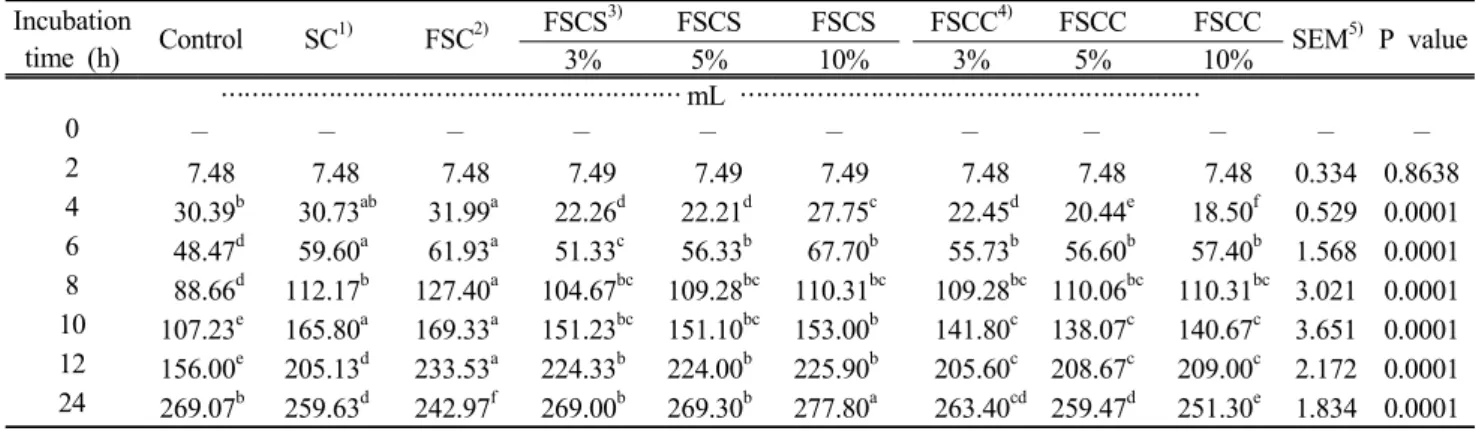
배양기간 동안 gas 생성량은 배양 2시간대까지 대조구와 모든 처리구에서 차이가 없었으며, 4~12시간대까지 FSC 처리구가 가장 높은 결과를 나타내었다 (p<0.05). FSCS와 FSCC 처리구는 배양 4~10시간대까지 대조구 보다 유의적 으로 높은 gas 생성량을 나타내었으나 (p<0.05), SC와 FSC 처리구 보다 유의적으로 낮은 결과를 나타내었다 (p<0.05).
FSCS 처리구는 배양 6시간대부터 사자발약쑥 함량이 증가 할수록 gas 생성량이 증가하는 경향을 나타내었는데. FSCS
처리구는 FSCC 처리구보다 배양 10시간때부터 유의적으로 높은 gas 발생량을 나타내었다 (p<0.05) (Table 4). 이와 같 은 결과는 FSCS 처리구와 FSCC 처리구에 포함되어 있는 FSC에 의해 NFC 함량이 증가되어 반추위 내 미생물의 발 효에 영향을 미친 것으로 사료되며 (Valadares et al., 1999;
Park et al., 2011), 사자발약쑥과 커피박의 높은 섬유소 함 량은 배양 후기 반추위 내 미생물 발효를 지속적으로 유지 시켰기 때문이다 (Bartley et al., 1978).
3. 건물소화율 변화
건물소화율은 배양 2시간대 대조구가 유의적으로 낮았으 며 (p<0.05), 배양 12시간대까지 FSC 처리구에서 가장 높았 다 (p<0.05). 배양 24시간대 건물소화율은 FSCS 10% 처리 구에서 유의적으로 높았으며 (p<0.05), FSC 처리구에서 가 장 낮은 결과를 나타내었다 (Table 5). 이와 같은 결과는 FSC 처리구가 배양 시간이 지남에 따라 가장 낮은 pH 수 준을 유지되었고, gas 생성량이 높았던 결과와 일치하였다.
또한 다른 모든 처리구에서도 배양 시간에 따른 건물소화 율에 따라 gas 발생량이 높아지는 결과를 나타내었다 (Theodorou et al., 1994; Theodorou et al., 1995). 특히, FSCS와 FSCC 처리구의 경우 SC와 FSC 처리구에 비해 배 양 초기 건물소화율은 낮은 경향을 나타내었는데, 24시간 대에는 사자발약쑥과 커피박 함량이 증가할수록 높은 건물 소화율을 나타내었다.
Table 6. Effect of fermented soybean curd byproducts with Artemisia princeps Pampanini cv. Sajabal or spent coffee grounds on NH3-N concentration in vitro
Incubation
time (h) Control SC1) FSC2) FSCS3) FSCS FSCS FSCC4) FSCC FSCC
SEM5) P value
3% 5% 10% 3% 5% 10%
……… mg/100 mL ………
0 14.07c 16.22abc 17.54a 16.34abc 16.43abc 15.15bc 15.34bc 15.22bc 15.64bc 0.783 0.1654 2 15.62e 16.70bcde 16.46cde 16.49abcd 17.96a 17.78ab 17.84ab 17.66abc 16.46cde 0.422 0.0078 4 10.95c 15.16ab 14.49b 16.52ab 15.44ab 14.96ab 14.78ab 16.82a 15.74ab 0.748 0.0019 6 12.75c 15.68b 15.26b 15.56b 16.22ab 15.39b 17.30a 16.34ab 15.98ab 0.529 0.0013 8 17.24a 14.55c 11.82d 15.08bc 15.48bc 15.35bc 16.78b 16.48b 16.04b 0.382 0.0001 10 15.00a 14.25ab 14.13b 14.44ab 14.52ab 14.37ab 14.97ab 12.93c 13.55c 0.290 0.0044 12 14.43a 10.80d 12.33bc 13.77ab 14.55a 14.37a 13.05abc 12.09cd 10.71d 0.513 0.0001 24 3.50bcd 3.53bcd 5.62a 4.01bc 4.60ab 4.24b 3.47bcd 2.93cd 2.87d 0.381 0.0001
1)SC: Soybean curd byproducts.
2)FSC: Fermented soybean curd byproducts.
3)FSCS: Mixture of soybean curd byproducts and Artemisia princeps Pampanini cv. Sajabal (5:5, dry matter basis).
4)FSCC: Mixture of soybean curd byproducts and spent coffee grounds (5:5, dry matter basis).
5)SEM: Standard error mean.
The lowercase letters above the spots indicate statistical significance; mean values with different letters are significantly different (p<0.05).
Table 5. Effect of fermented soybean curd byproducts with Artemisia princeps Pampanini cv. Sajabal or spent coffee grounds on dry matter digestibility in vitro
Incubation
time (h) Control SC1) FSC2) FSCS3) FSCS FSCS FSCC4) FSCC FSCC
SEM5) P value
3% 5% 10% 3% 5% 10%
……… % ………
0 - - - - - - - - - - -
2 24.72b 27.07a 27.23a 26.85a 27.34a 26.59a 27.36a 26.53a 27.31a 0.554 0.0559 4 29.03b 29.193b 31.79a 25.84d 25.58d 27.09c 25.23de 24.13e 22.52f 0.371 0.0001 6 31.45d 36.78a 36.92a 33.46c 36.40ab 36.76a 34.84bc 34.38c 36.56ab 0.597 0.0001 8 36.07c 38.86b 42.78a 38.22b 38.08b 37.79b 37.79b 38.06b 38.28b 0.430 0.0001 10 40.03e 41.34d 47.83a 45.87b 47.84a 48.38a 43.62c 43.45c 43.37c 0.293 0.0001 12 46.36e 49.24d 58.74a 53.44b 52.97b 52.7b 50.25c 50.01c 50.49c 0.5070 0.0001 24 69.12b 64.55e 64.32e 70.81b 71.14b 72.70a 66.67d 67.19cd 68.32c 0.457 0.0001
1)SC: Soybean curd byproducts.
2)FSC: Fermented soybean curd byproducts.
3)FSCS: Mixture of soybean curd byproducts and Artemisia princeps Pampanini cv. Sajabal (5:5, dry matter basis).
4)FSCC: Mixture of soybean curd byproducts and spent coffee grounds (5:5, dry matter basis).
5)SEM: Standard error of the mean.
The lowercase letters above the spots indicate statistical significance; mean values with different letters are significantly different (p<0.05).
4. NH3-N 함량 변화
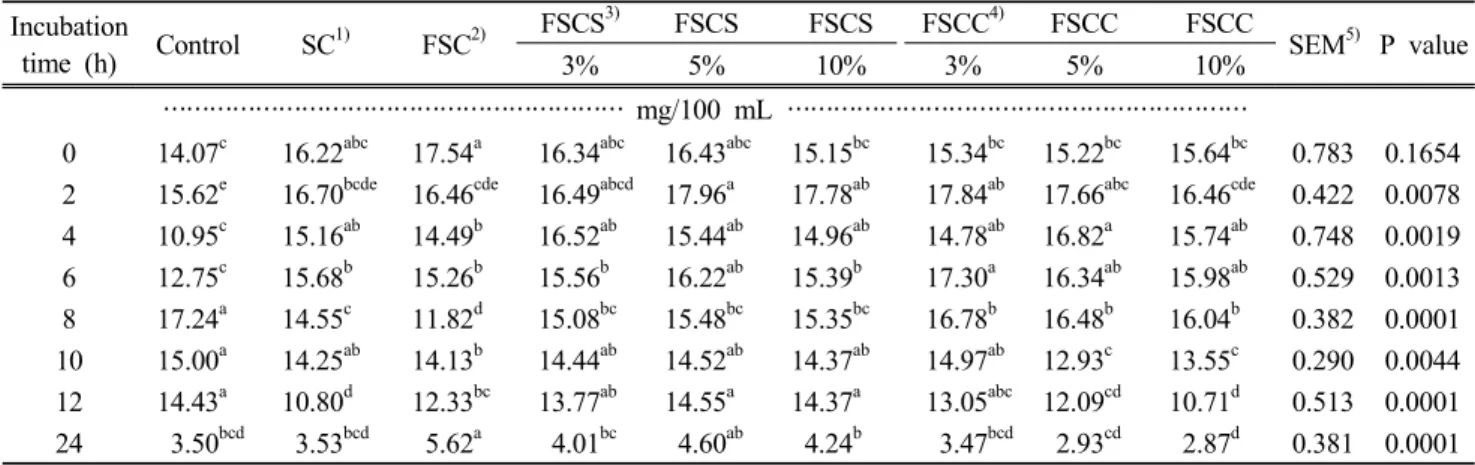
사료 내 포함되어 있거나 단백질원이 반추위 내 미생물 에 의해 분해되어 생성된 NH3-N은 반추위 내 미생물 성장 에 필수적인 질소공급원으로 작용을 하는데, 본 시험에서 배양 시간에 따른 NH3-N 함량은 배양 4시간대까지 대조구 에서 가장 낮았고 (p<0.05), 배양 종료 시 FSC 처리구가 가 장 높은 결과를 나타내었다 (p<0.05). 배양 4시간대 대조구
를 제외한 모든 처리구의 NH3-N 함량은 차이가 없었으며, 배양 8시간대 FCS 처리구가 유의적으로 높은 결과를 나타 내었다 (p<0.05). 이와 같은 결과는 대조구의 대두박이 비지 보다 rumen undegradable protein (RDP)이 높기 때문이고 (Park et al., 2011), 배양 24시간대 FSCS와 FSCC 처리구의 사자발약쑥과 커피박의 높은 섬유소함량 때문에 반추위 내 섬 유소 분해미생물 발효가 지속적으로 이루어졌기 때문으로 사 료된다 (Campbell et al., 1976; Bartley et al., 1978) (Table 6).
Table 7. Effect of fermented soybean curd byproducts with Artemisia princeps Pampanini cv. Sajabal or spent coffee grounds on microbial protein synthesis in vitro
Incubation
time (h) Control SC1) FSC2) FSCS3) FSCS FSCS FSCC4) FSCC FSCC
SEM5) P value
3% 5% 10% 3% 5% 10%
……… mg/100 mL………
0 40.03c 45.77bc 49.95ab 51.12ab 53.44a 55.70a 50.37ab 50.39ab 54.15a 2.017 0.0013 2 46.82b 58.51a 58.27a 58.33a 57.55a 58.05a 58.05a 58.45a 60.36a 1.440 0.0002 4 47.57d 53.37c 54.96bc 57.53ab 58.05a 58.23a 58.82a 56.70ab 59.11a 0.922 0.0001 6 53.62c 61.29b 65.77a 65.46a 65.12a 65.72a 62.11b 61.62b 62.72b 0.981 0.0001 8 57.20e 64.58b 66.55a 64.27bc 63.28bc 64.06bc 62.93cd 62.53cd 61.05d 0.645 0.0001 10 61.30e 68.22abc 65.60cd 66.06bcd 66.45abcd 67.21abcd 68.66ab 69.31a 68.42abc 0.989 0.0008 12 53.01d 55.02d 67.23c 67.33c 68.88bc 72.29a 68.17bc 68.09bc 70.36ab 0.821 0.001 24 71.86ab 70.39ab 68.80ab 67.94b 69.31ab 68.00b 71.56ab 69.42ab 72.08a 1.329 0.2370
1)SC: Soybean curd byproducts.
2)FSC: Fermented soybean curd byproducts.
3)FSCS: Mixture of soybean curd byproducts and Artemisia princeps Pampanini cv. Sajabal (5:5, dry matter basis).
4)FSCC: Mixture of soybean curd byproducts and spent coffee grounds (5:5, dry matter basis).
5)SEM: Standard error of the mean.
The lowercase letters above the spots indicate statistical significance; mean values with different letters are significantly different (p<0.05).
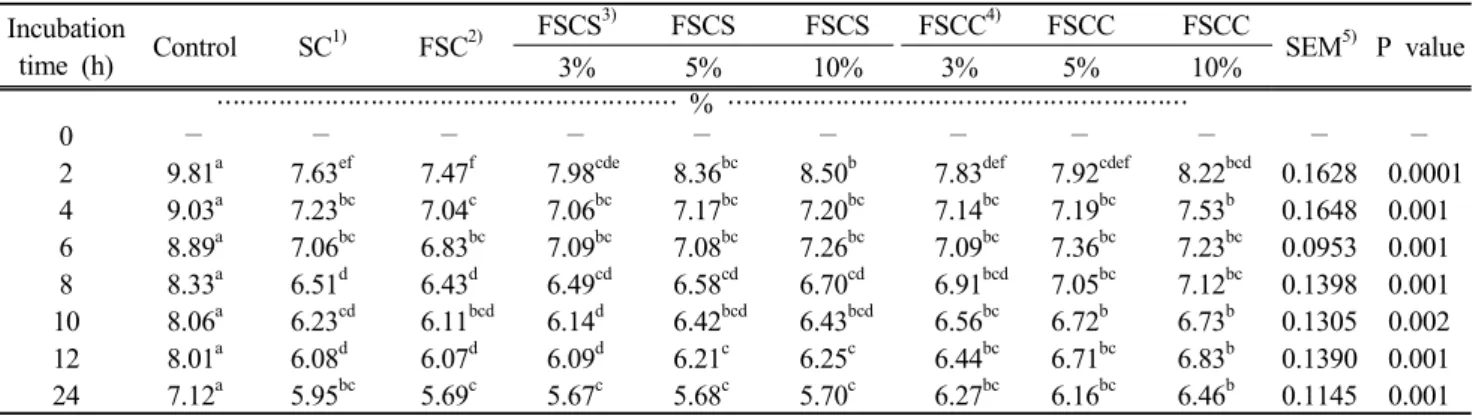
Table 8. Effect of fermented soybean curd byproducts with Artemisia princeps Pampanini cv. Sajabal or spent coffee grounds on undegradable protein content in vitro
Incubation
time (h) Control SC1) FSC2) FSCS3) FSCS FSCS FSCC4) FSCC FSCC
SEM5) P value
3% 5% 10% 3% 5% 10%
……… % ………
0 - - - - - - - - - - -
2 9.81a 7.63ef 7.47f 7.98cde 8.36bc 8.50b 7.83def 7.92cdef 8.22bcd 0.1628 0.0001 4 9.03a 7.23bc 7.04c 7.06bc 7.17bc 7.20bc 7.14bc 7.19bc 7.53b 0.1648 0.001 6 8.89a 7.06bc 6.83bc 7.09bc 7.08bc 7.26bc 7.09bc 7.36bc 7.23bc 0.0953 0.001 8 8.33a 6.51d 6.43d 6.49cd 6.58cd 6.70cd 6.91bcd 7.05bc 7.12bc 0.1398 0.001 10 8.06a 6.23cd 6.11bcd 6.14d 6.42bcd 6.43bcd 6.56bc 6.72b 6.73b 0.1305 0.002 12 8.01a 6.08d 6.07d 6.09d 6.21c 6.25c 6.44bc 6.71bc 6.83b 0.1390 0.001 24 7.12a 5.95bc 5.69c 5.67c 5.68c 5.70c 6.27bc 6.16bc 6.46b 0.1145 0.001
1)SC: Soybean curd byproducts.
2)FSC: Fermented soybean curd byproducts.
3)FSCS: Mixture of soybean curd byproducts and Artemisia princeps Pampanini cv. Sajabal (5:5, dry matter basis).
4)FSCC: Mixture of soybean curd byproducts and spent coffee grounds (5:5, dry matter basis).
5)SEM: Standard error of the mean.
The lowercase letters above the spots indicate statistical significance; mean values with different letters are significantly different (p<0.05).
5. 반추위 미생물단백질 함량 변화
배양 시작과 함께 대조구와 SC 처리구은 FSC, FSCS 그 리고 FSCC 처리구에 비해 유의하게 낮은 미생물단백질 함 량을 유지하였으며 (p<0.05), 각 FSCS와 FSCC 처리구에서 사자발약쑥과 커피박 함량이 증가할수록 높은 결과를 나타 내었다. 이와 같은 결과는 시험사료원의 발효를 위해 4종 의 Lactobacillus spp. 균종을 이용했기 때문이며, 배양 2시 간대까지 반추위 내 미생물단백질 합성량은 차이가 없었다.
배양 6~8시간대 FSC 처리구에서 가장 높은 미생물단백질 함량을 나타내었으며 (p<0.05), 배양 10시간대 FSC 처리구 보다 SC, FSCS, FSCC 처리구에서 유의하게 높은 결과를 나타내었다 (p<0.05). 배양 12시간대에 FSCC 10% 처리구에 서 가장 높은 반추위 내 미생물 함량을 나타내었는데 (p<0.05) (Table 7), 이와 같은 결과는 배양 초기 4종의 Lactobacillus spp.의 유용미생물 첨가와 배양 초기 FSC, FSCS 그리고 FSCC 처리구의 높은 NFC 함량 때문이며, 또한 배양 후기 섬유소 함량이 높아 반추위 내 미생물 발
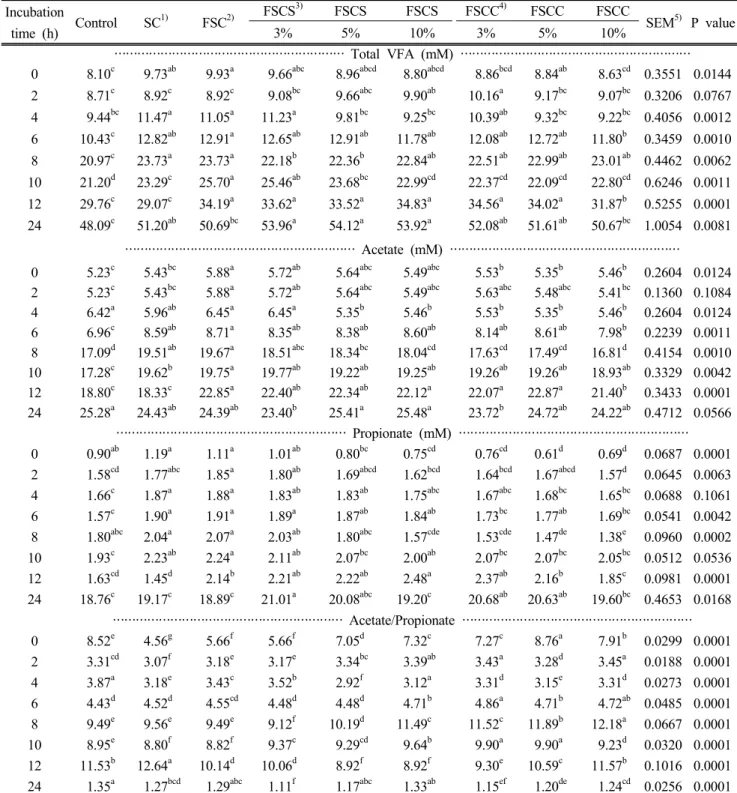
Table 9. Effect of fermented soybean curd byproducts with Artemisia princeps Pampanini cv. Sajabal or spent coffee grounds on total VFA concentration in vitro
Incubation
time (h) Control SC1) FSC2) FSCS3) FSCS FSCS FSCC4) FSCC FSCC
SEM5) P value
3% 5% 10% 3% 5% 10%
……… Total VFA (mM) ………
0 8.10c 9.73ab 9.93a 9.66abc 8.96abcd 8.80abcd 8.86bcd 8.84ab 8.63cd 0.3551 0.0144 2 8.71c 8.92c 8.92c 9.08bc 9.66abc 9.90ab 10.16a 9.17bc 9.07bc 0.3206 0.0767 4 9.44bc 11.47a 11.05a 11.23a 9.81bc 9.25bc 10.39ab 9.32bc 9.22bc 0.4056 0.0012 6 10.43c 12.82ab 12.91a 12.65ab 12.91ab 11.78ab 12.08ab 12.72ab 11.80b 0.3459 0.0010 8 20.97c 23.73a 23.73a 22.18b 22.36b 22.84ab 22.51ab 22.99ab 23.01ab 0.4462 0.0062 10 21.20d 23.29c 25.70a 25.46ab 23.68bc 22.99cd 22.37cd 22.09cd 22.80cd 0.6246 0.0011 12 29.76c 29.07c 34.19a 33.62a 33.52a 34.83a 34.56a 34.02a 31.87b 0.5255 0.0001 24 48.09c 51.20ab 50.69bc 53.96a 54.12a 53.92a 52.08ab 51.61ab 50.67bc 1.0054 0.0081
……… Acetate (mM) ………
0 5.23c 5.43bc 5.88a 5.72ab 5.64abc 5.49abc 5.53b 5.35b 5.46b 0.2604 0.0124 2 5.23c 5.43bc 5.88a 5.72ab 5.64abc 5.49abc 5.63abc 5.48abc 5.41bc 0.1360 0.1084 4 6.42a 5.96ab 6.45a 6.45a 5.35b 5.46b 5.53b 5.35b 5.46b 0.2604 0.0124 6 6.96c 8.59ab 8.71a 8.35ab 8.38ab 8.60ab 8.14ab 8.61ab 7.98b 0.2239 0.0011 8 17.09d 19.51ab 19.67a 18.51abc 18.34bc 18.04cd 17.63cd 17.49cd 16.81d 0.4154 0.0010 10 17.28c 19.62b 19.75a 19.77ab 19.22ab 19.25ab 19.26ab 19.26ab 18.93ab 0.3329 0.0042 12 18.80c 18.33c 22.85a 22.40ab 22.34ab 22.12a 22.07a 22.87a 21.40b 0.3433 0.0001 24 25.28a 24.43ab 24.39ab 23.40b 25.41a 25.48a 23.72b 24.72ab 24.22ab 0.4712 0.0566
……… Propionate (mM) ………
0 0.90ab 1.19a 1.11a 1.01ab 0.80bc 0.75cd 0.76cd 0.61d 0.69d 0.0687 0.0001 2 1.58cd 1.77abc 1.85a 1.80ab 1.69abcd 1.62bcd 1.64bcd 1.67abcd 1.57d 0.0645 0.0063 4 1.66c 1.87a 1.88a 1.83ab 1.83ab 1.75abc 1.67abc 1.68bc 1.65bc 0.0688 0.1061 6 1.57c 1.90a 1.91a 1.89a 1.87ab 1.84ab 1.73bc 1.77ab 1.69bc 0.0541 0.0042 8 1.80abc 2.04a 2.07a 2.03ab 1.80abc 1.57cde 1.53cde 1.47de 1.38e 0.0960 0.0002 10 1.93c 2.23ab 2.24a 2.11ab 2.07bc 2.00ab 2.07bc 2.07bc 2.05bc 0.0512 0.0536 12 1.63cd 1.45d 2.14b 2.21ab 2.22ab 2.48a 2.37ab 2.16b 1.85c 0.0981 0.0001 24 18.76c 19.17c 18.89c 21.01a 20.08abc 19.20c 20.68ab 20.63ab 19.60bc 0.4653 0.0168
……… Acetate/Propionate ………
0 8.52e 4.56g 5.66f 5.66f 7.05d 7.32c 7.27c 8.76a 7.91b 0.0299 0.0001 2 3.31cd 3.07f 3.18e 3.17e 3.34bc 3.39ab 3.43a 3.28d 3.45a 0.0188 0.0001 4 3.87a 3.18e 3.43c 3.52b 2.92f 3.12a 3.31d 3.15e 3.31d 0.0273 0.0001 6 4.43d 4.52d 4.55cd 4.48d 4.48d 4.71b 4.86a 4.71b 4.72ab 0.0485 0.0001 8 9.49e 9.56e 9.49e 9.12f 10.19d 11.49c 11.52c 11.89b 12.18a 0.0667 0.0001 10 8.95e 8.80f 8.82f 9.37c 9.29cd 9.64b 9.90a 9.90a 9.23d 0.0320 0.0001 12 11.53b 12.64a 10.14d 10.06d 8.92f 8.92f 9.30e 10.59c 11.57b 0.1016 0.0001 24 1.35a 1.27bcd 1.29abc 1.11f 1.17abc 1.33ab 1.15ef 1.20de 1.24cd 0.0256 0.0001
1)SC: Soybean curd byproducts.
2)FSC: Fermented soybean curd byproducts.
3)FSCS: Mixture of soybean curd byproducts and Artemisia princeps Pampanini cv. Sajabal (5:5, dry matter basis).
4)FSCC: Mixture of soybean curd byproducts and spent coffee grounds (5:5, dry matter basis).
5)SEM: Standard error of the mean.
The lowercase letters above the spots indicate statistical significance; mean values with different letters are significantly different (p<0.05).
Table 10. Effect of fermented soybean curd byproducts with Artemisia princeps Pampanini cv. Sajabal or spent coffee grounds on CH4 production in vitro
Incubation
time (h) Control SC1) FSC2) FSCS3) FSCS FSCS FSCC4) FSCC FSCC
SEM5) P value
3% 5% 10% 3% 5% 10%
……… mL ………
0 0.23c 1.73b 2.87a 0.65c 0.56c 0.45c 0.39c 0.46c 0.22c 0.2272 0.0001 2 0.91c 3.63b 7.43a 3.39b 1.62c 2.81b 2.81b 1.35c 0.91c 0.2970 0.0001 4 3.08de 5.97b 10.07a 4.06de 3.12cde 2.26e 4.10c 2.26e 3.08de 0.3426 0.0001 6 4.13cd 7.90b 12.52a 5.17c 4.02d 4.67cd 4.89cd 2.69e 4.47cd 0.3580 0.0001 8 5.66e 11.08b 14.39a 11.49b 4.81de 6.74c 6.10c 6.81c 5.66cd 0.4080 0.0001 10 5.59g 13.81b 16.38a 10.83c 8.46e 9.64d 10.00cd 8.46e 6.92f 0.3149 0.0001 12 16.18a 13.83bc 11.47e 12.66d 8.92f 14.43b 12.52de 11.57e 13.26cd 0.3562 0.0001 24 17.20ab 15.79cd 12.96f 18.12a 17.22ab 16.44bc 17.71a 14.87de 14.37e 0.4010 0.0001
1)SC: Soybean curd byproducts.
2)FSC: Fermented soybean curd byproducts.
3)FSCS: Mixture of soybean curd byproducts and Artemisia princeps Pampanini cv. Sajabal (5:5, dry matter basis).
4)FSCC: Mixture of soybean curd byproducts and spent coffee grounds (5:5, dry matter basis).
5)SEM: Standard error mean.
The lowercase letters above the spots indicate statistical significance; mean values with different letters are significantly different (p<0.05).
효작용이 지속적으로 이루어졌기 때문으로 사료된다.
6. Undgradable protein (UDP) 함량 변화
배양 기간 동안 UDP 함럄은 대조구에서 가장 높았고 (p<0.05), FSC 처리구는 가장 낮은 결과를 나타내었으며, 배양 24시간에 FSC 처리구는 FSCS 처리구와 같이 대조구 와 다른 처리구들에 비해 유의하게 낮은 UDP 함량을 유지 하였다. FSCC 처리구는 다른 모든 처리구들에 비해 배양 10시간대부터 UDP 함량이 감소하는 결과를 나타내었는데 (Table 8), 이와 같은 결과는 사자발약쑥과 커피박에 포함 되어 있는 saponin이 반추위 내에서 질소 대사를 증진시키 고 미생발효조건을 개선한 것으로 사료되며 (Wallace, 2004), 본 시험에서 FSCS와 FSCC 처리구에서 배양 후기 건물소화율, NH3-N 함량 그리고 UDP 함량이 대조구 및 SC 그리고 FSC 처리구에 대해 차이를 나타내었다. 또한 Wen-Shyg Chiou et al. (1998)의 면양을 이용한 시험에서 대조구 사료에 비지를 대체한 시험구에서 사료 섭취 후 반 추위 내에서 질소 흡수율과 질소 함량이 비지처리구에서 낮았던 결과와 일치하였다.
7. Volatile fatty acid (VFA) 농도의 변화
Total VFA 농도는 배양 6~12시간대 FSC 처리구에서 유 의하게 높은 결과를 나타내었으며 (p<0.05), 4시간대에는
SC와 FSCS 5% 처리구와 비슷하였고, 배양 종료 시에는 FSCS 처리구가 높은 결과를 나타내었다 (p<0.05). 또한 acetate 농도는 배양 0~12시간대까지 FSC 처리구에서 가장 높았으며(p<0.05), 배양 24시간대 FSCS 5, 10% 처리구에서 가장 높은 결과를 나타내었다(p<0.05). FSCC 5, 10% 처리 구는 배양 12~24시간대에 SC 처리구에 비해 유의적으로 높았으며 (p<0.05), acetate 농도는 배양 12~24시간대에 FSC 처리구와 비슷한 경향을 나타내었다. 이와 같은 결과는 SC 와 FSC 처리구의 높은 NFC 함량에 의해 배양초기 건물소 화율이 증가와 배양 후기 FSCC 처리구에서 건물소화율이 증가한 결과와 일치하였다. FSC 처리구의 propionate 농도 는 배양 24시간대를 제외하고 모든 처리구에서 유의하게 높은 결과를 나타내었다 (p<0.05). FSCS 3% 처리구는 대조 구와 비슷한 결과를 나타내었으나 FSCS 5, 10% 처리구와 FSCC 처리구에 비해 전체 배양 기간 동안 높은 경향을 나 타내었다. Acetate/Propionate 비율은 SC 처리구에서 배양 12시간대 가장 높았으며, 배양 24시간대에는 FSCS 3% 처 리구가 가장 낮은 결과를 나타내었다(p<0.05). 모든 처리구 의 acetate/propionate 비율은 배양 24시간대에 급격하게 감 소하는 경향을 나타내었다 (Table 9).
8. CH4 발생량 변화
CH4 가스 발생량은 FSC 처리구에서 배양 0~10시간대까 지 모든 처리구에 비해 유의하게 높았으며 (p<0.05), 24시
간대에는 가장 낮은 결과를 나타내었다 (p<0.05). 배양 24 시간대 CH4 가스 생성량은 FSCS 3%와 FSCC 3% 처리구 에서 유의적으로 높은 결과를 나타내었으며 (p <0.05), SC와 FSC 처리구는 대조구, FSCS 그리고 FSCC 처리구 보다 높 은 CH4 가스 생성량은 나타내었다 (p<0.05). 배양 4~10시간 대까지 FSCS와 FSCC 처리구는 SC와 FSC 처리구에 비해 유의하게 낮은 CH4 가스 생성량을 나타내었고 (p<0.05), 사 자발약쑥과 커피박 함량이 증가할수록 배양 종료 시까지 낮은 경향을 나타내었다 (Table 10). 이와 같은 결과는 사자 발약쑥과 커피박에 phenolic compound인 tannin, saponin, caffeine이 많이 함유되어 있고 (Belitz et al., 2009; Negesse et al., 2009; Mussatto et al., 2011), Puchala et al. (2005)의 보고에 의하면 반추동물에 있어서 tannin이 포함된 청초 급 여 시 CH4 가스 발생량이 감소하였으며, phenolic compound 가 함유된 coffee와 green tae가 함유된 사료를 이용한 in vitro 시험에서 24시간 배양시간 후 건물소화율은 다소 감 소하였으나 CH4 가스 발생량은 감소하였다는 결과와 일치 하였다 (Senevirathne et al., 2012).
Ⅳ. 요 약
본 연구는 농․식품부산물 중 비지박, 사자발약쑥 그리고 커피박의 유효미생물 (L. acidophilus ATCC 496, L. fermentum ATCC 1493, L. plantarum KCTC 1048, L. casei IFO 3533) 발효 사료원이 젖소 급여용 TMR (대조구) 중 대두박을 주 로 대체한 각 비지박 (SC), 발효 비지박 (FSC), 발효 비지박 +발효 사자발약쑥 부산물 (1:1, DM basis, FSCS) 3, 5, 10%
그리고 발효 비지박 + 발효 커피박 (1:1, DM basis, FSCC) 3, 5, 10%의 반추위 내 미생물 발효특성을 알아보기 위해 9처리구를 이용하여 3반복으로 in vitro 시험이 실시되었다.
배양 6~8시간대에 FSCS와 FSCC 처리구는 SC와 FSC 처 리구에 비해 높은 pH 수준을 유지하였고, 대조구에 비해 낮은 pH 수준을 유지하였다 (p<0.05). 또한 배양 24시간대 FSC와 FSCC 3% 처리구는 가장 높은 pH를 유지하였다 (p<0.05). Gas 생성량은 배양 4~10시간대까지 FSCS와 FSCC 처리구가 대조구 보다 유의적으로 높았으나 SC와 FSC 처리구 보다 낮은 결과를 나타내었다 (p<0.05). 건물소 화율은 배양 12시간대까지 FSC 처리구에서 유의적으로 높 았고 (p<0.05), 24시간대에는 FSCS 10% 처리구가 가장 높 은 결과를 나타내었다 (p<0.05). NH3-N 함량은 배양 4시간 대까지 대조구에서 가장 낮았고 (p<0.05), 24시간에서는 FSC 처리구가 가장 높은 결과를 나타내었다 (p<0.05). 미생
물단백질 합성량은 배양 시작 시 FSC, FSCS 그리고 FSCC 처리구가 4종의 Lactobacillus spp.에 의한 발효 때문에 대 조구와 SC 처리구에 비해 높았으며 (p<0.05), 배양 10시간 대 FSC 처리구 보다 SC, FSCS 그리고 FSCC 처리구에서 유의하게 높은 결과를 나타내었다 (p<0.05). Total VFA 농 도는 배양 6~12 시간대에는 FSC 처리구에 유의하게 높았 고(p<0.05), 배양 24시간대에는 FSCS 처리구에서 가장 높 았다 (p<0.05). Acetate 농도는 배양 0~12 시간대에 FSC 처 리구에서 가장 높았으며 (p<0.05), 24시간대에는 FSCS 5, 10% 처리구에서 가장 높은 결과를 나타내었다 (p<0.05).
Propionate 농도는 FSC 처리구가 배양 0~10시간대까지 가 장 높았으며 (p<0.05), 전체 배양기간 동안 FSCS 5, 10%
처리구와 FSCC 처리구에 비해 높은 경향을 나타내었다.
Acetate/Propionate 비율은 배양 12시간대에 SC 처리구에서 가장 높았으며, 배양 24시간대에는 FSCS 3% 처리구가 가 장 낮은 결과를 나타내었다 (p<0.05). CH4 가스 생성량은 FSC 처리구에서 배양 0~10시간대까지 가장 높았으며 (p<0.05), 24시간대에는 가장 낮은 결과를 나타내었다 (p<0.05). 배양 4~10시간대까지 FSCS와 FSCC 처리구는 SC와 FSC 처리구에 비해 유의하게 낮은 CH4 가스 생성량 을 나타내었고 (p<0.05), 사자발약쑥과 커피박 함량이 증가 할수록 CH4 가스 생성량은 배양 종료 시까지 낮은 경향을 나타내었다.
따라서, 본 in vitro 시험에서 젖소 급여용 TMR에 SC, FSC, FSCS 그리고 FSCC의 대체효과는 FSC 처리구에서 배양 초기부터 12시간대까지 반추위 내 미생물 발효 특성 이 가장 높았다. FSCS와 FSCC 처리구는 배양 6~8시간대 부터 반추위 내 미생물 작용이 높아지는 특징을 나타내었 으나, 배양 시작 후 6~8시간대까지 gas 생성량 및 CH4 가 스 발생량은 낮아지는 특징을 나타내었다. 이와 같은 결론 은 FSC는 젖소용 TMR 사료원 대체 효과가 높으며, TMR 사료원 중 FSCS와 FSCC 대체효과는 배양 초기 다소 낮은 반추위 내 미생물 발효 특성을 나타내었으나 CH4 저감효 과를 나타내었다. 또한 배양 후기에는 SC와 FSC의 반추위 내 미생물 발효 특성과 비슷한 경향을 나타내어 TMR 사 료원으로써 이용 가치가 높을 것으로 사료된다.
Ⅴ. 사 사
본 논문은 농촌진흥청 공동연구사업 (과제번호: PJ00915) 의 지원에 이루어진 것임.
Ⅵ. REFERENCES
AOAC. 1984. Official methods analysis (12th ed.), Association of Official Analytical Chemists, Arlington, VA. Washinton D. C., USA.
Barahona, R., Solange, S., Carlos, E.L., Emyr, O., Phillip, M. and Theodorou, M.K. 2006. Effect of condensed tannins from tropical legumes on the activity of fibrolytic enzymes from the rumen fungus neocallimastyx hurleyensis. Enzyme and Microbial Technology. 39:281-288.
Barry, T.N., Manley, T.R. and Duncan, S.J. 1986. The role of condensed tannins in the nutritional value of lotus pedunculatus for sheep. 4. Sites of carbohydrate and protein digestion as influenced by dietary reactive tannin concentration. British Journal of Nutrition. 55:123-137.
Bartley, E.E., Ibbetson, R.W., Chyba, L.J. and Dayton, A.D. 1978.
Coffee grounds. Ii. Effects of coffee grounds on performance of milking dairy cows and feedlot cattle, and on rumen fermentation and dry matter removal rate. Journal of Anim Science.
47:791-799.
Belitz, H.D., Grosch, W. and Schieberle, P. 2009. Coffee, tea, cocoa.
In H. D. Belitz, W. Grosch & P. Schieberle (eds.), Food Research International. 29:185-189.
Campbell, T.W., Bartley, E.E., Bechtle, R.M. and Dayton, A.D. 1976.
Coffee grounds. I. Effects of coffee grounds on ration digestibility and diuresis in cattle, on in vitro rumen fermentation, and on rat growth. Journal of Dairy Science. 59:
452-1460.
Chaney, A.L. and Marbach, E.P. 1962. Modified reagents for determination of urea and ammonia. Clinical Chemistry. 8:
30-132.
Delgado-Andrade, C., Rufian-Henares, J.A. and Morales, F.J. 2005.
Assessing the antioxidant activity of melanoidins from coffee brews by different antioxidant methods. Journal of Agricultural and Food Chemistry 53:7832-7836.
Erwin, E.S., Sterner, W., Gordon, R.S., Machlin, L.J. and Tureen, L.L. 1961. Etiology of muscular dystrophy in the lamb and chick. Journal Nutrition. 75:45-50.
Han, S.H., Han, K.S., Seung, J.H., Kwon, N.K. and Shin, I.A. 2012.
Operation of world grain market information system No. R661-1.
Korea Rural Economic Institute.
Hess, H.D., Tiemann, T.T., Noto, F., Carulla, J.E. and Kreuzer, M.
2006. Strategic use of tannins as means to limit methane emission from ruminant livestock. International Congress Series.
1293:164-167.
Hong, J.H., Jeon, J.L., Lee, J.H. and Lee, I.S. 2007. Antioxidative
properties of artemisia princeps pamp. Journal of Korean Society Food Science and Nutrition. 36:657-662.
Ishida, K., Yani, S., Kitagawa, M., Oishi, K., Hirooka, H. and Kumagai, H. 2012. Effects of adding food by-products mainly including noodle waste to total mixed ration silage on fermentation quality, feed intake, digestibility, nitrogen utilization and ruminal fermentation in wethers. Animal Science Journal.
83:735-742.
Kim, C.H., Kim, G.B., Chang, M.B., Bae, G.S., Paik, I.K. and Kil, D.Y. 2012. Effect of dietary supplementation of lactobacillus- ermented artemisia princeps on growth performance, meat lipid peroxidation, and intestinal microflora in hy-line brown male chickens. Poultry Science. 91:2845-2851.
Kim, Y.I., Jung, S.H., Yang, S.Y., Huh, J.W. and Kwak, W.S. 2007.
Effects of cellulolytic microbes inoculation during deep stacking of spent mushroom substrates on cellulolytic enzyme activity and nutrients utilization by sheep. Journal Animal Science and Technology. 49:667-676.
Lowry, O.H., Rosebrough, N.J., Farr, A.L. and Randall, R.J. 1951.
Protein measurement with the folin phenol reagent. Journal of Biological Chemistry. 193:265-275.
McDougall, E.I. 1948. Studies on ruminant saliva. 1. The composition and output of sheep's saliva. Biochemical Journal.
43:99-109.
Meehl, G.A., Karl, T., Easterling, D.R., Changnon, S., Pielke, R., Changnon, D., Evans, J., Groisman, P.Y., Knutson, T.R., Kunkel, K.E., Mearns, L.O., Parmesan, C., Pulwarty, R., Root, T., Sylves, R.T., Whetton, P. and Zwiers, F. 2000. An introduction to trends in extreme weather and climate events: Observations, socioeconomic impacts, terrestrial ecological impacts, and model projections. Bulletin of the American Meteorological Society.
81:413-416.
Miller, T.L. and Wolin, M.J. 1974. A serum bottle modification of the hungate technique for cultivating obligate anaerobes. Applied Microbiology. 27:985-987.
Min, B.R., Barry, T.N., Attwood, G.T. and McNabb, W.C. 2003. The effect of condensed tannins on the nutrition and health of ruminants fed fresh temperate forages: A review. Animal Feed Science and Technology. 106:3-19.
Mussatto, S., Machado, E.S., Martins, S. and Teixeira, J. 2011.
Production, composition, and application of coffee and its industrial residues. Food and Bioprocess Technology. 4:661-672.
National Institute of Animal Science R. 2012. Korean feeding standard for dairy cattle, National Institute of Animal Science, RDA.
Negesse, T., Makkar, H.P.S. and Becker, K. 2009. Nutritive value of