J Korean Soc Food Sci Nutr
한국식품영양과학회지37(7), 953~956(2008) DOI: 10.3746/jkfn.2008.37.7.953
국내 시판 포도씨유의 비타민 E, 식물성스테롤 및 지방산조성 비교
⁃연구노트⁃
위민정․성지혜․전건욱․정헌상․이준수†
충북대학교 식품공학과
Comparison of Vitamin E, Phytosterols and Fatty Acid Composition in Commercially Available Grape Seed Oils in Korea
Minjung Wie, Jihae Seong, Keonwook Jeon, Heon-Sang Jung, and Junsoo Lee†
Dept. of Food Science and Technology, Chungbuk National University, Cheongju 361-763, Korea
Abstract
Grape seeds have recently been utilized for the production of seed oil. Grape seed oils (GSOs) are generating increasing interest as a functional food product since it has been shown to contain high levels of vitamin E, unsaturated fatty acids, and phytosterols. The objective of this study was to determine the compositions of vitamin E, fatty acids, and phytosterols in commercially available grape seed oils in Korea. Vitamin E was analyzed by HPLC with fluorometric detector and phytosterol and fatty acid composition was analyzed by GC. GSOs contained total vitamin E in the range of 34.6 to 66.1 mg/100 g oil and high levels of tocotrienols.
The GSOs are mainly composed of linoleic acid ranging from 60 to 76%. GSOs also contained 77.0~166.9 mg of phytosterols/100 g oil.
Key words: grape seed oil, vitamin E, phytosterols, fatty acids, tocotrineols
†Corresponding author. E-mail: [email protected]
†Phone: 82-43-261-2566, Fax: 82-43-271-4412
서 론
포도는 전 세계적으로 가장 많이 생산되는 과일 중 하나이 다. 이러한 포도는 오래전부터 와인과 주스 가공에 이용되어 왔는데, 그 가공 부산물인 포도과피와 포도씨는 대부분 폐기 되어왔다. 그러나 최근 환경오염과 부산물가공에 대한 관심 이 늘어감에 따라 포도가공 부산물의 기능성 성분에 대한 연구가 꾸준히 진행되어지고 있다(1-4).
포도씨는 10~20%의 비교적 높은 지방을 함유하고 있어 최근에 이를 압착하여 식용유지로 사용하고 있다(5,6). 이러 한 포도씨유는 불포화지방산의 함량이 높으며 Yoo 등(7)의 연구에 의하면 리놀레인산의 함량이 가장 높은 것으로 보고 되었으며 리놀레인산은 항당뇨, 동맥경화증의 예방, 항염증 효과가 있음이 알려져 있다(8-10). 또한, 포도씨유는 다량의 비타민 E와 식물성스테롤을 함유하고 있다(11). 비타민 E는 필수영양소로서 체내에서 합성되지 않으므로 반드시 식품 의 형태로 섭취되어야 한다. 뿐만 아니라 비타민 E는 심혈관 계질환 및 암, 그리고 알츠하이머의 발병률을 낮춰준다는 연구결과가 보고되어 그 기능성에 많은 관심이 집중되고 있 다(11-13). 식물성스테롤은 콜레스테롤과 구조가 유사하나 그 기능이 다르고 체내에서 합성되지 않는다(14). 식물성스 테롤은 LDL(low density lipoprotein)-콜레스테롤을 감소시
켜 심혈관계질환 예방 및 항콜레스테롤 작용을 하는 물질로 현대인들의 주요 건강 문제로 떠오르고 있는 성인병 예방에 탁월한 효과가 있는 것으로 보고되고 있다(15).
여러 식품에 함유된 비타민 E와 식물성스테롤의 함량 및 지방산 조성에 대한 연구는 이미 많이 수행되어져왔다. Lee 와 Lee(16)는 국내에서 소비되고 있는 식물성 유지, 마가린, 버터 등의 비타민 E를 분석하였고, Chun 등(17)은 미국의 과일과 채소의 비타민 E를 분석하였으며 Baydar와 Akkurt (18)는 와인용 품종 포도씨의 비타민 E 함량 및 지방산 조성 을 분석하였다. 또한 Normén 등(19)은 스웨덴과 네덜란드에 서 소비되고 있는 지방질 식품의 식물성스테롤의 함량을 분 석해 데이터베이스로 제공하였다. 그러나 국내 시판중인 포 도씨유의 기능성 성분 분석에 대한 연구가 이루어지지 않고 있어 그에 대한 정보가 부족한 실정이다. 따라서 본 연구에 서는 국내 시판중인 포도씨유 10종의 비타민 E, 식물성스테 롤, 지방산 조성을 분석하여 포도씨유에 함유된 기능성성분 의 함량을 제시하고자 한다.
재료 및 방법 재료 및 시약
본 실험에 사용된 포도씨유 10종은 2007년 2월경 충북 청
954 위민정․성지혜․전건욱․정헌상․이준수
주시 소재 대형마트에서 구입하였으며 실험 시까지 -20oC 냉동고에 보관하여 사용하였다. 분석 표준품으로는 5α- cholestane, campesterol, stigmasterol, β-sitosterol을 Sigma (St. Louis, MO, USA)에서 구입하였고, α-, β-, γ-, δ-to- copherol과 tocotrienol kit는 Merk(Darmstadt, Germany) 제품을 사용하였고 fatty acid methyl ester mix는 Supelco (Bellefonte, PA, USA)에서 구입하였다. 그 밖의 ethanol,
n-hexane, ethyl acetate, isopropanol 등 HPLC 용매와 물은
J. T. Baker(Phillipsburg, NJ, USA) 제품을 사용하였다.비타민 E 분석
비타민 E의 측정은 Lee와 Lee(16)의 방법으로 측정하였 다. 시료(약 0.3 g)를 25 mL mess flask에 취하여 butylated hydroxytoluene(BHT)가 0.01% 함유된 hexane으로 채운 후 HPLC에 직접 주입하였다. HPLC 장치로는 Solvent Delivery Pump M930(Young-Lin Inc., Korea)와 model LC305 형광검출기(Thermo Separation Products Inc., CA, USA)를 이용하였으며, 분석 컬럼은 Merck(Darmstadt, Germany)로부터 LiChrosphere® Diol 100 column(250×4 mm i.d., 5 μm)을 구입하여 사용하였고, 기록계는 JASCO 807-IT(Jasco International Co., Tokyo, Japan)를 이용하였 다. 형광검출기의 파장은 excitation wavelength는 290 nm, emission wavelength는 330 nm를 이용하였으며 이동상은 1.3%의 isopropanol을 함유한 n-hexane으로 유속은 1.0 mL/min이었으며 시료 주입량은 20 μL였다.
지방산 조성 분석
지방산 분석은 Parcerisa 등(20)의 방법을 사용하였다. 즉 시료 0.2 g을 환류냉각기가 달린 실린더에 넣고 여기에 methanolic sodium methoxide(0.5 M/L) 3 mL을 넣었다. 그 리고 100oC에서 10분간 흔들어주며 반응시키고 완전히 식힌 후 14%의 methanolic boron trichloride 2 mL을 첨가하였다.
다시 100oC에서 10분간 흔들어주고 완전히 식힌 후 15 mL 시험관에 옮겼다. 여기에 5 mL의 hexane을 첨가하고 섞은 후 5 mL의 0.6% sodium chloride를 첨가하고 다시 흔들어주 었다. 상층액 2 mL을 다른 시험관에 옮기고 다시 5 mL의 hexane을 첨가하여 GC 분석 시료로 사용하였다. 지방산 분 석은 GC(Young-Lin, Acme 6000 GC, Korea)를 사용하였 다. 분석 column은 HP-INNOWax Capillary Column(30 m×0.25 mm×0.2 μm, Agilent, USA), 검출기는 flame ion- ization detector를 사용하여 측정하였다. Injector의 온도는 200oC, 검출기의 온도는 250oC로 하였으며 오븐 온도는 180oC에서 2분간 유지한 후 분당 1oC씩 200oC까지 올려 10분 간 유지시키고 다시 분당 3oC로 215oC까지 상승시켰다.
Carrier gas는 N2 gas(99.999%)를 사용하였으며 유속은 1.0 mL/min으로 최종 주입되는 양은 1 μL이었다. 지방산 조성 은 peak area의 상대적인 비로 나타내었다.
식물성스테롤 분석
식물성스테롤의 측정은 Schothorst와 Jekel(21)의 방법을 변형하여 다음과 같이 수행하였다. 환류냉각기가 달린 실린 더에 시료 1 g을 취한 후 2 mL의 internal standard(5α-chol- estane) 첨가 후 3% pyrogallol을 포함하는 ethanol 8 mL을 넣고 포화 KOH용액 3 mL을 첨가한 후 80oC에서 30분 동안 비누화하였다. 상온에서 냉각 후 2% NaCl을 포함하는 증류 수 22 mL을 넣은 후 15 mL의 ether로 3회 추출하여 50 mL mess flask에 정용하였다. 분리한 상등액을 5 mL을 질소 농축한 후 chloroform 1 mL로 재용해하여 GC 분석시료로 사용하였다. 식물성스테롤의 함량 분석은 GC(Young-Lin, Acme 6000 GC, Korea)를 사용하였다. Column은 SACTM-5 Fused Silica Capillary Column(30 m×0.25 mm×0.25 μm, Supelco, USA), 검출기는 flame ionization detector를 사용 하여 측정하였다. 검출기의 온도는 300oC로 하였으며 오븐 온도는 285oC에서 20분간 유지시켰다. Carrier gas는 N2 gas (99.999%)를 사용하였으며 유속은 1.0 mL/ min이었으며 최 종 주입되는 양은 2 μL이었다.
결과 및 고찰
비타민 E 함량 분석
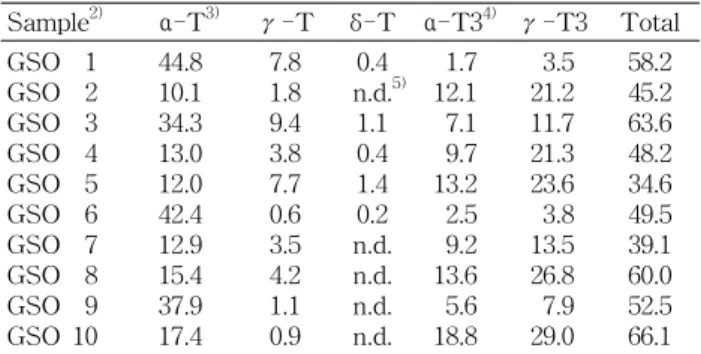
국내 시판되고 있는 포도씨유의 비타민 E의 분석 결과는 Table 1과 같다. 대부분의 시료에서 α-토코페롤(α-T)의 함 량이 가장 높게 나타났다. 10종의 포도씨유에서 분석된 α-T 함량은 10.1~44.8 mg/100 g으로 Lee와 Lee(16)의 연구에서 알려진 23.21 mg/100 g과 Gliszczyńska-Świgło 등(22)의 분 석결과인 10.5 mg/100 g과 유사한 결과이며 포도씨유의 α-T 함량은 Nam 등(23)이 분석한 올리브유의 α-T의 함량(7.9~
13.9 mg/100 g)과 비교해볼 때 높다고 할 수 있다. 또한 Lee 와 Lee(16)의 보고에 의하면 대두유, 해바라기씨유, 옥수
Table 1. Tocopherol and tocotrienol contents of commer- cially available grape seed oils1) (mg/100 g) Sample2) α-T3) γ-T δ-T α-T34) γ-T3 Total GSO 1
GSO 2 GSO 3 GSO 4 GSO 5 GSO 6 GSO 7 GSO 8 GSO 9 GSO 10
44.8 10.1 34.3 13.0 12.0 42.4 12.9 15.4 37.9 17.4
7.8 1.8 9.4 3.8 7.7 0.6 3.5 4.2 1.1 0.9
0.4 n.d.5)
1.1 0.4 1.4 0.2 n.d.
n.d.
n.d.
n.d.
1.7 12.1 7.1 9.7 13.2 2.5 9.2 13.6 5.6 18.8
3.5 21.2 11.7 21.3 23.6 3.8 13.5 26.8 7.9 29.0
58.2 45.2 63.6 48.2 34.6 49.5 39.1 60.0 52.5 66.1
1)Analytical values are mean of duplicate measurement.
2)The commercially available grape seed oil was remarked ir- respective of their own brand.
3)Corresponding tocopherol.
4)Corresponding tocotrienol.
5)The n.d. means not detected.
국내 시판 포도씨유의 비타민 E, 식물성스테롤 및 지방산조성 비교 955
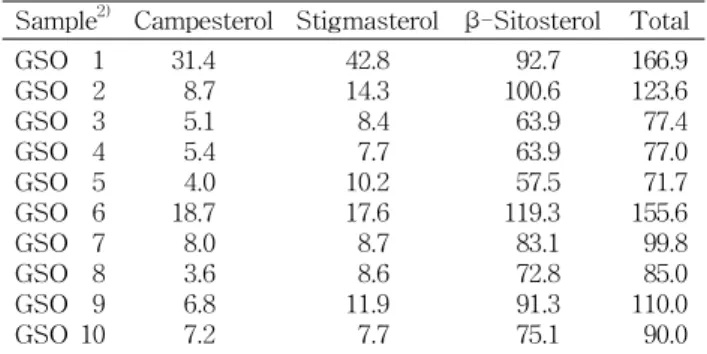
Table 2. Phytosterol contents of commercially available
grape seed oils1) (mg/100 g)
Sample2) Campesterol Stigmasterol β-Sitosterol Total GSO 1
GSO 2 GSO 3 GSO 4 GSO 5 GSO 6 GSO 7 GSO 8 GSO 9 GSO 10
31.4 8.7 5.1 5.4 4.0 18.7 8.0 3.6 6.8 7.2
42.8 14.3 8.4 7.7 10.2 17.6 8.7 8.6 11.9 7.7
92.7 100.6 63.9 63.9 57.5 119.3 83.1 72.8 91.3 75.1
166.9 123.6 77.4 77.0 71.7 155.6 99.8 85.0 110.0 90.0
1)Analytical values are mean of duplicate measurement.
2)The commercially available grape seed oil was remarked irre- spective of their own brand.
수유, 홍화유에서는 α-토코트리에놀(α-T3)과 γ-토코트리 에놀(γ-T3)이 전혀 검출되지 않은 반면 포도씨유에는 14.9 mg/100 g의 α-T3, 10.7 mg/100 g의 γ-T3가 검출되었다.
본 연구에서도 1.7~18.8 mg/100 g의 α-T3가 분석되었고, 3.5~29.0 mg/100 g의 γ-T3가 분석되었다. 다른 식용유지 에 비해 포도씨유에는 특히 α-T3와 γ-T3가 많이 포함되어 있음을 알 수 있다. 토코트리에놀은 토코페롤의 이성체로써 신경보호, 혈압 조절, 심혈관계 질환 예방, 항산화 등의 효과 가 보고된 바 있다(24-27). 따라서 토코페롤의 함량이 풍부 한 포도씨유의 섭취는 인체에 유익할 것으로 사료된다.
식물성스테롤 함량 분석
식물성스테롤은 식물성 유지에 함유되어 있는 화합물로 그 구조에 따라 campesterol, stigmasterol, β-sitosterol 등 으로 분류된다. 식물성스테롤 함량 분석결과(Table 2) 10종 의 포도씨유 모두 β-sitosterol(63.9~119.3 mg/100 g)의 함 량이 가장 높게 나타났으며 이는 Normén 등(19)의 포도씨유 식물성스테롤 분석결과와 비슷하다. 또한 Normén 등(19)의 연구에서는 세 종류의 식물성스테롤의 함량이 208.5 mg/100 g으로 나타났으며, 본 연구에서의 총 식물성스테롤 함량은 GSO 5가 가장 낮은 분석치(71.7 mg/100 g)을 나타냈고 GSO 1이 가장 높은 값(166.9 mg/100 g)으로 분석되어 각 시료간의 차이가 큰 것으로 나타났다. 이는 포도씨유 생산에 사용된 포도씨의 품종과 다른 품종의 포도씨의 혼합여부 그 리고 생산과정 중의 처리에서 생긴 것으로 생각한다.
지방산 함량 분석
국내 시판 포도씨유 10종의 지방산 조성 분석 결과는 Table 3과 같다. 지방산 조성의 비율은 palmitic(16:0, 6.84~
16.8%), palmitoleic(16:1, 0.11~0.19%), stearic(18:0, 4.70~
5.16%), oleic(18:1, 16.60~26.12%), linoleic(18:2, 16.60~
20.12%), linolenic acid(18:3, 0.27~0.45%) 및 arachidic acid(20:0, 0.26~0.46%)로 분석되었다. 포도씨유의 주된 지 방산은 linoleic acid로 분석되었으며 이는 Baydar와 Akkurt 의(18) 결과와 일치한다.
Table 3. Fatty acid compositions of commercially available
grape seed oils1) (%)
Sample2) 16:0 16:1 18:0 18:1 18:2 18:3 20:0 GSO 1
GSO 2 GSO 3 GSO 4 GSO 5 GSO 6 GSO 7 GSO 8 GSO 9 GSO 10
6.84 7.00 7.56 7.29 7.31 7.55 7.35 7.30 7.59 7.54
0.13 0.11 0.14 0.15 0.16 0.13 0.14 0.14 0.19 0.13
4.53 5.01 4.70 5.00 5.00 4.57 4.95 4.93 4.99 5.16
26.08 16.60 23.57 18.82 18.35 25.76 18.63 18.20 26.12 20.51
61.66 70.57 63.24 68.12 68.53 61.20 68.33 68.71 60.47 65.98
0.29 0.45 0.41 0.36 0.38 0.33 0.33 0.42 0.27 0.41
0.46 0.26 0.38 0.28 0.28 0.46 0.27 0.29 0.37 0.27
1)Analytical values are mean of duplicate measurement.
2)The commercially available grape seed oil was remarked irre- spective of their own brand.
요 약
국내 시중에서 유통되는 포도씨유 10종에 대한 비타민 E, 식물성스테롤 및 지방산 조성을 분석하였다. 비타민 E는 α- 토코페롤의 함량이 가장 높게 나타났으며 그 함량은 10.1~
44.8 mg/100 g이었다. 또한 다른 식물성 유지에서 분석되지 않거나 함량이 낮은 α-T3와 γ-T3가 비교적 높은 함량으로 분석되었다. 식물성스테롤 함량 분석에서 10종의 유지 모두 β-sitosterol(63.9~119.3 mg/100 g)의 함량이 가장 높게 나 타났다. 지방산 조성의 비율은 palmitic, stearic, oleic, lino- leic가 주요 지방산으로 분석되었다. 포도씨유 10종의 토코 페롤과 토코트리에놀, 식물성스테롤 및 지방산 성분의 조성 은 유사하였으나 그 함량에는 차이가 있었다. 이는 각각의 포도씨유 생산에 사용된 포도씨 품종의 차이와 서로 다른 품종의 포도씨의 혼합여부 그리고 생산과정 중의 차이에서 생긴 것으로 보인다.
감사의 글
이 논문은 농림부/농림기술관리센터 지정 포도연구사업 단의 연구비 지원에 의해 연구되었으며 이에 감사드립니다.
문 헌
1. Torres J, Varela B, Garcia MT, Carilla J, Matito C, Centelles JJ, Cascante M, Sort X, Bobet R. 2002. Valorization of grape (Vitis vinifera) byproducts. Antioxidant and biological properties of polyphenolic fractions differing in procyanidin composition and flavonol content. J Agric Food Chem 50:
7548-7555
2. Saucier C, Mirabel M, Daviaud F, Longieras A, Glories Y.
2001. Rapid fractionation of grape seed proanthocyanidins.
J Agric Food Chem 49: 5732-5735.
3. Hu M, McClements D, Decker EA. 2004. Antioxidant activ- ity of a proanthocyanidin-rich extract from grape seed in whey protein isolate stabilized algae oil-in-water emulsions.
J Agric Food Chem 52: 5272-5276.
956 위민정․성지혜․전건욱․정헌상․이준수
4. Saito M, Hosoyama H, Ariga T, Kataoka S, Yamaji N. 1998.
Antiulcer activity of grape seed extract and procyanidins.
J Agric Food Chem 46: 1460-1464.
5. Rice AC. 1976. Solid waste generation and byproduct re- covery potential from winery residues. Am J Enol Vitic 27: 21-26.
6. Tarandzhiiska R, Stamenov S. 1989. Triglyceride composi- tion of different grapeseed oils. Khranitelna Promyshlennost 38: 20-22.
7. Yoo JY, Shin DH, Min BY. 1984. Composition of grape seed oil. Korean J Food Sci Technol 16: 257-260.
8. Houseknecht KL, Heuvel JPV, Moya-Camarena SY, Portocarrero CP, Peck LW, Nickel KP, Belury MA. 1998.
Dietary conjugated linoleic acid normalizes impaired glu- cose tolerance in zucker diabetic fatty fa/fa rat. Biochem
Biophys Res Commun 244: 678-682.
9. Rudel LL. 1999. Atherosclerosis and conjugated linoleic acid. Br J Nutr 81: 177-179.
10. Yu Y, Correll PH, Heuvel JP. 2002. Conjugated linoleic acid decreases production of pro-inflammatory products in macrophages: evidence for a PPAR-dependent mechanism.
Biochim Biophys Acta 1581: 89-99.
11. Fleshner NE. 2002. Vitamin E and prostate cancer. Urol
Clin N Am 29: 107-113.
12. Pearce BC, Parker RA, Deason ME, Qureshi AA, Wright JJ. 1992. Hypocholesterolemic activity of synthetic and nat- ural tocotrienols. J Med Chem 35: 3595-3606.
13. Engelhart MJ, Geerlings MI, Ruitenberg A, van Swieten JC, Hofman A, Witteman JC, Breteler MM. 2002. Dietary intake of antioxidants and risk of Alzheimer disease. J Am
Med Assoc 287: 3223-3229.
14. Salen G, Ahrens Jr EH, Grundy SM. 2004. Metabolism of beta-sitosterol in man. J Clin Nutr 49: 952-967.
15. Katan MB, Grundy SM, Jones P, Law M. 2003. Efficacy and safety of plant stanols and sterols in the management of blood chloesterol levels. Mayo Clin Proc 78: 965-978.
16. Lee SM, Lee JS. 2006. Tocopherol and tocotrienol contents of vegitable oils, margarines, butters, and peanut butters consumed in Korean diet. Food Sci Biotechnol 15: 183-188.
17. Chun J, Lee J, Ye L, Exler J, Eitenmiller RR. 2006.
Tocopherol and tocotrienol contents of raw and processed fruits and vegetables in United States diet. J Food Compos
Anal 19: 196-204.
18. Baydar NG, Akkurt M. 2001. Oil content and oil quality properties of some grape seeds. Tur J Agric For 25:
163-168.
19. Normén L, Ellegård L, Brants H, Dutta P, Andersson H.
2007. A phytosterol database: Fatty foods consumed in Sweden and the Netherlands. J Food Compos Anal 20:
193-201.
20. Parcerisa J, Richardson DG, Refecas M, Codony R, Boatella J. 1998. Fatty acid, tocopherol and sterol content of some hazelnut varieties (Corylus acellana L.) harvested in Oregon (USA). J Chromatogr A 805: 259-268.
21. Schothorst RC, Jekel AA. 1999. Oral sterol intake in the netherlands: evaluation of the results obtained by GC anal- ysis of duplicate 24-h diet samples collected in 1994. Food
Chem 64: 561-566.
22. Gliszczyńska-Świgło A, Sikorska E. 2004. Simple re- versed-phase liquid chromatography method for determi- nation of tocopherols in edible plant oils. J Chromatogr A 1048: 195-198.
23. Nam HY, Lee JW, Hong JH, Lee KT. 2006. Analysis of physicochmical characterization and volatiles in pure or re- fined olive oils. J Korean Soc Food Sci Nutr 35: 1409-1416.
24. Khanna S, Roy S, Ryu H, Bahadduri P, Swaan PW, Sen CK. 2003. Molecular basis of vitamin E action: tocopherol modulates 12-lopoxygenase, a key mediator of glutamate- induced neurodebeneration. J Biol Chem 278: 43508-43515.
25. Newaz MA, Nawal NN. 1999. Effect of gamma-tocopherol on blood pressure, lipid peroxidation and total antioxidant aratus in spotaneously hypertensive rats (SHR). Clin Exp
Hy 21: 1297-1313.
26. Qureshi AA, Sami SA, Salser WA, Khan FA. 2001.
Synergistic effect of tocotrienol-rich fraction (TRF(25)) of rice bran and lovasrain on lipid parameters in hyper- cholesterolemic humans. J Nutr Biochem 12: 318-329.
27. Kamat JP, Devasagayam TP. 1995. Tocotrienols from palm oil as potent inhibitors of lipid peroxidation and protein oxi- dation in rat brain mitochodria. Neurosci Lett 195: 179-182.
(2008년 2월 11일 접수; 2008년 6월 11일 채택)