
Temporal variation of magma chemistry in association with extinction of spreading, the fossil Antarctic-Phoenix Ridge,
Drake Passage, Antarctica
Won Hie Choe
*1, Jong Ik Lee
1, Mi Jung Lee
2, Soon Do Hur
1and Young Keun Jin
11
Korea Polar Research Institute, KORDI, 1270, Sa‐2‐dong, Sangrokgu, Ansan 426‐744
2
Korea Institute of Geoscience and Mineral Resources, Gajeong-dong 30, Yuseong-gu, Daejeon, 305-350
ABSTRACT
The K‐Ar ages, whole‐rock geochemistry and Sr‐Nd‐Pb isotopes have been determined for the submarine basalts dredged from the P2 and P3 segments of the Antarctic-Phoenix Ridge (APR), Drake Passage, Antarctica, for better understanding on temporal variation of magma chemistry in association with extinction of seafloor spreading. The fossilized APR is distant from the known hot spots, and consists of older N-MORB prior to extinction of spreading and younger E-MORB after extinction.
The older N-MORB (3.5-6.4 Ma) occur in the southeast flank of the P3 segment (PR3)
and the younger E-MORB (1.4-3.1 Ma) comprise a huge seamount at the P3 segment
(SPR) and a big volcanic edifice at the P2 segment (PR2). The N-type PR3 basalts
have higher Mg#, K/Ba, and CaO/Al2O3 and lower Zr/Y, Sr, and Na8.0 with slight
enrichment in incompatible elements and almost flat REE patterns. The E-type SPR
and PR2 basalts are highly enriched in incompatible elements and LREE. The extinction
of spreading occurring at 3.3 Ma seems to have led to a temporal magma oversupply
with E-MORB signatures. Geochemical signatures such as Ba/TiO2, Ba/La, and Sm/La
suggest heterogeneity of upper mantle and formation of E-MORB by higher contribution
of enriched materials to mantle melting, compared to N-MORB environment. E-MORB
magmas beneath the APR seem to have been produced by low melting degree (up to 1% or more) at deeper low-temperature regime, where metasomatized veins consisting of pyroxenites have preferentially participated in the melting. The occurrence of E-MORB at the APR is a good example to better understand what kinds of magmatism would occur in association with extinction of spreading.
1. INTRODUCTION
In the Drake Passage, between South America and Antarctica, the last remnant of the once‐extensive Antarctic-Phoenix spreading center, the APR, appears to have become extinct at some time during the Pliocene (Larter and Barker, 1991). As a result, a small remnant of the former Phoenix plate, confined between the Shackleton and Hero Fracture Zones, has become welded to the Antarctic plate. Larter and Barker (1991) indicated that three inactive segments of the APR survive, which called (northeast to southwest) as P1, P2, and P3 (Fig. 1). On the basis of new bathymetric and magnetic anomaly data, Livermore et al. (2000) suggested that extinction of all three remaining segments occurred at the time of magnetic chron C2A (3.3±0.2 Ma), synchronous with a ridge‐trench collision south of the Hero Fracture Zone.
-4000 -4000 -4000
-4000
-4000 -4000
-4000
-4000 -4000
-4000
-4000 -4000
-4000 -4000 -4000
-4000
-4000 -3000
-3000
-3000
-3000
-3000
SFZ
EF.Z.
D F.Z.
HFZ
CF.Z.
N. ANV ERSF.Z.
P1 P2
P3
WSR
SST BS
68°W 68°W
64°W 64°W
60°W 60°W
56°W 56°W
52°W 52°W
64°S 64°S
62°S 62°S
60°S 60°S
58°S 58°S
56°S 56ÊS
Tectonic Boundary Inactive Axis Fracture Zone Active Boundary
Phoenix Plate Fig.2
Fig.3
Fig. 1. Tectonic boundary map over the bathymetry predicted using satellite altimetry in Drake Passage. Dark gray area shows below 4000 m depth and light gray above 3000 m. BS, Bransfield Strait; HFZ, Hero Fracture Zone; P1, P2, P3, Antarctic-Phoenix Ridges; SFZ, Shackleton Fracture Zone; SST, South Shetland Trench.
During the 1999‐2000 austral summer season, a half of P3 segment was mapped
using a multibeam echo sounder fitted to the Korean research vessel R/V Onnuri (Fig.
2), and an anomalously big seamount at the spreading axis was found. During the 2000
‐2001 and 2002‐2003 summer cruises with R/V Yuzhmorgeologiya, submarine fresh lavas from the P2 and P3 segments have been intensively dredged, and geochemically investigated.
We present new results of K‐Ar ages, whole‐rock geochemistry and Sr‐Nd‐Pb isotopes for the submarine basalts from the P2 and P3 segments, and will discuss on the origin of E-MORB in a fossil spreading center.
68°W 67°W 66°W 65°W
61°S 61°S
60°S 60°S
3000
3000
3000 4000
4000 5000 -4000 -4000
-4000 -4000
-3000 -3000
-3000 -3000
-3000
68°W 67°W 66°W 65°W
61°S 61°S
60°S 60°S
PR3-3(4.9-6.4Ma) PR3-4(3.5-4.5Ma) SPR1(2.1-3.1Ma) SPR2(1.9-2.2Ma) SPR3(1.5-2.5Ma)
68°W 67°W 66°W 65°W
68°W 67°W 66°W 65°W
1000 2000 3000 4000 5000 Depth (m)
Fig. 2. Bathymetry of P3 segment of the APR, obtained using SEABEAM 2000 mutibeam sonar. Solid sircles represent sampling locations together with K Ar age ranges.
PR2-4(2.1Ma) PR2-3(1.4-1.9Ma) PR2-2(1.5-1.9Ma) 58°30′S
59°00′S
59°30′S
58°30′S
59°00′S
59°30′S
66°W 66°W
67°W 65°W
67°W 65°W
1000 2000 3000 4000 5000 Depth(m)
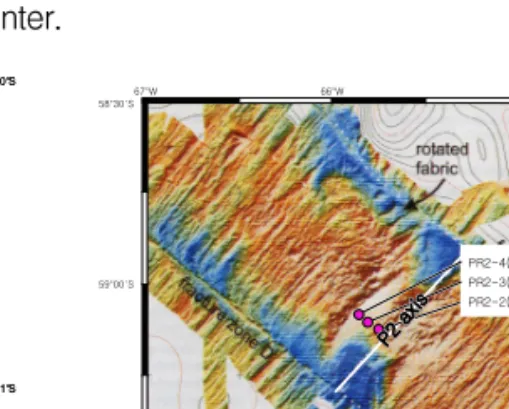
Fig. 3. Bathymetry of P2 segment of the Antarctic-Phoenix Ridge, obtained using Simrad EM12 multibeam sonar (Livermore et al., 2000). Solid circles represent sampling locations together with K Ar age ranges.
2. MORPHOLOGY
The near-axis spreading center morphology of the P3 segment shows high relief and
has a nodal basin, at depth of 4500‐5500 m (Fig. 2). At the segment center, a
prominent seamount is present, which rises to 750 m depth and has a mean diameter
of ~30 km. The southwestern region of the axial seamount is flanked by two great
ridges which rise to ~2500 m depth. The northwest flank is broader and further away
from the ridge axis than the southeast flank. It is supposed that both of flanks may be
rifted parts of a former axial topographic high, and the different depth of the ridges may
be caused by asymmetric lithospheric stretching during the last extension stage. The
axial valley is interrupted by fossil transform, Hero Fracture Zone. It is associated with
deep valley and flanked the steep scarp with a trend of N135°E parallel to the spreading axis.
Off‐axis morphology of the P2 segment is generally comparable to that of fast or intermediate spreading ridges, such as the East Pacific Rise or Pacific‐Antarctic Ridge, dominated by linear, axis‐parallel magmatic ridges and straight, sharply defined fracture zones (Fig. 3).
The near-axis spreading center morphology of P2 shows very high relief, and is anomalous when compared to either fast or slow spreading ridges elsewhere. Well‐
developed nodal basins occur at both ends of P2, at depths of 4000–4500 m, and are the only areas in which any significant accumulation of sediment has occurred. Between them, the ridge crest rises to a depth of ~2000 m near the segment center, forming a saddle‐like structure. The axial region is flanked by two great ridges; that on the northwest flank rises to an unexpectedly shallow 570 m depth near the segment center, and that on the southeast flank is deeper than 1500 m. The ridges are equidistant from the ridge axis, and have similar trends, suggesting that they are rifted parts of a former axial topographic high.
3. RESULT AND CONCLUSIONS
At the P3 segment, the K‐Ar ages of PR3 are 3.5‐6.4 Ma, and those for SPR are 1.5‐3.1 Ma. The K‐Ar ages for the PR2 basalts are 1.4‐2.1 Ma. Considering that the rifted ridge basalts were formed at a former axial topographic high, it is likely that the extinction of seafloor spreading at the P3 and P2 segments occurred at 3.3 and 1.5 Ma, respectively. Volcanic rocks are mostly basaltic lavas with glassy surfaces, and have SiO2 contents ranging from 49 to 52 wt.%. The PR3 (older than 3.3 Ma) are low‐
K tholeiitic basalts, and geochemically similar to N‐type MORB, except some higher
concentrations of alkali elements (Cs, Rb and K). The Ca/Al ratio increases nearly
linearly with increasing melting until clinopyroxene is exhausted at very high extents of
melting (>25%). The CaO/Al2O3 ratios of the PR3 basalts are higher than 0.7, and
those of the PR2 and SPR basalts lower than 0.7, indicating that the older, N-type
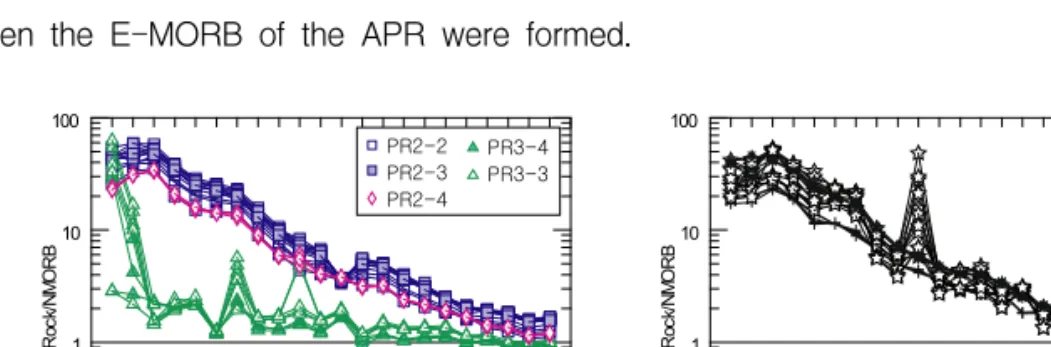
PR3 basalts were formed by higher extent of melting than the younger, E-type PR2 and SPR basalts. The PR2 and SPR basalts show similar enriched trace element patterns except Pb concentration (Fig. 4), This temporal variation suggests that the melting degree decreased and the melting depth deepened after 3.3 Ma, following that the melting zone became cool down to a depth. The most plausible enriched material is pyroxenite veins. It is estimated that the upper mantle may contain 2-5% pyroxenite (Hirschmann and Stolper, 1996). Typical mantle pyroxenites have lower temperature solidii than peridotites and are capable of producing large melt fractions at depths where peridotite is either solid or only slightly melted. Therefore, pyroxenite veins would preferentially participate in the melting at low-temperature and low-extent melting regime when the E-MORB of the APR were formed.
.1 1 10 100
Cs Rb Ba Th U Nb K La Ce Pb Pr Sr P Nd Zr SmEu Ti Dy Y Yb Lu
Rock/NMORB
.1 1 10 100
Cs Rb Ba Th U Nb K La Ce Pb Pr Sr P Nd Zr SmEu Ti Dy Y Yb Lu
Rock/NMORB
PR2-2 PR2-3 PR2-4
PR3-3
PR3-4 SPR1
SPR2 SPR3
Fig. 4. N MORB normalized diagrams of the Antarctic-Phoenix Ridge basalts.
The Ba/La versus Sm/La ratios are illustrated together with modal melting models from various sources to evaluate possible source materials and extent of melting (Fig.
5). Large degree of melting (up to 7%) from a depleted mantle source is required for the formation of PR3 magma. This is fairly possible, when compared to other N-MORB from ocean ridges worldwide, though the calculated melting degree is slightly lower. The slight enrichment in incompatible elements of the PR3 basalts relative to N-MORB average may indicate smaller degree of partial melting.
However, extremely low-degree partial melting (less than 0.3%) is necessary to
produce the younger, E-type SPR and PR2 magmas, if the source is composed of a
depleted mantle alone, but this extent of melting seems to be too low to produce
proper quantity of melts. Instead, if we presume the source as an enriched mantle
alone, the E-MORB in the APR could not be produced, because the majority of the E-MORB data are plotted below the calculated melting curve. Therefore, the models given in Fig. 5 suggest that vein materials consisting of pyroxenites have played an important role for the generation of E-MORB magmas beneath the APR, as well as the melting of the surrounded depleted lherzolite. (up to 1% or more). If this is the case, the upper mantle beneath the APR may be composed of aggregates of pyroxenites that have been left by the melting of subducted oceanic crust, and peridotites that have been contaminated by the melts from pyroxenites.
0.0 0.5 1.0 1.5
0 5 10 15 20 25 30
Ba/La
Sm/La
0.1
1 2 3 4
5 7 10 15
0.1
1
2
5 10
20 PY
DM
0.5
PR2-2 PR2-3 PR2-4 PR3-3 PR3-4 SPR1 SPR2 SPR3 SPR4 0.1
1
23
51015 EM
![Fig. 5. Modal batch partial melting equation, Cl=Co/[Do+F(1-Do)] is performed. Source composition of depleted mantle (DM) and garnet pyroxenite (PY), and partition coefficients were used from Donnelly et al](https://thumb-ap.123doks.com/thumbv2/123dokinfo/5197700.604861/6.892.274.555.365.564/equation-performed-composition-depleted-pyroxenite-partition-coefficients-donnelly.webp)
