Relationship between rice grain quality traits and starch pasting properties using early maturing rice cultivars in Chungnam plain area
Yeo-Tae Yun*, Chong-Tae Chung, Jae-Chul Lee, Young-Ju Lee, Han-Jung Na, Kwang-Won Lee, Young-Hwan Yoon
Chungnam Agricultural Research and Extension Services, Yesan 340-861, South Korea
Received on 30 July 2015, revised on 27 August 2015, accepted on 2 September 2015
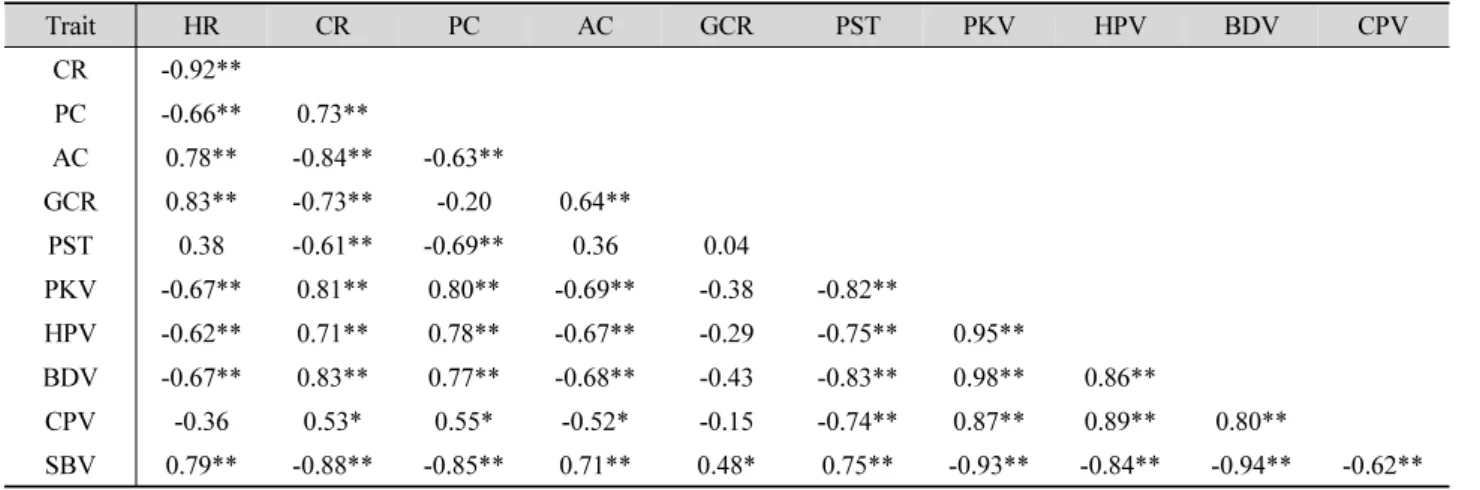
Abstract : T his study was conducted to know the variation and relationship of rice grain quality and starch pasting properties by transplanting times. Two early maturing rice cultivars which accounted for the most area of early maturing rice cultivar in Chungnam province were used. The experiment was laid out in a split-plot design with 3 replications. The main plot consisted of three transplanting times viz. early (April 25), ordinary (May 25) and late (June 25) with sub-plots containing two cultivars. According to the transplanting times, most of rice grain quality and starch pasting properties showed significant difference and Joami showed higher grain quality than Unkwang in all transplanting times. Especially, rice grain quality was improved when transplanted late, showing high head rice and glossiness of cooked rice due to the lower mean temperature during grain filling stage. Glossiness of cooked rice was positively correlated with head rice ratio, amylose content and setback value, and negatively correlated with chalky rice ratio and protein content. The highest positive and negative correlation were observed between breakdown value and peak viscosity (r = 0.98**), and breakdown and setback (r = -0.94**), respectively. These results provide some information for rice researchers and producers producing cultivars with an improved quality, suggesting that rice quality is highly influenced by temperature at grain filling stage, and transplanting times is crucial in improving rice quality. In addition, starch pasting properties are useful for determining rice quality because rice grain quality and starch pasting properties are dependent on each other.
Key words : Rice, Transplanting Time, Quality, Starch pasting property
*Corresponding author: Tel: +82-41-635-6052 E-mail address: [email protected]
I. Introduction
Rice grain quality is the most important consideration due to the elevated living condition and increased demand for high quality rice. Therefore, producing high quality rice is the top priority in rice production, and many researches for understanding the relationship between rice quality and other traits have been conducted for the last few decades. Rice grain quality was severly affected by mean temperature during grain filling stage (Yanase et al., 1984; Yoshinobu et al., 2007). Chun et al. (2009) reported that rice quality decreased, showing increased chalkiness and decreased palatability, because of the high mean temperature during ripening stage. Nishimura (1985)
showed that heading date affected the chemical components like alkali digestion value, and amylose and protein content because heading date might determine the mean temperature during grain filling.
These results imply the casual relationship between
heading date and grain quality, and environmental
factor is very important in producing high quality
rice. Also, rice grain quality was reported to be
different among cultivars tested under high temperature
(Nishimura et al., 2000), and heading date of early
maturing rice cultivars is more variable than mid and
mid-late maturing rice cultivars by transplanting
times (Choi et al., 2005). ‘Unkwang’ (Unbong 30),
widely grown since 2004 due to its high yield, showed
the worst appearance and grain quality among
cultivars tested when cultivated in plain areas by
early season cultivation (Lee et al., 2008). For these
reasons, there is a need to replace ‘Unkwang’ with other early maturing cultivars with better quality, and
‘Joami’ (Sangju 36) was selected as a suitable early maturing cultivar in middle plains areas due to the high head rice yield and eating quality (CNARES, 2009)
Amylose content is considered as the most important factor affecting eating quality. Because rice accumulates starch in the grain endosperm as energy reserve.
Starch comprises 90 percent of the total dry weight of milled rice. Eating and cooking quality of rice is mainly influenced by properties of its starch, which is comprised of amylose and amylopectin. However, amylose content can not explain the variation of cooking and eating qualities between rice samples with similar amylose content completely (Chung et al., 2011; Han et al., 2001; Ramesh et al., 19 9 9 ).
Starch pasting properties using rapid viscosity analyzer (RVA) is commonly used for pasting and physicochemical property tests as a prediction of cooked rice texture (Bao and Xia 1999; Juliano 1966;
Shu et al., 1998).
Therefore, this study was conducted to know the variation of rice grain quality and starch pasting properties by transplanting date in middle plain area using ‘Unkwang’ and ‘Joami’ cultivars, and understand the relationship between rice quality traits and starch pasting properties.
II. Materials and Methods
1. Plant materials and field trial
Seedlings of two early maturing rice cultivars were raised in the greenhouse for 30 days after sowing and then transplanted on April 25, May 25, and June 25th, respectively. A total of 4 - 5 seedlings per hill were transplanted with a spacing of 15 cm between plants and 30cm between rows at the experimental field of Chungcheongnam-do Agricultural Research and Services (CNARES) in 2010. A split plot design with three rep-
lications was employed with the transplanting date as the main plot, and the cultivar as the subplot. In the subplots, seedlings of each cultivar were planted in 7 lines, with 32 plants per line. Fertilizer (N-P
2O
5- K
2O) was applied at the rate of 90-45-57 kg/ha.
2. Trait evaluation
Each rice sample was harvested when the accumulated mean temperature reached 1,100℃ after heading. After harvesting, rice grains were air-dried until the moisture content reached 15%, and then dehulled to yield brown rice. Each brown rice sample was milled to 92% milling yield by a polishing machine (Toyo, Japan), and then the milled samples were stored in a refrigerator (15℃) to prevent change of quality. Head rice ratio (HR, unbroken and broken translucent grains with at least 3/4 of a whole grain), chalky rice ratio (CR, grains with an opaque, chalky appearance covering at least half of the body of the grain), and the broken and defected rice ratio (damaged and discolored rice) were calculated with an RN-300 automatic rice grader using a sample of 1,000 grains. Protein content (PC) and amylose content (AC) of milled rice was measured with a Grain Analyzer (AN700 Kett, Japan) using 100 g milled rice samples. Glossiness of cooked rice value (GCR) was calculated for 33 g samples of milled rice by the Toyo taste meter (MA-90A, Toyo, Japan), in accordance with the operation manual.
The amylogram characteristics of rice starch was
tested with a Rapid Visco-Analyzer (RVA-4, Newport
Scientific, Australia) using AACC Method 61-2 (AACC,
1995). Rice paste viscosity properties were described
by six parameters of the pasting curve : Pasting tem-
perature (PST), peak viscosity (PKV), hot paste viscosity
(HPV), cool paste viscosity (CPV), breakdown viscosity
(BDV = PKV - HPV), setback viscosity (SBV = CPV –
PKV). All amylogram characteristics were measured
in rapid visco units (RVU) with three replications for
each sample.
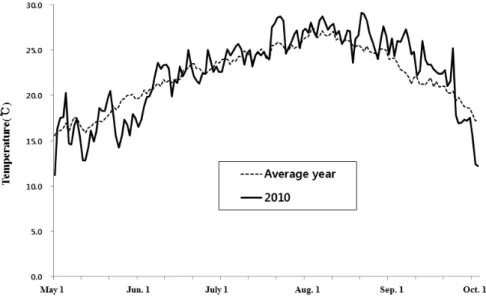
Fig. 1. Mean air temperature during the growing season in 2010, and the average of ten years from 2000 to 2009. Black and broken lines indicate air temperature in 2010 and the average of 10 years, respectively. Data were obtained from the website of the Korean Meteorological Administration (http://www.kma.go.kr).
Table 1. Meteorological data at grain filling stage.
Cultivar Transplanting time
Heading Date
Ripening temperature( ℃)
a)Sunshine hour
b)Harvesting time
c)Accumulative Mean
Unkwang (Unbong 30)
Early 7. 19 1,077 26.9 174 41
Ordinary 7. 28 1,068 26.7 158 42
Late 8. 19 951 23.8 178 50
Joami (Sangju 36)
Early 7. 18 1,077 26.9 171 41
Ordinary 7. 29 1,068 26.7 158 42
Late 8. 18 961 24.0 176 49
a)
Temperature during 40 days after heading.
b)
Sunshine hour during 40 days after heading.
c)
Days required to reach 1,100 ℃ of accumulative temperature after heading.
3. Statistical analysis
T-test, analysis of variance and correlation were performed using SPSS software (Ver. 18.0.0). Phenotypic means of each rice sample were compared using Duncan’s multiple range test.
III. Results and Discussion
1. Meteorological data
The graphs for meteorological data of rice growth duration in Yesan are shown in Fig. 1. Mean tem-
perature of the average 10 year and 2010 were similar
showing that temperature continually increased from
May to August, and then decreased. However, the
mean temperature in 2010 was a little lower in May,
and higher in August and September than the average
year. In Table 1, two early maturing rice cultivars
showed very similar heading dates, and accumulative
temperature for 40 days after heading was lowest in
the late transplanting, but the sunshine hour was the
lowest in the ordinary transplanting time. The mean
temperature during the grain filling stage for the late
transplanting was lowest, and were similar for both
cultivars in the ordinary and early transplanting.
Table 2. Rice appearance quality traits as the transplanting times.
Transplanting time(A)
Cultivar (B)
Rice appearance trait
b)Head (%) Chalky (%) Damaged (%) Broken (%)
Early
Unkwang 72.0 24.4 0.5 2.9
Joami 84.3 13.6 1.7 3.1
T-test 13.99** -3.68* 7.00** ns
Ordinary
Unkwang 58.3 26.6 1.3 13.3
Joami 65.9 28.7 1.6 2.1
T-test 4.49* ns ns ns
Late
Unkwang 81.6 11.6 3.7 5.3
Joami 90.4 6.1 1.2 6.8
T-test 5.87** -3.97** ns ns
Mean
a)Early 78.2 b 19.0 1.1 3.0
Ordinary 62.1 c 27.7 1.5 10.1
Late 86.0 a 8.8 2.5 3.7
Interaction A × B ns 8.73** ns ns
a)
Mean with the same letters in a column for each transplanting date are not significantly different at the 5% level, as determined by Duncan’s multiple range test.
b)
Significantly different between two cultivars at 0.05 and 0.01, respectively.
Especially, harvesting time was delayed in the late transplanting, because the mean temperature decreased after August 10
th(Fig. 1).
Rice grain quality is a complex character and many components such as appearance, cooking qualities and eating qualities are involved. Among these properties, consumers often pay more attention to appearance (Guo et al., 2011) because it influences customer selection when buying rice. For example, rice with high head and lower defects is considered to be high quality, and the appearance quality can easily be compared by customers in a short time without any equipment.
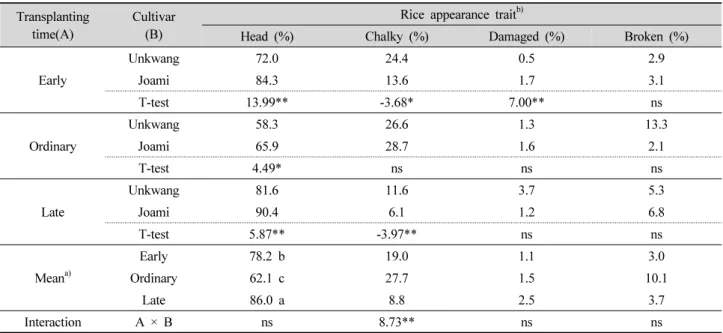
Rice appearance traits according to transplanting times and cultivars are summarized in Table 2. Head rice ratio was the highest in the late and lowest in the ordinary transplanting for both cultivars, but the chalky rice ratio showed a reverse trend. This result might be due to a difference in the mean temperature during the grain filling stage. Because high temperatures interfere with kernel development and reduce carbo- hydrates in rice plants at the grain filling stage leading to a decrease in head rice ratio (He et al., 1990; Morita
et al., 2008; Morita and Nakano 2011). However, ‘Joami’
showed higher head rice ratio than ‘Unkwang’ in all transplanting times suggesting that the rice appearance quality was also affected by genetic factor and de- veloping heat tolerance rice is one way to produce high quality rice (Morita 2008).
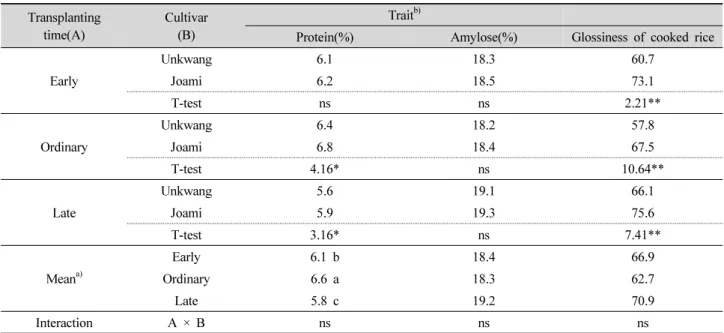
In Table 3, physicochemical property and eating quality according to the transplanting times were summarized. As for the protein, ‘Joami’ showed a higher content than ‘Unkwang’ in all transplanting times, and the content was lowest in the late trans- planting and the highest in the ordinary. Amylose content of rice which was recognized as one of the most important determinants of eating and cooking quality, ranged from 18.2% to 19.3%, displaying that there was no difference between two cultivars, with the highest at the late transplanting and the lowest at the ordinary. Glossiness of cooked rice (GCR) is generally used for the indirect index for eating quality due to the high correlation between GCR and eating quality (Azuma et al., 1994; Hoshi et al., 1995;
Nagasawa et al., 1994). In this study, the highest GCR
Table 3. Comparison of rice grain quality traits according to the transplanting times.
Transplanting time(A)
Cultivar (B)
Trait
b)Protein(%) Amylose(%) Glossiness of cooked rice
Early
Unkwang 6.1 18.3 60.7
Joami 6.2 18.5 73.1
T-test ns ns 2.21**
Ordinary
Unkwang 6.4 18.2 57.8
Joami 6.8 18.4 67.5
T-test 4.16* ns 10.64**
Late
Unkwang 5.6 19.1 66.1
Joami 5.9 19.3 75.6
T-test 3.16* ns 7.41**
Mean
a)Early 6.1 b 18.4 66.9
Ordinary 6.6 a 18.3 62.7
Late 5.8 c 19.2 70.9
Interaction A × B ns ns ns
a)
Mean with the same letters in a column for each transplanting date are not significantly different at the 5% level, as determined by Duncan’s multiple range test.
b)
Significantly different between two cultivars at 0.05 and 0.01, respectively.
value was displayed in late transplanting and lowest in ordinary, and ‘Joami’ showed higher value than
‘Unkwang’ in all transplanting times. These results coincide well with previous studies, showing that high temperature at the grain filling stage influences the physicochemical property such as protein and amylose content (Aboubacar et al., 2006). Jin et al. (2005) evaluated the influence of the temperatures at the filling stage on the activities of key enzymes related to grain starch synthesis to understand how temperature influences the biochemical characteristics, and showed that starch synthesis is dependent on temperature.
Especially, the activity of SBE (strarch branching enzyme) is sensitive to temperature and reached a maximum at 25℃, after which the activity decreased with temperature rising. In general, protein content was negatively correlated with eating quality (Akio et al., 1992; Juliano et al., 1965) as rice with higher protein content displayed lower adhesiveness and water uptake ratio than that with low protein content, and was also associated with a decrease in the glossiness, taste and stickiness of cooked rice (Yanase
et al., 1984; Yoshinobu et al., 2007).
Amylose content is considered as the most important factor affecting eating quality. However, amylose con- tent alone can not explain the variation of cooking and eating qualities between rice samples with similar amylose content (Chung et al., 2011; Han el al., 2001;
Ramesh et al., 1999). There have been many researches
to efficiently use the starch pasting properties in rice
(Bao et al., 1999; Bao and Xia 1999; Juliano 1966; Shu
et al., 1998). In order to determine the starch viscosity
characteristic of rice according to the transplanting
times, starch pasting property was evaluated for all
rice flour sample with three replications. As shown
in Table 4, most of the starch pasting properties,
including PST, PKV, HPV, BDV, CPV and SBV were
not significantly different between two cultivars, but
all of these properties showed difference among trans-
planting times., PKV, HPV, BDV and FV at the late
transplanting were the lowest, but PST and SBV were
the highest. Dang and Copeland (2004) showed that
higher amylose content in the coldest season attributed
to the higher setback in rice, and lower amylose content
Table 4. Starch viscosity characteristic as the transplanting dates.
Transplanting time (A)
Cultivar (B)
Trait
z)PST
( ℃)
PKV (rvu)
HPV (rvu)
BDV (rvu)
FV (rvu)
SBV (rvu)
Early
Unkwang 84.8 200.2 1309 69.4 203.7 3.5
Joami 86.2 186.0 126.8 59.3 200.2 14.2
T-test ns ns ns ns ns ns
Ordinary
Unkwang 87.7 194.3 130.3 63.9 195.9 1.8
Joami 77.0 215.9 138.8 77.2 207.9 -8.1
T-test -10.27** 3.812* ns ns ns ns
Late
Unkwang 88.3 166.0 116.5 49.5 188.9 22.9
Joami 87.9 171.9 121.6 50.2 192.2 20.4
T-test ns ns ns ns ns ns
Mean
y)Early 85.5 c 193.1 b 128.8 b 64.3 a 202.0 a 8.9 b
Ordinary 82.4 b 205.1 a 134.5 a 70.6 a 201.9 a -3.2 c
Late 88.2 a 168.9 c 119.2 c 49.9 b 190.6 b 21.6 a
Interaction A × B 20.99** 6.39* ns 6.12* ns 7.73**
z)
PST : Pasting temperature( ℃), PKV : Peak viscosity, BDV : Break down viscosity. FV : Final Viscosity, SBV : Setback viscosity
y)
Mean with the same letters in a column for each transplanting date are not significantly different at the 5% level, as determined by Duncan’s multiple range test.
z)