Copyright ⓒ 2014, The Microbiological Society of Korea
향신료와 프로폴리스에 대한 한국형 유산균의 안정성
이도경1․박재은1․김경태2․도명진1․정명준3․이과수3․김진응3․하남주1
*
1삼육대학교 약학과, 2삼육대학교 화학과, 3쎌바이오텍
Stability Traits of Probiotics Isolated from Korean on Spices and Propolis
Do Kyung Lee
1, Jae Eun Park
1, Kyung Tae Kim
2, Myung Jin Do
1, Myung Jun Chung
3, Gwa Soo Lee
3, Jin Eung Kim
3, and Nam Joo Ha
1*
1
College of Phamacy, Sahmyook University, Seoul 139-742, Republic of Korea
2
Department of Chemistry, Sahmyook University, Seoul 139-742, Republic of Korea
3
R&D Center, Cellbiotech, Co. Ltd., Gyeonggi 157-030, Republic of Korea
(Received July 8, 2014 / Accepted August 1, 2014)
Health beneficial probiotics are fastidious microorganisms and sensitive to various environmental conditions, so that their survival rates could be affected by various factors such as diet, stress, senescence, and antibiotics. This study was performed to evaluate the influence of various spices (garlic, ginger, scallion, onion, Chungyang red pepper, and red pepper) which have antimicrobial properties and used frequently in Korean diet, and propolis on probiotics isolated from Koreans. As a result, most Korean probiotic strains were resistant to all spices tested and propolis, and the growth rates of some Korean probiotic strains (Bifidobacterium lactis, Lactobacillus acidophilus, Lactobacillus casei, Lactobacillus rhamnosus, Streptococcus thermophiles) were even increased by specific spices or propolis. But on the other hand, the growth rates of most of european probiotic strains were reduced by various spices or propolis, and the growth rates of a few european probiotic strains (L. helveticus, S. thermophiles) were greatly decreased in the presence of specific spices. Likewise, all commercial probiotic products including Korean probiotic strains were rarely affected by spices tested. However, european probiotic product tended to be greatly reduced by garlic, onion, scallion, and propolis. Therefore, these results indicate that probiotic strains isolated from Korean have the strong viability and resistance to various spices with antimicrobial properties, so that they might be appropriate for Korean intestine.
Keywords: antimicrobial properties, probiotics, propolis, spice, viability
*For correspondence. E-mail: [email protected]; Tel.: +82-2-3399-1607;
Fax: +82-2-3399-1617
향신료(Spice)는 천연 식물성 물질로서 식욕증진, 향미(flavor) 의 강화 및 좋지 않은 냄새의 제거 등을 목적으로 널리 이용되고 있으며 각종 음식물에 첨가되어 우수한 영양과 방부효과 및 항 산화 효과 등을 나타내는 것으로 알려져 있다(Chipault et al., 1956; Wendorf and Wee, 1997; Kim et al., 2000). 마늘(Garlic), 생강(Ginger), 양파(Onion)와 같은 근채류(Root vegetables)와 파(Scallion), 고추(Hot pepper) 등은 매운 맛을 내는 향신료로써 한국에서 많이 섭취되는 주요한 농산물 중의 하나로 오래 전부 터 한국 식단에 많이 이용되고 있으며, 이들의 약리효과에 대한 성분들이 밝혀지면서 기능성 식품으로써의 이용도도 높아지고 있다(Lee and Kim, 2008; Chang et al., 2010; Jung and Park, 2013).
마늘, 생강, 양파, 파, 고추 등과 같은 향신료가 Staphylococcus aureus와 Salmonella typhimurium을 비롯한 각종 식중독 세균 과 같은 병원균의 증식을 억제하는 항균작용을 갖고 있다는 것은 이미 오래 전부터 알려져 왔다(Ziauddin et al., 1996; Kumar and Berwal, 1998; Sheo, 1999; Kim et al., 2000; Lee et al., 2011).
주로 육류나 어류를 날로 섭취할 때 식중독 예방을 목적으로 이 들 향신료를 첨가하는 경우가 많고, 한국의 전통 식품인 김치에 는 향미뿐만 아니라 보존능력의 증대를 위해서 각종 향신료를 사용하고 있다(Kim et al., 1998; Lee et al., 2011). 또한 건강기 능식품 원료로 떠오르고 있는 프로폴리스(Propolis)는 벌들이 다 양한 식물의 진액물질을 채취할 때 효소를 첨가시켜, 뜯어낸 뒤 밀납 등을 넣어 몇 개월간 30℃가 넘는 온도에서 숙성시켜 벌들 이 사용하기 가장 좋도록 만들어 놓은 물질이다. 프로폴리스의 유효성분으로는 polyphenols와 flavonoids가 있으며 우수한 항 균작용을 하는 성질을 가지고 있어 벌들은 이 프로폴리스를 벌
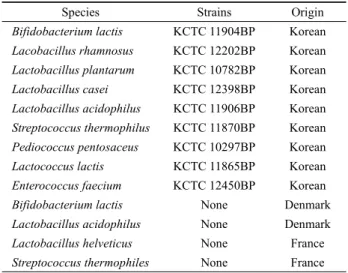
Species Strains Origin Bifidobacterium lactis KCTC 11904BP Korean Lacobacillus rhamnosus KCTC 12202BP Korean Lactobacillus plantarum KCTC 10782BP Korean
Lactobacillus casei KCTC 12398BP Korean
Lactobacillus acidophilus KCTC 11906BP Korean Streptococcus thermophilus KCTC 11870BP Korean Pediococcus pentosaceus KCTC 10297BP Korean
Lactococcus lactis KCTC 11865BP Korean
Enterococcus faecium KCTC 12450BP Korean
Bifidobacterium lactis None Denmark
Lactobacillus acidophilus None Denmark
Lactobacillus helveticus None France
Streptococcus thermophiles None France
Table 1. List of commercial probiotics used in this study
집출입구에 발라 외부로부터 바이러스나 해로운 세균의 유입을원천적으로 막고, 벌집 내부를 항상 청결한 상태로 유지하게 된 다(Cheng and Wong, 1996; Bankova et al., 1999; Son, 2003;
Farooqui and Farooqui, 2010).
오래 전부터 요구르트, 버터, 치즈와 같은 유가공 식품 및 김 치, 된장 등과 같은 발효식품에서 중요한 역할을 담당하고 있는 유산균은 모든 식품 산업 분야에서 폭 넓게 이용 되고 있으며, 이 들의 우수한 생리적 기능이 인정되어 건강 및 기능성 식품의 소 재로 각광 받고 있다(Hughes and Hoover, 1991; Fuller, 1992).
사람에게 투여되어 여러 가지 건강 증진 효과를 가져올 수 있는 유산균을 프로바이오틱스(Probiotics)라 부르며, 일반적으로 이 들 프로바이오틱스의 효능은 장까지 도달한 살아있는 유산균에 달려 있다(FAO/WHO, 2001; Sahadeva et al., 2011; Gueimonde and Sanchez, 2012). 그러나 대부분의 프로바이오틱스는 까다로 운(fastidious) 미생물로 다양한 환경조건에 매우 민감하여 제조, 유통, 저장단계에서 뿐만 아니라 항생제, 노화, 스트레스와 식이 등으로 인해 생존율에 크게 영향을 받게 되어 활성이 감소하게 된다(Marteau et al., 1997; Walker and Duffy, 1998; Gueimonde and Sanchez, 2012). 따라서 위장관 내의 산 또는 담즙, 그리고 항균물질과 같은 혹독한 조건에서의 생존력과 안정성(stability) 이 뛰어난 유산균주를 발굴하는 것은 매우 중요하다. 우리나라 는 유산균 종균을 대부분 일본, 프랑스, 덴마크 등 외국 선진 낙 농국으로부터 수입하고 있는 실정이며, 최근 한국인의 소화관 미생물총으로부터 분리된 한국형 유산균이 주목 받기 시작하였 다. 이는 한국인이 즐겨먹는 김치와 같이 각종 향신료가 들어간 한국의 전통 식품 및 식습관이 한국인의 장에 정착한 유산균을 각종 항균활성이 있는 향신료에 저항성을 가지는 균주로 변화시 켜, 생존력이 강하고 한국인의 장에 적합한 유산균으로 판단되 기 때문이다.
따라서 본 연구에서는 항균활성이 있는 각종 향신료(마늘, 생 강, 파, 양파, 청양고추, 홍고추)와 프로폴리스에 대한 한국형 유 산균주의 생존력을 분석하였으며 해외에서 상업적으로 이용되 고 있는 외래종 유산균주의 생존력과도 비교하여 보았다.
재료 및 방법
유산균과 배양배지
본 실험에 사용된 유산균주는 Table 1에서와 같으며, 한국인 의 소화관 미생물총으로부터 분리된 한국형 유산균 9종과 덴마크 C사의 외래종 유산균 2종(Bifidobacterium lactis, Lactobacillus acidophilus), 프랑스 R사의 외래종 유산균 2종(Lactobacillus helveticus, Streptococcus thermophilus)을 사용하였다. 또한 한국 형 유산균을 이용하여 국내에서 제조 판매되고 있는 프로바이오틱 스 제품 4종류: CBT-A (B. lactis, Lactobacillus casei, Lactobacillus rhamnosus, Lactobacillus plantarum), CBT-G (B. lactis, B.
bifidum, Bifidobacterium longum, L. helveticus, L. rhamnosus, S.
thermophilus), CBT-Z (L. plantarum, L. helveticus, L. casei, Leuconostoc mesenteroides, Enterococcus faecium, Pediococcus pentosaceus), CBT-C (B. longum, Bifidobacterium breve, L.
plantarum, L. acidophilus, E. faecium, S. thermophilus)과 해외 에서 제조 판매되고 있는 외래종 유산균 7종(B. bifidum, B. breve, B. lactis, L. rhamnosus, L. plantarum, L. acidophilus, Lactobacillus bulgaricus)이 이용된 프로바이오틱스 제품(European probiotic product, EP)을 시험에 이용하였다.
Bifidobacterium 속 유산균은 BL 배지(Difco, USA)를 이용하 여 Bactron Anaerobic Chamber (Sheldon Manufacturing Inc., USA)에서 37℃, 혐기조건(90% N2, 5% H2, 5% CO2)으로 배양하 였으며, Lactobacillus 속과 Streptococcus 속 유산균은 Lactobacilli MRS 배지(Difco, USA)를 이용하여 37℃에서 호기조건으로 배 양하였다. 또한 여러 균종이 혼합되어 있는 프로바이오틱스 제 품의 경우는 BL 배지를 이용하여 37℃, 혐기조건으로 배양하 였다.
사용 향신료와 프로폴리스
실험에 사용된 항균활성을 지니는 향신료와 프로폴리스는 Table 2에서와 같으며 총 6종의 향신료와 프로폴리스를 구입하 여 사용하였다. 마늘, 생강, 양파, 파, 청양고추와 홍고추를 흐르 는 물에 깨끗이 세척한 후 믹서기로 분쇄하고 부직포로 짜서 섬 유질을 제거한 즙을 여과지(0.45 μm Millipore filter)에 걸러서 여과 제균한 것을 시험 물질로 사용하였다.
유산균의 생육 저해 시험
각 시료 즙의 항균 농도와 콜로니 확인 가능 농도를 고려하여 각 원액을 유산균 배양배지에 첨가 하였다. 생강, 마늘, 파, 양파, 청양고추의 즙 원액은 10% (v/v)의 비율로 배지에 첨가 하였으 며 홍고추의 즙 원액은 5% (v/v), 프로폴리스는 flavonoid 함량 이 8.5 mg이 되도록 배지에 첨가하였다. 각 시료가 첨가된 유산 균 배양배지와 첨가되지 않은 배지에 각각 유산균을 접종하여 37℃에서 48–72시간 배양한 후 주입평판법(pour plate method) 을 이용하여 생균수를 측정하였다. 주입평판법에 따라 배양액의 일부와 액상의 고체배지를 섞어 평판접시에 함께 부은 다음 고 형화시킨 뒤 배양하여 형성된 집락의 수를 측정하였다. 생육 저
Common name Scientific name Main antimicrobial
component Sensitive microorganisms References
Garlic Allium sativum Allicin S. aureus, B. subtilis, Mycobacterium, Clostridium, VRE
Listeria monocytogenes, Escherichia coli, Salmonella enhteritidis,
S. typhimurium, Pseudomonas, Klesiella, Helicobacter
Lee and Kim (2008), Yoon (2009), Lee et al. (2011)
Ginger Zingiber officinale Gingerol S. aureus, B. subtilis, L. monocytogenes, E. coli, S. enteritidis, P. aeruginosa
Sheo (1999), Lee et al. (2012) Scallion Allium fistulosum Quercetin S. aureus, E. coli,
S. enteritidis,
Vibrio parahaemolyticus, Enterobacter cloacae
Sheo (1999),
Lakhanpal and Rai (2007)
Onion Allium cepa Quercetin
Chungyang red pepper
Capsicum annuum Capsaisin S. aureus, E. coli, S. enterica, E. cloacae, V. parahaemolyticus
Dima et al. (2013)
Red pepper Capsicum annuum Capsaisin
Propolis - Flavonoid S. aureus, E. coli,
Streptococcus mutans, B. subtilis, B. cereus,
L. monocytogenes, Salmonella, E. aerogenes, K. pneumonia
Park et al. (2008),
Farooqui and Farooqui (2010) Table 2. List of spices with antimicrobial properties commonly used in Korean cuisine
해 결과는 각 시료 처리군의 생균수를 처리하지 않은 미처리군 (대조군)의 생균수와 비교하여 Figs. 1–5에서와 같이 나타내었다.
통계처리
모든 결과는 3반복 실험 평균치로 표시하였으며, 각 대조군과 시험군간의 평균치의 통계적 유의성은 SPSS 통계분석 프로그램 을 이용하여 t-test에 의하여 검정하였다.
결과 및 고찰
마늘은 비위를 튼튼하게 하고 정장작용을 하며 식품의 맛을 증진할 뿐만 아니라 식품의 보존에도 좋으며, 항균, 항암, 해독 효과 등의 많은 기능성 소재로 광범위하게 이용되고 있다(Lee et al., 2011; Jung and Park, 2013). 마늘은 강한 살균력이 있어 소 독약인 석탄산 보다 살균력이 15배나 강하고, 세균, 진균 및 바 이러스에 대한 생육억제 작용이 보고되고 있다. 마늘의 주된 항 균 물질은 allicin으로 잘 알려져 있으며, 이는 마늘의 조직이 절 단되거나 으깨지는 등의 상처를 입게 되면 마늘 향미 성분의 주요 전구체인 alliin이 마늘에 들어 있는 효소인 alliinase의 작용에 의해 분해되면서 생성된다(Lee et al., 2011). Allicin의 항균 작 용은 thiosulfinate가 세포 내 대사에 관계되는 중요한 단백질의 SH기와 반응하여 단백질의 활성을 저해하기 때문이다(Beuchat and Golden, 1989; Lee and Kim, 2008). Allicin은 일반적으로 그람 음성균보다 그람 양성균에 대한 감수성이 높은 것으로 알 려져 있으며(Lee and Kim, 2008), 심지어 항생제 내성균인 methicillin-resistant S. aureus (MRSA)와 vancomycin-resistant enterococci (VRE)의 감염치료를 위한 새로운 치료제가 될 수 있다는 연구들도 있다(Jonkers et al., 1999). 여러 논문들에 따르면
마늘즙은 0–10% 범위에서 다양한 병원성 균들의 증식을 억제하 거나 사멸시키는 효과가 있다(Lee et al., 2011). 어떤 논문에서는 8종의 Lactobacillus 속 유산균(L. acidophilus ATCC 832, L. brevis ATCC 13648, L. casei KCTC 3109, L. plantarum ATCC 14917) 과, Lactococcus lactis ATCC 14917, L. lactis KCCM 32406, Leuconostoc mesenteroides KCCM 11324에 대한 마늘즙의 증 식억제 효과를 알아본 결과, 대부분이 2.0–2.5% (w/v) 농도에서 70–100% 증식이 억제되는 결과가 나타났으며, 게다가 마늘즙 농도에 따라 유산균간의 서로 다른 증식 억제율도 보여주었다 (Chung et al., 2003a). 또한 3종의 Bifidobacterium 속 유산균(B.
bifidum KCTC 3281, B. infantis KCTC 3249, B. longum KCTC 3215)도 0.5–2.5% (w/v) 농도의 마늘즙에서 농도 의존적으로 증 식이 억제되었다는 보고가 있다(Chung et al., 2003b). 본 연구에 서 한국형 B. lactis의 증식률에는 마늘즙이 아무런 영향을 주지 않았지만, 외래종 B. lactis의 증식률은 약 30% 감소시켰다. 또한 S. thermophilus의 증식률에서 한국형은 74%, 외래종은 57%로 각각 나타났다. 게다가 L. acidophilus의 경우, 외래종의 증식률은 약 40% 감소되었지만 한국형의 증식률은 오히려 증가하였다.
그밖에 한국형 유산균주들의 증식률은 각각 L. rhamnosus 109%, L. plantarum 117%, L. casei 90%, Pediococcus pentosaceus 116%, L. lactis 82%, Enterococcus faecium 122%로 나타났으며, 외래 종 L. helveticus의 증식률은 35%로 가장 낮게 나타났다(Fig. 1).
생강은 위액분비를 증가시켜 소화를 촉진하며 특유의 맛과 향기를 지니고 있는 기호성이 좋은 향신료 중의 하나로 항균작 용 및 항산화 작용이 있음이 보고되고 있다. 생강의 매운맛을 내 게 하는 주 성분인 gingerol은 항균, 항산화, 항염증의 특성을 가 지고 있어 많은 연구가 진행되고 있다(Bode et al., 2001; Lee et al., 2006). 어떤 논문에 따르면 생강즙은 0.5–2.5% 농도에서 S.
Fig. 1. Growth rates in different probiotic strains at garlic or ginger juice treatment. Experiments were performed by using a pour plate method.
Probiotics were incubated in the presence of garlic or ginger juice for 48–72 h. Columns represent means ± SDs with respect to the 100%
control. BL, B. lactis; LR, L. rhamnosus; LP, L. plantarum; LC, L. casei; ST, S. thermophiles; PP, P. pentosaceus; SL, L. lactis; EF, E. faecium;
LH, L. helveticus.
*p <0.01 significantly different compared with control.
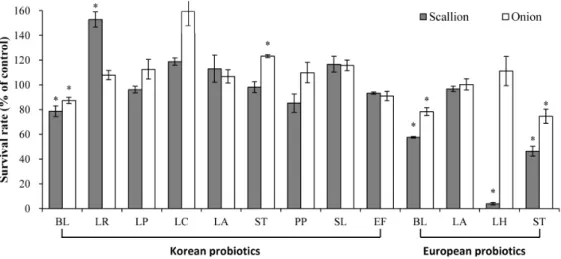
Fig. 2. Growth rates in different probiotic strains at scallion or onion juice treatment. Experiments were performed by using a pour plate method.
Probiotics were incubated in the presence of scallion or onion juice for 48–72 h. Columns represent means ± SDs with respect to the 100%
control. BL, B. lactis; LR, L. rhamnosus; LP, L. plantarum; LC, L. casei; ST, S. thermophiles; PP, P. pentosaceus; SL, L. lactis; EF, E. faecium;
LH, L. helveticus.
*p <0.01 significantly different compared with control.
aureus, S. enteritidis, Vibrio parahaemolyticus, Enterobacter cloacae를 억제하는 효과를 보여주었다(Sheo, 1999). 하지만 유 산균에 대한 항균활성 자료는 찾을 수 없었다. 본 연구에서 생강 즙은 한국형과 외래종 B. lactis의 증식률에 크게 영향을 주지 않 았다. 하지만 한국형 L. acidophilus의 증식률은 5%로 크게 떨어졌 으며, 외래종의 경우도 76%까지 감소되었다. 한국형 S. thermophilus 의 증식률은 93%로 크게 영향이 없었지만 외래종의 경우는 73%로 감소되었다. 마찬가지로 그밖에 한국형 유산균주들의 증 식률은 80% 이상으로 크게 영향을 받지 않았지만 외래종 L.
helveticus의 증식률은 23%로 크게 감소하였다(Fig. 1).
양파와 파는 한국인 식사에서 식재료 및 향신료로 가장 많이 사용되는 식품 중 하나로서 quercetin과 같은 flavonoid와 diallyl disulfide와 같은 유기황화합물이 함유되어 있어, 항균 및 항산화
작용을 포함한 다양한 생리활성을 지니는 것으로 알려져 있다 (Ra et al., 1997; Miean and Mohamed, 2001; Ramos et al., 2006). 또한 주요 성분인 quercetin은 quinolone 계열 항생제와 같이 세균의 DNA gyrase에 결합하여 항균 작용을 나타내는 것 으로 보고 되고 있다(Lakhanpal and Rai, 2007). 어떤 논문에 따 르면 양파 추출물은 L. plantarum과 L. mesenteroides에 대한 항 균력이 있음이 보고된바 있다(Kim et al., 1998). 본 연구에서 한 국형 B. lactis의 증식률은 양파즙과 파즙 모두에서 각각 87%, 79%로 감소되었으며 외래종의 경우도 각각 78%, 58%로 더욱 감소되었다. 반면에 L. acidophilus의 증식률에서는 한국형과 외 래종 모두 거의 영향을 받지 않았다. S. thermophilus의 증식률에 서는 외래종의 경우 양파즙에 의해 75%, 파즙에 의해 46%로 감 소되었으나 한국형은 파즙에는 거의 영향을 받지 않았고 양파즙에
Fig. 4. Growth rates in different probiotic strains at propolis treatment. Experiments were performed by using a pour plate method. Probiotics were incubated in the presence of propolis for 48–72 h. Columns represent means ± SDs with respect to the 100% control. BL, B. lactis; LR, L.
rhamnosus; LP, L. plantarum; LC, L. casei; ST, S. thermophiles; PP, P. pentosaceus; SL, L. lactis; EF, E. faecium; LH, L. helveticus.
*p <0.01 significantly different compared with control.
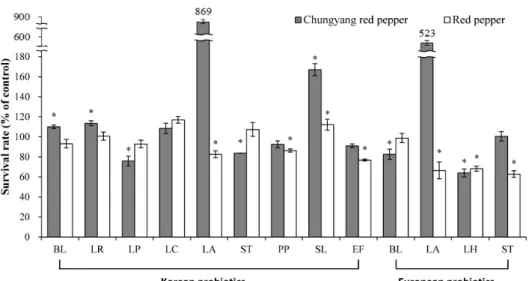
Fig. 3. Growth rates in different probiotic strains at Chungyang red pepper or red pepper juice treatment. Experiments were performed by using a pour plate method. Probiotics were incubated in the presence of Chungyang red pepper or red pepper juice for 48–72 h. Columns represent means ± SDs with respect to the 100% control. BL, B. lactis; LR, L. rhamnosus; LP, L. plantarum; LC, L. casei; ST, S. thermophiles; PP, P. pentosaceus;
SL, L. lactis; EF, E. faecium; LH, L. helveticus.
*p<0.01 significantly different compared with control.
는 오히려 증식률이 123%까지 증가하였다. 또한 한국형 L. casei 의 증식률은 양파즙에 의해 166%까지 증가하였으며, L. rhamnosus 의 증식률은 153%까지 증가하였다. 외래종 L. helveticus의 증식 률은 양파즙에는 영향을 받지 않았으나 파즙에는 4%까지 크게 감소하였다(Fig. 2).
고추는 매콤한 맛을 부여하여 식품의 기호성을 높이며, 특히 청양고추(Chungyang red pepper)는 한국에서 재배되는 고추 중 가장 매운 고추 품종 중의 하나이다. 고추속 식물의 주요 유효성 분인 capsaicin은 항균 및 항산화 활성이 있는 것으로 보고되고 있다(Park and Park, 2007). 또한 청양고추는 매운맛만큼 capsaicin 함량이 다른 일반 고추들에 비해 10배 이상 높다(Choi et al., 2006). 본 연구에서 한국형 B. lactis의 증식률은 청양고추
즙에 의해 110%로 증가하였지만 외래종의 경우는 83%로 감소 하였다. 또한 S. thermophilus의 증식률도 홍고추즙에 의해 한국 형은 107%로 증가하였고, 외래종은 63%로 감소하였다. 특히, L. acidophilus의 증식률은 청양고추즙에 의해 한국형의 경우 8배, 외래종은 5배 정도 증가하였으며 L. lactis의 증식률은 167%
까지 증가하였다. Sharma 등(2013)의 보고에서 capsaicin은 L.
acidophilus (ATCC 4356)의 증식률은 감소시켰지만 대사활성 증가에 의한 L-lactate의 생성은 증가 시켰다는 점과 큰 차이가 있어, 이는 좀더 연구가 필요할 것으로 사료된다. 그밖에 한국형 유산균주들의 증식률은 청양고추즙과 홍고추즙에 크게 영향을 받지 않았으며, 외래종 L. helveticus의 증식률은 30% 이상 감소 되었다(Fig. 3).
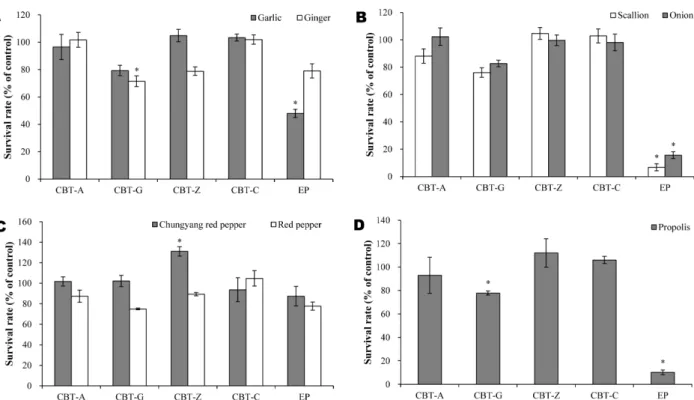
Fig. 5. Growth rates in different commercial probiotic products at various spices or propolis treatment. Experiments were performed by using a pour plate method. Probiotics were incubated in the presence of garlic or ginger (A), scallion or onion (B), Chungyang red pepper or red pepper (C), propolis (D) for 48–72 h. Columns represent means ± SDs with respect to the 100% control. CBT-A, G, C, and Z, Korean probiotic products; EP, European probiotic product.
*p<0.01 significantly different compared with control.
프로폴리스에 의한 유산균의 증식률에서는 B. lactis를 포함 한 대부분의 Lactobacillus 속 유산균이 크게 영향을 받지 않았 으나, 한국형과 외래종 L. acidophilus는 20% 이상 감소하였다.
특히, S. thermophilus의 증식률은 한국형과 외래종 모두 99%
이상 감소되었으며 L. helveticus의 경우도 99% 감소하였다. 반 면에 L. casei의 증식률은 122%까지 증가하였다(Fig. 4).
또한 각 향신료와 프로폴리스가 한국형 유산균주만 사용하여 제조된 프로바이오틱스 제품(CBT-A, CBT-G, CBT-C, CBT-Z) 과 외래종 유산균주가 사용된 해외 프로바이오틱스 제품(European product, EP)에 미치는 영향을 조사한 결과 한국형 프로바이오 틱스 제품은 모두 큰 영향을 받지 않았다. 하지만 해외 프로바이 오틱스 제품은 마늘즙, 양파즙, 파즙, 프로폴리스에 의해 크게 감 소하는 경향을 나타냈다(Fig. 5).
본 연구결과들을 종합해 볼 때 한국인의 장에서 분리한 유산 균은 대체적으로 항균활성이 있는 각종 향신료에 저항성을 가지 는 생존력이 강한 균주로 판단되며, 한국인의 장에 적합한 유산 균으로 사료된다.
적 요
건강에 유익한 작용을 하는 프로바이오틱스는 까다로운 미생 물로 다양한 환경조건에 매우 민감하여, 이들의 생존율은 항생 제, 노화, 스트레스와 식이 등과 같은 요인들에 크게 영향을 받는다.
이에 본 연구에서는 한국 식단에서 많이 이용되고 있는 항균활성
이 있는 각종 향신료(마늘, 생강, 파, 양파, 청양고추, 홍고추)와 프 로폴리스가 한국인의 장에서 분리한 유산균주의 생존율에 미치 는 영향을 조사하였다. 그 결과 대부분의 한국형 유산균주들은 모 든 향신료와 프로폴리스에 저항성을 나타냈으며, 심지어 일부 한 국형 유산균주(Bifidobacterium lactis, Lactobacillus acidophilus, Lactobacillus casei, Lactobacillus rhamnosus, Streptococcus thermophiles)는 특정 향신료 또는 프로폴리스에 의해 증식률이 증가하였다. 하지만 이와 다르게 대부분의 외래종 유산균주는 다양 한 향신료와 프로폴리스에 의해 증식률이 감소 하였으며, 일부 외래종 유산균주(L. helveticus, S. thermophiles)는 특정 향신료에 의해 증식률이 크게 감소 하였다. 마찬가지로 각 향신료와 프로 폴리스가 한국형 유산균주만 사용하여 제조된 프로바이오틱스 제품과 외래종 유산균주가 사용된 해외 프로바이오틱스 제품에 미치는 영향을 조사한 결과 한국형 프로바이오틱스 제품은 모두 큰 영향을 받지 않았다. 하지만 해외 프로바이오틱스 제품은 마늘, 양파, 파, 프로폴리스에 의해 크게 감소하는 경향을 나타냈다. 따라 서 본 연구결과, 한국인의 장에서 분리한 유산균은 대체적으로 항균활성이 있는 각종 향신료에 저항성을 가지는 생존력이 강한 균주로 판단되며, 한국인의 장에 적합한 유산균으로 사료된다.
감사의 말
본 연구는 2012년도 삼육대학교 교내연구비로 수행되었으며, 이에 감사드립니다.
References