Introduction
Enhanced soil fertility and improved environmental quality are both important goals of today’s agriculture.
With a view toward developing more environmentally friendly, ecologically sound and economically profitable agricultural systems and management practices, several research studied have evaluated organic systems as an alternative to chemical and synthetic fertilizer-based system (King and Buchanan, 1993; Drinkwater et al., 1998). Organic or ecological farming systems exclude the use of chemical nitrogen (N) fertilizers, instead requiring a balance between the supply and demand of N through the use of legume-based fertility in the crop rotation (Anonymous, 1991a). Green manures were used for soil structure improvement and organic matter accumulation (Allison, 1973), however, recently in order to improve the biodiversity and crop yield, most organic farmers have cultivated a lot of green manure crops in farmlands
during winter season after the harvest of a main crop. The use of leguminous green manures specifically for accumulation of N in organic crop rotations has become increasingly relevant in the context of set-aside management. Winter grown green manures have been found to reduce nitrogen losses significantly, which secures a higher N supply for succeeding crops (Thorup- Kristensen, 1994; Thorup-Kristensen & Bertelsen, 1996), and they can be assumed to have many other effects on the soil. Legume manure crops, such as hairy vetch, have been known to enrich soil N and increase fruit yield compared with non-legume crop or bare fallow (Abdul- Baki & Teasdale, 1993; Sainju et al., 1999). Non-legume manure crops, such as rye, have been known to increase soil organic C and N (Kuo et al., 1997a). Red-pepper is one of the most cultivated vegetables in Korea which has a life span of over 150 days. Therefore, red-pepper yield and growth are strongly dependent upon the nitrogen which is a major limiting factor. The split application of nitrogen is the best way to solve the lack of nitrogen in the conventional system. However, it is impossible to Received :March 20. 2008 Accepted : June 6. 2008
*Corresponding author: Phone : +82432612511,
E-mail : [email protected]
Effects of Green Manure Crops, Hairy vetch and Rye, on N Supply, Red- pepper Growth and Yields
Jwa-Kyung Sung1, Sang-Min Lee1, Jung-Ah Jung2, Jong-Mun Kim1, Yong-Hwan Lee3, Du-Hoi Choi4, Tae Wan Kim5, and Beom-Heon Song2,*
1NAAS, RDA, 249, Seodundong, Suwon, Korea
2Department of Plant Resources, Chungbuk National University, 48, Gaeshindong, Cheongju, Korea*
3NICS, RDA, 1085, Naeidong, Milyang, Korea
4NIHH, RDA, 80, Eumseong, Korea
5Department of Plant Resources Science, Hankyong National University, 67, Seokjeong-dong, Anseong, Korea
Winter annual green manure crops may be an effective tool for environmental-friendly agriculture system.
The effect of legume (hairy vetch), non-legume (rye) and N fertilization (190 kg N ha-1) was examined and compared on red-pepper yield, nitrogen uptake, carbohydrate composition, and soil N and C contents. We monitored soil N and C for 120 days after incorporation (DAI) of green manures or mineral fertilizer. The mineralization of nitrogen reached the maximum around 30 DAI. The amount of inorganic nitrogen supplied by mineralization of hairy vetch residue was greater than chemical N or rye. Photosynthetic rate was similar by 70 DAT in all treatments however, it in rye-incorporated red-pepper presented a sharp decline at the later growth period. Leaf total nitrogen was greater with hairy vetch and chemical N than rye throughout the experiment. The soluble sugar increased steadily in all treatments from 40 to 110 days after transplanting (DAT) whereas starch showed a tendency of great decrease. Hairy vetch greatly promoted red-pepper growth by the later period however, chemical N showed the highest fruit yields.
Key words: Red-pepper, Fruit yield, Green manure crop, Nitrogen, Carbohydrate, Soil nitrogen
introduce the conventional method in green manure crops-based system. We obtained the results of nitrogen release of cover crops and red-pepper growth during early period from the previous research. In the present work, we have evaluated the effects of green manure crops as an alternative for nitrogen supply and growth, and yields of red-pepper crop.
Materials and Methods
Field methods Study was conducted on the field for an organic red-pepper at NIAST, RDA in 2007. Hairy vetch and rye were fall-seeded at a rate of 80 kg and 100 kg ha-1, respectively, on September 28, 2006. On April 25, 2007, above ground of two green manures was cut and incorporated into soil. The biomass production and nitrogen accumulation of hairy vetch and rye harvested were different (Table 1). On May 10, six-week-pepper
‘Dokyacheongcheong’ seedlings were transplanted in the interval of 0.9 m × 0.3 m and an experimental design was a planned block with three replications. The size of an individual plot was 6 m by 3.7 m and each plot included six rows of pepper plant. No additional herbicides and fertilizers were added to any of green manures plots. As comparing with green manures, NPK plots were fertilized with 190 N, 135 P and 122 K kg ha-1and N and K were applied with 3- and 2-splits, respectively.
Soil sampling and analysis Soil at the depths of 10- 20 cm was taken to analyze physico-chemical properties before the experiment. The soil pH and EC were measured for soil solution by 1:5 ratio (soil : water). Total nitrogen and organic matter were determined by a CN elemental analyzer (Variomax CN, ELEMENTAR, Germany). Available phosphate was extracted by Lancaster solution and was read at 660 nm.
Exchangeable cations were extracted with 1N-NH4OAc and measured by ICP (GBC, Austrailia). In order to monitor temporal changes in soil nitrogen and organic matter in red-pepper-growing field incorporated with different N sources, six random soils were drawn from
the horizon (10-20 cm) of each plot using auger during 120 days after treatment. Soil inorganic nitrogen, NH4 (Kopp & McKee, 1978) and NO3(Keeney & Nelson, 1982), concentrations in the fresh soil were determined by flow injection analyzer after the extraction with 2 M KCl. Soil total nitrogen and organic matter content of air- dried soil were determined using a CN elemental analyzer (Variomax CN, ELEMENTAR, Germany).
Determination of leaf nitrogen and carbohydrate contents Total leaf nitrogen was determined by burning the ground leaf samples using a CN elemental analyzer (Variomax CN, ELEMENTAR, Germany). Net photosynthetic rate (PN) and stomatal conductance (gs) in fully expanded uppermost leaves (12 plants in each treatment) were measured at light saturating intensity between 11:00 and 14:00 h using portable photosynthesis system (LCpro+, ADC, UK). The atmospheric conditions during measurement were PAR, 1370 ±68 μmol m-2s-1; relative humidity 39 ±1 %, and atmospheric CO2369 ± 2 μmol mol-1. In order to determine carbohydrate contents, the dried leaf samples (0.2 g) were first boiled with 10 ml of 80 % EtOH at 100℃in a water bath. The alcoholic extracts were evaporated under nitrogen stream, and the residues were re-dissolved with distilled water.
The residue was digested with 2 ml of 9.3 N HClO4, and the supernatant after a centrifugation was used for the determination of starch. Water extracts were mixed with 2 volumes of 0.2 % anthrone in a concentrated H2SO4
followed by estimation of carbohydrate as described by Roe (1955). Glucose was used as a standard for both soluble sugars and starch.
Estimation of crop growth and fruit yield Red- pepper was cut 2 cm above ground at 40, 70 and 110th day after transplanting, separated by leaves and stems, oven-dried after analyzing leaf area, weighed, and ground to 1mm. Based on these results, the relative growth rates of 40 to 70 days and 70 to 110 days were determined.
Red-pepper fruit was harvested every two weeks as the color became red. Fruits were picked by hand from
Supplied nitrogen Nitrogen content
C/N ratio Water content
Dry weight Fresh biomass
Mg ha-1 Mg ha-1 % % kg ha-1
Treatment
Hairy vetch 70.2 11.9 83 11.9 3.17 379 (199)
Rye 24.2 14.6 81 19.6 2.11 197 (151)
Chemical fertilizer - - - - - 190 (100)
Table 1. Biomass production and nitrogen accumulation of two green manure crops.
random thirty plants in the middle rows. Total marketable fruit yield (Total fruits harvested diseased fruits) was determined by adding yields obtained at each harvest.
Data analysis All data were subjected to an analysis of variance and when significance (P < 0.05, 0.01, 0.001) occurred for the effect of treatment, a least significant difference (LSD) was calculated using SAS 9.0.
Results and Discussion
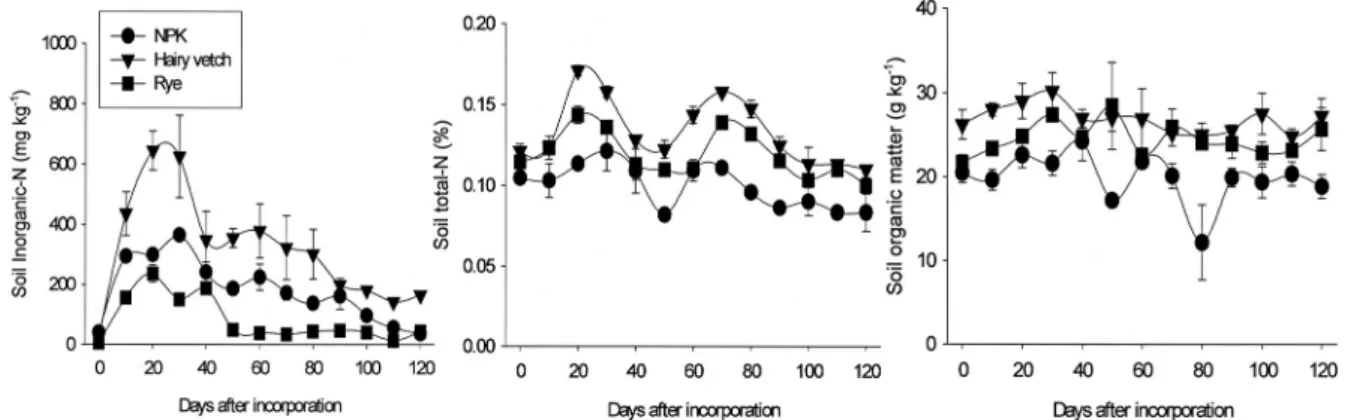
Changes in soil nitrogen and organic matter. Soil physico-chemical properties were checked before incorporation of green manure crops (Table 2). Soil pH was slightly high in green manure crops treatments and organic matter, available phosphate, and exchangeable cations were also greater. Soil nitrogen and organic matter in surface soil were monitored during 120 days after incorporation (DAI) (Fig. 1). Inorganic nitrogen was quickly released into soil after treatment and reached the peak around 20 DAI. The amount of inorganic nitrogen released was the greatest (645 mg kg-1 at 20 DAI) in hairy vetch treatment, which showed about 2 times higher as comparing with NPK. On the other hand, inorganic nitrogen in rye-incorporated soil was not come
up to NPK. The mineralization of inorganic nitrogen was strongly dependent upon the amount of green manure crops incorporated. According to Tejada and Gonzalez (2006), the C/N ratio of the organic wastes will largely determine the balance between mineralization and immobilization. The C/N ratio was the best predicting parameter for the potential amount of N that can be mineralized from a crop residue (Chaves et al., 2004). As monitoring the changes in inorganic nitrogen, which showed the decrease after around 30 DAI, in all treatments, it was considered that additional N sources should be supplied for crop growth and yield. Soil total nitrogen and organic matter by incorporating green manure crops were profoundly enhanced. Throughout the examination, soil total nitrogen in hairy vetch and rye was 1.3 and 1.2 times greater compared with NPK, and soil organic matter 1.4 and 1.3, respectively. Green manuring maintained elevated total nitrogen and organic matter levels (Mandal et al., 2003), and possible benefits of legumes to soil nitrogen may be due to nitrogen released from roots during their growth (Poth et al., 1986). In addition, enhanced soil nitrogen and organic matter levels by green manure crops promoted not only crop growth, but also soil microbial activities, which are responsible for important cycle such as C, N, P and S
Fig. 1. Changes in inorganic- (NH4+
+ NO3-
) and total-nitrogen, and organic matter of soil during experiment. Error bar represents standard deviation (n = 6).
Na Avali. P
Ca K
Ex. Cations Avali. P
O.M.
Inorg.-N" T-N EC
pH
1:5 dS m-1 mg kg-1 % g kg-1 mg kg-1 --- cmol+kg-1 --- Treatment
NPK 6.6 0.38 20 0.11 20.3 376 0.5 9.3 1.8 0.1
Hairy vetch 7.0 0.36 15 0.12 26.2 591 0.7 11.4 2.1 0.1
Rye 7.3 0.35 13 0.10 21.6 593 0.8 11.5 2.1 0.1
"
Inorganic-N means the sum of nitrate and ammonium.
Table 2. Soil physico-chemical properties before the experiment (n = 3).
(Tejada et al., 2008).
Leaf nitrogen, photosynthesis and carbohydrate synthesis. In spite of the significant differences of leaf nitrogen concentrations (Fig. 4) and crop growths (Fig. 2) among treatments, photosynthetic rate showed similar records (18.2 to 20.2 μmol m-2s-1) in all treatments by 70 days after transplanting (DAT) (Fig. 3). However, a decrease in nitrogen availability resulted in a sharp decline of photosynthetic rate in rye treatment at 110 DAT. The stomatal conductance was not found in differences among treatments throughout the experiment, and the evaporation rate was significant at 70 DAT (p <
0.01) and 110 DAT (p < 0.05) among treatments. Total nitrogen of leaf presented the similar pattern between NPK and hairy vetch however, it in rye treatment was much lower compared with other treatments (Fig. 4).
Leaf total nitrogen showed 5.1 (NPK) and 5.2 % (hairy vetch) at 40 DAT, respectively, gradually decreased in NPK and hairy vetch treatments by 70 DAT, and slightly increased at 110 DAT. Unlike those treatments, leaf nitrogen in rye treatment presented a slowly decreasing pattern, which ranging from 4.1 to 3.7 %, throughout the
experiment. This phenomenon was attributed to the entire shortage of nitrogen that is supplied by only 60 % of recommended doses as well as high C/N ratio of rye itself. The soluble sugar and starch of leaf showed entirely different results in all treatments (Fig. 4). The soluble sugar elevated steadily from 40 (47.3 mg g-1, the average of three treatments) to 110 (83.0 mg g-1) DAT.
On the contrary, starch decreased sharply by 70 DAT, and then has slowed a degree of the decrease by 110 DAT.
These results were presumed because of the demand of soluble sugar from source to sink to make fruits. Paul and Driscoll (1997) reported that the availabilities of nitrogen influence the photosynthetic rate through the source/sink balance. Koncalova et al (1993) and Cizkova et al (1996), in agreement with our present results, observed the accumulation of higher soluble sugars and lower starch with increasing nutrient availability. As starch/soluble
Fig. 2. Red-pepper growth in green manure crops and NPK treatments. The same letter are not significantly different within a column at the 5 % level as determined by LSD test (n
= 3).
Fig. 3. Photosynthetic charateristics in green manure crops and NPK treatments. Error bar represents standard deviation (n = 12). The symbols, *and **, mean the significance at P <
0.05 and P < 0.01 as determined by LSD, respectively.
sugar ratio is decreasing, the metabolic activity of the tissue grown under higher nutrient availability is increasing. Thus, this phenomenon may be the competitive signal for carbon between reserve storage and growth (Chapin et al., 1990).
Crop growth and yields. The growth of plants was maximally increased when hairy vetch was incorporated (Fig. 2). Red-pepper in NPK and hairy vetch treatments showed a similar growth by 70 DAT. However, its growth under hairy vetch was significant higher (36 % of increase at 110 DAT) than that of NPK after 70 DAT.
This result seemed to be closely related with soil inorganic nitrogen content. The supply of surplus nitrogen from hairy vetch favored red-pepper growth whereas had no influence on yields (Table 3). As a result of crop growth in hairy vetch treatment, an additional
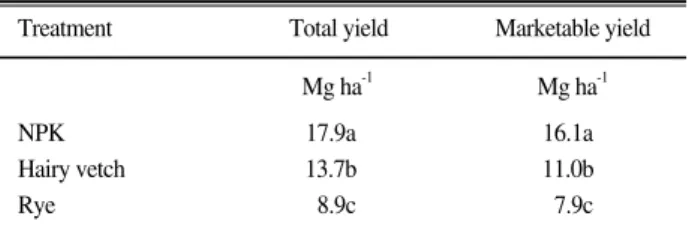
nitrogen supply was not required although inorganic nitrogen was obviously declined after 30 DAI. Unlike hairy vetch, rye treatment retarded red-pepper growth throughout growth period. The crop growth rate of rye treatment compared with hairy vetch was 0.81 (at 40 DAT), 0.58 (at 70 DAT), and 0.50 (at 110 DAT). This result was attributed to the lack of the mineralized nitrogen from rye incorporated. Rye supplied only 60 % of total nitrogen, which needs to entirely complete red- pepper life, and this has resulted in the nitrogen starvation since early period. Thereafter, yield of red-pepper in rye treatment was considerable reduced (Table 3). Total- and marketable fruit yields were significantly higher with NPK than hairy vetch and rye (Table 3), and those between green manure crops were greater in hairy vetch.
As mentioned above, the supply of abundant nitrogen from hairy vetch did not showed positive effect on crop yield. As comparing with NPK (17.9 Mg ha-1, 100 %), hairy vetch and rye were 13.7 (77 %), and 8.9 (50 %) Mg ha-1, respectively. The greater red-pepper fruit yield with hairy vetch than rye may have resulted from increased nitrogen concentration (soil) or accumulation (plant). In the previous researches, Abdul-Baki et al. (1996) and Sainju et al. (2001) reported that the promotion effect to crop growth and yield was significantly greater with hairy vetch and clover than rye.
Conclusion
A vigorous growth of hairy vetch during winter season produced an excess biomass and this resulted in greater nitrogen supply (199) into soil compared with chemical fertilizer (100) and rye (51). Inorganic nitrogen mineralized from hairy vetch residue ranged from 140 to 645 mg kg-1, the peak reached around 30 days after incorporation, throughout the experiment. The effects of hairy vetch and chemical fertilizer on crop growth, photosynthesis, carbohydrate composition and fruit yields were similar whereas rye resulted in poor crop growth, Fig. 4. Nitrogen and carbohydrates of red-pepper leaves in
green manure crops and NPK treatments. Error bar represents standard deviation (n = 3). The symbols, *and **, mean the significance at P < 0.05 and P < 0.01 as determined by LSD, respectively.
Treatment
The same letter are not significantly different within a column at the 5 % level as determined by LSD test (n = 30).
NPK 17.9a 16.1a
Hairy vetch 13.7b 11.0b
Rye 18.9c 17.9c
Marketable yield Mg ha-1 Mg ha-1
Total yield
Table 3. Pepper fruit yields by cover crop incorporation.
carbohydrate synthesis and fruit yield. On the basis of this study, it was demonstrated that hairy vetch was better green manure crops for the supply of nitrogen and growth of the succeeding crop.
References
Abdul-Baki, A. A., and J. R. Teasdale. 1993. A no-tillage tomato production system using hairy vetch and subterranean clover mulches. HortScience 28 : 106 ? 108.
Abdul-Baki, A. A., J. R., Teasdale, R. Korcak, D. J. Chirwood, and R. N. Huettel. 1996. Fresh-market tomato production in a low- input alternative system using cover crop mulch. HortScience 31 : 65-69.
Allison, F.E., 1973. Soil Organic Matter and its Role in Crop F’roduction. Elsevier, New York, pp. 450-456.
Anonymous. 1991a. Organic production of agricultural products and indications referring thereto on agricultural products and food stuffs. Official Journal of the European Community No. L198 : 1- 15.
Chapin, F. S., E. D. Schulze, and H. A. Mooney. 1990. The ecology and economics of storage in plant. Annu. Rev. Ecol. Syst. 21 : 423-447.
Chaves, B., S. De Neve, G. Hofman, P. Doeckx, and O. Van Cleemput. 2004. Nitrogen mineralization of vegetable root residues and green manures as related to their (bio)chemical composition. Eur. J. Agron. 21, 161-170.
Cizkova, H., J. Lukavska, K. Priban, J. Kopecky, and H. Brabcova.
1996. Carbohydrate levels in rhizomes of Phragmites australis at an oligotrophic and a eutrophic site: a preliminary study. Folia Gebot. Phytotx. 31 : 111-118.
Drinkwater, L. E., P. Wagoner, and M. Sarrantonio. 1998. Legume- base cropping systems have reduced carbon and nitrogen losses.
Nature 396 : 262-265.
Keeney, D. R., and D. W. Nelson. 1982. Nitrogen inorganic forms.
pp. 643-698. In Page A. L. et al. (ed.) Methods of soil analysis.
Part 2. 2nd ed. Agron. Monogr. 9. ASA and SSSA Madison. WI.
King, L. D., and M. Buchanan. 1993. Reduced chemicals input cropping systems in the Southeastern United States. I. Effect of rotations, green manure crops and nitrogen fertilizer on crop yield.
Amer. J. of Alternative Agriculture. 8 : 27-33.
Koncalova, H., J. Kvet, J. Polorny, and V. Hauser. 1993. Effect of flooding with sewage water on three wetland sedges. Wetlands Ecol. Manage. 2 : 199-211.
Kopp, J. F., and G. D. McKee. 1978. Methods for chemical analysis of water and wastes. Nitrogen ammonia-Method 350.1. USEPA Environ. Monitoring and Support Lab., Cincinnati.
Kuo, S., U. M. Sainju, and E. J. Jellum. 1997a. Winter cover crop effects on soil organic carbon and carbohydrate. Soil Sci. Soc. Am.
J. 61 : 145-152.
Mandal, U. K., S. Gurcharan, U. S. Victor, and K. L. Sharma. 2003.
Green manuring: its effect on soil properties and crop growth under rice-wheat cropping system Europ. J. Agronomy 19, 225- 237.
Paul, M. J., and S. P. Driscoll. 1997. Sugar repression of photosynthesis: the role of carbohydrates in signaling nitrogen deficiency through source:sink imbalance. Plant Cell Environ. 20 : 110-116.
Poth, M., J. S. La Favre, and D. D. Focht. 1986. Quantifications by direct 15N dilution of fixed N2 incorporation into soil by Cajanus cajan (Pigeon pea). Soil Biol. Biochem. 18, 125-127.
Roe. J. H. 1955. The determination of sugar in blood and spinal fluid with anthrone reagent. J. Biol. Chem. 212 : 335-343.
Sainju, U. M., B. P. Singh, and S. Yaffa. 1999. Tomato yield and soil quality as influenced by tillate, cover cropping, and nitrogen fertilization. In: Hook, J. E. (Ed.), Proceedings of the 22ndAnnual Southern Conservation Tillage Conference for Sustainable Agriculture. Tifton. GA. July 6-8. Spec. Pub. 95. Agric. Exp. Sta., Athens. GA. Pp. 104-113.
Sainju, U. M., B. P. Singh, and W. F. Whitehead. 2001. Comparison of the effects of cover crops and nitrogen fertilization on tomato yield, root growth, and soil properties. Scientia Horticulturae. 91 : 201-204.
Tejada, M. and J. L. Gonzalez. 2006. Crushed cotton gin compost on soil biological properties and rice yield. Eur. J. Agron. 25, 22- 29.
Tejada, M., J. L. Gonzalez, A. M. Garcia-Martinez, and J. Parrado.
2008. Effects of different green manures on soil biological properties and maize yield Bioresource Technology 99, 1758- 1767.
Thorup-Kristensen, K. 1994. Effect of nitrogen catch crop species on the nitrogen nutrition of succeeding crops. Fertilizer Research 37, 227-234.
Thorup-Kristensen, K., and M. Bertelsen. 1996. Green manure crops in organic vegetable production. In: Kristensen, N. H., Hoeg- Jensen, H. New Research in Organic Agriculture. Proceedings from the 11th International Scientific IFOAM Conference, Copenhagen, pp. 75-79.
동계녹비작물의 활용은 친환경농업을 위한 유용한 방법중의 하나이다. 고추 수량, 질소흡수, 탄수화물 합성 및 토양 질소공급에 대한 두과(헤어리베치) 및 화본과(호밀) 녹비작물의 효과를 조사하였다. 녹비작물로부터 무기 화된 질소는 토양환원 후 30일경에 최대치에 도달하였으며, 무기태 질소의 양은 645 mg kg-1 (헤어리베치) 및 237 mg kg-1 (호밀) 이었다. 토양 환원된 헤어리베치로부터 무기화된 질소의 양은 화학질소 (365 mg kg-1)보다 높았는데 이는 헤어리베치의 투입량이 질소기준으로 약 2배였기 때문인 것으로 판단된다. 광합성량과 탄수화물 합성은 정식 후 70일까지 처리간에 큰 차이를 보이지 않았지만, 생육후기 호밀처리구의 고추 광합성량과 탄수 화물 합성량(전분)이 다소 감소하는 경향을 보였다. 두과녹비작물인 헤어리베치가 호밀에 비해 고추의 생육 및 수량에 큰 영향을 미치는 것으로 나타나, 향후 고추재배시 헤어리베치의 화학비료 대체효과는 클 것으로 사료 된다.
질소공급, 고추의 생육 및 수량에 대한 녹비작물 환원 효과
성좌경1·이상민1·정정아2·김종문1·이용환3·최두회4·김태완5·송범헌3,*
1국립농업과학원, 2충북대학교 식물자원학과, 3국립식량과학원, 4국립원예특작과학원, 5한경대학교 식물자원과학과