Smart Air Conditioning Service Using Bio-signal and Emotional Lighting
Jong-Min Kim
1, Gab-Sang Ryu
2*1
Doctoral Course, Dept. of Computer Engineering, Dongshin University
2
Professor, Dept. of Computer Engineering, Dongshin University
생체신호와 감성조명을 이용한 스마트 에어컨 서비스
김종민
1, 류갑상
2*1
동신대학교 컴퓨터공학과 박사과정,
2동신대학교 컴퓨터공학과 교수
Abstract Recently, in the market of home appliances, the technical differentiation of products using convergence technology has been receiving a lot of response to satisfy consumer demand. However, air-conditioner products are an area that requires research and development in the early stages of convergence technology. In this paper, it is developed that a non-contact bio-signal(respiration, movement) collection technology using IR-UWB(Impulse-Radio Ultra Wideband) technology, which controls the air-conditioner direction according to the user’s location and also monitors sleep to provide an optimal sleep environment. In addition, emotional lighting and ASMR are developed to provide a comfortable and emotional place of life. Finally, based on the developed convergence technology, we develop intelligent smart air-conditioning services for the convenience of daily life and a comfortable resting space.
Key Words : Smart air conditioner, Bio-signal, IR-UWB, Emotional lighting, Bigdata, Platform, Convergence technology
요 약 최근들어 가전시장에서 융합기술을 이용한 제품 차별화는 소비자로부터 많은 호응을 얻고 있다. 그러나 에어컨 제품은 기계적 운영에서 센서와 플랫폼이 결합된 인공지능을 위한 융합기술이 적용하는 초기단계에 있어서 많은 연구 개발이 필요한 분야이다. 본 논문에서는 IR-UWB 기술을 이용한 비접촉 방식의 생체신호(호흡수, 이동) 수집기술을 개발하였다. 생체신호를 이용하여 사용자의 위치에 따라 에어컨 방향을 제어한다. 또한 최적의 수면 환경을 제공하기 위해 수면상태를 모니터링 한다. 감성조명과 ASMR은 안락하고 감성적인 삶의 공간을 제공하기 위해 개발되었다. 그리 고 개발된 융합기술을 기반으로 편리하고 안락한 휴식공간을 제공하는 지능형 스마트 에어컨 서비스 플랫폼을 제안하 였다.
주제어 : 스마트 에어컨, 생체신호, IR-UWB, 감성조명, 빅데이터, 플랫폼, 융합기술
*Corresponding Author : Gab-Sang Ryu([email protected]) Received August 31, 2021
Accepted September 20, 2021 Revised September 14, 2021
Published September 28, 2021
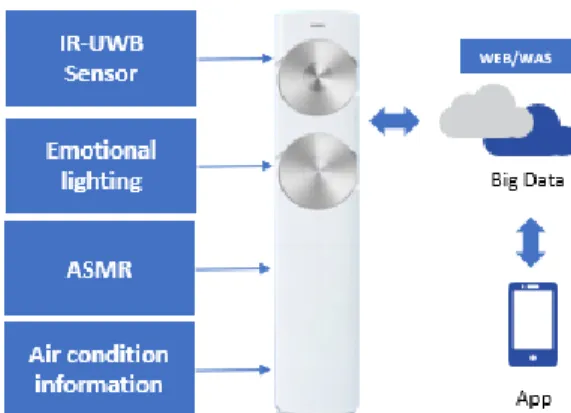
Fig. 1. Intelligent smart air conditioning service configuration
1. Instroduction
Recently, the development of ICT (Information and Communication Technologies) technology has led to the development of technology that can control and monitor objects with smartphones as it enters a hyper-connected society where things and the Internet converge.
Remote access and control of home appliances such as TVs, washing machines, refrigerators and air conditioners is now available. However, the home appliance industry, which is closely related to our daily lives, has entered a low-growth industry with 1.8% CAGR (Compound Annual Growth Rate) due to high penetration rate and overheated competition among home appliance manufactures. Thus, home appliance companies are looking for new growth engine technologies such as premium home appliances, smart home appliances and smart homes in the home appliance industry with bold R&D investments for sustainable growth [1]. Especially in the field of air conditioning, it is equipped with AI (Artificial Intelligence) that collects driving information by introducing ICT technology and drives on its own with smart algorithms[2].
Smart Home is built on a service platform, network interface, IoT (Internet of Things) sensor, and intelligent service technology, and platform services are operated in various fields such as Home IoT and Healthcare by utilizing smart apps due to the development of IoT technology. Choi et al. reviewed IoT platform technology trends such as oneM2M, Alljoyn, IoTivity, and Fog Computing [3]. It also proposed a technology that enables real-time user service through the introduction of technologies for architecture, technologies, and systems in smart homes [4]. Major consumer electronics such as Samsung, LG, and Google are securing sensor technology for smart air conditioner operation and building their own platforms based on big data.
Although it has developed a service to control the direction and intensity of wind by installing a camera on air conditioners and detecting a person’s location through video processing and analysis, the technology has not been applied due to personal information security issues[5, 6].
However, IR-UWB (Impulse-Radio Ultra-Wideband) technology using Doppler effect, which can measure bio-signal information (in-room location tracking) by non-contact method without invasion of privacy, has been studied and applied to various products. Byun. proposed Non-contact Realtime Heart Rate Estimation technology using IR-UWB radar and reported that it could be applied to polysomnography, actigraphy, sleep apnea, respiration rate, survivor detection, and occupancy detection [7, 8, 9]. A system study of bio-signals and indoor location tracking using IR-UWB was conducted by Choi et al. [10], and Choi et al. proposed a sleep efficiency measurement algorithm based on IR-UWB radar sensor in distance [11]. Lee. designed a smart pillow system for managing sleep apnea using voice sensors and pressure sensors for the safety of sleep [12].
Lee et al. has been tried to analyze
connectivity between heart and respiration and
to find the significantly connected variables for
emotional recognition [13]. Kim et al. conducted
a study on human physiological response of the emotional lighting system using LED flat lighting and evaluated electroencephalogram (EEG) and Heart Rate Variability (HRV) to analyze psychological conditions [14]. Development of indoor emotional lighting control system based on Android platform using Biological Signal is actively underway [15].
According to the auditory stimulation of ASMR (Autonomous Sensory Meridian Response) sound, the relative brainwave spectral measurement and awakening and relaxation levels were evaluated to analyze the comfort sleep inducement effect [16]. With the advent of artificial intelligence speakers and smart devices, the format of ASMR content is expected to vary as well.
In this paper, we will develop an intelligent smart air-conditioning service platform that can provide users with a comfortable living environment by collecting non-contact bio-signal (respiration, movement) using IR-UWB technology, and developing emotional lighting and ASMR emotional content technology.
2. Proposed Method
Our intelligent smart air conditioner service is equipped with IR-UWB radar sensor in air conditioner to collect bio-signal information (respiration, movement) and operate air conditioner according to user’s biorhythms, and air conditioner is operated to make a pleasant and comfortable sleeping environment through sleep monitoring. In addition, eight ASMR stored on the server are serviced through air conditioning speakers and plays ASMR through the app. Also, the combination of Warm/Cool white LED and RGB LED operates according to user’s emotions. Air conditioning operation information and sensor information for smart service are transmitted by JSON method using HTTP protocol and stored, processed, and
analyzed on big data platform. Big data include bio-singal (repetition, movement), emotional lighting operation information, air conditioner temperature and humidity information, and selected ASMR. Figure 1 shows the service configuration in which IR-UWB radar sensor, emotional lighting, ASMR, and air conditioning operation information are acquired and stored on a big data platform, the air conditioner is customized through algorithms, and the user can control it through a smart app.
3. Intelligent Service Technology Design
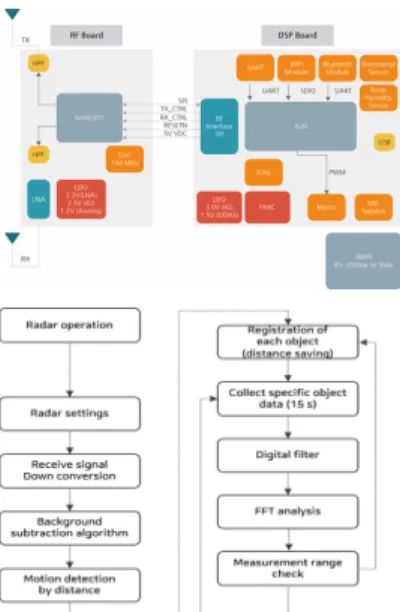
For our intelligent smart air conditioning service technology, we designed a big data platform for smart air conditioning including IR-UWB radar sensor, emotional lighting, and ASMR technology. Firstly, the development of IR-UWB radar sensor and signal processing algorithm for bio-signal data collection is shown in Figure 2. The radar sensor module consists of RF board and DSP board, designed with antenna frequency 6.0-8.5 GHz and vertical/horizontal 65
˚. Transceiver internal configuration used
Novella Single chip impulse radar transceiver (X2
Transceiver), and transmission signal used
multidimensional Gaussian pulse. Radar sensor
board designs circuits around radar controllers
using ARM Cortex processor, MCU and Radar
driver interface design QSPI communication. The
signal processing algorithm for respiration
measurement was applied in the order of Radar
operation, Radar settings, Receive signal down
conversion, Background subtraction algorithm,
Motion detection by distance, Registration of
each object, Collect specific object data, Digital
filter, FFT analysis, and Measurement range
check.
Fig. 2. IR-UWB Radar sensor configuration and signal process algorithm
Using two fixed-distance IR-UWB radars, the algorithm to obtain common solution from the equation of each circle of the radar identifies the movement and position of the object. The developed IR-UWB radar sensor is mounted in the center of the air conditioner.
Emotional lighting is configured and designed as shown in Figure 3 for the combination of Warm/Cool white LED and RGB LED. Warm/Cool white LED was used to represent 2,700-6,500K CCT (Correlated Color Temperature), and RGB LED was applied to implement CIE 1931 standard colorimetric. The developed emotional lighting will be mounted on both sides of the air conditioner.
Fig. 3. Emotional lighting configuration
ASMR is implemented by installing speakers inside the air conditioner. Control boards that are compatible with original main board of the air conditioner are designed with IR-UWB radar sensor driver, LED control driver, Audio out,
Wi-Fi module, power, main board interface, etc.
based on ARM Cortex MCU. The interface method uses UART communication protocol. Big data platform H/W consists of two NameNodes, three DataNodes, one WEB/WAS DataNode, and one ASMR streaming server. Platform S/W consists of Apache, Tomcat, Hadoop, Spark, Anaconda, MySQL, and Oracle. Pre-processing system of big data platform is Restful type modules that stores data in HDFS at same time that each sensor information is stored in RDBMS.
4. Technology Development and Results
IR-UWB radar sensor consists of control unit, transceiver, and power circuit unit, and transceiver’s receiver is designed with additional internal and external LNA (Low Noise Amplifier) to improve the reception sensitivity of the long distance. In addition, serial numbers and security codes were set for security during initial setup and operation using EEPROM (Electrically Erasable Programmable Read-Only Memory).
Two IR-UWB radar sensors are installed in the air conditioner at intervals of 200 mm so that object tracking can be carried out 8 m away. The average power of IR-UWB radar sensor was measured at -42.58 dBm/MHz, with a maximum frequency band 7.05GHz. Figure 4 shows IR-UWB radar sensor.
Fig. 4. IR-UWB radar sensor
The respiration rate of IR-UWB radar sensor can be measured from 0 to 40 times a minute.
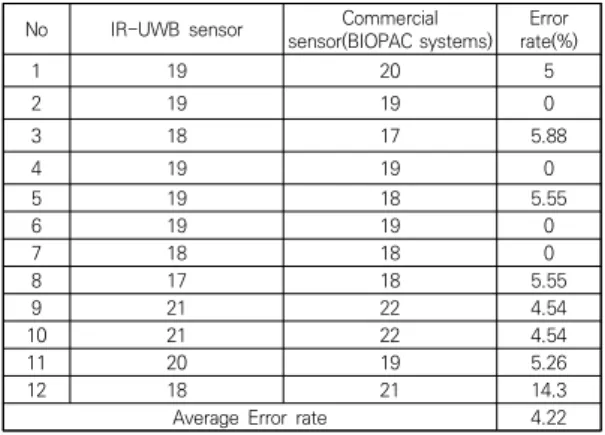
Comparing the IR-UWB radar sensor (developed)
and commercial sensor (mp150 model), average
error in the measurement of respiration rate was 4.22%. Results of comparison with commercial sensors are shown in Table 1.
No IR-UWB sensor Commercial
sensor(BIOPAC systems) Error rate(%)
1 19 20 5
2 19 19 0
3 18 17 5.88
4 19 19 0
5 19 18 5.55
6 19 19 0
7 18 18 0
8 17 18 5.55
9 21 22 4.54
10 21 22 4.54
11 20 19 5.26
12 18 21 14.3
Average Error rate 4.22