• 검색 결과가 없습니다.

Study on the Effectiveness of a Graphic Basic Design Course Based on Different Dimensions of Knowledge in a Flipped Classroom

N/A
N/A
Protected

Academic year: 2021

Share "Study on the Effectiveness of a Graphic Basic Design Course Based on Different Dimensions of Knowledge in a Flipped Classroom"

Copied!
12
0
0

로드 중.... (전체 텍스트 보기)

전체 글

(1)

Study on the Effectiveness of a Graphic Basic Design Course Based on Different Dimensions of Knowledge in a Flipped Classroom

Qin Cheng

1

, Yonghwan Pan

2*

1

Ph.D, Dept. of Experience Design, Techno Design, Kookmin University

2

Professor, Dept. of Experience Design, Techno Design, Kookmin University

다양한 지식 차원에 기반한 도형 기초 다자인 과정 플립클라스룸으로 효율성 연구

진쳉

1

, 반영환

2*

1

국민대학교 테크노디자인전문대학원 박사,

2

국민대학교 테크노전문대학원 교수

Abstract This paper’s research objective is to test educational content with different dimensions of knowledge during a graphic basic design course, while also proposing teaching plans and opinions for courses in flipped classrooms as well as enhancing educational efficiency. It categorizes educational content of courses based on the dimensions of knowledge in the learning objectives of Bloom’s taxonomy. 120 students are divided into four experimental groups to respectively under go flipped classroom learning by using different dimensions of knowledge involved in course content. Course pretests and post tests are used to obtain and analyze experimental data. Among this knowledge, factual and conceptual knowledge obtained during extra curricular independent learning as well as programmed and meta-cognitive knowledge obtained during in-class learning from a flipped classroom can stimulate student’s learning initiative and also enhance learning efficiency. According to research results and student feedback, this paper will propose targeted categorization methods for course content and also suggest educational strategies for these courses’ flipped classroom model.

Key Words : Flipped classroom, Graphic basic design course, Dimensions of knowledge, Design Education

요 약 본문의 연구목적은 디자인 교육의 도형 기초 다자인 과정에서 다양한 지식차원의 교육콘텐츠에 대한 플립러닝 수업모델의 효율성을 테스트하고, 도형 기초 다자인 과정을 대상으로 한 플립러닝 수업방안 및 의견을 제시함으로써 교육효과를 높이는 데 있다. 블룸의 교육목표 분류학의 지식차원을 사용하여 도형 기초 다자인 과정의 교육내용을 분류 하고, 120명의 학생을 4개의 실험조로 나눈 다음, 다양한 지식차원과정 콘텐츠의 플립러닝 학습을 각각 진행하고, 수업 전에 실시한 테스트와 수업 이후 실시한 테스트를 통해 실험데이터를 얻어 분석을 진행하였다. 그 중 사실성과 개념성 지식 수업의 경우 자기주도적 학습, 절차성과 메타인지 부류의 지식수업에서의 플립러닝 수업방식은 학습의 적극성을 유발하여 학습효율을 높일 수 있다. 연구결과와 학생의 피드백을 근거로 도형 기초 다자인 과정 콘텐츠의 분류방법 및 도형 기초 다자인 과정 플립러닝모델에 대한 수업전략을 제시하였다.

주제어 : 플립러닝, 도형 기초 다자인 과정, 지식차원, 디자인,교육

*Corresponding Author : Younghwan Pan([email protected]) Received May 27, 2020

Accepted November 20, 2020 Revised October 26, 2020

Published November 28, 2020

(2)

1. Introduction

The idea of flipped classroom originated from the "MOOCS" (MOOCS, large-scale online open courses) teaching initiated by MIT. Designed to provide an online learning platform that is readily accessible to any learner who wants to acquire new knowledge. Much of the existing literature on implementing flipped classroom consistently shows positive educational effects in higher education[1]. This has led many higher education institution practitioners and professors to switch their teaching approach from a traditional lecture-style method to that of a flipped classroom[2]. The adjustment of the process of knowledge imparting and internalization can enhance the effectiveness and extension of the classroom. Students' enthusiasm for learning is stimulated, and the whole class is in a proactive learning state, which is conducive to promoting students' cognition, emotional experience and internalization, and achieving greater academic achievements[3]. The practice cases of flipped classroom are more and more in the teaching of design education, but the related research of flipped classroom in the course of graphic basic design is limited. In the design education in China, the graphic basic design course is a professional basic course in the design education, and its course content has two levels of design theory research and drawing technique practice. This article wants to explore how to apply the flipped classroom in the graphic basic design course better. This article uses The Bloom's taxonomy to classify teaching content.

The Bloom's taxonomy was originally proposed by Bloom,who is American educational psychologist in 1956, and revised by Anderson in 2001. This two-dimensional classification of educational goals aims to provide specific guidance frameworks and evaluation standards for education and teaching, as well as a standard

language for teaching communication. This educational theory has profoundly influenced the two generations in the United States and has far-reaching influence internationally. It has important guiding significance for the learning and teaching of knowledge.

Based on the dimension of knowledge of The Bloom's taxonomy, the content of the graphic design of theory research and drawing technique practice is classified, and carry out the flipped classroom of different courses content.After the experiment, it was proposed to develop an implementation plan for teachers to design the graphic basic design course to follow the characteristics of students 'learning needs better.

Furthermore, the role of flipped classroom teaching methods in the university of design education is improved.

The purpose of this research is to test the effectiveness of the flipped classroom in the teaching content of different dimensions of knowledge in the graphic basic design course of design education, and to propose methods and opinions for the flipped classroom of graphic basic design course, to improve teaching efficiency.

2. Research Background 2.1 Graphic Basic Design Course in China

Basic design is the foundation of all design education, and must be learned well in order to pick up other professional design knowledge[4].

One of the basic design courses in China is

named Graphic Basic Design. As a basic subject

of modern design, the graphic basic design

course has become an important basic course for

Chinese art and design universitys. After the

1990s, China's graphic basic design courses have

developed rapidly, but the traditional teaching

model is still use today. In particular, the course

of graphic basic design is a design course to

(3)

The Knowledge Dimension from The Bloom's taxonomy

Factual Knowledge Basic information

Conceptual Knowledge The relationships among pieces of a larger structure that make them function together

Procedural Knowledge How to do something

Metacognitive Knowledge Knowledge of thinking in general and your thinking in particular Table 2. The Knowledge Dimension from The Bloom's taxonomy

cultivate students' creative thinking、basic drawing ability and lay a foundation for professional design. The course content of graphic basic design is based on perception, emphasizing the composition law of objective reality. In terms of graphic basic design courses, dot-line-surface are the basic elements of geometry and shape composition[5]. Through the exploration and recreation of the composition of the dot-line-surface, the image is redesigned by using thinking logic, visual reflection and visual effect, showing the effect of graphics and images beyond time and space.

The graphic basic design course is a basic course for art design majors.

However, many of colleges and universities have always adopted the traditional teaching mode and lacked specialized training for the course. The students passively accept the content of the course in the classroom. The survey found that there are many problems in the curriculum.

(1) Outdated Teaching Contents

At present, the most of the teaching materials of graphic basic design courses are similar in content, and Outdated design pictures, and the weak practicality and practicability in China's design education. which will inevitably be difficult to attract students, unable to stimulate students' interest and motivation in learning.

(2) Ignore innovation

Most of the teacher in graphic basic design courses focuses on the "form" of the rules. The homework imitates too many elements and did

not have a strong sense of creation. It is ignores the cultivation of students' creative thinking ability.

(3) Single result

In the most of design course, students learn and practice professional techniques to obtain a relatively mature design work with market recognition, such as poster design etc. However, the homework of graphic basic design courses focus on the combination of points, lines and surfaces to complete the layout of graphics. The students lack of interest, motivation and thinking with problems. It leads to a lack of understanding of knowledge.

However, it was found that the curriculum could not improve teachers 'enthusiasm and could not stimulate students' interest and motivation in learning, which was the core issue.

The flipped classroom can reduce the core problems effectively above graphic basic design course.

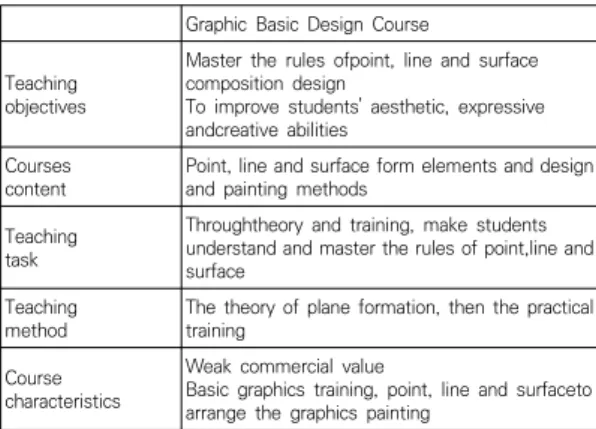
Graphic Basic Design Course Teaching

objectives

Master the rules ofpoint, line and surface composition design

To improve students' aesthetic, expressive andcreative abilities

Courses

content Point, line and surface form elements and design and painting methods

Teaching task

Throughtheory and training, make students understand and master the rules of point,line and surface

Teaching

method The theory of plane formation, then the practical training

Course characteristics

Weak commercial value

Basic graphics training, point, line and surfaceto arrange the graphics painting

Table 1. Introduction of Graphic Basic Design Course

(4)

Chapter Course contents The Knowledge dimension

1 Introduction to Plane Composition Factual Knowledge

Conceptual Knowledge 2 A design element formed by a plane

3 The law of Plane Composition

Procedural Knowledge Metacognitive Knowledge 4 The basic form of Plane Composition

5 The language of Plane Composition

Table 3. The classification of Graphic Basic Design Course contents Flipped classroom is a return to the essence of

learning and a response to personalized learning.

The adjustment of knowledge transfer and internalization processes can enhance the effectiveness and extensibility of the classroom.

In this strategy the student becomes a researcher by his own when using technology effectively through learning outside the school boundaries, promoting critical thinking, self-learning, communication skills and collaborative work among students, which all make difference in the students' educational outcomes[6]. The students 'enthusiasm for learning is stimulated. It is in a proactive learning state, which helps to promote students' cognitive, emotional experience and internalization, and help to get great academic achievement. The integration of new teaching technologies and classroom interaction activities can improve learning but not necessarily improve student satisfaction[7].

The content of the graphic basic design course has two aspects: design theory research and drawing technique practice. How to use the flipped classroom to be more effective? This research hopes to introduce the concept of knowledge dimension of the Bloom's taxonomy to discuss the problems.

2.2 Bloom's taxonomy

Bloom's taxonomy is a classification of learning outcomes that has as one of its main goals motivating educators towards designing more holistic courses. Such taxonomy has been used in many domains and it is considered as foundational and essential by the education

community. Bloom's taxonomy has been used to both design and assess learning outcomes[8-10].

The Bloom's taxonomy divided into four categories in the dimension of knowledge:

factual knowledge, conceptual knowledge, procedural knowledge and metacognitive knowledge[11]. Factual knowledge is a specific and fragmented content component, such as terms, specific details and basic elements;

Conceptual knowledge is a general concept or principle, including classification and category, principle and generalization, theory, model and structure, etc; Procedural Knowledge is

"knowledge of how to do things", such as the skills and algorithms of specific disciplines, techniques and methods, criteria for selecting appropriate procedures, etc; Metacognitive knowledge is "knowledge about cognition", including general strategies of cognition and learning Sexual knowledge, knowledge about cognitive tasks and task situations, self-knowledge.

We can understand that the knowledge

classification in Bloom's taxonomy is a

hierarchical system, the classification of

knowledge from simple to complex. The

development of the learning tasks of the latter

layer should be based on the realization of the

teaching goals of the previous layer. Use the

dimension of knowledge to classify the content

of graphic basic design, so that teachers and

students can be more clear about the knowledge

base included the level of knowledge of the

students themselves. Adjust teaching to help

students gradually move to a higher level of

(5)

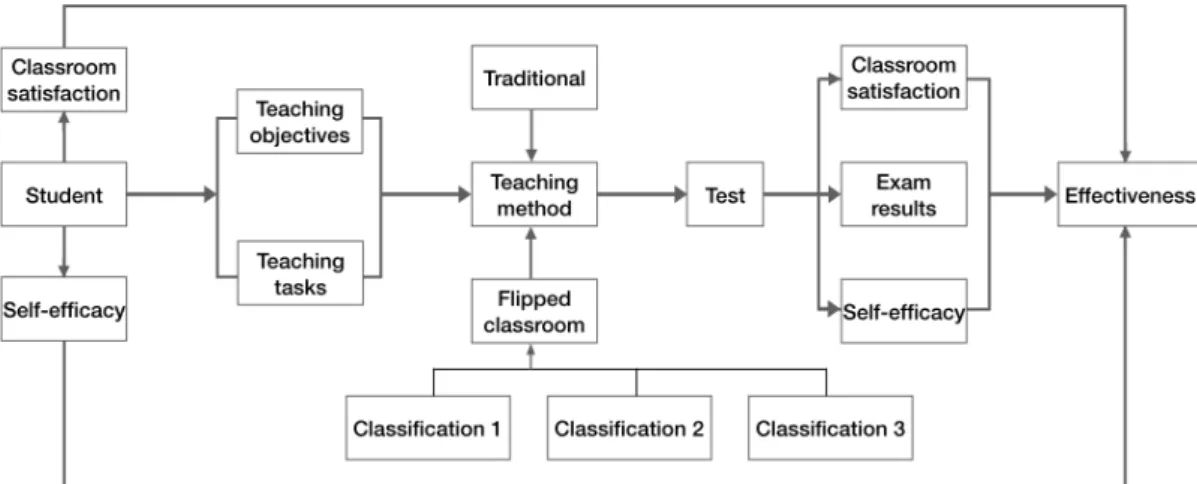
Fig. 1. The experimental process model of flipped classroom knowledge, gradually increase the depth of understanding of design knowledge, and improve the effectiveness of learning. And then, the classification of dimension of knowledge can be used to guide the teaching design of flipped classroom and refine the teaching content,in the teaching model of flipped classroom.

Through the flipped classroom of different course content, teachers are encouraged to use the students' existing knowledge experience as the growth point of new knowledge, and guide students to grow new knowledge experience from it.

This research takes the teaching content of graphic composition in a part of graphic basic design course as an example. The content of graphic composition is through the exploration and recreation of the composition of the dot-line-surface, the image is redesigned by using thinking logic, visual reflection and visual effect, showing the effect of graphics and images beyond time and space. In the training of graphic design, we can use the knowledge of graphic composition flexibly to make the layout of the layout more prominent. In the dimension of knowledge of The Bloom's taxonomy, factual and conceptual knowledge tends to the basic

theory, procedural and metacognitive knowledge tends to practice. It corresponds to the two levels of design theory research and drawing technique practice in content of graphic composition.

Therefore, the content of the five chapters of the graphic composition has been optimized and divided. The 1st and 2nd chapters of the contents tends to design theory research are classified as factual and conceptual knowledge, and the 3rd, 4th and 5th chapters of the content tends to drawing technique practice are classified as procedural and metacognitive knowledge. Then carry out the experiment of the flipped classroom on these two types of dimensions of knowledge.

3. Research Methodology

This research used quantitative and qualitative methods to collect data through the pre-test and post-test of the course, and used spss22 to analyze the data mean, standard deviation, dependent sample t-test and correlation analysis.

The experiment consisted of four groups and

each of 30 people. In the teaching period of 4

weeks, a total of 64 hours, the content of

(6)

different dimensions of knowledge was reversed.

The performance evaluation, curriculum satisfaction and self-efficacy of the four groups of students were compared. The independent variable of the experiment is the learning of the flipped classroom with different dimensions of knowledge, and the dependent variable is the value of the student's performance evaluation, curriculum satisfaction and self-efficacy.

This research collects and compares the data of performance evaluation, curriculum satisfaction, and self-efficacy of the flipped classroom of graphic basic design course. Take the above three aspects as an important basis for measuring the effect of flipped classroom.

3.1 Performance Evaluation

Students' performance evaluation can reflect the teaching effect intuitively and that is one of the important indicators for us to evaluate the teaching effect. Students' assignments are considered from the aspects of composition law, decomposition and combination of dots-lines-planes, composition and re-creation of changes, thinking logic, visual reflection, and visual effect redesign. In order to ensure the impartiality of performance evaluation, We give four groups of students the same test and homework requirements. Three professional teachers who did not attend classes scored each student. The average score of all students' homework is obtained. The higher the score, the higher the student's grade.

3.2 Curriculum Satisfaction

Students' learning experience is usually expressed as learning satisfaction. As a pleasant feeling or attitude to learning activities, it can be used to explain the motivation, demands and results of students' participation in learning activities. No matter whether the perception of students is correct or not, they will make

decisions about learning behaviors according to their own subjective judgment, which is usually regarded as an important sign of measuring teaching effectiveness and an important way to carry out classroom evaluation[12]. This curriculum satisfaction is in the form of Likert scale questionnaire, which includes measuring students' expectation of the graphic basic design course, and their attitude to the learning effect of the course after the flipped classroom. By adopting the opinions from experts, teachers and students, five levels of questionnaires were designed.

Use the Tencent questionnaire platform to send questionnaires of curriculum satisfaction to students of four classes for pre and post class tests. There are four questions in the questionnaire, each question has five answers,

"strongly agree", "agree", "not necessarily",

"disagree" and "very disagree". The score is recorded as 5, 4, 3, 2, 1. The score of each experimental group is obtained by adding all the scores, which means that the higher the score, the higher the satisfaction.

3.3 Self-efficacy

Self-efficacy is an important psychological factor in the study of individual initiative. It was firstly proposed by Bandura, an American psychologist. A large number of studies have proved that self-efficacy has an important impact on individual behavior, including activity selection, goal setting, effort level and persistence, and ultimately affects in dividual learning and achievement[13]. Academic self-efficacy is the specific manifestation of self-efficacy in the learning field, and it is learners' ability to predict whether they can complete learning tasks or achieve learning goals in various learning activities[14]. Later, it has been valued and developed by many researchers.

Self-efficacy is closely related to students'

learning achievements, so it is of great

(7)

Fig. 2. The flipped classroom mode of graphic basis design course significance to discuss the improvement of

self-efficacy for learning effect.

The self-efficacy questionnaire of the graphic basic design course is based on the Schwarzer-General Self-Efficacy Scale[15]. It is without changing its structural dimensions and basic meanings, but adding the expression of the graphic composition content, and completed the reliability test in the subsequent experiments.

Use the questionnaire star platform, the students are given a self-efficacy questionnaire for pre-test and post-test. There are 10 questions in the questionnaire. Each question has four answers, "completely correct", "somewhat correct", "most correct", "completely correct", the score is 4, 3, 2, and 1. The total score of each class is the total score of the answer. The higher the score, the higher the improvement of students' self-efficacy.

The research problems as follows:

Which kind of the dimension of knowledge classification has the greatest effect on

performance, curriculum satisfaction, and students 'self-efficacy in the graphic basic design course of flipped classroom? What is the reason?

4. Research Process

The subjects were freshmen in design major

from one Chinese university. At the time of

enrollment, students are randomly divided into

classes by the school, according to the

proportion of men and women, grades and

regions, so the matching is done by default. The

attendance rate of all subjects participating in

the experimental is 100%. They have not

participated in similar experiments, so the

homogeneity is assumed. One week before the

class, the teacher provided the students with an

independent learning task list, enumerating the

learning content, learning tasks, reference

materials and resources, MOOC content and PPT,

homework cases, etc. All classroom teaching in

(8)

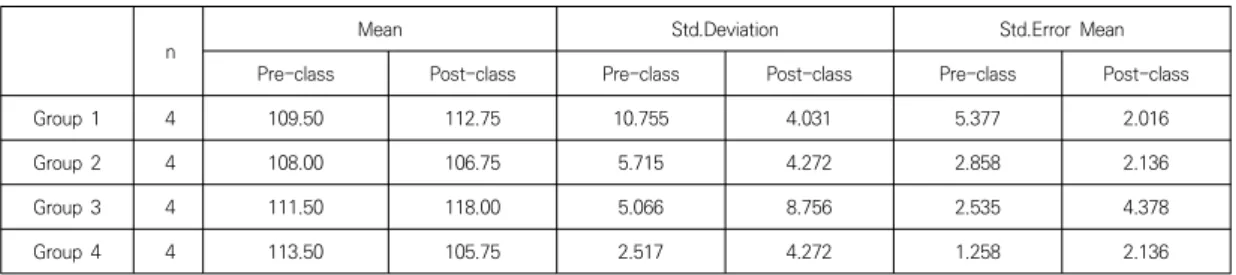
n Mean Std.Deviation Std.Error Mean

Pre-class Post-class Pre-class Post-class Pre-class Post-class

Group 1 4 109.50 112.75 10.755 4.031 5.377 2.016

Group 2 4 108.00 106.75 5.715 4.272 2.858 2.136

Group 3 4 111.50 118.00 5.066 8.756 2.535 4.378

Group 4 4 113.50 105.75 2.517 4.272 1.258 2.136

Table 5. The data of curriculum satisfaction

class include discussion, tutorial work, and Q &

A.

We can see the classification of the dimensions of knowledge from the picture above.

The group 1 of the experimental group is the traditional teaching mode, and all the content is completed in the class. Group 2 is a completely flipped, and the teacher only completes the discussion and guidance in class. Group 3 explained procedural and metacognitive knowledge and discussed guidance, self-study of factual and conceptual knowledge. Group 4 explained factual and conceptual knowledge and discussed in class. Self-study of procedural and metacognitive knowledge.

4.1 Data of Performance Evaluation

We arranged the same assignments for all groups. Three professional teachers who did not attend classes scored each student respectively, and get the average score and standard deviation of all students in four classes through SPSS software. The data of Cronbach's Alpha is α = 0.618 <0.7, with high reliability. The mean of group 1 was 74.33, and the standard deviation was 1.19. The mean of group 2 was 75.79, and the standard deviation was 1.63. The mean of group 3 was 76.01, and the standard deviation was 1.09. The mean of group 4 was 75.48, standard deviation was 1.64. We can find that the mean of group 2, group 3, and group 4 are higher than group 1. Group 3 has the highest mean and the smallest standard deviation, indicating that the overall student performance is

higher. The average standard deviation of group 2 and group 4 is relatively large, indicating the gap between students' grades is large.

Teacher A Teacher B Teacher C Final Score SD

Group 1 72.98 75.2 74.81 74.33 1.19

Group 2 74 77.18 76.21 75.79 1.63

Group 3 75 75.57 77.11 76.01 1.09

Group 4 74.06 75.26 77.11 75.48 1.54

Table 4. The data of performance evaluation

4.2 Data of Curriculum Satisfaction

The questionnaire of Cronbach's Alpha is α = 0.998, which is very credible. The mean of group 1 (Pre-109.50, Post-112.75) shows that traditional teaching methods can improve satisfaction. The mean of group 3 (Pre-111.50, post-118.00) has the largest increase in satisfaction, but the standard deviation (pre-5.066, Post-8.756) has improved, indicating that some students 'satisfaction with the teaching has also declined.

The mean of group 2 (Pre-108.00, Post-106.75) and group 4 (Pre-113.50, Post-105.75) decreased.

Group 2 is flipped classroom with the whole course content, and the group 4 is flipped classroom with procedural and metacognitive knowledge, explaining factual and conceptual knowledge and discussing in class,both of two reduced satisfaction.

4.3 Data of Self-Efficacy

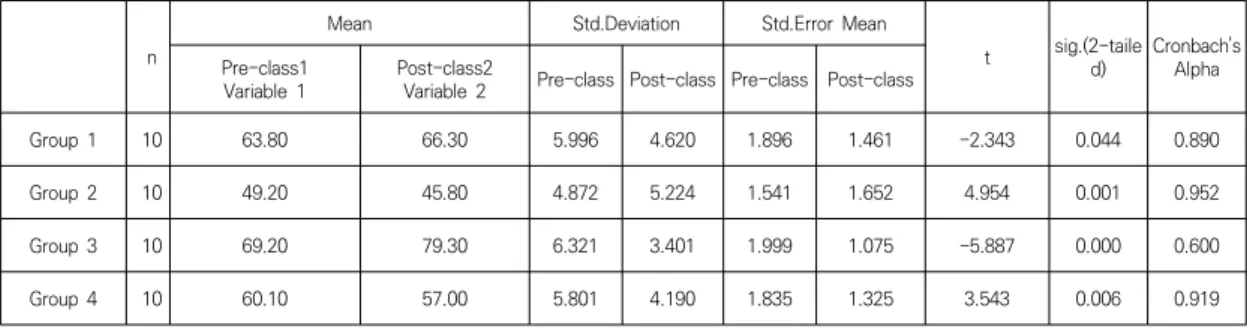
The data of Cronbach's Alpha are: α = 0.890,

α = 0.952, α = 0.600, α = 0.919, and the reliability

(9)

n

Mean Std.Deviation Std.Error Mean

t sig.(2-taile

d) Cronbach's Alpha Pre-class1

Variable 1 Post-class2

Variable 2 Pre-class Post-class Pre-class Post-class

Group 1 10 63.80 66.30 5.996 4.620 1.896 1.461 -2.343 0.044 0.890

Group 2 10 49.20 45.80 4.872 5.224 1.541 1.652 4.954 0.001 0.952

Group 3 10 69.20 79.30 6.321 3.401 1.999 1.075 -5.887 0.000 0.600

Group 4 10 60.10 57.00 5.801 4.190 1.835 1.325 3.543 0.006 0.919

Table 6. The data of Self-efficacy

is relatively high. In order to test the impact of different dimensions of knowledge on the self-efficacy. The dependent sample t-test was performed on the data. The pre-class data was set to variable 1, and the post-class data was set to variable 2. From the t-value of group 1 to group 4 (-2.343, 4.954, -5.887, 3.543) are different. The group 3 is the highest. The two-tailed(non-directional) hypothesis of the four groups (0.044, 0.001, 0.000, 0.006) are all less than 0.01. It is proving that the correlation between the self-efficacy of the four groups before and after class is significant. It means filled classroom can obviously make students feel the change of their ability.

The mean of self-efficacy in group 1(Pre-63.80, post-66.30) has changed, indicating that traditional teaching allow students to feel a slight improvement in ability. The mean of group 2 (Pre-49.20, post-45.80) and group 4 (Pre-60.10, post-57.00) were decreased. The data shows that the two type of flipped classroom cannot make students feel their ability to improve. The mean of group 3 (Pre-69.20, post-79.30) changed greatly, and the standard deviation (Pre-6.321, post-3.401) decreased. That explain this dimension of knowledge for flipped classroom can enable students to feel their ability has been greatly improved.

By analyzing the experimental data, the students completed the assignment after flipped classroom, and got a higher score. This proves that the flipped classroom is more helpful for

improving student performance evaluation.

Through data observation, although the teaching mode of traditional classroom can slightly improve curriculum satisfaction and self-efficacy, but the performance evaluation is not high. This phenomenon can be understood as students adapting to traditional teaching methods.

However, the innovation of course with assignment and drawing technique practice, the teaching mode of flipped classroom is superior to the traditional teaching.

In the experimental group 2 and group 4, curriculum satisfaction and self-efficacy showed negative growth. It proves that not all the content of the dimension of knowledge is suitable for flipped classroom. Through the analysis of experimental data, the students of group 3 are more adapted to the factual and conceptual knowledge of self-learning after class, and the flipped classroom with procedural and metacognitive knowledge by teaching in classes.

This shows that the face-to-face teaching and discussion of teachers in the classroom for procedural and metacognitive knowledge. It can enable students to understand the knowledge more clearly and deepen the impression, and express better in the design practice. Factual and conceptual knowledge have more resources on the Internet, and students can learn by themselves, which stimulates learning initiative and improves learning efficiency.

However, some problems were also discovered

during the research process. For example, the

(10)

The content of the basic design

course The Knowledge dimension

Basic concepts, constituent elements, expression forms,

content classification

Factual Knowledge Conceptual Knowledge Design rules and principles,

paintingtechniques, creative ideas Procedural Knowledge Metacognitive Knowledge Table 7. The Classification of Knowledge Dimensions of

Basic Design Courses

quality of factual and conceptual knowledge is not uniform, and students will be affected during the self-study process. The teaching process in classes and teaching method of flipped classroom are simple, it has a bad influence on the teaching effect of flipped classroom.

5. Suggestions

The author interviewed the students after the experiment. By analyzing the experimental data and student feedback, the author attempt to propose the suggestions for the flipped classroom of graphic basic design courses.

First, in the process of flipped classroom of graphic basic design course, we can use The Bloom's taxonomy to guide the teaching of flipped classroom, and refine the teaching tasks in steps. Divide the content that the students need to learn into four levels according to the dimension of knowledge, and then carry out flipped classroom. Factual knowledge should include what is the graphic basic design and the expression of the graphic basic design.

Conceptual knowledge should include understanding the types and uses of graphic basic design, as well as understanding the development and basic theories of graphic basic design. Procedural knowledge should include how and where to use graphic basic design, to master techniques of knowledge about graphic basic design, and be able to use and repeat these knowledge as need. Metacognitive knowledge

should include knowledge of students' own cognitive abilities and experience and strategies for learning and designing. We can refer to the figure below to classify the knowledge dimensions of basic design courses.

Second, the teacher need to explain flipped classroom before teaching, guide the students to understand the process of flipped classroom, and provide students with enlightening and authoritative courses for self-study in graphic basic design course. When teaching procedural and metacognitive knowledge in classes, the teacher adopt interactive teaching to reduce the time of theoretical lectures. For example, the teacher can organize small debate. Take the teaching focus or difficulty of the course as a topic, give each group a certain amount of time to prepare and discuss, and then debate.

Teachers need to adopt a variety of interesting teaching methods in flipped classroom to attract students' attention.

Third, teachers should play the role of facilitator in flipped classroom and help students take awareness of problems. Through the method of design thinking, stimulate students' imagination and creativity in graphic basic design, and improve the efficiency of teaching in classes. Regularly communicate with students about the situation after class, and adjust flipped classroom in time.

Fourth, we need to evaluate teaching

achievements from multiple level, to improve the

performance evaluation model of graphic basic

design course. It can attach the process of

improvement about students' own abilities. For

example, we can use various forms of homework

during and after the course, make various of

extracurricular practical activities, and use the

quantitative and qualitative to complete the

performance evaluation.

(11)

6. Conclusion 6.1 Conclusion

Design education is continually exploring the educational model of a flipped classroom. This article is to research the effectiveness in different dimensions of knowledge for flipped classroom in the graphic basic design course of design education, and propose teaching methods and opinions for the graphic basic design course to improve teaching efficiency. The content of graphic basic design course combines two parts, one of design theory research and drawing technique practice. By using the four dimensions of knowledge of the Bloom's taxonomy, the research has verified that flipped classroom of the factual and conceptual dimensions of knowledge is the most effective for improving student performance evaluation, curriculum satisfaction and self-efficacy. This flipped classroom can improve students' learning enthusiasm and initiative, thereby improving students Learning effect. It can be found from the research that the curriculum satisfaction and self-efficacy of group 2 and group 4 have decreased. The learning method and difficulty of the course content of different knowledge dimensions are different. Students can have a better understanding of Factual Knowledge and Conceptual Knowledge. However, Procedural Knowledge and Metacognitive Knowledge requires training in painting techniques, which is highly practical. The teacher's classroom teaching and painting demonstration will be more important. Therefore, if you use the flipped classroom teaching method in the graphic basis design course, you can choose what knowledge dimension of content, which according to the Bloom's taxonomy. Based on the research results and students 'feedback, the article propose plans and suggestions for graphic basic design course for flipped classroom, and help teachers formulate strategies for flipped classroom that

are more suitable for students' learning needs. It provides a new perspective for the reform and evaluation the flipped classroom of design education, and improves the application efficiency of the flipped classroom in the design of higher education.

6.2 Limitations

First, this research uses the Bloom's taxonomy to classify course content. But there are many educational theories and methods. We can also try a variety of classification methods in course content for further research.

Secondly, this research is to expand the graphic basic design course of design education.

It has limitations for compared with the flipped classroom of other types of courses in design education. For different courses in design education, related research is also needed to verify in subsequent research.

REFERENCES

[1] Michael A. Christiansen. (2014). Inverted teaching:

Applying a new pedagogy to a university organic chemistry class. Journal of Chemical Education, 1845-1850.

DOI : 10.1021/ed400530z

[2] S. J. Chung. (2017) The Effect of Flipped Classroom on Learning Outcome and Students' Learning Preference in a Large General Education Class. Korean Journal of General Education, 12, 359-390.

[3] Jacob Enfield. (2013). Looking at the Impact of the Flipped Classroom Model of Instruction on Undergraduate Multimedia Students at CSUN. Tech Trends, 11(1), p.14-27

DOI : 10.1007/s11528-013-0698-1

[4] Y. H. Wang. (2003). 「The effects of group discussion on EFL reading comprehension instruction. Master dissertation.

[5] L. Ruilin & J. C. Xie. (2010). Visual Point-Line-Plane Design of Chinese Idioms. International Journal of Technology and Engineering Education, 2010, . 8.

[6] N. Adhuwaykh. (2016). Educational teaching method

for schools: The Concept of Flipped Classroom,

http://aljubailtoday.com.sa/2013/10/10/31871.html

[7] Q. Wang. (2014). The essence and application of

(12)

"mooc", "micro-course" and "flipped classroom.

Shanghai education and scientific research, 15-18.

[8] McKay. (1956). B. S. Bloom, Taxonomy of educational objectives, Vol. 1: Cognitive domain.

[9] R. Lister. (2001). Objectives and objective assessment in cs. Technical Symposium on Computer Science Education, 3(1), 292-296.

DOI : 10.1145/364447.364605

[10] T. Scott. (2003). Bloom's taxonomy applied to testing in computer science classes, Compute. Sci. Coll, 19(1), p.267-274

[11] Anderson & Krathwohl. (2001). A taxonomy for learning, teaching, and assessing, New York: Longman.

DOI : 10.1093/ehr/114.458.1013,

[12] H. B. Long. (1989). Contradictory Expectations Achievementand Satisfactionin Adult Learning. Journal of Continuing Higher Education, 3, 10-12.

DOI : 10.1080/07377366.1985.10401035

[13] Jeanne, Ellis & Ormrod, (2011). Human Learning (6th edition).

[14] L. hongxia, Z. wei & l. shiping. (2015). A study on the intervention of college students' learning self-efficacy in a seamless learning environment. Modern distance education, 2015, 59-65

[15] R. Schwarzer & Jerusalem. (1995). Replicates the General Self‐Efficacy Scale.

진 쳉(Qin Cheng) [정회원]

․ 2005년 6월 : 시안공학대학 디자인 전 공(학사)

․ 2012년 6월 : 강남대학교 디자인 공학 전공(석사)

․ 2019년 3월 ~ 현재 : 국민대학교 테크 너디자인전문대학원(박사)

․ 관심분야 : 디자인 교육,UX, UCD, 인터랙션디자인,

․ E-Mail : [email protected]

반 영 환(Younghwan Pan) [정회원]

․ 1991년 2월 : 한국과학기술원 산업공 학과(공학사)

․ 1993년 2월 : 한국과학기술원 인간공 학(공학석사)

․ 1999년 8월 : 한국과학기술원 인간공 학(공학박사)

․ 2006년 9월 ~ 현재 : 국민대학교 테 크노디자인전문대학원 교수

․ 관심분야 : 인터랙션 디자인, 사용자경험(UX)

․ E-Mail : [email protected]

수치

Graphic  Basic  Design  Course Teaching
Table  3.  The  classification  of  Graphic  Basic  Design  Course  contentsFlipped classroom is a return to the essence of
Fig.  1.  The  experimental  process  model  of  flipped  classroom knowledge,  gradually  increase  the  depth  of understanding of design knowledge, and improve the  effectiveness  of  learning
Fig.  2.  The  flipped  classroom  mode  of  graphic  basis  design  coursesignificance  to  discuss  the  improvement  of
+3

참조

관련 문서