ISSN 2288-1069 (Online)
http://dx.doi.org/10.12925/jkocs.2014.31.3.534
가공조건에 따른 황기, 오미자, 맥문동 및 길경을 첨가한 한방차의 품질 특성
오성천✝
✝대원대학교 제약식품계열
(2014년 9월 15일 접수; 2014년 9월 22일 수정; 2014년 9월 25일 채택)
The Quality Properties in Herbal Tea Containing Astragalus membranaceus , Schizandra chinensis , Liriope platyphylla and
Platycodon grandiflorum which are affected by the Processing Conditions
Sung-Cheon Oh✝
✝
Dept. of Food & Pharmacy, Daewon University College, Jecheon 390-702, Korea (Received September 15, 2014; Revised September 22, 2014; Accepted September 25, 2014)
요 약 : 가공조건 차이에 따른 한방차의 성분변화를 분석한 결과, 팽화공정 처리한 것은 볶음공정을 한 것보다 조회분, 수분, 조단백질, 고형분 용출율이 증가하였으며 조지방은 소폭 감소하였다. 벤조피렌 [B(α)P]함량은 0.35 ppb에서 0.18 ppb로 크게 감소하였다. 전체적으로 심한 열처리 과정이 없는데도 불구하고 B(α)P 이 검출된 이유는 식품 중 B(α)P 는 주로 음식을 조리, 가공할 때 식품의 주성분인 탄수화물, 단백질, 지방 등이 열분해 되어 생성되기 때문이다. 한방차에서 맛, 향, 색상 모두 큰 차이를 보이지 않으나 다소 텁텁한 느낌이 강하고, 시큼한 맛이 강하여 선호도를 떨어뜨리는 것으로 나타났다.
주제어 : 볶음공정, 팽화공정, 벤조피렌, 한방차
Abstract : The analysis of the change in the herbal tea composition according to the difference in processing conditions result. Was slightly reduced crude is treated ash puffing process was relatively increased, moisture, crude protein, the solid elution rate than the roasting process.
Benzopyrene content was significantly reduced to 0.18 ppb from 0.35 ppb. Generation of food B (α)P is mainly include the thermal decomposition of food cooking, when the processing which is a main component of food carbohydrate, protein, fat reason despite severe heat treatment as a whole is to be detected even though the B(α)P in this way is considered to be. Generally the taste, aroma and color did not show a big difference but tasted quite stuffy and the strong sour taste reduced its preference.
Keywords : roasting, puffing, benzo[α]pyrene, herbal teas
✝
Corresponding author (E-mail: [email protected])
1. 서 론
벤조피렌을 포함한 다환방향족탄화수소
(Polycyclic Aromatic Hydrocarbons, PAHs)화합 물은 300-600℃에서 화석연료나 식물 등의 유기 물이 불완전연소될 때 생성되며 자동차배출가스, 담배연기 등이 주배출원이다. 환경오염으로 인해 조리, 가공하지 않은 농산물 및 수산물에 등의 식품에도 존재하고[1-3], 내분비계 장애물질로
알려진 PAHs 화합물인 벤조피렌
(Benzo[a]pyrene, B[α]P)이 체내에 유입되면 산 화되어 독성을 나타낸다[4]. 장기 노출 시 폐암 [5], 위암, 피부암, 대장암, 유방암[6] 등을 유발 할 수 있다.
한방차의 재료로 사용된 황기(
Astragalus membranaceus
)는 항염작용[7], 혈관형성 촉진작 용[8]이 우수하다는 보고가 있으며 황기를 첨가 한 청국장[9]과 된장[10]은 항산화력과 혈전용해 능이 우수한 것으로 보고되었다.오미자(
Schizandra chinensis
)는 강장, 진해, 간 장보호, 알콜 해독, 항 당뇨 작용을 하며[11-13], 독특한 색, 맛과 향을 이용하여 차로 쓰이고 있 다.맥문동(
Liriope platyphylla
)은 혈당강하작용, 항염작용이 보고된 바 있으며[14-15], 예 로부터 다기능의 음료로 사용되고 있으나 맥문동 열수 추출물은 신맛과 떫은맛이 있어서 음료 제조 시 기호성을 향상 시켜야 한다[16].길경(
Platycodon grandiflorum
)은 거담, 진해, 배농, 기침, 천식, 편도선염 등 호흡기계 질환에 효과가 있으며, 항염, 혈압강하, 중추신경 억제 및 항암 작용 등이 보고되어있다[17-21].직화 처리로 제조하는 한방차는 부분적으로 고 온에 노출되고 발생하는 연기로 인한 benzo (α)pyrene[B(α)P]의 발생으로 유해성 문제가 대 두되고 있다.
본 연구는 국내산 황기, 오미자, 맥문동 및 길 경을 첨가한 한방차를 개발하고 팽화공정과 볶음 공정을 최적화하여 B(α)P이 감소된 안전한 한방 차를 제조하는데 필요한 조건을 연구하였다.
2. 실험재료 및 방법
2.1. 실험 재료한약재는 충청북도 제천에서 2013년 수확한
건조, 포장 제품을 구매한 후 냉동보관하여 사용 하였다. 분석에 사용한 시약은 전량 특급 이다.
B(α)P 표준품은 benzo(α)pyrene standard (Wako Pure Chemical Ind.,Ltd.)를 구입하여 냉 장 보관하여 사용 하였다.
2.2. 한방차 및 B(α)P함량 측정용 시료의 조제 한방차의 재료는 황기(
Astragalus membranaceus
), 오미자(Schizandra chinensis
), 맥문동(Liriope platyphylla
) 및 길경(Platycodon grandiflorum
)을 가공 전 입자를 세절 및 선별하 고 각각 25%씩 혼합 제조하였다.가공 처리 온도를 140℃로 하여 팽화공정과 볶 음공정으로 나누어 제조한 한방차를 실험에 사용 하였다.
B(α)P 함량을 측정하기 위하여 분쇄한 한방차 시료 각 50 g에 ethyl ether 500 ml를 가하고 12 시간 동안 일체의 열처리 없이 기름 성분을 추출 하여 전처리 하였다. 추출물은 진공 감압 농축하 여 생성된 기름성분을 시료로 사용하였다.
2.3. 일반성분의 분석
일반성분은 A.O.A.C.법[22]에 의해 측정하였 다. 즉 수분함량은 상압가열 건조법, 조단백질의 정량은 semimicro-Kjeldahl법, 조지방의 정량은 Soxhlet추출법, 회분의 정량은 직접회화법으로 측 정하였다. 탄수화물은 100에서 수분, 조회분, 조 단백질, 조지방, 조섬유의 함량을 차감한 것으로 나타내었다.
2.4. 분석시료의 추출 및 정제
시료유 10g을 정량하고 n-hexane 100 ml에
녹여 분액깔때기에 옮기고 N,N-
dimethylformamide-water(9:1,
v/v
) 50 ml를 넣 어 격하게 흔들어 섞은 후 정치하여 N,N- dimethylformamide-water층을 다른 분액깔때기 에 옮겼다. n-Hexane 층에 N,N- dimethylformamide-water 25 ml씩 넣고 위와 같이 2회 반복하여 N,N-dimethylformamide- water 층을 위의 분액깔때기에 합하였다.이 층을 1% sodium sulfate용액 100 ml로 희 석한 후 n-hexane 50 ml를 넣고 격하게 흔들어 섞은 후 정치하여 n-hexane층을 분액깔때기에 옮겼다.
N,N-dimethylformamide-water층에 -hexane 35 ml씩을 넣고 위와 같이 2회 반복하여
n-hexane 층을 위의 분액깔때기에 합하였다. 여 기에 물을 40 ml씩 넣고 격하게 흔들어 섞은 후 정치하여 물 층을 버리는 조작을 2회 반복하였 다. n-Hexane 층을 무수황산나트륨을 넣은 1PS 여과지로 여과하였다. 다시 n-hexane 20 ml로 분액깔때기를 씻고 이 액으로 여과지의 잔류물을 씻는 조작을 2회 반복하여 여과하였다. 여액을 합쳐 40℃이하의 수욕 상에서 감압하여 약 2 ml 로 농축하였다.
활성화시킨 Sep-Pak Florisil cartridge에 시험 용액을 1 ml/min의 속도로 가하고 n-hexane 10 ml와 n-hexane/dichloromethane(3:1,
v/v
) 8 ml 로 용출시켜 전량을 40℃ 이하의 수욕 상에서 질 소가스 하에 거의 날려 보낸 후 잔사를 acetonitrile에 녹여 전량을 10 ml로 하여 이를 0.45 ㎛의 membrane filter로 여과한 것을 시험 용액으로 하였다.2.5. 고형분용출율
차 마시는 방법과 동일하게 각각의 차를 뜨거 운 물에 담가 고유성분을 용출시킨 후 이를 시료 로 하여 위의 수분함량 정량법을 이용하여 수분 함량을 측정하고 전체 100에서 얻어진 수분함량 을 빼 이를 고형분용출량으로 환산하였다.
2.6. Benzo(α)pyrene 함량의 정량
시료용액 50 ㎕를 형광검출기가 내장된 HPLC (Agilent Technologies, 1200Series, Germany)에 주입하고, acetonitrile-water(80:20,
v/v
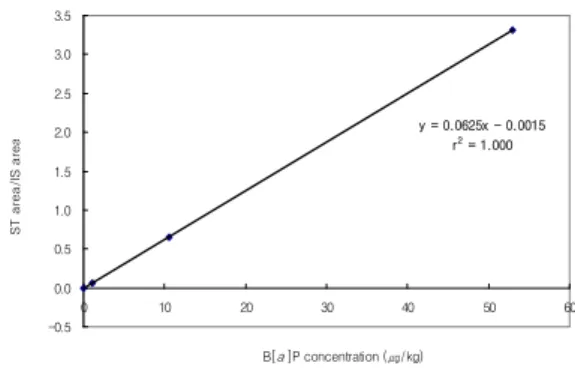
)혼합용매 를 이동상으로 하여 1.0 ml/min의 속도로 검출 기 파장 294 ㎚, 형광 파장 404 ㎚에서 분석하였 다. 이 때, B(a
)P의 양을 산출하기 위한 표준곡선 은 Fig. 1에 나타낸 바와 같이 작성하였으며, 계 산은 아래의 식으로 하였다.Benzo(α)pyrene(㎍/㎏) =
표준 용액의 농도(ng/ml)×PA/PS×1/S PS : 표준용액의 봉우리면적
PA : 시험용액의 봉우리면적 S : 시료채취량(g)
y = 0.0625x - 0.0015 r2 = 1.000
-0.5 0.0 0.5 1.0 1.5 2.0 2.5 3.0 3.5
0 10 20 30 40 50 60
B[a]P concentration (㎍/kg)
ST area/IS area
Fig. 1. Standard curve of benzo(α)pyrene by HPLC.
2.7. 관능검사
관능검사에 경험이 있는 패널을 구성하여 가공 조건에 따른 맛, 향, 색상 및 종합적기호도를 고 려하여 5점 척도법으로 실시하였다.
2.8. 통계처리
본 연구에서 얻어진 데이터는 SPSS package for Windows(Version 10.0)로 처리하여 분석하 였다. 상호간에 일부의 편차가 발생하여 모두 3 회 반복 실험을 행한 후 그 범위를 평균±표준편 차로써 나타냈다.
3. 결과 및 고찰
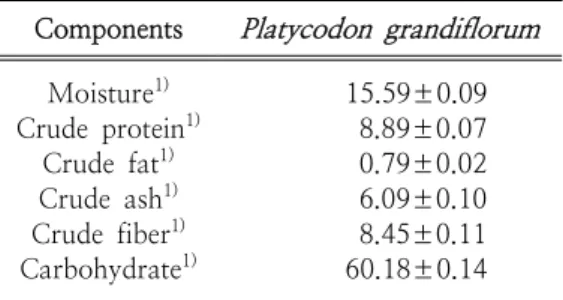
3.1. 한방차 원재료의 일반 성분본 연구에 사용된 한방차의 원재료인 황기, 오미자, 맥문동, 길경의 일반성분의 분석결과는 Table 1, 2, 3, 4와 같다.
Components
Astragalus membranaceus
Moisture1)Crude protein1) Crude fat1) Crude ash1) Crude fiber1) Carbohydrate1)
10.9±0.11 6.85±0.07 0.64±0.04 5.01±0.05 6.35±0.10 70.46±0.10 Table 1. Proximate composition of
Astragalus membranaceus
(%)
Values are mean±SD. Values are mean of triplicates
1)Percentages of wet weight basis.
Table 2. Proximate composition of
Schizandra chinensis
(%)Components
Schizandra chinensis
Moisture1)Crude protein1) Crude fat1) Crude ash1) Crude fiber1) Carbohydrate1)
14.23±0.21 8.38±0.05
1.04±0.04 5.84±0.11 6.34±0.07
64.17±0.26 Values are mean±SD. Values are mean of triplicates
1)Percentages of wet weight basis.
Table 3. Proximate composition of
Liriope platyphylla
(%)Components
Liriope platyphylla
Moisture1)Crude protein1) Crude fat1) Crude ash1) Crude fiber1) Carbohydrate1)
15.01±0.05 2.49±0.04 0.72±0.02 4.61±0.04 4.88±0.08 72.29±0.12 Values are mean±SD. Values are mean of triplicates
1)Percentages of wet weight basis.
Table 4. Proximate composition of
Platycodon grandiflorum
(%)Components
Platycodon grandiflorum
Moisture1)Crude protein1) Crude fat1) Crude ash1) Crude fiber1) Carbohydrate1)
15.59±0.09 8.89±0.07 0.79±0.02 6.09±0.10 8.45±0.11
60.18±0.14 Values are mean±SD. Values are mean of triplicates
1)Percentages of wet weight basis.
3.2. 가공조건 차이에 따른 한방차의 조회분 함량 변화
가공조건 차이에 따른 한방차의 조회분 함량 변화는 Table 5와 같이 볶음처리 한 것은 8.41±1.01(%), 팽화처리 한 것은 8.98±0.01(%) 로 볶음처리 한 것보다 팽화 처리한 것이 소폭 증가하였다.
Table 5. The changes of crude ash content in herbal tea affected by processing condition(%)
Processing
temperature 140(℃) Crude ash(%)1) Roasting condition 8.41±1.01
Puffing condition 8.98±0.01 Values are mean±SD. Values are mean of triplicates.
1)Percentages of wet weight basis.
3.3. 가공조건 차이에 따른 한방차의 수분 함량 변화
가공조건 차이에 따른 한방차의 수분 함량 변 화는 Table 6과 같이 볶음처리 한 것은 3.18±0.64(%), 팽화처리 한 것은 5.96±0.03(%) 로 볶음처리 한 것보다 팽화 처리한 것이 크게 증가하였다.
Table 6. The changes of moisture content in herbal tea affected by processing condition(%)
Processing
temperature 140(℃) Moisture(%)1) Roasting condition 3.18±0.64
Puffing condition 5.96±0.03 Values are mean±SD. Values are mean of triplicates.
1)Percentages of wet weight basis.
3.4. 가공조건 차이에 따른 한방차의 조단백질 함량 변화
가공조건 차이에 따른 한방차의 조단백질 함량 변화는 Table 7과 같이 볶음처리 한 것은
11.52±0.94(%), 팽화처리 한 것은 12.13±0.03(%)로 팽화 처리한 것이 볶음처리 한 것보다 소폭 증가하였다.
Table 7. The changes of crude protein content in herbal tea affected by processing condition(%)
Processing
temperature 140(℃) Crude protein(%)1) Roasting condition 11.52±0.94
Puffing condition 12.13±0.03 Values are mean±SD. Values are mean of triplicates
1)Percentages of wet weight basis.
3.5. 가공조건 차이에 따른 한방차의 조지방 함량 변화
가공조건 차이에 따른 한방차의 조지방 함량 변화는 Table 8과 같이 볶음처리 한 것은 3.18±0.71(%), 팽화처리 한 것은 2.64±0.02(%) 로 팽화 처리한 것이 볶음처리 한 것보다 소폭 감소하였다.
Table 8. The changes of crude fat content in herbal tea affected by processing condition(%)
Processing
temperature 140(℃) Crude fat(%)1) Roasting condition 3.18±0.71
Puffing condition 2.64±0.02 Values are mean±SD. Values are mean of triplicates
1)Percentages of wet weight basis.
3.6. 가공조건 차이에 따른 한방차의 고형분 용출율 변화
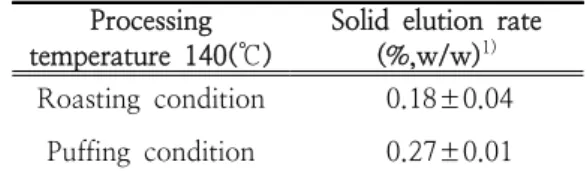
가공조건 차이에 따른 한방차의 고형분 용출율 변화는 Table 9와 같이 볶음처리 한 것은 0.18±0.04(%), 팽화처리 한 것은 0.27±0.01(%) 로 팽화 처리한 것이 볶음처리 한 것보다 크게 증가하였다. 고형분의 용출은 화학적 변화보다 물 리적 변화에 의해 식품의 원재료 성분인 탄수화
물, 단백질, 지방 등의 천연 상태에서 상호가교 결합이 물리적인 힘으로 파괴되어 성분의 용출이 용이해지기 때문으로 생각된다[23].
Table 9. The changes of solid elution rate in herbal tea affected by processing condition(%)
Processing
temperature 140(℃) Solid elution rate (%,w/w)1) Roasting condition 0.18±0.04
Puffing condition 0.27±0.01 Values are mean±SD. Values are mean of triplicates.
1)Percentages of wet weight basis.
3.7. 가공조건 차이에 따른 한방차의 벤조피렌 함량 변화
가공조건 차이에 따른 한방차의 벤조피렌 함량 변화는 Table 10과 같이 볶음처리 한 것은 0.35±0.03(%), 팽화처리 한 것은 0.18±0.01(%) 로 팽화 처리한 것이 볶음처리 한 것보다 크게 감소하였다.
전체적으로 심한 열처리 과정이 없는데도 불구 하고 이와 같이 B(α)P 이 검출되는 이유는 기존 의 연구결과에서 원인을 쉽게 찾을 수 있다. 즉, 식품 중 B(α)P 는 주로 음식을 조리, 가공할 때 식품의 주성분인 탄수화물, 단백질, 지방 등이 열 분해 되어 생성되는 것으로 알려져 있다[24]. 또 한 식품에는 고온 조리에 의한 탄수화물, 단백질 및 지방의 탄화에 의해 생성되며, 농산물 등 조 리, 가공하지 않는 식품에도 존재한다.
Table 10. The changes of Benzo(α)pyrene content in herbal tea affected by processing condition(%)
Processing
temperature 140(℃) Benzo(α)pyrene(㎍/㎏) Roasting condition 0.35±0.03
Puffing condition 0.18±0.01 Values are mean±SD. Values are mean of triplicates
3.8. 가공 조건 차이에 따른 한방차의 관능적 특성
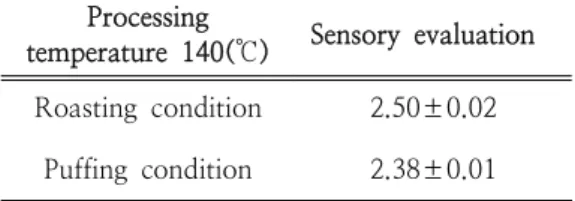
본 연구에서 사용된 한방차의 관능적 특성은 Table 11과 같이 볶음처리 한 것은 2.50±0.02(%), 팽화처리 한 것은 2.38±0.01(%) 로 모두 맛, 향, 색상에서 큰 차이를 보이지 않았 다. 즉 텁텁한 맛은 팽화 처리 시료에서는 전혀 나타나지 않았으나 볶음공정 처리 구에서는 다소 강하였고, 시큼한 맛이 강하여 선호도를 떨어뜨리 는 것으로 나타났다. 이러한 차이는 볶음처리의 경우 직화 가열로 인한 일부 성분의 열 변화 및 탄화가 진행되어 나타나는 현상으로, 가공 방법 차이가 종합적 기호도에 직접적인 영향을 미치지 않는 것으로 판단된다.
Table 11. The changes of sensory evaluation in herbal tea affected by processing condition
Processing
temperature 140(℃) Sensory evaluation Roasting condition 2.50±0.02
Puffing condition 2.38±0.01 Values are mean±SD. Values are mean of triplicates
4. 결 론
가공조건 차이에 따른 한방차의 성분변화를 분 석한 결과는 다음과 같다. 팽화 처리한 것이 볶 음처리 한 것보다 조회분, 수분, 조단백질, 고형 분 용출율이 증가하였으며 조지방은 소폭 감소하 였다.
벤조피렌 함량은 0.35 ppb에서 0.18 ppb로 크 게 감소하였다. 전체적으로 심한 열처리 과정이 없는데도 불구하고 B(α)P 이 검출되는 이유는 식품 중 B(α)P 는 주로 음식을 조리, 가공할 때 식품의 주성분인 탄수화물, 단백질, 지방 등이 열 분해 되어 생성되기 때문으로 보인다. 또한 식품 에서는 고온 조리에 의한 탄수화물, 단백질 및 지방의 탄화에 의해 생성되며, 농산물 등 조리, 가공하지 않는 식품에도 존재한다.
한방차에서는 모두 맛, 향, 색상에서는 큰 차이 를 보이지 않았으나 다소 텁텁한 느낌이 강하였
고, 시큼한 맛이 강하여 선호도를 떨어뜨리는 것 으로 나타났다.
References
1. MCR. Camargo and MCF. Toledo, Polycyclic aromatic hydrocarbons in Brazilian vegetables and fruits.
Food Control
14:49-53 (2003).2. S. Hu, NS. Oh, SY Kim and H. Lee.
Determining of polycyclic aromatic hydrocarbons in domestic vegetables and fruits.
Anal Sci Technol
. 19:415-421 (2006).3. S. Tao, YH. Cui, FL. Xu, BG. Li, J. Cao, WX. Liu, G. Schmitt, XJ Wang, WR.
Shen, BP. Qing and R. Sun. Polycyclic aromatic hydrocarbons in agricultural soil and vegetables from Tianjin.
Sci Total Environ
. 320:11-24 (2004).4. HV. Gelboin. Benzo[a]pyrene metabolism, activation and carcinogenesis : role and regulation of mixed-function oxidase and related enzymes.
Physiol Rev
. 60:1107-1166 (1980).
5. SS. Hecht, Tabacco smoke carcinogens and lung cancer.
J. Natl Cancer Inst.
91, 1194-1210 (1999).6. B. Sadikovic, DI. Rodenhier, Benzopyrene exposure disrupts DNA methylation and growth dynamics in breast cancer cells.
Toxicol Appl Pharmcol
. 216, 458-468 (2006).7. M. S. Ryu, E. H. Kim, M. S. Chun, S. H.
Kang, B. S. Shim, Y. B. Jeong and J. S.
Lee.
Astragali Radix
elicits anti- inflammation via activation of MKP-1, concomitant with attenuation of p38 and Erk.J
.Ethnopharmacol
. 115, 184-193 (2008).8. D. M. Seo, D. Y. Choi and J. D. Lee, Effects of
Astragalus membranaceus
on angiogenesis.J
.Kor
.Acupuncture
&Moxibustion Sci
. 24, 113-123 (2007).9. H. S. Choi, S. J. Joo, H. S. Yoon, K. S.
Kim, I. G. Song and K. B. Min, Quality characteristic of Hwangki(
Astragalus membranaceus
) Chungkukjang during fermentation.Kor
.J
.Food preserve
, 7, 297-302 (2007).10. S. H. Min, Quality characteristics of Doenjang containing
Astragalus membranaceus
water extracts.Kor
.J
.Food Cookery Sci
. 22, 514-520 (2006).11. H. Hikino, Y. Kios, H. Takuchi and Y.
Ikeya, Validity of the oriental medicines 60.
Liver-protective drugs. II. Antihepatotoxic action of lignoids from
S
.chinensis
fruits.Planta Med
. 50, 213-216 (1984).12. J. S. Lee and S. W. Lee, Effects of water extract in fruits of Omija on alcohol metabolism.
Korean J
.Dietary Culture
. 5, 259-262 (1990).13. H. J. Sheo, M. Y. Lee and J. S. Hwang, Effects of Schizandrae fructs extract on blood constituents of alloxan induced diabetic rabbits.
J
.Korean Soc
.Food Sci
.Nutr
. 16, 262-268 (1987).14. I. J. Rhee, Effect of
Liriopis
tuber extract on the decrease of blood glucose. Hyosung Bull.Pham
.Sci
. 2, 49-56 (1997).15. M. Shibata, R. Noguchi, M. Suzuki, H.
Iwase, K. Soeda, K. Niwayama, E. Kataoke and M. Hamano, Pharmacological studies on medicinal plant components. On the extracts of ophiopogen and some folk medicine.
Proc
.Hoshi Pharm
. 13, 66-76 (1971).16. S. D. Kim, Y. S. Ku, I. Z. Lee and K. S.
Youn, General components and sensory evaluation of hot water extract from
Liriopis
tuber.J
.Korean Soc
.Food Sci.
Nutr
. 30, 20-24 (2001).17. J. H. Choi, Y. P. Hwan, H. S. Lee, H. G.
Jeong, Inhibitory effect of
Platycodi radix
on ovoalbumin-induced airway inflammation in a murine model of asthma.Food Chem
.Toxicol
. 47, 1272-1279 (2009).18. M. Kubo, T. Nagao, H. Matsuda, K.
Namba, Immune pharmacological studies on
Platycodi radix
I : Effect on the phagocytosis in the mouse. Shoyagaku Zasshi. 40, 367 (1986).19. Y. S. Kim, B. E. Lee, K. J. Kim, Y. T.
Lee, K. B. Cho, Y. C. Chung, Antitumor and immundulatory activities of the
Platycodon grandiflorum
cultivated for more than 20years. 42, 382-387 (1998).20. K. S. Kim, O. Ezaki, S. Ikemoto, H.
Itakura, Effects of
Platycodon grandiflorum
feeding on serum and liver lipid concentrations in rats with diet-induced hyperlipidemia.J
.Nut
.Sci
.Vitamino
. 41, 485-491 (1995).21. N. Y. Sung, S. J. Lee, J. H. Shin, I. S.
Lee, Y. C. Effects of
Platycodon grandiflorum
extract on blood glucose and lipid composition in alloxan induced hyperglycemic rats.J
.Korean Soc
.Food Sci. Nutr
. 25, 986-992 (1996).22. Association of Official Analytical Chemists.
Official Methods of Analysis of the Association of Official Analytical Chemists.
3rd ed. (1980).
23. S. C. Oh. The Changes of Benzo[α]pyrene in Herbal Teas Containing
Astragalus membranaceus
,Schizandra chinensis
,Liriope platyphylla
andPlatycodon grandiflorum
which are Affected by the Puffing Conditions.Kor J
.Food &
Nutrition
. 27:75-79 (2014).24. D. J. Tilgner. Food in a carcinogenic environment.
Food Manuf
. 87:47-50(1970).