• 검색 결과가 없습니다.

Assessing Red List categories to a Korean endangered species based on IUCN criteria - Hanabusaya asiatica (Nakai) Nakai-

N/A
N/A
Protected

Academic year: 2021

Share "Assessing Red List categories to a Korean endangered species based on IUCN criteria - Hanabusaya asiatica (Nakai) Nakai-"

Copied!
11
0
0

로드 중.... (전체 텍스트 보기)

전체 글

(1)

Assessing Red List categories to a Korean endangered species based on IUCN criteria - Hanabusaya asiatica (Nakai) Nakai-

Soo-Kyung Park, Hui Kim

1

and Chin-Sung Chang

Department of Forest Sciences and The Arboretum, Seoul National University, Seoul 151-921, Korea

1

Department of Medicinal Plants Resources, Mokpo National University, Muan-gun 534-729, Korea (Received 12 February 2013; Revised 18 March 2013; Accepted 15 April 2013)

멸종위기식물의 IUCN 적색목록 보전지위 평가 -금강초롱꽃에 대하여-

박수경·김 휘1·장진성*
서울대학교 농업생명과학대학 산림과학부 및 수목원,

1

목포대학교 자연과학대학 한약자원학과

ABSTRACT : The conservation status of an endemic perennial herb, Hanabusaya asiatica (Nakai) Nakai (Cam- panulaceae) was determined by applying the IUCN risk assessment criteria from our field study and available specimen data. Also, the GIS technology was used to develop a species distribution map to calculate the extent of occurrence (EOO) and area of occupancy (AOO) for the taxon. After two years of continuous field studies, 269 mature individuals were found in four localities in 2011, while 216 mature individuals were confirmed in three localities in 2012. Based on the following data, such as EOO (2,742 km

2

), AOO (76 km

2

) and estimated population size of mature individuals, the taxon, which is known as 20 localities in Korean peninsula, is eval- uated as the category of Endangered (EN). A major difficulty in application of IUCN criteria to Korean rare plants were the lack of essential biological information and understanding the correct knowledge of the IUCN criteria in previous Korean studies. Sound conclusions regarding the conservation status of individual species require more intensive population studies, observations, and applying IUCN assessment procedures correctly.

Keywords : IUCN Red List, EOO (Extent of occurrence), AOO (Area of occupancy), mature individuals, Hanabusaya asiatica

적 요

: 특산식물 금강초롱꽃의 국제단위 IUCN 적색목록의 평가를 시도하기 위해, GIS를 이용하여 분포도

를 작성하고 분포면적과 점유면적을 계산하였다. 2011년과 2012년, 2년간 현장조사를 한 결과 성숙개체는 4 개 지역에서 269개체(2011년), 3개 지역에서 216개체(2012)를 확인하였는데, 기존 알려진 20여개의 서식지를 고려한다면 전체 성숙개체는 1,000개체 이상으로 추정된다. 분포면적은 12,742 km

2

, 점유면적은 76 km

2

이고 추정되는 성숙개체 수에 근거한 평가 결과, 금강초롱꽃은 위기종(EN)으로 판정되었다. 국내 희귀식물의 보 전지위 평가에 있어 IUCN 국제평가기준을 적용시키기 어려웠던 이유는 국내의 생물학적 정보 확보 노력의 부족과, IUCN 범주 및 기준의 낮은 이해도 때문인 것으로 판단한다. 개별 종의 정확한 보전지위 평가를 위 해서는 개체군 생태학적 정보를 축적해야 하며, IUCN 평가 절차를 준수해야 한다.

주요어: IUCN 적색목록, 분포범위, 점유영역, 성숙개체, 금강초롱

*Author for correspondence: [email protected] http://www.pltaxa.or.kr

Copyright © 2013 the Korean Society of Plant Taxonomists

(2)

IUCN 적색목록은 생물종의 멸종위협 정보를 제공하는 효율적인 관리체계로 오랫동안 가치를 인정받아 왔을 뿐 만 아니라(Callmander et al., 2005), 1980년대부터 희귀 동, 식물 보전정책 입안을 위해 생물종의 보전지위를 평가하 는 데 널리 사용되었다(Mace et al., 2008). 적색목록은 단순 히 어떤 종의 보전지위에 대한 정보를 제공하는 것 뿐 아 니라 생물종과 관련된 여러 정보를 통합 관리하여 특정 종에 대한 데이터를 공유하는 장치로써(Collar, 1996), 보 전 계획 수립에 효율적으로 활용된다.

IUCN 적색목록 범주(categories)와 기준(criteria)은 6년간 의 연구 끝에 1994년 처음 발간되었고, 이후 생물종의 보 전지위 평가의 객관성과 명료화를 목표로 개정을 거듭하 여 오늘날에는 2001년에 최종 수정한 version 3.1을 적용하 고 있다(IUCN Standards and Petitions Subcommittee, 2011).

평가는 5개의 기준 즉 개체군 감소율(criterion A), 분포범 위 및 점유면적(criterion B), 개체군 크기와 감소(criterion C), 매우 작고 제한된 개체군이거나 적은 성숙개체 수 (criterion D), 정량 분석(criterion E) 중 하나 이상을 적용하 여야 하며, 평가 후 대상종은 비평가종(NE)을 제외한 9개 범주 중 하나에 지정되고(IUCN, 2001), 평가 결과는 웹 데 이터베이스(http://www.redlist.org)에 공개된다. 10개 범주 중 멸종위기종(CR), 위기종(EN), 취약종(VU)이 멸종위험 군(threatened)에 해당되며, 희귀식물로서 보전 정책에서 고려되는 대상이 된다.

과거에는 전문가의 주관적인 판단에 의해 적색목록 보 전지위 평가가 이뤄졌지만(Walter and Gillett, 1998), 지금은 데이터를 근간으로 IUCN이 제시하는 절차에 따라 객관적 으로 평가해야 하며, 반드시 데이터에 대한 정당화, 출처, 불확실성에 대한 추정 근거 등을 명시해야 한다(Rodrigues et al., 2006). IUCN 적색목록 기준에 근거한 생물종의 희귀 성 평가(Sergio et al., 1992; Randrianasolo et al., 2002; Vischi et al., 2004; Kingston and Waldren, 2005; Milner-gulland et al., 2006; Minuto et al., 2006; Thomas et al., 2009; Ali et al, 2012) 는 점차 늘어가고 있으며, 평가 이후에도 주기적으 로 재평가를 실시하고(Mauchamp et al., 1998), 개체군의 동 태예측을 통한 추후 멸종 가능성을 예측하는 수준까지 연 구가 진행되고 있으나(Mauchamp et al., 1998; Garcia et al., 2002; Bernardos et al., 2006), 국내는 적색목록 보전지위 평 가와 관련된 분야의 연구가 매우 부족하다.

국내에서는 이미 IUCN의 평가기준을 적용하여 국내 희 귀식물의 멸종위기 정도를 평가하였지만, 평가 결과는 아 직 IUCN SIS(Species Information System)에 등재되어 있지 않고 있다. 국립수목원은 2000년부터 7년간의 연구 끝에 국내 관속식물 571종의 보전지위를 평가했지만(Korea National Arboretum, 2008), 단순히 평가 결과만 나열할 뿐 평가 자료를 제시하지 않아 정량적 현장 조사 데이터의 확보 여부에 대한 확인이 불가능하다. 또한 IUCN 적색목 록 기준을 잘못 이해하는 등(Son et al., 2012), 평가의 근거

가 불충분하거나 정당화에 있어 문제점이 발견된다.

국립수목원의 『한국 희귀식물 목록집』과 생물자원관의

『한국의 멸종위기 야생 동·식물 적색자료집. 관속식물』

을 비교하면, 평가 결과가 일치하는 경우는 33%에 불과하 였다. 4%는 같은 식물에 대하여 국립생물자원관이 국립 수목원보다 더 높은 수준의 범주를 채택하였고, 63%는 국 립수목원이 국립생물자원관보다 더 높은 범주로 평가하여 대체로 국립수목원이 더 보수적으로 평가하였으나 두 자 료 모두 평가기준의 정량적 근거를 제시하고 있지 않다 (Korea National Arboretum, 2008; National institute of biological resources, 2012).

금강초롱꽃[Hanabusaya asiatica (Nakai) Nakai]은 초롱 꽃과(Campanulaceae)에 속하는 다년생 초본으로서 한반도 중동부에 제한적으로 분포하는 특산종이고(Korea national arboretum, 2009) 국내에서는 산림청 지정 희귀식물, 환경 부 지정 특산속 야생식물로서 보호받고 있으며, 북한에서 는 천연기념물 322호로 지정되어 있다(Son, 2005). 그러나 금강초롱꽃의 적색목록 범주는 산림청, 국립생물자원관, IUCN SSC(Species Survival Commission) 인 한국식물전문가 그룹(Korean Plant Specialist Group, 이하 KPSG)의 평가 결 과가 상이하다. 국립수목원은 취약종(VU, 평가기준 미기 재)으로 보았으며(Korea National Arboretum, 2008), 생물자원 관은 약관심종(LC)으로 평가하였다(National institute of biological resources, 2012). 금강초롱꽃의 경우, KPSG는 멸종 위기종[CR B2ab(i)]으로 평가하여 국립수목원이나 국립생 물자원관보다 보수적인 평가 결과를 제시하였다.

본 연구는 IUCN 적색목록 ver. 3.1기준에 따라 금강초롱 꽃의 보전상의 지위에 대한 정확한 평가를 실시하여 기존 의 평가주체 별로 평가가 달랐던 원인을 파악하려고 한다.

정량적 데이터, 즉, 개체군의 분포범위와 점유면적, 성숙 개체 수 등에 근거한 정확환 평가 방법을 제시하고, 데이 터에 대한 정당화 과정을 통해 IUCN 적색목록 기준에 따 른 금강초롱꽃의 적색목록 범주를 지정하여 적색목록 평 가의 모델을 제시하고자 한다.

재료 및 방법

금강초롱꽃의 보전지위 평가를 위하여 IUCN 적색목록

평가기준 ver. 3.1에 해당되는 정보를 수집하여 적용하였

다. 기준 A는 개체군 감소율에 관한 것으로, 10년 또는 3세

대 이상 장기간 동안 과거 감소한 내력이나 혹은 예측되

는 미래 개체군의 감소에 해당되는데 관련 개체군의 모니

터링 자료 또는 현황조사가 불충분하여 이 평가기준을 적

용하지 않았다. 분포범위나 점유면적에 의한 정량 평가인

기준 B의 적용을 위해 국립수목원 데이터베이스에서 확

인되는 표본과(Korea National Arboretum, 2009) 서울대학

교 수우표본관의 소장표본, 북한의 적색자료집(Son, 2005)

등을 참고하였고, 국내 발표된 금강초롱꽃 관련 문헌(Kim

(3)

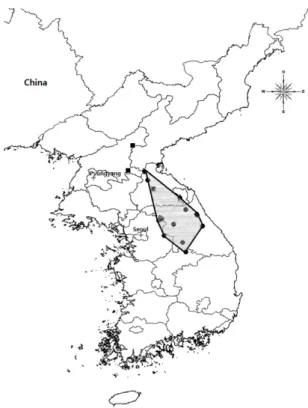
et al., 1996; Jang et al., 2010) 은 오동정으로 생각되는 일부 점을 제외하고 서식지 좌표값을 구했다. 작성된 분포도 (Fig. 1) 를 이용하여 Arc View 3.2 GIS로 분포영역과 점유 면적을 계산하였다.

개체군의 크기가 매우 작은 종의 개체군 크기에 대한 평 가 기준인 C와 D의 적용을 위하여 2011, 2012년 두 해 동안 현장조사를 실시하였다. IUCN에서는 개체군(population) 을 해당 분류군(taxon)의 전체 개체수로 정의하고 있으므 로(IUCN, 2001), 금강초롱꽃 개화기인 8-10월에 2011-2012 년 2년간 오대산, 화악산, 설악산 등 3개 지역에서 성숙개 체 수를 직접 조사하고 이를 바탕으로 전 개체군 내 성숙 개체 수를 예측하여 평가를 실시하였다. 적색목록에서는 클론으로 존재하는 생식 단위의 경우, 산호와 같이 각각 의 단위가 혼자서 생존할 수 없는 경우를 제외하고는 독 립된 개체로 간주하도록 하고 있으므로(IUCN Standards and Petitions Subcommittee, 2011) 금강초롱꽃 성숙개체 수 는 클론 여부와는 무관하게 개화한 지상부의 줄기 수를 기준으로 조사하였다.

IUCN 적색목록 평가기준 B는 분포범위(EOO, Extent Of Occurrence)와 점유영역(AOO, Area Of Occupancy)의 크기 를 이용한다. 분포범위는 분류군의 분포가 알려져 있거나 추리, 또는 투영한 현재 출현 장소의 공간 분포를 연결하 는 최소의 연속 경계 내부의 영역으로서 유랑하거나 혹은 분류군 전체 분포 범위 내의 불연속 또는 분리(disjunction) 를 제외하며, 내각이 180

o

미만이고 모든 출현 지역을 포함 하는 최소 다각형으로 측정한다. 점유영역은 분류군이 점 유하고 있는 출현범위 내부의 면적으로서 분류군이 존재 하고 있는 개체군 생존의 모든 단계에서 필요한 가장 작 은 면적을 의미하며, 분포범위를 일정 크기의 격자로 구 분하였을 때 점유한 격자 면적 합으로 도출하였다.

평가기준 B의 세부항목 (a) 지소(location)는 하나의 위 협적 사건이 현재 존재하는 분류군의 모든 개체에 신속한 영향을 줄 수 있는 지리적 또는 생태적으로 분명한 영역 을 말한다. 현장조사 결과 상당수의 개체가 등산로를 따 라 분포하는 경향이 있으며, 남획 등(Kim, 1998) 인간으로 인한 직간접적인 개체군 훼손이 위협 요인으로 판단된다.

위협요인이 남획일 경우 지소의 수는 동일한 정책의 영향 을 받는 행정구역의 수로 구분한다(IUCN Standards and Petitions Subcommittee, 2011). 세부항목 (b)의 출현범위와 점유면적의 지속적인 쇠퇴는 외부의 도움이 없다면 지속 될 수 있는 최근, 현재 또는 예상되는 미래의 쇠퇴를 말한 다. 금강초롱꽃은 한반도 중동부 비교적 해발이 높은 산 에 서식하므로, 남한 산림면적이 1995년부터 2010년까지 약 1.28% 감소한 것과(Fig. 2, Korean Forest Service, 2012), 북한 산림이 평균 14% 감소한 것에 근간하여(Lee et al., 1999) 점유면적이 지속적으로 감소했다고 추리(inference) 하였다(Hayes, 2009; UNEP, 2003).

결 과

본 연구의 현장조사, 기존의 표본기록 및 문헌에서 확 인한 금강초롱꽃 자생지는 경기도 지역에 명지산, 화악산, 석룡산, 용문산, 유명산 등과 강원도 지역에 오대산, 설악 산, 점봉산, 방태산, 대암산, 대룡산, 명성산, 치악산, 안산 등이었다. 최근 자료(Son, 2005)에 의하면 북한은 강원도 금강산, 두류산, 설봉, 명이덕산 등에 분포하는 것으로 명시 하고 있다(Appendix I). 기존자료(Chung, 1957; Im, 1999)에는 북한의 함경남도 삼방과 평안남도 양덕, 맹산 등의 다른 자 생지(Fig. 2, 사각형으로 표시)도 언급하고 있지만, 본 평가 에서는 최근의 북한 적색목록집의 정보만을 근간으로 분포 영역을 산출하였다(평안남도 양덕과 맹산 두 지역 제외).

북한에서는 금강초롱꽃[Keumkangsania asiatica (Nakai) Kim] 과, 꽃받침 갈래 조각 모양이 버들잎 모양으로 가늘면 서, 변두리가 큰톱모양인 것을 검산초롱꽃[Keumkangsania latisepala (Nakai) Kim]이라 하여 독립된 종으로 인정하지 만(Im, 1999), 현재는 검산초롱꽃은 금강초롱꽃의 이명으 로 보고 있다(The Plant List, 2013). 검산초롱꽃은 함경남도 의 검단산, 장안, 사수동과 평안북도의 낭림산, 그리고 강

Fig. 1. Distribution of Hanabusaya asiatica (Nakai) Nakai in Korea. Some of known sites represented by squares were excluded here because of uncertainty based on the recent North Korea Red List information (Son, 2005). Therefore, the area of occupancy (AOO) and the extent of occurrence (EOO) were estimated only based on the actual known localities represented by circles here.

The EOO is shown as a minimum convex polygon in the figure.

(4)

원도의 천불산 등 금강초롱에 비해 다소 북쪽에 몇 지역 이 추가로 알려져 있으나(Chung, 1957), 북한 적색목록집 (Son, 2005) 에서는 희귀식물로 언급하지 않아 본 연구의 분포면적 계산에서는 제외하였다.

자생지 좌표를 지도상에 투영하여 분포도를 작성하고 최소 다각형을 그려 내부 면적을 계산한 결과, 분포범위 (EOO) 는 12,742 km

2

이고, 2 km 크기의 격자(한 격자 당 4 km

2

) 상에서 확인된 점유면적(AOO)은 76 km

2

이었다(Fig. 1). 평가 기준의 적용은 양적인 기준가 함께 부기준(subcriteria) a, b, c 중 2개 이상의 기준을 만족해야 하며 본 종의 경우 지소의 수 와 서식지질의 지속적인 감소(Fig. 2) 등, 2개 부기준을 만족 한다. 분포범위는 20,000 km

2

미만으로 취약종(VU)에 해당 되며, 점유면적은 500 km

2

미만으로 위기종(EN)에 해당된다.

IUCN 적색목록에서는 개체군의 위협요인을 코드화하여 제시하도록 권고하고 있는데(IUCN Standards and Petitions Subcommittee, 2011), 금강초롱꽃 개체군의 위협 요인을 보 면, 많은 문헌에서 금강초롱꽃의 남획(위협요인 1.2)으로 인한 개체군 훼손을 지적하고 있으며(Chung et al., 2001;

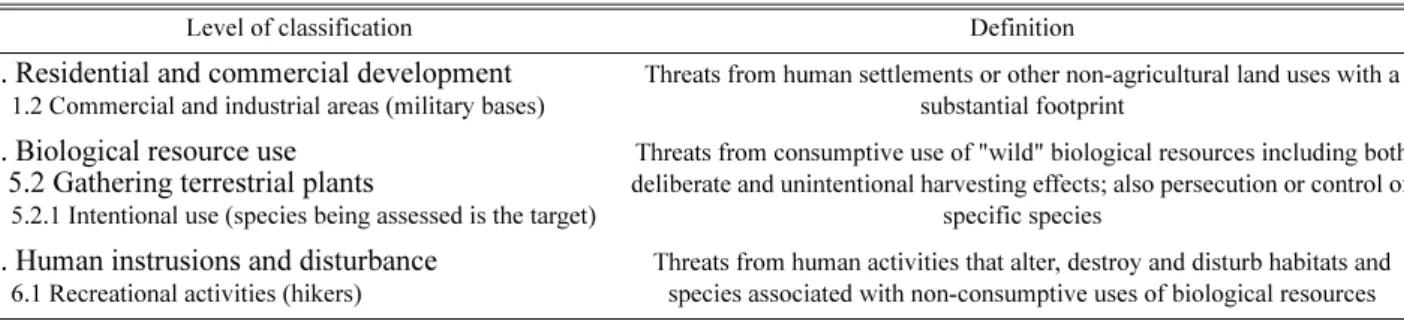
Ryu et al., 2002; Kim, 1988), 주로 등산로 주변에서 발견되 기 때문에 등산객의 영향(6.1)도 받는 것으로 판단하였다.

화악산의 경우 군부대가 밀집되어 있어 군부대의 영향 (1.2)도 있다고 판정하였다(Table 1). 군사 훈련이 전 개체 군에 영향을 미칠 경우엔 위협요인 코드 6.2를 선택해야 하지만, 개체군 중 일부만이 군부대로 인해 피해를 입을 경우엔 1.2를 선택하도록 되어있다(IUCN Standards and

Petitions Subcommittee, 2011). 평가기준 B의 세부기준 (a) 지소의 수를 정의하기 위하여, 지소의 수는 남획이 가장 큰 위협요인일 경우 행정구역으로 지소를 구분하고 있다.

금강초롱꽃 자생지의 관할 행정구역인 남한의 경기도와 강원도, 북한의 강원도 등 총 3개가 해당되며 이는 위기종 (EN) 범주에 포함된다.

평가기준을 B1ab(iii)로 적용할 경우 분포면적은 취약종 (VU)에 해당되지만 지소의 수가 위기종(EN)에 해당되므 로 최종 평가는 위기종(EN)이 된다. B2ab(iii)를 적용하면 Table 1. The threat types as listed in Hanaabusaya asiatica (Nakai) Nakai are shown here.

Level of classification Definition

1. Residential and commercial development 1.2 Commercial and industrial areas (military bases)

Threats from human settlements or other non-agricultural land uses with a substantial footprint

5. Biological resource use 5.2 Gathering terrestrial plants

5.2.1 Intentional use (species being assessed is the target)

Threats from consumptive use of "wild" biological resources including both deliberate and unintentional harvesting effects; also persecution or control of

specific species 6. Human instrusions and disturbance

6.1 Recreational activities (hikers)

Threats from human activities that alter, destroy and disturb habitats and species associated with non-consumptive uses of biological resources

Table 2. The number of mature individuals is estimated for two years based on field investigation (2011 and 2012).

Mt. Hwaak Mt. Odae Hankyeryong Osaak

2011

Mature individuals 146 55 37 31

Area(m

2

) 1500 750 1500 850

Total 269 individuals / 4100 m

2

2012

Mature individuals 115 56 42

Area(m

2

) 3000 175 750

Total 216 individuals / 3925 m

2

Fig. 2. The forest in the Republic of Korea has declined by less than

2 per cent during the last 15 years, while that of The Democratic

People's Republic of Korea has declined by more than 14% every

year.

(5)

점유면적과 지소의 수 모두 위기종 범주에 포함된다. 따 라서 평가기준 B에 대하여 금강초롱꽃의 평가 결과는 위 기종 EN B1ab(iii)+2ab(iii) 이다.

성숙개체 수는 2011년에는 총 4,100 m

2

에서 269개체를 발견했으며, 오대산은 750 m

2

에서 55개, 화악산은 1,500 m

2

에서 146개, 설악산은 한계령 구간 1,500 m

2

에서 37개, 오색 지역 850 m

2

에서 31개체를 확인했다. 2012년에는 오대산 175 m

2

에서 56개, 화악산 3,000 m

2

에서 115개, 설악산 750 m

2

42개체 등 총 3,925 m

2

에서 216개의 성숙개체를 확인하 였다(Table 2). 평가기준 C에 의하면 전체 집단(population) 의 성숙개체 수는 2,500개체 미만으로 추정되고, 전체 개체 군의 지속적인 감소와 더불어 각 아개체군(subpopulation) 에는 평균 250개체 미만이 확인되므로 금강초롱꽃은 위기 종(Endangered, EN) C2a(i) 에 해당된다. 평가기준 D는 전체 성숙개체 수가 1,000개체 미만일 때 적용 가능한데, 금강초 롱꽃의 아개체군이 20개 내외이고, 점유면적이 76 km

2

인 것을 고려하면 전 개체군 내 금강초롱꽃의 성숙개체 수는 1,000 개체를 훨씬 넘을 것으로 판단된다. 따라서 평가 결과 는 멸종위험 범주를 벗어난 약관심종 Least Concern D1 이 된다. 본 연구와 같이 복수의 평가 기준을 적용한 경우, 가 장 높은 수준의 범주를 택하여야 하므로 금강초롱꽃의 최 종 평가 결과는 Endangered B1ab(iii)+2ab(iii), C2a(i) 이 된다.

고 찰

금강초롱꽃은 평가기준 D를 적용한 결과와 문헌을 참 고하면(Korea National Arboretum, 2008) 비교적 개체수가 풍부한 것으로 보이지만, 무성번식을 하는 희귀식물은 현 존 개체의 상당수가 유전적으로 동일한 클론이기 때문에 유효개체군크기(effective population size)가 현 개체군 크 기보다 현저히 작아(Tepedino, 2012) 개체수에 비해 멸종 에 취약하다. 자생지에서 관찰한 결과 금강초롱꽃 상당수 가 무성번식을 통해서도 개체를 증가하는 것을 확인하였 다. 또한 최근 남획 등 사람의 영향으로 인한 유전적 다양 성의 유실이 우려되는데(Chung et al., 2001), 이는 질병 (Harper, 1985) 이나 기후변화(Honnay and Bossuyt, 2005), 극 단적인 서식지 변형 등(Spielman et al., 2004)과 같은 환경 변화에 대한 적응력 취약으로 이어질 수 있다.

KPSG 에서 금강초롱꽃을 CR B2ab(i,) 로 평가한 것은 다 소 보수적으로, 평가 기준에 따르면 금강초롱꽃의 점유면 적을 10 km

2

미만으로 보았다. IUCN에서는 점유면적에 대 하여 일반적으로 2 km(즉, 한 격자 당 4 km

2

) 를 권고하고 있으며, 만약 1 km 이하 수준으로 격자 크기를 줄일 경우 비어있는 1 km

2

의 격자에는 발견되지 않았다는 수준이 아 니라 실제로 부재하는 것을 확신할 수 있어야 적용이 가능 하다(IUCN Standards and Petitions Subcommittee, 2011). 즉 10 km

2

미만이라는 것은 격자 3개 미만에서 나타난다는 것 인데, 본 연구 결과와 비교하면 점유면적을 협소하게 생각

한 것으로 본다.

세계 각국에서는 자국 내 희귀 동·식물 보전 지위 평가 를 위하여 IUCN 적색목록 기준을 적용하고 있으며, 평가 결과를 정당화하기 위하여 평가 기준과 평가 대상종의 분 포, 생태, 위협요인 등에 대한 정보를 명확하게 기술하고 있다(Sergio et al., 1992; Randrianasolo et al., 2002; Vischi et al., 2004; Kingston and Waldren, 2005; Milner-gulland et al., 2006; Minuto et al., 2006; Thomas et al., 2009; Bilz et al., 2011; Ali et al, 2012). 종의 보전지위 평가는 반드시 데이터 에 대한 정당화, 출처, 불확실성에 대한 추정 근거 등을 명 시해 평가 기준을 준수하여야 정확한 평가가 가능하다 (Rodrigues et al., 2006).

국내에서 제시하는 적색목록집(Korea National Arboretum, 2008; National Institute of Biological Resources, 2012) 에는 평가 기준이나 혹은 평가 결과의 정당화에 대한 기술이 부재한 다. 국립수목원이나 생물자원관은 IUCN 외부 조사자이므 로 평가 결과는 국내 식물 RLA인 KPSG에 의해 재평가되어 야 데이터베이스에 등재가 가능하지만(IUCN Standards and Petitions Subcommittee, 2011), 단순히 평가 결과만 나열 할 뿐 정량적인 데이터를 제시하지 않아 검토가 불가능한 상황이다.

최근 국립수목원에서 시도한 매미꽃의 보전지위 평가 (Son et al., 2012) 의 경우 제시한 데이터의 정당화 과정에서 IUCN 적색목록 평가기준을 잘못 이해하고 적용한 사례이 다. 매미꽃을 약관심종(LC)에서 준위협종(NT)로 상승시키 면서, “ 집단수가 12개 이상이기 때문 ” 이라하며 집단을 아 개체군(subpopulation)과 동의어로 잘못 해석하였다. 여기 에서 IUCN이 의미하는 집단은 하나의 위협요인이 영향을 미치는 범위로 정의되는 지소(location)를 의미한다(IUCN Standards and Petitions Subcommittee, 2011). 아개체군은 유 전적, 생태적인 의미로 정의되는 반면, 지소는 위협요인에 의해 정의되는 단위이므로 서로 다른 개념이다. 따라서 지 소의 수를 정의하려면 가장 심각한 위협요인을 제시하고, 해당 위협요인의 영향 범위를 정의해야 하는데, 이에 대 한 위협 요인을 구체적으로 제시하지 않고 있다. 또한 분 포범위(EOO)를 계산할 때 불연속인 부분을 제외하기 위 하여 충청도와 제주도의 좌표를 제외하였지만, 분포범위 는 위협 요인에 대한 해당 생물종의 안정성을 가늠하기 위 한 것이기 때문에 오동정 이거나 특별한 경우를 제외하고 는 식물이라 할지라도 대륙과 도서지역을 연결하여 계산 하는 것을 권고하고 있다.

『한국 희귀식물 목록집』(Korea National Arboretum,

2008) 의 다른 문제점은 국가 수준의 평가에 세계 수준의

기준을 잘못 적용한 것이다. IUCN은 적색목록 평가기준

을 국가 등 소규모에 적용할 경우, 지역멸종종(Regionally

Extinct, RE)과 비적용종(Not Applicable, NA)이라는 범주를

추가하여 평가 대상종이 소규모에서 적용 가능한지 아닌

지를 판단하도록 하고 있으며, 정량 평가 후에는 주변국의

(6)

개체군 상태는 어떤지, 자국 내 개체군이 원천(source population) 인지 혹은 이주(sink population)인지 등을 고려 하여 평가 결과를 상향 또는 하향 조절하도록 하고 있다 (IUCN, 2003). 그러나 『한국 희귀식물 목록집』은 일본, 중 국, 대만 등 주변국에 분포하는 자생식물에 대하여 국내 에서 조사된 자료만을 바탕으로 평가를 실시하였고, 평가 범주도 지역멸종종(RE)과 비적용종(NA)을 제외한 채 제시하 고 있다. 특히 분포역의 최남단 혹은 최북단인 국내 식물의 경우, IUCN 적색목록 기준은 부적합한 경우가 대부분이므로 매우 신중하게 적용해야 한다(Thomas et al., 2009). 『한국의 멸 종위기 야생 동·식물 적색자료집. 관속식물』 (National Institute of Biological Resources, 2012)에서는 IUCN 적색목록의 평가기 준을 설명함에도 불구하고, 각 종별로 제시된 평가내용에는 임의나 자의적 해석 혹은 평가기준의 잘못 적용 등이 보여 IUCN 적색목록 평가를 위한 자료 활용에 한계가 있다.

자생하는 수백 종의 생물을 기준에 따라 범주화 하는 것 도 의미가 있지만 데이터 제시가 필요하며, 실질적으로 특정 생물에 대한 보전정책 수립을 위해서는 보전 지위 뿐 아니라 해당 생물종의 분포, 생태, 위협요인 등에 대한 자세한 정보가 필요하다. 여러 국가에 분포하는 식물의 경우 정확한 분포와 개체수, 위협요인 등의 파악이 어렵 지만, 일부 국가 혹은 지역에 협소하게 분포하는 특산 식 물의 경우에는 적색목록 기준을 적용하여 전 세계 수준에 서의 희귀성 평가가 가능하기 때문에(Valencia et al., 2000 cited in Rodrigues et al., 2006) 우선적인 평가 대상이 된다.

희귀, 특산 식물의 보전지위 평가를 위하여 가장 우선 수행되어야 할 작업은 표본을 활용해 분포도를 작성하고, 분포범위(EOO)와 점유면적(AOO)을 계산하는 것이다. 국 내 적색목록 평가 결과에서 국립수목원은 112종, 생물자 원관은 38종이 자료부족(DD)으로 평가되었는데, 표본을 활용하면 적어도 평가된 종을 자료부족(DD)이 아닌 다른 범주에 포함시킬 수 있다(Callmander et al., 2005). 이런 점 에서 식물 표본은 보전 정책의 수립과 실행을 위한 시발 점으로서 활용 가치가 크지만(Willis et al., 2003; Golding, 2004; Rivers et al., 2011), 국내 멸종희귀식물 연구에서는 이런 노력이 부족하다. 표본은 평가 대상종 당 15개의 좌 표를 활용할 때에 평가 결과가 95% 이상 일치했다는 연구 를 참고하면(Rivers et al., 2011) 적어도 15개 이상의 좌표를 이용하여 분포도를 작성, 평가기준 B를 적용하는 것이 바 람직하다. 그러나 표본만을 활용한 평가는 세대 길이, 개 체군 크기나 경향, 극단적 변동, 지소의 수 등 많은 요인들 에 대하여 주관적인 평가가 반영되어야 하므로, 표본 자 료와 함께 개체수와 자생지 상황 등 현장 조사를 반드시 병행해야 한다(Willis et al., 2003).

국내 멸종위기종의 효율적인 관리 및 보전을 위해서는 정확한 IUCN 적색목록 보전지위 평가가 선행되어야 하 며, 우선 기본적으로 IUCN의 적색목록 기준을 제대로 이 해하고 적용하고, 평가에서 가장 기본이 되는 분류학적

문제, 개체군 크기 및 증감 경향, 생태, 위협요인, 보전현황 등에 대한 연구 및 정보 파악이 필요하다. 이미 선진국에 서는 이러한 정보들을 모두 반영하여 자국 희귀식물을 관 리하고 있다(IUCN Standards and Petitions Subcommittee, 2011; Government of Newfoundland and Labrador, 2012). 특 히 개체군이 지속적으로 감소하는지의 여부는 IUCN 적 색목록 기준 적용에 있어 매우 중요한 요소이기 때문에 중장기적인 모니터링을 통해 개체군 크기에 대한 정량적 인 과학적 데이터 제시가 필수적이다.

현재 국내 멸종위기 식물 조사 방법 설계에 있어 선진화 된 방법이 고안, 적용될 필요가 있지만 국내에서는 희귀 식물 분포에 대한 조사만 있을 뿐(Kim et al., 2000; Lim et al., 2005), 자생지 내 개체수에 대한 정확한 정보가 제시되 어 있지 않아 IUCN 적색목록 평가적용이 불가능하다. 전 수조사를 할 경우, 조사 단위를 유성번식개체(genet)나 줄 기 등 어떤 것으로 할 것인지, 조사 대상을 어떤 단계로 구 분할 것인지[유식물(幼植物), 개화개체 등], 어디에서 어느 크기에 조사 지역을 설정할 것인지 등에 대한 조사가 선행 되어야 하고, 조사자가 바뀌더라도 관측 오류가 발생하지 않도록 정형화된 방법론이 필요하다(Elzinga et al., 1998).

국내에서는 히어리(Shin et al., 2011; Shim et al., 2003;

Lim et al., 2005), 한계령풀(Lee et al., 2011), 청사초(Beon and Kim, 2008), 왕제비꽃(Song et al., 2010), 만병초(Lee and Shim., 2011), 망개나무(Park and Cho, 2011), 동강할미꽃(Ahn et al., 2010), 매미꽃(Son et al., 2012) 등 희귀식물 자생지에 대한 연구가 다수 있지만, 자생지의 식생구조나 식물사회 학적 분석, 입지환경요인을 조사한 정도에 그치는 것이 대 부분이며, 실질적으로 희귀식물 보전 방안을 고안하는 데 있어 필요한 개체군 관련 연구는 부족하다.

희귀식물의 개체군 크기가 감소하는 것이 파악되면, 어 떤 요인이 개체군 크기에 영향을 주는 것인지에 관한 연 구까지 진행되어야 실질적으로 멸종 또는 멸절의 가속화 를 방지할 수 있다. 이를 위해 개체군 동태, 유식물 생장, 생식, 종자 분포 및 유전적 구조 등 개체군 활력도에 관련 된 다각적 측면의 연구가 필수적이다(Kesseli, 1992). 국내 모든 식물에 대한 정교한 조사를 진행하는 것은 어렵다면, 우선적으로 보호되어야 할 몇 종을 선정한 후, 해당 식물 에 대한 개체군 생태학적 단위에서의 본 연구와 유사한 중장기적인 자료 수집이 필요한 시기라 판단된다.

사 사

본 연구는 산림청 산림과학기술개발사업(과제번호:

S1 21212L020100, 세부과제번호: S121212L020110) 의 지 원에 의하여 이루어진 것이며, 2012년 북한생물다양성(

식물) DB 구축의 종발생자료 지역 정리 부분에 대한 결과

물입니다. 금강초롱꽃 자생지의 조사에 협조해 주신 오대

산 국립공원과 설악산 국립공원에 감사드립니다.

(7)

인용문헌

Ahn, C. H., H. S. Lee, Y. I. Park and J. S. Lee. 2010. Habitat Sur- vey and Seed Germination Test of Pulsatilla tongkangensis in Du-ta mountain, Sam-cheok City. Proceeding of Korean Soci- ety of Environment and Ecology Conference 20: 59-61. (in Korean)

Ali, H., M. Qaiser and K. B. Marwat. 2012. Contribution to the red list of Pakistan: A case study of Delphinium nordhagenii (Ranunculaceae). Pakistan Journal of Botany 44: 27-31.

Beon, M. S. and Y. H. Kim. 2008. Vegetation Structure and Pop- ulation Dynamics of Berchemia racemosa Habitats. Korean Journal of Environment and Ecology 22: 679-690 . (in Korean)

Bernardos, S., A. Amado and F. Amich. 2006. The narrow endemic Scrophularia valdesii Ortega-Olivenicia & Devesa (Scrophulariaceae) in the Iberian Peninsula: an evaluation of its conservation status. Biodiversity and Conservation 15:

4027-4043.

Bilz, M., S. P. Kell, N. Maxted and R. V. Lansdown. 2011. Euro- pean Red List of vascular plants. Publications Office of the European Communities, Luxembourg.

Callmander, M. W., G. E. Schatz and P. P. Lowry. 2005. IUCN red list assessment and the global strategy for plant conservation:

taxonomists must act now. Taxon 54: 1047-1050.

Chung, M. G., M. Y. Chung and B. K. Epperson. 2001. Conser- vation genetics of an endangered herb, Hanabusaya asiatica (Campanulaceae). Plant Biology 3: 42-49.

Chung, T. H. 1957. Korean Flora. Shinjisa, Seoul. Pp. 644. (in Korean)

Collar, N. J. 1996. The reasons for red data books. Oryx 30: 121- 130.

Elzinga, C. L., D. W. Salzer, J. W. Willoughby. 1998. Measuring and monitoring plant populations. U.S. Dept. of the Interior, Bureau of Land Management.

Garcia, M. B., D. Guazman and D. Goni. 2002. An evaluation of the status of five threatened plant species in the Pyrenees. Bio- logical Conservation 103: 151-161.

Golding, J. S. 2004. The use of specimen information influences the outcomes of Red List assessments: the case of southern African plant specimen. Biodiversity and Conservation 13:

773-780.

Government of Newfoundland and Labrador. 2012. Species Sta- tus Advisory Committee. http://www.env.gov.nl.ca/env/wild- life/endangeredspecies/ssac/.

Harper, J. L. 1985. Modules, branches, and the capture of resources. In Population biology and evolution of clonal organisms. Jackson, J. B. C., L. Buss and R. E. Cook (eds.).

Yale University Press, New Haven, Connecticut. Pp. 1–33.

Hayes, P. 2009. Unbearable Legacies: The Politics of Environmen- tal Degradation in North Korea. Global Asia 4: 33-39.

Honnay, O. and B. Bossuyt. 2005. Prolonged clonal growth:

Escape route or route to extinction? Oikos 108: 427–432.

Im, R. J. 1999. Flora Coreana. The Science and Technology Pub- lishing House, Pyongyang. Pp. 13-14. (in Korean)

IUCN Standards and Petitions Subcommittee. 2011. Guidelines for Using the IUCN Red List Categories and Criteria. Version 9.0.

Retrieved Jan. 25, 2013, from http://www.iucnredlist.org/docu- ments/RedListGuidelines.pdf

IUCN. 2001. IUCN Red List Categories and Criteria : Version 3.1.

IUCN Species Survival Commission. IUCN, Gland, Switzer- land and Cambridge, UK.

IUCN. 2003. Guidelines for Application of IUCN Red List Crite- ria at Regional Levels: Version 3.0. IUCN Species Survival Commission. IUCN, Gland, Switzerland and Cambridge, UK.

Jang, S. K., K. S. Cheon, J. H. Jeong, Z. S. Kim and K. O. Yoo.

2010. Environmental characteristics and vegetation of Hanabusaya asiatica habitats. Kor. Korean Journal of Horti- cultural Science & Technology 28: 497-506.

Kesseli, R. V. 1992. 4. Population biology and conservation of rare plants. In Jain, S. K. and L. W. Botsford (eds.). Applied pop- ulation biology. Springer, Netherlands. Pp. 69-90.

Kim, T. J. 1988. Wild flowers of Korea. Kyohaksa, Seoul. p. 358.

(in Korean)

Kim, W. B., K. S. Choi, B. H. Kim, J. K. Kim, J. K. Kim, J. H.

Kim, K. O. Yoo, W. T. Lee and H. T. Lim. 1996. Physioeco- logical characteristics of Hanabusaya asiatica. Journal of the Korean Society for Horticultural Science 37: 561-567. (in Korean)

Kim, Y. S., H. T. Shin and K. H. Kang. 2000. Vascular plants and Conservation of Rare and Endangered Plants in Ulnung Island.

Journal of Resource Development 19: 13-30. (in Korean) Kingston, N. and S. Waldren. 2005. A conservation appraisal of

the rare and endemic vascular plants of Pitcairn Island. Biodi- versity and Conservation 14: 781-800.

Korea National Arboretum. 2008. Rare Plants Data Book in Korea. Korea National Arboretum, Pocheon. (in Korean) Korea National Arboretum. 2009. Korea biodiversity information sys-

tem. Retrieved Jan. 25, 2013, from http://www.nature.go.kr/2011.

Korean Forest Service. 2012. Forest statistics. Retrieved Mar. 25, 2013, from http://www.forest.go.kr/.

Lee, B. C. and L. S. Shim. 2011. Environmental and Ecological Characteristics Distribution of Natural Growth Region in Rhododendron brachycarpum. Journal of the Environmental Science 20: 1319-1328. (in Korean)

Lee, K. S., M. R. Joung and J. S. Yoon. 1999. Content and Char-

(8)

acteristics of Forest Cover Changes in North Korea. Journal of Korean Forestry Society 88: 352-363. (in Korean)

Lee, S. H., M. H. Yeon and J. K. Shim. 2011. Habitat and Distri- bution Feature of Endangered Species Leontice microrhyncha S. Moore. Korean Journal of Environment and Ecology 25:

819-827. (in Korean)

Lim, D. O., H. L. Choun, J. H. Kim, I. C. Hwang, C. H. Kim and H. W. Lee. 2005. Conservation of an Endangered Corylopsis coreana Uyeki in and ex situ and Development of Coopera- tive Model within Local Community -2. Dynamics and Dis- tribution Characteristics of the Corylopsis coreana Population at Cheongsogol, Sunchon, Cholanam-do, Korea. Korean Jour- nal of Environment and Ecology 19: 269-278. (in Korean) Mace, G. M., N. J. Collar, K. J. Gaston, C. Hilton-Taylor, H. R.

Akçakaya, N. Leader-Williams, E. J. Milner-Gulland and S. N.

Stuart. 2008. Quantification of extinction risk: IUCN’s system for classifying threatened species. Conservation Biology 22:

1424-1442.

Mauchamp, A., I. Aldaz, E. Ortiz and H. Valdebenito. 1998.

Threatened species, a re-evaluation of the status of eight endemic plants of the Galapagos. Biodiversity and Conserva- tion 7: 97-107.

Milner-gulland, E. J., E. Kreuzberg-mukhina, B. Grenot, S. Ling, E. Bykova, I. Abdusalamov, A. Bekenov, U. Gardenfors, C.

Hilton-taylor, V. Salnikon and L. Stogova. 2006. Application of IUCN Red Listing Criteria at the Regional and National Levels: A Case Study from Central Asia. Biodiversity and Conservation 15: 1873-1886.

Minuto, L., F. Grassi and G. Casazza. 2006. Ecogeographic and genetic evaluation of endemic species in the Maritime Alps:

the case of Moehringia lebrunii and M. sedoides (Caryophyl- laceae). Plant Biosystems 140: 146-155.

National institute of biological resources. 2012. Korean red list of threatened species: mammalis, birds, reptiles, amphibians, fishes and vascular plants. National institute of biological resources, Incheon.

Park, I. H. and K. J. Cho. 2011. Synecological Characteristics and Vitality Analysis of the Berchemia berchemiaefolia Habitat.

Journal of the Korea Society of Environmental Restoration Technology 14: 97-105. (in Korean)

Randrianasolo, A., J. S. Miller and T. K. Consiglio. 2002. Appli- cation of IUCN criteria and Red List categories to species of five Anacardiaceae genera in Madagascar. Biodiversity and Conservation 11: 1289-1300.

Rivers, M. C., L. Taylor, N. A. Brummitt, T. R. Meagher, D. L.

Roberts and E. N. Lughadha. 2011. How many herbarium specimens are needed to detect threatened species? Biological Conservation 144: 2541-2547.

Rodrigues, A. S. L., J. D. Pilgrim, J. F. Lamoreux, M. Hoffmann and T. M. Brooks. 2006. The value of the IUCN Red List for conservation. Trends in Ecology and Evolution 21: 72-76.

Ryu, S. Y., H. S. Lee, K. S. Cho, D. L. Yoo, S. H. Kang and J. H.

Kim. 2002. Effects of some factors on germination and stem cutting of Hanabusaya asiatica. Journal of the Korean Soci- ety for Horticultural Science 43: 369-372. (in Korean) Sergio, C., R. Schumacker, S. Fontinha and M. Sim-Sim. 1992.

Evaluation of the status of the bryophyte flora of Maderia with reference to endemic and threatened European species. Bio- logical Conservation 59: 223-231.

Shim, K. K., Y. M. Ha, W. H. Lee, Y. H. Kim and D. S. Kim.

2003. Distribution of Korean Native Corylopsis coreana and Its Morphological Characteristics as Rare and Endangered Plant. Horticulture, Environment, and Biotechnology 44: 260- 266. (in Korean)

Shin, S. H., J. S. Kim, J. M. Kim, D. J. Seo, H. G. Kang, M. K.

Kim, G. J. Jo, C. H. Goo and E. H. Park. 2011. The Analysis of Growth Environment on Corylopsis coreana Community in Hallyeohaesang National Park. Journal of Agriculture and Life Science 45:49-56. (in Korean)

Son, K. N. 2005. Red Data Book of DPR Korea (Plant). MAB National Committee of DPR Korea, Pyongyang.

Son, S. W., J. M. Chung, J. K. Shin, B. C. Lee, K. W. Park and S.

J. Park. 2012. Distribution, vegetation characteristics and assessment of the conservation status of a rare and endemic plant, Coreanomecon hylomeconoides Nakai. Korean Journal of Plant Taxonomy 42: 116-125. (in Korean)

Song, J. M., G. Y. Lee, N. Y. Kim and J. S. Yi. 2010. Vegetation Structure and Site Environment of Natural Habitat of an Endangered Plant, Viola websteri. Journal of Korean Forestry Society 99: 267-276. (in Korean)

Spielman, D., B. W. Brook and R. Frankham. 2004. Most species are not driven to extinction before genetic factors impact them.

Proceedings of the National Academy of Sciences of the United States of America 101: 15261-15264.

Tepedino, V. J. 2012. Overestimating population size of rare clonal plants. Conservation Biology 26: 945-947.

The Plant List. 2013. http://www.theplantlist.org/tpl/record/kew- 370512.

Thomas, A., R. Gentili, G. Rossi, G. Bedini and B. Foggi. 2009. Can the IUCN criteria be effectively applied to peripheral isolated plant populations? Biodiversity and Conservation 18: 3877-3890.

UNEP. 2003. DPR Korea: State of the environment. United Nations Environmental Programme, Klong Luang, Pathumthani, Thailand.

Vischi, N., E. Natale and C. Villamil. 2004. Six endemic plant spe-

cies from central Argentina: an evaluation of their conserva-

(9)

tion status. Biodiversity and Conservation 13: 997-1008.

Walter, K. and H. J. Gillett (eds.). 1998. 1997 IUCN Red List of Threatened Plants. Compiled by the World Conservation Monitoring Centre. IUCN, Gland, Switzerland and Cam- bridge, UK.

Willis, F., J. Moat and A. Paton. 2003. Dening a role for herbar-

ium data in Red List assessments: a case study of Plectran-

thus from east rn and southern tropical Africa. Biodiversity

and Conservation 12: 1537–1552.

(10)

Appendix 1. Specimens examined for Hanabusaya asiatica (Nakai) Nakai

Appendix 2. A sample information sheet for Hanabusaya asiatica (Nakai) Nakai.

Gyeonggi-do: Gapyeong-gun, Buk-myeon, jeongmok-ri, Mt. Hwaak, 24 Aug. 2002, E. S. Jeon and G. H. Nam L-60776 (KH);

Mt. Myeongji, 9 Sep. 1939, T. H. Chung 1288 (SKK); 1 Aug. 2001, C. H. Kim JNU8001 (JNU); Hwaak-ri, Chokdaebong, 21 Sep. 1993, K. O. Yoo 0020049 (KWNA); Gapyeong-eup, Seungan-ri, Mt. Myeongji, 1 Oct. 1989. N. J. Yoo 21614 (SKK); Yangpyeong- gun, Yongmun-myeon, Sinjeom-ri, Mt. Yongmun, Aug. 1957, T. B. Lee 00058303 (SNUA). Gangwon-do: Gangneung-si, Yeongok- myeon, Samsan-ri, Mt. Odae, 12 Sep. 1983, W. T. Lee 0019948 (KWNA); Goseong-gun, Ganseong-eup, Jangsin-ri, Hyangrobong, 27 Sep. 1972, Y. H. Chung and J. H. An 44975 (SNBA); 29 Aug. 1990, B. H. Choi 1091-3 (IUIA) Geojin-eup, Sanbuk-ri, Hangrobong, 15 Aug. 1991, K. O. Yoo 0019971 (KWNA); Hongcheon-gun, Dong-myeon, Mt. Gongjak, 15 Sep. 1997, J. G. Lee s.n. (SKK); Hwacheon- gun, Sanae-myeon, Samil-ri, Mt. Hwaak, 12 Aug. 2006, Y. D. Kim s.n. (HHU); Mt. Seongnyong, 10 Sep. 1989, K. O. Yoo 0019958 (KWNA); Inje-gun, Buk-myeon, Wolhak-ri, Mt. Daeam, 28 Sep. 1969, Y. M. Kang 44615 (SNBA); Yongdae-ri, Eungbong, 13 Aug. 1981. W. T. Lee 0019947 (KWNA); Girin-myeon, Bangdong-ri, Gachilbong, 27 Sep. 1987, W. T. Lee 0019953 (KWNA);

Jindong-ri, Mt. Jeombong, Y. N. Lee and N. S. Lee 020208 (EWUA); Seolpibat, 22 Aug. 1989, W. T. Lee 0019956 (KWNA); Inje- eup, Gwidun-ri, Mt. Jeombong, 20 Aug. 1993, K. O. Yoo 0020035 (KWNA); Seohwa-myeon, Seoheung-ri, Mt. Daeam, 18 Oct.

1987, S. T. Lee et al. 21624 (SKK); Pyeongchang-gun, Jinbu-myeon, Dongsan-ri, Mt. Odae, 18 Sep. 1971, T. B. Lee 3246 (SNUA);

12 Aug. 1992, K. O. Yoo 0020025 (KWNA); 19 Aug. 1974, Y. N. Lee and Y. J. Oh 20428 (EWUA); Wonju-si, Hakgok-ri, Mt.

Chiak, 2 Sep. 2008, S. C. Ko 063884 (HNHM); Yanggu-gun, Dong-myeon, Mt. Daeam, 22 Sep. 1967, Y. N. Lee and Y. S. Lee 020219 (EWUA); Ganghyeon-myeon, Mulgap-ri, Daecheongbong, 13 Aug. 1993, K. O. Yoo 0020031 (KWNA); Seo-myeon, Oga- ri, Hangyeryeong, 15 Aug. 1992, K. O. Yoo 0020023 (KWNA); 7 Sep. 1996, Y. D. Kim and B. H. Lee 0003159 (HHU)

Appendix 2. A sample information sheet for Hanabusaya asiatica (Nakai) Nakai.

ASSESSMENT Hanabusaya asiatica TAXONOMY

Kingdom Phylum Class Order Family

PLANTAE TRACHEOPHYTA MAGNOLIOPSIDA CAMPANULALES CAMPANULACEAE

Scientific Name: Hanabusaya asiatica

Species Authority: (Nakai) Nakai

Common Name/s: Diamond Bluebell (Keumgangchorong)

Synonyms: Hanabusaya latisepala Nakai

Taxonomic Notes: Hanabusaya asiatica (Nakai) Nakai is a well known endemic in Korea. The species was first described as Symphyandra asiatica by Nakai (1909) because of its synantherous stamens. However, Nakai (1911) segregated the species into a new genus, Hanabusaya, based on its distinctive morphological characters, such as the absence of basal leaves and appendages between the calyx lobes. Nakai (1921) added another species to the genus, Hanabusaya latisepala, but this species is considered a synonym of H. asiatica.

ASSESSMENT INFORMATION

Red List Category & Criteria: EN B1ab(ⅲ)+2ab(ⅲ), C2a(i)

Justification: H. asiatica is a small-range Korean endemic, occurring in forest habitats. These habitats are declining due to human disturbance and its area of occupancy is below 76 km², and extent of occurrence is below 12,742 km², but it is presumed that there are three locations as the threats to this plant are locally confined. Population size is noted as at least 2,500 individuals, and there is a good evidence of continuing decline. Therefore, criterion C could apply. Given its small range, continuing decline in extent and quality of habitats, and the very small size of the population, this species is listed as Endangered.

GEOGRAPHIC RANGE

Range Description: H. asiatica is strictly endemic to Korean peninsula. Its distribution is limited to the middle of

Baekdudaegan, from Mt. Duryu in North Korea to Mt. Chiak in South Korea. The extent of occurrence

is about 13,000, and the area of occupancy is 76.

(11)

Countries Native: Republic of Korea, Democratic People's Republic of Korea.

POPULATION

Population: This species is known from about 20 sites, containing a few to two hundreds mature individuals per site. For example, there are ca. 150 flowers on Mt. Hwaak where one of the large populations in South Korea.

Population Trend: Decline

HABITAT & ECOLOGY

Habitat & Ecology: This perennial herb lives high in the mountains of Korean peninsula, above ca. 1,000 meters in altitude. It grows in the shade of large trees or on the cliffs. Total forest area has been decreasing in both ROK and DPRK.

Systems: Terrestrial

Habitat codes: 1.4 Temperate

USE & TRADE

Use & Trade: Its flowers are large and attractive, so it has been collected for a long time. It is protected as a rare plant by law in ROK, so collecting from wild is illegal.

THREATS

Major Threats: The main threat to this species is the loss of mature individuals by illegal collection. Most of them are found along mountain trails, so its habitats are vulnerable to be degraded by hikers.

Military activities also affect population viability because there are military bases on several habitats, for example, Mt. Hwaak.

Threat codes: 1.2 Commercial and industrial areas (military bases) 5.2.1 Intentional use (species being assessed is the target) 6.1 Recreational activities (hikers)

CONSERVATION ACTIONS

Conservation Actions: It is designated as a rare plant by Korea Forest Service and the endemic genus by the ministry of environment in ROK to prohibit collections from wild populations. Some habitats are locally protected. It is also protected as a natural monument in DPRK.

Research Action codes: 1.1 Taxonomy 1.2 Population size, distribution & trends Conservation Needed codes: 2.1 Site/area management 5.1.2 National level

BIBLIOGRAPHY

Chang, C. S., Y. S. Kim and H. Kim. 2011. 5. IUCN Re-evaluation and registration of global endangered plants. In The second infrastructure report for preservation and restoration of rare or endemic plants. Korean National Arboretum, Pocheon. Pp. 545-572. (in Korean)

Chung, M. G., M. Y. Chung and B. K. Epperson. 2001. Conservation genetics of an endangered herb, Hanabusaya asiatica (Campanulaceae).

Plant Biology 3: 42-49.

Kim, T. J. 1988. Wild flowers of Korea. Kyohaksa, Seoul. p. 358. (in Korean)

Korea National Arboretum. 2009. Korea biodiversity information system. http://www.nature.go.kr/2011.

Son, K. N. 2005. Red Data Book of DPR Korea (Plant). MAB National Committee of DPR Korea, Pyongyang.

수치

Fig.  1. Distribution of Hanabusaya asiatica (Nakai) Nakai in Korea. Some of known sites represented by squares were excluded here because of uncertainty based on the recent North Korea Red List information (Son, 2005)
Table 2. The number of mature individuals is estimated for two years based on field investigation (2011 and 2012).

참조

관련 문서