• 검색 결과가 없습니다.

Establishing Effective Screening Methodology for Novel Herbicide Substances from Metagenome

N/A
N/A
Protected

Academic year: 2021

Share "Establishing Effective Screening Methodology for Novel Herbicide Substances from Metagenome"

Copied!
6
0
0

로드 중.... (전체 텍스트 보기)

전체 글

(1)

118

Research Article Weed & Turfgrass Science

Weed & Turfgrass Science was renamed from both formerly Korean Journal of Weed Science from Volume 32 (3), 2012, and formerly Korean Journal of Turfgrass Science from Volume 25 (1), 2011 and Asian Journal of Turfgrass Science from Volume 26 (2), 2012 which were launched by The Korean Society of Weed Science and The Turfgrass Society of Korea founded in 1981 and 1987, respectively.

신규 제초활성 물질 발굴을 위한 메타게놈 스크리닝 방법 연구

이보영·최지은·김영숙·송재광·고영관·최정섭*

한국화학연구원 친환경신물질연구센터, 305-600 대전광역시 유성구 가정로 141

Establishing Effective Screening Methodology for Novel Herbicide Substances from Metagenome

Boyoung Lee, Ji Eun Choi, Young Sook Kim, Jae Kwang Song, Young Kwan Ko, and Jung Sup Choi*

Eco-friendly and New materials Research Center, Korea Research Institute of Chemical Technology, P.O. Box 107, 141, Gajeong-ro, Yuseong-gu, Daejeon 305-600, Korea

서 론

유기합성 제초제는 상대적인 높은 효율과 낮은 생산 비 용으로 효율적인 농작물 관리를 위해 오랜 기간 사용되어 왔고 지금도 각광 받고 있지만, 연용으로 인한 저항성 잡 초 출현 및 인축독성 이나 환경오염 등의 문제가 대두됨에 따라 새로운 제초활성 소재 개발에 대한 관심이 증대되고 있다. 이러한 관점에서 저독성의 생 분해가 가능하고 환경 친화적인 제초제 개발에 대한 연구가 진행되고 있는데 (Hoagland, 1990), 최근, 미생물 대사체 기반의 제초활성 후 보소재들은 높은 살초 효율과 환경 친화적인 특징을 지녀 연구 재료뿐 아니라 산업적 측면에서도 관심이 높아지고

있는 추세이다(Lydon et al., 1999; Duke et al., 1996).

미생물 유래 제초제는 세균, 곰팡이 또는 방선균으로부 터 합성된 생리활성물질로 세균으로부터 분리된 phaseolotoxin, syringomycin, tabtoxin (Bender et al., 1999), 방선균 유래의 bialaphos (Bayer et al., 2004; Duke et al., 1996), albucidin (Hahn et al., 2009), glufosinate-ammonium (Hoerlein, 1994) 등이 알려져 있다. 이와 같이 다양한 미생물 유래 제 초제가 개발되었지만 bialaphos의 경우 범용 경쟁제품 개 발로 경쟁력이 약화 되었고, bialaphos의 유용 성분을 합성 한 제초제인 glufosinate-ammonium의 경우 다른 비선택성 제초제에 비해 상대적으로 높은 가격으로 시장경쟁력이 약 화되고 있기 때문에 잡초의 효율적 관리를 위한 새로운 제 ABSTRACT. Metagenomics is a powerful tool to isolate novel biocatalyst and biomolecules directly from the environmental DNA libraries. Since the metagenomics approach bypasses cultivation of microorganisms, un-cultured microorganisms that are majority of exists can be the richest reservoir for natural products discovery. To discover novel herbicidal substances from soil metagenome, we established three easy, simple and effective high throughput screening methods such as cucumber cotyledon leaf disc assay, microalgae assay and seed germination assay. Employing the methods, we isolated two active single clones (9-G1 and 9- G12) expressing herbicidal activity which whitened leaf discs, inhibited growth of microalgae and inhibited root growth of germinated Arabidopsis seeds. Spraying butanol fraction of the isolated active clones’ culture broth led to growth retardation or desiccation of Digitalia sanguinalis (L) Scop. in vivo. These results represent that the screening methods established in this study are useful to screen herbicidal substances from metagenome libraries. Further identifying molecular structure of the herbicidal active substances and analyzing gene clusters encoding synthesis systems for the active substances are in progress.

Key words: Herbicide, High throughput screening, Metagenome, Natural product Received on June 5, 2015; Revised on June 10, 2015; Accepted on June 15, 2015

*
Corresponding author: Phone) +82-42-860-7431, Fax) +82-42-861-4913; E-mail) [email protected]

© 2015 The Korean Society of Weed Science and The Turfgrass Society of Korea

This is an Open-Access article distributed under the terms of the Creative Commons Attribution Non-Commercial License (http://cre-

ativecommons.org/licenses/by-nc/3.0) which permits unrestricted noncommercial use, distribution, and reproduction in any medium,

provided the original work is properly cited.

(2)

초활성물질에 대한 탐색은 계속 되어야 할 것 이다.

역사적으로 오랜 동안 미생물은 제초활성물질 뿐 아니라 새로운 효소나 촉매, 생리활성물질의 보고로써 연구되어 왔지만, 실제로 실험실에서 배양할 수 있는 미생물은 전체 환경에 존재하는 총 미생물의 1% 미만인 것으로 알려져 있다(Iqbal et al., 2012; Langer et al., 2006; Lämmle et al., 2007). 여전히 밝혀지지 않은 유용한 물질을 생산하는 미 생물의 존재는 무궁무진 하며, 이러한 난 배양성 미생물 (un-cultured microorganism) 또는 이 미생물이 합성하는 물 질을 연구하는 것은 고전적인 방법 외에 새로운 방법론이 필요한 시점이다(Iqbal et al., 2012; Daniel, 2004). 1990년대 후반 순수분리 가능한 미생물을 이용하는 기존 기술의 한 계를 극복할 기술로 배양없이 직접 유전체를 연구하는 메 타게노믹스(metagenomics)가 부각된 이래, 환경 유전체 라 이브러리를 제작하고 이 라이브러리를 대상으로 직접 유 전체 서열 분석을 통한 생태계 구조 연구 및 유용물질이나 생촉매 등을 스크리닝하는 다양한 방법들이 개발되어 왔 다(Handelsman et al., 1998; Gillespie et al., 2002; Simon and Daniel, 2011). 메타게놈은 배양이 불가능했던 미생물 로부터 유용 산물을 확보할 수 있는 매력적인 대상으로 항 생제 연구분야(Gillespie et al., 2002), drug discovery 분야 (Courtois et al., 2003) 또는 새로운 활성을 갖는 지질분해 효소(Henne et al., 2000), 단백질 분해 효소 등을 탐색하기 위해 활발히 이용되고 있다(Daniel, 2004).

그러나 지금까지 메타게놈으로부터 제초활성을 갖는 물 질을 탐색하는 연구는 보고된 바 없다. 본 연구에서는 새 로운 개념의 제초활성 물질을 탐색 하기 위한 대상으로 토 양 메타게놈 라이브러리를 선택하여 원하는 활성을 나타 내는 클론을 선별하고자 다양한 접근법을 활용 하였는데, 메타게놈은 정보의 단위가 매우 크기 때문에 단순하고 효 율적인 스크리닝 방법을 정립하는 것이 무엇보다 중요하 다고 할 수 있다(Iqbal et al., 2012; Langer et al., 2006;

Simon and Daniel, 2011). 따라서 본 연구는 전식물체(in vivo or in planta) 적용 이전에 간단히 메타게놈 유래 살초활성 물질을 스크리닝 할 수 있는 오이떡잎절편검정법, 미세조 류생장저해검정법, 식물종자발아검정법을 구축하였고, 구 축한 세 가지 스크리닝 방법은 앞으로 메타게놈 또는 큰 사이즈의 라이브러리를 대상으로 한 살초활성물질 스크리 닝 시 high throughput screening (HTS) 시스템으로 유용한 방법이 될 수 있을 것이다.

재료 및 방법

메타게놈라이브러리 배양 및 배양액 분획

메타게놈라이브러리를 보유하고 있는 Escherichia coli EP100

은 1/2 농도의 LB broth (Duchefa, The Netherlands) + Cm34 (34 µg mL

-1

chloramphenicol, SIGMA) 배지를 사용 하여 37

o

C 에서 3일간 진탕배양 하였다. 배양액 분획 시 우 선 배양액을 가압멸균(121℃ 에서 15분간 autoclave) 한 것 을 원심분리 하여 상징액을 확보한 후 butanol 과 1:1 (v/

v) 로 섞고 분획용 funnel 에서 butanol 분획 만을 획득했다.

Butanol 분획은 감압 농축기(Coolace CCA-1100, EYELA, Japan)를 사용하여 완전히 건조시킨 뒤 원 배양액 부피의 1/100 이 되도록 40% acetone에 녹였다.

식물 생장 및 in vivo application

메타게놈 배양액의 살초력을 평가하기 위해서는 원예용 상토를 충진한 폴리스티렌 폿트(표면적 38 cm

2

)에 바랭이 (Digitaria sanguinalis (L) Scop.) 를 파종하여 온실(30/20±5

o

C, Light/Dark = 14/10 h)에서 9일 동안 생육시킨 뒤 사용 하 였다. 배양액 또는 배양액의 분획물을 포트당 5 mL으로 분 무 처리하고 동일한 온실에서 관리 하며 처리 후 1일부터 5일 까지 외형적인 증상을 달관 조사 하였다.

오이떡잎절편검정

9 일 동안 온실에서 생육시킨 오이 떡잎을 70% 에탄올 용 액에 담가 살균한 뒤 여과지(filter paper)를 사용하여 실온 건조 하였다. 건조한 떡잎에 지름 5 mm 콜크보러(cork- borer) 를 이용하여 엽 절편을 분리하여 사용하였다. 96 well plate에서 배양한 뒤 가압멸균한 메타게놈 배양액 상징액 50 µl 씩을 96 well plate에 분주하고 살균된 오이 잎 절편 을 한 웰(well)당 하나씩 배양액 위에 띄웠다. 상기 96 well plate 는 투명한 플레이트 실(plate seal)로 밀봉하고 뚜껑을 덮은 후 다시 랩으로 밀봉하여 25

o

C 생장상(Lignt/dark = 16 h/8 h) 에서 배양하였다. 처리 5일 또는 7일 동안 배양한 오이 잎 절편의 상태변화를 육안으로 관찰하였고 엽절편 의 색이 황화, 백화 또는 괴사하는 과정을 평가하여 활성 이 있는 위치의 배양액을 선택하였다.

미세조류 배양 및 메타게놈배양액의 미세조류 생장저해활성 평가

두 종류의 미세조류 Scenedesmus accuminatus와 Chlorella

vulgaris를 사용하였고, 두 종류의 조류는 메타게놈 배양액

처리 이전에 Allen’s media (Allen, 1952) 에서 5일간 진탕

배양 하였다. 메타게놈 배양액 처리를 위해서는 배양한 미

세조류를 OD

673

= 1 되도록 희석 하고 메타게놈 배양액과

1:1 비율로 섞은 뒤 25

o

C, 16 h/8 h (light/dark) 조건에서 배

양 하며 673 nm에서 흡광도의 변화를 확인 함으로써 생장

변화를 관찰하였다. 96 well plate를 사용 하는 경우 microplate

reader (xMark Microplate Spectrophotometer, BIO-RAD)를

이용하여 동일한 파장에서 관찰하고 처리 당일의 흡광도

(3)

와 이틀 또는 삼일 후의 흡광도를 비교 하였다.

식물종자 발아저해 검정법

메타게놈 배양액의 식물 종자 발아에 미치는 영향을 알 아보기 위해 애기장대(Arabidopsis thaliana) Col-0의 종자를 사용하였다. 애기장대종자는 sodium hypochloride로 살균 하고 무균상태로 건조한 뒤 MS agar media를 1 mL씩 분 주한 24 well plate에 각 well 당 10~15립씩 파종하였다. 메 타게놈 배양액은 멸균 한 뒤 상징액만을 사용하였으며 애기 장대종자가 파종된 각 well당 100 µl 씩 분주하여 무균상태 로 자연건조 하였다. 배양액을 처리한 종자를 포함한 24 well plate는 밀봉하여 뒤 25

o

C, 16 h/8 h (light/dark) 조건의 생장 상에서 배양하며 발아 여부 및 발아 후 생장과정을 관찰하였다.

결과 및 고찰

오이 떡잎절편 검정법

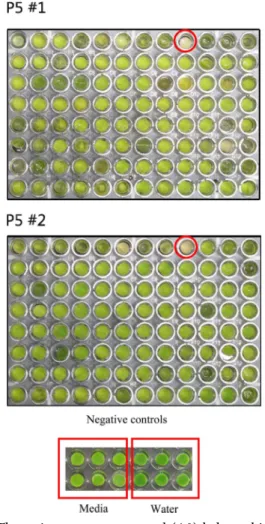
메타게놈으로부터 합성되는 제초활성물질을 찾기 위하 여 그림 1에 나타낸 방법과 같이 오이 떡잎절편을 이용하 여 잎의 황화, 백화 또는 괴사 등의 증상을 유발하는 클론 을 스크리닝 하였고, 세 번 이상의 반복실험을 통해 백화 현상을 나타내게 하는 A9 위치를 1차 선택 하였다(Fig. 1).

본 연구 그룹에서 보유하고 있는 메타게놈라이브러리의 경 우 96 well plate 에 보관 중이며 각 well 에는 약 3000 종 류의 서로 다른 클론이 포함된 풀(pool) 단위로 구성되어 있다. 따라서 그림 1의 첫 번째 스크리닝에서 선택한 A9 풀에 특별히 오이 떡잎절편의 백화현상을 유도하는 클론 이 하나 이상 포함되어 있을 것이므로 A9 풀로부터 3000 개의 콜로니(colony) 즉, 단일 클론을 분리 하여 96 well plate (1 colony well

-1

)에 각각 접종 하고 배양 하였다. 각 웰 당 단일 클론으로 존재할 것으로 판단되는 메타게놈 배양액 을 가지고 동일한 실험을 수행하였고, Fig. 2에 나타낸 바 와 같이 7-A5, 7-G9, 8-D8, 8-D9, 9-A5, 9-E11, 9-G1, 9-G12 를 포함한 강력한 탈색 효과를 나타나게 하는 클론을 확인 하였다(Fig. 2). 상기 여덟 종류의 단일 클론은 다른 종류의 검정법을 통해 제초활성을 확인하였다.

오이 떡잎절편 검정법은 제초제를 경엽처리하는 경우를 고려하였으며, 오이뿐 아니라 다양한 식물에서도 병원균이 나 제초제를 포함한 다양한 물질에 대한 반응을 연구하는 데 자주 이용되는 방법이다(Olmstead et al., 2000; Tworkoski, 2002). 이 방법은 식물 시스템을 함에도 불구하고 잎 절단 면이 연약하고 반응 성이 좋기 때문에 비교적 간편하게, 빠 른 시간 안에 결과물을 확인 할 수 있는 장점이 있으나 같 은 이유로 false positive의 빈도가 매우 높아 여러 번의 반 복실험으로 경향을 파악해야 한다는 단점이 있다.

Fig. 1. The active metagenome pool (A9) led to whitening of cucumber cotyledon leaf discs. Representative picture of the repetition after 7 days following the culture broth application on leaf discs. The leaf disc inside red circle (A9) whitened by the metagenome culture broth.

Fig. 2. The selected active single clones inhibited microalgal

growth. The black bar represents algal growth change of

Scenedesmus accuminatus (A) and Chlorella vulgaris (B) for two

days after mixed with metagenome culture broth.

(4)

미세조류 생장 저해 검정법

민물에 서식하는 남조류에 속하는 미세조류는 낮은 농도 의 다양한 제초제에도 민감한 반응을 보여 환경내 제초제 바이오센서(biosensor)로 개발하고자 한다는 보고가 있다 (Védrine et al., 2003; Podola and Melkonian, 2005; Ma et al., 2002). 미세조류는 단일 세포 형태이며 수생이기 때문 에 플라스크에서 또는 매우 간략한 배양 형태인 96 well plate 에서도 배양이 용이 하여 HTS 시스템으로 사용하기 편리하다(Pavlic et al., 2006). Fairchild 등이 연구한 여섯 종 류의 조류를 사용하여 다양한 제초제에 대한 민감도를 조 사한 기존의 결과에 따르면 Chlorella와 Scenedesmus가 여 러 제초제에 대해 상대적으로 민감하게 영향을 받았다고 한다(Fairchild et al., 1998).

본 실험에서는 기존 연구 결과를 참고하여 검정용 미세 조류로 Chlorella vulgaris와 Scenedesmus accuminatus를 사용 하여 상기 오이떡잎절편 검정법을 통해 백화현상을 유도 한 8종류의 단일 클론에 의한 조류의 생장저해 활성이 나 타나는지 확인하였다. 이때 오이떡잎절편에 활성이 없었던 4-D1과 4-D5 단일 클론을 음성 대조군으로 사용 하였다.

충분히 배양한 두 종류의 조류 배양액을 96 well plate에 분 주하고 동일 부피의 메타게놈 배양액을 처리한 뒤 처리 당 일과 2일 후 673 nm에서 조류 흡광도의 변화를 살펴본 결 과 오이떡잎절편에 백화현상을 야기한 단일클론 모두 흡 광도의 변화를 야기하지 않았거나 감소시켜 조류의 생장 을 억제하는 활성을 나타내는 것을 확인 할 수 있었다(Fig.

2.). 반면 음성 대조군으로 사용한 4-D1과 4-D5, 8-D8, 메 타게놈 배양용 배지(LB), 메타게놈 호스트 배양액(EP100) 의 경우 흡광도가 크게 증가하여 상대적으로 조류 생장억 제 활성이 낮거나 없는 것으로 나타났다(Fig. 2.). 조류 생 장저해 검정법의 경우 96 well plate등의 microplate 사용이 용이하고 식물 시험을 하는 경우 보다 검정 시간이 비교적 짧은 편이며 시험 반복수를 최대화 할 수 있으므로 대량의 스크리닝에는 가장 적합한 방법이라고 할 수 있다.

식물종자 발아저해 검정법

제초활성이 있는 메타게놈 배양액이 토양내 식물 종자의 발아에 미치는 영향을 예측하기 위한 실험으로 애기장대 종자의 in vitro 발아 시험을 수행 하였다. 애기장대 에코타 입 콜럼비아(Arabidopsis thaliana Col-0) 종자를 24 well plate 한 웰당 일정한 개수의 종자가 들어가도록 분주하고 종자 위에 제초 활성을 나타내는 메타게놈 클론 배양액을 100 µl 씩 첨가하고 정치배양 하면서 일주일 후, 발아율 및 발아 상태를 관찰하였다.

그 결과, Table 1에 나타낸 바와 같이, 8-D9를 제외한 모 든 처리구에서 발아율 자체에 미치는 영향은 없었고 다만

발아 후 자라난 뿌리의 길이에서 다소 차이를 나타냈다. 음 성대조군으로 사용한 4-D1과 8-D6의 경우에도 뿌리 생장 이 저해 되었고 배지만을 처리한 경우에만 정상적인 뿌리 생장이 이루어졌다. 상대적으로 7-A5, 7-G9, 8-D8의 경우 다른 처리구에 비해 뿌리 생장이 저해 되었다(Table 1). 따 라서 식물종자 발아저해 검정법은 대장균이 배양된 배양 액을 단독으로 사용 할 경우 발아율이나 생장저해를 관찰 하기에 명확한 방법으로 사용될 수는 없으며 다른 검정법 과 함께 사용하여 특징을 비교해야 할 것으로 생각된다.

In vivo activity 확인

상기 실험을 통하여 생장저해 효과를 나타내는 선발된 단일 클론의 실제 식물체에 대한 살초효과를 확인 하기 위 해 5종의 선발클론(8-D9, 9-A5, 9-E11, 9-G1 and 9-G12)을 대량배양(1 L) 한 후 배양액의 염분 제거를 위해 butanol 분 획만을 농축하여 바랭이(D. sanguinalis)에 경엽처리 하였다.

Fig. 3 및 Table 2에 나타낸 바와 같이, 메타게놈 배양액을 처리한 바랭이 군에서는 처리 2일 후부터 육안으로 관찰 이 가능했으며, 선발된 활성 단일 클론의 배양액을 처리한 군과 음성 대조군(4-D1, 4-D5 and media)을 비교하였을 때, 선발된 단일 클론의 살초 효과를 관찰 할 수 있었다. 8-D9, 9-A5, 9-E11 의 경우 음성대조군과 비교 할 때 확실히 증가 한 살초효과를 나타내지는 않았으나 9-G1과 9-G12 클론 배양액의 경우 90%의 살초 효과를 나타냈다(Fig. 3 and Table 2). 결과적으로 9-G1과 9-G12를 최종 살초효과를 나타내는 단일 클론으로 선택할 수 있었다.

따라서 오이 떡잎절편검정, 미세조류 생장저해검정, 종자 Table 1. Seed germination assay. Active single clones selected from cucumber cotyledon leaf disc assay inhibited root growth of germinated Arabidopsis Col-0 seeds.

Clone Germination Relative Root

Length Note

7-A5 6/8 5-10%

7-G9 6/7 10-30%

8-D8 11/12 10-30%

8-D9 1/11 Below 5%

9-A5 4/4 20%

9-E11 9/9 20-70%

9-G1 10/11 20-80%

9-G12 10/10 20-70%

4-D1 9/10 10-50% Weak negative control 8-D6 11/11 70% Negative control Media 10/10 100% Negative control

(media only)

(5)

발아저해검정 등을 통해 광범위한 메타게놈 라이브러리로 부터 제초활성이 있는 단일클론의 스크리닝이 가능하며, 선별한 단일 클론을 실제 식물체에 적용했을 때 에도 충분 한 활성을 관찰 할 수 있음을 확인하였다. 현재 선별한 메 타게놈 단일 클론이 합성하는 제초활성 물질의 동정과 단 일 클론의 유전자 서열을 분석하여 제초활성 물질을 합성 하는데 필요한 유전자군의 구조 분석을 진행 중에 있다. 제 초제 연구 분야에서 메타게놈은 흥미로운 재료이며 메타

게놈이 제초활성물질을 개발하는 재료로서 가능성이 있음 을 소개한 적은 있으나 아직 제초활성물질이 동정된 바는 없다(Kao-Kniffin et al., 2013). 만약 본 연구를 통해 선발 된 클론에 의해 만들어진 제초활성물질이 밝혀진다면 메 타게놈에서 유래된 최초의 물질이 될 것으로 기대하고 있다.

요 약

메타게놈(metagenome)은 연구실에서 배양이 불가능한 미 생물을 포함한 자연계에 존재하는 미생물의 유전자를 직 접 연구하는 학문분야이다. 지구상 거의 모든 자연, 인공 환경에서 살고 있는 미생물 DNA를 분리·정제하는 것이 가능하며, 재조합 DNA 기술 등을 이용하여 배양 가능한 숙주미생물에 메타지놈을 클로닝함으로서 메타지놈 라이 브러리를 제작할 수 있다. 최근 메타게노믹스를 통하여 자 연계에 존재하고 있는 대다수의 미생물들이 실험실에서 배 양되지 않았던 이유를 구명할 수 있게 되었고, 그들이 가 지고 있는 생태학적인 의미와 역할에 대한 이해와 더불어 점차 그 응용 분야와 범위도 확대되고 있다. 이와 같은 메 타게놈의 응용 분야 확대의 한 방안으로 본 연구에서는 새 로운 제초활성 물질 및 제초활성 물질 생산에 필요한 유전 자를 확보하기 위해 메타게놈 라이브러리를 대상으로 오 이 떡잎절편 검정, 미세조류 생장저해 검정, 종자발아 저해 검정의 HTS (high throughput screening) 시스템을 구축하 였고, 구축된 시스템으로부터 선발된 최종 단일 클론인 9-G1 과 9-G12의 바랭이에 대한 in vivo assay를 통해 본 연구에서 개발한 HTS 시스템의 유효성을 확인 하였다. 후속연구로서 활성단일클론이 만들어내는 제초활성물질의 동정 및 제초활 성물질을 합성하는 유전자군에 대한 연구를 수행 중에 있다.

주요어: 제초제, 고속스크리닝, 메타게놈, 천연물 Fig. 3. Butanol fraction of culture broth of active single clones

led to desiccation and growth retardation of Digitalis sanguinalis in vivo. Representative pictures of D. sanguinalis at 3 days after spraying butanol fraction of culture broth of the selected single clones. The growth of 9-G1 and 9-G12 treated plants was strongly inhibited and desiccated relative to the negative controls (4-D1, 4-D5, media control, EP100 and mock).

Table 2. In vivo application of culture broth from selected single clones. Butanol fraction of culture broth of active single clones led to desiccation or growth retardation of Digitalis sanguinalis in vivo.

Clone Herbicidal Activity

8-D9 50%

9-A5 30%

9-E11 40%

9-G1 90%

9-G12 90%

4-D1 40%

4-D5 30%

Media 10%

(6)

Acknowledgement

This research was supported by a project No SI1508 (Development of crop protection agents leading the future market) and thse Integrated Technology Development program (project No KK1507-C04; High-throughput screening-based metagenomic discovery of crop protection agents) from the Korea Research Institute of Chemical Technology.

References

Allen, M.B. 1952. The cultivation of Myxophyceae. Arch.

Microbiol. 17:34-53.

Bayer, E., Gugel, K., Hägele, K., Hagenmaier, H., Jessipow, S., et al.

2004. Stoffwechselprodukte von mikroorganismen. 98.

Mitteilung. Phosphinothricin und Phosphinothricyl-Alanyl- Alanin. Helv. Chim. Acta. 55:224-239.

Bender, C.L., Alarcon-Chaidez, F. and Gross, D.C. 1999.

Pseudomonas syringae phytotoxins: mode of action, regulation, and biosynthesis by peptide and polyketide synthetases.

Microbiol. Mol. Biol. Rev. 63:266-92.

Courtois, S., Cappellano, C.M., Ball, M., Francou, F.X., Normand, P., et al. 2003. Recombinant environmental libraries provide access to microbial diversity for drug discovery from natural products. Appl. Environ. Microbiol. 69:49-55.

Daniel, R. 2004. The soil metagenome--a rich resource for the discovery of novel natural products. Curr. Opin. Biotechnol.

15:199-204.

Duke, S., Abbas, H., Amagasa, T. and Tanaka, T. 1996. Phytotoxins of microbial origin with potential for use as herbicides. Critical Reports on Applied Chemistry 35:82-112.

Fairchild, J.F., Ruessler, D.S. and Carlson, A.R. 1998. Comparative sensitivity of five species of macrophytes and six species of algae to atrazine, metribuzin, alachlor, and metolachlor. Environ.

Toxicol. Chem. 17:1830-1834.

Gillespie, D.E., Brady, S.F., Bettermann, A.D., Cianciotto, N.P., Liles, M.R., et al. 2002. Isolation of antibiotics turbomycin a and B from a metagenomic library of soil microbial DNA. Appl.

Environ. Microbiol. 68:4301-4306.

Hahn, D.R., Graupner, P.R., Chapin, E., Gray, J., Heim, D., et al.

2009. Albucidin: a novel bleaching herbicide from streptomyces albus subsp. chlorinus NRRL B-24108. J. Antibiot. 62:191-194.

Handelsman, J., Rondon, M.R., Brady, S.F., Clardy, J. and Goodman, R.M. 1998. Molecular biological access to the chemistry of unknown soil microbes: a new frontier for natural

products. Chemistry & biology. 5:R245-R249.

Henne, A., Schmitz, R.A., Bomeke, M., Gottschalk, G. and Daniel, R. 2000. Screening of environmental DNA libraries for the presence of genes conferring lipolytic activity on escherichia coli. Appl. Environ. Microbiol. 66:3113-3116.

Hoagland, R.E. 1990. Microbes and microbial products as herbicides. An overview. ACS Symposium Series1990. 439:2- 52.

Hoerlein, G. 1994. Glufosinate (phosphinothricin), a natural amino acid with unexpected herbicidal properties. Rev.

Environ. Contam. Toxicol. 138:73-146.

Iqbal, H.A., Feng, Z. and Brady, S.F. 2012. Biocatalysts and small molecule products from metagenomic studies. Curr. Opin.

Chem. Biol. 16:109-16.

Kao-Kniffin, J., Carver, S.M. and DiTommaso, A. 2013. Advancing weed management strategies using metagenomic techniques.

Weed Sci. 61:171-184.

Lämmle, K., Zipper, H., Breuer, M., Hauer, B., Buta, C., et al. 2007.

Identification of novel enzymes with different hydrolytic activities by metagenome expression cloning. J. biotechnol.

127:575-592.

Langer, M., Gabor, E.M., Liebeton, K., Meurer, G., Niehaus, F., et al.

2006. Metagenomics: An inexhaustible access to nature's diversity. Biotechnol. J. 1:815-821.

Lydon, J., Duke, S.O. and Singh, B. 1999. Inhibitors of glutamine biosynthesis, Marcel Dekker: New York, NY, USA.

Ma, J., Xu, L., Wang, S., Zheng, R., Jin, S., et al. 2002. Toxicity of 40 herbicides to the green alga chlorella vulgaris. Ecotoxicol.

Environ. Saf. 51:128-132.

Olmstead, J.W., Lang, G.A. and Grove, G.G. 2000. A leaf disk assay for screening sweet cherry genotypes for susceptibility to powdery mildew. HortSci. 35:274-277.

Pavlic, Z., Stjepanovic, B., Horvatic, J., Persic, V., Puntaric, D., et al.

2006. Comparative sensitivity of green algae to herbicides using Erlenmeyer flask and microplate growth-inhibition assays. Bull.

Environ. Contam. Toxicol. 76:883-890.

Podola, B. and Melkonian, M. 2005. Selective real-time herbicide monitoring by an array chip biosensor employing diverse microalgae. Journal of Applied Phycol. 17:261-271.

Simon, C. and Daniel, R. 2011. Metagenomic analyses: past and future trends. Appl. Environ. Microbiol. 77:1153-1161.

Tworkoski, T. 2002. Herbicide effects of essential oils. Weed Sic.

50(4):425-431.

Védrine, C., Leclerc, J.C., Durrieu, C. and Tran-Minh, C. 2003.

Optical whole-cell biosensor using Chlorella vulgaris designed

for monitoring herbicides. Biosens Bioelectron. 18:457-463.

수치

Fig. 1. The active metagenome pool (A9) led to whitening of cucumber cotyledon leaf discs
Table 2.  In vivo application of culture broth from selected single clones. Butanol fraction of culture broth of active single clones led to desiccation or growth retardation of Digitalis sanguinalis in vivo.

참조

관련 문서