• 검색 결과가 없습니다.

Location Based Concierge Service with Spatially Extended Topology for Moving Objects

N/A
N/A
Protected

Academic year: 2021

Share "Location Based Concierge Service with Spatially Extended Topology for Moving Objects"

Copied!
10
0
0

로드 중.... (전체 텍스트 보기)

전체 글

(1)

* Postdoctoral Fellow, Department of Information Technology Leadership, Washington & Jefferson College, USA

Location Based Concierge Service with Spatially Extended Topology for Moving Objects

Byoungjae Lee*

ABSTRACT

Beyond simple transfer of information through sensor network, this study will provide the insights about the way to embody the real context aware location based service in an ubiquitous computing environment. In this paper, a new formal approach is introduced to derive knowledge about the scope of influence for a point object. A scope of influence is defined as the conceptual area where there is a possibility of the phenomenon or event occurring because of this point object. A point object can be spatially extended by considering this scope of influence in conjunction with the point. These point objects are called Spatially Extended Point (SEP) objects. Compositions of gradual changes of topological relations between a SEP and the environment near the SEP show how to represent the qualitative spatial behaviors of a SEP objects. These qualitative spatial behaviors will be good standards for Location Based Service (LBS) to provide more subdivided and suitable information to the users.

Keywords : Qualitative spatial behavior, Ubiquitous computing environment, Scope of influence, Spatially Extended Point (SEP), Location Based Service (LBS)

요 약

이 연구는 센서 네트워크를 통한 단순한 정보 전달을 넘어서서 유비쿼터스 컴퓨팅 환경에서의 진정한 상황 인식 위치 기반 서비스를 구현하기 위한 방법에 대한 제안을 하고자 한다. 그러기 위해, 이 글에서는 점 개

체의 영향력 범위에 대한 새로운 형식의 접근이 소개된다 . 여기서, 영향력 범위란 점 개체 주변에 점 개체로

인해 어떤 현상이나 사건이 발생한 가능성이 있는 구역을 설정한 것을 뜻한다. 점 개체는 이러한 영향력 범위 설정을 통해 공간적으로 확장 될 수 있다 . 이러한 점 개체를 Spatially Extended Point (SEP) 개체라 한다.SEP와 그 주변 환경 사이의 위상적 관계의 점진적 변화 조합은 그 개체의 정성적 공간 행위를 표현하는데 이용될 수 있다. 이렇게 표현된 정성적 공간 행위들은 좀더 구체적이고 적합한 정보를 사용자에게 제공하는데 필요 한 기준으로 쓰일 수 있다.

주요어 : 정성적 공간 행위, 유비쿼터스 컴퓨팅 환경, 영향력 범위, 공간적으로 확장된 점, 위치 기반 서비스

(2)

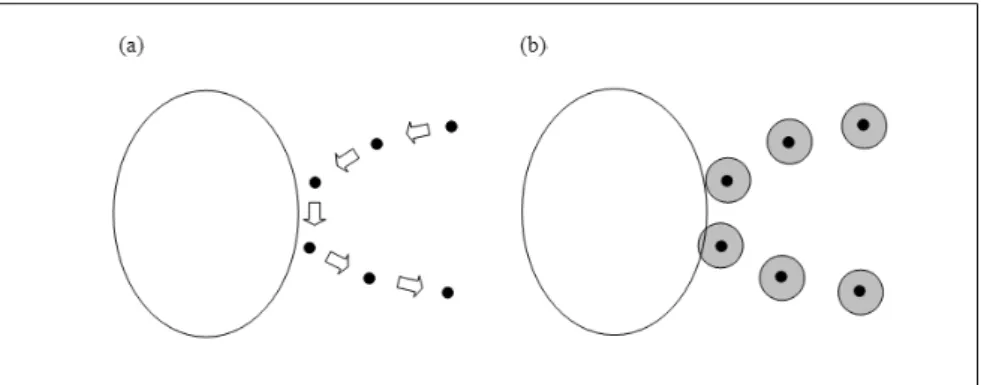
Figure 1. Behaviors of point object and spatially extended point object

1. Introduction

The meaning of ubiquitous computing is continuously extending to the technology that makes it possible to con- nect and control the things around us, like mobile phones, home appliances, audio/visual devices machines, and so on. Weiser (1991) emphasized that the goal of ubiquitous computing is to enhance computer use by making many computers available throughout the physical environment, at the same time making them effectively invisible to the user. According to Huber and Huber (2002), there are two ways that we can be supported by computers wherever we go. One is that computers are embedded in everything around us. The other is that we carry the device or tool which can communicate with any other computer, chip, and sensor in the network. The former is similar to Mark Weiser’s idea of omnipresence. The latter focuses on mobility and interoperability. Recently, the mobile phone is being widely used for a variety of powerful functions beyond simple conversation. Thus, the idea of mobile devices or tools is gaining a persuasive power, and the meaning of ubiquitous computing is ex- panded. If the computer chip is embedded in a mobile device like mobile phone, we can use computers anywhere, and ubiquitous computing may be realized more easily.

Furthermore, if the things around us have embedded pro- cessors and are controlled by this mobile device through back networks, it can be considered an ubiquitous comput- ing environment.

Therefore, it is natural that Location Based Services (LBS) are highlighted as one of the fastest growing con- cierge applications in an ubiquitous computing environ- ment. However, current LBS products are limited to pro- viding fixed information for the specific location of a mobile device or information receiver without consider- ing their past or future behaviors of them. In this situa- tion, understanding the behavioral pattern of a point ob- ject such as a mobile device is a crucial issue for a spa- tial decision support system. In contrast to the geometric pattern recognition through detecting a change of loca- tion of point object, little attention has given to the qua- litative behavior of point object. This is largely due to the relatively trivial relationship between points and hig- her dimensional objects. In Figure 1(a), the movement of the point object around a region shows such behav- ior. However, there is no way to represent this behavior in a qualitative manner because the topological relation between a region and a point object is essentially unch- anged. The point object is always outside the region.

If a scope of influence is added to this point object, we can detect a change of topological relation between a region and a point object (Figure 1(b)). Here, the scope of influence for the point object can be defined as the conceptual area where there is a possibility of the phe- nomenon or event occurring because of this point ob- ject. The definition of a scope of influence for each po- int object is flexible, and it is possible to define a var- iety of scopes of influence for the same point object.

Therefore, variety qualitative behaviors can be found

(3)

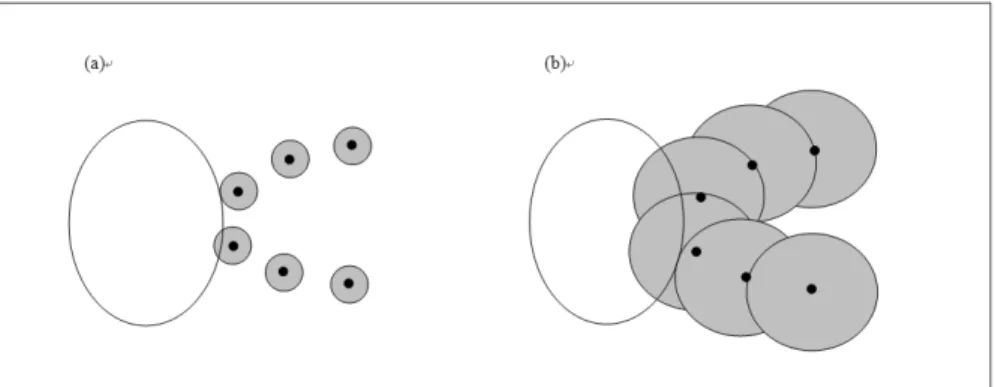
Figure 2. Different behaviors for same movement of a point object for same point object. Lee and Flewelling (2004) intro-

duced this kind of point object as a Spatially Extended Point (SEP) object. There are several possible applica- tion of this concept to ubiquitous computing including location based services and wireless GIS. For instance, location-specific information or advertisements could be provided based on the qualitative spatial behavior of a person who has a mobile device. Moreover, an emer- gency management system can be alerted by detecting suspicious behavior of a dangerous point object. In this paper, the concept of a SEP will be explained in detail, and a framework for a relationship between a SEP ob- ject and higher dimensional object such as a region in this study will be presented. By adopting Egenhofer’s 9-intersection model, a new model for the topological relations between a region and a spatially extended point object will be presented. It was found that there are fo- urteen topological relations between a region and a spatially extended object. The gradual change between these fourteen topological relations can be represented as the spatial behavior of a point object.

The remainder of this paper is structured as follows:

the next section provides a definition and significance of SEP. Section 3 introduces a new approach for repre- senting topological relations between a region and a SEP.

Section 4 shows the way to represent the movement be- havior of SEP by using the concept of gradual changes between topological relations between a region and a SEP.

Section 5 presents the conclusions and discusses more complex situations.

2. SPATIALLY EXTENDED POINT

A scope of influence for a point object is not a physi- cal area but an area of potential interaction. It is an invi- sible and conceptual area which is defined for a specific purpose of analysis. Based on its own definition, there can be various types of the scope of influence for a point object. For example, a distance which a person’s hand can reach can be a scope of influence for this person who will be represented as a point object in spatial data- base or a transmission footprint around a broadcast ante- nna can be defined as a scope of influence for the broad- cast antenna. Moreover, various definitions for the same point object are possible, like the distance which a person can see and the distance which this person can reach in one minute. This flexibility can provide computational advantages for qualitative spatial reasoning about a beha- vior of a point object. By using the same data which is storing the change of location of a specific point object, different behavior can be represented based on the defi- nition of a scope of influence associated with this point object. Figure 2 shows different behaviors for the same movement of a point object which is used in Figure 1.

In Figure 2(a), the relationship between a region and a spatially extended point object is changed as follows:

disjoint → disjoint → meet at the boundary → overlap

→ disjoint → disjoint. By contrast, Figure 2(b) shows different series of the relationship as follows: disjoint

→ disjoint → overlap → overlap → meet at the boun-

(4)

dary → disjoint.

A point object can be spatially extended by adding the concept of its own interior, boundary, and exterior.

Here, a point object is renamed a pivot. The pivot is conceptually similar to a 0-dimensional object. Major di- fferences between an ordinary point and a pivot are that a pivot is a standard for determining which region or any other object is affecting the SEP object substantially.

Even after a point object is spatially extended, this pivot acts as the most significant component for the identifi- cation of the SEP object. The labels for three distinct and mutually exclusive components of the scope of influence match those used by the point-set (or 9-intersection) approach (Clementini et al., 1993;

Egenhofer, 1989; Egenhofer and Franzosa, 1991;

Egenhofer and Herring, 1990) to represent a region.

Like a usual region, the interior of the SEP object should be understood as the sum of infinite possibilities of phenomena or events occurring because of the point object. By contrast, the exterior of the SEP object is a complement of the point object’s influencing area which is including the interior and boundary. The exterior can be understood as the sum of the possibilities which are 0 or below the acceptable level to be included in the scope of influence. According to the point-set approach for regions, the boundary of the region is defined as the intersection of the closure of the region and the closure of the complement of the region (Egenhofer and Franzosa, 1991). The boundary of the SEP object is also described as a threshold line which is neither the interior nor exterior. It should be understood as both a limit of the scope of influence and a start of the non-influencing area. Furthermore, the boundary of the SEP object plays an important role in qualifying a limit of the other objects such a region or line. That is, if a boundary of the SEP object is sharing a common point with a boundary of the other objects without any overlap between them, the SEP object is detecting the existence of that object as a prior step of ‘overlap’ (Ege- nhofer, 1989) or ‘connection’ (Clarke, 1985; Randell et al., 1992).

There have been many attempts to add more refinements

to generic concept of the topological relations, such as the gradual change (Egenhofer and Al-Taha, 1992) bet- ween the conceptual neighborhood (Freksa, 1992), dimen- sion of intersection (Clementini et al., 1993), consistency between R 2 and Z 2 (Egenhofer and Sharma, 1993), content and component equivalence (Egenhofer and Franzosa, 19 95), relational consistency (Grigni et al., 1995), integrity constrains based on the aggregation of the regions (Tryfo- na and Egenhofer, 1997), metric refinement (Egenhofer, 1997), and metric details for natural-language spatial rela- tions (Shariff et al., 1998). Moreover, some studies applied a vague boundary concept like the broad boundary con- cept (Clementini and Di Felice, 1997), egg-yolk theory (Cohn and Gotts, 1996; Lehmann and Cohn, 1995), and rough set theory (Bittner and Stell, 2002). However, the fundamental limitation of generic topological relations has not been overcome yet. The topological concept cannot define the distinction between objects close together or far apart. Only the cases that two objects are involved are chosen as the subject to be looked into (Hernandez, 1994). As we can see Papadias et al. (1995) gives an example of the number of hits per search about the topolo- gical relations between spatial objects, the majority of the relations between spatial objects in real world is disjo- int. As the first step to overcome this limitation, the con- cept of a spatially extended point object can provide the chance to represent and reason new relations between spatial objects which had previously even disjoint rela- tions. By adding a scope of influence into a point object, a SEP object can define new relations with the other object, such as a region or line.

3. A FRAM EW ORK FOR A SPATIALLY EXTENDED POINT AND A REGION

In this section, as an application of the concept of

a spatially extended point object, a relationship between

a SEP and a general region will be examined. Here, the

region includes any specified environmental factor which

can potentially limit or affect the event or phenomena

resulting from the pivot in the SEP. For instance, a cross-

(5)

   ∩    ∩    ∩   (1)

Figure 3. Relationships between a region and point object

Figure 4. Binary topological relationships between a region and point object

walk region can limit the movement of a vehicle, and a building region can affect the signal transmission of a mobile device. Therefore, the region can be chosen and defined based on a specific point object.

3.1 12-intersection model

Conventionally, a point object is described as a 0-di- mensional object. Thus, a point object has been defined by a conceptual location linked to a time, theme, and value. The basic definition is that a point object has no length, area, volume, or any other range. Therefore, the usual relationships between a region and point object are relatively straight forward as shown in Figure 3.

Using the 9-intersection model, a point has a boun- dary (the point) and exterior (everything else). All rela- tionships between the point’s exterior and a region’s parts are non-empty and all relationship with the point’s interior are empty. Therefore, it is possible to represent point-region relationships with a 3×1-matrix. M p repre- sents the criteria for region-point relations (Equation 1) where the region-point relations can be defined as the binary topological relationships based on a point object (P), and a region’s interior (R°), boundary (R), and exterior (R ).

Hence, by considering the values empty (Ø) and non- empty (¬Ø), the relationships between a region and point object can be simply represented in Figure 4.

A SEP has its own interior, boundary, and exterior to represent its own scope of influence. In addition to

interior (P°), boundary (P), and exterior (P ) from the 9-intersection model, a pivot (P ∙ ) can be added as the major factors for representing a SEP. Even though the interior, boundary, and exterior of the SEP show the sim- ilar shape of the interior, boundary, and exterior of the region, those of the SEP should not be understood as identical to those of the region.

A 3×4-matrix, M sep shows the criteria for the region- SEP relations (Equation 2). The first row of M sep refers to the relations between the pivot of the SEP and the region. The other rows of M sep refer to the relations be- tween the scope of influence of the SEP and the region.

This 3×4-matrix was named as 12-intersection model in this paper.

  

∩ 

∩  

∩ 

∩ 

∩  

∩ 

 ∩ 

 ∩   ∩ 

∩ 

∩  

∩ 

(2)

3.2. Topological Relations

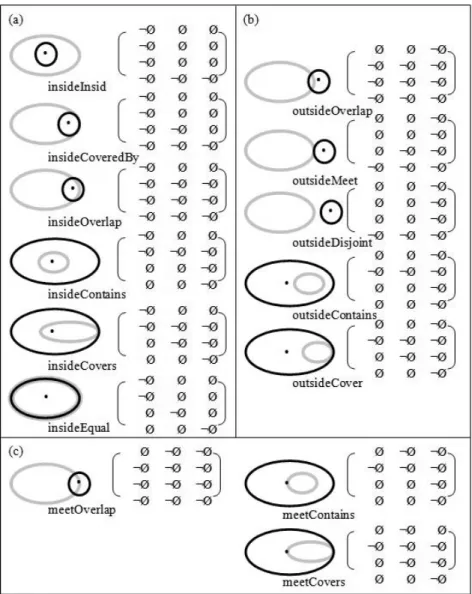
From the perspective of a region-like spatially exte- nded point, the relationships between a region and spa- tially extended object can be described by extending the concept of eight topological relations between two reg- ions (Bennett et al., 2000). It was found that there are fourteen topological relations between a region and a SEP. These fourteen topological relations can be divided into three parts based on the location of the pivot of the SEP: pivot within the region (Figure 5a), pivot out- side the region (Figure 5b), and pivot on the boundary of the region (Figure 5c).

The label for each topological relation is composed

(6)

Figure 5. Binary topological relations between a region and a spatially extended point ((a): Pivot within the region, (b): Pivot outside the region, (c): Pivot on the boundary)

of two concatenated words. In each label the first words describes the location of the pivot (i.e. inside, outside, and meet). The second word describes the relationship between the scope of influence of the SEP and a region (i.e. contains, overlap, and disjoint). These scope-region labels match those used by Egenhofer and Franzosa (1991) for topological relations between two regions.

Clementini and Di Felice (1997) identified fourteen

topological relations between a region with a broad

boundary and a region with a sharp boundary. While it

is interesting that both models generate fourteen relations,

there are significant differences. First of all, there are

semantic difference between the interior, boundary, and

exterior of the SEP and the corresponding parts of a re-

gion. Even after it is extended, the SEP is still a point,

and the relations between a region and a SEP are also

(7)

understood from this perspective. Additionally, as this paper mentioned, the pivot retains the 0-dimensional characteristics even after the point is spatially extended.

Thus, the pivot cannot act like the usual interior of the region. It means that the pivot cannot exist or share with more than one part among three parts of the region like the interior of the region with broad boundary does.

4. BEHAVIOR OF A SPATIALLY EXTENDED POINT W ITH A REGION

Compositions of gradual changes between topological relations show how to represent the movement of a spatia- lly extended point object in relation to a region. By exami- ning a set of topologic relations between a SEP and a region it may be possible to detect behaviors, or reoccurr- ing patterns. The actual semantic character of the object being represented may also imply specific goals or intents that could be assigned a behavioral signature. The model presented here provides a richer vocabulary to describe these near-boundary behaviors. Gradual changes of topolo- gical relations can be described more qualitatively as the behaviors of a SEP object. Sample movement behaviors can be expressed as follows:

1) Detect a boundary

2) Fail to escape from the region

3) Give up escaping from the region

4) Escape from the region

5) Detect a region

6) Fail to enter the region

7) Give up entering the region

8) Enter the region

9) Return to the region

10) Path through the region

Existing relations between a region and point object can similarly show only Behaviors 3, 4, 7, 8, 9 and 10 because current approaches have focused on the exis- tence of point objects within a specific region at a spec- ific time. In Behaviors 9 and 10, it is possible that the infinite behaviors can exist between insideInside and out- sideDisjoint. Here, those are shown for comparison to the usual behaviors of a point.

An important benefit of the SEP concept is that current

(8)

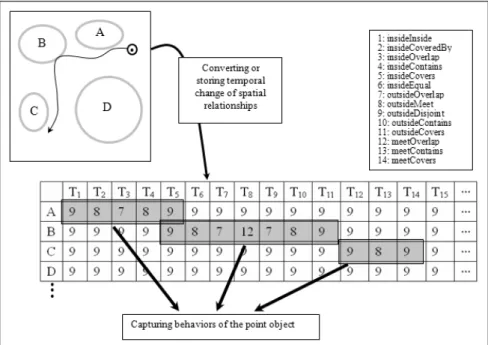
Figure 6. Process of capturing movement behaviors of a point object in relation to several regions geospatial database which is storing temporal changes of

the location can be used to capture the behaviors of the various point objects. Figure 6 shows the process of cap- turing the movement behaviors of a point object in rela- tion to several regions. Objects A, B, C, and D are the general regions, and one SEP is moving around these regions. Based on the predefined fourteen topological rel- ations between a SEP and a region, temporal changes of spatial relationships between the SEP and region A, B, C, and D are recorded in a database. Here, this database can be created from the geospatial database which is pre- viously recording temporal changes of the location by adding the SEP scope of influence. T 1 , T 2 , and so on are observation times in order. And then, from these ob- servations, the spatial data mining methods will be used to find frequent or reoccurring patterns as the behaviors of the point object. Of course, thorough verification is necessary to construct taxonomy of qualitative spatial behaviors of a point object. As a result of this, there is potential for associating intents or goals of the beha- viors of the point objects to LBS. These intents or goals can, in turn, be used to assign appropriate actions.

Location Based Services (LBS) should then be able to prepare more focused information for each behaviour (Li, 2008; Park et al., 2002). With current LBS applica- tions, there is no desirable difference in the behavior of the customer (point) as it passes each service area (region).

Moreover, in Figure 6, the SEP has a chance to have the same outsideMeet (8) relation with Regions A, B, and C at different times. However, the information which is needed for each situation should be different because the SEP is exhibiting different behaviors. It is true that an empirical study will be needed to understand which information is needed for specific behaviors. Nonetheless, the concept of the SEP offers the power to dramatically upgrade current LBS approaches.

5. CONCLUSIONS AND FUTURE W ORK

Definitions of a scope of influence and basic struc-

tures for a spatially extended point object have been

introduced. In ubiquitous computing environment, the

(9)

significance of the concepts of the SEP object is the richer vocabulary for expressing the dynamics of point- like object in spatial databases and applications. Based on the formalism for a SEP object, a framework for topological relations between regions and point objects have been developed by using the concept of SEP.

Topological relations between a region with a SEP are described by a 3x4 matrix we call the 12-intersection model. Gradual changes between binary topological rel- ations among 12-intersection model are used for descri- bing the qualitative movement behaviors of a SEP. These qualitative spatial behaviors can be good standards for Location Based Service (LBS) to provide more subdivi- ded and suitable information to the users.

Further work with SEP objects will consider a frame- work for multiple SEP objects. Between multiple scopes of influence of different SEP objects, there can be many peculiar definitions beyond generic topological relations.

There can be a conflict between exclusive SEP objects, or a synergy because of interdependent relationships. To provide comprehensive rules for this case, more in depth examination should be performed. Moreover, it is possible that there are more complex compositions of topological relations between region and SEP. For example, if many SEPs try to cross the same boundary at the same time, the topological relations should be described in a different way. Even though there is room for discussing various complex situations, this study will be the first step to formalize the qualitative behaviors of spatially extended point objects.

REFERENCES

Bennett, B., Cohn, A. G., Torrini, P., and Hazarika, S. M., 2000, A foundation for region-based qualitative geo- metry, In: the 14th European Conference on Artificial Intelligence (ECAI-2000), 204-208.

Bittner, T. and Stell, J. G., 2002, Vagueness and Rough Location, Geoinformatica, 6, 99-121.

Clarke, B. L., 1985, Individuals and points, Notre Dame J. Formal Logic, 26, 61-67.

Clementini, E. and Di Felice, P., 1997, Approximate topolo-

gical relations, International Journal of Approximate Reasoning, 16(2), 173-204.

Clementini, E., Di Felice, P., and van Oosterom, P., 1993, A Small Set of Formal Topological Relationships for End-User Interaction, In: Advances in Spatial Databases - Third Internation Symposium, 277-295.

Cohn, A. G. and Gotts, N. M., 1996, The ‘Egg-Yolk’ Repre- sentation of Regions with Indeterminate Boundaries.

In P. A. Burrough and A. U. Frank (Eds.), Geographic Objects with Indeterminate Boundaries (pp. 171-187), London: Taylor & Francis, 374 pages.

Egenhofer, M., 1997, Query Processing in Spatial-Query- by-Sketch, JVLC, 8(4), 403-424.

Egenhofer, M. and Sharma, J., 1993, Topological Relations Between Regions in R2 and Z2, In: Advances in Spatial Databases-Third International Symposium on Large Spatial Databases, SSD. Singapore.,316-336.

Egenhofer, M. J., 1989, A Formal Definition of Binary Topological Relationships, LNCS, 367, 457-472.

Egenhofer, M. J. and Al-Taha, K. K., 1992, Reasoning About Gradual Changes of Topological Relationships. LN CS, 639, 196-219.

Egenhofer, M. J. and Franzosa, R. D., 1991, Point-Set Topological Spatial Relations, International Journal of Geographic Information Science, 5(2), 161-174.

Egenhofer, M. J. and Franzosa, R. D., 1995, On the Equi- valence of Topological Relations, International Journal of Geographic Information Science, 9(2), 133-152.

Egenhofer, M. J. and Herring, J., 1990, A Mathematical Frame- work for the Definition of Topological Relationships, In: Fourth International Symposium on Spatial Data Handling. Zurich, Switzerland, 803-813.

Freksa, C., 1992, Temporal Reasoning Based on Semi- Intervals, AI, 54(1), 199-227.

Grigni, M., Papadias, D., and Papadimitriou, C. H., 1995, Topological Inference, In: IJCAI (1), 901-907.

Hernandez, D., 1994, Qualitative Representation of Spatial Knowledge (1 st ed.), Springer Verlag, 202 pages.

Huber, A. and Huber, J., 2002, UMTS and mobile com- puting (1 st ed.), Artech House Publishers, 460 pages.

Lee, B. and Flewelling, D. M., 2004, Spatial Organicism:

Relations between a Region and a Spatially Extended Point. In: Extended Abstract, The Third International Conference on Geographic Information Science (GI Science 2004).

Lehmann, F. and Cohn, A. G., 1995, The EGG/YOLK reliab-

ility hierarchy: Semantic data integration using sorts

with prototypes, In: 3rd Int. Conf. on Information and

(10)

Knowledge Management, 272-279.

Li, K., 2008, Indoor Spatial Awareness Project and Indoor Spatial Data Model, Journal of GIS Association of Korea, 16(4), 441 - 453.

Papadias, D., Theodoridis, Y., Sellis, T., and Egenhofer, M., 1995, Topological relations in the world of min- imum bounding rectangles: a study with R-trees, In: ACM SIGMOD. San Jose, California, 92-103.

Park, K., Jung, J., and Hwang, M., 2002, Design of gCRM system integrated with LBS, Journal of GIS Associa- tion of Korea, 10(4), 567 - 578.

Randell, D. A., Cui, Z., and Cohn, A. G., 1992, A spatial logic based on regions and connection, In: 3rd Int.

Conf. on Knowledge Representation and Reasoning.

Cambridge, Massachusetts, 165-176.

Shariff, A., Egenhofer, M. J., and Mark, D. M., 1998, Natu-

ral-language spatial relations between linear and areal objects: the topology and metric of English-language terms, International Journal of Geographic Information Science, 12(3), 215-245.

Tryfona, N. and Egenhofer, M., 1997, Consistency among Parts and Aggregates: A Computational Model, Tran- sactions in GIS, 1(3), 189-206.

Weiser, M., 1991, The computer for the twenty-first cent- ury. Scientific American, 265(3), 94-100.

Received (November 7, 2009)

Revised (December 22, 2009)

Accepted (December 22, 2009)

수치

Figure  1.  Behaviors  of  point  object  and  spatially  extended  point  object
Figure  2.  Different  behaviors  for  same  movement  of  a  point  objectfor same point object
Figure  5.  Binary  topological  relations  between  a  region  and  a  spatially  extended  point  ((a):  Pivot  within  the  region,  (b):  Pivot  outside  the  region,  (c):  Pivot  on  the  boundary)
Figure  6.  Process  of  capturing  movement  behaviors  of  a  point  object  in  relation  to  several  regionsgeospatial database which is storing temporal changes of

참조

관련 문서