ORIGINAL ARTICLE
도로개발 사업이 외래식물 유입에 미치는 영향
Impact on Introduction of the Alien Plants by Road Development Projects
추연수ㆍ김중권ㆍ이효혜미*
국립생태원 환경영향평가팀
Yunsoo Chu, Jung-Kwon Kim and Hyohyemi Lee*
Environmental Impact Assessment Team, National Institute of Ecology, Seocheon 33657, Korea
Received 14 September 2017, revised 22 September 2017, accepted 22 September 2017, published online 30 September 2017
ABSTRACT: Linear development such as road and railway construction is considered to be an important factor in the dipersion agent of alien species. The purpose of this study is to investigate the effect of road project implementation on the introduction of alien plants. We selected the roadworks that have been completed or completed by more than 70% of the projects in the Han River basin environment agency. The alien plant data were divided into five phases: pre-construction (P0) and construction (P25, P50, P75, P100) according to the annual process rate. As the construction progresses, the naturalization rate, the urbanization index and the tendency of the number of exotic plants increase. Especially, alien plants were introduced rapidly at the beginning of the construction period, and the introduced species continued to appear until the construction was completed. Therefore, it is necessary to minimize the introduction of ailen plants by concentrating management of embankment process and the vegetation restoration process at the beginning of roadworks.
KEYWORDS: Alien plants, Introduction, Road development, Management, Construction Process
요 약: 도로 및 철도 건설과 같은 선형개발은 외래생물의 확산에 중요한 요인으로 고려된다. 본 연구는 도로사업 수행이 외래식물 유입에 미치는 영향을 파악하기 위하여, 한강유역환경청 관할 사업 (80개 사업) 중 현재 공사가 70% 이상 진행 중이거나 완공된 도로사업장을 대상으로 공정률에 따른 외래식물 변화를 연구하였다. 공정률은 공사 전 (P0)과 공사 중 (P25, P50, P75, P100)의 5단계로 구분하였다. 공사가 진행됨에 따라 귀화율, 도시화지수 및 외래식물 종수가 증가하였다. 특히 외래식물은 공사 초기에 급속히 유입되고 유입종은 공사가 완료될 때까지 지속적으로 출현하는 경향이었다. 그러므로 도로사업장의 외래식물 관리를 위하여 공사 초기에 성토 공정과 식생복원 공정을 집중관리하여 외래식물 유입을 최소화시킬 필요가 있다고 생각된다.
핵심어: 외래식물, 도입, 도로개발, 관리, 공정률
*Corresponding author: [email protected], ORCID 0000-0002-5088-4751
ⓒ Korean Society of Ecology and Infrastructure Engineering. All rights reserved.
This is an open-access article distributed under the terms of the Creative Commons Attribution Non-Commercial License (http://creativecommons.org/licenses/by-nc/3.0/), which permits unrestricted non-commercial use, distribution, and reproduction in any medium, provided the original work is properly cited.
1. 서 론
도로 및 철도 건설과 같은 선형사업 (linear development) 은 교통수단을 통한 이동 기능을 기반으로 하여 산업입 지의 지원 등의 접근 기능, 공간 제공 및 방재 기능 등 경
제성장의 견인차 역할을 담당한다 (Fan and Chan-Kang 2005). 우리나라에서는 광복 이후 산업화가 급격하게 이루어지면서 도로 및 철도가 상당수 건설이 되었으며, 현재는 국토공간상 시간과 거리가 단축됨에 따라 전국 의 1일 생활권화되었다 (Choi 1996). 풍요로운 삶의 영
156
위뿐만 아니라 국가 경쟁력 강화를 위하여 도로 및 철도 와 같은 선형사업은 지속적으로 진행되고 있는 중이다.
그러나 선형사업의 이면에는 교통사고의 증대, 지구온 난화・대기오염・소음 등 환경오염의 가중, 지역단절 그 리고 정체성의 저하 등 인간에게 부정적인 영향이 증대 되고 있다 (Lee at al. 2004b). 또한 최근에 와서야 자연 환경 훼손의 최소화, 이용객의 안전 강화 등을 고려한 환경친화적인 도로건설을 추진하고 있으나, 진행된 대 부분의 도로사업은 저감방안이 체계적으로 수립되지 못하여 지역적인 규모에서 생물다양성을 포함하는 생 태 및 환경에도 부정적인 영향이 미치고 있다 (Findlay et al. 2000). 서식처 파편화 및 가장자리 효과로 인한 생 물의 이동성 제한과 로드킬 발생, 야생동물 서식처에 인간의 접근성 증가 및 외래종의 침입 등이 대표적인 예 이다 (Mader 1984, Cowie and Warner 1993, Goodman et al. 1994).
도로개발은 벌목, 성토, 절토 등의 토공이 기본적으 로 진행되는 공사로써, 대상 지역은 안정화된 생태계 훼손 또는 표토의 교란으로 나대지 또는 초지 생태계로 변화하여 (Doody 2013, Faucette et al. 2006), 외래식 물의 침입에 매우 용이한 지역이 된다 (Forman et al.
2003). 외래식물은 교란된 환경에 적응하기 쉽고, 생존 력 및 번식력이 고유종에 비해 뛰어나다. 이 중에는 생 태계의 균형을 깨트리고 종 다양성을 감소시키는 심각 한 문제를 일으키기 때문에 법적으로 관리되는 생태계 교란 식물도 포함되어 있다. 정착에 성공한 외래식물은 주변지역의 고유생태계로 확산되면서 피해를 유발하 기 때문에 외래식물 종자가 포함된 토양이 특별한 대책 없이 외부로 반출될 경우 반입된 지역에도 식생 교란 및 생태계 훼손 등의 피해를 줄 수 있다 (Okimura 2016).
사후환경영향조사는 환경영향평가법 제36조 및 동 법 시행규칙 제19조에 의거 사업자 혹은 사업자가 지정 한 대행자가 수행하는 것으로, 해당 사업을 착공한 후 에 그 사업이 주변 환경에 미치는 영향을 협의내용에서 제시한 환경영향조사 계획에 따라 조사하고 그 결과와 그에 따른 조치사항 및 이행사항을 구체적으로 작성하 여 환경부장관, 승인기관의 장에게 통보하는 일련의 과 정을 거친다. 이러한 체계를 통해서 진행된 도로건설사 업은 2016년 12월까지 수행된 사후환경영향조사서 중 약 20.7% 정도를 차지할 정도로 환경영향평가 대상사 업 중 단일사업으로는 가장 많음에도, 그 동안 이에 대
한 체계적인 연구가 수행되지 않아 평가단계의 영향 예 측과 공사 시 및 운영 시 실제 영향의 정도가 정밀하게 파악되지 못하고 있다 (Lee et al. 2004a). 특히 도로개 발의 영향으로 생태계교란 식물의 확산 및 피해에도 불 구하고, 현재까지 환경영향평가 절차 중에 생태계교란 식물의 피해 확산 방지와 관련된 환경영향평가 규정이 나 지침은 미흡한 실정이다 (Bang 2014).
본 연구에서는 도로개발이 진행됨에 따른 외래식물 의 분포 및 확산 추이를 파악하기 위하여 (1) 선정된 도 로사업에서 수행된 환경영향평가 및 사후환경영향조 사 통보서의 식물상 자료를 정리 및 분석하고, (2) 공사 의 진행률 (공정률)에 따른 외래식물의 변화를 파악하 여, (3) 도로개발 사업의 환경영향평가 단계에서 활용 할 수 있는 외래식물 관리 및 저감방안 수립의 기초자료 를 제공하는데 있다.
2. 재료 및 방법
2.1 조사지 개황
도로개발의 영향으로 인한 외래식물의 출현현황을 파악하기 위하여, 도로 사업의 환경영향평가서 및 사후 환경영향조사결과 통보서에 제시된 식물상 자료를 이 용하였다. 사업수행에 따른 외래식물상 변화를 분석하 기 위하여 조사대상 사업은 공사가 완료된 ‘운영시’거 나, 거의 완료된 ‘공사시’ 사업을 선정하였으며, 사업장 간의 지역적 식생변이를 최소화하고자 서로 인접한 사 업장을 선택하였다. 따라서 도로개발 사업이 가장 활발 하게 일어나는 한강유역환경청 관할의 도로개발 사업 총 80개 사업(2016년 기준) 중 다음을 만족하는 사후환 경영향조사 사업을 선정하였다.
- 공사가 5년이상 지속된 사업장
- 공정률이 2016년 12월 기준 70% 이상이거나, 완공 된 사업장
- 연도별 조사자료를 모두 제출한 사업장
위의 조건을 만족하는 사업장은 총 8곳으로, 기존의 개통된 도로를 확 포장하는 공사가 진행되는 4개 사업과;
설마~구읍간 도로 (SM), 연천~신탄리간 도로 (YC), 본 오~오목천간 도로 (BO), 조리~법원간 도로 (JL), 도로 를 신설하는 4개 사업으로; 신갈우회도로 (SG), 적성~
전곡 도로 (JS), 장흥~송추 우회도로 (JH), 여주IC~장 호원 도로 (YJ) 사업이다 (Fig. 1, Table 1).
Fig. 1. Map showing the eight study sites of road construction in Korea (BO, Bono~Omokcheon; SM, Seolma~Gueup;
SG, Singal; YJ, Yeoju IC~Janghowon; YC, Yeoncheon~Sintan; JH, Jangheung~Songchu; JS, Jeokseong~Jeongok;
JL, Jori~Paju).
Table 1. Road section, implementation company, authorizing institution, road length and road type of the study sites.
Project name
(Site abbreviation) Road section Implementation
company Authorizing institution
Road length
(km) Road type Bono~Omokcheon
road construction (BO)
Bono-dong, Ansan-si ~
Omokcheon-dong, Suwon-si Gyeonggi-do
Construction office Gyeonggi-do 5.4 Local road Seolma ~Gueup
road construction (SM)
Nam-myeon, Yangju-si ~
Jeokseong-myeon, Paju-si Gyeonggi-do
Construction office Gyeonggi-do 8.0 Local road
Singal road construction
(SG) Giheung-gu, Yongin-si
Seoul Regional Construction and
Management Administration
Seoul Regional Construction and
Management Administration
5.1 Detour
Yeoju IC ~Janghowon road construction
(YJ)
Jeombong-dong, Yeoju-si ~ Jeomdong-myeon, Yeoju-si
Seoul Regional Construction and
Management Administration
Seoul Regional Construction and
Management Administration
8.3 National road
Yeoncheon~Sintan road construction
(YC)
Yeoncheon-eup, Yeoncheon-gun
Seoul Regional Construction and
Management Administration
Seoul Regional Construction and
Management Administration
10.7 National road
Jangheung~Songchu road construction
(JH)
Jangheung-myeon, Yangju-si
Seoul Regional Construction and
Management Administration
Seoul Regional Construction and
Management Administration
8.3 Detour
Jeokseong~Jeongok road construction
(JS)
Cheongsan-myeon, Yeonche on-gun ~ Jeokseong-myeon, Paju-si
Seoul Regional Construction and
Management Administration
Seoul Regional Construction and
Management Administration
17.8 National road
Jori~Paju road construction
(JL)
Jori-eup, Paju-si ~
Beobwon-eup, Paju-si Gyeonggi-do
Construction office Gyeonggi-do 13.7 Local road
Table 2. Summary of ANOVA for testing the effects of road length on floristic characteristics of alien species.
Floristic characteristics Road length
F value P value
Number of alien species 1.845 0.223 ns
Percentage of alien species 2.457 0.168 ns
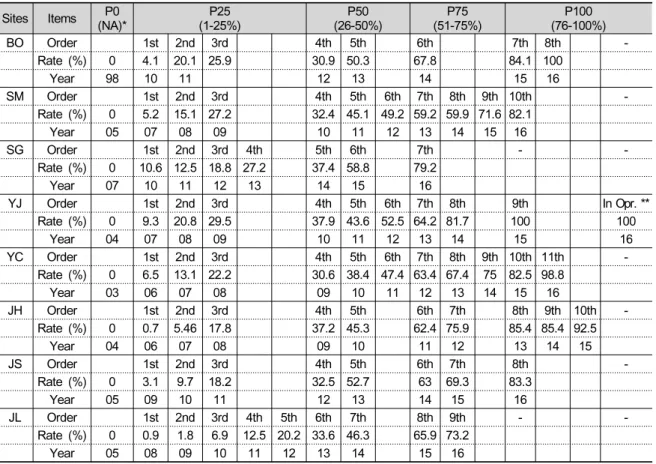
Table 3. Classification of the construction progress rate by annual reports (Abbreviations of sites refer to Fig. 1) (P0, pre-construction; P25, P50, P75 and P100, 1-25%, 26-50%, 51-75% and 76-100% of construction progress rate, respectively).
Sites Items P0
(NA)* P25
(1-25%) P50
(26-50%) P75
(51-75%) P100
(76-100%)
BO Order 1st 2nd 3rd 4th 5th 6th 7th 8th -
Rate (%) 0 4.1 20.1 25.9 30.9 50.3 67.8 84.1 100
Year 98 10 11 12 13 14 15 16
SM Order 1st 2nd 3rd 4th 5th 6th 7th 8th 9th 10th -
Rate (%) 0 5.2 15.1 27.2 32.4 45.1 49.2 59.2 59.9 71.6 82.1
Year 05 07 08 09 10 11 12 13 14 15 16
SG Order 1st 2nd 3rd 4th 5th 6th 7th - -
Rate (%) 0 10.6 12.5 18.8 27.2 37.4 58.8 79.2
Year 07 10 11 12 13 14 15 16
YJ Order 1st 2nd 3rd 4th 5th 6th 7th 8th 9th In Opr. **
Rate (%) 0 9.3 20.8 29.5 37.9 43.6 52.5 64.2 81.7 100 100
Year 04 07 08 09 10 11 12 13 14 15 16
YC Order 1st 2nd 3rd 4th 5th 6th 7th 8th 9th 10th 11th -
Rate (%) 0 6.5 13.1 22.2 30.6 38.4 47.4 63.4 67.4 75 82.5 98.8
Year 03 06 07 08 09 10 11 12 13 14 15 16
JH Order 1st 2nd 3rd 4th 5th 6th 7th 8th 9th 10th -
Rate (%) 0 0.7 5.46 17.8 37.2 45.3 62.4 75.9 85.4 85.4 92.5
Year 04 06 07 08 09 10 11 12 13 14 15
JS Order 1st 2nd 3rd 4th 5th 6th 7th 8th -
Rate (%) 0 3.1 9.7 18.2 32.5 52.7 63 69.3 83.3
Year 05 09 10 11 12 13 14 15 16
JL Order 1st 2nd 3rd 4th 5th 6th 7th 8th 9th - -
Rate (%) 0 0.9 1.8 6.9 12.5 20.2 33.6 46.3 65.9 73.2
Year 05 08 09 10 11 12 13 14 15 16
*NA, no action; ** In Opr., period of ‘in operation’ after construction
선정된 사업장의 사업구간 길이가 출현 외래식물 종 수에 미치는 영향을 파악하기 위해 R 환경 (R Core Team 2017)에서 일원분산분석 (one-way ANOVA)를 수행하였다 (Table 2). 그 결과 사업구간의 길이에 따른 외래식물 종수와 귀화율 (PN) 모두 유의한 차이가 없는 것을 확인하였기 때문에, 이후 도로사업장 연장 (길이) 요인은 분석에서 제외하였다.
2.2 자료 처리 및 분석
각 사업장에서 수행된 환경영향평가조사 및 사후환 경영향조사의 식물상 조사 자료 중 외래식물상 자료를
추출하였다 (Appendix 1). 사업규모 및 재정 상황에 따 라 사업 연차별 공정률 진행이 상이하므로 사업 연차가 아닌 공정률을 분석 기준으로 활용하였다. 공정률 구분 은 공사 전 (pre-construction, P0), 공사진행 1~25%
(post-construction25, P25), 공사진행 26~50% (P50), 공사진행 51~75% (P75) 그리고 공사진행 76~100%
(P100)로 5단계로 분류하였다 (Table 3). 5단계로 분류 한 외래식물상 자료를 이용하여 도시화지수 (UI), 귀화 율 (PN), 일년생 식물 (PAN) 및 이년생 (PBI)의 비율 그 리고 총 과수 (NOF)를 산출하였다 (Kim et al. 2000, Park 2009).
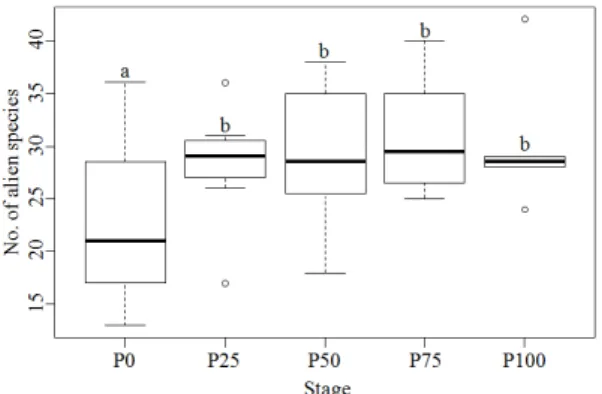
Fig. 2. Comparison of the number of alien species with construction progress rate. The horizontal line within the box indicates the median, boundaries of the box indicate the 25th- and 75th- percentiles. Error bars indicate the value of range from the greatest to the least, excluding outliers and circles indicate outliers.
Different letters above the graph mean significant differences between the numbers of exotic species according to the construction progress rate (* p < 0.05) (P0, pre-construction; P25, P50, P75 and P100, 1-25%, 26-50%, 51-75% and 76-100% of construction progress rate, respectively).
Fig. 3. Relationship between the number of alien species and the progress rate of road construction (* p < 0.05).
5단계의 공정률에 따른 외래식물 출현종 수의 차이 를 검증하기 위해 R의 ‘aov’의 함수를 이용하여 다중비 교를 실시하였다 (R Core Team 2017). 공정률과 외래 종수의 관계는 직선회귀분석을 실시하여 결정계수 (R2)로 유의성을 검증하였다. 각 사업장에서 사업진행 (공정률)에 따른 외래식물상의 변화를 파악하기 위하 여 서열분석을 실시하였다. 2개 이상의 사업장에서 출 현한 외래식물의 출현 유무로 식물상 자료를 구축하였 다. 이 자료를 이용하여 vegan 패키지의 ‘vegdist’ 함수 로 Bray-Curtis 거리지수를 구하고, ‘cmdscale’ 함수로 주좌표분석 (principal coordinates analysis, PCoA)을 실시하였다 (Oksanen et al. 2017).
3. 결과 및 고찰
3.1 공정률에 따른 외래식물 풍부도 변화
공정률에 따른 외래식물 풍부도의 변화를 파악하기 위한 일원분산분석의 결과에 따르면, 외래식물의 풍부 도는 공사 전 (P0)보다 공사 후 (P25, P50, P75, P100) 에 더 많은 외래식물이 출현하였고, 공사에 의해 사업 장 및 주변지역에 외래식물이 증가하는것으로 확인되 었다 (Fig. 2). 직선회귀분석 결과에서도 공사가 진행됨 에 따라 사업장 및 주변지역에서 외래식물이 유의하게
증가하였다 (p < 0.05) (Fig. 3).
3.2 공정률에 따른 외래식물 군집 특성
조사대상 사업의 공정률에 따른 외래식물 군집의 생 태적 특성 및 천이 양상 등을 포함하는 특성을 파악하기 위하여 서열법을 실시하였다 (Fig. 4). 여주IC~장호원 도로 (YJ), 적성~전곡 도로 (JS), 신갈우회도로 (SG) 사 업장은 현존식생의 차이로 인해 다른 사업장과 구별되 었다 (Fig. 4a). 공정률에 따라 각 사업장은 도시화지수 (UI) 및 귀화율 (PN)이 증가하는 1사분면 방향으로 이 동하는 경향이 확인되었다 (Fig. 4b). 또한 유입된 외래 식물은 시간이 경과함에 따라 일년생 (PAN)에서 이년 생 이상 다년생 (PBE)으로 대체되었으며, 주요한 2년 생 이상 외래식물로는 가시상추 (La.sc), 서양등골나물 (Eu.ru), 오리새 (Da.gl), 실망초 (Er.bo) 등이 확인된다 (Fig. 4b). 이상의 결과를 종합하면, 각 사업장의 공정률 이 증가함에 따라 조사대상 사업장에서 귀화율 (PN), 도시화지수 (UI), 출현 외래식물 과 (family)의 수 (NOF) 및 이년생 이상 다년생 외래식물 출현비율 (PBE)은 증 가하고 1년생 외래식물의 출현비율(PAN)은 감소하는 방향으로 이동하고 있으며, 공사의 진행이 외래식물 종 의 천이에 영향을 미치고 있다는 것을 알 수 있다 (Zeng et al. 2010).
3.3 외래식물 현황 및 출현의 지속성
공정률에 따라 각 사업장에서 출현하는 외래식물 군 집의 조성이 일년생에서 이년생 혹은 다년생으로 변화 하면서 점차로 증가하는 경향을 나타나는 것을 확인되
(a) Plot (b) Species
Fig. 4. Results of principal coordinates analysis (PCoA) using flora data at the construction sites. Biplot of road construction sites (a) (white, P0; vertical line, P25; horizontal line, P50; grid, P75; black, P100, abbreviations refer to Table 1) and biplot of alien species with species traits (b) (UI, urban index; PN, naturalized ratio; NOF, no. of family; PAN, percent of annuals; PBE, percent of biennials) (abbreviations of species refer to Table 5). The length and angle of arrows show the contribution of a particular plant trait variable to the PCoA axes.
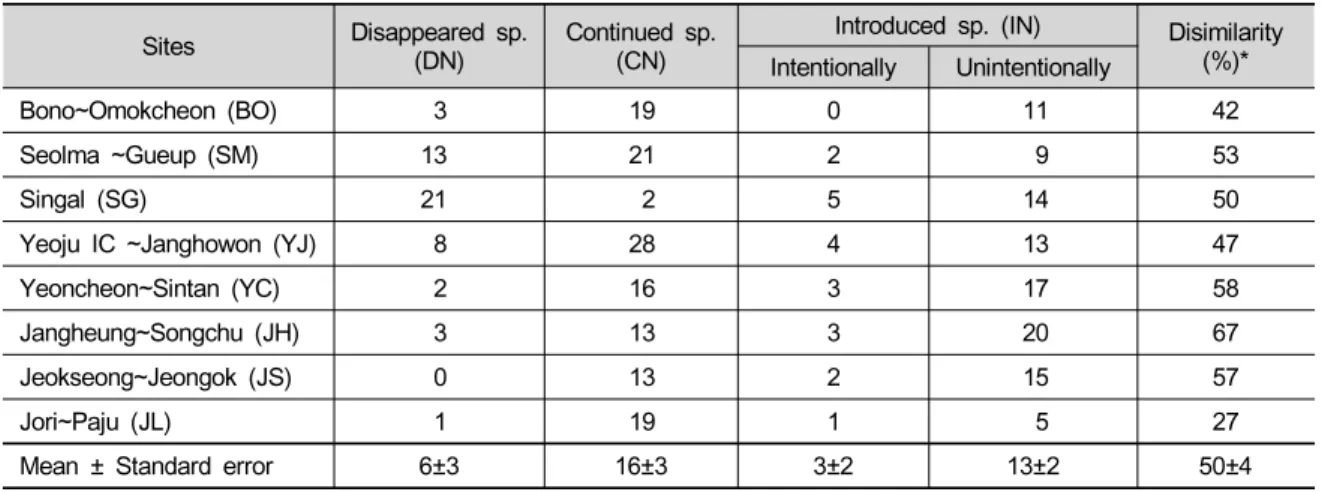
Table 4. Changes in number of alien species according to the status and introduction types (abbreviations of sites refer to Table 1).
Sites Disappeared sp.
(DN) Continued sp.
(CN)
Introduced sp. (IN) Disimilarity Intentionally Unintentionally (%)*
Bono~Omokcheon (BO) 3 19 0 11 42
Seolma ~Gueup (SM) 13 21 2 9 53
Singal (SG) 21 2 5 14 50
Yeoju IC ~Janghowon (YJ) 8 28 4 13 47
Yeoncheon~Sintan (YC) 2 16 3 17 58
Jangheung~Songchu (JH) 3 13 3 20 67
Jeokseong~Jeongok (JS) 0 13 2 15 57
Jori~Paju (JL) 1 19 1 5 27
Mean ± Standard error 6±3 16±3 3±2 13±2 50±4
*Dissimilarity = (DN + IN) / Total no. of species.
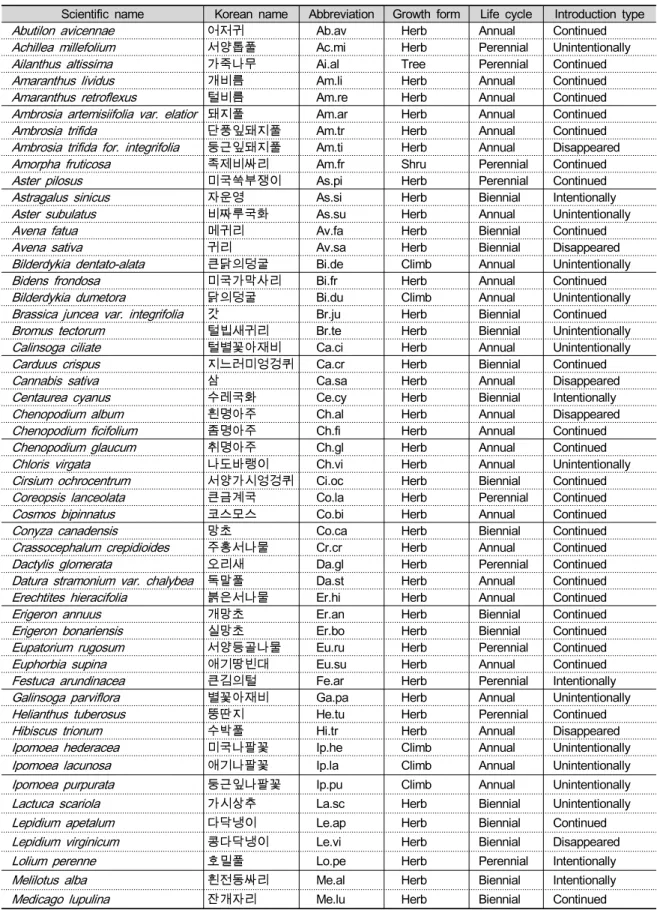
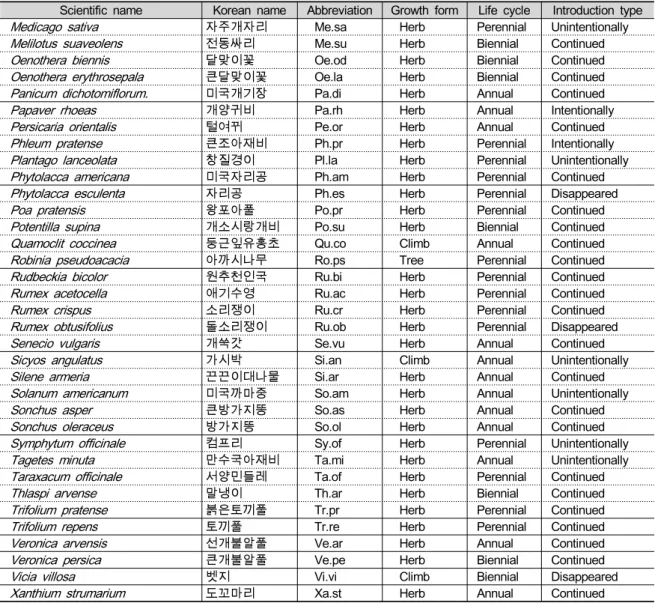
었으므로, 군집 변화의 속성을 파악하기 위하여 종수준 의 출현 지속성을 분석하여 Table 4에 정리하였다. 둥 근잎돼지풀, 삼, 자리공 등의 9종은 공사전에만 발견되 고 공사가 시작된 후 사라졌으며, 단풍잎돼지풀, 돼지 풀, 미국쑥부쟁이 등의 53종은 공사이전부터 공사가 완료되는 시점까지 지속적으로 출현이 확인되었다 (Table 5). 공사 이후 새로게 도입된 외래식물은 총 25 종으로 큰김의털, 큰금계국, 끈끈이대나물 등과 같이 식생복원의 목적으로 의도적 도입을 한 종 (7종)과, 가 시박, 가시상추, 털여뀌 등과 같이 비의도적으로 유입 된 종 (18종)으로 구분할 수 있다. 비의도적 도입 외래
식물은 사업장 주변지역에서 자연적으로 확산되었거 나 성토 및 복원을 위하여 외부로부터 반입된 토양에 종 자상태로 포함되어 유입된 것으로 판단된다. 외래식물 조성의 변화에서는 신갈우회도로 (SG), 장흥~송추 우 회도로 (JH)가 각각 67% ((3+3+20)/53), 58%로 가장 큰 변화가 있는 것으로 분석되었으며, 반면에 조리~법 원간 도로 (JL)는 27%로 변화가 가장 적은 사업장인 것 으로 나타났다 (Table 5). 대부분의 사업장의 외래식물 의 변화는 40~60%로, 초기출현 외래식물의 50%가 공 사 마지막까지 지속적으로 출현하며 나머지는 다른 외 래종으로 대체되는 것으로 파악되었다.
Table 5. Major alien species at the road construction sites.
Scientific name Korean name Abbreviation Growth form Life cycle Introduction type
Abutilon avicennae 어저귀 Ab.av Herb Annual Continued
Achillea millefolium 서양톱풀 Ac.mi Herb Perennial Unintentionally
Ailanthus altissima 가죽나무 Ai.al Tree Perennial Continued
Amaranthus lividus 개비름 Am.li Herb Annual Continued
Amaranthus retroflexus 털비름 Am.re Herb Annual Continued
Ambrosia artemisiifolia var. elatior 돼지풀 Am.ar Herb Annual Continued
Ambrosia trifida 단풍잎돼지풀 Am.tr Herb Annual Continued
Ambrosia trifida for. integrifolia 둥근잎돼지풀 Am.ti Herb Annual Disappeared
Amorpha fruticosa 족제비싸리 Am.fr Shru Perennial Continued
Aster pilosus 미국쑥부쟁이 As.pi Herb Perennial Continued
Astragalus sinicus 자운영 As.si Herb Biennial Intentionally
Aster subulatus 비짜루국화 As.su Herb Annual Unintentionally
Avena fatua 메귀리 Av.fa Herb Biennial Continued
Avena sativa 귀리 Av.sa Herb Biennial Disappeared
Bilderdykia dentato-alata 큰닭의덩굴 Bi.de Climb Annual Unintentionally
Bidens frondosa 미국가막사리 Bi.fr Herb Annual Continued
Bilderdykia dumetora 닭의덩굴 Bi.du Climb Annual Unintentionally
Brassica juncea var. integrifolia 갓 Br.ju Herb Biennial Continued
Bromus tectorum 털빕새귀리 Br.te Herb Biennial Unintentionally
Calinsoga ciliate 털별꽃아재비 Ca.ci Herb Annual Unintentionally
Carduus crispus 지느러미엉겅퀴 Ca.cr Herb Biennial Continued
Cannabis sativa 삼 Ca.sa Herb Annual Disappeared
Centaurea cyanus 수레국화 Ce.cy Herb Biennial Intentionally
Chenopodium album 흰명아주 Ch.al Herb Annual Disappeared
Chenopodium ficifolium 좀명아주 Ch.fi Herb Annual Continued
Chenopodium glaucum 취명아주 Ch.gl Herb Annual Continued
Chloris virgata 나도바랭이 Ch.vi Herb Annual Unintentionally
Cirsium ochrocentrum 서양가시엉겅퀴 Ci.oc Herb Biennial Continued
Coreopsis lanceolata 큰금계국 Co.la Herb Perennial Continued
Cosmos bipinnatus 코스모스 Co.bi Herb Annual Continued
Conyza canadensis 망초 Co.ca Herb Biennial Continued
Crassocephalum crepidioides 주홍서나물 Cr.cr Herb Annual Continued
Dactylis glomerata 오리새 Da.gl Herb Perennial Continued
Datura stramonium var. chalybea 독말풀 Da.st Herb Annual Continued
Erechtites hieracifolia 붉은서나물 Er.hi Herb Annual Continued
Erigeron annuus 개망초 Er.an Herb Biennial Continued
Erigeron bonariensis 실망초 Er.bo Herb Biennial Continued
Eupatorium rugosum 서양등골나물 Eu.ru Herb Perennial Continued
Euphorbia supina 애기땅빈대 Eu.su Herb Annual Continued
Festuca arundinacea 큰김의털 Fe.ar Herb Perennial Intentionally
Galinsoga parviflora 별꽃아재비 Ga.pa Herb Annual Unintentionally
Helianthus tuberosus 뚱딴지 He.tu Herb Perennial Continued
Hibiscus trionum 수박풀 Hi.tr Herb Annual Disappeared
Ipomoea hederacea 미국나팔꽃 Ip.he Climb Annual Unintentionally
Ipomoea lacunosa 애기나팔꽃 Ip.la Climb Annual Unintentionally
Ipomoea purpurata 둥근잎나팔꽃 Ip.pu Climb Annual Unintentionally
Lactuca scariola 가시상추 La.sc Herb Biennial Unintentionally
Lepidium apetalum 다닥냉이 Le.ap Herb Biennial Continued
Lepidium virginicum 콩다닥냉이 Le.vi Herb Biennial Disappeared
Lolium perenne 호밀풀 Lo.pe Herb Perennial Intentionally
Melilotus alba 흰전동싸리 Me.al Herb Biennial Intentionally
Medicago lupulina 잔개자리 Me.lu Herb Biennial Continued
Table 5. Continued.
Scientific name Korean name Abbreviation Growth form Life cycle Introduction type
Medicago sativa 자주개자리 Me.sa Herb Perennial Unintentionally
Melilotus suaveolens 전동싸리 Me.su Herb Biennial Continued
Oenothera biennis 달맞이꽃 Oe.od Herb Biennial Continued
Oenothera erythrosepala 큰달맞이꽃 Oe.la Herb Biennial Continued
Panicum dichotomiflorum. 미국개기장 Pa.di Herb Annual Continued
Papaver rhoeas 개양귀비 Pa.rh Herb Annual Intentionally
Persicaria orientalis 털여뀌 Pe.or Herb Annual Continued
Phleum pratense 큰조아재비 Ph.pr Herb Perennial Intentionally
Plantago lanceolata 창질경이 Pl.la Herb Perennial Unintentionally
Phytolacca americana 미국자리공 Ph.am Herb Perennial Continued
Phytolacca esculenta 자리공 Ph.es Herb Perennial Disappeared
Poa pratensis 왕포아풀 Po.pr Herb Perennial Continued
Potentilla supina 개소시랑개비 Po.su Herb Biennial Continued
Quamoclit coccinea 둥근잎유홍초 Qu.co Climb Annual Continued
Robinia pseudoacacia 아까시나무 Ro.ps Tree Perennial Continued
Rudbeckia bicolor 원추천인국 Ru.bi Herb Perennial Continued
Rumex acetocella 애기수영 Ru.ac Herb Perennial Continued
Rumex crispus 소리쟁이 Ru.cr Herb Perennial Continued
Rumex obtusifolius 돌소리쟁이 Ru.ob Herb Perennial Disappeared
Senecio vulgaris 개쑥갓 Se.vu Herb Annual Continued
Sicyos angulatus 가시박 Si.an Climb Annual Unintentionally
Silene armeria 끈끈이대나물 Si.ar Herb Annual Continued
Solanum americanum 미국까마중 So.am Herb Annual Unintentionally
Sonchus asper 큰방가지똥 So.as Herb Annual Continued
Sonchus oleraceus 방가지똥 So.ol Herb Annual Continued
Symphytum officinale 컴프리 Sy.of Herb Perennial Unintentionally
Tagetes minuta 만수국아재비 Ta.mi Herb Annual Unintentionally
Taraxacum officinale 서양민들레 Ta.of Herb Perennial Continued
Thlaspi arvense 말냉이 Th.ar Herb Biennial Continued
Trifolium pratense 붉은토끼풀 Tr.pr Herb Perennial Continued
Trifolium repens 토끼풀 Tr.re Herb Perennial Continued
Veronica arvensis 선개불알풀 Ve.ar Herb Annual Continued
Veronica persica 큰개불알풀 Ve.pe Herb Biennial Continued
Vicia villosa 벳지 Vi.vi Climb Biennial Disappeared
Xanthium strumarium 도꼬마리 Xa.st Herb Annual Continued
4. 결론 및 제언
본 연구에 의하면, 도로개발이 진행될수록 외래식물 종 수, 귀화율 (UI) 및 도시화지수 (PN)가 증가한다. 그 러므로, 도로공사는 사업장 및 사업장 인근의 외래식물 종 수 증가에 영향을 미치는 것으로 파악되었다. 또한 공사초기에는 일년생 초본이 우점하고, 완공 시기에는 이년생 및 다년생 초본으로 외래식물 종 조성이 변화하는 외래식생의 천이도 확인되었다 (Johnston and Johnston 2004). 공사에 따른 외래식물 종 수는 공사 초기 외래식 물 종수가 적을 경우 그 증가 경향이 뚜렷하게 나타났다.
또한 외래식물의 유입은 공사 초기에 주로 일어나며,
한 번 유입된 외래식물은 공사가 완료될 때까지 지속적 으로 출현하는 것도 본 연구로 확인되었다. 외래식물 유입과 연관있는 주요공정은 식생복원과 성토 공정을 고려할 수 있으며, 식생복원은 의도적 도입으로, 성토 공정은 비의도적 유입으로 구분할 수 있다.
따라서 도로사업장의 외래식물 관리를 위하여, 외부 반입 토양의 사업장 적체시 ‘포장 관리 (외부로부터 종 자가 날아와 적체된 토양에 정착하여 외래식물의 공급 원 (source)이 되지 않도록 덮어서 관리하는 방법)’, 사 업장 내 표토를 활용 혹은 자생종을 활용한 식생복원 등 의 유입방지 노력이 필요하다.
감사의 글
본 연구는 국립생태원 “선형사업대상 생태분야 환 경영향평가 방법 연구 (NIE-기반연구-2017-04)”의 연 구비지원에 의해 수행되었습니다.
References
Bang, S.W. 2014. Environmental impact assessment plant of invasive alien plant in Korea. Korea Environment Institute, Seoul, Korea. (in Korean)
Choi, J.H. 1996. Role of road and change of policy. Journal of Korean Society of Civil Engineers 44: 10-14. (in Korean) Cowie, I.D. and Werner, P.A. 1993. Alien plant species
invasive in Kakadu National Park, tropical northern Australia. Biological Conservation 63: 127-135.
Doody, J.P. 2013. Alien plant invasion. In Doody, J.P. (ed.), Sand Dune Conservation, Management and Restoration.
Springer, Netherlands. pp. 177-199.
Fan, S. and Chan-Kang, C. 2005. Road Development, Economic Growth, and Poverty Reduction in China.
International Food Policy Research Institute, Washington, DC, USA.
Faucette, L.B., Risse, L.M., Jordan, C.F., Cabrera, M.L., Coleman, D.C. and West, L.T. 2006. Vegetation and soil quality effects from hydroseed and compost blankets used for erosion control in construction activities. Journal of Soil and Water Conservation 61: 355-362.
Findlay, T., Scot, C. and Bourdages, J. 2000. Response time of wetland biodiversity to road construction on adjacent lands. Conservation Biology 14: 86-94.
Forman, R.T.T., Sperling, D., Bissonette, J.A., Clevenger, A.P., Cutshal, C.D., Dale, V.H., Fahrig, L., France, R., Goldman, C.R., Haenue, K., Jones, J.A., Swanson, F.J., Turrentine, T. and Winter, T.C. 2003. Road Ecology:
Science and Solutions. Island Press, Washington, DC, USA.
Goodman, S.M., Pidgeon, M. and O'Connor, S. 1994. Mass mortality of Madagascar radiated tortoise caused by road construction. Oryx 28: 115-118.
Johnston, F.M. and Johnston, S.W. 2004. Impacts of road disturbance on soil properties and on exotic plant occurrence in subalpine areas of the Australian Alps.
Arctic, Antarctic, and Alpine Research 36: 201-207.
Kim, J.M., Yim, Y.J. and Cheon, E.S. 2000. The Naturalized Plants in Korea. Science Books, Seoul, Korea. (in Korean) Lee, S.J., Choi, J.K., Choi, S.G., Lee, H.S., Jeong, H.R., Lee,
G.K., Kang, Y.H. and Seo, S.C. 2004a. Environmental Impact Assessment of Road Construction Projects: Analysis of Prediction and Monitoring. Korea Environment Institute, Seoul, Korea. (in Korean)
Lee, Y.M., Park, S.H., Jung, S.Y., Oh, S.H. and Yang, J.C.
2011. Study on the current status of naturalized plants in South Korea. Korean Journal of Plant Taxonomy 41:
87-101. (in Korean)
Lee, Y.T., Jeong, I.H., Kim, S.H., Min, M.G., Kim, J.S., Kim, E.S., Seo, J.C., Sin, B.Y. and Choi, J.S. 2004b. Roads and the Environment. Korea Research Institute for Human Settlements, Anyang, Korea. (in Korean)
Mader, H.J. 1984. Animal habitat isolation by roads and agricultural fields. Biological Conservation 29: 81-96.
National Institute of Ecology (NIE). 2015. Nationwide Survey of Non-native Species in Korea. Chungcheongnam-do, Korea (in Korean)
Oksanen, J., Blanchet, F.G., Kindt, R., Legendre, P., Minchin, P.R., O’Hara, R.B., Simpson, G.L., Solymos, P., Stevens, M.H.H. and Wagner, H. 2017. Package ‘vegan’, Community Ecology Package. http://vegan.r-forge.r- project.org. (Assessed 01 August 2017)
Okimura, T., Koide, D. and Mori, A.S. 2016. Differential processes underlying the roadside distributions of native and alien plant assemblages. Biodiversity and Conservation 25: 995-1009.
Park, S.H. 2009. New Illustrations and Photographs of Naturalized Plants of Korea. Ilchokak, Seoul, Korea. (in Korean)
R core Team. 2017. R: A Language and Environment for Statistical Computing. Vienna, Austria. http://www.R- project.org. (Assessed 01 August 2017)
Zeng, S.L., Zhang, T.T., Gao, Y., Ouyang, Z.T., Chen, J.K.,
Li, B. and Zhao, B. 2010. Effects of road disturbance on
plant biodiversity. World Academy of Science, Engineering
and Technology 42: 437-448.
Appendix 1. List of alien plants emerged in the road construction sites (Abbrevations of sites refer to Table 1 and abbrevations of species refer to Table 5).
Abbr. SM JS YC JL
P0 P25 P50 P75 P100 P0 P25 P50 P75 P100 P0 P25 P50 P75 P100 P0 P25 P50 P75
Ab.av ○ ○ ○
Ac.mi
Ai.al ○ ○ ○ ○ ○ ○ ○ ○ ○
Am.ar ○ ○ ○ ○ ○ ○ ○ ○ ○ ○ ○ ○ ○ ○ ○ ○ ○ ○ ○
Am.fr ○ ○ ○ ○ ○ ○ ○ ○ ○ ○ ○ ○ ○ ○ ○ ○ ○ ○
Am.li ○ ○ ○ ○ ○
Am.re ○
Am.tr ○ ○ ○ ○ ○ ○ ○ ○ ○ ○ ○ ○ ○ ○ ○ ○ ○ ○ ○
Am.ti
As.pi ○ ○ ○ ○ ○ ○ ○ ○ ○
As.si As.su
Av.fa ○ ○ ○ ○ ○ ○ ○ ○ ○ ○ ○
Av.sa
Bi.de ○ ○
Bi.du ○ ○ ○
B i.fr ○ ○ ○ ○ ○ ○ ○ ○ ○ ○ ○ ○ ○ ○ ○ ○
Br.ju ○
Br.te ○ ○
Ca.ci
Ca.cr ○ ○ ○ ○ ○ ○ ○ ○ ○ ○ ○ ○ ○ ○ ○
Ca.sa Ce.cy Ch.al ○
Ch.fi ○ ○ ○ ○ ○ ○ ○ ○ ○ ○ ○
Ch.gl ○ ○ ○
Ch.vi ○
Ci.oc Co.la
Co.bi ○ ○ ○ ○ ○ ○ ○ ○ ○ ○ ○ ○
Co.ca ○ ○ ○ ○ ○ ○ ○ ○ ○ ○ ○ ○ ○ ○ ○ ○ ○ ○ ○
Cr.cr ○ ○ ○
Da.gl ○ ○ ○ ○ ○ ○ ○
Da.st ○
Er.hi ○ ○ ○ ○ ○ ○ ○ ○ ○ ○ ○ ○ ○ ○
Er.an ○ ○ ○ ○ ○ ○ ○ ○ ○ ○ ○ ○ ○ ○ ○ ○ ○ ○ ○
Er.bo ○
Eu.ru
Eu.su ○ ○
Fe.ar
Ga.pa ○ ○ ○ ○ ○
He.tu ○ ○ ○ ○
Hi.tr ○
Ip.he ○ ○ ○
Ip.la ○ ○ ○
Appendix 1. Continued.
Abbr. BO SG JH YJ
P0 P25 P50 P75 P100 P0 P25 P50 P75 P0 P25 P50 P75 P100 P0 P25 P50 P75 P100 Ab.av
Ac.mi ○
Ai.al ○ ○ ○ ○ ○ ○ ○ ○ ○ ○ ○ ○ ○
Am.ar ○ ○ ○ ○ ○ ○ ○ ○ ○ ○ ○ ○ ○ ○ ○ ○ ○ ○
Am.fr ○ ○ ○ ○ ○ ○ ○ ○ ○ ○ ○ ○ ○ ○ ○ ○ ○ ○ ○
Am.li ○ ○ ○ ○ ○ ○ ○ ○ ○ ○ ○
Am.re ○ ○ ○ ○ ○ ○ ○
Am.tr ○ ○ ○ ○ ○ ○ ○ ○ ○ ○ ○ ○ ○
Am.ti
As.pi ○ ○ ○ ○ ○ ○ ○ ○ ○ ○ ○ ○
As.si ○
As.su ○
Av.fa ○ ○ ○ ○ ○ ○
Av.sa ○ ○ ○
Bi.de ○
Bi.du
B i.fr ○ ○ ○ ○ ○ ○ ○ ○ ○ ○ ○ ○ ○ ○ ○ ○ ○
Br.ju ○ ○
Br.te
Ca.ci ○ ○
Ca.cr ○ ○ ○ ○ ○ ○ ○ ○ ○ ○ ○ ○
Ca.sa ○
Ce.cy ○ ○
Ch.al
Ch.fi ○ ○ ○ ○ ○
Ch.gl ○ ○ ○ ○ ○ ○ ○ ○
Ch.vi
Ci.oc ○ ○ ○ ○ ○
Co.la ○ ○ ○ ○ ○ ○
Co.bi ○ ○ ○ ○ ○ ○ ○ ○ ○ ○ ○ ○ ○ ○ ○
Co.ca ○ ○ ○ ○ ○ ○ ○ ○ ○ ○ ○ ○ ○ ○ ○ ○ ○ ○ ○
Cr.cr ○ ○
Da.gl ○ ○ ○ ○ ○ ○ ○ ○ ○
Da.st ○ ○ ○ ○
Er.hi ○ ○ ○ ○ ○ ○ ○ ○
Er.an ○ ○ ○ ○ ○ ○ ○ ○ ○ ○ ○ ○ ○ ○ ○ ○ ○ ○ ○
Er.bo ○ ○ ○ ○ ○
Eu.ru ○ ○ ○ ○ ○
Eu.su ○ ○ ○ ○ ○ ○
Fe.ar ○ ○ ○
Ga.pa ○ ○ ○ ○
He.tu ○ ○ ○ ○ ○ ○ ○
Hi.tr
Ip.he ○ ○ ○
Ip.la ○
Appendix 1. Continued.
Abbr. SM JS YC JL
P0 P25 P50 P75 P100 P0 P25 P50 P75 P100 P0 P25 P50 P75 P100 P0 P25 P50 P75 Ip.pu
La.sc
Le.ap ○ ○ ○ ○ ○ ○ ○ ○ ○ ○ ○ ○ ○ ○ ○ ○ ○ ○
Le.vi ○ Lo.pe Me.al Me.lu Me.sa Me.su
Oe.od ○ ○ ○ ○ ○ ○ ○ ○ ○ ○ ○ ○ ○ ○ ○ ○ ○ ○ ○
Oe.la
Pa.di ○ ○ ○ ○ ○ ○ ○ ○ ○ ○ ○ ○
Pa.rh
Pe.or ○ ○ ○ ○ ○ ○
Ph.am ○ ○ ○ ○ ○ ○ ○ ○ ○ ○ ○ ○ ○
Ph.es ○
Ph.pr ○ ○
Pl.la Po.pr
Po.su ○ ○ ○ ○ ○ ○ ○ ○
Qu.co ○ ○ ○ ○ ○ ○ ○ ○ ○ ○
Ro.ps ○ ○ ○ ○ ○ ○ ○ ○ ○ ○ ○ ○ ○ ○ ○ ○ ○ ○ ○
Ru.bi ○ ○
Ru.ac ○ ○ ○ ○ ○ ○ ○ ○ ○ ○
Ru.cr ○ ○ ○ ○ ○ ○ ○ ○ ○ ○ ○ ○ ○ ○ ○ ○ ○ ○ ○
Ru.ob ○ Se.vu ○
Si.an ○ ○ ○
Si.ar ○
So.am ○ ○
So.as ○
So.ol ○ ○ ○ ○ ○ ○ ○ ○ ○ ○ ○ ○ ○ ○
Sy.of Ta.mi
Ta.of ○ ○ ○ ○ ○ ○ ○ ○ ○ ○ ○ ○ ○ ○ ○ ○ ○ ○
Th.ar ○ ○ ○ ○ ○ ○ ○ ○ ○ ○ ○ ○ ○
Tr.pr ○ ○ ○ ○ ○ ○ ○ ○
Tr.re ○ ○ ○ ○ ○ ○ ○ ○ ○ ○ ○ ○ ○ ○ ○ ○ ○ ○ ○
Ve.ar ○ ○ ○
Ve.pe ○ ○ ○ ○ ○
Vi.vi
Xa.st ○ ○ ○ ○ ○ ○ ○ ○ ○ ○ ○ ○ ○ ○ ○ ○ ○
Appendix 1. Continued.