폐 절제술 후 걷기 운동을 경험한 폐암 환자의 수술 후 회복 관련 요인
김예솔
1, 최지연
2, 조종호
3, 최모나
21연세대학교 간호대학⋅4단계 두뇌한국(BK)21 S-L.E.A.P 미래간호인재 교육연구단,
2연세대학교 간호대학 · 김모임간호학연구소, 3성균관대학교 의과대학 삼성서울병원 흉부외과
Factors Associated with Postoperative Recovery among Lung Cancer Patients with Walking Exercise after Lung Resection
Yesol Kim
1, JiYeon Choi
2, Jong Ho Cho
3, Mona Choi
21College of Nursing · Brain Korea 21 FOUR Project, Yonsei University, Seoul, Korea
2College of Nursing · Mo-Im Kim Nursing Research Institute, Yonsei University, Seoul, Korea
3Department of Thoracic and Cardiovascular Surgery, Samsung Medical Center, Sungkyunkwan University School of Medicine, Seoul, Korea
Background: Treatment for lung cancer, which has high incidence and mortality rates, involves lung resection;
however, the risk of postoperative pulmonary complications is high. Early walking exercise is a core strategy for preventing complications and promoting postoperative recovery, which is essential for returning to everyday life. This study aims to identify the factors associated with the postoperative recovery of patients who performed walking exercises in an intensive care unit after having a lung resection.
Methods: This cross-sectional study collected data from 90 patients on the day before discharge at a tertiary hospital in Seoul between April and June 2019. Patients’ postoperative recovery was measured using the Postoperative Recovery Profile.
Results: The mean score for postoperative recovery was 0.70±0.41 out of 3, 0 being none of the problems.
Among the five subcategories, the psychological dimension had the highest recovery level at 0.57±0.58, while physical symptoms were rated lowest at 0.89±0.50. As a result of regression analysis, employment status (β=4.353, P=0.005), symptoms of nausea and vomiting during walking (β=0.596, P=0.043), and perceived ex- ertion during walking (β=1.105, P=0.007) were associated with postoperative recovery.
Conclusions: The study indicated unemployed patients, those with more nausea and vomiting, and those who perceived severe exertion during walking showed lower perceived postoperative recovery levels. Not only mul- tidisciplinary, patient-tailored interventions to facilitate return to work after surgery but also interventions to con- trol physical symptoms actively should be developed and implemented to achieve higher postoperative recov- ery levels. Patients also need to exercise at an appropriate subjective level of perceived exertion.
Korean J Health Promot 2021;21(1):17-26
Keywords: Early ambulation, Intensive care units, Lung neoplasms, Pneumonectomy, Recovery of function
■ Received: Jan. 8, 2021 ■ Revised: Feb. 26, 2021 ■ Accepted: Mar. 3, 2021
■Corresponding author : Mona Choi, PhD
College of Nursing · Mo-Im Kim Nursing Research Institute, Yonsei University, 50-1 Yonsei-ro, Seodaemun-gu, Seoul 03722, Korea Tel: +82-2-2228-3341, Fax: +82-2-2227-8303
E-mail: [email protected]
ORCID: https://orcid.org/0000-0003-4694-0359
■ This research was supported by the Brain Korea 21 FOUR Project funded by National Research Foundation (NRF) of Korea, Yonsei University College of Nursing, and by the Seoul Nurses Association's scholarship for a master’s degree in 2019.
■ This manuscript is a revision of the first author’s master's thesis from Yonsei University. Year of approval 2019.
Copyright ⓒ 2021 The Korean Society of Health Promotion and Disease Prevention
This is an Open Access article distributed under the terms of the Creative Commons Attribution Non-Commercial License (http://creativecommons.org/licenses/by-nc/3.0/), which permits unrestricted noncommercial use, distribution, and reproduction in any medium, provided the original work is properly cited.
INTRODUCTION
Lung cancer has the fourth-highest incidence rate among cancer types in Korea.1) Cancer was the leading cause of death in Korea in 2018, and lung cancer, which had the
highest mortality rate, accounted for 22.5%.2) Surgery is a core method for treating lung cancer patients; however, lung resections can lead to pulmonary complications such as ate- lectasis, prolonged air leak, pneumonia, and acute respira- tory distress syndrome.3,4) It can also result in other compli- cations such as atrial fibrillation, acute myocardial ischemia, cardiac infarction, pneumothorax, hemothorax, and bron- chopulmonary fistula.3) Furthermore, thoracic surgery car- ries higher risks of postoperative pulmonary complications (PPCs) than do other surgeries.5) PPCs could increase early postoperative mortality and admission rates to intensive care units (ICUs) and prolong the length of stay in the ICU and hospital,6) which eventually delays patients' postoperative recovery.
Postoperative recovery is a process that requires energy to recover to normal health by regaining physical, psycho- logical, social, and habitual functions and returning to the levels of patients’ independence and psychological well-be- ing before surgery.7) It includes not only the physical but also emotional and social domains. Therefore, healthcare providers need to help improve patients' postoperative re- covery process to enable them to return to their daily lives as soon as possible.8)
As a way to promote postoperative recovery, Enhanced Recovery After Surgery (ERAS) protocols, including treat- ment and nursing, are the leading example of interventions provided by a multidisciplinary team.9) Interest in ERAS has been increasing, as studies have demonstrated its effective- ness in reducing lengths of hospital stay, patients’ complica- tions, and medical costs.10) The ERAS 2018 guidelines for lung surgery consist of 45 items in the pre-admission, ad- mission, intraoperative, and postoperative phases to improve patients’ recovery.11) Among the ERAS items, early mobi- lization in the postoperative phase is associated with re- ducing immobilization-related complications and the length of stay in hospital.11) It was found that early mobilization was effective in reducing the incidence of PPCs such as ate- lectasis and pleural effusion at postoperative day (POD) 2-3.12)
Early walking exercise also facilitates patients’ recovery by improving their functional status in an effective, safe, and feasible manner and has a critical role in reducing post- operative complications and improving quality of life after discharge.13) When patients participated in exercise inter- vention, it was determined that self-efficacy among the vari-
ous psychological variables increased walking ability and physical activity.14) Additionally, self-efficacy triggers changes in health promotion behavior, maintaining exercise, and en- gaging in self-care for postoperative patients.15) In other words, self-efficacy can increase physical activity for func- tional state recovery, which may eventually facilitate post- operative recovery.16)
Although postoperative recovery is an essential part of re- turning to daily life, to our knowledge, there have been few studies examining factors associated with postoperative re- covery from the patients' perspective, especially lung cancer patients. Identifying factors associated with postoperative recovery would help develop strategies to promote recovery in lung cancer patients. Therefore, using a sample of 90 Korean patients, this study aimed to 1) identify the charac- teristics of lung cancer patients after lung resection, includ- ing the performance of walking exercises in an ICU and 2) explore the factors associated with lung resection patients’
postoperative recovery before discharge.
METHODS
1. Study design
This study used a cross-sectional study to identify factors associated with postoperative recovery among patients who underwent lung resection for lung cancer and performed walking exercises while in the ICU.
2. Study setting and participants
Postoperative walking exercise is part of the standard care for thoracic surgery patients in the hospital. Lung resection patients should perform walking exercises at least once to transfer to general wards. If patients had no problems, they performed walking exercises in the order of bedside sitting, standing, and walking around the ICU (about 30 m) with the assigned nurse's help on POD 1. While a patient was walking, the nurse monitored their symptoms, heart rate (HR), and saturation of percutaneous oxygen (SpO2) via a portable monitor and documented them.
This study used convenience sampling. Participants per- formed walking exercises in a thoracic surgery ICU after lung resection for lung cancer in a tertiary hospital in Seoul, Korea. The selection criteria included 1) those over 19 years
of age, 2) who had been diagnosed with primary lung cancer, and 3) who had had a lung resection. The sample size was calculated using G*Power software 3.1.9.2 (Heinrich-Heine University, Düsseldorf, Germany) for multiple linear re- gression, with an effect size of 0.2, α (significance level) of 0.05, a power of 0.8, and nine predictors. The minimum number of participants required was 88. Initially, 91 partic- ipants were recruited, but data from only 90 participants were analyzed because one was excluded due to missing data.
3. Measurement
1) Participants’ characteristics
(1) General and clinical characteristics
Data were collected regarding participants' general char- acteristics: age, gender, religion, marital status, main care- giver, education level, employment status, and monthly income. Clinical characteristics were the history of pre- operative chemotherapy and radiotherapy, smoking history, American Society of Anesthesiologists' Classification, cancer history, operation history, stage of lung cancer, type of sur- gical approach, the extent of resection, and length of ICU and postoperative hospital stay.
(2) ICU walking-related characteristics
ICU walking-related characteristics consisted of variables related to walking exercises in POD 1. Walking distance, maximum HR, and minimum SpO2 recorded during the walking exercise in POD 1 were collected from electronic medical records. Symptoms included pain, fatigue, dizziness, shortness of breath, and nausea and vomiting (N&V) experi- enced by patients during walking exercises. These were measured on an 11-point numeral rating scale (0=none;
10=very severe). The Category Ratio 10 scale (0=nothing at all; 10=extremely strong) was used to measure perceived ex- ertion during walking;17) the modified Borg Scale (0=nothing at all; 10=maximal) was also used to measure dyspnea dur- ing walking.18) Through questionnaires, participants selected a number on a vertical scale to indicate their subjective de- gree of difficulty and dyspnea during walking exercises, respectively.
2) Postoperative recovery
Postoperative Recovery Profile (PRP) was used to meas-
ure postoperative recovery as perceived by patients on the day before discharge.19) The Korean version of the PRP has well-established reliability and validity.20) It included 17 problems across five dimensions: physical symptoms (five items), physical functions (four items), psychological prob- lems (four items), social problems (two items), and activity problems (two items).20) Each item was rated on a 4-point scale from 0 (none) to 3 (severe) according to the partic- ipant's experience within 24 hours. Higher scores indicate lower levels of postoperative recovery. The Cronbach’s α was 0.80-0.88 for the Korean version20) and 0.84 for this study.
3) Self-efficacy
Self-efficacy was assessed using 10 items from the General Self-Efficacy Scale, which were rated on a 4-point Likert scale (1=not at all true; 4=exactly true),21,22) with higher scores reflecting higher self-efficacy. The Cronbach’s α was 0.88 for the Korean version22) and 0.86 for this study.
4. Data collection
This study was approved by the Institutional Review Board of a tertiary hospital in Seoul, Korea (SMC 2019-03-137-002). Data were collected using self-reported questionnaires from April to June 2019. The researcher vis- ited patients in the general thoracic surgery wards on the day before discharge and explained the study's purpose and procedure. Subsequently, written informed consent was ob- tained from patients who agreed to participate in the study voluntarily. If participants had difficulty reading the ques- tionnaire, the researcher read it aloud and obtained answers from them. Some elements of clinical and ICU walk- ing-related characteristics were extracted from electronic medical records by the researcher.
5. Statistical analysis
Statistical analyses were performed using SPSS version 24.0 (IBM Corp., Armonk, NY, USA). This study used de- scriptive statistics to analyze frequencies, percentages, means, and standard deviations of collected data. T-tests and analyses of variance were performed to analyze differences in post- operative recovery according to participants’ characteristics.
Pearson’s correlation was performed to explore the relation-
Variable Value General characteristics
Age, y 63.23±8.12
<65 57 (63.3)
≥65 33 (36.7)
Gender
Male 45 (50.0)
Female 45 (50.0)
Religion
Yes 60 (66.7)
No 30 (33.3)
Marital status
Married 72 (80.0)
Other (single, bereaved, divorced, or
separated) 18 (20.0)
Main caregiver
Spouse 61 (67.8)
Other (parents, sibling, or children) 29 (32.2) Education level
≤Middle school 28 (31.1)
≥High school 62 (68.9)
Employment status
Employed 41 (45.6)
Unemployed 49 (54.4)
Monthly income, 10,000 KRW
<300 38 (42.2)
≥300 52 (57.8)
Clinical characteristics
Pre-op chemotherapy & radiotherapy
Yes 12 (13.3)
No 78 (86.7)
Smoking
Non-smoker 43 (47.8)
Ex-smoker 25 (27.8)
Current smoker 22 (24.4)
ASA classification
I 5 (5.6)
II 71 (78.9)
III 14 (15.6)
Cancer history
Yes 19 (21.1)
No 71 (78.9)
Operation history, number 1.06±1.14
Yes 57 (63.3)
No 33 (36.7)
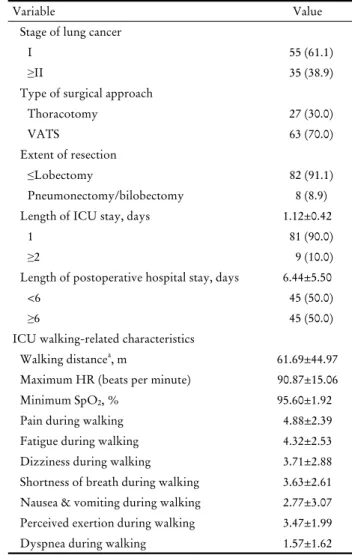
Table 1. General, clinical, and ICU walking-related characteristics of participants (n=90)
Variable Value
Stage of lung cancer
I 55 (61.1)
≥II 35 (38.9)
Type of surgical approach
Thoracotomy 27 (30.0)
VATS 63 (70.0)
Extent of resection
≤Lobectomy 82 (91.1)
Pneumonectomy/bilobectomy 8 (8.9)
Length of ICU stay, days 1.12±0.42
1 81 (90.0)
≥2 9 (10.0)
Length of postoperative hospital stay, days 6.44±5.50
<6 45 (50.0)
≥6 45 (50.0)
ICU walking-related characteristics
Walking distancea, m 61.69±44.97
Maximum HR (beats per minute) 90.87±15.06
Minimum SpO2, % 95.60±1.92
Pain during walking 4.88±2.39
Fatigue during walking 4.32±2.53
Dizziness during walking 3.71±2.88
Shortness of breath during walking 3.63±2.61 Nausea & vomiting during walking 2.77±3.07 Perceived exertion during walking 3.47±1.99
Dyspnea during walking 1.57±1.62
Values are presented as mean±standard deviation or number (%).
Abbreviations: ASA, American Society of Anesthesiologists; HR, heart rate; ICU, intensive care unit; SpO2, saturation of percuta- neous oxygen; VATS, video-assisted thoracoscopic surgery.
aResponse was collected from 62 participants because records of the other participants were missing from the electronic medical record.
Table 1. Continued
ships among perceived postoperative recovery and other variables. Finally, a multiple regression analysis was per- formed to identify the factors associated with postoperative recovery.
RESULTS
1. General, clinical, and ICU walking-related characteristics of the participants
The mean age of participants was 63.23±8.12 years, rang- ing from 37 to 79 years. Half of them were male, and 54%
Variable Value Ranking Postoperative recoverya
Physical symptoms
Pain 1.34±0.69 1
Appetite changes 1.10±1.08 2
Fatigue 0.96±0.76 4
Sleeping difficulties 0.84±0.99 6
Nausea 0.20±0.52 16
Subtotal 0.89±0.50
Physical functions
Gastrointestinal function 1.01±1.13 3
Mobilization 0.78±0.73 7
Muscle weakness 0.74±0.71 8
Bladder function 0.16±0.42 17
Subtotal 0.67±0.52
Psychological
Feeling down 0.74±0.74 8
Anxiety and worry 0.67±0.82 10
Difficulty in concentration 0.57±0.70 13 Feeling lonely/abandoned 0.30±0.63 14
Subtotal 0.57±0.58
Social
Dependence on others 0.66±0.77 11
Interest in surroundings 0.58±0.76 12
Subtotal 0.62±0.68
Activity
Re-establishing everyday life 0.90±0.91 5
Personal hygiene 0.29±0.66 15
Subtotal 0.59±0.65
Total recovery 0.70±0.41
Self-efficacyb 3.06±0.42 NA
Values are presented as mean±standard deviation.
Abbreviation: NA, not applicable.
aAs measured by the Postoperative Recovery Profile on a 4-point Likert scale, 0 (none) to 3 (severe).
bAs measured by the General Self-Efficacy Scale on a 4-point Likert scale, 1 (not at all true) to 4 (exactly true).
Table 2. Participants’ postoperative recovery and self-efficacy (n=90)
were unemployed. A quarter of the participants were cur- rent smokers; about one-third had no previous operation history, and nearly two-thirds were diagnosed with the first stage of lung cancer. The mean length of ICU stay was 1.12±0.42 days, and the mean postoperative hospital stay was 6.44±5.50 days. The mean walking distance was 61.69±44.97 m, based on an analysis of the data from 62 participants because records of the other participants were missing from the electronic medical record. Among the symptoms experienced during walking exercises, participants reported pain as the most severe, while N&V was the weakest. The mean score for perceived exertion during walk- ing was 3.47, indicating moderate to strong exertion. The mean score for dyspnea during walking was 1.57, indicating slight dyspnea (Table 1).
2. Postoperative recovery and self-efficacy of the participants
Table 2 shows participants’ scores for postoperative re- covery and self-efficacy. As to postoperative recovery, high- er scores reflect lower levels of recovery. The mean score for postoperative recovery was 0.70±0.41 out of 3, indicat- ing a high level of perceived recovery. Among the five di- mensions, the physical symptoms indicated the lowest, and the psychological dimension indicated the highest recovery level. Among the problems, the pain ranked at the lowest recovery level, followed by appetite changes and gastro- intestinal function, whereas bladder function was ranked highest, followed by nausea and personal hygiene. The mean self-efficacy score of the participants was 3.06±0.42 out of 5.
3. Postoperative recovery according to the characteristics of the participants
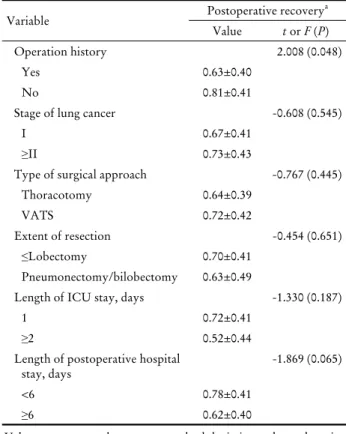
There was no significant difference in postoperative re- covery according to age, gender, marital status, stage of lung cancer, and extent of resection (Table 3). However, there were significant differences in postoperative recovery ac- cording to employment status (t=-2.689, P=0.009) and oper- ation history (t=2.008, P=0.048).
4. Correlation among postoperative recovery,
self-efficacy, and ICU walking-related characteristics
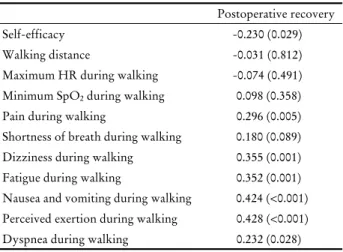
Postoperative recovery and self-efficacy had a negative correlation (r=-0.230, P=0.029), which indicates that the higher the self-efficacy, the higher the level of recovery. In addition, postoperative recovery was positively correlated to
Variable Postoperative recoverya Value t or F (P) General characteristics
Age, y 0.356 (0.723)
<65 0.68±0.41
≥65 0.72±0.42
Gender -1.525 (0.131)
Male 0.63±0.40
Female 0.76±0.42
Religion 0.411 (0.682)
Yes 0.71±0.44
No 0.67±0.36
Marital status 0.597 (0.552)
Married 0.71±0.44
Other (single, bereaved,
divorced, or separated) 0.64±0.29
Main caregiver 0.037 (0.970)
Spouse 0.70±0.45
Other (parents, sibling, or
children) 0.69±0.33
Education level -0.376 (0.708)
≤Middle school 0.72±0.42
≥High school 0.69±0.42
Employment status -2.689 (0.009)
Employed 0.58±0.29
Unemployed 0.80±0.47
Monthly Income, 10,000 KRW 0.443 (0.659)
<300 0.67±0.43
≥300 0.71±0.41
Clinical characteristics Pre-op chemotherapy &
radiotherapy 1.193 (0.236)
Yes 0.56±0.39
No 0.72±0.42
Smoking 1.911 (0.154)
Non-smoker 0.77±0.41
Ex-smoker 2.79±0.57
Current smoker 0.57±0.37
ASA classification 2.146 (0.123)
I 1.01±0.49
II 0.70±0.41
III 0.57±0.39
Cancer history -0.006 (0.995)
Yes 0.70±0.44
No 0.70±0.41
Table 3. Differences in postoperative recovery by participants’ general and clinical characteristics (n=90)
Variable Postoperative recoverya
Value t or F (P)
Operation history 2.008 (0.048)
Yes 0.63±0.40
No 0.81±0.41
Stage of lung cancer -0.608 (0.545)
I 0.67±0.41
≥II 0.73±0.43
Type of surgical approach -0.767 (0.445)
Thoracotomy 0.64±0.39
VATS 0.72±0.42
Extent of resection -0.454 (0.651)
≤Lobectomy 0.70±0.41
Pneumonectomy/bilobectomy 0.63±0.49
Length of ICU stay, days -1.330 (0.187)
1 0.72±0.41
≥2 0.52±0.44
Length of postoperative hospital
stay, days -1.869 (0.065)
<6 0.78±0.41
≥6 0.62±0.40
Values are presented as mean±standard deviation unless otherwise indicated.
Abbreviations: ASA, American Society of Anesthesiologists; ICU, intensive care unit; VATS, video-assisted thoracoscopic surgery.
aAs measured by the Postoperative Recovery Profile on a 4-point Likert scale, 0 (none) to 3 (severe).
Table 3. Continued
pain during walking (r=0.296, P=0.005), dizziness during walking (r=0.355, P=0.001), fatigue during walking (r=0.352, P=0.001), N&V during walking (r=0.424, P<0.001), perceived exertion during walking (r=0.428, P<0.001), and dyspnea during walking (r=0.232, P=0.028). This indicates that the more severe the symptoms, the lower the level of post- operative recovery. On the other hand, postoperative recov- ery and self-efficacy had a negative correlation (r=-0.230, P=0.029), which indicates that the higher the self-efficacy, the higher the level of recovery (Table 4).
5. Factors associated with postoperative recovery
The results of the multiple regression model found that unemployment (β=4.353, P=0.005), more N&V during walk- ing (β=0.596, P=0.043), and severe perceived exertion during walking (β=1.105, P=0.007) influenced postoperative recov- ery (F=4.692, P<0.001). The adjusted R2 indicated that this
Postoperative recovery
Self-efficacy -0.230 (0.029)
Walking distance -0.031 (0.812)
Maximum HR during walking -0.074 (0.491) Minimum SpO2 during walking 0.098 (0.358)
Pain during walking 0.296 (0.005)
Shortness of breath during walking 0.180 (0.089) Dizziness during walking 0.355 (0.001)
Fatigue during walking 0.352 (0.001)
Nausea and vomiting during walking 0.424 (<0.001) Perceived exertion during walking 0.428 (<0.001)
Dyspnea during walking 0.232 (0.028)
Values are presented as r (P).
Abbreviations: ICU, intensive care unit; HR, heart rate; SpO2, satu- ration of percutaneous oxygen.
Table 4. Correlation among postoperative recovery, self-efficacy, and ICU walking-related characteristics (n=90)
Variable β SE t P
Age, y -0.169 0.087 -1.930 0.057
Gender -1.621 1.561 -1.038 0.302
Employment status 4.353 1.496 2.909 0.005
Previous operation 1.801 1.343 1.341 0.184
Self-efficacy -0.298 0.164 -1.821 0.072
Pain during walking 0.377 0.312 1.210 0.230
Dizziness during walking -0.060 0.330 -0.182 0.856
Fatigue during walking 0.076 0.364 0.210 0.834
Nausea and vomiting during walking 0.596 0.290 2.053 0.043
Perceived exertion during walking 1.105 0.397 2.779 0.007
Dyspnea during walking -0.346 0.484 -0.714 0.477
R2=0.398, adjusted R2=0.313, F=4.692, P<0.001.
Abbreviations: SE, standard error.
Table 5. Factors associated with postoperative recovery (n=90) regression model explained their perception of postoperative recovery before discharge by 31.3% (Table 5).
DISCUSSION
The study was conducted to examine the factors asso- ciated with perceived postoperative recovery in lung cancer patients after lung resection. In this study, the level of post- operative recovery before discharge was relatively high, and results showed higher levels of postoperative recovery among lung resection patients compared to gastrectomy,23) gastrointestinal surgery,20) and cardiac surgery24) patients.
The patients analyzed actively performed walking exercises to promote postoperative recovery as a part of the ERAS, emphasizing the postoperative phase.9,25) According to the ERAS guideline, exercising within 24 hours after surgery can help improve postoperative recovery despite several ob- stacles such as chest tube, foley catheter, and pain.11) As ex- ercise has positive effects on patients’ physical and psycho- logical aspects,9,11) the study participants who participated in walking exercises early on also showed positive post- operative recovery levels.
Among the five dimensions of postoperative recovery perceived by participants before discharge, the psychological dimension had the highest recovery level, while physical symptoms had the lowest level. Previous studies also re- ported psychological recovery as having the highest lev- el,23,24) which can be attributed to the belief that patients can be treated by surgery and return to their daily lives after discharge.24)
In this study, 70% of the participants underwent surgery through VATS, a minimally invasive method, and their ex- tent of resection was mostly below lobectomy. Compared to thoracotomy, patients who had lung resection through VATS showed relatively lower pain in a previous study.26) Despite the high percentage of the VATS method, the re- sults of this study indicated that the recovery level for phys- ical symptoms was the lowest, of which pain was the lowest among all problems. In the process of lung resection, sur- geons cut or retract muscles, fracture or sever ribs, and in- sert chest tubes that irritate or damage the pleura or inter-
costal muscles, which may cause more pain than other operations.11) Pain is a common physical symptom that pa- tients frequently experience after lung resection, and this pain can be further aggravated by walking exercises. Other symptoms with lower recovery levels, such as appetite changes and gastrointestinal function, also did not meet the patients' expectation of recovery during the postoperative phase. Therefore, nursing interventions to alleviate and con- trol these symptoms need to be implemented to enhance postoperative recovery.
In the multiple regression analysis, employed participants reported significantly higher postoperative recovery levels than unemployed ones. Jeon et al.23) found that stomach cancer patients who were employed showed higher post- operative recovery levels. The reason might be that em- ployed patients make more effort to recover to return to daily life quickly after discharge compared to unemployed ones.27) Moreover, it was identified that females, older adults, and those who had poor health status had difficulty returning to work after the treatment.28) Consequently, mul- tidisciplinary, patient-tailored interventions should be pro- vided at discharge or in outpatient clinics to assist those who are less likely to return to work after surgery.29,30)
Furthermore, those who felt less N&V during the walk- ing exercises reported higher levels of postoperative recovery.
Postoperative nausea and vomiting are one of the most fre- quent complications, with negative effects on the early stages of recovery after surgery.11) Controlling these symp- toms could also make early exercise more plausible.25) When nurses care for patients who perform walking exercises, they need to alleviate N&V to affect postoperative recovery positively.
This study is the first in Korea to investigate subjective postoperative recovery and the associated factors using pa- tients’ reports and objective data on walking exercises in an ICU after lung resection. However, this study has several limitations. As convenience sampling was used to recruit pa- tients in a specific ICU after surgery, it is difficult to gen- eralize the results to all post-surgical lung cancer patients.
Furthermore, given that more than a 2-day interval passed between the actual walking exercises in the ICU and data collection, a patient’s recollection might not reflect their real condition. Another limitation is that this study did not com- pare results with those who did not engage in walking ex- ercises in ICU. However, such a comparison was impossible
because all patients performed walking exercises based on physicians' order in this study site.
In conclusion, our study revealed that unemployed pa- tients, patients who experienced severe N&V during walk- ing, or had high levels of perceived exertion during walking reported lower levels of perceived postoperative recovery.
Multidisciplinary, patient-centered interventions should be implemented to support patients who plan to return to work. To enhance patients’ recovery following lung re- section surgery, nursing interventions should be applied to alleviate physical symptoms and patients also need to ex- ercise at an appropriate level of perceived exertion. These findings can contribute to promoting postoperative recovery among lung resection patients, which can ultimately im- prove their quality of life.
요 약
연구배경: 발생률과 사망률이 높은 폐암을 치료하기 위해
폐 절제술을 실시하지만, 수술 후 폐 합병증의 위험이 높다.
조기 걷기 운동은 합병증을 예방하고, 일상생활 복귀를 위
해 필수적인 수술 후 회복을 향상시키기 위해 중요한 요소
이다. 본 연구는 중환자실 내 걷기 운동을 실시한 폐 절제술
환자가 퇴원 전 인식하는 수술 후 회복에 영향을 미치는 요
인에 대해 살펴보고자 한다.
방법: 본 연구는 조사 연구로, 서울의 일 상급종합병원에 서 폐 절제술을 시행하고 중환자실 내 걷기 운동을 실시한 후 퇴원을 앞둔 폐암 환자 90명을 대상으로 2019년 4월부터 6월까지 자료를 수집하였다. 일반적 특성, 임상적 특성, 중
환자실 내 걷기 운동 특성 및 수술 후 회복(역문항)을 조사
하였다.
결과: 환자가 인식하는 수술 후 회복의 평균 점수는 3점 만 점 중 0.70±0.41점이었고, 심리적 영역이 회복 정도가 가장
높았으며 신체적 증상이 가장 낮았다. 또한 통증, 식욕의 변
화, 소화기계 장애 순으로 회복이 부족하다고 나타났다. 수술
후 회복은 직업이 없는 환자인 경우(β=4.353, P=0.005), 걷기 운동 중 오심 및 구토 증상이 심할수록(β=0.596, P=0.043), 주 관적 운동자각도가 심각할수록(β=1.105, P=0.007) 수술 후
회복 정도가 낮은 것으로 나타났다.
결론: 폐 절제술 환자의 수술 후 회복을 향상시키기 위해 신체적 증상을 조절하고 직장 복귀를 촉진시킬 수 있는 다 학제적, 환자 맞춤형 중재 개발 및 적용이 필요하다. 또한 이들의 수술 후 회복을 위해 적절한 강도로 운동을 실시하 는 것이 동반될 필요가 있다.
중심 단어: 조기 운동, 중환자실, 폐암, 폐 절제술, 수술 후 회복
ORCID
Yesol Kim https://orcid.org/0000-0002-3540-1723 JiYeon Choi https://orcid.org/0000-0003-1947-7952 Jong Ho Cho https://orcid.org/0000-0003-3362-4621 Mona Choi https://orcid.org/0000-0003-4694-0359
REFERENCES
1. Korean Statistical Information Service (KOSIS). The number of cancer occurrence and cancer incidence by type of cancer, gender, and age in Korea [Internet]. Daejeon: KOSIS; 2019 [Accessed 2019 Dec 1]. Available from: http://kosis.kr/statHtml/statHtml.
do?orgId=117&tblId=DT_117N_A00023&conn_path=I2.
2. Korean Statistical Information Service (KOSIS). The number of deaths and mortality rate by cause of death, gender, and age in Korea [Internet]. Daejeon: KOSIS; 2019 [Accessed 2019 Dec 1].
Avilable from: http://kosis.kr/statHtml/statHtml.do?orgId=
101&tblId=DT_1B34E01&conn_path=I2.
3. Bédat B, Abdelnour-Berchtold E, Perneger T, Licker MJ, Stefani A, Krull M, et al. Comparison of postoperative compli- cations between segmentectomy and lobectomy by video-as- sisted thoracic surgery: a multicenter study. J Cardiothorac Surg 2019;14(1):189.
4. Cho JH, Choi YS. Minimally invasive thoracic surgery in lung cancer operation. Hanyang Med Rev 2014;34(1):26-30.
5. Rupp M, Miley H, Russell-Babin K. Incentive spirometry in postoperative abdominal/thoracic surgery patients. AACN Adv Crit Care 2013;24(3):255-63.
6. Fernandez-Bustamante A, Frendl G, Sprung J, Kor DJ, Subramaniam B, Martinez Ruiz R, et al. Postoperative pulmo- nary complications, early mortality, and hospital stay following noncardiothoracic surgery: a multicenter study by the Perioperative Research Network Investigators. JAMA Surg 2017;152(2):157-66.
7. Allvin R, Berg K, Idvall E, Nilsson U. Postoperative recovery: a concept analysis. J Adv Nurs 2007;57(5):552-8.
8. Allvin R, Ehnfors M, Rawal N, Idvall E. Experiences of the postoperative recovery process: an interview study. Open Nurs J 2008;2:1-7.
9. Ljungqvist O, Scott M, Fearon KC. Enhanced recovery after surgery: a review. JAMA Surg 2017;152(3):292-8.
10. Lau CS, Chamberlain RS. Enhanced recovery after surgery pro- grams improve patient outcomes and recovery: a meta-analysis.
World J Surg 2017;41(4):899-913.
11. Batchelor TJP, Rasburn NJ, Abdelnour-Berchtold E, Brunelli A, Cerfolio RJ, Gonzalez M, et al. Guidelines for enhanced re- covery after lung surgery: recommendations of the Enhanced Recovery After Surgery (ERAS®) Society and the European Society of Thoracic Surgeons (ESTS). Eur J Cardiothorac Surg 2019;55(1):91-115.
12. Moradian ST, Najafloo M, Mahmoudi H, Ghiasi MS. Early mo- bilization reduces the atelectasis and pleural effusion in patients
undergoing coronary artery bypass graft surgery: a randomized clinical trial. J Vasc Nurs 2017;35(3):141-5.
13. Sosnowski K, Lin F, Mitchell ML, White H. Early rehabilitation in the intensive care unit: an integrative literature review. Aust Crit Care 2015;28(4):216-25.
14. DePew ZS, Karpman C, Novotny PJ, Benzo RP. Correlations between gait speed, 6-minute walk distance, physical activity, and self-efficacy in patients with severe chronic lung disease.
Respir Care 2013;58(12):2113-9.
15. Bandura A. Self-efficacy: the exercise of control. New York:
W.H. Freeman and Co.; 1997.
16. Lin YY, Liu MF, Tzeng JI, Lin CC. Effects of walking on qual- ity of life among lung cancer patients: a longitudinal study.
Cancer Nurs 2015;38(4):253-9.
17. Kim KH, Kim WH, Lee BK, Kim YJ, Park GW, Kim DY.
Comparison of rating of perceived exertion and category ratio scale 10 during graded exercise test. Korean J Phys Educ 2006;45(3):513-23.
18. Lee YK, Yoon HS. Usefulness of modified borg scale in assess- ing dyspnea. J Korean Clin Nurs Res 2005;10(2):173-85.
19. Allvin R, Ehnfors M, Rawal N, Svensson E, Idvall E.
Development of a questionnaire to measure patient-reported postoperative recovery: content validity and intra-patient reliability. J Eval Clin Pract 2009;15(3):411-9.
20. Kim YM, Jung HJ, Oh EG. Influences of resilience and social support on postoperative recovery among patients with gastro- intestinal cancer. Korean J Adult Nurs 2017;29(4):432-40.
21. Schwarzer R, Jerusalem M. Generalized self-efficacy scale. In:
Weinman J, Wright S, Johnston M, editors. Measures in health psychology: a user’s portfolio. Causal and control beliefs.
Windsor: NFER-NELSON; 1995. p.35-7.
22. Schwarzer R, Born A, Iwawaki S, Lee YM. The assessment of optimistic self-beliefs: comparison of the Chinese, Indonesian, Japanese, and Korean versions of the general self-efficacy scale.
Psychologia 1997;40(1):1-13.
23. Jeon BH, Choi M, Lee J, Noh SH. Relationships between gas- trointestinal symptoms, uncertainty, and perceived recovery in patients with gastric cancer after gastrectomy. Nurs Health Sci 2016;18(1):23-9.
24. Kim SY. Influential factors on quality of recovery of patients undergone cardiac surgery. Korean J Rehabil Nurs 2014;17(2):
64-71.
25. Slim K. The benefits of enhanced recovery after surgery. J Visc Surg 2016;153(6):S41-4.
26. Bendixen M, Jørgensen OD, Kronborg C, Andersen C, Licht PB. Postoperative pain and quality of life after lobectomy via video-assisted thoracoscopic surgery or anterolateral thor- acotomy for early stage lung cancer: a randomised controlled trial. Lancet Oncol 2016;17(6):836-44.
27. van Egmond MP, Duijts SFA, Loyen A, Vermeulen SJ, van der Beek AJ, Anema JR. Barriers and facilitators for return to work in cancer survivors with job loss experience: a focus group study. Eur J Cancer Care (Engl) 2017;26(5):e12420.
28. Ito H, Hozawa A, Yamashita H, Kubota I, Nemoto K, Yoshioka T, et al. Employment status among non-retired cancer survivors in Japan. Eur J Cancer Care (Engl) 2015;24(5):718-23.
29. Zaman AGNM, Tytgat KMAJ, van Hezel S, Klinkenbijl JHG, de Boer AGEM, Frings-Dresen MHW. Development of a tail- ored work-related support intervention for gastrointestinal can-
cer patients. Eur J Cancer Care (Engl) 2018;27(2):e12782.
30. Leensen MCJ, Groeneveld IF, Rejda T, Groenenboom P, van Berkel S, Brandon T, et al. Feasibility of a multidisciplinary in-
tervention to help cancer patients return to work. Eur J Cancer Care (Engl) 2018;27(2):e12690.