• 검색 결과가 없습니다.

A Study on the Effect of Retail Ready Packaging (RRP) in Discount Stores on Customer Satisfaction and Repurchase Intention

N/A
N/A
Protected

Academic year: 2021

Share "A Study on the Effect of Retail Ready Packaging (RRP) in Discount Stores on Customer Satisfaction and Repurchase Intention"

Copied!
14
0
0

로드 중.... (전체 텍스트 보기)

전체 글

(1)

Vol. 27, No. 2 71~84 (2021)

https://doi.org/10.20909/kopast.2021.27.2.71

A Study on the Effect of Retail Ready Packaging (RRP) in Discount Stores on Customer Satisfaction and Repurchase Intention

Sung-Tae Jung

1

*

1

Department of Distribution and Logistics, Sejong Cyber University

Abstract The purpose of this study is to establish a new management strategy to meet customer needs of discount stores as customers demand higher and more diverse services in addition to low prices. An empirical analysis on con- sumers to explore the structural relationships between the quality, environmentally friendliness, consumer perception, service value, and emotional response of retail ready packaging (RRP) in discount stores in order to find out how they affect customer satisfaction and repurchase intention. First, it was confirmed that the RRP quality of discount stores that affects customer satisfaction is mediated by the emotional response. Second, it was found that RRP in discount stores should continue to devise strategies to improve service quality along with efforts to provide more benefits per- ceived by customers to increase customer satisfaction and repurchase intention. Third, it was confirmed that the RRP image of discount stores has a positive (+) effect on service value, emotional response, customer satisfaction, and repurchase intention.

Keywords RRP, Discount store, Environment friendly, Customer satisfaction, Repurchase

Introduction

Recently, as a new consumption trend is formed according to economic, cultural, and social factors, the distribution envi- ronment has entered an era of unlimited competition with no boundaries between channels due to the development of tech- nology, entry into various channels, and changes in con- sumption patterns

1-2)

. The most important keyword for all corporations around the world has to be competitiveness rein- forcement. Competitiveness reinforcement not only means expansions of corporations but has become the surviving strat- egy of corporations. When examining the data released by the National Statistical Office, the situation of department stores and discount stores. The term discount store changed from large-scale shops to discount stores during the enactment of the Distribution Industry Development Act of 1977 to be changed again with the revision in 2004. In terms of figures, discount stores recorded sales of 19.2 trillion KRW in 2003, which was 11.7% higher than 17.1 trillion KRW of depart- ment stores

3)

. In addition, as of 2021, it continues to grow with PB (Private Brand) products and online sales strategies.

However, the discount stores of Korea are facing very difficult conditions where they have to take part in competition of busi- ness conditions but also fiercely compete with same business conditions within the saturated retail market. Like the inno- vation stage of the wheel of retailing

4)

, the domestic discount stores began with the innovative concept of low prices and minimal service in the entry phase, they have strengthened with services, product assortments and high quality facilities with the growth phase to accomplish an unique business con- dition positioning that is ‘Korean discount store’ of ‘semi- department store status.’

Such competition in enhancements between businesses caused 1st and 2nd generation discount stores that focused on basic functions to evolve under the concept of 3rd and 4th generation discount stores as lifestyle value stores combining professional tenants, cultural centers, and convenient facilities.

Furthermore, establishing new business strategies are required for discount stores to meet the desires of customers in accordance with the demand of various services of higher quality as well as low prices. Despite such changes, there have not been sufficient amounts of empirical studies on Korea’s typical retail channel that is discount stores. Over the past decade, the studies on service quality of retail stores were mainly focused on department stores to investigate the cause- and-effect relationship between few concepts such as service quality, customer satisfaction and preferences and the few studies on discount stores have also been limited to fragmentary studies

*Corresponding Auth

or: Sung-Tae Jung

Department of Distribution and Logistics, Sejong Cyber University, 121, Gunja-ro, Gwangjin-gu, Seoul 05000, Korea Tel: +82-10-6616-8955, Fax: +82-2-528-2680

E-mail: [email protected]

(2)

investigating the cause-and-effect relationship between few concepts such as the relationships between service quality and satisfaction as well as store selection factor and preference. In short, majority of the study results concluded that service quality and customer satisfaction were closely related and that preferences were related to store selection factors. However, customer satisfaction achieved with good physical environment and human services won’t always lead to repeated purchases and although low prices and strong preferences are important factors in store selection, they cannot be described as the only factors for repurchase intentions. It is particularly difficult to find studies analyzing the relationship between customer satisfaction and repurchase intentions by considering service quality, reputation, service value and emotional response as both theoretical and leading variables.

Hence, there are insufficient number of comprehensive studies on determining what the factors influential to user satisfaction and repurchase intentions are for discount store services. This study attempted an integrated study on the cognitive and emotional aspects of discount store retail ready packaging (RRP) customers according to the discount store Service Relationship related research results of Jung

2)

, and derived model and hypotheses of research on the relationship between each constituent concept and hypothesis testing. For this purpose, the sample was composed of customers and a survey was conducted. The purpose of this study was to explore the structural relationship between service quality, image, service value, and emotional response through RRP of large marts, and to empirically analyze how it affects customer satisfaction and repurchase intention. The two-factor solution method, that was suggested as the dependency problem among the 5 levels of SERVQUAL (a compound word of SERVEC + QUALITY), which has been widely used in service evaluation, was applied to classify RRP environmental factors and Quality factors to examine the influence that cognitive evaluation on service quality has on customer satisfaction and repurchase intentions through the customer’s emotional responses.

Moreover, based on the precedent studies stating that service quality influences service value, customer satisfaction and repurchase intentions perceived by customers, the discount store RRP image was included in the leading variable since the basic properties of discount stores services possess properties close to experiential products, thus there exist high probability that consumers may determine purchases based on RRP image or word-of-mouth from their surroundings. The analysis to verify the reliability and validity of constructs was conducted and the structural equation modeling method was used to verify the proposed hypothesis. Furthermore, the reliability of variables was verified by using the Cronbach's α and squared multiple correlation (SMC) that exhibits internal consistency. The path analysis based on the structural equation modeling was also conducted.

Documents Research

Concept of discount stores and characteristics of Korean discount stores

Amidst technological development, changing consumption patterns, introduction of various channels, and increasing competition, retailers are a crucial part of the value chain

5)

. Discount stores are one of the most important kinds of retailers that distribute goods and services to the final consumer.

6)

. Kotler and Armstrong

7)

defined it as “businesses that sell normal products at low prices with mass sales and low profit margins.” In Korea, it has been described as “more popular than mass merchandisers to organize products practically and is an industry in the form of quick sales at small profits, self- service and price destruction

8)

. Discount stores are the large- scale retailers that charge low prices by mainly focus on durable consumer goods and are also called as discounters. In short, these are retailers that mainly sell durable consumer goods to consumers at prices below the listed price

9)

. Discount stores can be defined as stores conducting mass sales of standard products under self-service

10)

.

According to the 10 Years of Open Distribution, while the status of small scale shops have declined for 10 years since the complete opening of the domestic distribution market in 1996, new business conditions such as discount stores, convenient stores and non-store retailing have achieved rapid growth

11)

. In such aspect, the shopping culture focusing on department stores and supermarkets have deteriorated and the discount stores with massive shopping spaces have come to lead the market. Meanwhile, according to the analytical report of Shinsegye’s distribution research center (2007), the competitors commercial districts with competitors has reached 90% as displayed in Table 1 in the case of A, which is the represen- tative business in the discount store market. Furthermore, it appears as though 63% of entire stores are operating in very competitive situations of above the average competition intensity to find that businesses need establishing differentiated strategies and competitive shops to survive. Another change is that the competitive aspect among the discount stores is being expanded from price competition to non-price competitions.

In the early stages of discount stores, the 1st generation discount stores that imposed low prices with warehouse-type store structure as element of competition were common.

However, low prices are no longer demonstrating strength as elements of competitive edge due to the change in needs and increase in income levels of customers.

According to the study of Della, Monroe and Mcginnis

12)

,

price discounts under 10% do not have significant impact on

consumer behavior. Unlike the current discount store market

appearing by imposing price destruction, the competition is

being further accelerated due to the differentiation and

enhancements of services by each business and such occurrences

(3)

are thought to be related to the rapid deterioration of American style discount stores focusing on bulk bundle sales to transform into Korean style discount stores providing various services in spacious and pleasant environments. Moreover, the appearance of these Korean style discount stores in the discount store market could be the result of reflecting upon the needs of Korean customers that desire to shop with better treatments even if the prices are a little bit higher.

On the other hand, Discount Store are introducing various RRP as shown in Figure 1 and Figure 2 to enhance their competitiveness. contributing. Therefore, this study is to explore the structural relationship between quality, friendly environ- ment, image, service value, and emotional response through RRP, and to empirically analyze how it affects customer satisfaction and repurchase intention.

Service-related theoretical analysis

1. Quality and environment

Unlike a product, a service is produced and delivered at the same time, so the interaction between the service provider and the customer at the service contact point has a very important effect on performance

13-14)

. Once the relationship between the firm and the customer is established in the marketplace, continued customer contact, successful interactions and ongoing repeat transactions will enhance the relationship between the service firm and its customer

15)

. Above all, since the main source of competitive advantage is customer value, it is important to secure a competitive advantage in the market so that it can provide customers with perceived value that is higher than that of competitors

15)

. Although the definition of Table 1. Competition intensity of discount store A

Competition Type

Competition Intensity

Relevant No.

of Stores

Average no. of stores within core commercial area

Average no. of stores within strategic commercial area

Average no. of stores within wide area commercial districts

Intense 20~28 6 5 3 8

High 12~17 17 3 1 37

Mid 7~11 34 1 2 39

Low 1~6 33 0 1 26

Note: Shinsegye’s Distribution Research Center (2007), “Countermeasures according to competition status of discount stores” CI (Competition Intensity), core commercial area: 1km radius, strategic commercial area: 3km radius, wide area commercial district:

5 km radius

Fig. 1. Example of inner box-type RRP display pattern.

(4)

service quality varies among scholars, they commonly view perceived quality as a customer-oriented concept and an attitude related to facts, expectations, perception, and satisfaction

17-20)

. On the other hand, Parasuraman et al.

21)

defined service quality as an individual's overall judgment or attitude toward the superiority of a specific service, and this definition is commonly cited

22)

. In addition, as a measuring tool for service quality, SERVQUAL of Parasuraman, Zeithaml and Berry

18)

is mainly used, and it has been used in various service industries until now. Reimer and Kuehn

23)

divided the shopping environment into the scale used in Parasuraman et al.

18)

, and Servicescape was seen to include surrounding elements such as music, noise, and temperature, and elements such as the appearance of employees and interiors.

2. Image

Reputation can be explained as the concept of corporation’s image and association being focused on the consumer’s perspective

14)

. While Fombrun and Van Riel

24)

claimed that although precedent studies have put much effort in the management of corporate reputations, they have failed to shed light on the definition and dynamics of clear and strong corporate reputation and systematically studied the reputation within each domain of knowledge

14)

. Gotsi and Wilson

25)

claimed that reputation and image are different concepts but also dynamic structures that had mutual influence

26)

. Meanwhile, it was also claimed that corporate identity is the true nature held by the corporation since corporate identity can be used as a tool to separate from other corporations with differentiated characteristics with competition

27)

and these were different concepts because the reputation of a corporation is evaluated from the outside

28)

. Kotler

29)

defined an image as “a set of beliefs, ideas, and impressions that a person has about an object”. In other words, an image is premised on the existence of a certain object

30)

. On the other hand, Kotler

29)

argued that

the image can be applied to a variety of objects, suggesting the corporate image, which is the point of view of the whole company, and the product image, which is the point of view of a specific product category, and the brand image, which is the point of view of a specific brand in competition with other brands, and the concept of a marketing image, which is a perspective of looking at the quality of a company's overall marketing efforts or marketing mix. In addition, it was said that the image has both individuality, which is a differentiated attribute, and favorableness, which means good or bad.

Combining various scholars' discussions on image, it can be seen that image refers to the customer's overall perception of the organization and is composed of several sub-concepts. In other words, an image is premised on the existence of an object, and it is a picture in the mind about the whole rather than any one aspect of the object, and it can be said that it has a direction like an attitude.

3. Service value

Service value is captured by two aspects: benefits gained

and costs paid by consumers. Therefore, it is a leading

variable of customer-satisfaction. This is a much better way to

understand the concept than merely saying that service quality

impacts customer-satisfaction and purchasing intentions

31)

. As

the relationship between service quality and customer satis-

faction is being studied, many researchers have concluded that

service corporations must deliver service value to increase

customer-satisfaction

32,33,14)

. In the field of marketing, service

value can be defined as profits or benefits expected by consumers

through products or services and this applies as a factor more

important than price during the purchase decision-making

process

34-37)

. Hence, the psychological viewpoints of humans

must be included when considering to define service value

and service value can be viewed as a more helpful concept

when explaining or predicting the consumer’s reactions since

Fig. 2. Outer box-type RRP pattern example.

(5)

service production itself is not the fundamental value but factors like perceived service quality is formed into the overall service value

38)

.

4. Emotional reaction

Studies are being actively conducted on the emotions felt by consumers in accordance with the increase in awareness that consumers are both intelligent and emotional

39)

. According to Gardner

40)

, affect is a perception on environmental stimulation within daily life that is closely related to the perception process, to be either feelings of pleasure or displeasure and unlike affect, emotions are behavioral responses that occur with physical agitation in accordance with external stimulation and therefore, emotions are not just feelings of pleasure or displeasure but rather a more complex, abundant and comprehensive emotional experience. Moreover, emotions can be explained in a broader concept that includes experiences and feelings of the past as well as interpretations of perceived information while affect is an one-dimensional state created during physio- logical activity. On the other hand, feelings are more general and momentary state of emotion while mood defines the momentary state of emotion that influences human’s activity at a certain time and situation

41-42)

. In this study, the emotional responses that customers feel during service situations at discount stores were not classified as emotion, affect, feeling and mood but rather holds the meaning of the overall psychological and emotional condition experienced by the customer. In short, the emotional responses were defined as the emotional and psychological conditions as a concept that is opposite of perception and emotional responses are not the conscious and perceptual information processing process.

Therefore, the overall emotional and psychological conditions experienced by the customers can be viewed as the emotional response, which is an important research unit in the present study. The present study was based on the claim that cognitive responses act as factors that precede emotional responses

43-44, 14)

.

5. Customer satisfaction

Enhancing customer satisfaction and customer retention leads to advantages of profit improvements, positive word-of- mouth, and less expenses for marketing costs

45-46,14)

. Customer satisfaction can be defined as the judgment influenced by positive or negative emotional responses and cognitive dissonance. In short, it can be defined as “the comprehensive psychological condition that occurs when the expectancy discrepancy and the emotions the consumer had regarding consumption experience prior to the actual experience are combined”

47)

. High customer satisfaction leads to increase in loyalty of existing customers, decline in price sensitivity, prevention of losing existing customers, decrease in marketing failure costs, decline in costs to draw new customers and improvements in corporate reputation

48)

. Until now, the

studies conducted on customer satisfaction can be divided into four domains of ① conceptual studies on conceptual distinction, explanation or definition and investigation into limitations and theory, ② methodological studies on methodological issues or relationships between variables related to the concept of customer satisfaction, ③ descriptive studies on explanations of satisfaction/dissatisfaction or degree of complaints and ④ management study researching by applying the satisfaction/

dissatisfaction concept and scale on subjects of independent companies

14)

.

6. Repurchase intention

According to Kim

14)

and Oliver

49)

argued that customer satisfaction affects post-purchase attitude and increases repurchase intention. In the studies of Bearden and Teel

50)

and Bitner

51)

, It has been proven that it affects the attitude of con- sumers and influences the intention to repurchase. Furthermore, in marketing or organizational behavior literature, repurchase intention is understood as intention to maintain relationships in the relationship commitment aspects. Hence, the importance of defensive marketing strategies for enhancing customer loyalty and maintaining existing customers are increasing in comparison to offensive marketing strategies of attracting new customers and expansion of market share

48,52)

. Reichheld

53)

claimed that the key of marketing strategy in the service industry is to maximize the maintenance rate of existing customers by increasing customer loyalty. And existing studies on service marketing also show that management of existing customers is more efficient than attracting new customers and the qualitative performance index of customer loyalty has closer connections with corporate earnings than quantitative performance index of market share

54)

.

As examined above, discount stores have introduced customer relationship management (CRM) based on customer database, mileage points cards, customer service centers, and various warranty programs to meet the needs of customers.

Some experts may disagree with the idea of implementing CRM in discount stores, but I believe they are important because they improve customer satisfaction for discount stores.

Otherwise, such stores have to rely on price-based competition,

which is tough because they keep their prices low as it is. By

implementing CRM, a discount store can offer better value to

its customers even when it charges the same or higher price

compared to its competitors

55)

. Meanwhile, Zimmer & Golden

56)

present study results that the store names apply as important

factors when consumers are choosing stores and there exist

clear differences in favorable-non favorable cognition in relation

to the image of discount stores. Therefore, this study was

conducted by applying Jung

2)

's discount store service-related

research results to RRP in discount stores. The monetary value

felt compared to the money paid for the store's shopping cost

leads to service value, and positive hearsay regarding

(6)

reasonable prices lead to the store's image. The research was conducted by setting the service value and the factors that constitute the image of discount stores. Hence, the present study will examine how the consumer (customer)‘s process of reaction is influenced by the RRP as well as its relationship with service quality and image, service value, emotional response, customer satisfaction and repurchase intentions.

Method and hypotheses of research

1. Research method

This study was conducted by applying the research results according to Jung

2)

to domestic discount stores. It was set up for the following two purposes. First, this study introduces the service quality and image of RRP in discount stores, service value perceived by customers and the emotional response felt by customers to test the influence that it has on customer satis- faction and repurchase intentions to investigate the corre- lation. Second, although Parasuraman et al.

18,21)

‘SERVQUAL has been widely used in existing service evaluations, it raises questions regarding independence between the 5 domain types of service evaluation and faces limitations where the connection between the intangible dimensions appear very high. Hence, Wakefield and Blodgett

57)

and Reimer and Kuehn

23)

insisted that the four factors (reliability, reactivity, certainty, perceptual openness) of SERVQUAL’s evaluation dimensions, that cannot be differentiated, should be tied into a single factor to approach with the two-factor solution of tangibility and intangibility.

Therefore, the present study classifies the dimensions of discount store’s service quality to tangible and intangible factors of

quality and image to find out how the cognitive evaluation on the tangibility and intangibility of customer services influence the emotional responses of customers and understand the influence that it has on customer satisfaction and repurchase intentions through the emotional responses of customers.

2. Research hypotheses

Howard

58)

claimed that cognitive elements determine the emotional responses based on the hierarchical influence suggested by the casual flow of cognition, affect and behavior and that this influences behavior to suggest the cognition- affect-behavior model. Furthermore, the studies on the relation- ship between such cognitive evaluations and emotions mainly cover the influence of environment on emotions

59,60,14)

and the significant relationship between the consumer’s emotions and environments of services have been revealed through various studies

61,62,57,63,33)

. Bolton and Drew

19)

revealed that service value is a conceptual structure determined according to the service quality, consumer’s devotion, and the consumer’s charac- teristics and therefore, service quality is a leading variable of service value. Cronin et al.

32)

claimed that the explanation ability for consumer’s purchase intentions can be enhanced by adding the service value to the consumer decision-making process model based on service quality and costs to present the study result that the service value increases when the service quality rises. Therefore, the present study presented the following hypotheses on the influence of quality and friendly environments of discount stores based on the precedent researches mentioned above.

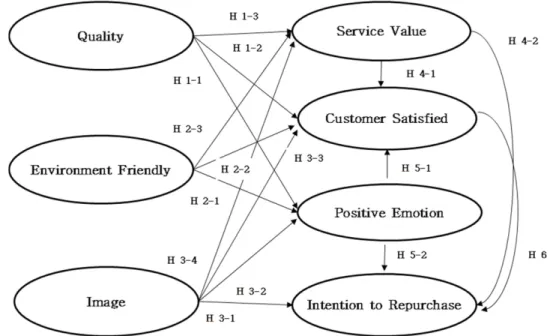
H1-1: RRP quality of discount stores will have positive (+)

Fig. 3. Research model.

(7)

influence on emotional responses.

H1-2: Environment friendly RRP of discount stores will have positive (+) influence on emotional responses.

H1-3: RRP quality of discount stores will have positive (+) influence on customer satisfaction.

H2-1: Environment friendly RRP of discount stores will have positive (+) influence on customer satisfaction.

H2-2: RRP quality of discount stores will have positive (+) influence on service values.

H2-3: Environment friendly RRP of discount stores will have positive (+) influence on service values.

The packaging industry contributes to the expansion of product exports and the improvement of people's living standards through functions such as product protection and storage, distribution convenience, and sales promotion

64)

. In the process of trying to minimize the perceived dangers during the process of purchase, positive images for certain subjects will suggest ideas customers can expect from the relevant services to heighten their confidence in result of purchase to reduce risks. Such images minimize uncertainty caused by lack of confidence, time, and information when consumers are determining purchase intentions

65)

. Therefore, since the discount store services also have the qualities close to experiential products, it can be suggested that there is high chance that customers will determine their purchase based on image or word-of-mouth from their surroundings during the decision- making-process. Based on the above-mentioned precedent researches, the present study settled on the following hypotheses.

H3-1: RRP image of discount stores will have positive (+) influence on service values.

H3-2: RRP image of discount stores will have positive (+) influence on customer satisfaction.

H3-3: RRP image of discount stores will have positive (+) influence on repurchase intentions.

H3-4: RRP image of discount stores will have positive (+) influence on emotional responses.

Westbrook and Michel

66)

has viewed satisfaction-dissatis- faction as emotional responses caused by cognition or conviction regarding certain subjects, behaviors or situations compared with human’s values (or desires-needs-hopes) in the Value-Percent Disparity Model (VPDM). Meanwhile, it was explained that customers determine the service value expressed by cost in comparison to benefits during actual shopping situations to experience satisfaction and dissatisfaction for this to have positive (+) influence on purchase intentions

67)

. Based on the above-mentioned precedent researches, the present study settled on the following hypotheses.

H4-1: Service values will have positive (+) influence on

customer satisfaction.

H4-2: Service values will have positive (+) influence on repurchase intentions.

Since the positive and negative emotions consumers experience in stores increase their loyalty, the relationship of emotions and loyalty is very significant

56)

and the emotions that occur when consumers visit specific stores influence their revisit intentions

61)

. Moreover, the majority of researchers agree that satisfaction has positive influence on repurchase intentions

68,69,70.49)

. Based on the above-mentioned precedent researches, the present study settled on the following hypotheses.

H5-1: Emotional responses will have positive (+) influence on customer satisfaction.

H5-2: Emotional responses will have positive (+) influence on repurchase intentions.

H6: Customer satisfaction will have positive (+) influence on repurchase intentions.

Empirical analysis

1. Sample composition operational definition and measurement of variables

The survey was conducted by interviewers on two discount stores located in Seoul and two discount stores located in Bundang, Gyeonggi-do, from January 11 to February 15, 2021.

The questionnaire was distributed to four hypermarkets, respectively, 300 copies, 350 copies, 300 copies, 300 copies, a total of 1250 copies, and a total of 1000 responses were obtained, and the demographic characteristics of the respondents used as samples for this study. Is shown in Table 2.

2. Operational definition and measurement of vari- ables

2.1. RRP quality

After testing the effect of discount store private brand (PB) product quality perception on customer preference, Jung

2)

confirmed that each attribute leads to customer satisfaction only through perceived quality. Kim et al.

1)

analyzed the desires of customers for home meal replacement (HMR) products at large supermarkets, and as a result, various menus (29.1%), packaging containers (23.6%), prices (22%), menu information (14.2%), and Quality (11.0%) appeared in the order. Therefore, the components of the RRP quality were classified into four categories: accessibility, cleanliness, aesthetic appeal, and convenience. To measure this, the items used in previous studies were modified and measured on a Likert 5-point scale.

2.2. Environment friendly RRP

As environmental pollution is emerging as the most urgent

problem today, countries around the world are strengthening

environmental regulations and paying attention to the

(8)

introduction of a resource 'circular economy' and 'producer responsibility recycling' system

71)

. Therefore, it is necessary to propose packaging materials that can partially replace disposable packaging materials such as corrugated cardboard and Styrofoam to overcome the environmental problems facing society and to suggest ways to reduce logistics costs for companies

72)

. As a result of performing exploratory factor analysis (factor extraction method, principal component analysis, rotation method, varimax with Kaiser normalization), kindness, and expertise overlap, so one observation variable, kindness, is included in expertise. They were divided into following dimensions. To measure this, items with overlapping item contents among items used in previous studies were refined and measured on a Likert 5-point scale.

2.3. RRP image

Under the general reputation approach, a company can improve its reputation by having belief in its products and services

73)

. Image is impossible to measure quantitatively, and the reputation of a company as felt by individual customers differs environmentally, regionally or contextually. Therefore, by modifying it according to the characteristics of the discount store, 6 factors such as Generally good feeling, store operation

such as merchandiser (MD) and distribution managers, their know-how and experience, image and rumors of the people around them, and reasonable selling price, etc. Measured.

2.4. Service value

Service value can be said to be the offset effect between the perceived benefits of the product and service purchased by the customer and the cost (Sacrificial) paid to purchase the product or service

74,75)

. In this study, to measure this, the items developed in the preceding study were modified and extracted to suit the discount store field, and the sales service value was classified into perceived monetary value and perceived non- monetary value, and the service provided with the sales price of the visited store. It included whether it was appropriate in light of RRP.

2.5. Emotional reaction

Kim and Yoon

75)

stated that the service contact's emotions represent the customer's subjective mood and can be divided into positive and negative emotions. This study was limited to a positive dimension to measure the emotions customers feel at the discount store site and was extracted and modified according to the discount store format by referring to previous Table 2. General characteristics of samples

Division Frequency Percentage Division Frequency Percentage

Gender

Man 347 34.7%

Job

Student 50 5.0%

Woman 653 65.3% Employee 308 30.8%

Total 1000 100.0% Self-employed 72 7.2%

Age

Under 19 33 3.3% Professional 140 14.0%

20~29 92 9.2% Housewife 287 28.7%

30~39 305 30.5% Official 47 4.7%

40~49 322 32.2% Entrepreneur 27 2.7%

50~59 200 20.0% Soldier 0 0.0%

Over 60 48 4.8% Inoccupation 15 1.5%

Total 1000 100.0% Other 55 5.5%

Education

Middle school graduate 43 4.3% Total 1000 100.0%

High school graduate 285 28.5%

Mainly purchased

product

Food 442 44.2%

College graduate 205 20.5% Home appliance 80 8.0%

College graduate 392 39.2% Adult goods 12 1.2%

Graduate school or higher 75 7.5% Household goods 277 27.7%

Total 1000 100.0% Baby products 17 1.7%

Average monthly income

Less than 1 million won 130 13% Women's goods 47 4.7%

1~2 million won 230 23% Clothing 68 6.8%

2~3 million won 272 27.2% Elderly goods 8 0.8%

3-4 million won 148 14.8% Hygiene products 7 0.7%

4-5 million won 123 12.3% Office Supplies 15 1.5%

5 million won or more 97 9.7% Home appliance 12 1.2%

Total 1000 100.0% Other 17 1.7%

Total 1000 100.0%

(9)

studies. Five questions on positive emotions such as happiness, hum, joy, comfort, and faith were measured using the Likert 5-point scale.

2.6. Customer satisfaction

The definition of customer satisfaction in this study is’

evaluation of the overall service perceived by the use of large mart' by referring to previous studies by Anderson et al.

68)

, Cronin and Taylor

76)

, and Kim

42)

. Defined, in order to measure customer satisfaction, the scales suggested in previous studies were used and revised and supplemented according to this study. Three questions asking about the overall satisfaction with the discount store, the satisfaction with the service level, and the degree of satisfaction with the facilities and equipment were measured on a Likert 5-point scale.

2.7. Intention to repurchase

A customer's repurchase intention means that they are likely to repurchase or continue to use it

77)

. To measure the repurchase intention of this study, the scale suggested by Bitner

51)

, Dodds et al.

78)

, Yi

79)

, and Woodside et al.

70)

was used, and a single- dimensional scale of 3 It was measured on a Likert 5-point scale.

Reliability and validity test

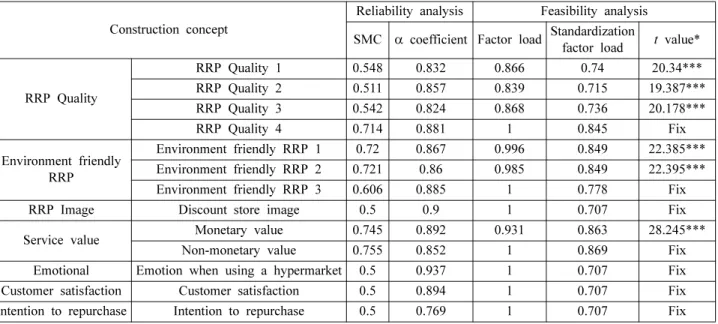
As shown in Table 3 below, if you look at the coefficient of reliability output from AMOS, the multiple correlation square (SMC), it is found that all of them exceed 0.5, the measure- ment index used to measure each latent variable in this study.

All of them were found to have a reflective personality and

secured internal consistency.

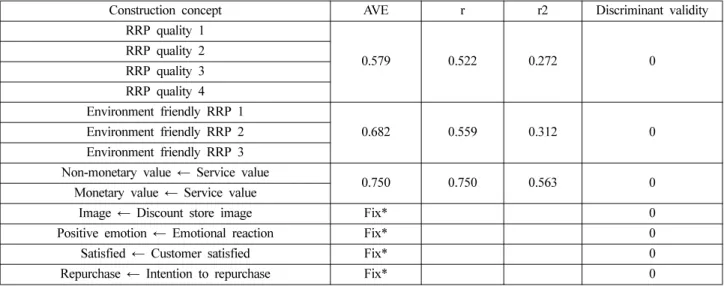
In addition, discriminant validity relates to how different a constituent concept actually differs from another constituent concept. In this study, the AVE of each of the two constituent concepts subject to discriminant validity evaluation and the square of the correlation between the two constituent concepts are compared. Therefore, we used a method to check whether both AVEs are greater than the correlation square. At this time, if all of the AVEs are greater than the square of correlation, it can be said that there is discriminant validity

80)

. The AVE value and correlation square of each constituent concept are compared as shown in Table 4 below.

As shown in the results of Table 4, the magnitude of the squared correlation between all constituent concepts included in this study was 0.272~0.563. As the AVE value is larger, it can be seen that all constituent concepts have discriminant validity.

Testing of structural equation models

1. Model specification, estimation, and fit evaluation There are 7 theoretical variables that make up this research model, and it consists of 3 exogenous variables and 4 endogenous variables. Exogenous variables are RRP quality, Environment friendly RRP, and RRP image, and endogenous variables are service value, emotional response, customer satisfaction, and repurchase intention. First, AMOS was used to estimate the model based on the effect hypothesis test. As a result of testing the overall structural model between research units used in this study, the degree of fit was χ² = 184.561, df = 51, p = .000, GFI = .965, AGFI = .894, RMR = .012, NFI

Table 3. Analysis of reliability and validity of measurement indicators

Construction concept

Reliability analysis Feasibility analysis SMC α coefficient Factor load Standardization

factor load t value*

RRP Quality

RRP Quality 1 0.548 0.832 0.866 0.74 20.34***

RRP Quality 2 0.511 0.857 0.839 0.715 19.387***

RRP Quality 3 0.542 0.824 0.868 0.736 20.178***

RRP Quality 4 0.714 0.881 1 0.845 Fix

Environment friendly RRP

Environment friendly RRP 1 0.72 0.867 0.996 0.849 22.385***

Environment friendly RRP 2 0.721 0.86 0.985 0.849 22.395***

Environment friendly RRP 3 0.606 0.885 1 0.778 Fix

RRP Image Discount store image 0.5 0.9 1 0.707 Fix

Service value Monetary value 0.745 0.892 0.931 0.863 28.245***

Non-monetary value 0.755 0.852 1 0.869 Fix

Emotional Emotion when using a hypermarket 0.5 0.937 1 0.707 Fix

Customer satisfaction Customer satisfaction 0.5 0.894 1 0.707 Fix

Intention to repurchase Intention to repurchase 0.5 0.769 1 0.707 Fix

Notes 1. ***: Significant at p < 0.001.

2. χ

2

= 134.347(p = .000, df = 44), GFI = .962, AGFI = .913 CFI = .953, NFI = .957, RMSEA = .063

(10)

= .964, CFI = .948, TLI = .937, and RMSEA = .016 were derived, so the overall conformity of the structural model is judged to be appropriate.

2. Test hypothesis

The overall path of this research model analyzed to test hypotheses about the relationship between research units, such as RRP quality of discount store, Environment friendly RRP, RRP image, customer perceived service value, customer's emotional response, customer satisfaction, and repurchase intention. The results of the coefficient analysis are shown in Table 5.

The theoretical model presented in this study presented a hypothesis through a research model on the relationship between the RRP quality of a Discount Store, Environment friendly RRP, service value perceived by customers, emotional reactions felt by customers, customer satisfaction, and customer's repurchase intention. The results of the effect analysis of the research model for a total of 15 hypotheses presented as research hypotheses in this study are summarized and presented as shown in (Table 5) below. The results of analyzing the research hypothesis using the structural equation (SEM) model setting show that the RRP quality of the discount store has positive emotions (t = 0.539, p > 0.05) and customer satisfaction (t = 0.732, p > 0.05), The impact of Environment friendly RRP on service value (t = 1.327, p > 0.05) and customer satisfaction (t = 0.117, p > 0.05), In addition, the hypothesis about the effect of service value on customer satisfaction (t = 0.906, p > 0.05) and repurchase intention (t = 0.929, p > 0.05) was found to be insignificant and rejected. All nine hypotheses were adopted.

When summarizing the above results, the RRP quality of stores do not have significant influence on emotions and customer satisfaction but appeared to have positive (+) influence

on service values and therefore, it was found that consumers felt that there was value to pay the shopping costs because the service they received at the store was very impressive. This shows that the accessibility, cleanliness, aesthetic attractiveness, and convenience are important elements when experiencing service values to have significant influence. Although the Environment friendly RRP of the stores appeared to not have significant influence on service values and customer satisfaction, it did have positive influence on emotional responses. The RRP image of discount stores appeared to have positive (+) influence on service values, emotional responses, customer satisfaction and repurchase intentions and therefore, it was possible to confirm how big of a variable the influence of positive hearsay or reputation about the store is on customer satisfaction and repurchase intentions. Furthermore, it was found that positive emotions cause by human services and reputations had direct influence leading to customer satisfaction and repurchase intentions. However, although the RRP quality and RRP image of discount stores had direct influence on service values, it was confirmed that this does not directly connect to customer satisfaction and repurchase intentions.

When examining the reasons for service values having significant influence on customer satisfaction and repurchase intentions in precedent researches but not being chosen in this study, it was found that unlike the precedent researches, this study used the discount store RRP image as leading variable for a comprehensive study and to already influence emotional responses, customer satisfaction and repurchase intentions and also, it can be analyzed that the results do not imply that service value concept itself has no correlation with customer satisfaction and repurchase intentions. Therefore, it can be determined that the results were different from the precedent researches that did not include discount store RRP image in their theoretical variables.

Table 4. Squared correlation with AVE value of each constituent concept

Construction concept AVE r r2 Discriminant validity

RRP quality 1

0.579 0.522 0.272 0

RRP quality 2 RRP quality 3 RRP quality 4 Environment friendly RRP 1

0.682 0.559 0.312 0

Environment friendly RRP 2 Environment friendly RRP 3 Non-monetary value ← Service value

0.750 0.750 0.563 0

Monetary value ← Service value

Image ← Discount store image Fix* 0

Positive emotion ← Emotional reaction Fix* 0

Satisfied ← Customer satisfied Fix* 0

Repurchase ← Intention to repurchase Fix* 0

Note: * It is a variable with one measurement variable

(11)

Conclusion & Implications

In the past, the characteristics of discount stores that determined customer satisfaction were the prices and for department stores, it was the mood of the store

81)

. However, unlike the initial stages when they put forth price destruction, the current market of discount stores displays further acceleration of competition due to the differentiation of services per business according to the needs of customers. The positioning of an unique business condition that is ‘Korean style discount stores’ of ‘semi-department store level’ is being accomplished by strengthening services, high quality facilities and product assortments. They have transformed into discount stores that are like department stores or ‘Korean style discount stores’

equipped with various services and large pleasant environments for customers to want department store level services along with purchasing products at low prices. The customers are wanting to be supplied with complex elements such as new shopping spaces to satisfy the various needs of customers,

unique shopping experiences, convenience of store usage, harmony with consumer’s lifestyle and pursuit of joy and individuality. To present business strategies that are both appropriate and efficient in actively coping with the ever- changing internal and external business environment of discount stores, the present study searched for the structural relationship between RRP quality, Environment friendly RRP, RRP image, service value and emotional response to conduct empirical study on how it influences customer satisfaction and repurchase intentions. Due to the dependency problem among the five types of dimension held by the widely used SERVQUAL, the two-factor solution method was applied to classify as factors of RRP quality and Environment friendly RRP in examining the influence that cognitive evaluations of service quality has on customer satisfaction and repurchase intentions through the emotional responses of customers. Through the analytical results mentioned above, it was confirmed that the consumer (customer)‘s process of reaction was closely connected to RRP quality, Environment friendly RRP, RRP image, service Table 5. Results of analysis of the total path coefficient of the research model

Route Standardization

coefficient

Non-standardization

coefficient S.E. t P Hypothesis test result Service

value ← RRP quality 0.142 0.237 0.119 4.188 0.035* Selection

Positive

emotion ← RRP quality 0.079 0.184 0.147 0.539 0.59 Dismiss

Customer

satisfied ← RRP quality 0.078 0.139 0.107 0.732 0.464 Dismiss

Service

value ← Environment

friendly RRP 0.18 0.310 0.136 1.327 0.185 Dismiss

Emotion

reaction ← Environment

friendly RRP 0.433 0.569 0.175 2.473 * Selection

Customer

satisfied ← Environment

friendly RRP 0.015 0.089 0.13 0.117 0.907 Dismiss

Service

value ← RRP image 1.07 1.27 0.1 10.73 *** Selection

Emotion

reaction ← RRP image 1.391 1.581 0.13 10.68 *** Selection

Customer

satisfied ← RRP image 0.752 0.936 0.205 6.664 *** Selection

Intention to

repurchase ← RRP image 0.351 0.127 0.334 5.154 0.008** Selection

Customer

satisfied ← Service value 0.134 0.248 0.147 0.906 0.365 Dismiss

Intention to

repurchase ← Service value 0.159 0.276 0.171 0.929 0.353 Dismiss

Customer

satisfied ← Emotion

reaction 0.422 0.539 0.159 5.655 0.008** Selection

Intention to

repurchase ← Emotion

reaction 0.335 0.476 0.195 7.718 *** Selection

Intention to

repurchase ← Customer

satisfied 0.627 0.776 0.195 8.718 *** Selection

Note: ***Significant at p < 0.001, **p < 0.01, *p < 0.05.

(12)

value, emotional response, customer satisfaction and repurchase intentions when using discount stores and it can be concluded that this greatly influences the discount store’s establishment of marketing strategies to improve service quality and actively cope with rapidly changing distribution environment. By recognizing that the service quality of discount stores influencing customer satisfaction is mediated by emotional responses, it implicates that discount stores must continue to seek for efforts to provide more benefits perceived by customers and strategies to enhance service quality to increase customer satis- faction and repurchase intentions. Since the RRP image of discount stores have been confirmed to have positive (+) influence on service values, emotional response, customer satisfaction and repurchase intentions, the service provider must improve their image by continuing to provide professio- nalism and differentiated services and through this process, continue to attract customers. The drawbacks of precedent researches on the service quality, service values, emotional responses, customer satisfaction and repurchase intentions of discount stores and the academic significance of the present study are as follows. First, it is difficult of find researches that have analyzed the relationship with customer satisfaction and repurchase intentions by simultaneously considering RRP quality, Environment friendly RRP, RRP image, service values and emotional responses as both theoretical and leading variables. Hence, the present study attempted a comprehensive research on the cognitive and emotional aspects in relation to the influence of RRP quality, service values, emotional responses and RRP image of discount stores on customer satisfaction and repurchase intentions. Second, while the existing researches tied RRP quality and Environment friendly RRP into a single dimension by grafting onto environments such as hotels, restaurants and hospitals, the present study set tangible and intangible dimensions as the two key dimensions to classify multi-dimensionally for the detailed analysis and verification of the research model. Third, although there are many research results that have individually applied the theory and concepts presented above, the attempts to empirically verify by con- sidering both the cognitive and emotional aspects from the customer’s perspective is very rare. Therefore, the research model presented in this study can find its significance from the point that it is a systematic and comprehensive model for studying service quality, service values, emotional responses, customer satisfaction and repurchase intentions. The limitations of the present study and the direction for future researches are as follows. First, the sample was collected from subjects who were customers at four discount stores located in Seoul and Gyeonggi-do. Hence, the samples are arbitrary, and the number of samples are not sufficient for the representative nature to be weak and it would be impractical to apply the study results to all discount stores. Therefore, there is need to expand the area of investigation and a more meticulous method of research

and data collection should be developed to increase the accuracy of data as well as the representative nature of the samples. Second, there is need to further elaborate on the relationship between the constructs used in the present study.

In short, reputation can be considered as the leading variable or the trailing variable of service quality and for the emotional responses, this study only measured the positive emotions, it is necessary to measure single emotion including negative emotions or measure by detailed and specific emotions. This is because their relations are set up differently in existing researches. Therefore, their relationships are expected to differ according to field of service and researcher to require consideration from an extensive angle.

References

1. Kim, H.A., Lee, L.K., Chae, N.B., and Park, J.Y. 2020. Loy- alty Structure of Private Label Brand: Applying Panel and Survey Data, Journal of Channel and Retailing. 25(4): 91-118.

2. Jung, S.T. 2021. A Study on the Analysis of Influence According to Service Relationship in Discount Store. Jour- nal of Distribution and Logistics. 8(1): 109-134.

3. Seo, G.W. 2004. The great counterattack of department store, The Weekly Economist. 1(1): 14.

4. Seo, Y.G. and Lee, J.H. 2007. Distribution Management Learned in 100 Days, Seoul Economics & Business. 1(1): 1-100.

5. Lee, L.K., and Park, J.Y. 2020. The Relationship between Private Label Brand Share and Store Loyalty by Applying Panel Data, Journal of Channel and Retailing. 25(2): 25-52.

6. Williamson, O.E. 1997. Transaction Cost Economics: The Governance of Contractual Relations, Journal of Law and Eco- nomics. 22(1): 233-261.

7. Kotler, P. and Amstrong, G. 1997. Principles of Marketing, 6th ed. Prentice-Hall. 1(1): 640.

8. Ok, S.J. and Kim, W.J. 2000. Introduction to Distribution, Hyungseol publishing. 1(1): 60-66.

9. Byun, M.S., Lee, Y.C., and Kim, Y. I. 2010. Understanding of distribution, Seoul: Academic Publishing House. 1(1): 192.

10. Oh, S.J. and Park, J.Y. 2001. Distribution Management, Seoul: Pakyoung publishing. 1(1): 94.

11. Choi, H.G. and Yoon, J.G. 2008. Development of Tradi- tional Marketplaces in the New Distribution Market: with Emphasis on Daejeon Metropolitan City, Journal of Distribu- tion Science. 6(1): 32-45.

12. Della, A.J., Monroe, K.B., and Mcginnis, J.M. 1981. Consumer Perception of Comparative Price Advertisement, Journal of Retailing. 1(1): 1-10.

13. Jung, H.K., Choi, S.Y., and Kwon, M.Y. 2007. A Study on the Medical Service MOT Control and Service Performance on the Small and Medium Hospital, Journal of Korea Service Management Society. 8(1): 161-186.

14. Kim, S.S. 2010. A Study on the Effects of Service Quality,

Service Value, Emotional Response and Reputation on Cus-

tomer Satisfaction and Repurchase Intention in Accordance

(13)

with Service Relationship in Healthcare Services”, (Doctoral Dissertation), Seoul: Hanyang University. 1(1): 1-169.

15. Han, S.L. 2004. Effects of Restaurant Service Quality on Customer Retention and Word-of- Mouth, Korea Marketing Journal. 9(1): 29-46.

16. Lapierre, J. 2000. Customer-perceived value in industrial con- texts, Journal of Business and Industrial Marketing. 15(2): 122- 140.

17. Gronroos, C. 1984. A service Quality model and its market- ing implication, European Journal of Marketing. 18(4): 36-44.

18. Parasuraman, A., Zeithaml, V.A., and Berry, L.L. 1988.

SERVQUAL: a multiple item scale for measuring consumer perceptions of service quality, Journal of Retailing. 64(1):

12-40.

19. Bolton, R.N., and Drew, J. H. 1991. A Multistage model of customer's assessments of service quality and value, Journal of Consumer Research. 17(4): 375-384.

20. Zeithaml, V. A. 1988. Consumer Perceptions of price, qual- ity and value: A means-end model and synthesis of evi- dence, Journal of Marketing. 52(7): 2-22.

21. Parasuraman, A., Zeithaml, V. A. and Berry, L. L. 1985. A Conceptual Model of Service Quality and Its Implications for Future Research, Journal of Marketing. 49(3): 41-50.

22. Lee, H.S. and Kim, Y. 1999. Service quality and service value, Korea Marketing Journal. 1(2): 77-99.

23. Reimer, A. and Kuhen, R. 2005. The impact of service scape on quality perception, European Journal of Marketing. 39(7):

785-808.

24. Fombrun, C., and Riel, C.V. 1997. The reputation landscape, Corporate Reputation Review. 8(1): 5-13.

25. Gotsi, M. and Wilson, A. M. 2001. Corporate reputation:

seeking a definition, Corporate Communication: An Interna- tional Journal. 6(1): 24-30.

26. Kang, M. J. and Cha, H. W. 2007. The Effect of Corporate Reputation and Public Issue Frame on the Perceived Corpo- rate Legitimacy: Focused on the issue about the succession to the right of management of Samsung”, Korean Journal of Journalism and Communication Studies. 51(2): 479-507.

27. Markwick, N. and Fill, C. 1997. Towards a framework for managing corporate identity, European Journal of Market- ing. 31(5): 396-410.

28. Argenti, P. A. and Druckenmiller, B. 2004. Reputation and the Corporate Brand, Corporate Reputation Review. 6(4): 368- 374.

29. Kotler, P. 2016. Service Quality Experience and Customers’

Behavioural Intentions in Active Sport Tourism, Journal of Mod- ern Economy. 7(12); 1361-1384.

30. Hir, J.D. 2008. The Effects of Service Quality and the Cor- porate Image on Customer Satisfaction and Loyalty, Incheon, Korea: Thesis for Doctorate in Inha University.

31. Lee, Y. G., Park, K. H., Kim, W. G., and Kwon, Y. J. 1999.

The Impact of Service Quality, Store Image, and Service Value on Customer Satisfaction-Focused on Korean Restau- rant, Korea Hospitality and Tourism Academe. 8(2): 59-276.

32. Cronin, J. J. Jr., Michael, K. B., Richard, R. B., Roscoe, H.

T. Jr., and Donald, J. S. 1997. A Cross-sectional Test of the Test of the Effect and Conceptualization of Service Value, The Journal of Service Marketing. 11(6): 375-391.

33. Lee, I. G., Kim, J. B., and Lee, M. K. 2000. A Causal Model of Perceived Service Quality, Consumer Attitude, and Intention to Repatronize, Asia Marketing Journal. 2(3): 44-61.

34. Perkins, W. S. and Reynolds, T. J. 1988. The Explanatory Power of Values in Preference Judgement: Validation of the Means-End Perspective, Advances Consumer Research. 15(1):

122-126.

35. Sheth, J. N. and Parvatiyar, A. 1995. The evolution of rela- tionship marketing, International Business Review. 4(4): 397-418.

36. Zimmer, M. R. and Golden, L. L. 1988 Impressions of Retail Stores: A Content Analysis of Consumer Images, Journal of Retailing. 64(3): 265-293.

37. Zeithaml, A. and Bitner, M. J. 1996. Services Marketing, New York: McGraw-Hill. 1(1): 201-207.

38. Kim, M. H. 2008. A Study on Effects of Customer Orienta- tion Factors in Relation to Medical Services on the Values of the Services and Customer Satisfaction, The Korean Jour- nal of Health Service Management. 2(1): 1-26.

39. Jo, M. N., and Yang, I. S. 2006. The Analysis of the Differ- ences of Evaluation Level of Service Encounter Quality, Emo- tional Responses, Customer Satisfaction and Service Loyalty by Types of Restaurants, Korean Journal Dietary Culture.

21(5): 524-535.

40. Gardner, M. P. 1985. Mood States and Consumer Behavior:

Critical Review, Journal of Consumer Research. 12(3): 281-300.

41. Jo, M. N. 2005. The effect of restaurant customers' cogni- tive and emotional responses to service encounters on service loyalty formation”, (Doctoral Dissertation), Seoul: Yonsei Uni- versity. 1(1): 51-60.

42. Kim, J. Y. 2007. The Influence of Physical Surroundings and Human Services on Emotional Responses and Behavioral Intentions of Theme Restaurant Customers, International Jour- nal of Tourism and Hospitality Research. 21(2): 91-107.

43. Frijda N. H. 1993. Relations among emotion, appraisal, and emotional action readiness, Journal of Personality and Social Psychology. 57(2): 212-228.

44. Parkinson, B., and Manstead, A. S. R. 1992. Appraisal as a cause of emotion. In M. S. Clark (Ed.)”, Emotion(Review of Personality and Social Psychology. 13(1): 122-149.

45. Reichheld, F. F. 1996. The Loyalty Effect, Harvard Business School Press. Boston. MA.

46. Hesktt, J. I., Sasser J. W. E. and Schlesinger, L. A. 1997.

The Service-Profit Chain, Free Press. New York, NY.

47. Oliver, R. L. 1993. Cognitive, affective, and attribute bases of the satisfaction response, Journal of Consumer Research.

20(1): 418-430.

48. Fornell, C. 1992. A National Customer Satisfaction Barome- ter: The Swedish Experience, Journal of Marketing. 56(1): 1-21.

49. Oliver R. L. 1980. A Cognitive Model of the Antecedents and Consequences of Satisfaction Decisions, Journal of Mar- keting Research. 17(11): 46-49.

50. Bearden, W. O., and Teel, J. E. 1983. Selected determinants of

(14)

Consumer Satisfaction and Complaint Reports. Journal of Mar- keting Research. 20(1):.21-28.

51. Bitner, M. J. 1990. Evaluating Service Encounters: The Effects of Physical Surroundings and Employee Responses, Journal of Marketing. 54(1): 69-82.

52. Fornell, C., and Wernerfelt, B. 1988. Defensive Marketing Strategy by Consumer Complaint Management: A Theoreti- cal Analysis, Journal of Marketing Research. 24(11): 337-346.

53. Reichheld, F. 1993. Loyalty-based management, Harvard Business Review. 71(2): 64-73.

54. Johnes, T. O., and Sassers, W. E. 1995. Why Satisfied Cus- tomers Defect, Harvard Business Review. 1(1): 11-12.

55. Oh, S. J. 2001. Discount Store management, Seoul: Pakyo- ung publishing. 1(1): 126.

56. Zimmer, M. R., and Golden, L.L. 1988. Impressions of retail stores: a content analysis of consumer images, Journal of Retail- ing. 64(3): 265-293.

57. Wakefield, K. L., and Blodgett, J. G. 1999. Customer response to intangible and tangible service factors, Psychol- ogy and Marketing. 16(1): 51-69.

58. Howard, J. A. 1974. The Structure of Buyer Behavior In Consumer Behavior: Theory and Application, John, U.Farley, John, A. Howard, and L. Winston Ring, eds., Boston: Allyn

& Bacon. 1(1): 1-11.

59. Roh, Y. M. 2004. Influence of Physical Environment Percep- tion on Restaurant Patrons Attitude Formation: The Mediat- ing Role of Psychological Responses, International Journal of Tourism and Hospitality Research. 18(2): 249-264.

60. Park, M. J., and Lee, J. S. 2005. The Relationship Among Servicescape, Emotional Response and Behavior Intention in Hotel Restaurant, Journal of Korea Service Management Society. 16(2): 105-128.

61. Donovan, R. J., and Rossiter, J. R. 1982. Store Atmosphere:

An Environmental Psychology Approach, Journal of Retail- ing. 58(1):34-57.

62. Ryu, C. J. 1996. Experiential Aspects of Shopping Behav- ior: Study on the Effects of In Store Emotions on Store Atti- tudes and Visit Intentions, Journal of Consumer Studies. 7(1):

51-73.

63. Kwon, I. H. and Yoo, C. J. 1997. A Study on Stimulus and Response Factors of Consumers Emotional Responses in a Ski - Resort Encounter, Journal of Consumer Studies. 8(1): 59-78.

64. Shim, J.K. 2020. Eco-friendly Smart Packaging Trend 2020, Abstract collection of research papers of the Korea Indus- trial Chemical Society. 2020(0): 118-118.

65. Kang, K. H. 2005. Effects of Perceived Service Quality on Service Value and Service Image of Swimming Pool Cus- tomer, Korea Sport Research. 16(4): 743-752.

66. Westbrook, R. A.. and Michel, D. R. 1983. Value-Percept Disparity: An Alternative to the Disconfirmations of Expecta- tions Theory of Consumer Satisfaction, In Advances in Con- sumer Research. 10(2): 256-261.

67. Lee, M. Y. and Ulgado, F. M. 1997. Customer evaluation of

fast-food sevices: a cross national comparison, The Journal of Service Marketing, 11(1): 39-52.

68. Anderson, E. W., Claes , F., and Donald, R. L. 1994. Cus- tomer Satisfaction, Market Share, and Profitability: Findings From Sweden, Journal of Marketing, 58(7): 53-66.

69. Boulding, W., Kalra, A. Stealing, R. and Zeithaml, V. A.

1993. A Dynamic Process Model of Service Quality: From Expectations to Behavioral Intentions, Journal of Marketing Research, 30(2): 7-27.

70. Woodside, A. G., Frey, L. L. and Daly, R. T. 1989. Linking Service Quality, Customer Satisfaction, and Behavioral Inten- tion, Journal of Health Care Marketing, 9(4): 5-17.

71. Choi, J.Y., Lee, H. S. 2021. Trend Analysis and Implica- tions of Eco Package for Revitalizing the Circular Econ- omy, Brand Design Studies, 19(1): 1-10.

72. Woo, T. H., and Kim, B, C. 2018. Cost Rationalization of Corporate Logistics based on the Use of Environment- Friendly Packing Materials : With a focus on home appli- ances, Journal of the Korean Society of Management Engi- neering, 23(3): 111-123.

73. Seo, C. J. and Kim, Y. H. 2002. A study on the relationship between reputation and service quality of medical institu- tions, Journal of Korean Society for Production Manage- ment, 12(3): 125-152.

74. Park, J. O., and Hwang, Y. C. 2007. The effect of service situation factors on service quality, service value, customer satisfaction and repurchase intention, Journal of Korea Ser- vice Management Society. 8(1):79-110.

75. Kim, S. B., and Yoon, S. W. 2007. Antecedents and Conse- quences of the Types of Waiting Times in Medical Services, Korea Journal of Hospital Management. 12(2): 69-92.

76. Cronin, J. J., and Taylor, S. A. 1992. Measuring Service Quality: A Re-examination and Extension, Journal of Mar- keting. 56(7): 55-68.

77. Rho, J. O. 2002. An Empirical Study on the Effect of Medi- cal Service Value on the Medical Customer Satisfaction, (Doctoral Dissertation), Busan: Kyungsung University. 1(1):

41-50.

78. Dodds, W. B., Monroeand, K. B., and Grew, A. D. 1991.

Effect of price, brand and store information on subjective product evaluations, Advances in Consumer Research. 12(1):

85-90.

79. Yi, Y. 1990. A Critical Review of Consumer Satisfaction, in Review of Marketing, Valarie A. Zeithaml, ed., Chicago, IL:

AMA. 1(1): 68-123.

80. Fornell, C., and Larker D. F. 1981. Evaluation Structural Models with Unobservable Variables and Measurement Error, Journal of Marketing Research. 18(1): 39-50.

81. Doo, K. J. 2004. Consumers store Satisfaction and Utilizing Behavior: on the Department and Discount stores, Journal of Social Sciences. 17(1): 1-12.

투고: 2021.07.20 / 심사완료: 2021.08.12 / 게재확정: 2021.08.12

수치

Fig. 1. Example of inner box-type RRP display pattern.
Fig. 3. Research model.
Table 3. Analysis of reliability and validity of measurement indicators
Table 4. Squared correlation with AVE value of each constituent concept

참조

관련 문서