제조물책임법에 대응하기 위한 시스템 구축에 관한 연구 -중소기업을 중심으로-
한민석
호서대학교 인문융합대학
A Study on System Construction to the Product Liability Law-with focus on a small & medium business
Min-Suk Han
College of Humanities and Fusion, Hoseo University
요 약 2002년 제조물책임법(PL)을 시행하여 소비자가 제조물을 생산하고 판매하는 기업에 대하여 제품의 결함에 따른 손해 배상을 청구할 수 있도록 하는 제도적 장치를 마련하였다. 그러나 최근 가습기 살균제 사건 등으로 인해 기업의 제조물책임 강화와 소비자 피해구제를 위한 집단소송제도, 징벌적배상제 도입을 위하여 제조물책임법 개정안 등 현재, 12여건의 관련 법안이 국회에 발의되어 있으나 정작 법안의 이해 당사자인 중소기업의 62.6%는 이에 대해 잘 알고 있지 못한 것으로 나타났 다고 하고 있다. 많은 기업들이 PL 방어대책(Product Liability Defense : PLD)으로 문서작성·보관의 적정화, 관련업자와의 책임관계의 명확화, PL 보험의 가입 또는 배상자금의 확보 등으로 대비하고 있으나 이와 같은 대비책은 제품의 설계와 제품 의 안전성을 고려한 부분에 대하여 한계점을 느끼게 한다. 이에 본 연구는 먼저 PL의 명확한 개념과 대응방안에 대해 살펴보 고 PL 시스템과 개별 경영시스템 간의 관련성을 파악하고 제조물책임법에 대비한 PL 대응시스템을 기업의 개별경영시스템 에 통합하고 보다 제품의 안전에 중점을 둔 개별경영시스템 모델을 제시하고자한다. 이 같은 연구목적에 따른 결과는 중소기 업의 PL법 대응을 위한 합리적 대응방안으로 평가 받을 것으로 기대된다.
Abstract In 2002, the government arranged an institutional strategy to make it possible for a consumers to make a claim for damages caused by product defects against a business that produces and sells a product by enforcing the Product Liability Law(hereinafter referred to as 'PL'). On the other hand, due to the recent humidifier sterilizer accident, approximately 12 cases of related bills, such as a revised bill for the product liability law, have been proposed to the National Assembly at present in an effort to introduce the group action system and punitive compensation system for the purpose of the strengthening of the corporate product liability, and consumer damage relief. Ironically, as much as 62.6% of small & medium businesses, which are actual interested parties to this bill, are unaware of this. Many companies are responding to PL with the rationalization of document preparation & storage, clarification of responsibility relations with related business operators, and PL insurance policy purchase, or securing compensation funds as a means of Product Liability Defense(PLD), but the methodsof preparation such asthis leave much room for limits on theconsiderations of product design and product safety. This paper presents the individual management system model with more focus on product safety by looking into the clear concept of PL and the countermeasures against it, grasping the relevancebetween the PL system and individual management system, and integrating the PL response system in preparation for the PL. It is hoped that the result of this research objective will be evaluated as a rational countermeasure for small & medium businesses to respond effectively to the PL.
Keywords : Integrated Model, ISO Integrated Management System, Small & Medium Business, Punitive Damages, PL Law
*Corresponding Author : Min-Suk Han(Hoseo Univ.) Tel: +82-10-6287-2565 email: [email protected] Received March 2, 2017
Accepted June 9, 2017
Revised (1st April 21, 2017, 2nd May 1, 2017) Published June 30, 2017
1. 서론
기술의 발전과 소비자의 다양한 욕구는 기업의 제조 기술력 향상이란 성과를 이루어냈으나 이러한 복잡하고 다양한 제품은 제품의 잠재적 결함과 같은 문제 등으로 인하여 제조자와 소비자 사이의 분쟁역시 끊임없이 발생 하게 되었다.
이에 정부는 2002년 7월 1일 제조물책임법(PL)을 시 행하여 소비자가 제조물을 생산하고 판매하는 기업에 대하여 제품의 결함에 따른 손해배상을 청구할 수 있도 록 하는 제도적 장치를 마련하였다. 그러나 중소기업중 앙회[1]는 최근 가습기 살균제 사건 등으로 인해 기업의 제조물책임 강화와 소비자 피해구제를 위한 집단소송제 도, 징벌적배상제 도입을 위하여 제조물책임법 개정안 등 현재, 12여건의 관련 법안이 국회에 발의되어 있으나 정작 법안의 이해 당사자인 중소기업의 62.6%는 이에 대해 잘 알고 있지 못한 것으로 나타났다고 하고 있다.
또한 중소기업중앙회가 2016년 제조물책임 단체보험에 가입한 중소기업 310개사를 대상으로 실시한 “중소기업 제조물책임(PL) 대응실태 및 의견조사” 결과에 따르면, 제조물책임 강화 법안 도입에 대해 조사업체의 19.4%
가 “전혀 모른다.”고 응답하였고, 43.2%는 “들어본 적 은 있으나 잘 모르겠다.”고 응답 하였다. “잘 알고 있다”
고 응답한 비율은 5.2%에 불과하다는 조사결과가 발표 되었다.
많은 기업들이 PL 방어대책(Product Liability Defense : PLD)으로 문서작성·보관의 적정화, 관련업자 와의 책임관계의 명확화, PL 보험의 가입 또는 배상자금 의 확보 등으로 대비하고 있으나 이와 같은 대비책은 제 품의 설계와 제품의 안전성을 고려한 부분에 대하여 한 계점을 느끼게 한다. 그럼에도 불구하고 국내에서 발표 된 다수의 관련 연구가 있었다.
제조물책임에 대한 연구는 주로 기업대응방안과 예방 전략, 피해사례 분석을 중심으로 이루어졌다(서준혁⦁고 복수⦁배성민)[2]. 이후 기업의 제조물책임 실태, 제조물 책임의 예방전략과 피해사례분석에 관한 연구가 이루어 졌다고 보았다. 통합경영시스템 연구는 이상훈[3]은 KS, QMS, EMS 통합경영시스템 구축방법을 제시 하였고, 김연성[4]은 ISO 9001, ISO 14001, OHSAS 18001의 통합전략과 효율적 운영방안 관계를 규명하고 실제 통합 방법이 경영성과에 미치는 영향에 대한 규명을 하였고,
김광수⦁임갑출⦁정순석[5]은 QMS, EMS, OHSAS, PL 시스템 통합모형을 제안하고 이의 운영방안을 제시하였 고, 최영훈⦁양진국⦁이상범[6]과 서종석[7], 송경준, 장 준순[8]은 ISO 9001, ISO 14001, OHSAS 18001, ISO 50001의 통합 및 구축 방안을 제시하였다.
한편 유왕진[9], 김백환[10]은 ISO 9001, KS 및 PL 통합시스템의 모형을 설계하였고, 정규복[11]은 ISO 9001 절차서에 PL요구사항별 대비표를 만들어 ISO 9001 요구사항에 추가하였다.
이에 본 연구는 최근 새로운 규격으로 개정된 품질경 영시스템(ISO 9001)을 근간으로 환경경영시스템(ISO 14001), 에너지경영시스템(ISO 5001), 안전보건경영시 스템(OHSAS 18001)을 통합하여 개별시스템에 PL법의 주요내용을 추가하여 통합시스템을 구축함으로써 제조 물책임법에 대한 대책으로 제품의 설계 시점부터 제품의 안전성을 고려한 통합모형을 개발함으로써 연구의 차별 성을 기했다.
최근에 와서 일부 제조물안전경영시스템에 대한 시스 템을 구축하고 활용하고 있으나 경영시스템 구축의 근간 인 ISO 9001 품질경영시스템이 2015년 개정되었고 개 정이후 관련된 연구를 찾아 볼 수 없었다.
본 연구의 배경 및 목적은 중소기업의 실정에 적합하 고 시스템 구축시 문서의 양을 감소시킬 수 있는 통합모 형의 실제와 운영을 위한 방안을 제시하고, 구축된 통합 경영시스템에 제조물책입법에 따른 기업이 필요로 하는 통합모형의 구축에 대하여 연구하는 것을 목적으로 한 다. 구체적으로는 ISO 9001 품질경영시스템을 기초로, ISO 14001 환경경영시스템, OHSAS 18001 보건안전경 영시스템의 통합 운영을 시도하고, 최근 주목되고 있는 에너지경영시스템 ISO 50001을 통합한 통합모형 구축 을 통한 기업의 대응책에 대하여 연구하는 것이다.
이와같은 연구는 통합모형과 입법적 제안을 통해 중 소기업의 경쟁력 향상을 위한 정책방향에 시사점을 제공 할 수 있을 것이다.
2. 제조물책임법
2.1 제조물책임법의 정의와 선행연구
제조물책임법(PL : Product Liability)은 제조품의 하 자로 인한 소비자의 피해시 제조자등에게 책임을 부과하
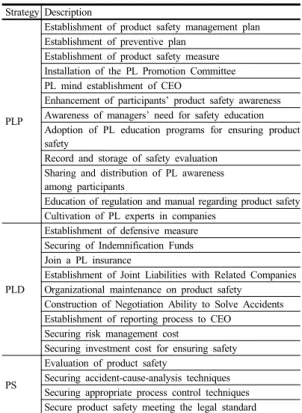
Strategy Description
PLP
Establishment of product safety management plan Establishment of preventive plan
Establishment of product safety measure Installation of the PL Promotion Committee PL mind establishment of CEO
Enhancement of participants’ product safety awareness Awareness of managers’ need for safety education Adoption of PL education programs for ensuring product safety
Record and storage of safety evaluation Sharing and distribution of PL awareness among participants
Education of regulation and manual regarding product safety Cultivation of PL experts in companies
PLD
Establishment of defensive measure Securing of Indemnification Funds Join a PL insurance
Establishment of Joint Liabilities with Related Companies Organizational maintenance on product safety
Construction of Negotiation Ability to Solve Accidents Establishment of reporting process to CEO
Securing risk management cost
Securing investment cost for ensuring safety
PS
Evaluation of product safety
Securing accident-cause-analysis techniques Securing appropriate process control techniques Secure product safety meeting the legal standard Table 2. Response strategies of manufacturers 도록 하는 규정이다. 이를 통하여 소비자의 피해구제를
원활히 하고 소비자의 권익을 강화하는 동시에 제품의 안전에 대한 인식을 제고함으로써 기업의 경쟁력을 향상 시켜 나가고자 하는 취지에서 제정된 법률이다. PL법은 2000년 1월 12일 공포되어 2002년 7월 1일 시행된 후 2013년 5월 22일 일부 개정 되었고 2016년 12월 12일 일부개정법률안이 발의 되었다.
PL법은 제1조 목적에서 ‘제조물의 결함으로 발생한 손해에 대한 제조업자 등의 손해배상책임을 규정함으로 써 피해자 보호를 도모하고 국민생활의 안전향상과 국민 경제의 건전한 발전에 이바지함을 목적으로 한다.’고 규 정함으로써 제품의 안전성제고를 목표로 하고 있다. 위 계찬[17]은 PL법 시행 전에는 제품사용 후 피해를 입은 경우 제조업자의 고의나 과실유무를 고객이 입증해야만 배상을 받을 수 있었으나, PL법 시행 이후에는 제조자의 고의나 과실이라는 사실을 피해자가 입증함이 없이 오직 결함과 손해사이의 인과간계만을 입증하면 배상을 받을 수 있게 되었다고 주장하고 있다. 이같은 PL법의 시행은 피해자측면에서는 간편하고 단시간 내에 문제를 해결할 수 있게 되는 효과가 있다. 반면에 기업(제조자)의 측면 에서는 사전적 제품안전의 확보뿐만 아니라 사후적 제조 품 책임방어의 효과가 있다. 즉, 제품의 안전성 확보를 위한 기업경영상의 많은 변화에 능동적으로 대처하기 위 한 방법론으로서 가치가 있다.
여기서 PL법의 주요내용을 표로 작성하면 Table 1과 같다.
Table 1. Product Liability Main Content Division Main Content
Article 1 PL Purpose Article 2 PL Definitions Article 3 PL Product Liability Article 4 PL Exemptions
Article 5 PL Joint and Several Liability
Article 6 PL Restrictions on Special Agreement Concerning Exemption
Article 7 PL Time Limitations, etc.
Article 8 PL Application of Civil Act
2016년 12월 12일 일부개정법률안의 취지를 살펴보 면 현행법상 제조물의 결함으로 인한 피해발생시 제조물 의 결함으로 손해를 입은 자가 결함의 존재 및 인과관계 를 입증하여야 한다는 부담을 지고 있으며 제조물의 결 함으로 발생한 생명·신체상의 중대한 손해에 대한 가중
된 배상책임 등에 대한 별도의 규정이 없어 제조업자의 불법행위 방지에 한계를 가지고 있어 제조물의 결함의 추정과 정보제출명령 규정을 도입해 인과관계에 관한 입 증부담을 경감하고, 중대한 손해에 대한 가중된 배상책 임제도를 도입하여 피해자 보호를 도모하고자 하였다.
이러한 제조물책임에 대비해서 기업이 강구할 수 있 는 대책으로는 제조물책임 예방(PLP : Product Liability Prevention)과 제조물책임 방어(PLD : Product Liability Defence)를 들 수 있다.
제조물책임 예방은 PL발생을 사전에 방지하기 위한 일련의 제조물 안전대책이다. 이는 개발, 제조, 판매에서 부터 사용에 이르기까지 모든 측면에서 안전성을 확보하 고, 최고경영자에서부터 제조, 설계, 판매에 관여하는 모 든 임직원에게 제조물 안전 마인드를 확산시키고, 결함 유형에 따른 대책을 마련하는 체계적인 시스템을 갖추는 것을 말한다.
제조물 책임방어는 사고발생후의 대책으로 PL사고에 의해 제품사고가 발생할 경우를 사전에 예상하여 클레임 대응체계를 정비하고 기업의 손실을 최소화하기 위한 대 책을 강구하는 제반활동을 말한다.
서준혁, 배성민[18]에 따르면 제조업체 대응전략을 기 업이 사전에 제조물 사고를 예방하는(Product Liability Prevention; PLP)대책, 제품안전(Product Safety; PS) 대 책, 발생할 가능성이 있는 사고에 대비하기 위한 방어대 책(Product Liability Defence; PLD) 측면으로 구분하여 Table 2과 같이 설명하고 있어 중소기업의 경쟁력 향상 을 위하여 시사해 주는 바가 크다.
2.2 PL시스템
제조물책임 예방대책이란 제조물의 하자로 인한 안전 사고에 대한 대책을 총칭한다. S전선[19]에 따르면 제조 물 책임법의 시행에 따라 제조물책임법에 대응할 수 있 는 방안은 적극적 예방의 측면에서 제품의 수명에 관련 된 모든 업무체계를 사용자의 안전에 초점을 맞추고 각 단계별 즉, 조사, 분석, 안전설계, 안전부품확보, 검증, 제 조/검사, 출하/판매, 폐기 단계별로 실시해야 할 중점업 무를 도출하며, 세부적인 실행방법을 단계별로 세워야 한다고 한다. 이를 자세히 살펴보면 다음과 같다.
첫째, 기획, 개발, 설계단계의 예방대책절차이다.
제품의 좋고 나쁨은 60∼80%가 그 설계에 의해서 좌 우된다, 안전설계, 안전부품확인, 검증, 제조/검사, 출하 판매, 폐기, 조사, 분석에 이르기까지 제품책임 전반에 걸친 절차를 정하고 있다. 이는 고유의 기술측면과 안전 측면을 모두 고려하고 있다.
둘째, 제조, 판매, 기타단계의 예방대책 절차이다.
제조상의 결함을 예방하기 위해서는 구입단계부터 안 전성 확보가 필요하다. 김종현[20]에 의하면 원재료 또 는 부품을 구입할 때에는 협력업체를 선정단계에서부터 협력업체의 품질이 곧 당사의 품질이라는 사고위에 협력 업체를 선정하고 아울러 협력업체를 통해 공급되는 구매 품의 지속적인 관리가 필요하다고 하고 있다. 권상로와 한도율[21]에 의하면 판매단계의 고려사항으로 판매 직 원에게 안전 및 제품 교육실시, 고객에게 제품성능, 취급 방법 등 정확한 설명, 광고 및 취급설명서의 적절성 검 토, PL소통 및 리콜사례를 수집하여 피드백, 리콜체계 수립, 판매기록의 유지(추적성, 기타) 등을 고려할 것을 강조하고 있다. 제품책임 예방대책 절차는 기존의 경험 노하우와 교육을 통해 문제를 줄여나가야 한다.
3. 통합관리시스템의 도출
3.1 ISO 경영시스템의 고찰
경영시스템이란 Ansoff. H. I[22]에 따르면 기업경영 의 체계화에 따른 일정한 규범화하는 작업으로, 복잡한 조직의 목표달성과 통제방법에 대한 제시라고 말하고 있다.
ISO(International Organization for Standardization : 국제표준화기구)에서는 경영시스템을 방침 및 목표를 수 립하고 그 목표를 달성하기 위해 상호 연관되거나 상호 작용하는 요소의 집합을 의미한다고 정의 한다. 경영시 스템의 공통된 특징은 계획-실행-점검-조치의 PDCA사 이클 이다. 이는 전체 및 각 계층별로 회전하여 지속적인 개선·향상을 도모하는 경영기법으로 프로세스가 상호 유 기적으로 연계되어 관리될 수 있도록 하고 필수요구사항 을 준수하도록 규격화하고 있다.
홍종인, 박지혁[23]은 1987년 ISO 9000으로 시작된 경영시스템 국제표준은 2015년 7월 현재 약 20종에 이 른다. 이러한 표준은 주제만 다를 뿐 본문 내용상으로는 그다지 차이가 없음에도 불구하고 조항의 구성과 본문의 표현 방식이 각기 달라 혼선을 빚고 있다고 했다. 이러한 조항의 구성과 본문의 표현방식의 차이로 시스템을 통합 하여 운영하려는 기업은 어려움이 많았다.
국제표준화기구(ISO)에서는 이런 구조를 표준화하기 위한 방법으로 개별 표준보다 상위의 개념에서 공통되는 내용을 정한 HLS(High Level Structure)를 제시하여 국 제표준의 기본 틀로 정하고 기존 경영시스템 중 HLS 규 격과 다른 표준은 개정하고 이후 제정되는 모든 표준은 HLS를 따르기로 하였다.
ISO 9001, ISO 14001은 2015년 개정판에서 HLS 규격을 준수하여 개정하였고, ISO 50001은 개정시 HLS 규격을 준수할 예정이다. 아직 정식 ISO로 제정 되지 않은 OHSAS 18001은 HLS 규격에 맞춰 현재 개 발 중이다.
3.1.1 품질경영시스템(ISO 9001)
품질경영시스템 (QMS : Quality Management System)은 고객 요구사항 및 적용되는 규제 사항과 고객 만족을 증진시키기 위한 조직의 능력을 검증하기 위한 요구사항의 규정으로 1987년 최초 제정이후로 1994년 에 2판, 2000년에 3판, 2008년에 4판, 2015년에 5판이
1 Scope
2 Normative references 3 Terms and definitions 4 Context of the organization
4.1 Understanding the organization and its context
4.2 Understanding the needs and expectations of interested parties
4.3 Determining the scope of the quality management system 4.4 Quality management system and its processes 5 Leadership
5.1 Leadership and commitment
5.2 Quality policy
5.3 Organizational roles, responsibilities and authorities
6 Planning
6.1 Actions to address risks and opportunities 6.2 Quality objectives and planning to achieve them 6.3 Planning of changes
7 Support
7.1 Resources 7.2 Competence 7.3 Awareness 7.4 Communication 7.5 Documented information
8 Operation
8.1 Operational planning and control 8.2 Requirements for products and services 8.3 Design and development of products and services 8.4 Control of externally provided products and services 8.5 Production and service provision
8.6 Release of products and services 8.7 Control of nonconforming outputs 9 Performance evaluation
9.1 Monitoring, measurement, analysis and evaluation 9.2 Internal audit
9.3 Management review 10 Improvement 10.1 General
10.2 Nonconformity and corrective action 10.3 Continual improvement
개정되었다.
이 표준은 고객만족을 증진시키기 위해 품질경영시스 템의 효과성을 개발, 실행 및 개선할 때 프로세스 접근방 법을 채택하도록 권장한다.
Fig. 1. PDCA Cycle
프로세스 접근 방법론은 PDCA 사이클로 모든 프로 세스에 대하여 적용될 수 있다. P(Plan:계획)는 고객 요 구사항 및 조직의 방침에 따라 결과를 도출하는데 필요 하고, D(Do:실시)는 프로세스의 실행을, C(Check:체크) 는 방침, 목표 및 제품 요구사항에 대하여 프로세스 및 제품의 모니터링, 측정 및 그 결과의 보고를, A(Act:조 치)는 프로세스 성과를 지속적으로 개선하기 위한 계획 과 실행 활동을 말한다. PDCA 사이클에서 이 표준의 구 조를 표현하면 Fig 1과 같다.
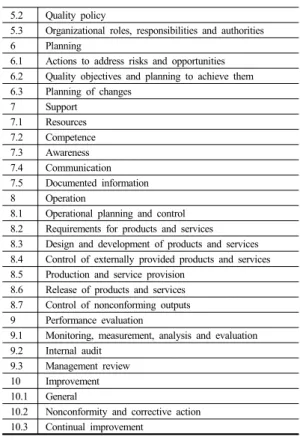
품질경영시스템은 고객중시, 리더십, 인원의 적극참 여, 프로세스 접근법, 개선, 증거기반 의사결정, 관계관 리/관계경영 요구사항인 품질경영원칙을 기반으로 한 다. 품질경영시스템의 구성내용을 살펴보면 Table 3와 같다.
Table 3. ISO 9001 Requirements
3.1.2 환경경영시스템(ISO 14001)
환경경영시스템 (EMS : Environmental Management System)은 조직의 활동이 환경에 미치는 영향을 관리하 기 위해 조직의 활동, 제품이나 서비스 등을 경영하는 수 단으로 대표적인 표준이다.
1996년 환경경영에 대한 국제규격 ISO 14000 시리즈 를 제정한 이후 2004년에 제1차 개정이 이루어졌고 2015년 2차 개정이 이루어졌다.
ISO에서 제정한 모든 시스템 모델들은 품질경영시스 템과 같은 PDCA 프로세스로 이루어져있다. P(Plan)은 조직의 환경방침에 관련된 결과를 도출하기 위한 목표 및 프로세스를 수립, D(Do)는 프로세스의 실행, C(Check)는 환경방침, 목표, 세부목표, 법규 및 그 밖의 요구사항 그리고 결과보고에 대한 프로세스의 모니터링 및 측정, A(Act)는 시스템의 성과를 지속적으로 개선하 기 위한 활동을 의미한다.
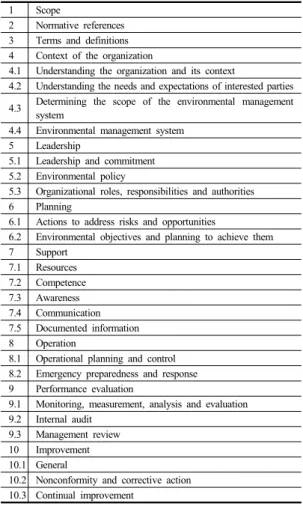
환경경영시스템의 구성내용은 Table 4과 같다.
1 Scope
2 Normative references 3 Terms and definitions 4 Context of the organization
4.1 Understanding the organization and its context
4.2 Understanding the needs and expectations of interested parties 4.3 Determining the scope of the environmental management
system
4.4 Environmental management system 5 Leadership
5.1 Leadership and commitment 5.2 Environmental policy
5.3 Organizational roles, responsibilities and authorities 6 Planning
6.1 Actions to address risks and opportunities
6.2 Environmental objectives and planning to achieve them 7 Support
7.1 Resources 7.2 Competence 7.3 Awareness 7.4 Communication 7.5 Documented information 8 Operation
8.1 Operational planning and control 8.2 Emergency preparedness and response 9 Performance evaluation
9.1 Monitoring, measurement, analysis and evaluation 9.2 Internal audit
9.3 Management review 10 Improvement 10.1 General
10.2 Nonconformity and corrective action 10.3 Continual improvement
1 Scope
2 Normative references 3 Terms and definitions
4 Energy management system requirements 4.1 General requirements
4.2 Management responsibility 4.2.1 Top management 4.2.2 Management representative 4.3 Energy policy
4.4 Energy planning 4.4.1 General
4.4.2 Legal and other requirements 4.4.3 Energy review
4.4.4 Energy baseline
4.4.5 Energy performance indicators
4.4.6 Energy objectives, energy targets and energy management action plans
4.5 Implementation and operation 4.5.1 General
4.5.2 Competence, training and awareness 4.5.3 Communication
4.5.4 Documentation 4.5.5 Operational control 4.5.6 Design
4.5.7 Procurement of energy services, products, equipment and energy
4.6 Checking
4.6.1 Monitoring, measurement and analysis
4.6.2 Evaluation of legal requirements and other requirements 4.6.3 Internal audit of the EnMS
4.6.4 Nonconformities, correction, corrective, and preventive action
4.6.5 Control of records 4.7 Management review 4.7.1 General
4.7.2 Input to management review 4.7.3 Output from management review Table 4. ISO 14001 Requirements
3.1.3 에너지경영시스템(ISO 50001)
에너지경영시스템 (EMS : Energy Management System)은 에너지 방침 및 에너지 목표를 확립하는, 상 호 관련되었거나 또는 상호 관련된 요소의 집합으로 목 적을 달성하기 위한 프로세스 및 절차이다. 즉, 조직 활 동에 필요한 에너지를 효율적으로 이용하기 위한 경영을 실행하는 시스템이다.
이 표준의 목적은 조직이 에너지 효율, 이용 및 사용 량을 포함한 에너지성과의 지속적 개선을 달성하기 위하 여 조직이 체계적으로 접근하는 것을 가능하게 한다(KS A ISO 50001:2011).
에너지경영시스템의 모델은 앞서 제시한 다른 경영시 스템의 모델과 같이 PDCA 사이클에 기초하여 에너지경 영을 일상적, 주기적 활동으로 포함하여 접근한다.
ISO 50001은 개발 과정에서 ISO 14001과의 정합성
이 고려된 만큼 기본적인 체계는 동일하나 ISO 14001과 차이점은 ISO 50001은 에너지 사용에 중심을 둔 경영시 스템으로 기획 단계에서 에너지 검토, 에너지 베이스라 인, 에너지 성과지표라는 세 가지 항목을 설정하였고, 실 시 단계에서도 운전관리, 설계, 에너지 서비스·제품·장비 및 에너지 구매의 세 가지 항목을 설정하여 요구사항을 규정하고 있다.
에너지경영시스템의 요구사항은 Table 5와 같다.
Table 5. ISO 50001 Requirements
3.1.4 안전보건경영시스템(OHSAS 18001) 안전보건경영시스템 (OHSAS : Occupational Health
& Safety Assessment System)은 정태휘와 한성용[24]에 따르면 안전보건경영시스템은 기업의 산업재해 예방과 쾌적한 작업환경 조성을 목적으로 모든 조직원 및 이해
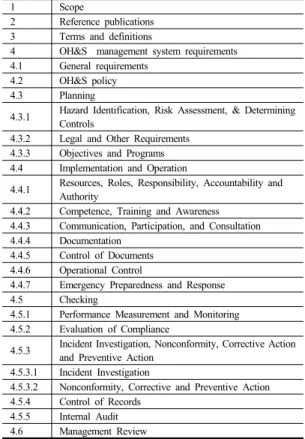
1 Scope
2 Reference publications 3 Terms and definitions
4 OH&S management system requirements 4.1 General requirements
4.2 OH&S policy 4.3 Planning
4.3.1 Hazard Identification, Risk Assessment, & Determining Controls
4.3.2 Legal and Other Requirements 4.3.3 Objectives and Programs 4.4 Implementation and Operation
4.4.1 Resources, Roles, Responsibility, Accountability and Authority
4.4.2 Competence, Training and Awareness 4.4.3 Communication, Participation, and Consultation 4.4.4 Documentation
4.4.5 Control of Documents 4.4.6 Operational Control
4.4.7 Emergency Preparedness and Response
4.5 Checking
4.5.1 Performance Measurement and Monitoring 4.5.2 Evaluation of Compliance
4.5.3 Incident Investigation, Nonconformity, Corrective Action and Preventive Action
4.5.3.1 Incident Investigation
4.5.3.2 Nonconformity, Corrective and Preventive Action 4.5.4 Control of Records
4.5.5 Internal Audit 4.6 Management Review
Table 6. OHSAS 18001 Requirements
관계자가 참여하여 근로자, 하청업자 및 방문자의 안전 및 보건의 유지, 증진을 위한 목표를 수립하고, 이를 달 성하기 위한 조직, 책임, 절차를 규정(문서화)하여 조직 내 물적, 인적 자원을 효율적으로 배분하여 조직적으로 관리하는 경영시스템이라고 하고 있다.
직장보건안전경영시스템에 대한 국제적 인증 표준인 OHSAS 18001 표준을 제정 공포하였고 보건에 대한 정 의가 강화되어 2007년 7월 1일 2차 개정판이 공포되었 다.(서종석).[7] OHSAS 18001 또한 다른 경영시스템과 같이 PDCA 사이클로 프로세스를 구축하는 것을 기반으 로 하고 있다. 현재 ISO 규격으로 개발 중이며 향후 국 제규격으로 제정되면 ISO 인증서로 전환하여 발급 될 예정에 있다.
Table 6에서 볼 수 있듯이 OHSAS 18001과 ISO 14001은 일정한 형태의 위험성 평가를 실시하고, 식별 된 위험을 관리한다는 점에서 매우 유사하다. 차이점은 사고발생 시 안전경영시스템은 사업장 내의 종업원·계약 자에게 해를 입히는 반면, 환경경영시스템은 조직과 직
접적인 관련이 없는 외부에도 영향을 미친다는 점이다.
따라서 ISO 18001은 안전 위험성 분석에 필요한 실태분 석 및 위험성 분석기법의 적용이 강조되고 있다.
3.2 통합관리시스템의 필요성과 과제 3.2.1 통합모형 구축의 필요성
각 경영시스템은 공통의 요소로 구성되어 있음에도 구조적 차이로 복수의 경영시스템을 운영하는 조직에게 혼란을 가중시켜왔다. 이러한 혼란을 방지하기 위하여 개별 경영시스템의 공통·유사한 부분을 통합하여 하나의 시스템으로 통합 할 필요가 생겼다.
통합경영시스템(IMS : Intergrated Management System)이란 김광수·임갑출·정순석[5]에 따르면 조직의 모든 서브시스템과 모든 경영요소를 포함하는 하나의 포 괄적인 시스템(Comprehensive Mansgement System)으로 정의된다. 조직갈등을 해소하고 시스템 구성요소들이 상 호 유기적으로 결합함으로써 외부 환경변화에 적극 대응 하기 위한 시스템이기도 하다(이상훈).[3]사전적 의미로 통합(Intergration)은 둘이상의 조직이나 기구를 하나로 합쳐 다스리는 것이라는 의미를 갖고 있다. 따라서 IMS 는 구성되는 서브시스템 상호간에 모순이 예상되는 다양 한 제약조건 가운데 공통요소는 통합 조정하고, 개별요 소는 독립적으로 그 역할을 할 수 있도록 제작되게 된다.
PL에 대응하기 위하여 개별시스템을 결합하여 구축 한 통합경영시스템에 PL 요구사항을 추가하여 통합모형 을 구축한다.
3.2.2 구축방안
먼저 HLS 규격을 기준으로 개정된 ISO 9001, ISO 14001을 통합하고, 기본적인 체계가 동일한 ISO 50001, OHSAS 18001을 통합하여 시스템을 구축한 후 PL법의 주요내용을 추가하여 Fig 2와 같이 통합모형을 구축하 기로 한다.
Fig. 2. Interated Model
Quality management system (ISO 9001)
Environmental management system
(ISO 14001) Process
4 4.1 4.2 4.3
4.4
Context of the organization
Understanding the organization and its context Understanding the needs and expectations of interested parties
Determining the scope of the quality management system
Quality management system and its processes 4 4.1 4.2 4.3
4.4
Context of the organization
Understanding the organization and its context Understanding the needs and expectations of interested parties
Determining the scope of the environmental management system
Environmental management system
·Manual
·Context of the organization
5 5.1 5.2 5.3
Leadership
Leadership and commitment Quality policy
Organizational roles, responsibilities and authorities
5 5.1 5.2 5.3
Leadership
Leadership and commitment Environmental policy
Organizational roles, responsibilities and authorities
·Administer an organization
·Control of policy
6 6.1 6.2
6.3 Planning
Actions to address risks and opportunities Quality objectives and planning to achieve them Planning of changes
6 6.1 6.2
Planning
Actions to address risks and opportunities Environmental objectives and planning to achieve them
·Risk Management
·Management by objective
·Change Management
·Environmental effect appraisal
·Legal control
7 7.1 7.2 7.3 7.4 7.5
Support Resources Competence Awareness Communication Documented information
7 7.1 7.2 7.3 7.4 7.5
Support Resources Competence Awareness Communication Documented information
·human resources
·Control of measuring devices
·Control of manufacture equipment
·Work environment
·Communication
·Control of documents
·Control of records 8
8.1 8.2
8.3 8.4
8.5 8.6
8.7
Operation
Operational planning and control Requirements for products and services Design and development of products and services Control of externally provided products and services
Production and service provision Release of products and services Control of nonconforming outputs
8 8.1 8.2
Operation
Operational planning and control Emergency preparedness and response
·Review customer requirements
·Design and development
·Purchasing
·Production
·Materials and Product
·Control of nonconforming product
·Environmental operational control
·Emergency preparedness and response
9 9.1
9.2 9.3
Performance evaluation
Monitoring, measurement, analysis and evaluation
Internal audit Management review
9 9.1
9.2 9.3
Performance evaluation
Monitoring, measurement, analysis and evaluation
Internal audit Management review
·Monitoring and measurement
·Control of customer complaints
·Internal audit
·Management review
10 10.1 10.2 10.3
Improvement General
Nonconformity and corrective action
Continual improvement
10 10.1 10.2 10.3
Improvement General
Nonconformity and corrective action Continual improvement
·Corrective and preventive action
·Control of improvement Table 7. Quality·Environment Integrated Management System Design
Energy Management System (ISO 50001)
Occupational Health & Safety Assessment System
(OHSAS 18001)
Process
4.1 General requirements 4.1 General requirements ·Manual
4.2 4.2.1 4.2.2
Management responsibility Top management Management representative
·Context of the organization
4.3 Policy 4.2 Policy ·Control of policy
4.4 4.4.1 4.4.2 4.4.3 4.4.4 4.4.5 4.4.6
Planning General
Legal and other requirements Energy review
Energy baseline
Energy performance indicators Energy objectives, energy targets and energy management action plans
4.3 4.3.1 4.3.2 4.3.3
Planning
Hazard Identification, Risk Assessment, &
Determining Controls Legal and Other Requirements Objectives and Programs
·Energy baseline
·Energy assessments
·Risk assessments
·Risk Management
·Legal control
·Management by objective
4.5 4.5.1 4.5.2 4.5.3 4.5.4 4.5.5 4.5.6 4.5.7
Implementation and operation General
Competence, training and awareness Communication
Documentation Operational control Design
Procurement of energy services, products, equipment
and energy
4.4 4.4.1 4.4.2 4.4.3 4.4.4 4.4.5 4.4.6 4.4.7
Implementation and operation Resources, Roles, Responsibility, Accountability and Authority Competence, Training and Awareness Communication, Participation, and Consultation
Documentation Control of Documents
Operational Control Emergency Preparedness and Response
·Administer an organization
·human resources
·Control of documents
·Communication
·Operational control
·Design
·Purchasing
·Emergency preparedness and response
4.6 4.6.1
4.6.2 4.6.3 4.6.4
4.6.5
Checking
Monitoring, measurement and analysis Evaluation of legal requirements and other requirementsEnMS
Internal audit of the EnMS Nonconformities, correction, corrective, and preventive action
Control of records
4.5 4.5.1
4.5.2 4.5.3
4.5.4 4.5.5
Checking
Performance Measurement and Monitoring Evaluation of Compliance
Incident Investigation, Nonconformity, Corrective Action and Preventive Action Control of Records
Internal Audit
·Monitoring and measurement
·Control of improvement
·Control of records
·Internal audit
·Corrective and preventive action
4.7 4.7.1 4.7.2 4.7.3
Management review General
Input to management review Output from management review
4.6 Management review
·Management review Table 8. Energy·Occupation Health & Safety Integrated Management System Design
품질, 환경, 에너지, 안전보건 경영시스템은 요구사항 이 명시되어 있다. 여기에 PL법의 해석을 토대로 PL법 요구사항을 추가하여 통합모형의 설계에 반영한다.
3.2.3 장단점
품질·환경·에너지·안전보건·PL을 통합한 통합모형의 운영효과를 살펴보면 다음의 것으로 요약된다. 첫째, 통 합시스템 적용 후 한 조사에 의하면 피해보상건수는 전 년대비 11%각 감소되었고 피해건수당 소비자 보상비용 은 14%가 개선되어 연간 8천만원의 절감효과를 보았다
(김광수·임갑출·정순석).[5]둘째, 절차서 및 기록사항의 공통부분을 관리하고 업무의 효율성을 증대하였다. 셋 째, 중복업무를 감소시켜 직무분장을 명확히 할 수 있다.
넷째, 프로세스별로 검토한 후 통합을 추진하고 여기에 PL을 추가하여 통합운영이 가능하다.
4. PL대응을 위한 통합관리시스템 구축
품질·환경, 에너지·안전보건 경영시스템의 요구사항을
Quality management system
(ISO 9001) PL System Process
4 Context of the organization
PL Policy
Identify competitor technology Product information gathering Technical level survey Product Environment Survey
·Manual
·Context of the organization
5 Leadership
PL Organization Responsibility and authority Provision of resources
·Administer an organization
·Control of policy
6 Planning
PL objectives planning
legal and Requirements
·Management by objective
·Risk Management
·Legal control
7 Support
human resources Authorization
Equipment, transport identification Work environment
Sharing information Instruction Manual Warning labels Record retention period
·human resources
·Control of measuring devices
·Control of manufacture equipment
·Work environment
·Communication
·Control of documents
·Control of records
8 Operation
Identify product specifications Review customer requirements Product risk assessment Drawing verification Safety review
Product safety verification Verify product validity Confirm specification change PL Identify items PL Specifying parts
Item registration and verification Process FMEA
Product History Management Identification and traceability Storage conditions Review required equipment Calibration
·Review customer requirements
·Design and development
·Purchasing
·Production
·Materials and Product
·Control of nonconforming product
9 Performance evaluation PL Internal audit
·Monitoring and measurement
·Control of customer complaints
·Internal audit
·Management review 10 Improvement Establish system to improve complaints
Safety Product Defective Action
·Corrective and preventive action
·Control of improvement Table 9. PL System Design
비교하여 프로세스를 도출한다. 프로세스는 ISO 9001을 기준으로 비교하는데 이는 ISO 9001가 근간이 되도록 설계 되었고 그것을 바탕으로 통합하는 것이 일반적이기 때문이다.
4.1 품질·환경 통합경영시스템 설계
품질경영시스템은 조직이 외부(고객)에 제공하는 제 품과 서비스의 품질을 유지하고 제공함으로써 고객 만족
의 향상이 매우 중요하므로 Table 7과 같다.
8항의 운용에 해당되는 요구사항은 프로세스를 보다 더 세분화시켰다. 즉, 고객요구사항검토를 바탕으로 설 계 및 개발업무, 구매관리, 생산관리, 자재, 제품관리 순 서로 프로세스를 설계하였다.
환경경영시스템은 기업의 제조 및 업무과정에서 환경 관리 능력 확보하는 것이 주요 내용이므로 이를 중심으 로 설계하였다.
Integrated Management Process ISO 9001 ISO 14001 ISO 50001 OHSAS 18001 PL System
Integrated management Manual Manual Manual Manual Manual Manual
Context of the organization Context of the organization
Context of the organization
Context of the organization
Context of the organization Administer an organization Administer an
organization
Administer an organization
Administer an organization
Administer an organization
Administer an organization Control of policy Control of policy Control of policy Control of policy Control of policy Control of policy Risk Management Risk Management Risk Management Risk Management Risk Management Risk Management
Management by objective
Management by objective
Change Management
Management by objective
Management by objective
Management by objective
Management by objective
Assessments Environmental effect
appraisal
Energy baseline
Energy assessments Risk assessments
Legal control Legal control Legal control Legal control Legal control
human resources human resources human resources human resources human resources human resources Control of measuring devices Control of measuring
devices
Control of measuring devices
Control of manufacture equipment
Control of manufacture equipment
Control of manufacture equipment
Control of manufacture equipment
Work environment Work environment Work environment Work environment
Communication Communication Communication Communication Communication Communication
Control of Documents and records
Control of documents Control of records
Control of documents Control of records
Control of documents Control of records
Control of documents Control of records
Control of documents Control of records Review customer requirements Review customer
requirements
Review customer requirements Design and development Design and
development Design Design and
development
Purchasing Purchasing Purchasing Purchasing
Production Production Production
Materials and Product Materials and Product Materials and Product
Control of nonconforming product
Control of nonconforming product
Control of nonconforming product
Operational control Environmental
operational control Operational control Operational control Emergency preparedness and
response
Emergency preparedness and response
Emergency preparedness and response Monitoring and measurement Monitoring and
measurement
Monitoring and measurement
Monitoring and measurement
Monitoring and measurement
Monitoring and measurement
Integrated Management Process ISO 9001 ISO 14001 ISO 50001 OHSAS 18001 PL System
Control of customer complaints Control of customer complaints
Control of customer complaints Internal audit Internal audit Internal audit Internal audit Internal audit Internal audit Management review Management review Management review Management review Management review Management review Corrective and preventive action Corrective and
preventive action
Corrective and preventive action
Corrective and preventive action
Corrective and preventive action
Corrective and preventive action Control of improvement Control of
improvement
Control of improvement
Control of improvement
Control of improvement
Control of improvement Table 10. Integrated Model Design
4.2 에너지·안전 경영시스템 설계
에너지경영시스템은 에너지 검토, 에너지 베이스라 인, 에너지 성과지표 세 가지 항목이 다른 경영시스템 과 다르게 요구사항에 규정되어 있어 이를 고려하여 설계하였다.
안전보건경영시스템에서 설비의 개념이란 안전모, 소 방시설 같은 운영프로세스에 속하는 시설 및 장비가 대 부분으로 이루어져 있어 생략하였다.
에너지·안전보건 경영시스템 설계에 관하여는 Table 8과 같이 나타낼 수 있다.
4.3 PL시스템 설계
제조물책임의 핵심은 제품의 결함이다. 결함을 충분 히 이해하고 예방할 수 있다면 기업은 제조물책임에서 자유로울 수 있다. 통상 결함은 설계상의 결함, 제조상의 결함, 지시·경고상의 결함으로 분류되기 때문에 결함을 중심으로 PL시스템을 설계한다.
Table 9은 제조물책임법의 주요내용을 품질경영시스 템을 기반으로 PL 시스템을 설계하였다.
4.4 통합모형 구축
먼저 구축한 Table 7 품질·환경 경영시스템 설계와, Table 8 에너지·안전보건 경영시스템 설계에 Table 9 PL 시스템 설계를 통합하여 통합모형을 구축하면 Table 10 통합모형과 같다.
기존의 경영시스템으로 구축되는 KS, ISO, PL 법규 의 내용은 중소기업이 보유하는 기존의 내용과 관련된 부분과 개별적으로 구축되는 시스템의 내용으로 조직에 서 인식되는 4개의 경영시스템은 통합 매뉴얼로 나타내 고 절차와 지침서는 공동절차서 및 지침서와 개별절차서 와 지침서로 설계할 수 있다.
이같은 통합모형은 일관성 있는 업무의 진행이 가능 하고 업무숙련 시간의 감소, 품질향상으로 인한 비용절 감, PL보험가입으로 인한 리스크 저감 등의 효과를 기할 수 있다.
5. 결론
중소기업에서는 지금까지 서로 상이하거나 중복된 시 스템을 2중·3중으로 구축하고 유지함으로써 자원낭비와 시스템의 운영효과가 크게 저하됨이 문제점으로 지적되 어 왔다.
이처럼 중복적이고 비효율적인 경영시스템의 구축 과 관리방식에서 탈피하여 효과적인 시스템을 통합하 여 관리하고 운영함으로써 중소기업의 경쟁력 제고를 위한 연구를 진행하였는데 그 연구결과를 요약하면 다 음과 같다.
새로운 규격으로 개정된 품질경영시스템, 환경경영시 스템과 에너지경영시스템, 안전보건경영시스템의 요구 사항과 특성을 파악하여 시스템의 통합을 위한 기본개념 을 정립하고, 비교분석 테이터를 구축하여 통합모형을
제시하였다.
또한 기존의 선행연구를 분석하여 ISO 통합경영시스 템 구축 후 PL법에 대비하기 위해 새롭게 통합모형을 구 축하였다.
이 논문이 시사하는 바는 다음과 같습니다.
그동안 ISO 통합경영시스템에 관한 연구가 몇 가지 있었으나 다수의 ISO 통합프로그램에 더하여 PL법을 결합시킨 모델에 관한 연구는 없었다. 이 논문은 이러한 점에서 PL법을 반영하고 ISO 통합경영시스템의 발전방 향을 모색하였다는 점에서 시사하는 바가 크다.
또한 제조물책임법이 제정되고 시행되는 현재에서 법 리적 경제학적 연구와 함께 법률로부터 조직이 보호받을 수 있는 시스템적 운영방안이 본격적으로 이뤄져야 할 단계라 판단된다. 따라서 제조물책입법에서 요구되는 사 항들을 기업이 적절하게 이해하고, 대응하는 시스템적 연구와 실행방안에 대한 연구의 틀을 제공했다는 점에서 의의가 있다
본 연구의 한계점으로는 품질경영시템과 환경경영시 스템의 개정이 2015년에 이루어지고 2016년 중순에 KS 규정으로 등록, 배포되어 아직까지 적용하는 기업이 많 이 없고, 또한 2016년 제조물책임법 개정법률안이 발의 되어 본 통합모형을 적용하고 평가할 수 없어 아쉬운 점 이 있다. 향후 시스템 통합모형의 적용 및 평가가 필요하 다. 따라서 향후 추가적 연구과제는 품질, 환경, 에너지, 안전보건 이외의 경영시스템의 통합 외에 더 기업이 필 요로 하는 다른 경영시스템과의 시스템 통합에 대한 연 구가 추가적으로 필요하다.
References
[1] Korea Federation of SMEs, Actual situation and opinion investigation of small & medium business product liability law K-BIZ, 2016.
[2] J. H. Seo, B. S. Ko, S. M. Bae, "Extracting Priorities of Strategic Components of Product Liability Response System using AHP", J Korean Soc Qual Manag vol. 42, no. 2. pp. 235-252, 2014.
DOI: https://doi.org/10.7469/JKSQM.2014.42.2.235 [3] S. H. Lee, "A Study on the Integrated Management
Systems Establishment and Operation of the KS, QMS and EMS", M. A. dissertation graduate School, Chungju National University, 2010.
[4] Y. S. Kim, "A strategy for the Integration of management system and the methodology of operational efficiency", M. A. dissertation graduate School, Kyonggi
University, 2010.
[5] K. S. Kim, G. C. Lim, S. S. Chung, "A Study on the PL Response by Integrated Management System", Journal of the Korean Society for Quality Management, vol. 39, no.
1, p. 129, 2011.
[6] Y. H. Choi, J. K. Yang, S. B. Lee, " A Development of Integration System Process for the integrated operation of the ISO Working - Concentrated on Construction Industry", Journal of Architectural Institute of Korea, vol. 14, no. 4, 2012.
[7] J. S. Seo, "A study on the integration method of ISO 9001, ISO 14001, OHSAS 18001, ISO 50001 management system" M. A. dissertation graduate School, Pusan National University, 2012.
[8] K. I. Song, J. S. Jang, "Comparative Analysis among ISO 9001, ISO 14001, OHSAS 18001 and ISO 50001 and Case Study for Integration Management System", Journal of the Korean Institute of Plant Engineering, vol.
18, no. 3, 2013.
[9] W. J. Yoo, “Research about Integrated System construction design of ISO 9001;2000, KS and Product Safety Management by PL(Product LiabilityO law practice” Journal of the Korean Society for Quality Management, vol. 31, no. 4, 2003.
[10] B. W. Kim, “A Study of Constructing Integration System with ISO 9001:2000, Korean Industrial Standard and Product Safety Management Under the Execution of Product Liability Law” M. A. dissertation graduate School, Konkuk University, 2003.
[11] G. B. Chong, “A Study on the Effective Countermove of P/L System by Integrated Quality Management System : the Case of Medical Instruments Industry in the Nation”, M. A. dissertation graduate School, Hongik University, 2003.
[12] Product Liability Law.
[13] KS Q ISO 9001:2015 Quality Management System Requirements, Korean Agency for Technology and Standards, 2015.
[14] KS I ISO 14001:2015 Environment Management System Requirements, Korean Agency for Technology and Standards, 2015.
[15] KS A ISO 50001:2011 Energy Management System Requirements, Korean Agency for Technology and Standards, 2011.
[16] OHSAS 18001:2007 Occupational Health and Safety Assessment System Requirements, British Standards Institution, 2007.
[17] K. C. We, "Rechtsvergleichende Untersuchung uber Produkthaftung fur reinen Vermogensschaden", Kyungpook National University, Law Journal, vol. 42, pp. 275-306, 2013.
[18] J. H. Seo, S. M. Bae, "Identifying Inderstry-Specific Components of Product Liability Response System Using Delphi-AHP Method", Management and Production Engineering Review, vol. 7, no. 4, pp. 29, 2016.
DOI: https://doi.org/10.1515/mper-2016-0033
[19] LS Cable & System Ltd, Quality Management Teaching materials, 2007.
[20] J. H. Kim, “Die verschuldensunabhangige Haftung fur fehlerhafte Produkte - Zur Notwendigkeit der Beweislasterleichterungen” Legal Research, vol. 44, pp.
59-7, 2014.
[21] S. L. Kwon, D. Y. Han, "A Study on Issues and Improvement Plans concerning the Product Liability Act", Korea Law Association, vol. 51, pp. 173-194, 2013.
[22] Ansoff. H. I, "The Sate of Practice in Planning System", Sloan Management Review, Winter, 1972.
[23] J. I. Hong, J. H. Park, ISO New paradigm of management system HLS, Korea Standards Association Media, 2015.
[24] T. H. Jung, S. Y. Han, Occupational Health & Safety Assessment System Deployment guide, Future Publisher, 2015.
한 민 석(Min-Suk Han) [정회원]
⦁2012
년
2월
:숭실대 중소기업대 학원
(경영학석사
)⦁2016
년
2월
:호서대학교 벤처대 학원 벤처경영학과
(경영학박사
)⦁2013
년
5월
~현재
:한국경제인 증원 이사
⦁2017
년
3월
~현재
:호서대학교 인문융합대학 강사
<