Diagnosis and Treatment of Growth Hormone Deficiency:
A Position Statement from Korean Endocrine Society and Korean Society of Pediatric Endocrinology
Jung Hee Kim1, Hyun Wook Chae2, Sang Ouk Chin3, Cheol Ryong Ku4, Kyeong Hye Park5, Dong Jun Lim6, Kwang Joon Kim7, Jung Soo Lim8, Gyuri Kim9, Yun Mi Choi10, Seong Hee Ahn11, Min Ji Jeon12, Yul Hwangbo13, Ju Hee Lee14, Bu Kyung Kim15, Yong Jun Choi16, Kyung Ae Lee17, Seong-Su Moon18, Hwa Young Ahn19,
Hoon Sung Choi20, Sang Mo Hong10, Dong Yeob Shin4, Ji A Seo21, Se Hwa Kim22, Seungjoon Oh3, Sung Hoon Yu23, Byung Joon Kim24, Choong Ho Shin25, Sung-Woon Kim3, Chong Hwa Kim26, Eun Jig Lee4
1Department of Internal Medicine, Seoul National University Hospital, Seoul National University College of Medicine;
2Department of Pediatrics, Yonsei University College of Medicine; 3Department of Endocrinology and Metabolism, Kyung Hee University School of Medicine; 4Division of Endocrinology and Metabolism, Department of Internal Medicine, Yonsei
University College of Medicine, Seoul; 5Division of Endocrinology and Metabolism, Department of Internal Medicine, National Health Insurance Service Ilsan Hospital, Goyang; 6Division of Endocrinology and Metabolism, Department of Internal
Medicine, College of Medicine, The Catholic University of Korea; 7Division of Geriatrics, Department of Internal Medicine, Yonsei University College of Medicine, Seoul; 8Department of Internal Medicine, Yonsei University Wonju College of Medicine, Wonju; 9Division of Endocrinology and Metabolism, Department of Medicine, Thyroid Center, Samsung Medical Center, Sungkyunkwan University School of Medicine, Seoul; 10Department of Internal Medicine, Hallym University Dongtan Sacred Heart Hospital, Hallym University College of Medicine, Hwaseong; 11Department of Endocrinology, Inha University School of Medicine, Incheon; 12Department of Internal Medicine, Asan Medical Center, University of Ulsan College of Medicine, Seoul; 13Department of Internal Medicine, National Cancer Center, Goyang; 14Department of Internal Medicine, Chungnam National University College of Medicine, Daejeon; 15Department of Internal Medicine, Kosin University College of Medicine, Busan; 16Department of Endocrinology and Metabolism, Ajou University School of Medicine, Suwon; 17Division of Endocrinology and Metabolism, Department of Internal Medicine, Research Institute of Clinical Medicine of Jeonbuk National University-Biomedical Research Institute of Jeonbuk National University Hospital, Jeonju; 18Department of Internal Medicine, Dongguk University College of Medicine, Gyeongju; 19Department of Internal Medicine, Chung-Ang University College of Medicine, Seoul; 20Department of Internal Medicine, Kangwon National University School of Medicine, Chuncheon; 21Division of Endocrinology, Department of Internal Medicine, Korea University Ansan Hospital, Korea University College of Medicine, Ansan; 22Department of Internal Medicine, International St. Mary’s Hospital, Catholic Kwandong University College of Medicine, Incheon; 23Department of Endocrinology and Metabolism, Hanyang University Guri Hospital, Hanyang University College of Medicine, Guri; 24Division of Endocrinology, Department of Internal Medicine, Gachon University College of Medicine, Incheon; 25Department of Pediatrics, Seoul National University College of Medicine, Seoul; 26Division of Endocrinology and Metabolism, Department of Internal Medicine, Sejong General Hospital, Bucheon, Korea
Received: 4 February 2020, Revised: 2 April 2020, Accepted: 23 April 2020 Corresponding authors: Chong Hwa Kim
Division of Endocrinology and Metabolism, Department of Internal Medicine, Sejong General Hospital, 28 Hohyeon-ro 489beon-gil, Sosa-gu, Bucheon 14754, Korea Tel: +82-32-340-1116, Fax: +82-32-340-1236, E-mail: [email protected] Eun Jig Lee
Division of Endocrinology and Metabolism, Department of Internal Medicine, Yonsei University College of Medicine, 50-1 Yonsei-ro, Seodaemun-gu, Seoul 03722, Korea
Tel: +82-2-2228-1983, Fax: +82-2-393-6884, E-mail: [email protected]
Copyright © 2020 Korean Endocrine Society
This is an Open Access article distributed under the terms of the Creative Com- mons Attribution Non-Commercial License (https://creativecommons.org/
licenses/by-nc/4.0/) which permits unrestricted non-commercial use, distribu- tion, and reproduction in any medium, provided the original work is properly cited.
Growth hormone (GH) deficiency is caused by congenital or acquired causes and occurs in childhood or adulthood. GH replacement therapy brings benefits to body composition, exercise capacity, skeletal health, cardiovascular outcomes, and quality of life. Before initiating GH replacement, GH deficiency should be confirmed through proper stimulation tests, and in cases with proven genetic causes or structural lesions, repeated GH stimulation testing is not necessary. The dosing regimen of GH replacement therapy should be individualized, with the goal of minimizing side effects and maximizing clinical improvements. The Korean Endocrine Society and the Korean Society of Pediatric Endocrinology have developed a position statement on the diagnosis and treatment of GH defi- ciency. This position statement is based on a systematic review of evidence and expert opinions.
Keywords: Growth hormone; Dwarfism, pituitary; Hypopituitarism; Hormone replacement therapy
1. Diagnosis of growth hormone deficiency in adults 1. The insulin tolerance test is recommended as the stan-
dard test for diagnosing growth hormone (GH) deficien- cy (B).
2. When GH deficiency is suspected, but an insulin toler- ance test is contraindicated, two or more GH stimulation tests (GH-releasing hormone—arginine, glucagon, le- vodopa, or clonidine stimulation tests) should be admin- istered (B).
3. GH deficiency cannot be ruled out even if insulin-like growth factor-1 (IGF-1) levels are normal. However, low serum IGF-1 levels may be indicative of GH deficiency in individuals who do not have a history of poorly con- trolled diabetes, chronic liver disease, or treatment with oral contraceptives (C).
4. GH deficiency can be diagnosed without GH stimulation testing when the typical clinical characteristics of GH deficiency are present, accompanied by deficiencies in three or more pituitary hormones with low serum IGF-1 levels (B).
5. Repeated GH stimulation testing should be performed in patients with childhood-onset GH deficiency if they do not have a proven genetic cause of GH deficiency or ir- reversible damage (B).
6. Adult patients with irreversible pituitary damage should not receive repeated GH stimulation tests (B).
2. Treatment of growth hormone deficiency in adults 1. Unless contraindicated, GH therapy is recommended for
patients with GH deficiency. GH therapy should start from a low dose, considering the patient’s age, sex, and
estrogen levels (A).
2. Clinical improvements, side effects, and targeting serum IGF-1 levels within the age-adjusted reference range should be considered when adjusting the GH dose (A).
3. During the adjustment period, IGF-1 levels should be monitored monthly or bimonthly. Once the maintenance level is determined, IGF-1 levels should be monitored around twice per year. Monitoring should include an evaluation of the patient’s clinical response, side effects, and IGF-1 levels (B).
3. Diagnosis and treatment of growth hormone deficien- cy in children and adolescents
1. Two or more GH stimulation tests should be adminis- tered when GH deficiency is suspected in children (A).
2. Repeated GH stimulation tests are not required in GH patients with pituitary lesions or a proven genetic cause of GH deficiency (C).
3. GH replacement should be continued in children and ad- olescents until the epiphyseal plates close or their full height is reached (C).
4. GH replacement should be resumed as soon as possible in patients with GH deficiency during transition (B).
4. Benefits of growth hormone treatment
1. GH treatment improves body composition, exercise ca- pacity, and bone mineral density in patients with GH de- ficiency (A).
2. GH treatment lowers the risk of cardiovascular disease in patients with GH deficiency, but there is insufficient evidence regarding its effects on mortality reduction (B).
SUMMARY
INTRODUCTION
Growth hormone (GH) deficiency can be categorized into childhood-onset and adult-onset. Childhood-onset GH deficien- cy can be further categorized as congenital, acquired, or idio- pathic. Adult-onset GH deficiency is generally acquired, al- though GH deficiency in adults can also occur as a continuation of childhood-onset GH deficiency. The congenital causes are
mutations of genes related to GH synthesis and GH receptors and developmental structural disabilities in the brain. The main causes of acquired GH deficiency are tumors in the pituitary gland and hypothalamus, the treatment of such tumors with sur- gery or radiation, infiltrative diseases, vascular damage, and in- fections (Table 1) [1,2].
The most common cause of adult-onset GH deficiency is hy- pothalamic-pituitary tumors—either the tumor itself, or surgery 3. GH treatment improves quality of life in patients with
GH deficiency (A).
5. Risks and side effects of growth hormone treatment 1. GH treatment is contraindicated in patients with an ac-
tive malignancy (except basal cell or squamous cell skin cancers) (A).
2. Changes in blood glucose levels should be observed dur- ing the course of GH treatment in patients with diabetes mellitus, who may require their antidiabetic medication to be adjusted (B).
3. Thyroid and adrenal gland function should be monitored during GH treatment in patients with hypopituitarism (B).
Table 1. Cause of Growth Hormone Deficiency
Congenital Acquired
Genetic
Transcription factor defects (PIT-1, PROP-1, LHX3/4, HESX-1, PITX-2) GHRH receptor gene defects
GH secretagogue receptor gene defects GH gene defects
GH receptor/post receptor defects
Neoplastic Pituitary adenoma Craniopharyngioma Rathke’s cleft cyst Glioma/astrocytoma Germinoma Metastatic Associated with brain structural defects
Agenesis of corpus callosum Septo-optic dysplasia Empty sella syndrome Holoprosencephaly Encephalocele Hydrocephalus Arachnoid cyst
Infiltrative/granulomatous disease Langerhans cell histiocytosis Sarcoidosis
Hypophysitis Vascular damage Head injury
Pituitary tumor apoplexy Sheehan’s syndrome Subarachnoid hemorrhage Associated with midline facial defects
Single central incisor
Cleft lip/palate Treatment of pituitary and hypothalamic diseases
Cranial irradiation
Surgery of the pituitary or hypothalamus Central nervous system infection Idiopathic
Modified from Molitch et al. [1]; and Melmed [2], with permission from Massachusetts Medical Society.
PIT-1, pituitary transcription factor-1; PROP-1, prophet of pit-1; LHX3/4, LIM class homeobox transcription factor Lhx3, 4; HESX-1, homeobox-1;
PITX-2, paired-like homeodomain transcription factor-2; GHRH, growth hormone-releasing hormone; GH, growth hormone.
or radiation treatment performed to treat the tumor. Although it is rare for pituitary microadenoma to present with hypopituita- rism, pituitary macroadenoma presents with at least one pitu- itary hormone deficiency in approximately 30% to 60% of cases [3]. The main mechanism of hormone deficiency is disruption of circulation due to pressure on the portal veins of the pituitary stalk [4]. Hypopituitarism can also occur after the removal of pituitary tumors, but surgery can lead to a 50% recovery of tu- mor-induced hypopituitarism [5]. However, GH is the least re- covering pituitary hormone [4]. Radiation also induces GH de- ficiency. The risk of GH deficiency after intracranial radiation is higher in younger patients, and increases with the time after ra- diation therapy [6]. If the amount of radiation is above 40 Gy, there is a 50% chance of GH deficiency [7].
GH deficiency occurs in 25% of patients with head injury or subarachnoid hemorrhage [8,9]. Some patients recover with time, while others deteriorate; therefore, pituitary hormone lev- els in these patients should be monitored upon admission and at regular intervals thereafter.
Clinically, patients with GH deficiency report increased body fat, decreased muscle mass, lethargy, and decreased quality of life [10]. However, the presenting symptoms such as fatigue and weakness are nonspecific and common. Therefore, controversy has persisted regarding the correct diagnosis and appropriate treatment of GH deficiency. The Insurance Committee of the Korean Endocrine Society therefore developed a guideline for the diagnosis and treatment of GH deficiency, as cases of GH deficiency increase and some issues arise regarding insurance reimbursements in South Korea.
METHODS USED IN THE DEVELOPMENT OF THIS GUIDELINE
This guideline was developed by the Insurance Committee of the Korean Endocrine Society in consultation with the Korean Neuroendocrine Study Group, and the Korean Society of Pedi- atric Endocrinology. Since there are currently no diagnostic guidelines for GH deficiency and few domestic research has been conducted on this topic, the basis of this guideline was formed by consensus from panel discussion of experts, and the review of existing literature. When evidence was insufficient, recommendations were written according to experts’ opinions.
When there were differences in opinions, a majority vote was taken. Each recommendation was graded according to the strength of evidence supporting the recommendation, as defined in Table 2.
DISCUSSION OF THE RECOMMENDATIONS
1. Diagnosis of growth hormone deficiency in adults GH deficiency is suspected in patients with suggestive clinical presentations (increased body fat, decreased muscle mass, leth- argy, and decreased quality of life), and it is diagnosed through GH stimulation tests. An evaluation for GH deficiency should be considered in patients with conditions that can cause GH de- ficiency, since GH deficiency can be misdiagnosed in patients who only have non-specific clinical symptoms such as lethargy, weakness, and obesity. Before GH secretion is tested, other de- ficient hormones should be supplemented. Since GH is released in spurts, GH deficiency is diagnosed through GH stimulation
Table 2. Definition of Recommendation Levels Recommendation
level Definition
A When there is a clear rationale for the recommendations:
When manifold randomized controlled trials that can be generalized because they have sufficient test or meta-analysis results support a recommendation.
B When there is a reliable basis for the recommendations:
When reasonable grounds support this through well-performed cohort studies or patient—control group studies.
C When there is a possible basis for the recommendations:
When relevant grounds are seen through randomized clinical studies or case reports and observational studies carried out in a small institution, despite their inherent unreliability.
E Expert recommendations:
There is no basis to support the recommendations, but they are supported by expert opinion or expert clinical experience.
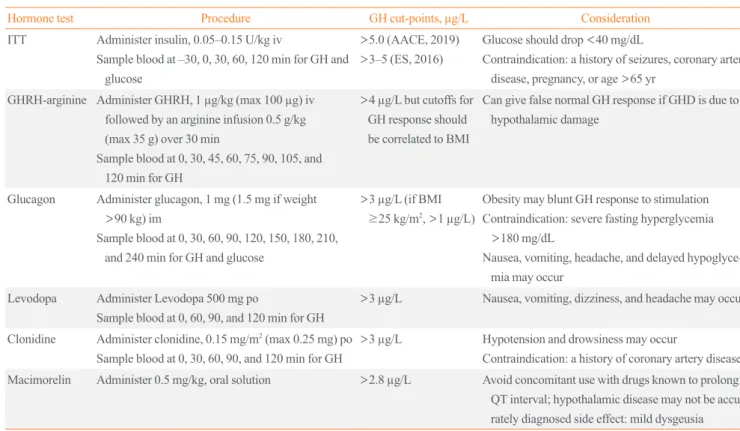
tests such as the insulin tolerance test (ITT), the growth hor- mone-releasing hormone (GHRH), arginine, glucagon, levodo- pa, and clonidine stimulation tests. There is no single gold-stan- dard test, but the ITT is a major GH stimulation test. The use of GHRH is withdrawn in South Korea as well as in the United States. The basic principle of GH stimulation test is consecu- tively measuring blood GH levels after an administration of a medication that rapidly stimulates GH. The highest GH level in the samples is then interpreted as the patient’s GH response. Ta- ble 3 summarizes the methods, standards, and precautions for GH stimulation tests.
1.1. The insulin tolerance test is recommended as the standard test for diagnosing GH deficiency.
1.2. When GH deficiency is suspected, but an ITT is con- traindicated, two or more GH stimulation tests (GHRH- arginine, glucagon, levodopa, or clonidine stimulation tests) should be administered.
The ITT is recommended as the standard test for the diagno- sis of GH deficiency. ITT has been validated as a standard test
for GH deficiency, but it causes hypoglycemia; therefore, it is contraindicated in elderly patients and patients with a history of epilepsy or cardiovascular disease due to its risks [11]. Even healthy individuals should be continuously monitored during ITT. In obese patients with insulin resistance, a greater dose of insulin is injected to induce hypoglycemia, and this process in- creases the risk of delayed hypoglycemia. ITT is also difficult to replicate, since the response to ITT varies from occasion to oc- casion in healthy individuals. The response to ITT also depends on the menstrual cycle.
Aimaretti et al. [12] reported that injecting arginine, which suppresses the secretion of hypothalamic somatostatin, together with GHRH served as a potent and safe GH stimulation test.
Biller et al. [13] compared five types of GH stimulation tests. In their study, five stimulation tests were administered in random order to 39 patients with panhypopituitarism, 21 patients with either isolated GH deficiency or no more than one additional pi- tuitary hormone deficiency, and 34 healthy controls matched by age, sex, and body mass index (BMI). At a GH level of 5.1 μg/L, ITT had 96% sensitivity and 92% specificity, and the GHRH- arginine test had a similar diagnostic validity at a GH level of
Table 3. Dynamic Tests for Diagnosing GH deficiency
Hormone test Procedure GH cut-points, µg/L Consideration
ITT Administer insulin, 0.05–0.15 U/kg iv
Sample blood at –30, 0, 30, 60, 120 min for GH and glucose
>5.0 (AACE, 2019)
>3–5 (ES, 2016)
Glucose should drop <40 mg/dL
Contraindication: a history of seizures, coronary artery disease, pregnancy, or age >65 yr
GHRH-arginine Administer GHRH, 1 µg/kg (max 100 µg) iv followed by an arginine infusion 0.5 g/kg (max 35 g) over 30 min
Sample blood at 0, 30, 45, 60, 75, 90, 105, and 120 min for GH
>4 µg/L but cutoffs for GH response should be correlated to BMI
Can give false normal GH response if GHD is due to hypothalamic damage
Glucagon Administer glucagon, 1 mg (1.5 mg if weight
>90 kg) im
Sample blood at 0, 30, 60, 90, 120, 150, 180, 210, and 240 min for GH and glucose
>3 µg/L (if BMI
≥25 kg/m2, >1 µg/L)
Obesity may blunt GH response to stimulation Contraindication: severe fasting hyperglycemia
>180 mg/dL
Nausea, vomiting, headache, and delayed hypoglyce- mia may occur
Levodopa Administer Levodopa 500 mg po
Sample blood at 0, 60, 90, and 120 min for GH
>3 µg/L Nausea, vomiting, dizziness, and headache may occur
Clonidine Administer clonidine, 0.15 mg/m2 (max 0.25 mg) po Sample blood at 0, 30, 60, 90, and 120 min for GH
>3 µg/L Hypotension and drowsiness may occur
Contraindication: a history of coronary artery disease Macimorelin Administer 0.5 mg/kg, oral solution >2.8 µg/L Avoid concomitant use with drugs known to prolong QT interval; hypothalamic disease may not be accu- rately diagnosed side effect: mild dysgeusia GH, growth hormone; ITT, insulin-tolerance test; iv, intravenous; AACE, American Association of Clinical Endocrinologists; ES, Endocrine Society;
GHRH, growth hormone-releasing hormone; BMI, body mass index; GHD, growth hormone deficiency; im, intramuscular; po, per os.
4.1 μg/L, with 95% sensitivity and 91% specificity. GHRH, however, stimulates the pituitary gland directly and may result in false negatives in patients with disorders in the hypothalamus or a history of radiation treatment. The GH level for the GHRH- arginine test needs to be adjusted in patients who are older or have a higher BMI [14,15]. A higher BMI also leads to a slight- ly lower GH response in ITT, but it is not recommended to ad- just the GH levels for the diagnostic cut-point [16]. For tests us- ing arginine alone, a GH level of 0.4 μg/L was identified as a suitable cut-point; however, this low value compromises diag- nostic accuracy, and this test is therefore not recommended.
Glucagon indirectly stimulates GH by stimulating insulin se- cretion; since the GH response is delayed, the glucagon stimula- tion test requires a minimum of 3 hours to complete and poses a risk of delayed hypoglycemia. For this test, intramuscular or subcutaneous injection is more effective than intravenous injec- tion. The GH level for diagnosis is adequate at 3 μg/L, while in patients with obesity (BMI >25 kg/m2) whose GH response is less sensitive, the GH level for diagnosis is 1 μg/L [17-21]. Al- though higher blood glucose levels are associated with a weaker GH response, specific GH levels for diagnosis according to blood glucose levels have not been determined yet [22]. Side ef- fects include nausea, vomiting, and headaches; furthermore, se- vere hypotension, hypoglycemia, and convulsions have been re- ported in the elderly.
Levodopa stimulates GH through dopamine receptors in the hypothalamus, and clonidine through releasing GHRH via alpha receptors. Levodopa and clonidine are weak GH stimulators, so a diagnosis is possible when a sensitive method of GH measure- ment is used. There are lack of data regarding the optimal GH cut-off values according to age, sex, BMI, blood glucose levels, or the presence of any underlying disorders.
Macimorelin, an oral GH secretagogue receptor-1a agonist that was recently approved in the United States and Europe, stimulates GH release with similar sensitivity (92%) and speci- ficity (96%) to ITT, and has fewer side effects [23]. A common side effect is a slight disturbance in taste that improves with time, although a severe side effect reported was long QT inter- val on electrocardiography. Macimorelin is not yet introduced in South Korea.
The analytical method of determining GH levels has a major impact on the GH cut-off value for the diagnosis of GH defi- ciency. Thus, it is important to ensure that accurate measure- ments of GH are applied. However, GH in blood samples is made up of diverse isoforms and isomers, of which the 22 and 20 kDa forms are the most common. Furthermore, GH binding
proteins can bind up to 50% of GH in the blood, which can in- terfere with the immunoassay of GH. Moreover, institutions measure GH in different ways. This variation in GH measure- ment underscores the importance of using the GH calibration standard 98 of 574 of the National Institute for Biological Stan- dards and Control and using highly purified recombinant pitu- itary GH [24]. All manufacturers of measurement equipment should specify the validity of the assays, the GH isoforms mea- sured, the analytes, the antibodies used, and whether GH bind- ing proteins interfere with the measurements.
1.3. GH deficiency cannot be ruled out even if IGF-1 levels are normal. However, low serum IGF-1 levels may be indicative of GH deficiency in individuals who do not have a history of poorly controlled diabetes, chronic liver disease, or treatment with oral contracep- tives.
1.4. GH deficiency can be diagnosed without GH stimu- lation testing when the typical clinical characteristics of GH deficiency are present, accompanied by deficien- cies in three or more pituitary hormones with low se- rum IGF-1 levels.
GH deficiency cannot be ruled out even when serum IGF-1 levels are normal [13,25-27]. Higher BMIs are associated with a weaker GH response and increased IGF-1 levels [28]. Howev- er, if a patient with a high BMI has a low IGF-1 level, it can be considered as GH deficiency.
GH stimulation tests can be omitted if there are abnormally low levels of three or more pituitary hormones and IGF-1 levels are low (at least 2.0 standard deviations lower than normal), if the patient has a structural hypothalamic-pituitary condition, if the patient has a genetic condition that impacts the hypothalam- ic-pituitary axis, and if there is a structural lesion in the hypo- thalamus or pituitary gland [1,25,29].
1.5. Repeated GH stimulation testing should be per- formed in patients with childhood-onset GH deficiency if they do not have a proven genetic cause of GH defi- ciency or irreversible damage.
1.6. Adult patients with irreversible pituitary damage should not regularly receive repeated GH stimulation tests.
When patients with idiopathic child-onset GH deficiency are re-evaluated in adulthood, most show normal GH secretion [30].
However, GH deficiency due to structural conditions, including tumors, surgery, radiation, and genetic disorders, do not im- prove in adulthood, so GH stimulation tests is not needed to be repeated in such patients [31] .
2. Treatment of growth hormone deficiency in adults 2.1. Unless contraindicated, GH therapy is recommended
for patients with GH deficiency. GH therapy should start from a low dose, considering the patient’s age, sex, and estrogen levels.
2.2. Clinical improvements, side effects, and targeting se- rum IGF-1 levels within the age-adjusted reference range should be considered when adjusting the GH dose.
Unless contraindicated, GH replacement therapy is recom- mended for patients with GH deficiency diagnosed through GH stimulation tests. Patients should be started on low doses, since side effects are dose-dependent [32]. Common side effects in- clude fluid retention, arthralgia, muscle pain, sensory distur- bances, carpal tunnel syndrome, sleep apnea, sleep disorders, and dyspnea. Most of these side effects occur in around 20% of patients, in a dose-dependent manner. Side effects are more fre- quent in elderly, obese, and female patients, but subside after the dose is lowered [33]. The GH doses for adults were initially extrapolated based on body weight from dose recommendations for children. However, shifting from weight-based to individu- alized dose recommendations reduces side effects by half [34].
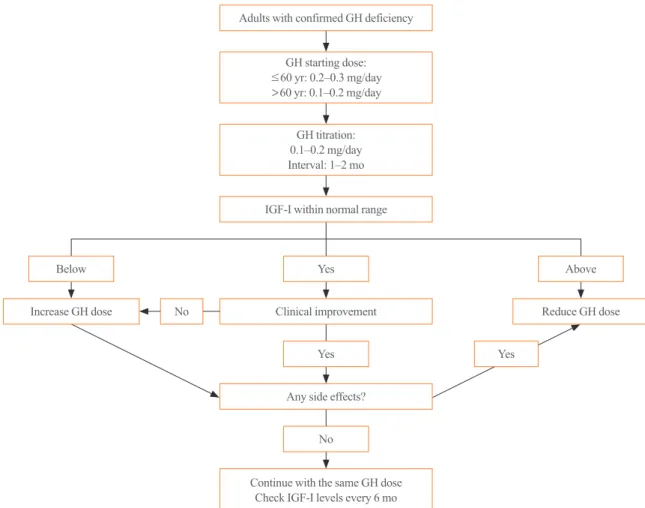
GH secretion decreases with age, and the side effects of GH are more common in elderly patients. Therefore, the appropriate therapeutic levels of GH are lower in elderly individuals and higher in younger individuals [35]. For individuals between the ages of 30 to 60, a suitable starting dose is 0.2 to 0.3 mg/day (0.8 to 1.2 IU/day). For those below the age of 30, a higher dose of 0.4 to 0.5 mg/day (1.6 to 2.0 IU/day) is possible, while in in- dividuals above the age of 60, the starting dose should be 0.1 to 0.2 mg/day (0.4 to 0.8 IU/day) and increased slowly thereafter (Fig. 1). The dosage should be increased by 0.1 to 0.2 mg/day (0.4 to 0.8 IU/day) monthly or bimonthly, and the maintenance level should be determined based on an evaluation of the pa- tient’s clinical response, side effects, and the normal range of IGF-1 levels for the patient’s age group [1]. Although a normal IGF-1 level is targeted, the evidence remains unclear. Clinical responses can usually be observed after 6 months of treatment.
Females generally show higher GH resistance, and therefore require higher starting and maintenance doses [36]. Estrogen
stimulates suppressor of cytokine signaling 2 (SOCS2), a spe- cific non-competitive suppressor of GH in the liver [37], where 85% of serum IGF-1 originates. Since oral estrogen suppresses IGF-1, a higher dose of GH is required to maintain the same IGF-1 levels in females [37]. Even at the same IGF-1 levels, GH has less effect on body fat, low-density lipoprotein choles- terol, and bone turnover markers in females [38]. When oral es- trogen is changed to transdermal estrogen, GH requirement is reduced [39].
2.3. During the adjustment period, IGF-1 levels should be monitored monthly or bimonthly. Once the mainte- nance level is determined, IGF-1 levels should be moni- tored around twice per year. monitoring should include an evaluation of the patient’s clinical response, side ef- fects, and IGF-1 levels.
During the adjustment period, Adequacy of GH dose includ- ing an evaluation of the patient’s clinical response, side effects, and IGF-I levels [1] should be monitored monthly or bimonthly.
Once the maintenance level is determined, IGF-1 levels should be monitored every six months (Fig. 1). The blood levels of lip- id and fasting glucose should be tested every year, and if the ini- tial bone mineral density is abnormal, bone mineral density should be re-evaluated every 1.5 to 2 years. Additionally, waist circumference and quality of life should be evaluated. If the pa- tient is already taking thyroid or adrenal hormones, their doses should be adjusted after GH is introduced. These recommenda- tions are based on empirical experience. Although it is unclear precisely how long GH should be administered, if there is no clear response to GH replacement after at least 1 year, treatment can be suspended [1].
The recently developed long-acting GH is formulated to be taken once a week or once a month instead of daily. Long-acting GH may be more effective because it reduces the inconvenience and discomfort of daily GH injections, thereby increasing com- pliance. A recently published meta-analysis reported long-acting GH and daily GH to have similar efficacy and safety profiles [40]. However, IGF-1 levels were significantly elevated in chil- dren with GH deficiency who received long-acting GH. Thus, additional research on long-acting GH should investigate how the peak and trough levels of GH and IGF-1 influence efficacy and safety, how the dose should be adjusted, when IGF-1 levels should be monitored, and how to compare long-term cost-effec- tiveness between daily and long-acting GH preparations [41].
3. Diagnosis and treatment of growth hormone deficiency in children and adolescents
3.1. Two or more GH stimulation tests should be admin- istered when GH deficiency is suspected in children.
Childhood onset GH deficiency may be a long lasting endo- crine conditions, starting in childhood and continuing into adult- hood. Diagnostic workup of childhood onset GH deficiency in- clude auxology, bone age view, measurement of IGF-1 and IGF binding protein 3, GH stimulation tests, brain imaging and, ge- netic tests if needed [42]. GH stimulation test is one of the most important diagnostic tools, but it is also intrusive and is accom- panied by a risk of side effects [43]. The validity and reproduc- ibility of GH stimulation tests have also been called into ques- tion [44,45]. Therefore, to diagnose GH deficiency, two or more GH stimulation tests should be administered. Children diag- nosed with GH deficiency should receive GH replacement six to seven times a week, at 22 to 35 μg/kg/day (0.16 to 0.24 mg/
kg/week) or 12 IU (4 mg) per body surface area (m2)/week by subcutaneous injection until their epiphyseal plates close [46].
3.2. Repeated GH stimulation tests are not required in GH patients with pituitary lesions or a proven genetic cause of GH deficiency.
Controversy exists regarding the management in the transi- tion period of adolescence of children or adolescents with GH deficiency. If a patient requires ongoing GH therapy, GH stimu- lation tests should be re-administered to reevaluate the function of the hypothalamic-pituitary axis. However, in patients with a high probability of irreversible GH deficiency, re-evaluation of GH status is not necessary [25]. Patients with structural lesions in the hypothalamus or pituitary gland or other structural prob- lems, such as tumors, have a high risk of persistent GH defi- ciency [47,48]. Several genetic defects may also lead to an irre- versible GH deficiency [49]. Therefore, GH stimulation tests is not need to be repeated in patients with definite genetic or struc-
Adults with confirmed GH deficiency
GH starting dose:
≤60 yr: 0.2–0.3 mg/day
>60 yr: 0.1–0.2 mg/day
GH titration:
0.1–0.2 mg/day Interval: 1–2 mo IGF-I within normal range
Yes Below
Increase GH dose
Above Reduce GH dose Clinical improvement
No
Yes Any side effects?
No
Continue with the same GH dose Check IGF-I levels every 6 mo
Fig. 1. Algorithm for growth hormone (GH) therapy in GH deficiency adults. IGF-1, insulin-like growth factor-1.
Yes
tural pituitary abnormalities.
3.3. GH replacement should be continued in children and adolescents until the epiphyseal plates close or their full height is reached.
The benefits of GH replacement during the transition period of adolescence are widely recognized. Childhood-onset GH de- ficiency contributes to low bone mass and an increased risk of fracture in adulthood [50]. It also results in developmental bone mass deficits both at the time of diagnosis and final height [51].
In a previous study, when GH replacement was resumed, body composition improved, with a 14% increase in muscle mass and a 7% decrease in body fat over a 2-year period [35]. Some stud- ies have reported deterioration in dyslipidemia after suspension of GH replacement in patients with childhood-onset GH defi- ciency [52]. Other studies have reported a reduction in cardiac dimensions after suspension of GH therapy during this transi- tion period [53]. Therefore, GH replacement should be main- tained until either the epiphyseal plates close or the final height is reached, since there are various benefits besides height gain.
3.4. GH replacement should be resumed as soon as possi- ble in patients with GH deficiency during adolescence.
It is widely known that appropriate GH replacement during the transition period of adolescence is necessary [54]. The pur- pose of GH replacement during this transition period is to main- tain the continuity of hormonal care and to prevent health prob- lems. Several studies have reported a risk of dropout among pa- tients with GH deficiency who did not receive GH replacement during this transition period [54]. In one study, 21% of patients in puberty discontinued GH treatment without a comprehensive evaluation, and among those patients, 18% were lost to follow- up [55]. Thus, strategies for successful transition including stan- dardized referral systems should be established [56]. If GH re- placement is discontinued in such patients, it should be resumed as soon as possible.
4. Benefits of growth hormone treatment
4.1. GH treatment improves body composition, exercise capacity, and bone mineral density in patients with GH deficiency.
GH deficiency can cause decreased bone mineral density,
muscle strength, and exercise capacity, deterioration in memory, decreased physical activity and vitality, lethargy, difficulty in concentration, and sleep disorders [57,58]. Patients also are ex- posed to a high risk of cardiovascular disease due to central obesity, dyslipidemia, or insulin resistance [59-61].
Several studies consistently reported that GH treatment had the significant effect on body composition including decrease in fat mass and increase in muscle mass [62,63]. It was further re- ported that GH replacement led to a decrease preferentially in visceral fat [64] and an increase in lean body mass [27,65], and improvements in muscle function [65] and lipid metabolism [66] can be expected as well. Studies in South Korea confirmed the tendency for GH treatment to achieve reductions in weight, body fat, and insulin resistance [67-70].
Published data have shown that bone mineral density in adults with GH deficiency is lower than the age- and sex-matched healthy controls [71-73]. Moreover, the severity of bone loss is correlated to the severity of GH deficiency [74]. Accordingly, the fracture risk in GH deficiency patients is 2- to 5-fold higher than in healthy controls [75,76]. Significant improvements in bone mineral density in response to GH treatment were reported among males and patients with severe bone loss [77]. Even in patients without a history of osteoporosis, GH treatment pre- vented fractures [78].
4.2. GH treatment lowers the risk of cardiovascular disease in patients with GH deficiency, but there is insufficient evidence regarding its effects on mortality reduction.
Previous studies have shown that GH deficiency increases the risk of cardiovascular disease via its negative effects on meta- bolic parameters, such as abdominal obesity, insulin resistance, and deterioration of lipid panels, and increases in various in- flammatory markers [79]. GH deficiency has also been reported to negatively influence heart function and atherosclerosis by causing reduced thickness of the left ventricle, impairment of ejection fraction, and diastolic filling in the left ventricle [80]. A previous study reported that the cardiovascular mortality rate was twice as high in adult patients with GH deficiency than in their counterparts without GH deficiency [81]. Svensson et al.
[82] reported that in patients with hypopituitarism, GH replace- ment led to lower rates of fatal myocardial infarction and a low- er mortality rate [83]. A meta-analysis also found that GH re- placement reduced the mortality rate among male patients with hypopituitarism [84], and a domestic study reported a reduction in markers of inflammation through GH replacement [70]. GH
replacement can be expected to have a positive effect on cardio- vascular disease. However, the mortality improvement is lower for women than for men [80], and the question of whether GH replacement can fully restore the long-term negative effects of GH deficiency on cardiovascular risk factors remains [83].
Therefore, it is still difficult to draw a definite conclusion on GH replacement and improvements in cardiovascular mortality, and additional longitudinal, large-scale research is required [85].
4.3. GH treatment improves quality of life in patients with GH deficiency.
Patients with GH deficiency may experience an impaired quality of life due to the deterioration in metabolic parameters and physical capacity, as well as because of their increased car- diovascular risk. Studies measuring the quality of life among adult patients diagnosed with GH deficiency using various tools in comparison to that of healthy adults found significantly poor- er results for sleep, social integration, and physical activity among patients with GH deficiency, and their physical health negatively influenced their occupational status and daily life [86]. It was found by Svensson et al. [82] that GH replacement improved quality of life, and a domestic study also reported im- provements in quality of life through increase of bone mineral density, lean body mass, and muscular strength, and decrease of body fat among healthy Korean women aged 60 or above after 6 months of GH replacement [87,88].
5. Risks and side effects of growth hormone treatment The most common side effects of GH treatment are peripheral edema, joint pain, carpal tunnel syndrome, sensory disturbanc- es, and increased blood glucose levels [33,89]. Side effects are more prevalent in elderly or obese patients and those who have been overtreated with GH [33]. The side effects of GH treat- ment can last for 3 or more years [90]. In particular, the possi- bility that GH replacement may cause malignant conditions to worsen should be carefully considered in the management of hypopituitarism.
5.1. GH treatment is contraindicated in patients with an active malignancy (other than basal cell or squamous cell skin cancers).
Theoretically, the increased activity of the IGF-1 axis result- ing from GH treatment can exacerbate malignant tumors, as GH and increased IGF-1 levels are independently associated with
the development of various malignant tumors [91]. Therefore, GH treatment is contraindicated in patients with malignancies.
This recommendation is based on the theoretical possibility that GH treatment could increase the size of existing tumors, but there is not yet any concrete support for this proposal from clini- cal research [92]. Inpatients with GH deficiency, research on the risk of GH treatment-related recurrence of malignant tumors or secondary tumor formation has mostly been conducted among childhood cancer patients who had received GH treatment [93- 95]. Although some studies reported a slight increase in the risk of secondary tumor formation among childhood cancer patients who had previously received GH treatment [94,95], most stud- ies found no association between GH treatment and the recur- rence of malignant tumors or secondary tumor formation [96- 103]. These results indicate that if an intracranial residual be- nign tumor is stable over a long period, there is no need to pro- hibit GH treatment. GH treatment can be administered to pa- tients with a history of malignancy if they have been in remis- sion for at least 1 year without recurrence [104].
5.2. Changes in blood glucose levels should be observed during the course of GH treatment in patients with di- abetes mellitus, who may require their antidiabetic medication to be adjusted.
GH and IGF-1 independently influence insulin resistance and insulin secretion by pancreatic β-cells [105]. Both increased and decreased GH and IGF-1 levels can cause abnormalities in blood glucose levels. The elevated blood glucose levels present in patients with acromegaly and the increased insulin resistance in patients with GH deficiency are clinically observed. Large- scale clinical studies have reported GH treatment is related to insulin resistance and type 2 diabetes [106]. Insulin sensitivity following GH treatment varies since abnormlities in blood glu- cose levels depend on body composition, age, and genetic char- acteristics. According to a randomized controlled trial conduct- ed by Hoffman et al. [27], compared to the placebo group, the group that received GH treatment had a statistically significant 13% increase in prediabetes and a 4% increase in diabetes.
Therefore, when GH treatment is given, careful follow-up on diabetes is necessary, and adjustments to anti-diabetic medica- tion should be considered.
5.3. Thyroid and adrenal gland function should be mon- itored during GH treatment in patients with hypopitu- itarism.
It is common for patients with GH deficiency to have other manifestations of hypopituitarism, and thyroid and adrenal gland function—even if they are initially normal—should be monitored during GH treatment [58]. Hypothyroidism is ac- companied by reduced secretion of IGF-1 and GH [107,108].
Therefore, in order to evaluate GH function accurately, central hypothyroidism should be treated first. During treatment, thy- roid function must be evaluated, since GH treatment can reduce free thyroxine levels. Among patients with GH deficiency, 36%
to 47% of those with normal thyroid function became hypothy- roid and 16% to 18% of those with hypothyroidism required an increase in levothyroxine dose within 3 to 6 months of GH treatment [109,110]. When GH treatment is started or the dose is changed, central hypothyroidism should be checked after 6 weeks [111].
In addition, hypothalamic-pituitary-adrenal function should be evaluated before and after GH treatment. Since GH sup- presses the enzyme 11 β-hydroxysteroid dehydrogenase type 1 converting cortisone to cortisol, the ratio of cortisone to cortisol is higher in patients with GH deficiency [108,112]. Therefore, even if adrenal insufficiency is present, it might not be diag- nosed if accompanied by GH deficiency. When GH is given to such patients, possible adrenal function deterioration should be carefully considered [113,114].
CONCLUSIONS
Although it remains controversial whether GH treatment reduc- es cardiovascular mortality in patients with hypopituitarism, GH treatment in patients with GH deficiency has more benefits than harm. It is important to accurately diagnose GH deficiency through GH stimulation tests before starting GH treatment. The GH dose should be individualized to minimize side effects and to maximize clinical efficacy. Side effects and clinical response should be monitored regularly while patients are treated with the maintenance dose.
CONFLICTS OF INTEREST
No potential conflict of interest relevant to this article was re- ported.
ACKNOWLEDGMENTS
This work was supported by the Korean Endocrine Society.
AUTHOR CONTRIBUTIONS
Conception or design: J.H.K., H.W.C., S.O.C., C.R.K., C.H.K., E.J.L. Acquisition, analysis, or interpretation of data: J.H.K., H.W.C., S.O.C., C.R.K., C.H.K., E.J.L. Drafting the work or re- vising: J.H.K., H.W.C., S.O.C., C.R.K., K.H.P., D.J.L., K.J.K., J.S.L., G.K., Y.M.C., S.H.A., M.J.J., Y.H., J.H.L., B.K.K., Y.
J.C., K.A.L., S.S.M., H.Y.A., H.S.C., S.M.H., D.Y.S., J.A.S., S.H.K., S.O., S.H.Y., B.J.K., C.H.S., S.W.K., C.H.K., E.J.L. Fi- nal approval of the manuscript: J.H.K., H.W.C., S.O.C., C.R.K., C.H.K., E.J.L.
ORCID
Jung Hee Kim https://orcid.org/0000-0003-1932-0234 Chong Hwa Kim https://orcid.org/0000-0002-4563-7772 Eun Jig Lee https://orcid.org/0000-0002-9876-8370
REFERENCES
1. Molitch ME, Clemmons DR, Malozowski S, Merriam GR, Vance ML; Endocrine Society. Evaluation and treatment of adult growth hormone deficiency: an Endocrine Society clinical practice guideline. J Clin Endocrinol Metab 2011;
96:1587-609.
2. Melmed S. Pathogenesis and diagnosis of growth hormone deficiency in adults. N Engl J Med 2019;380:2551-62.
3. Molitch ME. Nonfunctioning pituitary tumors and pituitary incidentalomas. Endocrinol Metab Clin North Am 2008;37:
151-71.
4. Arafah BM, Prunty D, Ybarra J, Hlavin ML, Selman WR.
The dominant role of increased intrasellar pressure in the pathogenesis of hypopituitarism, hyperprolactinemia, and headaches in patients with pituitary adenomas. J Clin Endo- crinol Metab 2000;85:1789-93.
5. Webb SM, Rigla M, Wagner A, Oliver B, Bartumeus F. Re- covery of hypopituitarism after neurosurgical treatment of pituitary adenomas. J Clin Endocrinol Metab 1999;84:3696- 700.
6. Mulder RL, Kremer LC, van Santen HM, Ket JL, van Trot- senburg AS, Koning CC, et al. Prevalence and risk factors of radiation-induced growth hormone deficiency in child- hood cancer survivors: a systematic review. Cancer Treat Rev 2009;35:616-32.
7. Gleeson HK, Gattamaneni HR, Smethurst L, Brennan BM, Shalet SM. Reassessment of growth hormone status is re-
quired at final height in children treated with growth hor- mone replacement after radiation therapy. J Clin Endocrinol Metab 2004;89:662-6.
8. Agha A, Rogers B, Sherlock M, O’Kelly P, Tormey W, Phil- lips J, et al. Anterior pituitary dysfunction in survivors of trau- matic brain injury. J Clin Endocrinol Metab 2004;89:4929- 36.
9. Schneider HJ, Kreitschmann-Andermahr I, Ghigo E, Stalla GK, Agha A. Hypothalamopituitary dysfunction following traumatic brain injury and aneurysmal subarachnoid hem- orrhage: a systematic review. JAMA 2007;298:1429-38.
10. Hong JW, Kim JY, Kim YE, Lee EJ. Metabolic parameters and nonalcoholic fatty liver disease in hypopituitary men.
Horm Metab Res 2011;43:48-54.
11. Yuen KC, Tritos NA, Samson SL, Hoffman AR, Katznelson L. American Association of Clinical Endocrinologists and American College of Endocrinology Disease State Clinical Review: update on growth hormone stimulation testing and proposed revised cut-point for the glucagon stimulation test in the diagnosis of adult growth hormone deficiency. Endocr Pract 2016;22:1235-44.
12. Aimaretti G, Corneli G, Razzore P, Bellone S, Baffoni C, Arvat E, et al. Comparison between insulin-induced hypo- glycemia and growth hormone (GH)-releasing hormone+
arginine as provocative tests for the diagnosis of GH defi- ciency in adults. J Clin Endocrinol Metab 1998;83:1615-8.
13. Biller BM, Samuels MH, Zagar A, Cook DM, Arafah BM, Bonert V, et al. Sensitivity and specificity of six tests for the diagnosis of adult GH deficiency. J Clin Endocrinol Metab 2002;87:2067-79.
14. Corneli G, Di Somma C, Baldelli R, Rovere S, Gasco V, Croce CG, et al. The cut-off limits of the GH response to GH-releasing hormone-arginine test related to body mass index. Eur J Endocrinol 2005;153:257-64.
15. Colao A, Di Somma C, Savastano S, Rota F, Savanelli MC, Aimaretti G, et al. A reappraisal of diagnosing GH deficien- cy in adults: role of gender, age, waist circumference, and body mass index. J Clin Endocrinol Metab 2009;94:4414- 22.
16. Qu XD, Gaw Gonzalo IT, Al Sayed MY, Cohan P, Chris- tenson PD, Swerdloff RS, et al. Influence of body mass in- dex and gender on growth hormone (GH) responses to GH- releasing hormone plus arginine and insulin tolerance tests.
J Clin Endocrinol Metab 2005;90:1563-9.
17. Berg C, Meinel T, Lahner H, Yuece A, Mann K, Petersenn S.
Diagnostic utility of the glucagon stimulation test in com-
parison to the insulin tolerance test in patients following pi- tuitary surgery. Eur J Endocrinol 2010;162:477-82.
18. Hamrahian AH, Yuen KC, Gordon MB, Pulaski-Liebert KJ, Bena J, Biller BM. Revised GH and cortisol cut-points for the glucagon stimulation test in the evaluation of GH and hypothalamic-pituitary-adrenal axes in adults: results from a prospective randomized multicenter study. Pituitary 2016;
19:332-41.
19. Gomez JM, Espadero RM, Escobar-Jimenez F, Hawkins F, Pico A, Herrera-Pombo JL, et al. Growth hormone release after glucagon as a reliable test of growth hormone assess- ment in adults. Clin Endocrinol (Oxf) 2002;56:329-34.
20. Conceicao FL, da Costa e Silva A, Leal Costa AJ, Vaisman M. Glucagon stimulation test for the diagnosis of GH defi- ciency in adults. J Endocrinol Invest 2003;26:1065-70.
21. Dichtel LE, Yuen KC, Bredella MA, Gerweck AV, Russell BM, Riccio AD, et al. Overweight/obese adults with pitu- itary disorders require lower peak growth hormone cutoff values on glucagon stimulation testing to avoid overdiagno- sis of growth hormone deficiency. J Clin Endocrinol Metab 2014;99:4712-9.
22. Wilson JR, Utz AL, Devin JK. Effects of gender, body weight, and blood glucose dynamics on the growth hormone response to the glucagon stimulation test in patients with pi- tuitary disease. Growth Horm IGF Res 2016;26:24-31.
23. Garcia JM, Biller BMK, Korbonits M, Popovic V, Luger A, Strasburger CJ, et al. Macimorelin as a diagnostic test for adult GH deficiency. J Clin Endocrinol Metab 2018;103:3083-93.
24. Clemmons DR. Consensus statement on the standardization and evaluation of growth hormone and insulin-like growth factor assays. Clin Chem 2011;57:555-9.
25. Hartman ML, Crowe BJ, Biller BM, Ho KK, Clemmons DR, Chipman JJ, et al. Which patients do not require a GH stimulation test for the diagnosis of adult GH deficiency? J Clin Endocrinol Metab 2002;87:477-85.
26. Hilding A, Hall K, Wivall-Helleryd IL, Saaf M, Melin AL, Thoren M. Serum levels of insulin-like growth factor I in 152 patients with growth hormone deficiency, aged 19-82 years, in relation to those in healthy subjects. J Clin Endo- crinol Metab 1999;84:2013-9.
27. Hoffman AR, Kuntze JE, Baptista J, Baum HB, Baumann GP, Biller BM, et al. Growth hormone (GH) replacement therapy in adult-onset GH deficiency: effects on body com- position in men and women in a double-blind, randomized, placebo-controlled trial. J Clin Endocrinol Metab 2004;89:
2048-56.
28. Brabant G, Krogh Rasmussen A, Biller BM, Buchfelder M, Feldt-Rasmussen U, Forssmann K, et al. Clinical implica- tions of residual growth hormone (GH) response to provoc- ative testing in adults with severe GH deficiency. J Clin En- docrinol Metab 2007;92:2604-9.
29. Yuen KCJ, Biller BMK, Radovick S, Carmichael JD, Jasim S, Pantalone KM, et al. American Association of Clinical Endocrinologists and American College of Endocrinology guidelines for management of growth hormone deficiency in adults and patients transitioning from pediatric to adult care. Endocr Pract 2019;25:1191-232.
30. Wacharasindhu S, Cotterill AM, Camacho-Hubner C, Bess- er GM, Savage MO. Normal growth hormone secretion in growth hormone insufficient children retested after comple- tion of linear growth. Clin Endocrinol (Oxf) 1996;45:553-6.
31. Nicolson A, Toogood AA, Rahim A, Shalet SM. The preva- lence of severe growth hormone deficiency in adults who received growth hormone replacement in childhood [see comment]. Clin Endocrinol (Oxf) 1996;44:311-6.
32. Melmed S. Idiopathic adult growth hormone deficiency. J Clin Endocrinol Metab 2013;98:2187-97.
33. Holmes SJ, Shalet SM. Which adults develop side-effects of growth hormone replacement? Clin Endocrinol (Oxf) 1995;43:143-9.
34. Hoffman AR, Strasburger CJ, Zagar A, Blum WF, Kehely A, Hartman ML, et al. Efficacy and tolerability of an individu- alized dosing regimen for adult growth hormone replace- ment therapy in comparison with fixed body weight-based dosing. J Clin Endocrinol Metab 2004;89:3224-33.
35. Underwood LE, Attie KM, Baptista J; Genentech Collabor- ative Study Group. Growth hormone (GH) dose-response in young adults with childhood-onset GH deficiency: a two-year, multicenter, multiple-dose, placebo-controlled study. J Clin Endocrinol Metab 2003;88:5273-80.
36. Johannsson G, Bjarnason R, Bramnert M, Carlsson LM, De- gerblad M, Manhem P, et al. The individual responsiveness to growth hormone (GH) treatment in GH-deficient adults is dependent on the level of GH-binding protein, body mass in- dex, age, and gender. J Clin Endocrinol Metab 1996;81:
1575-81.
37. Birzniece V, Sata A, Ho KK. Growth hormone receptor modulators. Rev Endocr Metab Disord 2009;10:145-56.
38. Burman P, Johansson AG, Siegbahn A, Vessby B, Karlsson FA. Growth hormone (GH)-deficient men are more respon- sive to GH replacement therapy than women. J Clin Endo- crinol Metab 1997;82:550-5.
39. Cook DM, Ludlam WH, Cook MB. Route of estrogen ad- ministration helps to determine growth hormone (GH) re- placement dose in GH-deficient adults. J Clin Endocrinol Metab 1999;84:3956-60.
40. Yang Y, Bai X, Yuan X, Zhang Y, Chen S, Yang H, et al. Ef- ficacy and safety of long-acting growth hormone in chil- dren with short stature: a systematic review and meta-anal- ysis. Endocrine 2019;65:25-34.
41. Miller BS, Velazquez E, Yuen KCJ. Long-acting growth hormone preparations: current status and future consider- ations. J Clin Endocrinol Metab 2020;105:dgz149.
42. Stanley T. Diagnosis of growth hormone deficiency in child- hood. Curr Opin Endocrinol Diabetes Obes 2012;19:47-52.
43. Van Vught AJ, Nieuwenhuizen AG, Gerver WJ, Veldhorst MA, Brummer RJ, Westerterp-Plantenga MS. Pharmaco- logical and physiological growth hormone stimulation tests to predict successful GH therapy in children. J Pediatr En- docrinol Metab 2009;22:679-94.
44. Ghigo E, Bellone J, Aimaretti G, Bellone S, Loche S, Cap- pa M, et al. Reliability of provocative tests to assess growth hormone secretory status: study in 472 normally growing children. J Clin Endocrinol Metab 1996;81:3323-7.
45. Muller A, Scholz M, Blankenstein O, Binder G, Pfaffle R, Korner A, et al. Harmonization of growth hormone mea- surements with different immunoassays by data adjustment.
Clin Chem Lab Med 2011;49:1135-42.
46. Grimberg A, DiVall SA, Polychronakos C, Allen DB, Co- hen LE, Quintos JB, et al. Guidelines for growth hormone and insulin-like growth factor-I treatment in children and adolescents: growth hormone deficiency, idiopathic short stature, and primary insulin-like growth factor-I deficiency.
Horm Res Paediatr 2016;86:361-97.
47. Kalina MA, Kalina-Faska B, Gruszczynska K, Baron J, Malecka-Tendera E. Usefulness of magnetic resonance find- ings of the hypothalamic-pituitary region in the management of short children with growth hormone deficiency: evidence from a longitudinal study. Childs Nerv Syst 2012;28:121-7.
48. Tillmann V, Tang VW, Price DA, Hughes DG, Wright NB, Clayton PE. Magnetic resonance imaging of the hypotha- lamic-pituitary axis in the diagnosis of growth hormone de- ficiency. J Pediatr Endocrinol Metab 2000;13:1577-83.
49. Mullis PE. Genetics of isolated growth hormone deficiency.
J Clin Res Pediatr Endocrinol 2010;2:52-62.
50. Boot AM, van der Sluis IM, Krenning EP, de Muinck Keiz- er-Schrama SM. Bone mineral density and body composi- tion in adolescents with childhood-onset growth hormone
deficiency. Horm Res 2009;71:364-71.
51. Aimaretti G, Corneli G, Rovere S, Croce CG, Ghigo E, Procopio M. Is GH therapy useful to preserve bone mass in transition-phase patients with GH deficiency? J Endocrinol Invest 2005;28(10 Suppl):28-32.
52. Bechtold S, Bachmann S, Putzker S, Dalla Pozza R, Schwarz HP. Early changes in body composition after cessa- tion of growth hormone therapy in childhood-onset growth hormone deficiency. J Clin Densitom 2011;14:471-7.
53. Colao A, di Somma C, Pivonello R, Cuocolo A, Spinelli L, Bonaduce D, et al. The cardiovascular risk of adult GH de- ficiency (GHD) improved after GH replacement and wors- ened in untreated GHD: a 12-month prospective study. J Clin Endocrinol Metab 2002;87:1088-93.
54. Ahmid M, Ahmed SF, Shaikh MG. Childhood-onset growth hormone deficiency and the transition to adulthood: current perspective. Ther Clin Risk Manag 2018;14:2283-91.
55. Ahmid M, Fisher V, Graveling AJ, McGeoch S, McNeil E, Roach J, et al. An audit of the management of childhood- onset growth hormone deficiency during young adulthood in Scotland. Int J Pediatr Endocrinol 2016;2016:6.
56. Downing J, Gleeson HK, Clayton PE, Davis JR, Wales JK, Callery P. Transition in endocrinology: the challenge of maintaining continuity. Clin Endocrinol (Oxf) 2013;78:29- 35.
57. Roshan S, Nader S, Orlander P. Review: ageing and hor- mones. Eur J Clin Invest 1999;29:210-3.
58. Kim SY. Diagnosis and treatment of hypopituitarism. En- docrinol Metab (Seoul) 2015;30:443-55.
59. Weaver JU, Monson JP, Noonan K, John WG, Edwards A, Evans KA, et al. The effect of low dose recombinant human growth hormone replacement on regional fat distribution, insulin sensitivity, and cardiovascular risk factors in hypopi- tuitary adults. J Clin Endocrinol Metab 1995;80:153-9.
60. Beshyah SA, Johnston DG. Cardiovascular disease and risk factors in adults with hypopituitarism. Clin Endocrinol (Oxf) 1999;50:1-15.
61. Khang AR, Ku EJ, Kim YA, Roh E, Bae JH, Oh TJ, et al.
Sex differences in the prevalence of metabolic syndrome and its components in hypopituitary patients: comparison with an age- and sex-matched nationwide control group.
Pituitary 2016;19:573-81.
62. Attanasio AF, Bates PC, Ho KK, Webb SM, Ross RJ, Stras- burger CJ, et al. Human growth hormone replacement in adult hypopituitary patients: long-term effects on body com- position and lipid status: 3-year results from the HypoCCS
Database. J Clin Endocrinol Metab 2002;87:1600-6.
63. Attanasio AF, Shavrikova E, Blum WF, Cromer M, Child CJ, Paskova M, et al. Continued growth hormone (GH) treatment after final height is necessary to complete somatic development in childhood-onset GH-deficient patients. J Clin Endocrinol Metab 2004;89:4857-62.
64. Beauregard C, Utz AL, Schaub AE, Nachtigall L, Biller BM, Miller KK, et al. Growth hormone decreases visceral fat and improves cardiovascular risk markers in women with hypopituitarism: a randomized, placebo-controlled study. J Clin Endocrinol Metab 2008;93:2063-71.
65. Gotherstrom G, Elbornsson M, Stibrant-Sunnerhagen K, Bengtsson BA, Johannsson G, Svensson J. Ten years of growth hormone (GH) replacement normalizes muscle strength in GH-deficient adults. J Clin Endocrinol Metab 2009;94:809-16.
66. Maison P, Griffin S, Nicoue-Beglah M, Haddad N, Balkau B, Chanson P, et al. Impact of growth hormone (GH) treat- ment on cardiovascular risk factors in GH-deficient adults:
a metaanalysis of blinded, randomized, placebo-controlled trials. J Clin Endocrinol Metab 2004;89:2192-9.
67. Kim KW, Nam SY, Kim DS, Ahn CW, Kim KR, Lim SK, et al. Effects of growth hormone treatment beyond the body fat changes in GH-deficient adults. Korean J Obes 2013;22:56- 65.
68. Choi HS, Kim SS, Ko KJ, Lee EJ, Park IW, Park TW, et al.
The effects of growth hormone administration on the mark- ers of cardiovascular disease in growth hormone deficient adults. Korean J Med 2005;68:519-27.
69. Park JK, Hong JW, Kim CO, Kim SW, Lim CY, Chung YS, et al. Sustained-release recombinant human growth hor- mone improves body composition and quality of life in adults with somatopause. J Am Geriatr Soc 2011;59:944-7.
70. Hong JW, Park JK, Lim CY, Kim SW, Chung YS, Kim SW, et al. A weekly administered sustained-release growth hor- mone reduces visceral fat and waist circumference in ab- dominal obesity. Horm Metab Res 2011;43:956-61.
71. Holmes SJ, Economou G, Whitehouse RW, Adams JE, Shalet SM. Reduced bone mineral density in patients with adult onset growth hormone deficiency. J Clin Endocrinol Metab 1994;78:669-74.
72. Murray RD, Columb B, Adams JE, Shalet SM. Low bone mass is an infrequent feature of the adult growth hormone deficiency syndrome in middle-age adults and the elderly. J Clin Endocrinol Metab 2004;89:1124-30.
73. Rosen T, Hansson T, Granhed H, Szucs J, Bengtsson BA.
Reduced bone mineral content in adult patients with growth hormone deficiency. Acta Endocrinol (Copenh) 1993;129:
201-6.
74. Colao A, Di Somma C, Pivonello R, Loche S, Aimaretti G, Cerbone G, et al. Bone loss is correlated to the severity of growth hormone deficiency in adult patients with hypopitu- itarism. J Clin Endocrinol Metab 1999;84:1919-24.
75. Vestergaard P, Jorgensen JO, Hagen C, Hoeck HC, Laurb- erg P, Rejnmark L, et al. Fracture risk is increased in pa- tients with GH deficiency or untreated prolactinomas: a case-control study. Clin Endocrinol (Oxf) 2002;56:159-67.
76. Rosen T, Wilhelmsen L, Landin-Wilhelmsen K, Lappas G, Bengtsson BA. Increased fracture frequency in adult pa- tients with hypopituitarism and GH deficiency. Eur J Endo- crinol 1997;137:240-5.
77. Gotherstrom G, Bengtsson BA, Bosaeus I, Johannsson G, Svensson J. Ten-year GH replacement increases bone min- eral density in hypopituitary patients with adult onset GH deficiency. Eur J Endocrinol 2007;156:55-64.
78. Mo D, Fleseriu M, Qi R, Jia N, Child CJ, Bouillon R, et al.
Fracture risk in adult patients treated with growth hormone replacement therapy for growth hormone deficiency: a pro- spective observational cohort study. Lancet Diabetes Endo- crinol 2015;3:331-8.
79. Giovannini L, Tirabassi G, Muscogiuri G, Di Somma C, Colao A, Balercia G. Impact of adult growth hormone defi- ciency on metabolic profile and cardiovascular risk [re- view]. Endocr J 2015;62:1037-48.
80. Colao A, Cuocolo A, Di Somma C, Cerbone G, Della Morte AM, Nicolai E, et al. Impaired cardiac performance in elderly patients with growth hormone deficiency. J Clin Endocrinol Metab 1999;84:3950-5.
81. Rosen T, Bengtsson BA. Premature mortality due to cardio- vascular disease in hypopituitarism. Lancet 1990;336:285- 8.
82. Svensson J, Mattsson A, Rosen T, Wiren L, Johannsson G, Bengtsson BA, et al. Three-years of growth hormone (GH) replacement therapy in GH-deficient adults: effects on quality of life, patient-reported outcomes and healthcare consumption. Growth Horm IGF Res 2004;14:207-15.
83. van Bunderen CC, van Nieuwpoort IC, Arwert LI, Hey- mans MW, Franken AA, Koppeschaar HP, et al. Does growth hormone replacement therapy reduce mortality in adults with growth hormone deficiency?: data from the Dutch National Registry of Growth Hormone Treatment in adults. J Clin Endocrinol Metab 2011;96:3151-9.
84. Pappachan JM, Raskauskiene D, Kutty VR, Clayton RN.
Excess mortality associated with hypopituitarism in adults:
a meta-analysis of observational studies. J Clin Endocrinol Metab 2015;100:1405-11.
85. Fleseriu M, Hashim IA, Karavitaki N, Melmed S, Murad MH, Salvatori R, et al. Hormonal replacement in hypopitu- itarism in adults: an Endocrine Society Clinical Practice Guideline. J Clin Endocrinol Metab 2016;101:3888-921.
86. Bjork S, Jonsson B, Westphal O, Levin JE. Quality of life of adults with growth hormone deficiency: a controlled study. Acta Paediatr Scand Suppl 1989;356:55-60,73-4.
87. Woo JT, Kim DY, Kim SW, Yang IM, Kim JW, Kim YS, et al. Effects of human growth hormone treatment in healthy older female. J Korean Soc Endocrinol 1992;7:352-7.
88. Kim Y, Hong JW, Chung YS, Kim SW, Cho YW, Kim JH, et al. Efficacy and safety of sustained-release recombinant human growth hormone in Korean adults with growth hor- mone deficiency. Yonsei Med J 2014;55:1042-8.
89. Moller N, Jorgensen JO. Effects of growth hormone on glu- cose, lipid, and protein metabolism in human subjects. En- docr Rev 2009;30:152-77.
90. Chipman JJ, Attanasio AF, Birkett MA, Bates PC, Webb S, Lamberts SW. The safety profile of GH replacement thera- py in adults. Clin Endocrinol (Oxf) 1997;46:473-81.
91. Boguszewski CL, Boguszewski MC. Growth hormone’s links to cancer. Endocr Rev 2019;40:558-74.
92. Sheppard MC. Growth hormone therapy does not induce cancer. Nat Clin Pract Endocrinol Metab 2006;2:532-3.
93. Packer RJ, Boyett JM, Janss AJ, Stavrou T, Kun L, Wisoff J, et al. Growth hormone replacement therapy in children with medulloblastoma: use and effect on tumor control. J Clin Oncol 2001;19:480-7.
94. Sklar CA, Mertens AC, Mitby P, Occhiogrosso G, Qin J, Heller G, et al. Risk of disease recurrence and second neo- plasms in survivors of childhood cancer treated with growth hormone: a report from the Childhood Cancer Survivor Study. J Clin Endocrinol Metab 2002;87:3136-41.
95. Ergun-Longmire B, Mertens AC, Mitby P, Qin J, Heller G, Shi W, et al. Growth hormone treatment and risk of second neoplasms in the childhood cancer survivor. J Clin Endocri- nol Metab 2006;91:3494-8.
96. Arnold JR, Arnold DF, Marland A, Karavitaki N, Wass JA.
GH replacement in patients with non-functioning pituitary adenoma (NFA) treated solely by surgery is not associated with increased risk of tumour recurrence. Clin Endocrinol (Oxf) 2009;70:435-8.